

ISO 22926:2023
(Main)Implants for surgery — Specification and verification of synthetic anatomical bone models for testing
General Information
- Abstract
This document provides requirements and recommendations for specification and verification of synthetic anatomical bone models for use in testing of implants. The anatomical source of the synthetic model can be digital data from computed tomography (CT) scanning or any other sources such as from cadaveric specimens or statistically determined shape data. The specifications covered in this document are 3D shape and mechanical characteristics. Other characteristics, such as colour or cosmetic features, are not considered in this document.
- Status
- Published
- Publication Date
- 30-Jul-2023
- Technical Committee
- ISO/TC 150 - Implants for surgery
- Drafting Committee
- ISO/TC 150 - Implants for surgery
- Current Stage
- 6060 - International Standard published
- Start Date
- 31-Jul-2023
- Due Date
- 15-Oct-2023
- Completion Date
- 31-Jul-2023
Buy Documents

ISO 22926:2023 - Implants for surgery — Specification and verification of synthetic anatomical bone models for testing Released:31. 07. 2023

ISO 22926:2023 - Implants chirurgicaux — Spécification et vérification des modèles osseux anatomiques synthétiques pour les essais/1/2024
Overview
ISO 22926:2023 - Implants for surgery: Specification and verification of synthetic anatomical bone models for testing defines requirements and recommendations for specifying, verifying and reporting synthetic anatomical bone models used in implant testing. The standard focuses on 3D shape and mechanical characteristics (not cosmetic features). Digital anatomical sources can include CT scans, cadaveric-derived data or statistically determined shape datasets that are used to produce physical synthetic models via casting, machining or additive manufacturing.
Key technical topics and requirements
- Scope and focus
- Covers specification and verification of synthetic bone models for implant testing.
- Excludes colour and cosmetic characteristics.
- Digital and physical models
- Defines a digital anatomical bone model (STL, CAD/STEP, voxel models) and the resulting synthetic anatomical bone model.
- Required physical model characteristics
- 3D overall shape and segmented anatomy (e.g., cortical, cancellous, intramedullary canal).
- Material properties: density, hardness, porosity, Young’s modulus, surface roughness.
- Structural mechanical characteristics: stiffness, ultimate strength, fatigue strength under specified loading.
- Other relevant characteristics: thermal/chemical resistance, residual stress, dimensional stability, fluid absorption.
- Verification process
- Three-step verification: model geometrical verification, model material verification, and model mechanical verification (when required).
- Geometrical verification requires comparison to the digital model and consideration of measurement protocol, device and software errors (fiducial points, registration variability).
- Material and mechanical verifications are compared to the specified properties and reported.
- Traceability and reporting
- Producers must ensure traceability through design and manufacturing.
- A specification report must document intended use, geometry, measurement methods and protocols, test results (mean, max, deviations), material tests and any limitations or contraindications. Annex C provides an example report; Annex B gives geometrical verification examples.
Practical applications
- Standardizes how synthetic bone models are specified and verified for:
- Mechanical testing of orthopaedic implants and fixation constructs (stiffness, strength, fatigue).
- Preclinical device development, bench testing and comparative performance studies.
- Verification of manufacturing processes for medical device test fixtures and surgical tool validation.
- Helps users choose models with appropriate anatomical fidelity and mechanical behavior for their specific implant tests.
Who should use this standard
- Synthetic bone model producers and manufacturers
- Medical device developers and test engineers
- Biomechanics laboratories and notified bodies
- Regulatory and quality teams preparing test evidence for implants
- Research groups conducting implant or surgical tool evaluation
Related standards
- ISO 19213 - Test methods for synthetic cortical bone materials (referenced for material testing)
- ASTM F1839 - Specification for rigid polyurethane foam (material commonly used as cancellous bone analogue)
Keywords: ISO 22926, synthetic anatomical bone models, implant testing, 3D shape verification, model material verification, geometrical verification, specification report, CT-based bone models.
Buy Documents
ISO 22926:2023 - Implants for surgery — Specification and verification of synthetic anatomical bone models for testing Released:31. 07. 2023
ISO 22926:2023 - Implants chirurgicaux — Spécification et vérification des modèles osseux anatomiques synthétiques pour les essais/1/2024
Get Certified
Connect with accredited certification bodies for this standard

BSI Group
BSI (British Standards Institution) is the business standards company that helps organizations make excellence a habit.

TÜV Rheinland
TÜV Rheinland is a leading international provider of technical services.

TÜV SÜD
TÜV SÜD is a trusted partner of choice for safety, security and sustainability solutions.
Sponsored listings
Frequently Asked Questions
ISO 22926:2023 is a standard published by the International Organization for Standardization (ISO). Its full title is "Implants for surgery — Specification and verification of synthetic anatomical bone models for testing". This standard covers: This document provides requirements and recommendations for specification and verification of synthetic anatomical bone models for use in testing of implants. The anatomical source of the synthetic model can be digital data from computed tomography (CT) scanning or any other sources such as from cadaveric specimens or statistically determined shape data. The specifications covered in this document are 3D shape and mechanical characteristics. Other characteristics, such as colour or cosmetic features, are not considered in this document.
This document provides requirements and recommendations for specification and verification of synthetic anatomical bone models for use in testing of implants. The anatomical source of the synthetic model can be digital data from computed tomography (CT) scanning or any other sources such as from cadaveric specimens or statistically determined shape data. The specifications covered in this document are 3D shape and mechanical characteristics. Other characteristics, such as colour or cosmetic features, are not considered in this document.
ISO 22926:2023 is classified under the following ICS (International Classification for Standards) categories: 11.040.40 - Implants for surgery, prosthetics and orthotics. The ICS classification helps identify the subject area and facilitates finding related standards.
ISO 22926:2023 is available in PDF format for immediate download after purchase. The document can be added to your cart and obtained through the secure checkout process. Digital delivery ensures instant access to the complete standard document.
Standards Content (Sample)
INTERNATIONAL ISO
STANDARD 22926
First edition
2023-07
Implants for surgery — Specification
and verification of synthetic
anatomical bone models for testing
Reference number
© ISO 2023
All rights reserved. Unless otherwise specified, or required in the context of its implementation, no part of this publication may
be reproduced or utilized otherwise in any form or by any means, electronic or mechanical, including photocopying, or posting on
the internet or an intranet, without prior written permission. Permission can be requested from either ISO at the address below
or ISO’s member body in the country of the requester.
ISO copyright office
CP 401 • Ch. de Blandonnet 8
CH-1214 Vernier, Geneva
Phone: +41 22 749 01 11
Email: copyright@iso.org
Website: www.iso.org
Published in Switzerland
ii
Contents Page
Foreword .iv
Introduction .v
1 Scope . 1
2 Normative references . 1
3 Terms and definitions . 1
4 Design and development of a synthetic model . 2
4.1 General . 2
4.2 Identification of physical model characteristics . 2
4.3 Model verification . 3
4.3.1 General . 3
4.3.2 Model geometrical verification . 3
4.3.3 Model material verification . 3
4.3.4 Model mechanical verification . 3
5 Specification report .4
Annex A (informative) Background, detailed scope and rationale . 5
Annex B (informative) Example of model geometrical verification methods .8
Annex C (informative) Example of a specification report .10
Bibliography .17
iii
Foreword
ISO (the International Organization for Standardization) is a worldwide federation of national standards
bodies (ISO member bodies). The work of preparing International Standards is normally carried out
through ISO technical committees. Each member body interested in a subject for which a technical
committee has been established has the right to be represented on that committee. International
organizations, governmental and non-governmental, in liaison with ISO, also take part in the work.
ISO collaborates closely with the International Electrotechnical Commission (IEC) on all matters of
electrotechnical standardization.
The procedures used to develop this document and those intended for its further maintenance are
described in the ISO/IEC Directives, Part 1. In particular, the different approval criteria needed for the
different types of ISO document should be noted. This document was drafted in accordance with the
editorial rules of the ISO/IEC Directives, Part 2 (see www.iso.org/directives).
ISO draws attention to the possibility that the implementation of this document may involve the use
of (a) patent(s). ISO takes no position concerning the evidence, validity or applicability of any claimed
patent rights in respect thereof. As of the date of publication of this document, ISO had not received
notice of (a) patent(s) which may be required to implement this document. However, implementers are
cautioned that this may not represent the latest information, which may be obtained from the patent
database available at www.iso.org/patents. ISO shall not be held responsible for identifying any or all
such patent rights.
Any trade name used in this document is information given for the convenience of users and does not
constitute an endorsement.
For an explanation of the voluntary nature of standards, the meaning of ISO specific terms and
expressions related to conformity assessment, as well as information about ISO's adherence to
the World Trade Organization (WTO) principles in the Technical Barriers to Trade (TBT), see
www.iso.org/iso/foreword.html.
This document was prepared by Technical Committee ISO/TC 150, Implants for surgery.
Any feedback or questions on this document should be directed to the user’s national standards body. A
complete listing of these bodies can be found at www.iso.org/members.html.
iv
Introduction
Synthetic anatomical bone models can be useful to characterize mechanical performance of surgical
implants and instruments, such as those used in musculoskeletal fixation or reconstruction surgery. A
synthetic bone model is typically made by methods of casting, machining and/or recently by additive
manufacturing, all of which can leverage medical image-based modelling. To use a synthetic anatomical
bone model for mechanical testing of an implant, its similarity to natural bone in terms of shape and
mechanical behaviour is of paramount importance to bone model users.
This document provides a way to specify, verify and report characteristics of synthetic bone models
used for implant testing. The details of testing and the choice of a suitable bone model is outside the
scope of this document. A more detailed rationale for this document is provided in Annex A.
There are two related standards for synthetic materials that are used as mechanical models of bone
[1]
for implant testing. ASTM F1839 was first issued in 1997 and is a standard specification for rigid
polyurethane foam. Polyurethane foam is a cellular solid that exhibits certain aspects of mechanical
behaviour that are similar to bone such as the relationship between apparent density and its stress-
[2]
strain response to mechanical loading. A second relevant standard is ISO 19213 which was first
issued in 2017 and provides a list of test methods to describe synthetic material models of cortical bone.
The methods referenced in ISO 19213 report material properties from long standing test methods for
plastics, and include specialized tests to mimic certain orthopaedic surgical processes such as drilling,
milling (burring) and cutting. This document goes beyond materials, and includes shape and structure
of a synthetic bone model.
While the scope of this document is limited to bone models, it is intended to lay the framework for
future models of other biologic tissues.
v
INTERNATIONAL STANDARD ISO 22926:2023(E)
Implants for surgery — Specification and verification of
synthetic anatomical bone models for testing
1 Scope
This document provides requirements and recommendations for specification and verification of
synthetic anatomical bone models for use in testing of implants.
The anatomical source of the synthetic model can be digital data from computed tomography (CT)
scanning or any other sources such as from cadaveric specimens or statistically determined shape data.
The specifications covered in this document are 3D shape and mechanical characteristics. Other
characteristics, such as colour or cosmetic features, are not considered in this document.
2 Normative references
There are no normative references in this document.
3 Terms and definitions
For the purposes of this document, the following terms and definitions apply.
ISO and IEC maintain terminology databases for use in standardization at the following addresses:
— ISO Online browsing platform: available at https:// www .iso .org/ obp
— IEC Electropedia: available at https:// www .electropedia .org/
3.1
digital anatomical bone model
digital model
dataset to represent the shape and any other desired characteristics for target synthetic model (3.2)
Note 1 to entry: The procedure to produce digital model of the knee bone from computed tomography (CT) data
can be found in ISO 19233-1.
EXAMPLE STL, CAD STEP, voxel-based model.
Note 2 to entry: Examples of other desired characteristics are: density, hardness, porosity, Young’s modulus.
3.2
synthetic anatomical bone model
synthetic model
physical model resulting from the manufacturing process based on the digital model (3.1)
3.3
physical model characteristic
parameter or feature used to represent the physical anatomical bone in order to establish the design
requirements for the synthetic model (3.2)
Note 1 to entry: The physical model characteristics include both geometrical shape, material and mechanical
properties.
Note 2 to entry: Physical model characteristics can be specified by the bone model producer (3.4) and/or user.
3.4
bone model producer
model producer
organization or individual responsible for producing the synthetic model (3.2)
3.5
bone model user
model user
organization or individual that uses the synthetic model (3.2)
3.6
specification report
report which provides information of characteristics of the synthetic model (3.2) manufactured
according to the design requirements established in this document
Note 1 to entry: See Annex C for an example.
4 Design and development of a synthetic model
4.1 General
The applicable requirements for characterizing physical and digital anatomical bone models, and
verification after production are shown in 4.2 to 4.3.
The bone model producer shall establish appropriate system controls in order to ensure the traceability
of each synthetic anatomical bone model throughout the design and development process.
4.2 Identification of physical model characteristics
The required physical model characteristics shall be specified by either the bone model producer or the
bone model user. This specification shall include any of the following if required based on the intended
application of the model:
a) the overall shape described geometrically in any manner, such as surface model (e.g. an STL file),
solid vector model (e.g. CAD STEP file), or volumetric representation (e.g. voxel based model), as
input for an overall digital bone model;
b) the description of the 3D shapes of any segments within the overall shape [of list item a)], such as
cortical bone, cancellous bone and intramedullary canal;
c) the material and properties for the overall model or each segment, such as density, hardness,
porosity, surface roughness and Young’s modulus;
d) structural mechanical characteristics of the overall or part of the bone model, such as stiffness,
ultimate strength and fatigue strength, under certain loading conditions;
e) any other characteristics such as chemical or thermal resistance, residual stress levels and
dimensional stability due to manufacturing process, and fluid absorption in the intended working
environment of the model.
The bone model user should determine which of the above characteristics are critical for their
application and which verification model is needed.
NOTE Reference of material and mechanical characteristics for human bone segments can be collected from
the published literature, for examples, see References [3] to [11].
4.3 Model verification
4.3.1 General
To verify that the synthetic anatomical bone model fulfils the requirements of desired digital model,
this process shall be conducted by the bone model producer, and the results reported to the bone model
user. This verification includes model geometrical and model mechanical performance if required,
according to the following steps:
a) model geometrical verification (4.3.2),
b) model material verification (4.3.3), and
c) when necessary, model mechanical verification (4.3.4).
The bone model producer shall select and implement the processes for model geometrical, material and
mechanical verifications of the synthetic anatomical bone model as required or agreed with the bone
model users.
Results of verification shall be presented in specification report in accordance with Clause 5.
4.3.2 Model geometrical verification
Geometrical characteristics of the synthetic anatomical bone model shall be verified by examining the
agreement to the geometrical specifications established in 4.2 a) and b). Geometrical characteristics
are specified and referenced by the combination of
— anatomical landmarks, and
— digital anatomical bone model.
A detailed example of a model geometrical verification is provided in Annex B.
The results of the model geometrical verification shall be reported in accordance with Clause 5.
The interpretation of the agreement between the synthetic model and its reference shall also consider
effects and errors from the measurement protocol, the measurement device and the software used in
the protocol, including
— the choice of fiducial points including their location, and
— the variability of the results from registration and computation of the deviation between the
synthetic and the intended digital model.
When the protocol or instruments used for measurement of the digital anatomical and synthetic
anatomical bone models differ, such differences shall be reported.
4.3.3 Model material verification
Materials and other characteristics for each spatial segment or region of the synthetic anatomical bone
model shall be verified by comparison to the specifications established in 4.2 c). The results of the
model material verification shall be reported in accordance with Clause 5.
NOTE Testing methods of material characteristics can be found in various ISO and ASTM standards. For
cortical segment, the mechanical characteristics of the bone materials can be tested according to ISO 19213.
4.3.4 Model mechanical verification
Structural mechanical characteristics of the synthetic anatomical bone model shall be verified
by comparison to the specifications established in 4.2 c) or d). The results of the model mechanical
verification shall be reported in accordance with Clause 5.
5 Specification report
The specification report shall include at least the following information.
Provide reporting recommendations for model definition, creation, verification and use.
a) Intended use: The intended use of the synthetic anatomical bone model typically has, but is not
limited to the following:
— anatomical part that the model represents,
— population that the model assumes to reflect,
— if any anomaly that the model represents,
— expected implants that is used with the model,
— tests that are performed with the model, and
— if any contraindication or warning regarding reasonably foreseeable misuse of the model.
EXAMPLE Femur model for primary stiffness evaluation of fracture fixation constructs. Such
a model is typically used for stiffness testing of various fracture fixation constructs simulating
orthopaedic trauma treatments. The model here simulates a fractured or intact femur repair with one
or more trauma plates and screws, and the stiffness of the construct is tested in anterior-posterior
bending, medial-lateral bending, axial compression and/or torsion, or any combination of those.
b) Geometrical characteristics identified in 4.2 a) and b) and measurement methods to verify them.
Typical examples are:
— name or any identification information to specify the digital anatomical bone model,
— dimensions of anatomical landmarks, e.g. total length,
— for measurements to create the digital anatomical bone model, the measurement methods (e.g.
CT scan) and details of the protocol used,
— effects and errors from measurement protocol, measurement device and software used,
— error allowance of those specifications,
— result of measurements, either in absolute dimensions or relative bias or deviation from the
digital anatomical bone model. This may be written in the maximum, mean value, etc.,
— for characterization of the synthetic anatomical bone model, the measurement methods and
devices used, number of specimens (assume three when omitted), and how the resulting
measurements for different specimens are combined in data processing and interpreted, and
— any other measurement conditions that can affect the results of geometrical verification, e.g.
ambient temperature.
c) Material and other characteristics in 4.2 c), and testing methods.
d) If there are applicable mechanical characteristics, methods to verify them.
e) If any, other characteristics that can affect the results of testing using the model.
EXAMPLE Estimated lifetime, manufacturing process, storage conditions.
NOTE 1 See Annex C for an example.
NOTE 2 The contents of this specification report are only related to model geometrical, material and
mechanical verification. Other characteristics can be also included to inform to the bone model users.
Annex A
(informative)
Background, detailed scope and rationale
A.1 General
This document is intended to provide a way to specify, verify and report characteristics of synthetic
bone models used for implant testing. This document is useful for the model producer and model
users, because it defines the terms that are necessary to describe the synthetic models and provides a
suggested set of characteristics that can be useful in specifying the model. A specification report based
on this document will help both the producer and the user of a bone model to have structure and clarity
in what a bone model is, how it was tested, the results of the verification tests and how the models from
different producers can be more easily compared.
This document has been proposed as a response to the demands and progress of technology, including:
— increasing demands on in situ bench testing of implants for even greater patient safety;
— emerging technology of the digital transformation in production of both implants and bone models,
including digital data workflow, 3D images or digitizer, 3D CAD, numerical control machining and
additive manufacturing;
— potential of the patient specific implants.
Therefore, this document assumes that the workflow is centred around the digital model. However, this
document does not specifically assume bone models for patient specific implants or models produced
by the additive manufacturing. It is also applicable and useful for bone models not manufactured from
digital data such as casting, which is indeed the majority production method to date.
These new technologies made productio
...
NORME ISO
INTERNATIONALE 22926
Première édition
2023-07
Implants chirurgicaux — Spécification
et vérification des modèles osseux
anatomiques synthétiques pour les
essais
Implants for surgery — Specification and verification of synthetic
anatomical bone models for testing
Numéro de référence
DOCUMENT PROTÉGÉ PAR COPYRIGHT
© ISO 2023
Tous droits réservés. Sauf prescription différente ou nécessité dans le contexte de sa mise en œuvre, aucune partie de cette
publication ne peut être reproduite ni utilisée sous quelque forme que ce soit et par aucun procédé, électronique ou mécanique,
y compris la photocopie, ou la diffusion sur l’internet ou sur un intranet, sans autorisation écrite préalable. Une autorisation peut
être demandée à l’ISO à l’adresse ci-après ou au comité membre de l’ISO dans le pays du demandeur.
ISO copyright office
Case postale 401 • Ch. de Blandonnet 8
CH-1214 Vernier, Genève
Tél.: +41 22 749 01 11
E-mail: copyright@iso.org
Web: www.iso.org
Publié en Suisse
ii
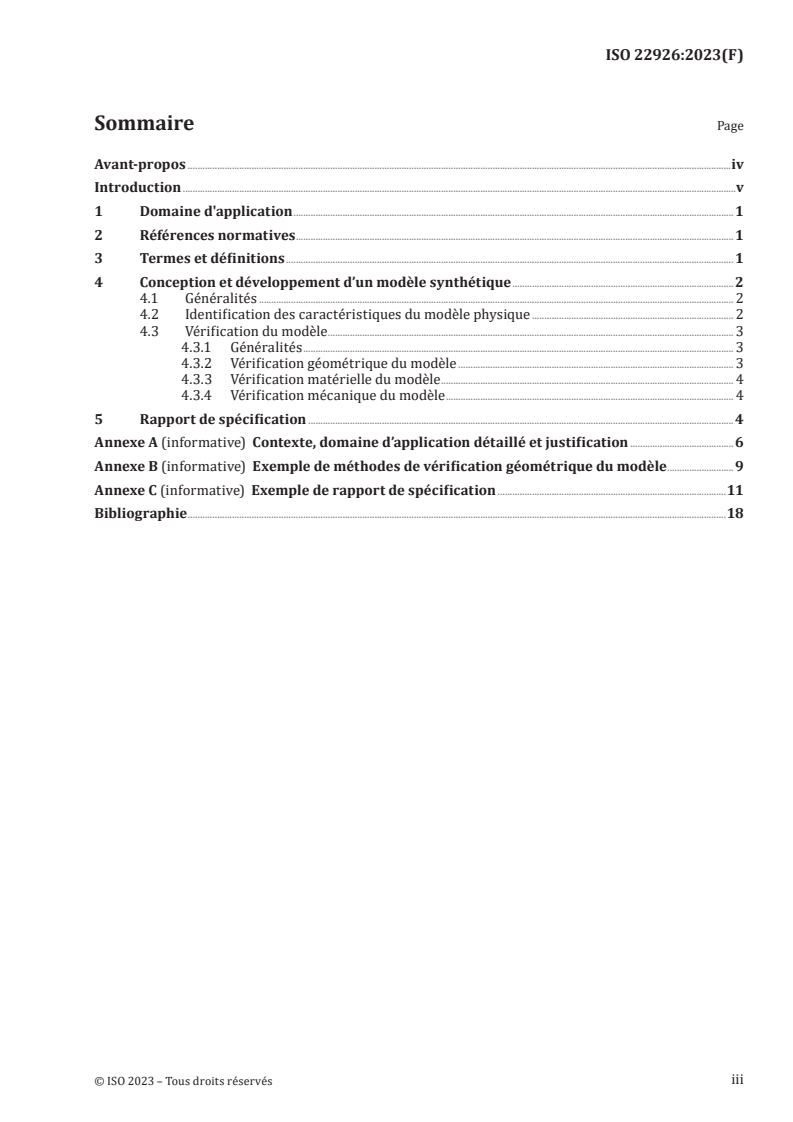
Sommaire Page
Avant-propos .iv
Introduction .v
1 Domaine d'application .1
2 Références normatives .1
3 Termes et définitions . 1
4 Conception et développement d’un modèle synthétique . 2
4.1 Généralités . 2
4.2 Identification des caractéristiques du modèle physique . 2
4.3 Vérification du modèle . 3
4.3.1 Généralités . 3
4.3.2 Vérification géométrique du modèle . 3
4.3.3 Vérification matérielle du modèle . 4
4.3.4 Vérification mécanique du modèle . 4
5 Rapport de spécification .4
Annexe A (informative) Contexte, domaine d’application détaillé et justification .6
Annexe B (informative) Exemple de méthodes de vérification géométrique du modèle .9
Annexe C (informative) Exemple de rapport de spécification .11
Bibliographie .18
iii
Avant-propos
L’ISO (Organisation internationale de normalisation) est une fédération mondiale d’organismes
nationaux de normalisation (comités membres de l’ISO). L’élaboration des Normes internationales est
en général confiée aux comités techniques de l’ISO. Chaque comité membre intéressé par une étude
a le droit de faire partie du comité technique créé à cet effet. Les organisations internationales,
gouvernementales et non gouvernementales, en liaison avec l’ISO participent également aux travaux.
L’ISO collabore étroitement avec la Commission électrotechnique internationale (IEC) en ce qui
concerne la normalisation électrotechnique.
Les procédures utilisées pour élaborer le présent document et celles destinées à sa mise à jour sont
décrites dans les Directives ISO/IEC, Partie 1. Il convient, en particulier de prendre note des différents
critères d'approbation requis pour les différents types de documents ISO. Le présent document
a été rédigé conformément aux règles de rédaction données dans les Directives ISO/IEC, Partie 2
(voir www.iso.org/directives).
L’ISO attire l’attention sur le fait que la mise en application du présent document peut entraîner
l’utilisation d’un ou de plusieurs brevets. L’ISO ne prend pas position quant à la preuve, à la validité et
à l’applicabilité de tout droit de propriété revendiqué à cet égard. À la date de publication du présent
document, l’ISO n'avait pas reçu notification qu’un ou plusieurs brevets pouvaient être nécessaires à sa
mise en application. Toutefois, il y a lieu d’avertir les responsables de la mise en application du présent
document que des informations plus récentes sont susceptibles de figurer dans la base de données de
brevets, disponible à l'adresse www.iso.org/brevets. L’ISO ne saurait être tenue pour responsable de ne
pas avoir identifié de tels droits de brevet.
Les appellations commerciales éventuellement mentionnées dans le présent document sont données
pour information, par souci de commodité, à l’intention des utilisateurs et ne sauraient constituer un
engagement.
Pour une explication de la nature volontaire des normes, de la signification des termes et expressions
spécifiques de l’ISO liés à l’évaluation de la conformité, ou pour toute autre information au sujet de
l’adhésion de l’ISO aux principes de l’Organisation mondiale du commerce (OMC) concernant les
obstacles techniques au commerce (OTC), voir www.iso.org/iso/fr/avant-propos.html.
Le présent document a été élaboré par le comité technique ISO/TC 150, Implants chirurgicaux.
Il convient que l’utilisateur adresse tout retour d’information ou toute question concernant le présent
document à l’organisme national de normalisation de son pays. Une liste exhaustive desdits organismes
se trouve à l’adresse www.iso.org/fr/members.html.
iv
Introduction
Les modèles osseux anatomiques synthétiques peuvent être utiles pour caractériser les performances
mécaniques d’implants et instruments chirurgicaux, tels que ceux utilisés en chirurgie de reconstruction
ou de réparation musculo-squelettique. Un modèle osseux synthétique est généralement fabriqué par
des méthodes de coulée, d’usinage et/ou dernièrement par fabrication additive, toutes pouvant tirer
parti de la modélisation d’images médicales. Pour utiliser le modèle osseux anatomique synthétique
pour les essais mécaniques d’un implant, sa similitude avec l’os naturel en termes de formes et de
comportement mécanique a une importance capitale pour les utilisateurs de modèles osseux.
Le présent document fournit une manière de spécifier, vérifier et consigner les caractéristiques
de modèles osseux synthétiques utilisés pour les essais d’implants. Les détails des essais et le choix
d’un modèle osseux approprié ne font pas partie du domaine d’application du présent document. Une
justification plus détaillée à propos de ce document est fournie à l’Annexe A.
Il existe deux normes pertinentes pour les matériaux synthétiques utilisés comme modèles osseux
[1]
mécaniques pour les essais d’implants. La première édition de l’ASTM F1839 , qui est une spécification
normalisée pour la mousse de polyuréthane rigide, a été publiée en 1997. La mousse de polyuréthane est
un matériau cellulaire solide dont certains aspects de son comportement mécanique sont similaires à
ceux de l’os, notamment la relation entre masse volumique apparente et réponse contrainte-déformation
[2]
à une charge mécanique. Une seconde norme pertinente est l’ISO 19213 dont la première édition a été
publiée en 2017 et qui fournit une liste de méthodes d’essai pour décrire les modèles synthétiques d’os
cortical. Les méthodes référencées dans l’ISO 19213 rapportent des propriétés de matériaux provenant
de méthodes d’essai applicables au plastique, et comprennent des essais spécialisés pour reproduire
certains procédés chirurgicaux orthopédiques tels que le forage, l’ébarbage et le découpage. Le présent
document ne se limite pas aux matériaux et comprend la forme et la structure d’un modèle osseux
synthétique.
Bien que le domaine d’application du présent document soit limité aux modèles osseux, il est destiné à
établir un cadre pour les futurs modèles d’autres tissus biologiques.
v
NORME INTERNATIONALE ISO 22926:2023(F)
Implants chirurgicaux — Spécification et vérification des
modèles osseux anatomiques synthétiques pour les essais
1 Domaine d'application
Le présent document fournit des exigences et des recommandations pour la spécification et la
vérification des modèles osseux anatomiques synthétiques pour une utilisation dans les essais
d’implants.
La source anatomique du modèle synthétique peut être les données numériques obtenues par
tomodensitométrie, ou toute autre source telle que des échantillons cadavériques ou des données de
forme déterminées statistiquement.
Les spécifications abordées dans le présent document sont la forme 3D et les caractéristiques
mécaniques. D’autres caractéristiques, telles que la couleur ou l’aspect esthétique, ne sont pas prises en
compte dans le présent document.
2 Références normatives
Le présent document ne contient aucune référence normative.
3 Termes et définitions
Pour les besoins du présent document, les termes et définitions suivants s’appliquent.
L’ISO et l’IEC tiennent à jour des bases de données terminologiques destinées à être utilisées en
normalisation, consultables aux adresses suivantes:
— ISO Online browsing platform: disponible à l’adresse https:// www .iso .org/ obp
— IEC Electropedia: disponible à l’adresse https:// www .electropedia .org/
3.1
modèle osseux anatomique numérique
modèle numérique
jeu de données servant à représenter la forme et toute autre caractéristique souhaitée pour le modèle
synthétique (3.2) cible
Note 1 à l'article: Le mode opératoire de production d’un modèle numérique de l’os du genou à partir de données
tomodensitométriques est donné dans l’ISO 19233-1.
Note 2 à l'article: Des exemples de représentation de modèle numérique peuvent être, entre autres, les
modèles STL, CAD STEP et à base de voxels.
Note 3 à l'article: Des exemples d’autres caractéristiques souhaitées sont la densité, la dureté, la porosité et le
module de Young.
3.2
modèle osseux anatomique synthétique
modèle synthétique
modèle physique résultant du procédé de fabrication basé sur le modèle numérique (3.1)
3.3
caractéristique du modèle physique
paramètre ou élément utilisé pour représenter l’os anatomique physique afin d’établir les exigences de
conception du modèle synthétique (3.2)
Note 1 à l'article: Les caractéristiques du modèle physique comprennent la forme géométrique, le matériau et les
propriétés mécaniques.
Note 2 à l'article: Les caractéristiques du modèle physique peuvent être spécifiées par l’utilisateur et/ou le
producteur de modèle osseux (3.4).
3.4
producteur de modèle osseux
producteur de modèle
organisme ou personne responsable de produire le modèle synthétique (3.2)
3.5
utilisateur de modèle osseux
utilisateur de modèle
organisme ou personne qui utilise le modèle synthétique (3.2)
3.6
rapport de spécification
rapport qui fournit des informations sur les caractéristiques du modèle synthétique (3.2) fabriqué
conformément aux exigences de conception établies dans le présent document
Note 1 à l'article: Voir l’Annexe C pour un exemple.
4 Conception et développement d’un modèle synthétique
4.1 Généralités
Les exigences applicables pour la caractérisation des modèles osseux anatomiques physiques et
numériques et la vérification après la production sont présentées en 4.2 à 4.3.
Le producteur de modèle osseux doit établir des contrôles appropriés du système afin d’assurer la
traçabilité de chaque modèle osseux anatomique synthétique tout au long du procédé de conception et
de développement.
4.2 Identification des caractéristiques du modèle physique
Les caractéristiques requises du modèle physique doivent être spécifiées soit par le producteur de
modèle osseux soit par l’utilisateur de modèle osseux. Cette spécification doit comprendre l’une des
caractéristiques suivantes, si nécessaire, selon l’application prévue du modèle:
a) la forme globale décrite géométriquement de n’importe quelle manière, notamment le modèle
surfacique (par exemple, fichier STL), le modèle de vecteur solide (par exemple, fichier CAD STEP)
ou la représentation volumétrique (par exemple, modèle à base de voxels) comme entrée pour un
modèle osseux numérique global;
b) la description des formes 3D des segments de forme globale (du point a) ci-dessus), notamment os
cortical, os spongieux et canal centro-médullaire, etc.;
c) le matériau et les propriétés du modèle global ou de chaque segment, notamment la masse
volumique, la dureté, la porosité, la rugosité de surface, le module de Young;
d) les caractéristiques mécaniques structurelles du modèle osseux global, notamment la rigidité, la
résistance ultime, la résistance à la fatigue, etc. sous certaines conditions de charge;
e) toute autre caractéristique telle que la résistance chimique ou thermique, les niveaux de contrainte
résiduelle et la stabilité dimensionnelle due au procédé de fabrication, et l’absorption des fluides
dans l’environnement de travail prévu du modèle.
Il convient que l’utilisateur de modèle osseux détermine, parmi les caractéristiques ci-dessus, celles qui
sont indispensables à son application et pour lesquelles une vérification est nécessaire.
NOTE La référence du matériau et des caractéristiques mécaniques pour les segments osseux humains peut
être extraite de la littérature publiée, pour des exemples, voir les Références [3] à [11].
4.3 Vérification du modèle
4.3.1 Généralités
Pour vérifier que le modèle osseux anatomique synthétique satisfait aux exigences du modèle numérique
souhaité, ce processus doit être effectué par le producteur de modèle osseux, et les résultats transmis à
l’utilisateur de modèle osseux. Cette vérification porte sur la performance géométrique du modèle et, si
nécessaire, sur la performance mécanique du modèle, conformément aux étapes suivantes:
a) vérification géométrique du modèle (4.3.2);
b) vérification matérielle du modèle (4.3.3); et
c) le cas échéant, vérification mécanique du modèle (4.3.4).
Le producteur de modèle osseux doit choisir et mettre en œuvre les processus applicables aux
vérifications géométriques, matérielles et mécaniques du modèle osseux anatomique synthétique
comme il se doit, ou comme convenu avec les utilisateurs de modèle osseux.
Les résultats de vérification doivent être présentés dans le rapport de spécification conformément
à l’Article 5.
4.3.2 Vérification géométrique du modèle
Les caractéristiques géométriques du modèle osseux anatomique synthétique doivent être vérifiées
en s’assurant qu’elles concordent avec les spécifications géométriques établies en 4.2 a) et b). Les
caractéristiques géométriques sont spécifiées et référencées par la combinaison de deux éléments:
— des repères anatomiques; et
— un modèle osseux anatomique numérique.
Un exemple détaillé de vérification géométrique du modèle est fourni à l’Annexe B.
Les résultats de la vérification géométrique du modèle doivent être consignés conformément
à l’Article 5.
L'interprétation de la concordance entre le modèle synthétique et sa référence doit également tenir
compte des effets et des erreurs liés au protocole de mesure, au dispositif de mesure et au logiciel utilisé
pendant le protocole, notamment:
— le choix des points de repère, y compris leur emplacement;
— la variabilité des résultats depuis l’enregistrement et calcul de l’écart entre le modèle synthétique et
le modèle numérique attendu.
Lorsque le protocole ou les instruments utilisés pour mesurer les modèles osseux anatomiques
synthétiques et numériques sont différents, ces différences doivent être consignées.
4.3.3 Vérification matérielle du modèle
Les matériaux et autres caractéristiques de chaque région ou segment spatial du modèle osseux
anatomique synthétique doivent être vérifiés en les comparant aux spécifications établies en 4.2 c). Les
résultats de la vérification matérielle du modèle doivent être consignés conformément à l’Article 5.
NOTE Les méthodes d’essai des caractéristiques matérielles sont disponibles dans plusieurs normes ISO
et ASTM. Pour le segment cortical, les caractéristiques mécaniques des matériaux osseux peuvent être soumises
à essai conformément à l’ISO 19213.
4.3.4 Vérification mécanique du modèle
Les caractéristiques mécaniques structurelles du modèle osseux anatomique synthétique doivent être
vérifiées en les comparant aux spécifications établies en 4.2 c) ou d). Les résultats de la vérification
mécanique du modèle doivent être consignés conformément à l’Article 5.
5 Rapport de spécification
Le rapport de spécification doit au moins comporter les informations suivantes.
Fournir des recommandations de compte-rendu pour la définition, la création, la vérification et
l’utilisation du modèle.
a) Utilisation prévue. L’utilisation prévue du modèle osseux anatomique synthétique comprend
généralement, entre autres:
— la partie anatomique que le modèle représente;
— la population que le modèle est censé refléter;
— le cas échéant, l’anomalie que le modèle représente;
— l’implant prévu pour être utilisé avec le modèle;
— les essais effectués avec le modèle; et
— le cas échéant, toute contre-indication ou mise en garde concernant un mauvais usage
raisonnablement prévisible du modèle.
EXEMPLE Modèles de fémur pour l’évaluation de rigidité primaire des constructions de
réparation de fractures. Ce type de modèle est généralement utilisé pour évaluer la rigidité de plusieurs
constructions de réparation de fractures simulant des traitements traumatiques orthopédiques. Dans le
cas présent, le modèle simule un fémur fracturé ou un fémur intact réparé avec une ou plusieurs plaques
et vis, et la rigidité des constructions est évaluée en flexion antéropostérieure, en flexion médiolatérale,
en compression et/ou torsion axiale ou dans n’importe quelle combinaison de ces positions.
b) Caractéristiques géométriques identifiées en 4.2 a) et b) et méthodes de mesure permettant de les
vérifier. Exemples:
— le nom ou toute information d’identification permettant de spécifier le modèle osseux
anatomique numérique;
— les dimensions des repères anatomiques, par exemple longueur totale;
— pour les mesurages permettant de créer le modèle osseux anatomique numérique, les méthodes
de mesure (par exemple, tomodensitométrie) et les détails du protocole utilisé;
— les effets et erreurs liés au protocole de mesure, au dispositif de mesure et au logiciel utilisé;
— la tolérance d’erreur de ces spécifications;
— le résultat de mesure, soit sous forme de dimensions absolues soit sous forme de biais ou d'écart
relatif par rapport au modèle osseux anatomique numérique. Il peut être écrit sous forme de
valeur maximale, moyenne, etc.
— pour la caractérisation du modèle osseux anatomique synthétique, les méthodes et dispositifs
de mesure utilisés, le nombre d'échantillons (prendre 3 en cas d’oubli) et comment les mesures
pour les différents échantillons sont combinées lors du traitement et de l’interprétation des
données;
— toute autre condition de mesure susceptible d’affecter les résultats de la vérification géométrique,
par exemple la température ambiante, etc.
c) Caractéristiques matérielles et autres en 4.2 c), et méthodes d’essai.
d) En cas de caractéristiques mécaniques applicables, les méthodes permettant de les vérifier.
e) Le cas échéant, d’autres caractéristiques susceptibles d’affecter les résultats de l’essai utilisant le
modèle.
EXEMPLE Durée de vie estimée, procédé de fabrication, conditions de stockage.
NOTE 1 Voir l’Annexe C pour obtenir un exemple.
NOTE 2 Le contenu de ce rapport de spécification concerne uniquement la vérification géométrique, matérielle
et mécanique du modèle. D’autres caractéristiques peuvent également être ajoutées pour informer les utilisateurs
de modèle osseux.
Annexe A
(informative)
Contexte, domaine d’application détaillé et justification
A.1 Généralités
Le présent document est destiné à fournir une manière de spécifier, vérifier et consigner les
caractéristiques de modèles osseux synthétiques utilisés pour les essais d’implants. Il est utile pour
le producteur de modèle et les utilisateurs de modèle car il définit les termes nécessaires pour décrire
les modèles synthétiques et fournit un ensemble de caractéristiques qui peuvent être utiles lors de la
spécification du modèle. Un rapport de spécification basé sur le présent document aidera le producteur
et l’utilisateur d’un modèle osseux à obtenir un modèle osseux structuré et clarifié, à savoir comment il
a été soumis à essai, à connaître les résultats des essais de vérification et à savoir comment les modèles
des différents producteurs peuvent être plus facilement comparés.
Le présent document a été proposé en réponse aux demandes et à l’évolution technologique, notamment:
— demandes croissantes d’essais au banc in situ d’implants pour une sécurité renforcée du patient;
— technologie émergente de la transformation numérique lors de la production d’implants et de
modèles osseux, y compris flux de production de données numériques, images 3D ou numériseur,
CAO 3D, usinage à commande numérique et fabrication additive;
— potentiel des implants spécifiques aux patients.
Par conséquent, le présent document suppose que le flux de production est centré sur le modèle
numérique. Cependant, le présent document ne concerne pas spécifiquement des modèles osseux pour
implants spécifiques aux patients ou des modèles produits par fabrication additive. Il est également
applicable et utile pour les modèles osseux non fabriqués d’après des données numériques
...