

EN 13617-2:2012
(Main)Petrol filling stations - Part 2: Safety requirements for construction and performance of safe breaks for use on metering pumps and dispensers
- Abstract
This European Standard specifies safety requirements for the construction and performance of safe breaks to be fitted to metering pumps and dispensers installed at filling stations and used to dispense liquid fuels into the tanks of motor vehicles, boats and light aircraft and into portable containers at flow rates up to 200 l min-1.
The requirements apply to safe breaks at ambient temperatures from –20 °C to +40 °C with the possibility for an extended temperature range.
It pays particular attention to electrical, mechanical and hydraulic characteristics of, and electrical apparatus incorporated within or mounted on, the safe break.
This European Standard applies mainly to hazards related to the ignition of liquid fuels being dispensed or their vapour. This European Standard also addresses electrical and mechanical hazards.
NOTE 1 This European Standard does not apply to equipment for use with liquefied petroleum gas (LPG) or liquefied natural gas (LNG) or compressed natural gas (CNG).
NOTE 2 Fuels other than of Explosion Group IIA are excluded from this European Standard.
- Status
- Withdrawn
- Publication Date
- 13-Mar-2012
- Withdrawal Date
- 13-Oct-2026
- Technical Committee
- CEN/TC 393 - Equipment for storage tanks and for service stations
- Current Stage
- 9960 - Withdrawal effective - Withdrawal
- Start Date
- 15-Sep-2021
- Completion Date
- 14-Oct-2026
- Directive
- 2014/34/EU - Directive 2014/34/EU Of The European Parliament And Of The Council of 26 February 2014 on the harmonisation of the laws of the Member States relating to equipment and protective systems intended for use in potentially explosive atmospheres (recast)OJ Ref: C, C 126, C 293/52, HARMONIZIRAN OJ Date: 08-Apr-2016
94/9/EC - Equipment and protective systems intended for use in potentially explosive atmospheres (ATEX)OJ Ref: C, C 130 OJ Date: 04-May-2012



Relations
- Effective Date
- 22-Dec-2008
- Effective Date
- 08-Jun-2022
- Effective Date
- 25-Aug-2026
- Effective Date
- 25-Aug-2026
- Effective Date
- 25-Aug-2026
- Effective Date
- 18-Mar-2026
- Effective Date
- 09-Feb-2026
- Effective Date
- 28-Jan-2026
- Effective Date
- 28-Jan-2026
- Effective Date
- 28-Jan-2026
- Effective Date
- 28-Jan-2026
- Effective Date
- 28-Jan-2026
- Effective Date
- 28-Jan-2026
- Effective Date
- 28-Jan-2026
- Effective Date
- 28-Jan-2026
Get Certified
Connect with accredited certification bodies for this standard

Element Materials Technology
Materials testing and product certification.

ABS Group Brazil
ABS Group certification services in Brazil.

ABS Quality Evaluations Inc.
American Bureau of Shipping quality certification.
Sponsored listings
Frequently Asked Questions
EN 13617-2:2012 is a standard published by the European Committee for Standardization (CEN). Its full title is "Petrol filling stations - Part 2: Safety requirements for construction and performance of safe breaks for use on metering pumps and dispensers". This standard covers: This European Standard specifies safety requirements for the construction and performance of safe breaks to be fitted to metering pumps and dispensers installed at filling stations and used to dispense liquid fuels into the tanks of motor vehicles, boats and light aircraft and into portable containers at flow rates up to 200 l min-1. The requirements apply to safe breaks at ambient temperatures from –20 °C to +40 °C with the possibility for an extended temperature range. It pays particular attention to electrical, mechanical and hydraulic characteristics of, and electrical apparatus incorporated within or mounted on, the safe break. This European Standard applies mainly to hazards related to the ignition of liquid fuels being dispensed or their vapour. This European Standard also addresses electrical and mechanical hazards. NOTE 1 This European Standard does not apply to equipment for use with liquefied petroleum gas (LPG) or liquefied natural gas (LNG) or compressed natural gas (CNG). NOTE 2 Fuels other than of Explosion Group IIA are excluded from this European Standard.
This European Standard specifies safety requirements for the construction and performance of safe breaks to be fitted to metering pumps and dispensers installed at filling stations and used to dispense liquid fuels into the tanks of motor vehicles, boats and light aircraft and into portable containers at flow rates up to 200 l min-1. The requirements apply to safe breaks at ambient temperatures from –20 °C to +40 °C with the possibility for an extended temperature range. It pays particular attention to electrical, mechanical and hydraulic characteristics of, and electrical apparatus incorporated within or mounted on, the safe break. This European Standard applies mainly to hazards related to the ignition of liquid fuels being dispensed or their vapour. This European Standard also addresses electrical and mechanical hazards. NOTE 1 This European Standard does not apply to equipment for use with liquefied petroleum gas (LPG) or liquefied natural gas (LNG) or compressed natural gas (CNG). NOTE 2 Fuels other than of Explosion Group IIA are excluded from this European Standard.
EN 13617-2:2012 is classified under the following ICS (International Classification for Standards) categories: 75.200 - Petroleum products and natural gas handling equipment. The ICS classification helps identify the subject area and facilitates finding related standards.
EN 13617-2:2012 has the following relationships with other standards: It is inter standard links to EN 13617-2:2004, EN 13617-2:2021, ISO 11925-3:1997, ISO 261:1998, ISO 965-2:1998, EN ISO 1825:2026, EN IEC 60079-0:2018, EN 13617-1:2012, EN ISO 9013:2002/A1:2003, EN 13463-1:2009, EN ISO 8031:2009, EN 1360:2013, EN ISO 6878:2004, EN ISO 1825:2017, EN 1127-1:2019. Understanding these relationships helps ensure you are using the most current and applicable version of the standard.
EN 13617-2:2012 is associated with the following European legislation: EU Directives/Regulations: 2014/34/EU, 94/9/EC; Standardization Mandates: M/079. When a standard is cited in the Official Journal of the European Union, products manufactured in conformity with it benefit from a presumption of conformity with the essential requirements of the corresponding EU directive or regulation.
EN 13617-2:2012 is available in PDF format for immediate download after purchase. The document can be added to your cart and obtained through the secure checkout process. Digital delivery ensures instant access to the complete standard document.
Standards Content (Sample)
2003-01.Slovenski inštitut za standardizacijo. Razmnoževanje celote ali delov tega standarda ni dovoljeno.Tankstellen - Teil 2: Sicherheitstechnische Anforderungen an Bau- und Arbeitsweise von Abreißkupplungen für Zapfsäulen und druckversorgte ZapfsäulenStations-service - Partie 2: Exigences de sécurité relatives à la construction et aux performances des raccords cassants utilisés pour distributeurs de carburantsPetrol filling stations - Part 2: Safety requirements for construction and performance of safe breaks for use on metering pumps and dispensers75.200Petroleum products and natural gas handling equipmentICS:Ta slovenski standard je istoveten z:EN 13617-2:2012SIST EN 13617-2:2012en,fr,de01-maj-2012SIST EN 13617-2:2012SLOVENSKI
STANDARDSIST EN 13617-2:20041DGRPHãþD
EUROPEAN STANDARD NORME EUROPÉENNE EUROPÄISCHE NORM
EN 13617-2
March 2012 ICS 75.200 Supersedes EN 13617-2:2004English Version
Petrol filling stations - Part 2: Safety requirements for construction and performance of safe breaks for use on metering pumps and dispensers
Stations-service - Partie 2: Exigences de sécurité relatives à la construction et aux performances des raccords cassants utilisés pour les distributeurs de carburant
Tankstellen - Teil 2: Sicherheitstechnische Anforderungen an Bau- und Arbeitsweise von Abreißkupplungen für Zapfsäulen und druckversorgte Zapfsäulen This European Standard was approved by CEN on 28 January 2012.
CEN members are bound to comply with the CEN/CENELEC Internal Regulations which stipulate the conditions for giving this European Standard the status of a national standard without any alteration. Up-to-date lists and bibliographical references concerning such national standards may be obtained on application to the CEN-CENELEC Management Centre or to any CEN member.
This European Standard exists in three official versions (English, French, German). A version in any other language made by translation under the responsibility of a CEN member into its own language and notified to the CEN-CENELEC Management Centre has the same status as the official versions.
CEN members are the national standards bodies of Austria, Belgium, Bulgaria, Croatia, Cyprus, Czech Republic, Denmark, Estonia, Finland, France, Germany, Greece, Hungary, Iceland, Ireland, Italy, Latvia, Lithuania, Luxembourg, Malta, Netherlands, Norway, Poland, Portugal, Romania, Slovakia, Slovenia, Spain, Sweden, Switzerland, Turkey and United Kingdom.
EUROPEAN COMMITTEE FOR STANDARDIZATION
COMITÉ EUROPÉEN DE NORMALISATION EUROPÄISCHES KOMITEE FÜR NORMUNG
Management Centre:
Avenue Marnix 17,
B-1000 Brussels © 2012 CEN All rights of exploitation in any form and by any means reserved worldwide for CEN national Members. Ref. No. EN 13617-2:2012: ESIST EN 13617-2:2012
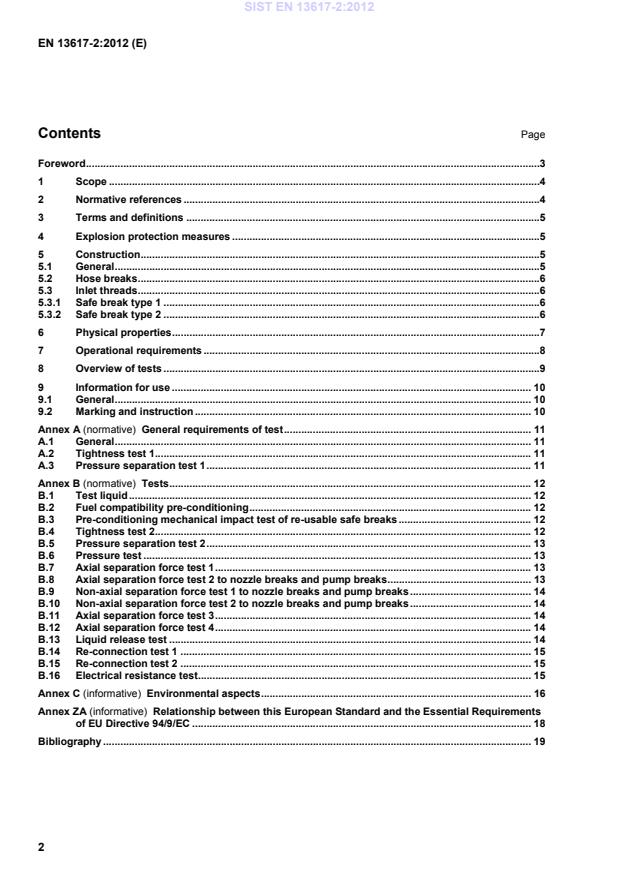
General requirements of test . 11A.1General . 11A.2Tightness test 1 . 11A.3Pressure separation test 1 . 11Annex B (normative)
Tests . 12B.1Test liquid . 12B.2Fuel compatibility pre-conditioning . 12B.3Pre-conditioning mechanical impact test of re-usable safe breaks . 12B.4Tightness test 2 . 12B.5Pressure separation test 2 . 13B.6Pressure test . 13B.7Axial separation force test 1 . 13B.8Axial separation force test 2 to nozzle breaks and pump breaks . 13B.9Non-axial separation force test 1 to nozzle breaks and pump breaks . 14B.10Non-axial separation force test 2 to nozzle breaks and pump breaks . 14B.11Axial separation force test 3 . 14B.12Axial separation force test 4 . 14B.13Liquid release test . 14B.14Re-connection test 1 . 15B.15Re-connection test 2 . 15B.16Electrical resistance test . 15Annex C (informative)
Environmental aspects . 16Annex ZA (informative)
Relationship between this European Standard and the Essential Requirements of EU Directive 94/9/EC . 18Bibliography . 19 SIST EN 13617-2:2012
(ISO 1825) EN ISO 8031:2009, Rubber and plastics hoses and hose assemblies — Determination of electrical resistance and conductivity (ISO 8031:2009) ISO 261, ISO general-purpose metric screw threads — General plan ISO 965-2, ISO general purpose metric screw threads — Tolerances — Part 2: Limits of sizes for general purpose external and internal screw threads — Medium quality ISO 11925-3, Reaction to fire tests — Ignitability of building products subjected to direct impingement of flame — Part 3: Multi-source test SIST EN 13617-2:2012
EN 13463–1. The safe break shall fulfil the requirements for temperature class T3 and Group IIA to EN 60079-0 or EN 13463–1. 5 Construction 5.1 General 5.1.1 All electrical and non-electrical equipment and components, intended for use in potentially explosive atmospheres, shall be designed and constructed according to good engineering practice and in conformity with the required categories for group II equipment to ensure avoidance of any ignition source. To classify the category of the equipment it shall be subjected to an ignition hazard assessment in accordance with 5.2 of EN 13463-1:2009. 5.1.2 All materials used in the construction shall be chemically and dimensionally stable under known service conditions. Materials likely to come into contact with fuels in both liquid and vapour phases shall be resistant to attack by these fuels. Compliance shall be demonstrated by manufacturer's declaration and compliance with the tests B.1 to B.16 inclusive. SIST EN 13617-2:2012
MALE THREADSb
Maximum thread depth mm Minimum thread length mm ¾” 12,5 11,0 1” 15,5 14,0 1 1/4” 15,5 17,5 1 1/2” 15,5 18,0 a The thread depth is measured from the outer to the metallic inner sealing face. b The stated minimum lengths does only apply if the female thread of the hose fitting includes an inner flat gasket. In case of using an outer flat gasket, the male threads may be shorter as stated.
5.3.2 Safe break type 2 Threads shall comply with Form 2: Form 2. M 34 × 1,5 female or male according to ISO 261 and ISO 965–2. The total thread depth shall be not less than 15,0 mm. The inlet end shall be controlled to a diameter of (35,0 ± 0,05) mm for a length (6,0 ± 0,1) mm. SIST EN 13617-2:2012
Physical properties The physical properties of the safe break shall be according to Table 2. Table 2 — Physical properties of safe break PROPERTY REQUIREMENT TEST METHOD Electrical resistance of inlet thread to outlet thread when fully assembled. All readings to be < 105 Ω B.16 Electrostatic properties 6.7 of EN 13463-1:2009 EN 13463-1 Fuel compatibility Clause 7 B.2 Ignitability of composites on safe break, Ignition source C; Effect time 20 s; Surface flame impingement The material tested shall not afterflame ISO 11925–3 Characteristics of safe break body and/or cover to prevent dangerous, mechanically generated, sparks (resistance to sparking). 6.4.4.2 of EN 13463-1:2009
EN 13463-1 SIST EN 13617-2:2012
...