


EN 15734-1:2010
(Main)Railway applications - Braking systems of high speed trains - Part 1: Requirements and definitions
Railway applications - Braking systems of high speed trains - Part 1: Requirements and definitions
This European Standard describes the functionality, constraints, performance and operation of a brake system for use in high speed trains as described in the TSI High Speed Rolling Stock, operating on routes of the European railways and their infrastructure systems.
The brake system requirements specified in this European Standard apply to trains that may operate at a maximum speed of up to 350 km/h on lines specifically built for high speed and define graduated values for deceleration related to four speed ranges (see Clause 6).
This European Standard covers:
- all new vehicle designs of high speed trains;
- all major overhauls of the above-mentioned vehicles if they involve redesigning or extensive alteration to the brake system of the vehicle concerned.
This European Standard does not cover locomotive hauled trains, which are specified by EN 14198.
NOTE This document applies the functional subdivision into subsystems as specified in the TSI High speed. The braking system is part of the function: "Accelerate, maintain speed, brake and stop".
Bahnanwendungen - Bremssysteme für Hochgeschwindigkeitszüge - Teil 1: Anforderungen und Definitionen
Diese Europäische Norm beschreibt die Anforderungen an die Funktionalität, die Einschränkungen, die Leistungsfähigkeit und den Betrieb von Bremssystemen für die Anwendung in Hochgeschwindigkeitszügen nach TSI Fahrzeuge HGV, die zum Betrieb auf den Strecken der Europäischen Bahnen und deren Infrastruktursystemen bestimmt sind.
Die in der vorliegenden Norm enthaltenen Anforderungen für das Bremssystem gelten für Züge, die bei einer Höchstgeschwindigkeit von bis zu 350 km/h auf speziell für den Hochgeschwindigkeitsverkehr gebauten Strecken verkehren können und legt für Bremsverzögerungen in vier Geschwindigkeitsbereiche abgestufte Werte fest (siehe Abschnitt 6).
Diese Norm gilt für:
- alle neuen Fahrzeugbauarten für Hochgeschwindigkeitszüge;
- alle größeren Grundüberholungen der oben genannten Fahrzeuge, wenn diese Neukonstruktionen oder umfassende Änderungen der Bremsanlage des betreffenden Fahrzeuges mit einschließt.
Diese Norm behandelt nicht lokomotivbespannte Züge, welche in EN 14198 behandelt werden.
ANMERKUNG Dieses Dokument folgt einer funktionalen Einteilung aus der TSI HGV und behandelt das Bremssystem als Teil der Funktion: “Beschleunigen, Geschwindigkeit halten, bremsen und anhalten“.
Applications ferroviaires - Systèmes de freinage pour trains à grande vitesse - Partie 1 : Exigences et définitions
La présente Norme européenne décrit les fonctions, les contraintes, les performances et le fonctionnement
d’un système de freinage destiné à être utilisé sur les trains à grande vitesse décrits dans la STI Grande
vitesse - Matériel roulant, circulant sur des lignes des réseaux ferrés européens et leur infrastructure.
Les exigences du système de freinage spécifiées dans la présente Norme européenne s'appliquent aux trains
pouvant circuler à une vitesse maximale pouvant aller jusqu’à 350 km/h sur des lignes spécialement conçues
pour les trains à grande vitesse et définissent des valeurs de décélération associées à quatre plages de
vitesses (voir Article 6).
La présente Norme européenne couvre :
¾ toutes les nouvelles conceptions de trains à grande vitesse ;
¾ toutes les grandes révisions des véhicules susmentionnés si celles-ci entraînent une reconception ou une
transformation majeure du système de freinage du véhicule concerné.
La présente Norme européenne ne couvre pas les trains remorqués par une locomotive, qui font l’objet de
l’EN 14198.
NOTE Le présent document applique la sous-division fonctionnelle en sous-systèmes comme le spécifie la STI
Grande vitesse - Matériel roulant. Le système de freinage fait partie de la fonction : « Accélérer, maintenir la vitesse,
freiner et s’arrêter ».
Železniške naprave - Zavorni sistemi na vlakih za velike hitrosti - 1. del: Zahteve in definicije
Ta evropski standard opisuje funkcionalnost, omejitve, delovanje in obratovanje zavornega sistema, ki se uporablja na vlakih za visoke hitrosti, kot je opisano v TSI Železniška vozila za visoke hitrosti, ki obratujejo na progah evropskih železnic in njihovih infrastrukturnih sistemih. Zahteve za zavorni sistem, določene v tem evropskem standardu, veljajo za vlake, ki lahko obratujejo pri najvišji hitrosti 350 km/h na linijah, zgrajenih posebej za visoke hitrosti, in opredeljujejo postopne vrednosti zaustavljanja, ki se nanašajo na štiri hitrostne razpone (glej točko 6). Ta evropski standard zajema: vse nove oblike vozil vlakov za visoke hitrosti; - vse večje prenove zgoraj navedenih vozil, če prenove vključujejo preoblikovanje in obširne spremembe zavornega sistema zadevnega vozila. Ta evropski standard ne zajema vlakov, ki jih vlečejo lokomotive; te določa EN 14198.
General Information
- Status
- Withdrawn
- Publication Date
- 23-Nov-2010
- Withdrawal Date
- 10-Feb-2026
- Technical Committee
- CEN/TC 256 - Railway applications
- Drafting Committee
- CEN/TC 256/SC 3/WG 47 - Braking
- Current Stage
- 9960 - Withdrawal effective - Withdrawal
- Start Date
- 05-Mar-2022
- Completion Date
- 11-Feb-2026
Relations
- Effective Date
- 13-Oct-2021
- Effective Date
- 09-Feb-2026
- Effective Date
- 09-Feb-2026
- Effective Date
- 09-Feb-2026
- Effective Date
- 09-Feb-2026
- Effective Date
- 09-Feb-2026
- Effective Date
- 09-Feb-2026
- Effective Date
- 28-Jan-2026
- Effective Date
- 28-Jan-2026
- Effective Date
- 28-Jan-2026
- Effective Date
- 28-Jan-2026
- Effective Date
- 28-Jan-2026
- Effective Date
- 28-Jan-2026
- Effective Date
- 28-Jan-2026
- Refers
EN 854:2015 - Rubber hoses and hose assemblies - Textile reinforced hydraulic type - Specification - Effective Date
- 28-Jan-2026

Get Certified
Connect with accredited certification bodies for this standard

Bureau Veritas Railway Certification
Railway and transportation certification.

Deutsch Quality Systems (India) Pvt. Ltd. (DQS India)
Subsidiary of DQS Holding GmbH, founding member of IQNet. CDSCO Notified Body.

Excellence Ireland Quality Association (EIQA)
Irish quality certification organization.
Sponsored listings
Frequently Asked Questions
EN 15734-1:2010 is a standard published by the European Committee for Standardization (CEN). Its full title is "Railway applications - Braking systems of high speed trains - Part 1: Requirements and definitions". This standard covers: This European Standard describes the functionality, constraints, performance and operation of a brake system for use in high speed trains as described in the TSI High Speed Rolling Stock, operating on routes of the European railways and their infrastructure systems. The brake system requirements specified in this European Standard apply to trains that may operate at a maximum speed of up to 350 km/h on lines specifically built for high speed and define graduated values for deceleration related to four speed ranges (see Clause 6). This European Standard covers: - all new vehicle designs of high speed trains; - all major overhauls of the above-mentioned vehicles if they involve redesigning or extensive alteration to the brake system of the vehicle concerned. This European Standard does not cover locomotive hauled trains, which are specified by EN 14198. NOTE This document applies the functional subdivision into subsystems as specified in the TSI High speed. The braking system is part of the function: "Accelerate, maintain speed, brake and stop".
This European Standard describes the functionality, constraints, performance and operation of a brake system for use in high speed trains as described in the TSI High Speed Rolling Stock, operating on routes of the European railways and their infrastructure systems. The brake system requirements specified in this European Standard apply to trains that may operate at a maximum speed of up to 350 km/h on lines specifically built for high speed and define graduated values for deceleration related to four speed ranges (see Clause 6). This European Standard covers: - all new vehicle designs of high speed trains; - all major overhauls of the above-mentioned vehicles if they involve redesigning or extensive alteration to the brake system of the vehicle concerned. This European Standard does not cover locomotive hauled trains, which are specified by EN 14198. NOTE This document applies the functional subdivision into subsystems as specified in the TSI High speed. The braking system is part of the function: "Accelerate, maintain speed, brake and stop".
EN 15734-1:2010 is classified under the following ICS (International Classification for Standards) categories: 45.060.01 - Railway rolling stock in general. The ICS classification helps identify the subject area and facilitates finding related standards.
EN 15734-1:2010 has the following relationships with other standards: It is inter standard links to EN 15734-1:2010+A1:2021, EN IEC 61133:2021, EN 50121-3-1:2017, EN 50121-3-2:2016, EN 50125-1:1999, EN 50163:2004, EN 50126-1:2017, EN 15273-2:2025, EN 15611:2020+A1:2022, EN 14198:2016+A2:2021, EN 15020:2022, EN 14535-2:2019, EN 14535-1:2019, EN 10305-6:2016, EN 854:2015. Understanding these relationships helps ensure you are using the most current and applicable version of the standard.
EN 15734-1:2010 is associated with the following European legislation: EU Directives/Regulations: 2008/57/EC, 96/48/EC; Standardization Mandates: M/275. When a standard is cited in the Official Journal of the European Union, products manufactured in conformity with it benefit from a presumption of conformity with the essential requirements of the corresponding EU directive or regulation.
EN 15734-1:2010 is available in PDF format for immediate download after purchase. The document can be added to your cart and obtained through the secure checkout process. Digital delivery ensures instant access to the complete standard document.
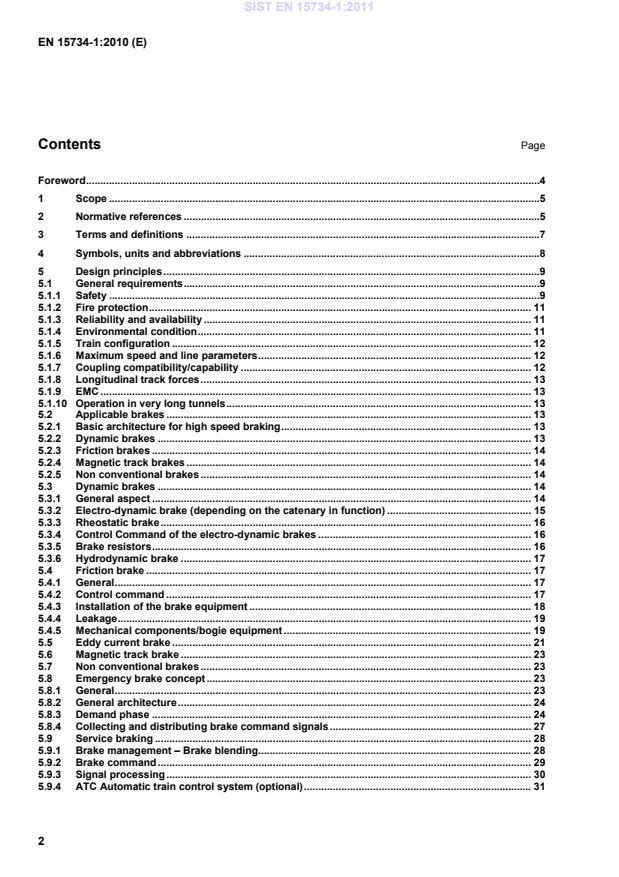
Standards Content (Sample)
2003-01.Slovenski inštitut za standardizacijo. Razmnoževanje celote ali delov tega standarda ni dovoljeno.Železniške naprave - Zavorni sistemi na vlakih za velike hitrosti - 1. del: Zahteve in definicijeBahnanwendungen - Bremssysteme für Hochgeschwindigkeitszüge - Teil 1: Anforderungen und DefinitionenApplications ferroviaires - Systèmes de freinage pour trains à grande vitesse - Partie 1 : Exigences et définitionsRailway applications - Braking systems of high speed trains - Part 1: Requirements and definitions45.040Materiali in deli za železniško tehnikoMaterials and components for railway engineeringICS:Ta slovenski standard je istoveten z:EN 15734-1:2010SIST EN 15734-1:2011en,fr,de01-oktober-2011SIST EN 15734-1:2011SLOVENSKI
STANDARD
EUROPEAN STANDARD NORME EUROPÉENNE EUROPÄISCHE NORM
EN 15734-1
November 2010 ICS 45.060.01 English Version
Railway applications - Braking systems of high speed trains - Part 1: Requirements and definitions
Applications ferroviaires - Systèmes de freinage pour trains à grande vitesse - Partie 1 : Exigences et définitions
Bahnanwendungen - Bremssysteme für Hochgeschwindigkeitszüge - Teil 1: Anforderungen und Definitionen This European Standard was approved by CEN on 23 October 2010.
CEN members are bound to comply with the CEN/CENELEC Internal Regulations which stipulate the conditions for giving this European Standard the status of a national standard without any alteration. Up-to-date lists and bibliographical references concerning such national standards may be obtained on application to the CEN Management Centre or to any CEN member.
This European Standard exists in three official versions (English, French, German). A version in any other language made by translation under the responsibility of a CEN member into its own language and notified to the CEN Management Centre has the same status as the official versions.
CEN members are the national standards bodies of Austria, Belgium, Bulgaria, Croatia, Cyprus, Czech Republic, Denmark, Estonia, Finland, France, Germany, Greece, Hungary, Iceland, Ireland, Italy, Latvia, Lithuania, Luxembourg, Malta, Netherlands, Norway, Poland, Portugal, Romania, Slovakia, Slovenia, Spain, Sweden, Switzerland and United Kingdom.
EUROPEAN COMMITTEE FOR STANDARDIZATION
COMITÉ EUROPÉEN DE NORMALISATION EUROPÄISCHES KOMITEE FÜR NORMUNG
Management Centre:
Avenue Marnix 17,
B-1000 Brussels © 2010 CEN All rights of exploitation in any form and by any means reserved worldwide for CEN national Members. Ref. No. EN 15734-1:2010: ESIST EN 15734-1:2011
Passenger alarm system. 49Annex ZA (informative)
Relationship between this European Standard and the Essential Requirements of EU Directive 2008/57/EC . 50Bibliography . 52 SIST EN 15734-1:2011
This European Standard covers: all new vehicle designs of high speed trains; all major overhauls of the above-mentioned vehicles if they involve redesigning or extensive alteration to the brake system of the vehicle concerned. This European Standard does not cover locomotive hauled trains, which are specified by EN 14198.
NOTE This document applies the functional subdivision into subsystems as specified in the TSI High speed. The braking system is part of the function: “Accelerate, maintain speed, brake and stop”. 2 Normative references The following referenced documents are indispensable for the application of this document. For dated references, only the edition cited applies. For undated references, the latest edition of the referenced document (including any amendments) applies. EN 837-1:1996, Pressure gauges — Part 1: Bourdon tube pressure gauges — Dimensions, metrology, requirements and testing EN 854, Rubber hoses and hose assemblies — Textile reinforced hydraulic type — Specification EN 10220, Seamless and welded steel tubes — Dimensions and masses per unit length EN 10305-4, Steel tubes for precision applications — Technical delivery conditions — Part 4: Seamless cold drawn tubes for hydraulic and pneumatic power systems EN 10305-6, Steel tubes for precision applications — Technical delivery conditions — Part 6: Welded cold drawn tubes for hydraulic and pneumatic power systems EN 13749:2005, Railway applications — Wheelsets and bogies — Methods of specifying structural requirements of bogie frames EN 14198, Railway applications — Braking — Requirements for the brake system of trains hauled by a locomotive EN 14478:2005, Railway applications — Braking — Generic vocabulary EN 14531-6, Railway applications — Methods for calculation of stopping and slowing distances and immobilisation braking — Part 6: Step by step calculations for train sets or single vehicles
EN 14535-1, Railway applications — Brake discs for railway rolling stock — Part 1: Brake discs pressed or shrunk onto the axle or drive shaft, dimensions and quality requirements SIST EN 15734-1:2011
EN 14601, Railway applications — Straight and angled end cocks for brake pipe and main reservoir pipe EN 15020, Railway applications — Rescue coupler — Performance requirements, specific interface geometry and test methods
EN 15179, Railway applications — Braking — Requirements for the brake system of coaches
EN 15220-1, Railway applications — Brake indicators — Part 1: Pneumatically operated brake indicators EN 15273-2, Railway applications — Gauges — Part 2: Rolling stock gauge prEN 15328, Railway applications — Braking — Brake pads prEN 15329, Railway applications — Braking — Brake block holder and brake shoe key for rail vehicles
EN 15355, Railway applications — Braking — Distributor valves and distributor-isolating devices EN 15566, Railway applications — Railway rolling stock — Draw gear and screw coupling EN 15595, Railway applications — Braking — Wheel slide protection EN 15611, Railway applications — Braking — Relay valves EN 15663, Railway applications — Definition of vehicle reference masses EN 15734-2, Railway applications — Braking systems of high speed trains — Part 2: Test methods CEN/TS 45545 (all parts), Railway applications — Fire protection on railway vehicles
EN 50121-3 (all subparts), Railway applications — Electromagnetic compatibility
EN 50125-1:1999, Railway applications — Environmental conditions for equipment — Part 1: Equipment on board rolling stock EN 50126-1, Railway applications — The specification and demonstration of Reliability, Availability, Maintainability and Safety (RAMS) — Part 1: Basic requirements and generic process EN 50163, Railway applications — Supply voltages of traction systems EN 50215, Railway applications — Rolling stock — Testing of rolling stock on completion of construction and before entry into service
UIC 541-03:1984, Brakes; regulations concerning manufacture of the different brake parts; driver's brake valve UIC 544-1:2004, Brakes — Braking power UIC 557:1998, Diagnosis techniques for coaches UIC 648:2001, Connections for electric cables and air pipes on headstocks of locomotives and driving trailers UIC 651:2002, Layout of driver's cabs in locomotives, railcars, multiple unit trains and driving trailers
3.12 independent brake unit set of equipment, constituting an independent unit, whose function is to generate a retarding force on a vehicle or a part of a vehicle in response to a train brake signal SIST EN 15734-1:2011
Air brake pipe EBL
Emergency brake loop ECB Eddy current brake
EP
Electro-pneumatic brake MRP Main reservoir pipe SIST EN 15734-1:2011
Hydrodynamic brake MMI
Man-machine interface sB
Braking distance 1 bar = 105 N/m2 = 105 Pa = 10-1 MPa 5 Design principles 5.1 General requirements 5.1.1 Safety Braking systems shall conform to the following: a) the braking performances defined in Clause 6; b) the design principles listed in the document below; c) the design principles listed in relevant standards on brake systems; d) the requirements for the operator using and maintaining the brake system in the intended manner;
e) keeping within the required limits, in order to reduce the effects on the track, as specified in 5.1.9 and 5.5. In the course of the system design the following risks shall be considered and mitigated. As a minimum, the following hazards shall be taken into account:
f) the brake force applied is greater than the level of brake demanded: 1) impact on standing passengers; NOTE No limits are so far defined to secure passengers, only reference could be made to the TSI requirement considering longitudinal forces which corresponds to 2,5 m/s². 2) excessive jerk; 3) significant damage to the contact surface of the wheels; g) the brake performance is lower than the level of brake demanded: 1) keeping traction effort on the whole train while emergency brake is requested; 2) emergency brake performance not achieved;
3) parking brake: performance not achieved; 4) holding brake for brake test not achieved; h) there is no brake force, when demanded: 1) emergency brake not activated on the whole train when requested; SIST EN 15734-1:2011
Concluding from the hazards listed above the emergency brake shall have a high level of integrity and shall always be available when the brake system is set up for operation, whereas the service brake, whilst it may share subsystems and components, etc. with the emergency brake, need not achieve the same level of integrity. Nevertheless the service brake shall be designed to conform to the following requirements: k) the service brake shall be activated on the whole train when requested; l) in the case of a loss of service brake efficiency and: 1) if detected by the driver there shall be a means available for the driver to immediately apply the emergency brake by using the same lever which is used for service braking; 2) if the driver fails to detect a loss of efficiency then the train protection system (technical intervention system) shall have access to an emergency brake application; m) cut off traction effort on the whole train while service brake is requested; n) provide service brake effort at the level requested. High-speed trains incorporate a speed control system functioning with different deceleration levels. The prescribed performance levels defining the minimum braking power for trains suitable for running on all high-speed lines are given in Clause 6. The compliance of these performance levels and the safety of the braking system shall be fully demonstrated as specified in EN 15734-2. Accepted benchmark safety level for a brake system is the UIC-architecture as described in EN 14198. It is characterized by the following items: o) a continuous, automatic and inexhaustible brake system;
p) the medium is compressed air with its favourable properties; q) an energized (pressurized to release) brake pipe;
r) decentralized brake actuators, developing the brake force; s) proven design components. The components used shall withstand during their period in service any normal or exceptional stresses that have been specified. The safety implication of any failures shall be limited by appropriate means; as described in this standard. SIST EN 15734-1:2011
b) The time which is required to continue train operation with a fire declared to be on board is: 1) 4 min for category A trains according to TSI SRT; 2) 15 min for category B trains according to TSI SRT. c) In order to prevent fire, materials with low flammability shall be used and electrical installations shall meet appropriate European Standards.
5.1.3 Reliability and availability To comply with the essential requirements of the Directive 2008/57/EC and the requirement of the TSI related to Reliability and Availability, the requirements of 5.13 and 5.17 shall be applied.
5.1.4 Environmental condition The rolling stock and the equipment on board shall perform under conditions as specified in EN 50125-1:1999. They shall function properly in those climatic zones for which they have been designed and where they will be operated. NOTE For certain lines the operator of the infrastructure and/or the rail authorities may specify further requirements, e.g. for the Nordic countries. SIST EN 15734-1:2011
Without other particular specifications the functionality and the performances of the brake system shall be fulfilled when formed up to a maximum train length of 400 m. 5.1.6 Maximum speed and line parameters The brake system requirements specified in this standard apply to trains that may operate at a maximum speed of up to 350 km/h on lines specifically built for high speed and define graduated values for deceleration related to four speed ranges (see Clause 6).
Where trains are permitted to travel at greater speeds the brake requirements shall be specified as a result of a cooperation between the operator and the relevant transport authority 1).
The Interoperable European high speed network also includes lines specifically upgraded for high speed and lines specifically upgraded for high speed but with special features subjected to national rules determined by the topographic conditions, the track parameters, the signalling equipment, etc. Those line conditions shall be specified for trains which shall be designed for and operated on those specific lines.
5.1.7 Coupling compatibility/capability Interoperable European high speed trains shall: a) couple automatically and therefore shall be equipped with a coupler at each end of a unit according to TSI High Speed: 1) if trains of the same type are coupled then the pneumatic, electrical and electronic connections or others necessary for control shall be coupled and they shall provide full functionality; 2) if trains of a different type are coupled then the pneumatic connection shall provide sufficient functionality of the brake system to allow hauling a damaged unit by another interoperable unit without adapter. Relying upon the pneumatic brake solely in that case operation restrictions may apply; b) for rescue purpose a coupling with a conventional traction unit with UIC train hook according to EN 15566 by using a special adapter according to EN 15020 shall be provided. The auxiliary coupling device shall be compatible with the pneumatic pipes according to UIC 648.
If the brake demand is communicated using the brake pipe (in accordance with EN 14198) then the trainset being rescued shall respond in the form of a proportional brake force. For the rescued trainset equipped with
1) Transport authority means ERA and/or national representative. SIST EN 15734-1:2011
The brake design shall take into account the particular safety conditions in very long tunnels. 5.2 Applicable brakes 5.2.1 Basic architecture for high speed braking Interoperable European high speed trains shall be equipped with brakes which are free of wear and these brakes should play a major part in the brake concept. This could be achieved by application of sufficiently powered electro-dynamic brakes.
The safety and reliability aspects of the brake system is considered to be satisfied by a system architecture in accordance with EN 14198. This is also a benchmark for alternative brake systems, if they are applied in emergency cases. 5.2.2 Dynamic brakes Applicable dynamic brakes are: a) The electro-dynamic brake, i.e. operating the traction motors in the generator mode which: 1) develops a retarding force at the wheel/rail interface; 2) returns the braking energy to the main power supply; 3) alternatively, only if the electro-dynamic brake is independent from the main power supply, the braking energy shall be dissipated in the form of heat by sufficiently dimensioned brake resistors;
NOTE 1 The preferred method for dissipating the braking energy from an electro-dynamic brake is to return the energy to the main power supply. NOTE 2 The member state may allow an exception from this restriction. SIST EN 15734-1:2011
b) The (linear) eddy current brake which is characterised by non contacting electromagnetic forces in the magnetic shoe/rail interface. 5.2.3 Friction brakes Applicable friction brakes are: disc brakes, designed as wheel mounted, axle mounted, or transmission mounted discs; block brakes − if used, there shall be an appropriate limitation of energy input to the wheel; if appropriate, other types of brakes, e.g. drum brakes. 5.2.4 Magnetic track brakes In order to keep stopping distances within specified limits on certain lines in national infrastructure with conventional signalling and fixed distances interoperable high speed trains (with reference to a limited adhesion coefficient) may be equipped with additional magnetic track brakes. They will only be applied in emergency cases (TSI: below 280 km/h) or separately activated by the driver. It is permissible to include the contribution made by electromagnetic brakes independently from wheel rail adhesion for emergency braking on all lines as a means of maintaining the envisaged braking performance. When magnetic track brakes are used, these shall either be: electromagnetically excited, battery supported track brakes, which are kept in an upper position and clearance free in the bogie frame in the released status; permanently magnetically excited track brakes which are kept in an upper position and clearance free in the bogie frame in the released status. It is permissible for this type of track brake to also fulfil the parking brake function, if a sufficient brake force development can be demonstrated to comply with 5.11.
5.2.5 Non conventional brakes Non conventional brake systems (e.g. electromechanical, hydro-dynamic) may be used providing that they function and perform in a manner comparable to that of a conventional brake system as described in this standard. 5.3 Dynamic brakes 5.3.1 General aspect Interoperable European high speed trains with electrical traction are typically supplied with a voltage of 15 kV AC (16,7 Hz) or 25 kV AC (50 Hz) 2) and in certain cases 3 kV DC. The corresponding networks are generally or under certain conditions capable of dissipating the electrical energy which is returned to the main power supply during braking. This enables the distribution of electrical energy for use by other trains or consumers. The capacity (of dissipation) generally is in the same range as that of the provided traction power. Interoperable European high speed trains shall return the electrical energy which is gained from electro-dynamic braking according to the braking force versus speed diagram to the main power supply.
2) Nominal values. SIST EN 15734-1:2011
The main power supply networks of the railways may not always be fully receptive – this is a permitted service condition and features and controls shall be incorporated into the brake system to take account of it.
The electro-dynamic brakes of the high speed rolling stock therefore shall be designed in a manner that will facilitate the dissipation of the electrical energy generated during braking. This may be achieved via a brake resistor. This is electro-dynamic braking in the rheostatic mode.
Furthermore, it is necessary that all of the auxiliary devices used for the conversion of the energy shall fully function without being dependent on electrical energy from the main power supply (e.g. conditioning of the converters, for excitation and ventilation of the traction motors, conditioning of the transformers and the brake resistors, etc.). In the rheostatic mode working on brake resistors the electro-dynamic brake again works free from wear and does not depend upon the main power supply.
Maximum use should be made of the power/capacity available within the traction system for electro-dynamic braking whilst respecting the effects of adhesion between wheel and rail during braking. In both the regenerative and rheostatic modes the vehicle shall be capable of generating the braking power without time restriction. If lines of DC networks are to be operated by interoperable high speed trains regenerative braking is permitted, but optional. Restrictions and conditions such as those specified in EN 50163 or imposed by the infrastructure manager shall be respected. The maximum brake force of the electro-dynamic brake for each wheel set should be of that value, which is implied by the maximum adhesion coefficient (see Clause 6), in order to cover a maximum range of speed without additional application of the friction brake. In the event of a fault in a power unit, only the electric brake of this damaged unit is unavailable.
In the case of emergency braking this loss shall be compensated by the application of the pneumatic brake up to its performance limit. In the case of service braking train wide blending should be used to compensate for the loss by using the other dynamic brakes up to their performance limit before the application of the pneumatic brake. As an alternative to using the rheostatic brake an eddy current brake may be used if suitably rated for such duties and its use is permitted by the infrastructure manager.
5.3.2 Electro-dynamic brake (depending on the catenary in function) A reliable contribution to the retardation can only be considered, if the electro-dynamic brake is independent from the main power supply, i.e. the braking energy shall be dissipated in the form of heat by sufficiently dimensioned brake resistors. NOTE The member state may allow an exception from this restriction.
Rolling stock equipped with a regenerative braking system able to return energy to the catenary shall, under all circumstances, not cause the voltage to exceed the limits given in the TSI and as defined in EN 50163. In addition, in the event that the supply to the catenary is lost, the train shall detect this and shall suspend the regenerative brake so that it does not impede the line voltage dropping to 0 V.
At least a qualitative examination shall be carried out. 5.3.4 Control Command of the electro-dynamic brakes It shall be possible to vary the electro-dynamic brake alone or in connection with further brake systems in a minimum of seven levels of braking between “OFF” and “MAXIMUM”. If the electro-dynamic and the friction brakes act simultaneously on the same wheelset the total brak
...
Questions, Comments and Discussion
Ask us and Technical Secretary will try to provide an answer. You can facilitate discussion about the standard in here.
Loading comments...