

EN 14986:2017
(Main)Design of fans working in potentially explosive atmospheres
- Abstract
1.1 This European Standard specifies the constructional requirements for fans constructed to Group II G (of explosion groups IIA, IIB and hydrogen) categories 1, 2 and 3, and Group II D categories 2 and 3, intended for use in explosive atmospheres.
NOTE 1 Operation conditions for the different categories of fans used in this European Standard are defined in Clause 4.
NOTE 2 Technical requirements for category 1 D fans are not given in this document. Where explosive dust atmospheres are regularly conveyed, explosion protection measures as described in EN 1127–1 are required if this specific us is needed.
1.2 This European Standard does not apply to group I fans (fans for mining), cooling fans or impellers on rotating electrical machines, cooling fans or impellers on internal combustion engines.
NOTE 1 Requirements for group I fans are given in EN 1710.
NOTE 2 The requirements for electrical parts are covered by references to electrical equipment standards.
1.3 This European Standard specifies requirements for design, construction, testing and marking of complete fan units intended for use in potentially explosive atmospheres in air containing gas, vapour, mist and/or dusts. Such atmospheres may exist inside (the conveyed atmosphere (flammable or not)), outside, or inside and outside of the fan.
1.4 This European Standard is applicable to fans working in ambient atmospheres and with normal atmospheric conditions at the inlet, having
- absolute pressures ranging from 0,8 bar to 1,1 bar,
- and temperatures ranging from −20 °C to +60 °C,
- and maximum volume fraction of 21 % oxygen content,
- and an aerodynamic energy increase of less than 25 kJ/kg.
NOTE 1 25 kJ/kg is equivalent to 30 kPa at inlet density of 1,2 kg/m3.
This European Standard may also be helpful for the design, construction, testing and marking of fans intended for use in atmospheres outside the validity range stated above or in cases where other material pairings need to be used. In this case, the ignition risk assessment, ignition protection provided, additional testing (if necessary), manufacturer's marking, technical documentation and instructions to the user, should clearly demonstrate and indicate the equipment's suitability for the conditions the fan may encounter.
This European Standard should not apply to integral fans as a part of Diesel engines, vehicles or electric motors.
NOTE 2 Where undated references are used in the body of the standard the latest edition applies.
- Status
- Withdrawn
- Publication Date
- 10-Jan-2017
- Withdrawal Date
- 06-Oct-2026
- Current Stage
- 9960 - Withdrawal effective - Withdrawal
- Start Date
- 24-Apr-2024
- Completion Date
- 07-Oct-2026
- Directive
- 2014/34/EU - Directive 2014/34/EU Of The European Parliament And Of The Council of 26 February 2014 on the harmonisation of the laws of the Member States relating to equipment and protective systems intended for use in potentially explosive atmospheres (recast)OJ Ref: C, C 183 OJ Date: 09-Jun-2017

Relations
- Effective Date
- 18-Jan-2017
- Effective Date
- 18-Jan-2023
- Effective Date
- 25-Aug-2026
- Effective Date
- 09-Feb-2026
- Effective Date
- 09-Feb-2026
- Effective Date
- 04-Feb-2026
- Effective Date
- 28-Jan-2026
- Effective Date
- 28-Jan-2026
- Effective Date
- 28-Jan-2026
- Effective Date
- 28-Jan-2026
- Effective Date
- 28-Jan-2026
- Effective Date
- 28-Jan-2026
- Effective Date
- 28-Jan-2026
- Effective Date
- 28-Jan-2026
- Effective Date
- 28-Jan-2026
Get Certified
Connect with accredited certification bodies for this standard

IMQ S.p.A. (Certification)
Italian electrical product certification.

SLG Prüf- und Zertifizierungs GmbH
German testing and certification body.

UL Solutions
Global safety science company with testing, inspection and certification.
Sponsored listings
Frequently Asked Questions
EN 14986:2017 is a standard published by the European Committee for Standardization (CEN). Its full title is "Design of fans working in potentially explosive atmospheres". This standard covers: 1.1 This European Standard specifies the constructional requirements for fans constructed to Group II G (of explosion groups IIA, IIB and hydrogen) categories 1, 2 and 3, and Group II D categories 2 and 3, intended for use in explosive atmospheres. NOTE 1 Operation conditions for the different categories of fans used in this European Standard are defined in Clause 4. NOTE 2 Technical requirements for category 1 D fans are not given in this document. Where explosive dust atmospheres are regularly conveyed, explosion protection measures as described in EN 1127–1 are required if this specific us is needed. 1.2 This European Standard does not apply to group I fans (fans for mining), cooling fans or impellers on rotating electrical machines, cooling fans or impellers on internal combustion engines. NOTE 1 Requirements for group I fans are given in EN 1710. NOTE 2 The requirements for electrical parts are covered by references to electrical equipment standards. 1.3 This European Standard specifies requirements for design, construction, testing and marking of complete fan units intended for use in potentially explosive atmospheres in air containing gas, vapour, mist and/or dusts. Such atmospheres may exist inside (the conveyed atmosphere (flammable or not)), outside, or inside and outside of the fan. 1.4 This European Standard is applicable to fans working in ambient atmospheres and with normal atmospheric conditions at the inlet, having - absolute pressures ranging from 0,8 bar to 1,1 bar, - and temperatures ranging from −20 °C to +60 °C, - and maximum volume fraction of 21 % oxygen content, - and an aerodynamic energy increase of less than 25 kJ/kg. NOTE 1 25 kJ/kg is equivalent to 30 kPa at inlet density of 1,2 kg/m3. This European Standard may also be helpful for the design, construction, testing and marking of fans intended for use in atmospheres outside the validity range stated above or in cases where other material pairings need to be used. In this case, the ignition risk assessment, ignition protection provided, additional testing (if necessary), manufacturer's marking, technical documentation and instructions to the user, should clearly demonstrate and indicate the equipment's suitability for the conditions the fan may encounter. This European Standard should not apply to integral fans as a part of Diesel engines, vehicles or electric motors. NOTE 2 Where undated references are used in the body of the standard the latest edition applies.
1.1 This European Standard specifies the constructional requirements for fans constructed to Group II G (of explosion groups IIA, IIB and hydrogen) categories 1, 2 and 3, and Group II D categories 2 and 3, intended for use in explosive atmospheres. NOTE 1 Operation conditions for the different categories of fans used in this European Standard are defined in Clause 4. NOTE 2 Technical requirements for category 1 D fans are not given in this document. Where explosive dust atmospheres are regularly conveyed, explosion protection measures as described in EN 1127–1 are required if this specific us is needed. 1.2 This European Standard does not apply to group I fans (fans for mining), cooling fans or impellers on rotating electrical machines, cooling fans or impellers on internal combustion engines. NOTE 1 Requirements for group I fans are given in EN 1710. NOTE 2 The requirements for electrical parts are covered by references to electrical equipment standards. 1.3 This European Standard specifies requirements for design, construction, testing and marking of complete fan units intended for use in potentially explosive atmospheres in air containing gas, vapour, mist and/or dusts. Such atmospheres may exist inside (the conveyed atmosphere (flammable or not)), outside, or inside and outside of the fan. 1.4 This European Standard is applicable to fans working in ambient atmospheres and with normal atmospheric conditions at the inlet, having - absolute pressures ranging from 0,8 bar to 1,1 bar, - and temperatures ranging from −20 °C to +60 °C, - and maximum volume fraction of 21 % oxygen content, - and an aerodynamic energy increase of less than 25 kJ/kg. NOTE 1 25 kJ/kg is equivalent to 30 kPa at inlet density of 1,2 kg/m3. This European Standard may also be helpful for the design, construction, testing and marking of fans intended for use in atmospheres outside the validity range stated above or in cases where other material pairings need to be used. In this case, the ignition risk assessment, ignition protection provided, additional testing (if necessary), manufacturer's marking, technical documentation and instructions to the user, should clearly demonstrate and indicate the equipment's suitability for the conditions the fan may encounter. This European Standard should not apply to integral fans as a part of Diesel engines, vehicles or electric motors. NOTE 2 Where undated references are used in the body of the standard the latest edition applies.
EN 14986:2017 is classified under the following ICS (International Classification for Standards) categories: 23.120 - Ventilators. Fans. Air-conditioners; 29.260.20 - Electrical apparatus for explosive atmospheres. The ICS classification helps identify the subject area and facilitates finding related standards.
EN 14986:2017 has the following relationships with other standards: It is inter standard links to EN 14986:2007, EN 14986:2024, ISO 14694:2003, ISO 14694:2003/Amd 1:2010, EN IEC 60079-0:2018, EN ISO 11925-2:2026, EN ISO 13349:2010, EN ISO 11925-2:2020, EN ISO 5801:2017, EN ISO 16852:2010, EN ISO 8589:2010/A1:2014, EN ISO 80079-37:2016, EN ISO 80079-36:2016, EN ISO 12100:2010, EN 1127-1:2011. Understanding these relationships helps ensure you are using the most current and applicable version of the standard.
EN 14986:2017 is associated with the following European legislation: EU Directives/Regulations: 2014/34/EU, 94/9/EC; Standardization Mandates: M/BC/CEN/92/46. When a standard is cited in the Official Journal of the European Union, products manufactured in conformity with it benefit from a presumption of conformity with the essential requirements of the corresponding EU directive or regulation.
EN 14986:2017 is available in PDF format for immediate download after purchase. The document can be added to your cart and obtained through the secure checkout process. Digital delivery ensures instant access to the complete standard document.
Standards Content (Sample)
2003-01.Slovenski inštitut za standardizacijo. Razmnoževanje celote ali delov tega standarda ni dovoljeno.Konstruktion von Ventilatoren für den Einsatz in explosionsgefährdeten BereichenConception des ventilateurs pour les atmosphères explosiblesDesign of fans working in potentially explosive atmospheres29.260.20Electrical apparatus for explosive atmospheres23.120QDSUDYHVentilators. Fans. Air-conditionersICS:Ta slovenski standard je istoveten z:EN 14986:2017SIST EN 14986:2017en,fr,de01-april-2017SIST EN 14986:2017SLOVENSKI
STANDARDSIST EN 14986:20071DGRPHãþD
EUROPEAN STANDARD NORME EUROPÉENNE EUROPÄISCHE NORM
EN 14986
January
t r s y ICS
t uä s t r Supersedes EN
s v { z xã t r r yEnglish Version
Design of fans working in potentially explosive atmospheres Conception des ventilateurs pour les atmosphères explosibles
Konstruktion von Ventilatoren für den Einsatz in explosionsgefährdeten Atmosphären This European Standard was approved by CEN on
u r October
t r s xä
egulations which stipulate the conditions for giving this European Standard the status of a national standard without any alterationä Upætoædate lists and bibliographical references concerning such national standards may be obtained on application to the CENæCENELEC Management Centre or to any CEN memberä
translation under the responsibility of a CEN member into its own language and notified to the CENæCENELEC Management Centre has the same status as the official versionsä
CEN members are the national standards bodies of Austriaá Belgiumá Bulgariaá Croatiaá Cyprusá Czech Republicá Denmarká Estoniaá Finlandá Former Yugoslav Republic of Macedoniaá Franceá Germanyá Greeceá Hungaryá Icelandá Irelandá Italyá Latviaá Lithuaniaá Luxembourgá Maltaá Netherlandsá Norwayá Polandá Portugalá Romaniaá Serbiaá Slovakiaá Sloveniaá Spainá Swedená Switzerlandá Turkey and United Kingdomä
EUROPEAN COMMITTEE FOR STANDARDIZATION COMITÉ EUROPÉEN DE NORMALISATION EUROPÄISCHES KOMITEE FÜR NORMUNG
CEN-CENELEC Management Centre:
Avenue Marnix 17,
B-1000 Brussels
t r s y CEN All rights of exploitation in any form and by any means reserved worldwide for CEN national Membersä Refä Noä EN
s v { z xã t r s y ESIST EN 14986:2017
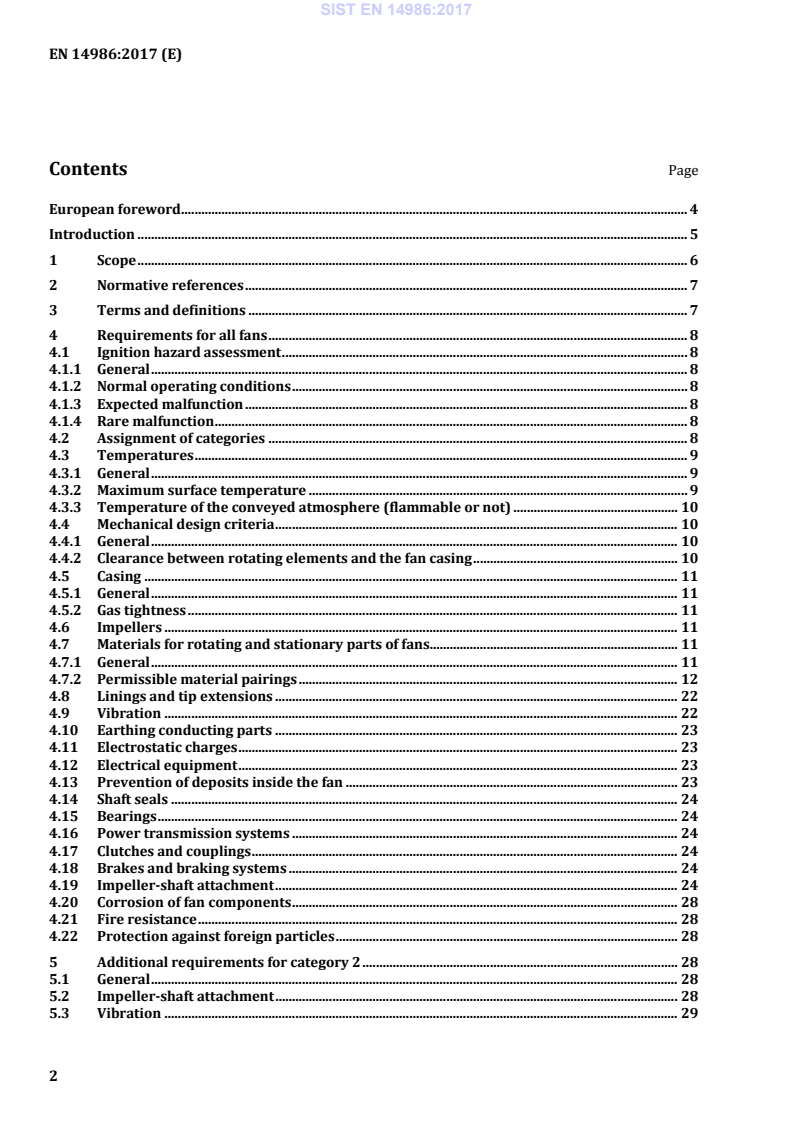
Additional requirements for category 1 G fans . 33 A.1 General . 33 A.2 Flame transmission test . 33 A.3 Pressure test . 34 Annex B (informative)
Classification of requirements for the different categories . 35 Annex C (informative)
Checklist for verification of the safety requirements and/or protective measures . 39 C.1 General . 39 C.2 All categories . 39 C.3 Category 2 – Gas and dust . 40 C.4 Category 1 – Gas . 40 Annex D (informative)
Examples of types of fans showing ignition minimizing features . 41 Annex E (normative)
List of significant hazards . 46 Annex ZA (informative)
Relationship between this European
Standard and the Essential Requirements of EU Directive 2014/34/EU. 50 Bibliography . 51
« t r °C to +60 °C, — and maximum volume fraction of 21 % oxygen content, — and an aerodynamic energy increase of less than 25 kJ/kg. NOTE 1 25 kJ/kg is equivalent to 30 kPa at inlet density of 1,2 kg/m3. This European Standard may also be helpful for the design, construction, testing and marking of fans intended for use in atmospheres outside the validity range stated above or in cases where other material pairings need to be used. In this case, the ignition risk assessment, ignition protection provided, additional testing (if necessary), manufacturer's marking, technical documentation and instructions to the user, should clearly demonstrate and indicate the equipment's suitability for the conditions the fan may encounter. This European Standard should not apply to integral fans as a part of Diesel engines, vehicles or electric motors. NOTE 2 Where undated references are used in the body of the standard the latest edition applies. SIST EN 14986:2017
or nickel base or cast iron
- Paint containing aluminium shall not be used because of the risk of thermite sparks (EN 1127–1). a f 2 Copper Carbon or stainless steel
or nickel base or cast iron
- Nickel based alloys shall contain a minimum mass fraction 60 % nickel. Nickel based alloys and nickel based steel alloys shall contain a maximum mass fraction of 4 % in total of magnesium, titanium and zirconium. All alloys shall have a homogeneous structure.
11 CuNi10Fe1.6Mn (CW352H) Any steel alloy or nickel base - This pairing can cause ignition of explosive atmospheres when rubbing occurs. This shall be included in the technical documentation provided to the user. - In category 1 or 2 fans these pairings shall be limited to fans having a motor power not exceeding 11 kW and a relative rubbing speed between stationary and rotating parts not exceeding 40 m/s, provided the clearances at all possible points of contact specified in 4.5.2 are ensured by design or checks during service. Where greater motor powers or relative rubbing speeds
- Even if these alloys are non-sparking, they can easily form hot spots due to friction and low heat conductivity
- These pairings can cause ignition of explosive atmospheres when rubbing occurs. This shall be included in the technical documentation provided to the user.
total of magnesium, titanium and zirconium. All alloys shall have a homogeneous structure. - Even if these alloys are non-sparking, they can easily form hot spots due to friction and low heat conductivity. - In category 1 or 2 fans these pairings shall be limited to fans having a motor power not exceeding 5,5 kW and a relative rubbing speed between stationary and rotating parts not exceeding 40 m/s, provided the clearances at all possible points of
contact specified in 4.5.2 are ensured by design or checks during service. Where greater motor powers or relative rubbing speeds occurs additional measures are required to control the clearance (e.g. vibration control, see 5.3).
- In this material pairing austenitic steel shall have a mass fraction of at least 16,5 % chrome (see [1], [2]), to minimize the probability of mechanically generated sparks in case of friction. - Even if this alloy generates no sparks it can in case of friction easily generate hot surfaces because of the low thermal conductivity.
8 Stainless steel Stainless steel
9 Any other steel alloy or cast iron Any other steel alloy or cast iron - Paint containing aluminium shall not be used because of the risk of thermite sparks (EN 1127–1).
10 Any steel alloy Brass CuZn37 Only category 3 allowed - Paint containing aluminium shall not be used because of the risk of thermite sparks
- Steps shall be taken to ensure that no flying rust particles or flakes can be deposited on surfaces that may come into contact with each other. - Paint containing iron oxides shall not be used because of the risk of thermite sparks (EN 1127–1). c 5 Aluminium alloy Naval brass CuZn39Sn
c f 6 Aluminium alloy Leaded brass CuZnPb3 / CuZn39Pb
a c 12 Plastic Plastic
- Plastic components shall fulfil the requirements of EN ISO 80079-36. The manufacturer shall give details of the material specification, thermal endurance and electrostatic properties in the technical documentation. Plastic materials for category 2 and category 1 fans d 17 Plastic Any steel alloy or cast iron
d 18 Plastic Stainless steel
d 13 Plastic Naval brass CuZn39Sn - Paint containing aluminium shall not be used because of the risk of thermite sparks (EN 1127–1). - Paint containing iron oxides shall not be used because of the risk of thermite sparks d 14 Plastic Aluminium alloy c d 16 Plastic Leaded brass CuZnPb3 a d SIST EN 14986:2017
or nickel based steel alloy - Nickel based alloys shall contain a minimum mass fraction 60 % nickel. Nickel based alloys and nickel based steel alloys shall contain a maximum mass fraction of 4 % in total of magnesium, titanium and zirconium. All alloys shall have a homogeneous structure. - Even if these alloys are non-sparking, they can easily form hot spots due to friction and low heat conductivity. c d - In fans plastic or rubber can be used to produce linings, rings or contact strips, or as extension to metallic parts (e.g. a tip extension to a metallic blade), or to manufacture entirely the impeller, the casing or both. 3 Tin or lead Carbon or stainless steel
or cast iron
- Paint containing aluminium shall not be used because of the risk of thermite sparks (EN 1127–1). a b 19 Rubber or rubber coated metal Any steel alloy or cast iron or nickel base or - Nickel based alloys shall contain a minimum mass - If the impeller is rubber coated the tip speed shall be limited to 70 m/s. c e SIST EN 14986:2017
e a Use of alloys containing lead may be prohibited or limited by national or local authorities if this may not be acceptable from an environmental point of view. b The use of tin may be the only permissible combination when explosive dust is present (see below) in order to fulfil the temperature requirements given in EN 1127–1. It will melt before dangerous hot surface temperatures are reached. On the other hand, a low melting temperature may represent a risk to touch underlying materials. c Aluminium alloys containing approximately 12 % silicon e.g. silumin are appropriate from an anti-sparking and corrosion viewpoint because the alloy is brittle and breaks on contact and thus prevents rubbing. d Where plastic is chosen, it should be noted that not all grades are automatically permissible, as they have a low heat conductivity leading relatively easily to hot surfaces. It should be noted that the mechanical properties of plastic may limit its use for impellers (see 4.12). e Rubbers may be natural or synthetic. The minimum thickness of the rubber layer shall be in accordance with Table 3. f Naval brass is sometimes designated CuZn38Sn1 as well as CuZn39Sn. SIST EN 14986:2017
a b 3 Cast iron Tin or lead a b 2 Nickel or nickel alloy Tin or lead Nickel based alloys shall contain a minimum mass fraction 60 % nickel. Nickel based alloys and nickel based steel alloys shall contain a maximum mass fraction of 4 % in total of magnesium, titanium and zirconium. All alloys shall have a homogeneous structure. NOTE 1 Even if these alloys are non-sparking, they can easily form hot spots due to friction and low heat conductivity.
a b 4 Aluminium alloys Tin or lead - Steps shall be taken to ensure that no flying rust particles or flakes can be deposited on surfaces that may come into contact with each other - Paint containing iron oxides shall not be used because of the risk of thermite sparks (EN 1127–1)
a b c SIST EN 14986:2017
- Plastic components shall fulfil the requirements of EN ISO 80079-36. The manufacturer shall give details of the material specification, thermal endurance and electrostatic properties in the technical documentation. d e
Plastic materials for category 2 and category 1 fans shall withstand short-term exposure to flames without burning, when tested according to 4.22.
- If the impeller is rubber coated the tip speed shall be limited to 70 m/s.
...