

EN 14767:2005
(Main)LPG equipment and accessories - Transportable refillable composite cylinders for Liquefied Petroleum Gas (LPG) - Periodic inspection
- Abstract
This European Standard specifies periodic inspection intervals, procedures for inspection, inspection and testing for transportable refillable composite LPG cylinders with a water capacity from 0,5 l up to and including 150 l.
This European Standard is applicable to cylinders that comprise a liner of metallic material (welded or seamless), or non-metallic material, (or a mixture thereof), reinforced by a wound composite consisting of fibres of glass or carbon or aramid (or a mixture thereof) embedded in a matrix.
This European Standard is also applicable to composite cylinders without liners.
- Status
- Withdrawn
- Publication Date
- 06-Dec-2005
- Withdrawal Date
- 26-Feb-2008
- Technical Committee
- CEN/TC 286 - Liquefied petroleum gas equipment and accessories
- Current Stage
- 9960 - Withdrawal effective - Withdrawal
- Start Date
- 27-Feb-2008
- Completion Date
- 27-Feb-2008

Relations
- Effective Date
- 22-Dec-2008
- Effective Date
- 15-Feb-2012
Get Certified
Connect with accredited certification bodies for this standard

Institut za varilstvo d.o.o. (Welding Institute)
Slovenia's leading welding institute since 1952. ISO 3834, EN 1090, pressure equipment certification, NDT personnel, welder qualification. Only IIW Au
Sponsored listings
Frequently Asked Questions
EN 14767:2005 is a standard published by the European Committee for Standardization (CEN). Its full title is "LPG equipment and accessories - Transportable refillable composite cylinders for Liquefied Petroleum Gas (LPG) - Periodic inspection". This standard covers: This European Standard specifies periodic inspection intervals, procedures for inspection, inspection and testing for transportable refillable composite LPG cylinders with a water capacity from 0,5 l up to and including 150 l. This European Standard is applicable to cylinders that comprise a liner of metallic material (welded or seamless), or non-metallic material, (or a mixture thereof), reinforced by a wound composite consisting of fibres of glass or carbon or aramid (or a mixture thereof) embedded in a matrix. This European Standard is also applicable to composite cylinders without liners.
This European Standard specifies periodic inspection intervals, procedures for inspection, inspection and testing for transportable refillable composite LPG cylinders with a water capacity from 0,5 l up to and including 150 l. This European Standard is applicable to cylinders that comprise a liner of metallic material (welded or seamless), or non-metallic material, (or a mixture thereof), reinforced by a wound composite consisting of fibres of glass or carbon or aramid (or a mixture thereof) embedded in a matrix. This European Standard is also applicable to composite cylinders without liners.
EN 14767:2005 is classified under the following ICS (International Classification for Standards) categories: 23.020.30 - Pressure vessels, gas cylinders; 23.020.35 - Gas cylinders. The ICS classification helps identify the subject area and facilitates finding related standards.
EN 14767:2005 has the following relationships with other standards: It is inter standard links to EN 1440:2008, EN ISO 4210-1:2014. Understanding these relationships helps ensure you are using the most current and applicable version of the standard.
EN 14767:2005 is associated with the following European legislation: EU Directives/Regulations: 94/55/EC, 96/49/EC, 96/86/EC, 96/87/EC; Standardization Mandates: M/086. When a standard is cited in the Official Journal of the European Union, products manufactured in conformity with it benefit from a presumption of conformity with the essential requirements of the corresponding EU directive or regulation.
EN 14767:2005 is available in PDF format for immediate download after purchase. The document can be added to your cart and obtained through the secure checkout process. Digital delivery ensures instant access to the complete standard document.
Standards Content (Sample)
2003-01.Slovenski inštitut za standardizacijo. Razmnoževanje celote ali delov tega standarda ni dovoljeno.LPG equipment and accessories - Transportable refillable composite cylinders for Liquefied Petroleum Gas (LPG) - Periodic inspectionÉquipements pour GPL et leurs accessoires - Bouteilles en matériau composite, transportables et rechargeables pour gaz de pétrole liquéfié (GPL) - Contrôle périodiqueFlüssiggas-Geräte und Ausrüstungsteile - Ortsbewegliche wiederbefüllbare Flaschen aus Verbundwerkstoffen für Flüssiggas (LPG) - Wiederkehrende PrüfungTa slovenski standard je istoveten z:EN 14767:2005SIST EN 14767:2006en23.020.30ICS:SLOVENSKI
STANDARDSIST EN 14767:200601-marec-2006
EUROPEAN STANDARDNORME EUROPÉENNEEUROPÄISCHE NORMEN 14767December 2005ICS 23.020.30 English VersionLPG equipment and accessories - Transportable refillablecomposite cylinders for Liquefied Petroleum Gas (LPG) -Periodic inspectionÉquipements pour GPL et leurs accessoires - Bouteilles enmatériau composite, transportables et rechargeables pourgaz de pétrole liquéfié (GPL) - Contrôle périodiqueFlüssiggas-Geräte und Ausrüstungsteile - Ortsbeweglichewiederbefüllbare Flaschen aus Verbundwerkstoffen fürFlüssiggas (LPG) - Wiederkehrende PrüfungThis European Standard was approved by CEN on 27 October 2005.CEN members are bound to comply with the CEN/CENELEC Internal Regulations which stipulate the conditions for giving this EuropeanStandard the status of a national standard without any alteration. Up-to-date lists and bibliographical references concerning such nationalstandards may be obtained on application to the Central Secretariat or to any CEN member.This European Standard exists in three official versions (English, French, German). A version in any other language made by translationunder the responsibility of a CEN member into its own language and notified to the Central Secretariat has the same status as the officialversions.CEN members are the national standards bodies of Austria, Belgium, Cyprus, Czech Republic, Denmark, Estonia, Finland, France,Germany, Greece, Hungary, Iceland, Ireland, Italy, Latvia, Lithuania, Luxembourg, Malta, Netherlands, Norway, Poland, Portugal, Slovakia,Slovenia, Spain, Sweden, Switzerland and United Kingdom.EUROPEAN COMMITTEE FOR STANDARDIZATIONCOMITÉ EUROPÉEN DE NORMALISATIONEUROPÄISCHES KOMITEE FÜR NORMUNGManagement Centre: rue de Stassart, 36
B-1050 Brussels© 2005 CENAll rights of exploitation in any form and by any means reservedworldwide for CEN national Members.Ref. No. EN 14767:2005: E
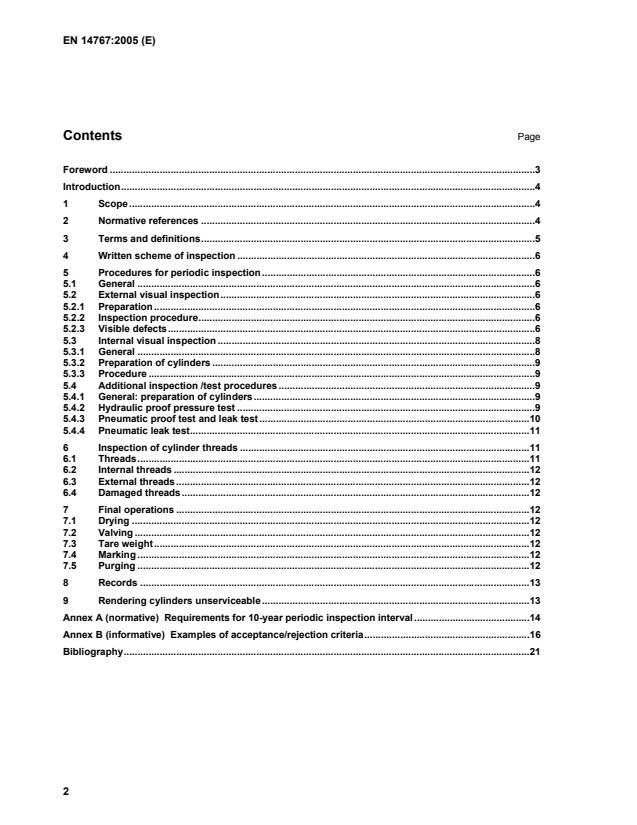
Requirements for 10-year periodic inspection interval.14 Annex B (informative)
Examples of acceptance/rejection criteria.16 Bibliography.21
3 Terms and definitions For the purpose of this European Standard, the following terms and definitions apply. 3.1 competent body person or corporate body defined by the national authority, which by a combination of appropriate qualification, training, experience and resources is able to make objective judgements on the subject 3.2 competent person person who by a combination of training, experience and supervision is able to make objective judgements on the subject 3.3 periodic inspection activities carried out at defined intervals, such as examining, measuring, testing or gauging the characteristics of a cylinder and comparing these with specified requirements as defined in EN 14427 and marking to attest conformity 3.4 LPG (liquefied petroleum gas) mixture of predominantly butane or propane with traces of other hydrocarbon gases classified in accordance with UN number 1965, hydrocarbon gases mixture, liquefied, NOS or UN number 1075, petroleum gases, liquefied NOTE In some countries, UN number 1011, 1978 may also be designated LPG. 3.5 tare weight sum of the mass of the empty cylinder, the mass of the valve including a dip tube where fitted, and the mass of all other parts that are permanently attached to the cylinder when it is being filled, e.g. fixed valve guard 3.6 casing permanently attached sleeve covering part of or the whole of the pressure containing envelope usually incorporating a foot ring and a shroud NOTE Permanently attached means that the casing cannot be removed during service without being destroyed, or by using special tools.
For transparent composite cylinders, the internal visual inspection may be made from outside. Periodic inspections/tests shall be carried out under the responsibility of a body approved by a competent authority. 5.2 External visual inspection 5.2.1 Preparation If required the cylinder shall be cleaned and have all labels, tar oil or other foreign matter removed from its external surface e.g. by water jet cleaning, chemical cleaning or other suitable methods. Care shall be taken to avoid damaging the cylinder. Cylinders rejected shall be segregated for rendering unserviceable. NOTE In some countries, render unserviceable means scrapping. 5.2.2 Inspection procedure The entire surface of the cylinder shall be inspected for: a) Cuts, gouges, bulges, cracks or de-laminations, applying the criteria for acceptance/rejection in 5.2.3. b) Other defects e.g. depressed bung or fire damage applying to the criteria for acceptance/rejection in
Table 1. c) Integrity of all permanent attachments. d) The integrity of the mandatory permanent marking. Any cylinder rejected by the competent person shall be segregated for scrapping. 5.2.3 Visible defects The owner (or his authorized representative) shall provide to the filler acceptance/rejection criteria for physical and material defects and heat damage on the cylinder/casing.
The size of this defect is recorded.
If the defects of the cylinders are different sizes, the size of the smaller defect shall be recorded; two cylinders shall be submitted to the burst test (see EN 14427:2004, 5.2.5) and two cylinders shall be submitted to the pressure cycle test (see EN 14427:2004, 5.2.6); if the cylinders pass the tests, the defect is acceptable.
The rejection limit can be defined by the size of that defect; when all rejection criteria have been established for a design of cylinder as defined in EN 14427:2004, A.2.1, Table 1 shall be completed by the owner/manufacturer of the cylinder.
Annex B shows an example of a completed table.
Abrasion damage caused by wearing, grinding or rubbing material away by friction. Cuts or gouges caused by contact with sharp objects in such a way as to cut into the composite, reducing its thickness at that point. See 5.2.3 De-lamination and
impact damage Inter-laminar de-lamination where there is a separation of layers of stran
...