


EN 13952:2017
(Main)LPG equipment and accessories - Filling operations for LPG cylinders
LPG equipment and accessories - Filling operations for LPG cylinders
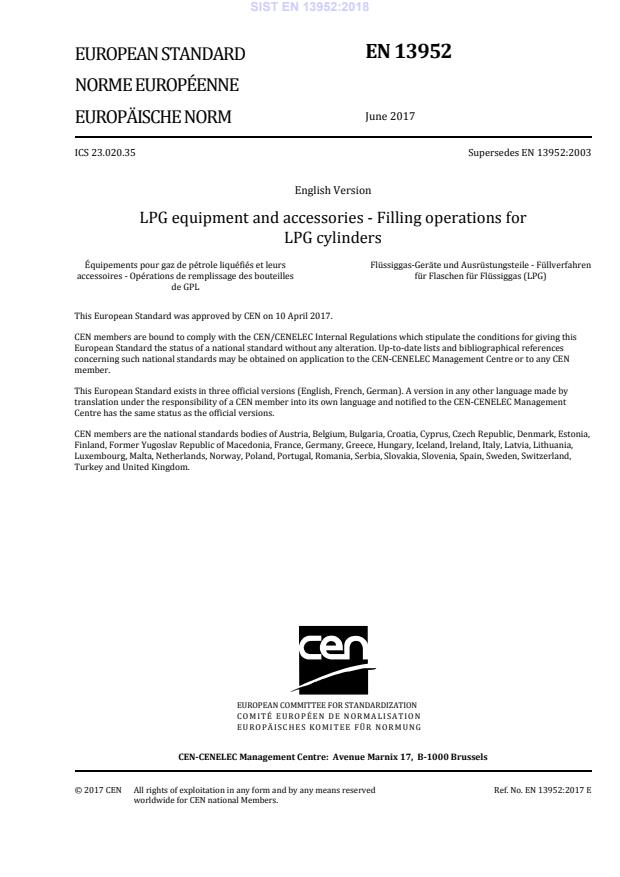
This European Standard specifies the requirements for the operation of a cylinder filling plant to ensure that filling of transportable refillable LPG cylinders is carried out in a controlled and safe manner.
This document is applicable to the filling of cylinders complying with RID/ADR [10][11] (including pi marked cylinders) and also to existing non RID/ADR cylinder populations.
This document is applicable to the following:
- welded and brazed steel LPG cylinders with a specified minimum wall thickness (see EN 1442 [1] and EN 12807 [2] or an equivalent standard);
- welded steel LPG cylinders without specified minimum wall thickness (see EN 14140 [4] or an equivalent standard);
- welded aluminium LPG cylinders (see EN 13110 [3] or an equivalent standard);
- composite LPG cylinders (see EN 14427 [5] or an equivalent standard); and
- over-moulded cylinders (OMC).
This document does not cover the requirements for filling LPG cylinders that are designed and equipped for filling by the user.
Flüssiggas-Geräte und Ausrüstungsteile - Füllverfahren für Flaschen für Flüssiggas (LPG)
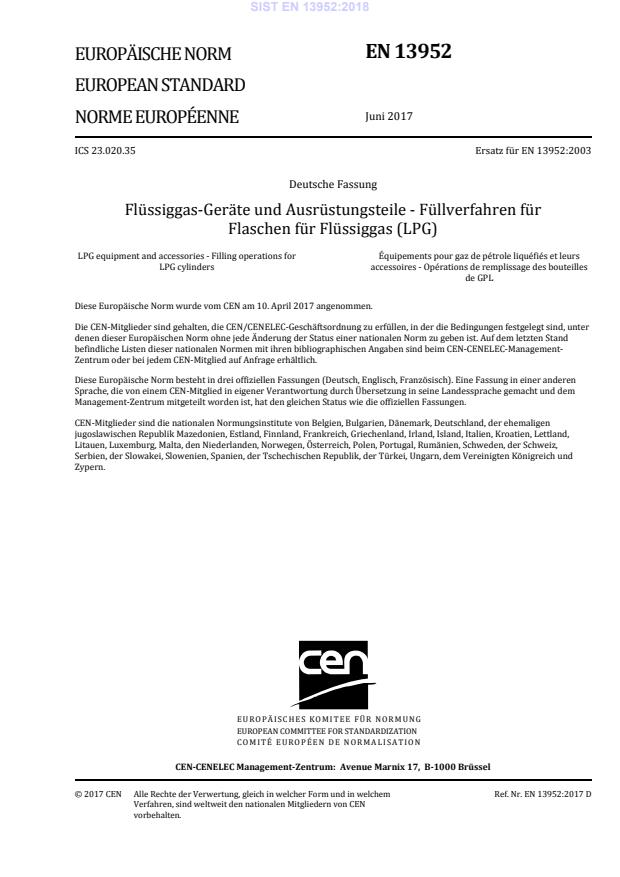
Diese Europäische Norm legt die Anforderungen an den Betrieb einer Füllanlage für Gasflaschen fest, um das kontrollierte und sichere Füllen von ortsbeweglichen, wiederbefüllbaren Flaschen für Flüssiggas (LPG) sicherzustellen.
Dieses Dokument ist zur Anwendung für das Füllen von Flaschen nach RID /ADR [10][11] (einschließlich Flaschen mit Pi-Kennzeichnung) vorgesehen, sowie für vorhandene Flaschenbestände, die nicht RID/ADR entsprechen.
Dieses Dokument gilt für Folgendes:
- geschweißte und hartgelötete Flaschen aus Stahl für Flüssiggas (LPG) mit festgelegter Mindestwand-dicke (siehe EN 1442 [1] und EN 12807 [2] oder gleichwertige Norm);
- geschweißte Flaschen aus Stahl für Flüssiggas (LPG) ohne festgelegte Mindestwanddicke (siehe EN 14140 [4] oder gleichwertige Norm);
- geschweißte Flaschen aus Aluminium für Flüssiggas (LPG) (siehe EN 13110 [3] oder gleichwertige Norm);
- Flaschen aus Verbundwerkstoff für Flüssiggas (LPG) (siehe EN 14427 [5] oder gleichwertige Norm); und
- umformte Flasche (OMC).
Dieses Dokument enthält keine Anforderungen für das Füllen von Flaschen für Flüssiggas (LPG), die für das Füllen durch den Benutzer ausgelegt und ausgerüstet sind.
Équipements pour gaz de pétrole liquéfiés et leurs accessoires - Opérations de remplissage des bouteilles de GPL
La présente Norme européenne spécifie les exigences concernant les activités d'un centre emplisseur de bouteilles pour s’assurer que le remplissage des bouteilles transportables et rechargeables pour GPL est accompli de façon contrôlée et en toute sécurité.
Le présent document est applicable au remplissage des bouteilles conformes aux RID/ADR [10][11] (y compris les bouteilles comportant un marquage pi) ainsi qu’aux familles de bouteilles existantes non conformes aux RID/ADR
Le présent document s'applique aux éléments suivants :
- bouteilles pour GPL, en acier soudé et brasé, avec une épaisseur minimale de paroi définie (voir EN 1442 [1] et EN 12807 [2] ou une norme équivalente) ;
- bouteilles pour GPL, en acier soudé, sans épaisseur minimale de paroi définie (voir EN 14140 [4] ou une norme équivalente) ;
- bouteilles pour GPL en aluminium soudé (voir EN 13110 [3] ou une norme équivalente) ;
- bouteilles pour GPL en matériau composite (voir EN 14427 [5] ou une norme équivalente) et
- bouteilles surmoulées (OMC).
Le présent document ne couvre pas les exigences concernant les bouteilles pour GPL conçues et équipées pour être remplies par l'utilisateur.
Oprema in pribor za utekočinjeni naftni plin (UNP) - Postopek polnjenja pri jeklenkah za UNP
Ta osnutek evropskega standarda določa zahteve za delovanje obrata za polnjenje jeklenk zaradi zagotavljanja, da je polnjenje prenosnih jeklenk LPG, ki jih je mogoče znova napolniti, izvedeno na nadziran in varen način.
Ta osnutek evropskega standarda ne obsega zahtev za polnjenje jeklenk LPG, ki so zasnovane in opremljene za polnjenje s strani uporabnika.
Ta osnutek evropskega standarda ne obsega zahtev za polnjenje posod LPG na vozilih.
Ta osnutek evropskega standarda se uporablja za naslednje:
– varjene in trdo spajkane jeklene jeklenke LPG z določeno minimalno debelino stene (glejte EN 1442 [2] in EN 12807 [3] ali enakovreden standard);
– varjene jeklene jeklenke LPG brez določene minimalne debeline stene (glejte EN 14140 [4] ali enakovreden standard);
– varjene aluminijaste jeklenke LPG (glejte EN 13110 [5] ali enakovreden standard); in
– kompozitne jeklenke LPG (glejte EN 14427 [6] ali enakovreden standard).
Ta osnutek evropskega standarda je predviden za uporabo pri polnjenju jeklenk v skladu z določbami RID/ADR [7][8] (vključno z jeklenkami z oznako pi) in tudi za obstoječe jeklenke, ki niso v skladu z določbami RID/ADR.
General Information
Relations
Overview
EN 13952:2017 is a CEN (European) standard that specifies requirements for the safe and controlled operation of LPG cylinder filling plants. It applies to the filling of transportable refillable LPG cylinders (including RID/ADR and pi‑marked cylinders) and covers welded steel, brazed steel, aluminium, composite, and over‑moulded cylinders. The standard focuses on operational requirements - organization, training, filling equipment, filling operations, maintenance and safety recommendations - to ensure cylinders are filled, handled and dispatched safely and in compliance with transport regulations.
Key topics and technical requirements
- Scope and applicability: Applies to a wide range of cylinder types (EN 1442, EN 12807, EN 13110, EN 14140, EN 14427 or equivalent) but excludes cylinders intended to be filled by the end user.
- Organization and competence: Filling plants must be run by an operator who is a competent person. Documented organizational charts, work and emergency procedures, job descriptions and written work instructions are required.
- Training: Mandatory training programmes for operatives covering product hazards, emergency drills, filling procedures (EN 1439), rejection limits, PPE, manual handling and equipment operation. Training records must be retained.
- LPG quality: LPG supplied for filling must meet national/specification requirements and be compatible with cylinder design; high‑quality LPG complying with ISO 9162 is recommended where extended inspection periods apply.
- Filling equipment: Equipment must be suitable for hazardous areas (see EN 60079 series). Special measures are required to control electrostatic risk for low‑conductivity cylinders (e.g., earthing, reduced jet speed, de‑ionizers); electrostatic discharge energies above ~0.2 mJ can be hazardous.
- Filling operations: Every cylinder must be checked (EN 1439) prior to filling; air must be removed before filling; filling tolerances and safe filling quantities (ADR/RID packing instruction P200) must be observed; procedures for detecting and removing overfills, fitting sealing/dust caps and preventing damaged cylinders entering the market are required.
- Checks and maintenance: Shift‑start checks for scales and leak detection equipment, regular maintenance per manufacturer instructions, documented maintenance schedules and annual audits/records.
Applications and users
- LPG filling plant operators and managers
- LPG distributors and cylinder refill stations
- Cylinder manufacturers and periodic inspection facilities
- Health & safety officers, auditors and competent authorities
- Designers of filling equipment and hazardous‑area installations
EN 13952:2017 is used to develop work instructions, training programs, maintenance schedules, compliance documentation and risk assessments for LPG cylinder filling operations.
Related standards
- EN 1439 (cylinder checking during filling)
- EN 1442, EN 12807, EN 13110, EN 14140, EN 14427 (cylinder design)
- EN/ISO 14245, EN/ISO 15995, EN 16119 (valves and caps)
- EN 60079‑0 / EN 60079‑10 / EN 60079‑14 (explosive atmospheres)
- ISO 9162 (LPG quality) and CEN/TS 16765 (environmental considerations)
- RID / ADR (transport regulations and packing instruction P200)
Standards Content (Sample)
2003-01.Slovenski inštitut za standardizacijo. Razmnoževanje celote ali delov tega standarda ni dovoljeno.Flüssiggas-Geräte und Ausrüstungsteile - Füllverfahren für Flaschen für Flüssiggas (LPG)Équipements pour gaz de pétrole liquéfiés et leurs accessoires - Procédures de remplissage des bouteilles de GPLLPG equipment and accessories - Filling procedures for LPG cylinders23.020.35Plinske jeklenkeGas cylindersICS:Ta slovenski standard je istoveten z:EN 13952:2017SIST EN 13952:2018en,fr,de01-maj-2018SIST EN 13952:2018SLOVENSKI
STANDARDSIST EN 13952:2003/A1:2006SIST EN 13952:20031DGRPHãþD
EUROPEAN STANDARD NORME EUROPÉENNE EUROPÄISCHE NORM
EN 13952
June
t r s y ICS
t uä r t rä u w Supersedes EN
s u { w tã t r r uEnglish Version
LPG equipment and accessories æ Filling operations for LPG cylinders Équipements pour gaz de pétrole liquéfiés et leurs accessoires æ Opérations de remplissage des bouteilles de GPL
FlüssiggasæGeräte und Ausrüstungsteile æ Füllverfahren This European Standard was approved by CEN on
s r April
t r s yä
egulations which stipulate the conditions for giving this European Standard the status of a national standard without any alterationä Upætoædate lists and bibliographical references concerning such national standards may be obtained on application to the CENæCENELEC Management Centre or to any CEN memberä
translation under the responsibility of a CEN member into its own language and notified to the CENæCENELEC Management Centre has the same status as the official versionsä
CEN members are the national standards bodies of Austriaá Belgiumá Bulgariaá Croatiaá Cyprusá Czech Republicá Denmarká Estoniaá Finlandá Former Yugoslav Republic of Macedoniaá Franceá Germanyá Greeceá Hungaryá Icelandá Irelandá Italyá Latviaá Lithuaniaá Luxembourgá Maltaá Netherlandsá Norwayá Polandá Portugalá Romaniaá Serbiaá Slovakiaá Sloveniaá Spainá Swedená Switzerlandá Turkey and United Kingdomä
EUROPEAN COMMITTEE FOR STANDARDIZATION COMITÉ EUROPÉEN DE NORMALISATION EUROPÄISCHES KOMITEE FÜR NORMUNG
CEN-CENELEC Management Centre:
Avenue Marnix 17,
B-1000 Brussels
t r s y CEN All rights of exploitation in any form and by any means reserved worldwide for CEN national Membersä Refä Noä EN
s u { w tã t r s y ESIST EN 13952:2018
Safety recommendations . 10 Bibliography . 11
...
2003-01.Slovenski inštitut za standardizacijo. Razmnoževanje celote ali delov tega standarda ni dovoljeno.Flüssiggas-Geräte und Ausrüstungsteile - Füllverfahren für Flaschen für Flüssiggas (LPG)Équipements pour gaz de pétrole liquéfiés et leurs accessoires - Procédures de remplissage des bouteilles de GPLLPG equipment and accessories - Filling procedures for LPG cylinders23.020.35Plinske jeklenkeGas cylindersICS:Ta slovenski standard je istoveten z:EN 13952:2017SIST EN 13952:2018en,fr,de01-maj-2018SIST EN 13952:2018SLOVENSKI
STANDARDSIST EN 13952:2003/A1:2006SIST EN 13952:20031DGRPHãþD
EUROPÄISCHE NORM EUROPEAN STANDARD NORME EUROPÉENNE
EN 13952
Juni
t r s y ICS
t uä r t rä u w Ersatz für EN
s u { w tã t r r uDeutsche Fassung
FlüssiggasæGeräte und Ausrüstungsteile æ Füllverfahren für LPG equipment and accessories æ Filling operations for LPG cylinders
Équipements pour gaz de pétrole liquéfiés et leurs accessoires æ Opérations de remplissage des bouteilles de GPL Diese Europäische Norm wurde vom CEN am
s rä April
t r s y angenommenä
ung zu erfüllená in der die Bedingungen festgelegt sindá unter denen dieser Europäischen Norm ohne jede Änderung der Status einer nationalen Norm zu geben istä Auf dem letzten Stand befindliche Listen dieser nationalen Normen mit ihren bibliographischen Angaben sind beim CENæCENELECæManagementæZentrum oder bei jedem CENæMitglied auf Anfrage erhältlichä
Spracheá die von einem CENæMitglied in eigener Verantwortung durch Übersetzung in seine Landessprache gemacht und dem ManagementæZentrum mitgeteilt worden istá hat den gleichen Status wie die offiziellen Fassungenä
CENæMitglieder sind die nationalen Normungsinstitute von Belgiená Bulgariená Dänemarká Deutschlandá der ehemaligen jugoslawischen Republik Mazedoniená Estlandá Finnlandá Frankreichá Griechenlandá Irlandá Islandá Italiená Kroatiená Lettlandá Litauená Luxemburgá Maltaá den Niederlandená Norwegená Österreichá Polená Portugalá Rumäniená Schwedená der Schweizá Serbiená der Slowakeiá Sloweniená Spaniená der Tschechischen Republiká der Türkeiá Ungarná dem Vereinigten Königreich und Zypernä
EUROPÄISCHES KOMITEE FÜR NORMUNG EUROPEAN COMMITTEE FOR STANDARDIZATION
COMITÉ EUROPÉEN DE NORMALISATION
CEN-CENELEC Management-Zentrum:
Avenue Marnix 17,
B-1000 Brüssel
t r s y CEN Alle Rechte der Verwertungá gleich in welcher Form und in welchem Verfahrená sind weltweit den nationalen Mitgliedern von CEN vorbehaltenä Refä Nrä EN
s u { w tã t r s y DSIST EN 13952:2018
Seite Europäisches Vorwort . 3 Einleitung . 4 1 Anwendungsbereich . 5 2 Normative Verweisungen . 5 3 Begriffe . 5 4 Allgemeines . 6 4.1 Organisation . 6 4.2 Ausbildung . 7 4.3 Qualität des Flüssiggases (LPG) . 7 5 Fülleinrichtung . 7 6 Füllarbeitsgänge . 8 7 Wartung des Füllsystems . 8
(informativ)
Sicherheitsempfehlungen . 9 Anhang ALiteraturhinweise . 10
...
Frequently Asked Questions
EN 13952:2017 is a standard published by the European Committee for Standardization (CEN). Its full title is "LPG equipment and accessories - Filling operations for LPG cylinders". This standard covers: This European Standard specifies the requirements for the operation of a cylinder filling plant to ensure that filling of transportable refillable LPG cylinders is carried out in a controlled and safe manner. This document is applicable to the filling of cylinders complying with RID/ADR [10][11] (including pi marked cylinders) and also to existing non RID/ADR cylinder populations. This document is applicable to the following: - welded and brazed steel LPG cylinders with a specified minimum wall thickness (see EN 1442 [1] and EN 12807 [2] or an equivalent standard); - welded steel LPG cylinders without specified minimum wall thickness (see EN 14140 [4] or an equivalent standard); - welded aluminium LPG cylinders (see EN 13110 [3] or an equivalent standard); - composite LPG cylinders (see EN 14427 [5] or an equivalent standard); and - over-moulded cylinders (OMC). This document does not cover the requirements for filling LPG cylinders that are designed and equipped for filling by the user.
This European Standard specifies the requirements for the operation of a cylinder filling plant to ensure that filling of transportable refillable LPG cylinders is carried out in a controlled and safe manner. This document is applicable to the filling of cylinders complying with RID/ADR [10][11] (including pi marked cylinders) and also to existing non RID/ADR cylinder populations. This document is applicable to the following: - welded and brazed steel LPG cylinders with a specified minimum wall thickness (see EN 1442 [1] and EN 12807 [2] or an equivalent standard); - welded steel LPG cylinders without specified minimum wall thickness (see EN 14140 [4] or an equivalent standard); - welded aluminium LPG cylinders (see EN 13110 [3] or an equivalent standard); - composite LPG cylinders (see EN 14427 [5] or an equivalent standard); and - over-moulded cylinders (OMC). This document does not cover the requirements for filling LPG cylinders that are designed and equipped for filling by the user.
EN 13952:2017 is classified under the following ICS (International Classification for Standards) categories: 23.020.30 - Pressure vessels, gas cylinders; 23.020.35 - Gas cylinders. The ICS classification helps identify the subject area and facilitates finding related standards.
EN 13952:2017 has the following relationships with other standards: It is inter standard links to EN 13952:2003/A1:2006, EN 13952:2003. Understanding these relationships helps ensure you are using the most current and applicable version of the standard.
EN 13952:2017 is associated with the following European legislation: EU Directives/Regulations: 2008/68/EC; Standardization Mandates: M/086. When a standard is cited in the Official Journal of the European Union, products manufactured in conformity with it benefit from a presumption of conformity with the essential requirements of the corresponding EU directive or regulation.
You can purchase EN 13952:2017 directly from iTeh Standards. The document is available in PDF format and is delivered instantly after payment. Add the standard to your cart and complete the secure checkout process. iTeh Standards is an authorized distributor of CEN standards.
Die EN 13952:2017, die sich mit den Anforderungen für das Befüllen von LPG-Zylindern befasst, stellt einen bedeutenden Teil der Sicherheit und Effizienz in der LPG-Branche dar. Der Anwendungsbereich dieser europäischen Norm ist klar definiert und umfasst die Betriebsanforderungen, die sicherstellen, dass das Befüllen von transportablen, nachfüllbaren LPG-Zylindern unter kontrollierten und sicheren Bedingungen erfolgt. Ein wesentlicher Stärke der Norm ist ihre umfassende Anwendbarkeit. Sie gilt nicht nur für Zylinder, die den RID/ADR-Vorschriften entsprechen, sondern auch für bestehende Zylinderpopulationen, die nicht den RID/ADR-Anforderungen unterliegen. Dies zeigt die Flexibilität und die breite Relevanz der EN 13952:2017 in verschiedenen Anwendungen. Die Norm beschreibt spezifische Vorgaben für verschiedene Arten von LPG-Zylindern, einschließlich geschweißter und verlöteter Stahlzylinder, Aluminiumzylinder, Verbundzylinder sowie überformte Zylinder. Die klare Abgrenzung der Anforderungen für jede Zylinderart ermöglicht eine bessere Anpassung an die jeweiligen Sicherheitsstandards und fördert die Einhaltung der erforderlichen Vorgaben in der Praxis. Ein weiterer positiver Aspekt ist, dass die Norm nicht nur auf die Sicherheit beim Befüllen eingeht, sondern auch die Effizienz der Befülloperationen fördern will. Durch die Festlegung von Kontrollen und Verfahren wird sichergestellt, dass die Befüllung nicht nur sicher, sondern auch effektiv durchgeführt wird. Die Relevanz der EN 13952:2017 zeigt sich zudem in ihrer Fähigkeit, einen umfassenden Rahmen für die Schulung und Zertifizierung von Personal in Befüllanlagen bereitzustellen. Dadurch wird eine einheitliche Anwendung der Sicherheitsstandards in der gesamten Branche gewährleistet. Insgesamt ist die EN 13952:2017 eine unverzichtbare Norm für die LPG-Branche, die sowohl die Sicherheit als auch die Effizienz bei Befülloperationen von LPG-Zylindern unterstützt. Sie erfüllt die Anforderungen der Industrie und trägt entscheidend zur Wahrung von Standards im Bereich der LPG-Ausrüstung und -Zubehör bei.
EN 13952:2017は、LPG装置およびアクセサリーに関する標準であり、特にLPGシリンダーの充填作業に関連した要件を明確に定めています。この標準の範囲は、移動可能な再充填可能なLPGシリンダーの充填が安全かつ制御された方法で行われることを確保するためのものであり、充填プラントの運営に関する重要なガイドラインを提供します。 この文書は、RID/ADRに準拠したシリンダー(ピマークシリンダーを含む)および既存の非RID/ADRシリンダーに適用される点が特筆すべき特徴です。具体的には、厚さが指定された溶接またはブレージングされたスチールLPGシリンダー、厚さが指定されていない溶接スチールLPGシリンダー、溶接されたアルミニウムLPGシリンダー、複合LPGシリンダー、ならびにオーバーモールドシリンダー(OMC)など、幅広いタイプのシリンダーに適用されるため、多様なニーズに応えられる適応性があります。 EN 13952:2017は、安全性と効率性を両立させる充填プロセスを確立するための基準を提供し、業界全体でのLPGの取り扱いにおける一貫性を高める役割を果たしています。このような強力な基準は、運用者が確実にリスクを管理しながら、料金を支払う顧客に対しても信頼性のあるサービスを提供することを可能にします。 さらに、この標準は、ユーザーによって充填されるために設計され装備されているLPGシリンダーの充填要件には適用されないことを明示し、専門の運用環境における明確な基準を設定しています。これにより、製品の安全性と効果的な充填作業を保証し、LPG業界における信頼性を向上させるものといえます。
표준 EN 13952:2017은 LPG 장비 및 액세서리의 안전하고 통제된 충전 작업을 위한 기준을 제공하는 유럽 표준입니다. 이 표준은 이동 가능한 재충전 가능 LPG 실린더의 충전 공정에 필요한 요건을 명시하여, 충전 공장이 안전하고 체계적으로 운영될 수 있도록 합니다. 이 문서는 RID/ADR에 따라 규정된 실린더를 포함한 다양한 실린더 유형에 적용 가능하며, 기존의 비 RID/ADR 실린더에 대해서도 해당됩니다. 특히, 다음과 같은 실린더 유형에 대한 요건을 다루고 있습니다: - 주조 및 모재의 두께가 규정된 강철 LPG 실린더 - 최소 벽 두께가 명시되지 않은 용접 강철 LPG 실린더 - 용접된 알루미늄 LPG 실린더 - 복합 LPG 실린더 - 오버 몰딩된 실린더(OMC) 이 표준의 장점 중 하나는 다양한 유형의 실린더에 대한 적용성을 통해, 다양한 충전 요구 사항을 충족할 수 있다는 점입니다. 이는 LPG 실린더 충전 공정의 안전성을 높이는 데 기여합니다. 또한, EN 13952는 자동차 및 산업 섹터에서 사용되는 LPG 실린더에 대해 특별히 강조하여, 환경과 소비자의 안전을 최우선으로 고려하고 있습니다. 이로 인해, 특히 충전소 및 관련 산업에서의 표준 준수는 증가된 생산성과 신뢰성을 가져다줄 수 있습니다. 마지막으로, 이 문서에서는 사용자가 충전할 수 있도록 설계된 LPG 실린더는 별도로 다루지 않음을 명시하고 있어, 비전문가가 충전하는 경우 발생할 수 있는 위험을 줄일 수 있습니다. 이러한 점에서 EN 13952:2017 표준은 LPG 충전 작업의 안전과 품질을 보장하는 데 매우 중요한 역할을 합니다.
La norme EN 13952:2017 est un document fondamental pour garantir des opérations de remplissage sécurisées et contrôlées des cylindres de GPL transportables et rechargeables. Son champ d'application est clairement défini, englobant non seulement les cylindres conformes aux réglementations RID/ADR, mais également les populations de cylindres non conformes à ces normes, ce qui témoigne de sa large pertinence dans le domaine du remplissage de GPL. Les forces de cette norme résident dans ses exigences précises qui visent à standardiser les pratiques au sein des usines de remplissage. En abordant différentes catégories de cylindres, qu'ils soient en acier soudé, en aluminium, en matériaux composites ou en étant dotés de moulages, la norme assure une harmonisation des procédures à suivre. Cette approche facilite non seulement la sécurité des opérations, mais également la compatibilité entre divers types de cylindres utilisés dans l'industrie. En outre, la norme EN 13952:2017 prend en compte les cylindres à parois épaisses spécifiées ainsi que ceux sans épaisseur minimale déterminée, apportant ainsi une flexibilité adaptée aux divers produits présents sur le marché. Cela souligne son importance pour les acteurs du secteur qui cherchent à répondre aux multiples exigences légales et aux standards de sécurité. Enfin, la non-inclusion des exigences pour les cylindres qui sont conçus pour être remplis par l'utilisateur montre une volonté de se concentrer sur les opérations professionnelles et industrielles de remplissage, garantissant ainsi une élévation du niveau de sécurité et de contrôle. Dans l'ensemble, EN 13952:2017 représente une avancée significative pour l'industrie du GPL, établissant une norme essentielle pour les exploitants de stations de remplissage, tout en préservant la sécurité et l'efficacité opérationnelle dans le traitement des cylindres de GPL.
The standard EN 13952:2017 is a comprehensive framework that outlines the specific requirements for the operation of cylinder filling plants, focusing on the filling of transportable refillable LPG (Liquefied Petroleum Gas) cylinders. Its scope seamlessly encompasses various cylinder types, including welded and brazed steel cylinders, aluminum cylinders, composite cylinders, and over-moulded cylinders, ensuring a broad applicability across diverse filling operations. One of the key strengths of this standard is its rigorous emphasis on safety and controlled processes. By mandating adherence to established guidelines, EN 13952:2017 serves as a crucial resource for operators, helping to mitigate risks associated with the handling and filling of LPG cylinders. This aspect not only fosters a safer working environment but also enhances operational efficiency, ultimately contributing to the overall safety of LPG distribution. Additionally, the standard's applicability to both RID/ADR compliant cylinders and existing non-RID/ADR cylinder populations offers a significant advantage, allowing for flexibility in operations. This inclusivity ensures that various cylinder types and filling practices can be effectively managed under a single regulatory framework, promoting consistency and uniformity in safety practices across the industry. Moreover, the specification of requirements pertaining to minimum wall thickness for different cylinder types (welded steel, aluminum, composite, and over-moulded cylinders) underscores the standard’s attention to structural integrity. By addressing various materials and construction methods, EN 13952:2017 not only addresses safety concerns but also supports manufacturers and filling facilities in maintaining compliance with best practices in the industry. Overall, EN 13952:2017 stands out as an essential standard for LPG equipment and accessories, specifically regarding the filling operations for LPG cylinders. Its comprehensive approach, detailed scope, and focus on safety enhance its relevance within the LPG sector, making it a vital reference for manufacturers, filling plant operators, and safety regulators.
Questions, Comments and Discussion
Ask us and Technical Secretary will try to provide an answer. You can facilitate discussion about the standard in here.
Loading comments...