


EN 1995-1-1:2025
(Main)Eurocode 5 - Design of timber structures - Part 1-1: General rules and rules for buildings
Eurocode 5 - Design of timber structures - Part 1-1: General rules and rules for buildings
1.1 Scope of prEN 1995-1-1
(1) prEN 1995-1-1 gives general design rules for timber structures.
(2) prEN 1995-1-1 also gives specific design rules for buildings and timber civil engineering works.
1.2 Assumptions
(1) The assumptions of EN 1990 apply to this document.
(2) prEN 1995-1-1 is intended to be used in conjunction with EN 1990, EN 1991 (all parts), EN 1998 (all parts) when timber structures are built in seismic regions.
Eurocode 5 - Bemessung und Konstruktion von Holzbauten - Teil 1-1: Allgemeine Regeln und Regeln für den Hochbau
1.1 Anwendungsbereich von prEN 1995 1 1
(1) prEN 1995 1 1 enthält allgemeine Bemessungsregeln für Holzbauten.
(2) prEN 1995 1 1 enthält ebenfalls spezifische Bemessungsregeln für Hochbauten und Tiefbauten aus Holz.
1.2 Annahmen
(1) Die Annahmen von EN 1990 sind auf dieses Dokument anzuwenden.
(2) prEN 1995 1 1 ist für die Anwendung in Verbindung mit EN 1990, EN 1991 (alle Teile), EN 1998 (alle Teile) vorgesehen, wenn Holzbauten in Erdbebenzonen errichtet werden.
Eurocode 5 - Calcul des structures en bois - Partie 1-1 : Règles générales et règles pour les bâtiments
1.1 Domaine d'application du prEN 1995-1-1
(1) Le prEN 1995-1-1 donne les règles générales de calcul pour les structures en bois.
(2) Le prEN 1995-1-1 donne également des règles de calcul spécifiques pour les bâtiments et les ouvrages de génie civil en bois.
1.2 Hypothèses
(1) Les hypothèses de l'EN 1990 s'appliquent au présent document.
(2) Le prEN 1995-1-1 est destiné à être utilisé conjointement avec l’EN 1990, l’EN 1991 (toutes les parties) et l’EN 1998 (toutes les parties) lorsque les structures en bois sont construites dans des régions sismiques.
Evrokod 5 - Projektiranje lesenih konstrukcij - 1-1. del: Splošna pravila in pravila za stavbe
General Information
Relations
Standards Content (Sample)
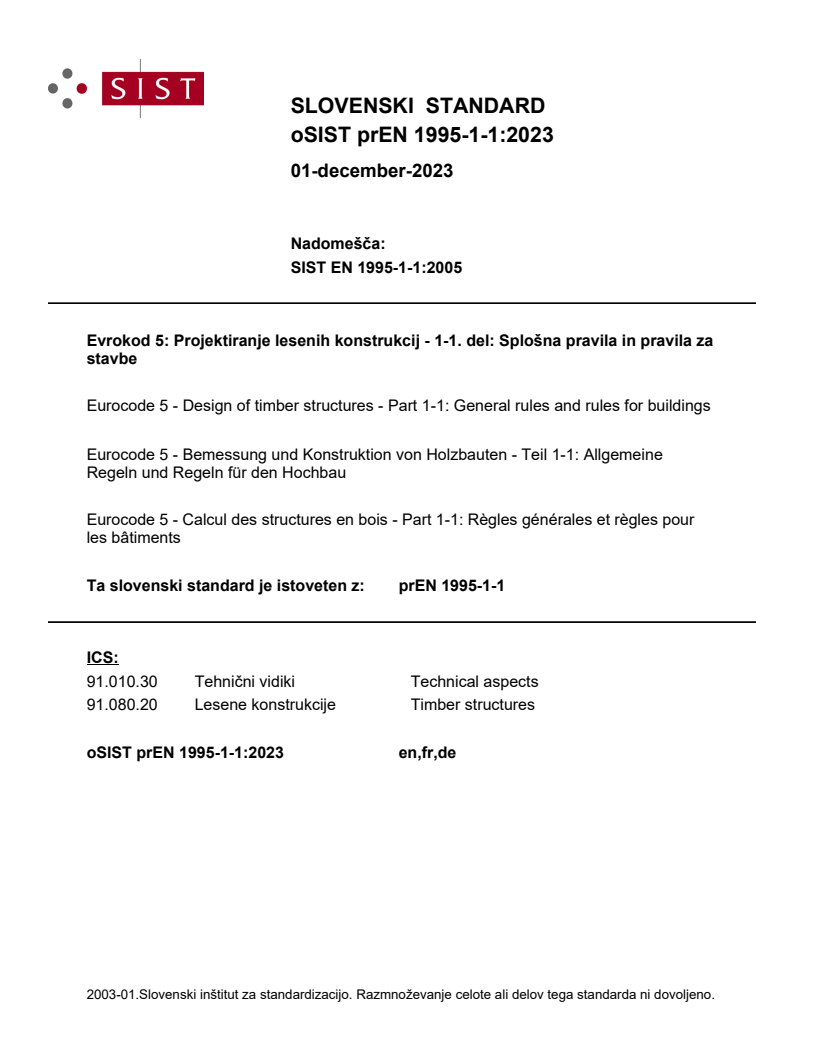
SLOVENSKI STANDARD
oSIST prEN 1995-1-1:2023
01-december-2023
Nadomešča:
SIST EN 1995-1-1:2005
Evrokod 5: Projektiranje lesenih konstrukcij - 1-1. del: Splošna pravila in pravila za
stavbe
Eurocode 5 - Design of timber structures - Part 1-1: General rules and rules for buildings
Eurocode 5 - Bemessung und Konstruktion von Holzbauten - Teil 1-1: Allgemeine
Regeln und Regeln für den Hochbau
Eurocode 5 - Calcul des structures en bois - Part 1-1: Règles générales et règles pour
les bâtiments
Ta slovenski standard je istoveten z: prEN 1995-1-1
ICS:
91.010.30 Tehnični vidiki Technical aspects
91.080.20 Lesene konstrukcije Timber structures
oSIST prEN 1995-1-1:2023 en,fr,de
2003-01.Slovenski inštitut za standardizacijo. Razmnoževanje celote ali delov tega standarda ni dovoljeno.
oSIST prEN 1995-1-1:2023
oSIST prEN 1995-1-1:2023
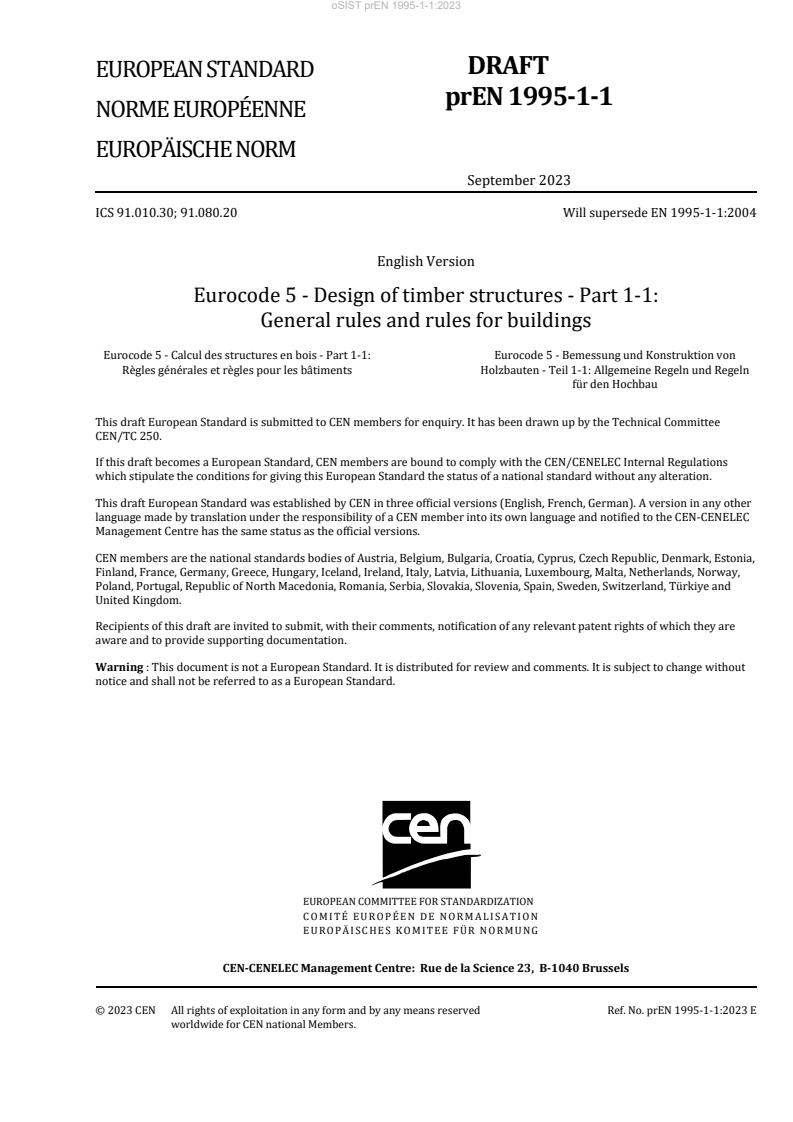
DRAFT
EUROPEAN STANDARD
prEN 1995-1-1
NORME EUROPÉENNE
EUROPÄISCHE NORM
September 2023
ICS 91.010.30; 91.080.20 Will supersede EN 1995-1-1:2004
English Version
Eurocode 5 - Design of timber structures - Part 1-1:
General rules and rules for buildings
Eurocode 5 - Calcul des structures en bois - Part 1-1: Eurocode 5 - Bemessung und Konstruktion von
Règles générales et règles pour les bâtiments Holzbauten - Teil 1-1: Allgemeine Regeln und Regeln
für den Hochbau
This draft European Standard is submitted to CEN members for enquiry. It has been drawn up by the Technical Committee
CEN/TC 250.
If this draft becomes a European Standard, CEN members are bound to comply with the CEN/CENELEC Internal Regulations
which stipulate the conditions for giving this European Standard the status of a national standard without any alteration.
This draft European Standard was established by CEN in three official versions (English, French, German). A version in any other
language made by translation under the responsibility of a CEN member into its own language and notified to the CEN-CENELEC
Management Centre has the same status as the official versions.
CEN members are the national standards bodies of Austria, Belgium, Bulgaria, Croatia, Cyprus, Czech Republic, Denmark, Estonia,
Finland, France, Germany, Greece, Hungary, Iceland, Ireland, Italy, Latvia, Lithuania, Luxembourg, Malta, Netherlands, Norway,
Poland, Portugal, Republic of North Macedonia, Romania, Serbia, Slovakia, Slovenia, Spain, Sweden, Switzerland, Türkiye and
United Kingdom.
Recipients of this draft are invited to submit, with their comments, notification of any relevant patent rights of which they are
aware and to provide supporting documentation.
Warning : This document is not a European Standard. It is distributed for review and comments. It is subject to change without
notice and shall not be referred to as a European Standard.
EUROPEAN COMMITTEE FOR STANDARDIZATION
COMITÉ EUROPÉEN DE NORMALISATION
EUROPÄISCHES KOMITEE FÜR NORMUNG
CEN-CENELEC Management Centre: Rue de la Science 23, B-1040 Brussels
© 2023 CEN All rights of exploitation in any form and by any means reserved Ref. No. prEN 1995-1-1:2023 E
worldwide for CEN national Members.
oSIST prEN 1995-1-1:2023
prEN 1995-1-1:2023 (E)
Contents Page
1 Scope . 11
1.1 Scope of EN 1995-1-1 . 11
1.2 Assumptions . 11
2 Normative references. 11
3 Terms, definitions and symbols . 11
3.1 Symbols and abbreviations . 20
4 Basis of design . 53
4.1 General rules . 53
4.2 Principles of limit state design . 53
4.3 Basic variables . 54
4.4 Stiffness values for structural analysis . 58
4.5 Verification by the partial factor method . 60
5 Materials . 62
5.1 General . 62
5.2 Strength graded structural timber (SL) with rectangular cross-section and structural
finger jointed timber (FST) . 70
5.3 Glued solid timber (GST) . 71
5.4 Glued laminated timber (GL) . 71
5.5 Cross laminated timber (CLT) . 72
5.6 Laminated veneer lumber (LVL) . 72
5.7 Glued laminated veneer lumber (GLVL) . 73
5.8 Softboards (SB) . 73
5.9 Adhesives . 73
6 Durability . 74
6.1 General . 74
6.2 Measures to prevent a biological attack . 74
6.3 Resistance to corrosion . 78
7 Structural analysis . 82
7.1 General . 82
7.2 Structural modelling . 83
7.3 Imperfections . 87
7.4 Simplified method for the evaluation of effects of actions based on second order
theory . 92
8 Ultimate limit states . 95
8.1 Member resistance verification. 95
8.2 Stability of members: simplified verification . 111
8.3 Additional rules for members with special geometries . 116
8.4 System strength . 144
9 Serviceability limit states . 145
9.1 General . 145
9.2 Deformations . 145
9.3 Vibrations . 148
9.4 Compressive deformation perpendicular to grain . 158
10 Fatigue . 159
oSIST prEN 1995-1-1:2023
prEN 1995-1-1:2023 (E)
10.1 General . 159
10.2 Fatigue verification for equivalent constant amplitude fatigue loading . 159
10.3 Fatigue verification for variable amplitude fatigue loading . 161
11 Connections . 161
11.1 General . 161
11.2 Resistance of a single dowel-type fastener . 163
11.3 Connection design with dowel-type fasteners . 182
11.4 Spacings, edge distances and end distances . 195
11.5 Brittle failure modes of connections with dowel-type fasteners laterally loaded
parallel to grain . 204
11.6 Brittle failure of connections loaded perpendicular to grain . 213
11.7 Shear connectors . 217
11.8 Punched metal plate fasteners . 225
11.9 Expanded tube fasteners . 225
11.10 Bonded-in rods . 225
11.11 Carpentry connections . 234
12 Mechanically jointed and glued webbed or flanged beams . 243
12.1 Glued thin-webbed beams . 243
12.2 Glued thin-flanged beams. 245
12.3 Mechanically jointed beams . 246
12.4 Mechanically jointed and glued columns . 247
13 Diaphragms . 247
13.1 General . 247
13.2 Diaphragms built out of timber framed elements . 248
13.3 Framed walls . 255
13.4 Framed floors . 263
13.5 Framed roofs . 271
13.6 Diaphragms built out of CLT, LVL and GLVL . 272
14 Timber foundation piles . 274
Annex A (informative) Additional guidance for increasing the robustness of timber
structures . 275
A.1 Use of this annex . 275
A.2 Scope and field of application . 275
A.3 Design for removal of structural elements . 276
A.4 Design for segmentation using fuse elements . 276
Annex B (informative) Stability and bracing of members and structural systems . 278
B.1 Use of this annex . 278
B.2 Scope and field of application . 278
B.3 Unbraced members: effective lengths and critical loads . 278
B.4 Braced members and bracing systems . 287
Annex C (informative) Buckling of beam columns – non-linear method . 307
C.1 Use of this annex . 307
C.2 Scope and field of application . 307
C.3 General . 307
oSIST prEN 1995-1-1:2023
prEN 1995-1-1:2023 (E)
C.4 In-plane buckling . 308
C.5 Buckling of members under major axis bending and axial force (compression or
tension), subject to lateral torsional buckling . 309
C.6 Buckling of members under biaxial bending and axial force (compression or tension),
subject to lateral torsional buckling . 312
C.7 Creep-buckling. 314
Annex D (normative) Additional design provisions for cross laminated timber (CLT) . 316
D.1 Use of this annex . 316
D.2 Scope and field of application . 316
D.3 Concentrated loads perpendicular to plane without reinforcement . 316
D.4 Concentrated loads perpendicular to the plane with reinforcement . 316
D.5 Concentrated loads in-plane . 319
D.6 Ribbed plates build up from ribs and CLT plates . 322
Annex E (informative) Mechanically jointed members . 325
E.1 Use of this annex . 325
E.2 Scope and field of application . 325
E.3 General . 325
E.4 Effective bending stiffness . 327
E.5 Stresses in the cross-section . 327
E.6 Load on mechanical fasteners . 328
Annex F (informative) Built-up columns . 329
F.1 Use of this annex . 329
F.2 Scope and field of application . 329
F.3 General . 329
F.4 Mechanically jointed columns. 330
F.5 Spaced columns with packs or gussets . 330
F.6 Lattice columns with glued or nailed joints . 334
Annex G (informative) Alternative method for vibration analysis of floors . 337
G.1 Use of this annex . 337
G.2 Scope and field of application . 337
G.3 General . 337
G.4 Transient response . 338
G.5 Resonant response . 339
Annex H (normative) Connections with punched metal plate fasteners (PMPF) . 342
H.1 Use of this annex . 342
H.2 Scope and field of application . 342
H.3 Design resistances . 342
oSIST prEN 1995-1-1:2023
prEN 1995-1-1:2023 (E)
H.4 Connection forces at an angle to the grain . 343
H.5 Plate geometry . 347
H.6 Plate strength and stiffness properties . 349
H.7 Plate anchorage strengths . 350
H.8 Connection strength verification in plane of timber assembly . 351
H.9 Plate withdrawal strengths. 355
H.10 Connection strength verification out of plane of timber assembly . 356
H.11 Plate slip modulus . 357
Annex I (informative) Connections with three-dimensional connectors . 358
I.1 Use of this annex . 358
I.2 Scope and field of application . 358
I.3 Connection slip modulus . 358
I.4 Connection capacity . 358
I.5 Angle bracket connection capacity . 360
I.6 Joist hanger connection resistance . 360
I.7 Post base connection resistance . 362
Annex J (informative) Connections with expanded tube fasteners . 363
J.1 Use of this annex . 363
J.2 Scope and application . 363
J.3 Introduction . 363
J.4 General requirements . 363
J.5 Design requirements . 364
J.6 Lateral load-carrying resistance and slip modulus . 365
J.7 Splice connections . 366
J.8 Connections exposed to bending moments, shear and normal forces . 367
Annex K (normative) Connections with interlayers . 370
K
.1 Use of this annex . 370
K.2 Scope and field of application . 370
K.3 Timber to timber connections . 370
K.4 Steel to timber joints . 375
Annex L (normative) Laminated timber decks (LTD) . 381
L.1 Use of this annex . 381
L.2 Scope and field of application . 381
L.3 Basis of design . 382
L.4 Materials . 382
L.5 Numerical analysis for laminated timber decks . 382
oSIST prEN 1995-1-1:2023
prEN 1995-1-1:2023 (E)
L.6 System stiffness . 382
L.7 System strength . 384
L.8 Simplifications for system strength . 385
L.9 Effective loaded area for concentrated vertical loads . 386
L.10 System verification of glued laminated timber decks . 386
Annex M (normative) Material and product properties for design . 387
M.1 Use of this annex . 387
M.2 Scope and field of application . 387
M.3 Timber products . 387
M.4 Gypsum and gypsum-based products. 394
M.5 Fasteners and connectors . 395
Annex N (informative) Classes and determination of some material properties . 400
N.1 Use of this annex . 400
N.2 Scope and field of application . 400
N.3 Strength classes for cross laminated timber (CLT) . 400
N.4 Strength classes for laminated veneer lumber (LVL) . 401
N.5 Characteristic strength and stiffness values of gypsum plasterboards and fibreboards 403
N.6 Categories for screws and rods with wood screw thread . 405
Annex O (informative) Numerical analysis for uni-directional timber elements . 407
O.1 Use of this annex . 407
O.2 Scope and field of application . 407
O.3 Determination of stiffness values . 407
Annex P (informative) Foundations with timber piles . 409
P.1 Use of this annex . 409
P.2 Scope and field of application . 409
P.3 General . 410
P.
4 Materials and properties . 411
P.5 Durability . 411
P.6 Structural analysis . 413
P.7 Ultimate limit states . 413
P.8 Serviceability limit states . 415
Annex Q (informative) Requirements for logs and pile extensions used as foundation piles . 416
Q.1 Use of this annex . 416
Q.2 Scope and field of application . 416
Q.3 Wood species . 416
Q.4 Geometrical properties . 417
oSIST prEN 1995-1-1:2023
prEN 1995-1-1:2023 (E)
Q.5 Grading . 418
Annex R (informative) Lateral displacement of multi storey monolithic shear walls and
single-storey segmented shear walls . 421
R.1 Use of this annex . 421
R.2 Scope and field of application . 421
R.3 Method of calculation of lateral displacement . 422
R.4 Displacement contributions for LTF, fully anchored- and monolithic CLT- and GLVL-C
shear walls without openings . 424
R.5 Displacement contributions for single-storey segmented CLT- and GLVL-C shear walls
without opening . 427
Annex S (informative) Framed walls with combined anchorage . 430
S.1 Use of this Annex. 430
S.2 Scope and field of application . 430
S.3 General . 430
S.4 Ultimate Limit State . 430
S.5 Serviceability limit state . 437
Bibliography . 438
oSIST prEN 1995-1-1:2023
prEN 1995-1-1:2023 (E)
European foreword
This document (prEN 1995-1-1:2023) has been prepared by Technical Committee CEN/TC 250 “Structural
Eurocodes”, the secretariat of which is held by BSI. CEN/TC 250 is responsible for all Structural Eurocodes
and has been assigned responsibility for structural and geotechnical design matters by CEN.
This document is currently submitted to the CEN Enquiry.
This document will supersede EN 1995-1-1:2004 and its amendments and corrigenda.
The first generation of EN Eurocodes was published between 2002 and 2007. This document forms part of
the second generation of the Eurocodes, which have been prepared under Mandate M/515 issued to CEN by
the European Commission and the European Free Trade Association.
The Eurocodes have been drafted to be used in conjunction with relevant execution, material, product and
test standards, and to identify requirements for execution, materials, products and testing that are relied
upon by the Eurocodes.
The Eurocodes recognize the responsibility of each Member State and have safeguarded their right to
determine values related to regulatory safety matters at national level through the use of National Annexes.
The main changes compared to the previous edition are listed below:
inclusions of main timber products, e.g. cross laminated timber (CLT);
inclusion of product groups with similar material behaviour;
inclusion of material parameters needed for the design according to this document;
improved guidance on durability;
inclusion of provisions on holes in beams;
extension of compression perpendicular to grain verifications to serviceability limit state design;
inclusion of provisions on reinforcements;
improved guidance on vibration verification;
inclusion on guidance on fatigue verification;
inclusion of provisions on carpentry connections;
inclusion of provisions on bonded-in rods;
inclusion of provisions on foundations with timber piles;
improved provisions on robustness.
oSIST prEN 1995-1-1:2023
prEN 1995-1-1:2023 (E)
0 Introduction
0.1 Introduction to the Eurocodes
The Structural Eurocodes comprise the following standards generally consisting of a number of Parts:
— EN 1990 Eurocode — Basis of structural and geotechnical design
— EN 1991 Eurocode 1 — Actions on structures
— EN 1992 Eurocode 2 — Design of concrete structures
— EN 1993 Eurocode 3 — Design of steel structures
— EN 1994 Eurocode 4 — Design of composite steel and concrete structures
— EN 1995 Eurocode 5 — Design of timber structures
— EN 1996 Eurocode 6 — Design of masonry structures
— EN 1997 Eurocode 7 — Geotechnical design
— EN 1998 Eurocode 8 — Design of structures for earthquake resistance
— EN 1999 Eurocode 9 — Design of aluminium structures
— New parts are under development, e.g. Eurocode for design of structural glass
The Eurocodes are intended for use by designers, clients, manufacturers, constructors, relevant authorities
(in exercising their duties in accordance with national or international regulations), educators, software
developers, and committees drafting standards for related product, testing and execution standards.
NOTE Some aspects of design are most appropriately specified by relevant authorities or, where not specified,
can be agreed on a project-specific basis between relevant parties such as designers and clients. The Eurocodes
identify such aspects making explicit reference to relevant authorities and relevant parties.
0.2 Introduction to EN 1995 (all parts)
EN 1995 (all parts) applies to the design of timber structures and gives specific design rules for buildings
and civil engineering timber works.
EN 1995 is subdivided in various parts:
EN 1995-2, Eurocode 5 — Design of timber structures — Part 2: Bridges
EN 1995-3, Eurocode 5 — Design of timber structures — Part 3: Execution
EN 1995-1 in itself does not exist as a physical document, but comprises the following three separate
documents, the basic part being EN 1995-1-1:
EN 1995-1-1, Eurocode 5 — Design of timber structures — Part 1-1: General rules and rules for buildings
EN 1995-1-2, Eurocode 5 — Design of timber structures — Part 1-2: Structural fire design
CEN/TS 19103, Design of timber structures — Structural design of timber-concrete composite structures –
Common rules and rules for buildings
oSIST prEN 1995-1-1:2023
prEN 1995-1-1:2023 (E)
EN 1995-2 “Bridges” refers to the common rules in EN 1995-1-1. The Clauses in EN 1995-2 supplement,
modify or supersede them, where relevant.
EN 1995-3 “Execution” refers to the common rules in EN 1995-1-1. The Clauses in EN 1995-3 supplement
the Clauses in EN 1995-1 and 1995-2.
0.3 Introduction to EN 1995-1-1
EN 1995-1-1 gives general design rules for timber structures and civil engineering timber works.
0.4 Verbal forms used in the Eurocodes
The verb “shall" expresses a requirement strictly to be followed and from which no deviation is permitted
in order to comply with the Eurocodes.
The verb “should” expresses a highly recommended choice or course of action. Subject to national
regulation and/or any relevant contractual provisions, alternative approaches could be used/adopted
where technically justified.
The verb “may" expresses a course of action permissible within the limits of the Eurocodes.
The verb “can" expresses possibility and capability; it is used for statements of fact and clarification of
concepts.
0.5 National Annex for EN 1995-1-1
National choice is allowed in this document where explicitly stated within notes. National choice includes
the selection of values for Nationally Determined Parameters (NDPs).
The national standard implementing EN 1995-1-1 can have a National Annex containing all national
choices to be used for the design of buildings and civil engineering works to be constructed in the relevant
country.
When no national choice is given, the default choice given in this document is to be used.
When no national choice is made and no default is given in this document, the choice can be specified by a
relevant authority or, where not specified, agreed for a specific project by appropriate parties.
National choice is allowed in EN 1995-1-1 through notes to the following clauses:
4.3.1.3(2) 4.3.1.4(1) 4.5.1(1) 4.5.2(1)
9.3.8(5) 10.1(2) 10.2(6) H.3(1)
L.3(1) L.3(2)
National choice is allowed in EN 1995-1-1 on the application of the following informative annexes:
Annex A Annex B Annex C Annex E
Annex F Annex G Annex I Annex J
Annex N Annex O Annex P Annex Q
Annex R Annex S
The National Annex can contain, directly or by reference, non-contradictory complementary information
for ease of implementation, provided it does not alter any provisions of the Eurocodes.
oSIST prEN 1995-1-1:2023
prEN 1995-1-1:2023 (E)
1 Scope
1.1 Scope of prEN 1995-1-1
(1) prEN 1995-1-1 gives general design rules for timber structures.
(2) prEN 1995-1-1 also gives specific design rules for buildings and timber civil engineering works.
1.2 Assumptions
(1) The assumptions of EN 1990 apply to this document.
(2) prEN 1995-1-1 is intended to be used in conjunction with EN 1990, EN 1991 (all parts), EN 1998 (all
parts) when timber structures are built in seismic regions.
2 Normative references
The following documents are referred to in the text in such a way that some or all of their content
constitutes requirements of this document. For dated references, only the edition cited applies. For undated
references, the latest edition of the referenced document (including any amendments) applies.
NOTE See the Bibliography for a list of other documents cited that are not normative references, including those
referenced as recommendations (i.e. through ‘should’ clauses) and permissions (i.e. through ‘may’ clauses).
EN 1990:2023, Eurocode - Basis of structural and geotechnical design
EN 1991 (all parts), Eurocode 1 - Actions on structures
prEN 1991-1-1:2023, Eurocode 1 - Actions on structures - Part 1-1: General actions - Specific weight of
materials, self-weight of construction works and imposed loads for buildings
prEN 1992-1-1, Eurocode 2 - Design of concrete structures - Part 1-1: General rules and rules for buildings,
bridges and civil engineering structures
prEN 1993-1-9, Eurocode 3 - Design of steel structures - Part 1-9: Fatigue
prEN 1995-3, Eurocode 5 - Design of timber structures - Part 3: Execution
prEN 1997-3, Eurocode 7 - Geotechnical design - Part 3: Geotechnical structures
EN 1998 (all parts), Eurocode 8 - Design of structures for earthquake resistance
EN 1999-1-1, Eurocode 9 - Design of aluminium structures - Part 1-1: General rules
EN 10255:2004+A1:2007, Non-alloy steel tubes suitable for welding and threading - Technical delivery
conditions
EN 14080:2013, Timber structures - Glued laminated timber and glued solid timber - Requirements
3 Terms, definitions and symbols
3.1 Terms and definitions
For the purposes
...
Questions, Comments and Discussion
Ask us and Technical Secretary will try to provide an answer. You can facilitate discussion about the standard in here.
Loading comments...