

EN 13457:2004
(Main)Footwear, leather and imitation leather goods manufacturing machines - Splitting, skiving, cutting, cementing and cement drying machines - Safety requirements
- Abstract
1.1 This European Standard applies to splitting, skiving, edge trimming, strip cutting, cementing and cement drying machines used in the manufacture of footwear, leather and imitation leather goods and other related components.
1.2 This European Standard does not apply to:
- trimming machines with rotary milling tool for the purpose of trimming edges of material see EN 930:1996;
- splitting and band knife machines used in tanneries see prEN 13112:1997;
- portable machines.
1.3 This European Standard specifies safety requirements for construction, transport, installation, adjustment, setting, teaching or process change-over, operation, cleaning, maintenance, decommissioning, dismantling and, as far as safety is concerned, disposal for machines mentioned in 1.1.
It takes account of intended use, component and system failure.
1.4 This European Standard deals with significant hazards relevant to the footwear, leather and imitation leather goods manufacturing industries. (For a List of hazards see clause 4.)
The European Standard does not deal with precise technical measures for reducing the risks of fumes and dusts detrimental to health.
The use of machines falling within the scope of this Standard for purposes other than those specified in 1.1, may give rise to hazards not considered during its preparation.
1.5 This European Standard also applies to equipment for material handling and operations which are an integral part of the machine.
1.6 This European Standard assumes the machines
- are operated by adequately trained persons
- are used with adequate workplace lighting conforming the local regulations or to prEN 12464:1998
- Status
- Withdrawn
- Publication Date
- 05-Oct-2004
- Withdrawal Date
- 27-Apr-2010
- Technical Committee
- CEN/TC 201 - Leather and imitation leather goods and footwear manufacturing machinery - Safety
- Drafting Committee
- CEN/TC 201/WG 8 - Splitting, skiving, trimming, and cementing machines
- Current Stage
- 9960 - Withdrawal effective - Withdrawal
- Start Date
- 28-Apr-2010
- Completion Date
- 28-Apr-2010
- Directive
- 98/37/EC - MachineryOJ Ref: C, C 336 OJ Date: 31-Dec-2005


Relations
- Effective Date
- 18-Jan-2023
- Referred By
EN ISO 9875:2001 - Ships and marine technology - Marine echo-sounding equipment (ISO 9875:2000) - Effective Date
- 28-Jan-2026
- Effective Date
- 22-Dec-2008
Get Certified
Connect with accredited certification bodies for this standard

Control Union Certifications
Global certification for agriculture and sustainability.

Hohenstein Institut
Textile testing and certification.

Bureau Veritas Bangladesh
Bureau Veritas certification services in Bangladesh.
Sponsored listings
Frequently Asked Questions
EN 13457:2004 is a standard published by the European Committee for Standardization (CEN). Its full title is "Footwear, leather and imitation leather goods manufacturing machines - Splitting, skiving, cutting, cementing and cement drying machines - Safety requirements". This standard covers: 1.1 This European Standard applies to splitting, skiving, edge trimming, strip cutting, cementing and cement drying machines used in the manufacture of footwear, leather and imitation leather goods and other related components. 1.2 This European Standard does not apply to: - trimming machines with rotary milling tool for the purpose of trimming edges of material see EN 930:1996; - splitting and band knife machines used in tanneries see prEN 13112:1997; - portable machines. 1.3 This European Standard specifies safety requirements for construction, transport, installation, adjustment, setting, teaching or process change-over, operation, cleaning, maintenance, decommissioning, dismantling and, as far as safety is concerned, disposal for machines mentioned in 1.1. It takes account of intended use, component and system failure. 1.4 This European Standard deals with significant hazards relevant to the footwear, leather and imitation leather goods manufacturing industries. (For a List of hazards see clause 4.) The European Standard does not deal with precise technical measures for reducing the risks of fumes and dusts detrimental to health. The use of machines falling within the scope of this Standard for purposes other than those specified in 1.1, may give rise to hazards not considered during its preparation. 1.5 This European Standard also applies to equipment for material handling and operations which are an integral part of the machine. 1.6 This European Standard assumes the machines - are operated by adequately trained persons - are used with adequate workplace lighting conforming the local regulations or to prEN 12464:1998
1.1 This European Standard applies to splitting, skiving, edge trimming, strip cutting, cementing and cement drying machines used in the manufacture of footwear, leather and imitation leather goods and other related components. 1.2 This European Standard does not apply to: - trimming machines with rotary milling tool for the purpose of trimming edges of material see EN 930:1996; - splitting and band knife machines used in tanneries see prEN 13112:1997; - portable machines. 1.3 This European Standard specifies safety requirements for construction, transport, installation, adjustment, setting, teaching or process change-over, operation, cleaning, maintenance, decommissioning, dismantling and, as far as safety is concerned, disposal for machines mentioned in 1.1. It takes account of intended use, component and system failure. 1.4 This European Standard deals with significant hazards relevant to the footwear, leather and imitation leather goods manufacturing industries. (For a List of hazards see clause 4.) The European Standard does not deal with precise technical measures for reducing the risks of fumes and dusts detrimental to health. The use of machines falling within the scope of this Standard for purposes other than those specified in 1.1, may give rise to hazards not considered during its preparation. 1.5 This European Standard also applies to equipment for material handling and operations which are an integral part of the machine. 1.6 This European Standard assumes the machines - are operated by adequately trained persons - are used with adequate workplace lighting conforming the local regulations or to prEN 12464:1998
EN 13457:2004 is classified under the following ICS (International Classification for Standards) categories: 59.140.40 - Machines and equipment for leather and fur production; 61.060 - Footwear. The ICS classification helps identify the subject area and facilitates finding related standards.
EN 13457:2004 has the following relationships with other standards: It is inter standard links to EN 13457:2004+A1:2010, EN ISO 9875:2001, EN 13457:2004/FprA1. Understanding these relationships helps ensure you are using the most current and applicable version of the standard.
EN 13457:2004 is associated with the following European legislation: EU Directives/Regulations: 98/37/EC; Standardization Mandates: M/079. When a standard is cited in the Official Journal of the European Union, products manufactured in conformity with it benefit from a presumption of conformity with the essential requirements of the corresponding EU directive or regulation.
EN 13457:2004 is available in PDF format for immediate download after purchase. The document can be added to your cart and obtained through the secure checkout process. Digital delivery ensures instant access to the complete standard document.
Standards Content (Sample)
SLOVENSKI STANDARD
01-marec-2005
Stroji za izdelavo obutve ter izdelkov iz usnja in njegovih imitacij – Stroji za
cepljenje, brušenje, rezanje ter nanos in sušenje lepila – Varnostne zahteve
Footwear, leather and imitation leather goods manufacturing machines - Splitting,
skiving, cutting, cementing and cement drying machines - Safety requirements
Maschinen zur Herstellung von Schuhen, Leder- und Kunstlederewaren - Spalt-, Schärf-,
Schneid-, Klebstoffauftrag- und Klebstofftrockenmaschinen - Sicherheitsanforderungen
Machines de fabrication de chaussures et d'articles en cuir et en matériaux similaires -
Machines a refendre, a parer, a couper, a encoller et a sécher l'adhésif - Prescriptions de
sécurité
Ta slovenski standard je istoveten z: EN 13457:2004
ICS:
59.140.40 Stroji in oprema za Machines and equipment for
proizvodnjo usnja in krzna leather and fur production
61.060 Obuvala Footwear
2003-01.Slovenski inštitut za standardizacijo. Razmnoževanje celote ali delov tega standarda ni dovoljeno.
EUROPEAN STANDARD
EN 13457
NORME EUROPÉENNE
EUROPÄISCHE NORM
October 2004
ICS 59.140.40; 61.060
English version
Footwear, leather and imitation leather goods manufacturing
machines - Splitting, skiving, cutting, cementing and cement
drying machines - Safety requirements
Machines de fabrication de chaussures et d'articles en cuir Maschinen zur Herstellung von Leder- und
et en matériaux similaires - Machines à refendre, à parer, à Kunstlederewaren und Schuhwerk - Spalt-, Schärf-,
couper, à encoller et à sécher l'adhésif - Prescriptions de Schneid-, Klebstoffauftrags- und
sécurité Klebstofftrocknungsmaschinen - Sicherheitsanforderungen
This European Standard was approved by CEN on 8 August 2004.
CEN members are bound to comply with the CEN/CENELEC Internal Regulations which stipulate the conditions for giving this European
Standard the status of a national standard without any alteration. Up-to-date lists and bibliographical references concerning such national
standards may be obtained on application to the Central Secretariat or to any CEN member.
This European Standard exists in three official versions (English, French, German). A version in any other language made by translation
under the responsibility of a CEN member into its own language and notified to the Central Secretariat has the same status as the official
versions.
CEN members are the national standards bodies of Austria, Belgium, Cyprus, Czech Republic, Denmark, Estonia, Finland, France,
Germany, Greece, Hungary, Iceland, Ireland, Italy, Latvia, Lithuania, Luxembourg, Malta, Netherlands, Norway, Poland, Portugal, Slovakia,
Slovenia, Spain, Sweden, Switzerland and United Kingdom.
EUROPEAN COMMITTEE FOR STANDARDIZATION
COMITÉ EUROPÉEN DE NORMALISATION
EUROPÄISCHES KOMITEE FÜR NORMUNG
Management Centre: rue de Stassart, 36 B-1050 Brussels
© 2004 CEN All rights of exploitation in any form and by any means reserved Ref. No. EN 13457:2004: E
worldwide for CEN national Members.
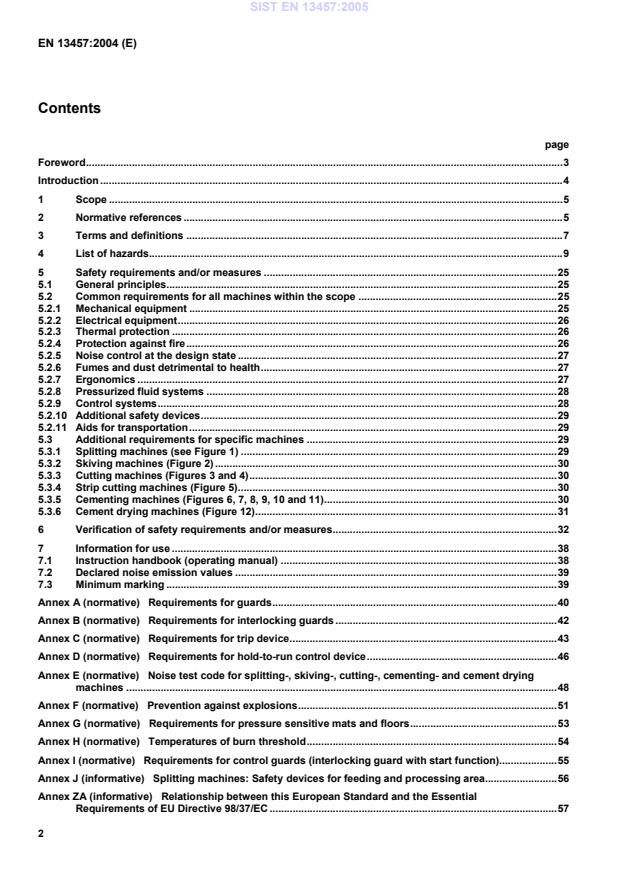
Contents
page
Foreword.3
Introduction .4
1 Scope .5
2 Normative references .5
3 Terms and definitions .7
4 List of hazards.9
5 Safety requirements and/or measures .25
5.1 General principles.25
5.2 Common requirements for all machines within the scope .25
5.2.1 Mechanical equipment .25
5.2.2 Electrical equipment.26
5.2.3 Thermal protection .26
5.2.4 Protection against fire.26
5.2.5 Noise control at the design state .27
5.2.6 Fumes and dust detrimental to health.27
5.2.7 Ergonomics .27
5.2.8 Pressurized fluid systems .28
5.2.9 Control systems.28
5.2.10 Additional safety devices.29
5.2.11 Aids for transportation.29
5.3 Additional requirements for specific machines .29
5.3.1 Splitting machines (see Figure 1) .29
5.3.2 Skiving machines (Figure 2).30
5.3.3 Cutting machines (Figures 3 and 4).30
5.3.4 Strip cutting machines (Figure 5).30
5.3.5 Cementing machines (Figures 6, 7, 8, 9, 10 and 11).30
5.3.6 Cement drying machines (Figure 12).31
6 Verification of safety requirements and/or measures.32
7 Information for use .38
7.1 Instruction handbook (operating manual) .38
7.2 Declared noise emission values .39
7.3 Minimum marking .39
Annex A (normative) Requirements for guards.40
Annex B (normative) Requirements for interlocking guards .42
Annex C (normative) Requirements for trip device.43
Annex D (normative) Requirements for hold-to-run control device.46
Annex E (normative) Noise test code for splitting-, skiving-, cutting-, cementing- and cement drying
machines .48
Annex F (normative) Prevention against explosions.51
Annex G (normative) Requirements for pressure sensitive mats and floors.53
Annex H (normative) Temperatures of burn threshold.54
Annex I (normative) Requirements for control guards (interlocking guard with start function).55
Annex J (informative) Splitting machines: Safety devices for feeding and processing area.56
Annex ZA (informative) Relationship between this European Standard and the Essential
Requirements of EU Directive 98/37/EC .57
Foreword
This document (EN 13457:2004) has been prepared by Technical Committee CEN/TC 201 “Leather and imitation
leather goods and footwear manufacturing machinery - Safety”, the secretariat of which is held by UNI.
This European Standard shall be given the status of a national standard, either by publication of an identical text or
by endorsement, at the latest by April 2005, and conflicting national standards shall be withdrawn at the latest by
April 2005.
This document has been prepared under a mandate given to CEN by the European Commission and the European
Free Trade Association, and supports essential requirements of EU Directives.
For relationship with EU Directives, see informative Annex ZA, which is an integral part of this document.
According to the CEN/CENELEC Internal Regulations, the national standards organizations of the following
countries are bound to implement this European Standard: Austria, Belgium, Cyprus, Czech Republic, Denmark,
Estonia, Finland, France, Germany, Greece, Hungary, Iceland, Ireland, Italy, Latvia, Lithuania, Luxembourg, Malta,
Netherlands, Norway, Poland, Portugal, Slovakia, Slovenia, Spain, Sweden, Switzerland and United Kingdom.
Introduction
The extent to which hazards are covered is indicated in the scope of this document.
This document is a type C standard as stated in EN 1070.
The machinery concerned and the extent to which hazards, hazardous situations and events are covered are
indicated in the scope of this document.
When provisions of this type C standard are different from those which are stated in type A and B standards, the
provisions of this type C standard take precedence over he provisions of the other standards, for information for
use and maintenance according to the provisions of this type C standard.
This document contains safety requirements for splitting, skiving, trimming, cementing and cement drying
machines. It is prepared for the use of designers, manufacturers, suppliers and importers.
1 Scope
1.1 This document applies to splitting, skiving, edge trimming, strip cutting, cementing and cement drying
machines used in the manufacture of footwear, leather and imitation leather goods and other related components.
1.2 This document does not apply to:
trimming machines with rotary milling tool for the purpose of trimming edges of material, see EN 930;
splitting and band knife machines used in tanneries, see EN 13112;
portable machines.
1.3 This document specifies safety requirements for construction, transport, installation, adjustment, setting,
teaching or process change-over, operation, cleaning, maintenance, decommissioning, dismantling and, as far as
safety is concerned, disposal for machines mentioned in 1.1.
It takes account of intended use, component and system failure.
1.4 This document deals with significant hazards relevant to the footwear, leather and imitation leather goods
manufacturing industries. (For a list of hazards see Clause 4.)
The document does not deal with precise technical measures for reducing the risks of fumes and dusts detrimental
to health.
The use of machines falling within the scope of this document for purposes other than those specified in 1.1, may
give rise to hazards not considered during its preparation.
1.5 This document also applies to equipment for material handling and operations which are an integral part of
the machine.
1.6 This document assumes the machines
are operated by adequately trained persons
are used with adequate workplace lighting conforming the local regulations or to EN 12464-1 and prEN
12464-2
1.7 This document applies to machines manufactured after its date of publication.
2 Normative references
The following referenced documents are indispensable for the application of this document. For dated references,
only the edition cited applies. For undated references, the latest edition of the referenced document (including any
amendments) applies.
EN 294:1992, Safety of machinery – Safety distances to prevent danger zones being reached by the upper limbs.
EN 349, Safety of machinery – Minimum gaps to avoid crushing of parts of the human body.
EN 418:1992, Safety of machinery – Emergency stop equipment, functional aspects – Principles for design.
EN 547-1, Safety of machinery – Human body measurements – Part 1: Principles for determining the dimensions
required for openings for whole body access into machinery.
EN 547-2, Safety of machinery – Human body measurements – Part 2: Principles for determining the dimensions
required for access openings.
EN 563:1994, Safety of machinery – Temperatures of touchable surfaces – Ergonomics data to establish
temperature limit values for hot surfaces.
EN 614-1, Safety of machinery – Ergonomic design principles – Part 1: Terminology and general principles.
EN 626-1:1994, Safety of machinery – Reduction of risks to health from hazardous substances emitted by
machinery – Part 1: Principles and specifications for machinery manufacturers.
EN 811, Safety of machinery – Safety distances to prevent danger zones being reached by the lower limbs.
EN 894-2: Safety of machinery – Ergonomics requirements for the design of displays and control actuators –
Part 2: Displays.
EN 894-3, Safety of machinery – Ergonomics requirements for the design of displays and control actuators –
Part 3: Control actuators.
EN 953:1997, Safety of machinery – Guards – General requirements for the design and construction of fixed and
movable guards.
EN 954-1:1996, Safety of machinery – Safety related parts of control systems – Part 1: General principles for
design.
EN 982:1996, Safety of machinery – Safety requirements for fluid power systems and their components –
Hydraulics.
EN 983:1996, Safety of machinery – Safety requirements for fluid power systems and their components –
Pneumatics.
EN 999, Safety of machinery – The positioning of protective equipment in respect of approach speeds of parts of
the human body.
EN 1005-2:2003, Safety of machinery – Human physical performance – Part 2: Manual handling of machinery and
component parts of machinery.
EN 1005-3:2002, Safety of machinery – Human physical performance – Part 3: Recommended force limits for
machinery operation.
EN 1037, Safety of machinery – Prevention of unexpected start-up.
EN 1050, Safety of machinery – Principles for risk assessment.
EN 1070:1998, Safety of machinery – Terminology.
EN 1088:1995, Safety of machinery – Interlocking devices associated with guards – Principles for design and
selection.
EN 1127-1:1997, Explosive atmospheres – Explosion prevention and protection – Part 1: Basic concepts and
methodology.
EN 1760-1, Safety of machinery – Pressure sensitive protective devices – Part 1: General principles for the design
and testing of pressure sensitive mats and pressure sensitive floors.
EN 1760-2, Safety of machinery – Pressure sensitive protective devices – Part 2: General principles for the design
and testing of pressure sensitive edges and pressure sensitive bars.
EN 12464-1, Light and lighting – Lighting of work places – Part 1: Indoor work places.
prEN 12464-2, Light and lighting – Lighting of work places – Part 2: Outdoor work places.
EN 12545:2000, Footwear, leather and imitation leather goods manufacturing machines – Noise test code –
Common requirements.
EN 13478, Safety of machinery – Fire prevention and protection.
EN 60204-1:1997, Safety of machinery – Electrical equipment of machines – Part 1: General requirements (IEC
60204-1:1997).
EN 60335-2-69:2003, Household and similar electrical appliances – Safety – Part 2-69: Particular requirements for
wet and dry vacuum cleaners, including power brush, for industrial and commercial use (IEC 60335-2-69:2002,
modified).
EN 60947-5-1:2004, Low-voltage switchgear and controlgear – Part 5-1: Control circuit devices and switching
elements – Electromechanical control circuit devices (IEC 60947-5-1:2003).
EN 61496-1:2004, Safety of machinery – Electro-sensitive protective equipment – Part 1: General requirements
and tests (IEC 61496-1:2004, modified).
IEC 61496-2:1997, Safety of machinery – Electro-sensitive protective equipment – Part 2: Particular requirements
for equipment using active opto-electronic protective devices (AOPDs).
EN ISO 4871, Acoustics - Declaration and verification of noise emission values of machinery and equipment (ISO
4871:1996).
EN ISO 11688-1:1998, Acoustics – Recommended practice for the design of low-noise machinery and equipment –
Part 1: Planning (ISO/TR 11688-1:1995).
EN ISO 11688-2:2000, Acoustics – Recommended practice for the design of low-noise machinery and equipment –
Part 2: Introduction to the physics of low-noise design (ISO/TR 11688-2:1998).
EN ISO 11689, Acoustics – Procedure for the comparison of noise-emission data for machinery and equipment
(ISO 11689:1996).
EN ISO 12100-1:2003, Safety of machinery – Basic concepts, general principles for design – Part 1: Basic
terminology, methodology (ISO 12100-1:2003).
EN ISO 12100-2:2003, Safety of machinery – Basic concepts, general principles for design - Part 2: Technical
principles (ISO 12100-2:2003).
EN ISO 14122-1:2000, Safety of machinery – Permanent means of access to machinery – Part 1: Choice of fixed
means of access between two levels (ISO 14122-1:2001).
EN ISO 14122-2:2001, Safety of machinery – Permanent means of access to machinery – Part 2: Working
platforms and walkways (ISO 14122-2:2001).
3 Terms and definitions
For the purposes of this document, the terms and definitions given in EN ISO 12100-1:2003, EN ISO 12100-
2:2003, EN 1070:1998 and the following apply.
3.1
splitting machine (see Figure 1)
machine which separates leather or other splitable materials to a required thickness by cutting. The separated part
is called split-leather. The material is fed to the cutting edge of the knife either between feeding rollers or, between
a roller in a fixed or movable mounting, and a fixed guide
3.2
skiving machine (see Figure 2)
machine which profiles the edges of workpieces of leather or other materials. The material is fed to the cutting edge
of a moving knife either between the feeding rollers and a following roller, or a fixed guide foot
3.3
cutting machines
edge trimming and last margin and strip cutting machines
3.4
edge trimming and last margin machine (see Figures 3 and 4)
machine for final preparation of the edges of lining and edges of the upper after lasting by means of reciprocating
or oscillating knives
3.5
strip cutting machine (see Figure 5)
stationary machine with circular rotating knives, roller plates or reciprocating knives for cutting straps, belts and
strips of all kinds of leather as well as artificial leather, rubber, felt, plastic material. Any required cutting width can
be obtained by inserting spacers between the knives
3.6
cementing machine (see Figures 6, 7, 8, 9, 10 and 11)
machine applying cement to a workpiece by means of a roller, dipping device, nozzle, spraying nozzle or brush
3.7
cement drying machine (see Figure 12)
machine for removing the carrier medium (solvent or water) from adhesive coated material prior to activation. A
reactivation device can be incorporated
3.8
hazardous movement
motion of a part of the machine or workpiece which may give rise to injury
3.9
danger points
points on splitting, skiving, edge trimming, strip cutting, cementing and cement drying machines which may give
rise to personal injury due to controlled-path movements of drives, machinery parts, tools or workpieces
3.10
fixed cover
fixed guard installed to prevent by itself, or together with other parts, access to the danger zones from the covered
side
3.11
fixed enclosing guard
fixed guard which prevents access to a danger zone from all sides
3.12
fencing
guard around danger zones of a machine or plant, which prevents uncontrolled access
3.13
operating area
zones in or around a machine which include:
the area of manual loading and unloading;
the operator standing or sitting area
3.14
processing area
area of the machine where the workpiece is being split, skived, trimmed, cut, cemented or cement dried
3.15
inlet safety device
device installed to prevent access from the feeding area into the processing area. This device can be:
a fixed or movable guard;
a trip device
3.16
feeding gap
area through which material is fed to the processing area
4 List of hazards
4.1 The significant hazards of splitting, skiving, edge trimming, strip cutting and cementing machines are outlined
in 4.3 to 4.12 and set out in Table 1.
NOTE Typical outlines of these machines together with explanatory sketches of processing areas are given in Figures 1 to
12. The Figures are given for information only.
4.2 Before using this document it is important to carry out a risk assessment of the machine in question.
Table 1 — List of hazards
Danger zone or source of hazard Type of hazard Figure
4.3 Mechanical hazards
4.3.1 Transmission and drive mechanisms entanglement, drawing-in and
trapping, friction, crushing, shearing
4.3.2 Moving machinery parts of
- electrical
- hydraulic
crushing, shearing, impact, drawing-
in
- pneumatic
- mechanical units and workpieces
4.3.3 Loading and unloading area
- clamping device crushing
- guiding rollers drawing-in, crushing J.1
- handling device crushing, shearing
- conveyor shearing, drawing in 12
4.3.4 Processing area
a) Splitting, skiving, edge trimming, last margin and
strip cutting machines
- cutting areas
edge of running or stationary
cutting, severing
• splitting knife
• skiving knife 2
• edge trimming knife 3
• last margin trimming knife cutting, severing 4
• strip cutting knife 5
- rotating grinding wheel abrasion, ejection of parts, injury to
eyes
Table 1 — List of hazards (continued)
Danger zone or source of hazard Type of hazard Figure
- setting, adjustment of
• skiving, splitting, strip cutting and
cutting, severing
• edge trimming knife
abrasion, bursting
• grinding wheel
injuries to skin and eyes, ignition
• sparks from dressing of grinding wheel
source
crushing, shearing
• falling down/out of the uptilted skiving
machine by gravity
b) Cementing machines
area between transport roller and application roller crushing, drawing-in, abrasion 6, 7
area between fixed machine parts shearing, crushing 8
e. g. dip tank and moveable suspension device
centrifugal device for counters and heels trapping 8
area between moving sole or last shoe and moving crushing 11
brush
c) Cement drying machines
area between fixed machine parts and conveyor trapping, drawing-in, shearing 12
4.3.5 Operator’s standing area
- uneven, sloping, slippery platforms slipping
- steps tripping
- protruding parts falling
4.3.6 Movement of machine due to gravity while being crushing, shearing
transported
4.4 Electrical hazards
Electrical contact, directly or indirectly, caused by
- component failure
- insulation failure
electric shock, burns
- incorrect design, installation or component
specifications of the electrical equipment
4.5 Thermal hazards
Accidental contact with
- roller dressed by hot melt cement
- hot melt chamber
- nozzle risk of burns
- reactivation unit
- during suspension or by squirting
4.6 Fire hazards
splitting, skiving machines
- the ignition of dust created by the action of the tool burns
on the material being worked
cementing and cement drying machines
- the ignition of fumes of flammable liquid (solvent, burns
solvent containing glue)
Table 1 — List of hazards (concluded)
Danger zone or source of hazard Type of hazard
4.7 Explosion hazards
cementing and cement drying machines
- the ignition of explosive atmosphere of
inflammable liquid (solvent, solvent containing
glue)
4.8 Noise
- hydraulic unit loss of hearing, interference with speech
communication and perception of acoustic signals
- pneumatic equipment
- extraction equipment
- machine parts and tools
4.9 Emission of fumes or skin contact
cementing and cement drying machines using solvent
containing glue during
- operation
risk of occupational disease (breathing system,
- setting
skin, nervous system)
- cleaning
- overheating of hot melt
- skin contact with solvents
splitting and skiving machines
- dust generated by cutting (breathing system, skin)
4.10 Neglect of ergonomic principles risk of occupational disease
- inadequate local lighting accidents resulting from poor visibility
- poor operator posture fatigue
- excessive effort during loading and unloading physical and mental stress
- poor control layout and display identification psychological stress
- unsuitable height and size in relation to human muscolo-skeletal injury/repetitive strain injury
body dimensions (work related upper limb disorder)
4.11 Functional disorders:
- failure of control system (malfunction safety all possible hazards generated by unexpected
devices and machine control) dangerous movements (e. g. unexpected start or
closing movement, prevention of stop function)
- fault of energy supply (irregularity failure,
unexpected reconnection)
- electromagnetic disturbances
4.12 High pressure fluid ejection or ejection of part of a injury from hot oil or impact from flexible hoses
burst component
by failure of hydraulic or pneumatic unit (broken hoses,
fittings and pipework)
Key
a Band knife splitting machine
b Processing area
c Splitting machine with fixed knife profiling splitting machine
1 Profile roller
2 Profiling roller
3 Counter roll
4 Drawing in mechanism
5 Feeding table
Figure 1 — Splitting machine
Key
a Skiving machine (front view) with bell shaped knife
b Computerised skiving machine with bell shaped knife
1 Processing area
Figure 2 — Skiving machine
Key
1 Processing area
Figure 3 — Edge trimming machine for linings with oscillating knife
Key
1 Processing area
Figure 4 — Last margin trimming machine
Key
a Strip cutting machine with circular knives
b Continuous cutting machine
1 Knife shaft
2 Limit bar
3 Spreader table
4 Processing area
5 Knife pair
6 Material
7 Belt
Figure 5 — Strip cutting machine
Key
1 Feed roller
2 Application roller
3 Processing area
4 Drive mechanism
Figure 6 — Roller cementing machine designed for solvent based adhesive
Key
1 Feed roller
2 Application roller
3 Processing area
4 Tension roller
5 Spreader table
6 Application roller
7 Stripper
8 Adhesive tank
Figure 7 — Roller cementing machine designed for water based adhesive
Key
a Cement-dipping machine for heels
b Cement-dipping machine for counters (centrifugal method)
1 Conveyor
2 Hanging device
3 Feeding
4 Dip tank
5 Centrifugal drive
Figure 8 — Cementing machine
Figure 9 — Hot melt fixed applicator for multi use
Key
1 Cement container
2 Support
Figure 10 — Spraying applicator for water based adhesive
Key
1 Processing area
2 Feeding area
Figure 11 — Automatic bottom cementing machine with rotary brush
Key
a Cement drying machine with conveyor configuration
b Cement drying machine with conveyor with additional ventilation system
1 Loading end
2 Unloading end
3 Reactivation system
4 Conveyor
5 Fan
6 Ventilation system
Figure 12 — Cement drying machine
5 Safety requirements and/or measures
5.1 General principles
Machines conforming to this standard shall satisfy the requirements and all measures set out in this clause. For the
reduction of hazards not identified in this document the principles contained in EN ISO 12100 (all parts) should be
applied.
For hazards which are reduced by application of a B-Level standard such as EN 294, EN 418, EN 60204-1 etc., the
manufacturer shall carry out a risk assessment to establish the requirements of the B-standard to be applied. This
specific risk assessment shall be part of the general risk assessment of the machine.
5.2 Common requirements for all machines within the scope
5.2.1 Mechanical equipment
5.2.1.1 Transmission and drive mechanisms
All transmission machinery and drive mechanisms shall be enclosed by fixed enclosing guards which meet the
requirements of EN 953.
5.2.1.2 Machinery parts, tools and workpieces
5.2.1.2.1 Unless otherwise specified by 5.3 and with consideration of a risk assessment in accordance with EN
1050, hazardous movements of machinery parts, tools and workpieces shall be safeguarded by the means shown
in the following listing given in order of preference:
fixed enclosing guards which meet the requirements of EN 953 or
fencing which meets the requirements of A.3, or
fixed covers which meet the requirements of A.1 and A.2, or
interlocking guards which meet the requirements of B.2
of this document.
5.2.1.2.2 Where the protective measures given in 5.2.1.2.1 cannot be provided, devices shall be provided which
will effect a shut down of the hazardous motion before the danger point is reached.
Devices which will effect this are:
trip devices which meet the requirements of Annex C of this document, such as electrosensitive protective
devices or mechanical trip devices;
pressure sensitive bars which meet the requirements of EN 1760-2;
hold to run control devices which meet the requirements of Clause D.1 of this document, unless otherwise
specified in 5.3.
5.2.1.2.3 Safety distances and gap limitations for guard shall comply at least with Tables 1, 3, 4 of EN 294:1992,
unless otherwise specified in 5.3.
5.2.1.2.4 Safeguards at crushing, shearing, drawing-in, trapping and friction points are not required if the
maximum force of moving parts is limited to 150 N and the contact pressure is limited to 50 N/cm².
5.2.1.3 Operator's standing area
The surface of an area where the operator stands for recurring manual intervention shall give a good grip and steps
and protruding parts shall be avoided, to prevent slipping, tripping and falling according to
EN ISO 14122-1.
5.2.2 Electrical equipment
5.2.2.1 Electrical systems and equipment shall be in accordance with EN 60204-1.
With respect to some clauses of EN 60204-1:1997, stated hereafter, the following shall apply:
4.3:
A.C. supplies: 4.3.2;
D.C. supplies: 4.3.3;
6.2:
Protection in accordance with 6.2.2 or 6.2.3 and, where applicable 6.2.4;
9.2.5.3/4:
stop function and emergency switching off: Category 0;
9.4:
the safety related parts of the control system shall meet the requirements of 5.2.9.4 and 5.2.9.5 of this
document;
12.3:
degree of protection: at least IP 54 (in case of fine dust, a higher degree than IP 54 can be necessary).
5.2.2.2 All operating control devices requiring frequent adjustment for altering process settings shall be located
outside the electrical control cabinet.
NOTE Controls for routine electrical adjustment are, for instance, to vary feed, speed, time, temperature or pressure.
5.2.3 Thermal protection
Hot surfaces within reach shall be avoided or safeguards provided against accidental contact such that, the
temperatures of burn threshold for the material concerned and a contact time of less than 1 s, given in
EN 563, are not exceeded. Selected values on the basis of Figures 2, 5 and 6 of EN 563:1994 are given in
Annex H.
5.2.4 Protection against fire
5.2.4.1 Machines which generate dust shall be designed and constructed such, that dust accumulation which
may be ignited by a machine overheating or by sparks is prevented, according to EN 13478.
5.2.4.2 Enclosed zones of a machine where dust accumulation could cause a fire hazard shall be cleanable by
the operator without the need for auxiliary means to gain access. These zones shall not contain danger points
caused by mechanical hazards.
Information on these zones and cleaning methods shall be included in the instructions for use, together with
recommendations on disposal of the dust.
5.2.4.3 For collection, transportation and disposal of generated dust the machines shall be equipped with a
provision for dust removal (e.g. dust collection bag or bin). Dust collectors shall be made out of non-flammable
materials. Dust filters shall be made flame retardant.
5.2.4.4 Internal dust exhaust equipment shall be interlocked with the drive mechanism of the machine. The
interlocking shall meet category 1 of EN 954-1:1996 or better.
5.2.5 Noise control at the design state
When designing the machine, the available information and technical measures to control at source the noise from
machine parts, tools, hydraulic, pneumatic and extraction equipment, shall be taken into account, according to EN
ISO 11688-1 and EN ISO 11688-2. Examples of noise control measures are:
a) reduction of vibration through static and dynamic balancing of rotation parts;
b) reduction of vibration within the machine by reducing both the mass of moving parts and their acceleration;
c) reduction of impactive over-clearance of rotational bearings by application of positive preloading;
d) proper choice and design of energy transfer-components to eliminate bouncing;
e) proper choice and design of transmission components (gears, pulleys, belts, bearings etc.);
f) proper design of machine structures taking into account vibration damping and avoidance of structural
resonance;
g) sound deadening of pneumatic discharges, vibration damping of hydraulic circuits.
The above list is not exhaustive. Other noise control measures with the same or better efficacy can be used by a
manufacturer.
5.2.6 Fumes and dust detrimental to health
Reduction of risk to health from fumes and dusts shall be carried out by observing the state of the art and Clause 6
of EN 626-1:1994. The machine shall either be designed with its own filter system or designed to enable it to be
fitted to a suitable capture hood.
Because of the range of materials concerned in the process covered by this document, it is not possible to give
more precise precautions. In recirculating systems dust filter shall meet dust class L and penetration 1 % of Annex
AA of EN 60335-2-69:2003.
5.2.7 Ergonomics
Machine design shall incorporate the ergonomic principles described in 4.8 of EN ISO 12100-2:2003 and EN 614-
1.
In particular, the design shall consider:
the working height;
operator posture and movement;
operator physical strength especially during setting, in accordance with EN 1005-2 and
EN 1005-3;
ease of access and compatibility of control actuators in accordance with EN 894-3;
operator access to the working area in accordance with EN 547-1 and EN 547-2; if necessary, a suitable
platform in accordance with EN ISO 14122-2 shall be provided; the platform shall be non-sloping;
design of displays in accordance with EN 894-2;
additional local lighting on the machine in accordance with EN 12464-1 and prEN 12464-2.
5.2.8 Pressurized fluid systems
Equipment of hydraulic and pneumatic systems shall meet the requirements of 4.10 of EN ISO 12100-2:2003, EN
982 and EN 983.
Flexible pipes containing pressurized hydraulic or pneumatic fluids shall be protected by sufficient distances or by
guards to prevent wear caused by other machine parts.
5.2.9 Control systems
5.2.9.1 Control systems shall comply with the following general requirements:
for electrical systems: 5.2.2 of the present standard and Clause 9 of EN 60204-1:1997;
for pneumatic systems: the requirements of EN 983;
for hydraulic systems: the requirements for EN 982.
5.2.9.2 Safety related parts of the control systems shall be designed in accordance with the principles of
EN 954-1. Safety related parts are for example emergency stopping systems, safety interlocking systems for
guards, safety devices, the monitoring, emergency system for the ventilation in case of explosion risk.
5.2.9.3 In general the following principles apply:
safety related parts of pneumatic and hydraulic safety related parts of the control system shall at least comply
with category 1 of EN 954-1:1996;
safety related parts of electrical/electronic control systems shall normally at least comply with category 3 of
EN 954-1:1996. Depending on the risk assessment, the safety related part of the control system related to the
emergency stop system shall at least comply with category 1.
This requirement includes that safety related functions shall not solely rely on normal traditional programmable
electronic systems (PES): the required safety category shall be realised by the use of, for example, an additional
hardwired circuit, a redundant solid state channel, or other provisions for redundancy.
when using a category 2 (based on the risk assessment) the test interval shall be as short as required and not
more than 4 hours.
the parts of the control system processing the signal of a safety device shall comply at least with the safety
category of that device.
5.2.9.4 Interlocking devices for safeguards and devices for muting of safeguards shall only be operated by
position sensors (pressure, time or programme controlled commands of interlocks alone are not permitted).
Electrical position sensors shall comply with EN 60947-5-1 and be appropriate for functioning in the positive mode
according to EN 1088. According to 5.1 of EN 1088:1995, non-positive mode actuation is only allowed in
conjunction with a detector with positive mode actuation, notably to avoid common cause failures.
5.2.9.5 Appropriate provisions shall be provided, taking into account the requirements of EN 1037,
EN 982, EN 983, EN 60204-1, against all hazards related to failure of the power supply, including irregularities,
unexpected reconnection after interruption of the power supply, or when the control circuit has been switched off.
5.2.9.6 Foot-actuated controls which actuate hazardous motion and which are not fixed to the machine, and
foot-actuated controls at standing working positions, shall be provided with a cover around the foot-actuated control
to prevent accidental operation.
5.2.9.7 The machine shall have sufficient immunity in relation with electromagnetic disturbances to enable
them to operate safety as intended and not fail to danger when exposed to the levels and types of disturbances
intended by the manufacturer.
The manufacturer shall select or design, install and wire the equipment and sub-assemblies taking account of the
recommendations of the suppliers of the sub-assemblies.
5.2.10 Additional safety devices
5.2.10.1 Emergency stop
The emergency stop shall meet the requirements of EN 418. Electrical emergency stops shall comply with
EN 60204-1:1997, 9.2.5.4.2. For other types of energy, the emergency stops shall comply with the first two
paragraphs of that clause.
5.2.10.2 Mode selection device
Machines designed for several operating modes or which can be operated by means of various safety devices
operating at different levels shall be equipped with mode selection devices which meet the requirements of 4.11.9
and 4.11.10 of EN ISO 12100-2:2003. Each position shall be secured e.g. by the use of a lock, or an access code,
etc.
Operating modes are, e.g. automatic operation, hand controlled operation, tool changing, adjustment, etc.
The act of mode selection by itself shall not initiate an operation. Separate actuation by the operator shall be
required.
5.2.11 Aids for transportation
Splitting, skiving, edge trimming, strip cutting, cementing machines, cement dryers and their auxiliary equipment
shall be constructed and equipped in such a manner that they can be safely transported.
The requirement is met by providing points for fitting the transport means and a machine frame design which allows
the use of a fork lift truck or a roller truck. Any special equipment or procedure required for safe transportation or
installation of the machine shall
...