

EN 12952-5:2001
(Main)Water-tube boilers and auxiliary installations - Part 5: Workmanship and construction of pressure parts of the boiler
- Abstract
This Part of the European Standard specifies requirements for the workmanship and construction of water-tube
boilers as defined in EN 12952-1.
- Status
- Withdrawn
- Publication Date
- 11-Dec-2001
- Withdrawal Date
- 01-Nov-2011
- Technical Committee
- CEN/TC 269 - Shell and water tube boilers
- Drafting Committee
- CEN/TC 269/WG 2 - Shell boilers
- Current Stage
- 9960 - Withdrawal effective - Withdrawal
- Start Date
- 02-Nov-2011
- Completion Date
- 02-Nov-2011
- Directive
- 97/23/EC - Pressure equipmentOJ Ref: C, C 171 OJ Date: 17-Jul-2002

Relations
- Effective Date
- 05-Nov-2011
- Effective Date
- 28-Jan-2026
- Effective Date
- 28-Jan-2026
Get Certified
Connect with accredited certification bodies for this standard

DNV
DNV is an independent assurance and risk management provider.

Lloyd's Register
Lloyd's Register is a global professional services organisation specialising in engineering and technology.
DNV Energy Systems
Energy and renewable energy certification.
Sponsored listings
Frequently Asked Questions
EN 12952-5:2001 is a standard published by the European Committee for Standardization (CEN). Its full title is "Water-tube boilers and auxiliary installations - Part 5: Workmanship and construction of pressure parts of the boiler". This standard covers: This Part of the European Standard specifies requirements for the workmanship and construction of water-tube boilers as defined in EN 12952-1.
This Part of the European Standard specifies requirements for the workmanship and construction of water-tube boilers as defined in EN 12952-1.
EN 12952-5:2001 is classified under the following ICS (International Classification for Standards) categories: 27.040 - Gas and steam turbines. Steam engines. The ICS classification helps identify the subject area and facilitates finding related standards.
EN 12952-5:2001 has the following relationships with other standards: It is inter standard links to EN 12952-5:2011, EN 12952-1:2001, EN ISO 16047:2005. Understanding these relationships helps ensure you are using the most current and applicable version of the standard.
EN 12952-5:2001 is associated with the following European legislation: EU Directives/Regulations: 97/23/EC; Standardization Mandates: M/071. When a standard is cited in the Official Journal of the European Union, products manufactured in conformity with it benefit from a presumption of conformity with the essential requirements of the corresponding EU directive or regulation.
EN 12952-5:2001 is available in PDF format for immediate download after purchase. The document can be added to your cart and obtained through the secure checkout process. Digital delivery ensures instant access to the complete standard document.
Standards Content (Sample)
2003-01.Slovenski inštitut za standardizacijo. Razmnoževanje celote ali delov tega standarda ni dovoljeno.Wasserrohrkessel und Anlagenkomponenten - Teil 5: Verarbeitung und Bauausführung für drucktragende KesselteileChaudieres a tubes d'eau et installations auxiliaires - Partie 5: Fabrication et construction des parties sous pression des chaudieresWater-tube boilers and auxiliary installations - Part 5: Workmanship and construction of pressure parts of the boiler27.060.30Grelniki vode in prenosniki toploteBoilers and heat exchangersICS:Ta slovenski standard je istoveten z:EN 12952-5:2001SIST EN 12952-5:2002en01-november-2002SIST EN 12952-5:2002SLOVENSKI
STANDARD
EUROPEAN STANDARDNORME EUROPÉENNEEUROPÄISCHE NORMEN 12952-5December 2001ICS 27.040English versionWater-tube boilers and auxiliary installations - Part 5:Workmanship and construction of pressure parts of the boilerChaudières à tubes d'eau et installations auxiliaires - Partie5: Fabrication et construction des parties sous pressiondes chaudièresWasserrohrkessel und Anlagenkomponenten - Teil 5:Verarbeitung und Bauausführung für drucktragendeKesselteileThis European Standard was approved by CEN on 8 September 2000.CEN members are bound to comply with the CEN/CENELEC Internal Regulations which stipulate the conditions for giving this EuropeanStandard the status of a national standard without any alteration. Up-to-date lists and bibliographical references concerning such nationalstandards may be obtained on application to the Management Centre or to any CEN member.This European Standard exists in three official versions (English, French, German). A version in any other language made by translationunder the responsibility of a CEN member into its own language and notified to the Management Centre has the same status as the officialversions.CEN members are the national standards bodies of Austria, Belgium, Czech Republic, Denmark, Finland, France, Germany, Greece,Iceland, Ireland, Italy, Luxembourg, Netherlands, Norway, Portugal, Spain, Sweden, Switzerland and United Kingdom.EUROPEAN COMMITTEE FOR STANDARDIZATIONCOMITÉ EUROPÉEN DE NORMALISATIONEUROPÄISCHES KOMITEE FÜR NORMUNGManagement Centre: rue de Stassart, 36
B-1050 Brussels© 2001 CENAll rights of exploitation in any form and by any means reservedworldwide for CEN national Members.Ref. No. EN 12952-5:2001 ESIST EN 12952-5:2002
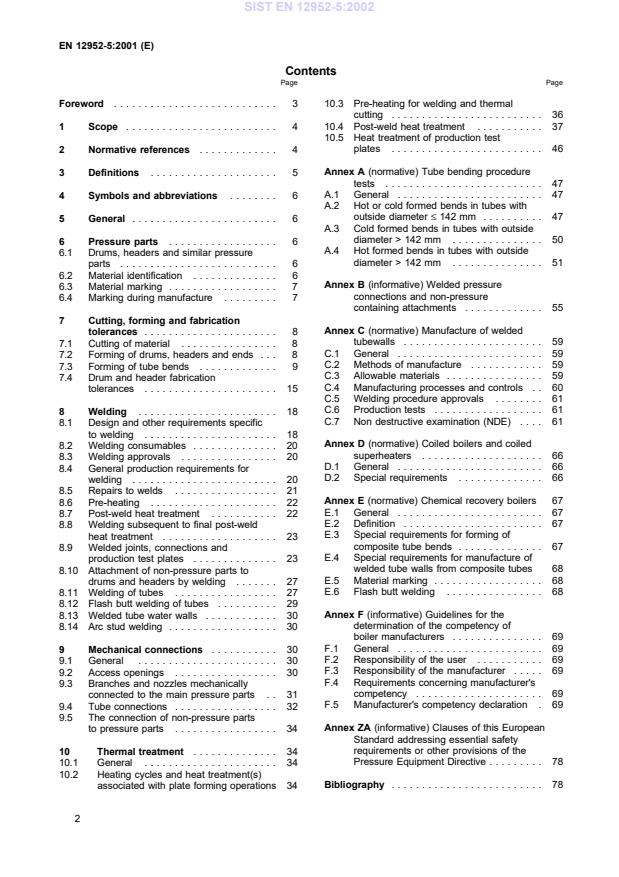
.......................309.2Access openings .................309.3Branches and nozzles mechanicallyconnected to the main pressure parts ..319.4Tube connections .................329.5The connection of non-pressure parts to pressure parts .................3410Thermal treatment ..............3410.1General ......................3410.2Heating cycles and heat treatment(s)associated with plate forming operations 3410.3Pre-heating for welding and thermal cutting .........................3610.4Post-weld heat treatment ...........3710.5Heat treatment of production test plates .........................46Annex A (normative) Tube bending proceduretests
..........................47A.1General ........................47A.2Hot or cold formed bends in tubes withoutside diameter £ 142 mm ..........47A.3Cold formed bends in tubes with outsidediameter > 142 mm ...............50A.4Hot formed bends in tubes with outsidediameter > 142 mm ...............51Annex B (informative) Welded pressure connections and non-pressure containing attachments .............55Annex C (normative) Manufacture of weldedtubewalls .......................59C.1General ........................59C.2Methods of manufacture ............59C.3Allowable materials ................59C.4Manufacturing processes and controls ..60C.5Welding procedure approvals ........61C.6Production tests ..................61C.7Non destructive examination (NDE) ....61Annex D (normative) Coiled boilers and coiled superheaters ....................66D.1General ........................66D.2Special requirements ..............66Annex E (normative) Chemical recovery boilers 67E.1General ........................67E.2Definition .......................67E.3Special requirements for forming of composite tube bends ..............67E.4Special requirements for manufacture ofwelded tube walls from composite tubes 68E.5Material marking ..................68E.6Flash butt welding ................68Annex F (informative) Guidelines for thedetermination of the competency ofboiler manufacturers ...............69F.1General ........................69F.2Responsibility of the user ...........69F.3Responsibility of the manufacturer .....69F.4Requirements concerning manufacturer'scompetency .....................69F.5Manufacturer's competency declaration .69Annex ZA (informative) Clauses of this EuropeanStandard addressing essential safetyrequirements or other provisions of thePressure Equipment Directive.........78Bibliography .........................782SIST EN 12952-5:2002
Part 4 is not applicable during the design, construction and installation stages.The annexes A, C, D and E are normative. The annexes B, F and ZA are informative.
1) Directive 97/23/EC of the European Parliament and of the Council of 29 May 1997 on the approximation of the laws of the Member States concerning pressuse equipment; OJEC L181.3SIST EN 12952-5:2002
ScopeThis Part of the European Standard specifies requirements for the workmanship and construction of water-tubeboilers as defined in EN 12952-1.2
Normative referencesThis European Standard incorporates, by dated or undated reference, provisions from other publications. Thesenormative references are cited at the appropriate places in the text and the publications are listed hereafter. Fordated references, subsequent amendments to or revisions of any of these publications apply to this EuropeanStandard only when incorporated in it by amendment or revision. For undated references, the latest edition of thepublication referred to applies.EN 287-1,
Approval testing of welders – Fusion welding – Part 1: Steels.EN 288-2,
Specification and approval of welding procedures for metallic materials – Part 2: Welding procedurespecification for arc welding.EN 288-3,
Specification and approval of welding procedures for metallic materials – Part 3: Welding procedure testsfor the arc welding of steels.EN 288-8,
Specification and approval of welding procedures for metallic materials – Part 8: Approval by a pre-production welding test.EN 571-1,
Non destructive testing – Penetrant testing – Part 1: General principles.EN 719,
Welding coordination – Tasks and responsibilities.EN 729-2,
Quality requirements for welding – Fusion welding of metallic materials – Part 2: Comprehensive qualityrequirements.EN 729-3,
Quality requirements for welding – Fusion welding of metallic materials – Part 3: Standard qualityrequirements.EN 1011-1,
Welding – Recommendations for welding of metallic materials – Part 1: General guidance for arcwelding.EN 1011-2:1999,
Welding – Recommendations for welding of metallic materials – Part 2: Arc welding of ferriticsteels.prEN 1092-1:1997,
Flanges and their joints – Circular flanges for pipes, valves, fittings and accessories, PNdesignated – Part 1: Steel flanges.EN 1092-2,
Flanges and their joints – Circular flanges for pipes, valves, fittings and accessories – Part 2: Cast ironflanges.prEN 1258:1993,
Welding – Measurement of preheating temperature, interpass temperature and preheatmaintenance temperature during welding.EN 1290,
Non-destructive examination of welds – Magnetic particle examination of welds.EN 1418,
Welding personnel – Approval testing of welding operators for fusion welding and resistance weld setterfor fully mechanized and automatic welding of metallic materials.EN 1708-1,
Welding – Basic weld joint details in steel – Part 1: Pressurized componentsprEN 1759-1,
Flanges and their joints – Circular flanges for pipes, valves, fittings and accessories, class desig-nated – Part 1: Steel flanges, NPS 1/2 to 24.prEN 10002-1:1998,
Metallic materials – Tensile testing – Part 1: Method of test (at ambient temperature).4SIST EN 12952-5:2002
Hot rolled products of non-alloy structural steels – Technical delivery conditions (includesamendment A1:1993).EN 10028-1,
Flat products made of steels for pressure purposes – Part 1: General requirements.EN 10028-2,
Flat products made of steels for pressure purposes – Part 2: Non alloy and alloy steels with specifiedelevated temperature properties.EN 10045-1,
Metallic materials – Charpy impact test – Part 1: Test method.EN 10204,
Metallic products – Types of inspection documents.prEN 10216-1:1995,
Seamless steel tubes for pressure purposes – Technical delivery conditions – Part 1: Non-alloysteel tubes with specified room temperature properties.prEN 10216-2:1998,
Seamless steel tubes for pressure purposes – Technical delivery conditions – Part 2: Non-alloyand alloy steel tubes with specified elevated temperature properties.EN 12952-1,
Water-tube boilers and auxiliary installations– Part 1: General.EN 12952-2,
Water-tube boilers and auxiliary installations – Part 2: Materials for pressure parts of boilers andaccessories.EN 12952-3,
Water-tube boilers and auxiliary installations – Part 3: Design and calculation for pressure parts.EN 12952-4,
Water-tube boilers and auxiliary installations – Part 4: In-service boiler life expectancy calculations.EN 12952-6,
Water-tube boilers and auxiliary installations – Part 6: Inspection during construction, documentationand marking of pressure parts of the boiler.EN 12952-7,
Water-tube boilers and auxiliary installations – Part 7: Requirements for equipment for the boiler.EN 25817,
Arc-welded joints in steel – Guidance on quality levels for imperfections (ISO 5817:1992).EN 26520,
Classification of imperfections in metallic fusion welds, with explanations (ISO 6520:1982).EN ISO 4063,
Welding and allied precesses – Nomenclature of processes and reference number (ISO 4063:1998).EN ISO 4759-1:1999,
Tolerances for fasteners – Part 1: Bolts, screws, studs and nuts – Product grades A, B andC (ISO/DIS 4759-1:1999).EN ISO 9692-2,
Welding and allied processes – Joint preparation – Part 2: Submerged arc welding of steels(ISO 9692-2:1998).EN ISO 14555,
Welding – Arc stud welding of metallic materials (ISO 14555:1998).ISO 8501-1,
Preparation of steel substrates before application of paints and related products – Visual assessmentof surface cleanliness – Part 1: Rust grades and preparation grades of uncoated steel subtrates and of steelsubstrates after overall removal of previous coatings.CR ISO 15608,
Welding – Guideless for a metallic material grouping system (ISO/TR 15608:2000).3
DefinitionsFor the purposes of this standard the definitions given in EN 12952-1 and the following apply.3.1cold formingfor ferritic steels, it is forming at temperatures below the maximum permissible temperature for post-weld heattreatment in accordance with table 10.4-1. Cold forming for austenitic materials is forming at temperatures below300 °C.5SIST EN 12952-5:2002
Symbols and abbreviationsFor the purposes of this European Standard, the symbols given in table 4 – 1 of EN 12952-1 shall apply. Throughoutthis European Standard, additional terminology and symbols have been included, where necessary, to meet therequirements of the specific text concerned. It should also be noted that in some clauses the same additional symbolis used in different equations to represent different terms. However, in all such cases, the special meaning of eachsymbol is indicated for each equation.5
GeneralWater-tube boilers shall be manufactured and assembled in accordance with approved drawings, procedures andspecifications and good engineering practice.The workshops and sites associated with the construction of water-tube boilers shall be properly equipped and havesuitable provisions for all the inspection and testing specified in EN 12952-6. The relevant manufacturing proceduresshall be adequate and manufacturing personnel shall be competent and properly qualified for their assigned tasks.The procedures for the approval of welding and NDE personnel are given respectively in clauses 7 and 9.2 ofEN 12952-6.Appropriate records of manufacturing operations shall be maintained.6
Pressure parts6.1
Drums, headers and similar pressure parts6.1.1
Drums, headers and similar pressure parts shall be constructed from tubes, forgings, plates or castings.Drums and headers shall be in a suitably clean condition, both internally and externally, to enable proper visualinspection of the surface to be carried out before drilling of holes for tube stubs, branches, etc. and before weldingof any permanent connections.6.1.2
The ends of forged or other seamless steel tube headers shall be carried out by any one of the followingmethods:a)forging or spinning;b)welding in accordance with clause 8, see also figure 10.3-1 of EN 12952-3;c)bolted flanges in accordance with the relevant European Standards e.g prEN 1092-1 or prEN 1759-1.Bolted flanges in accordance with c) shall not be used where the bolts would be exposed to gases of combustion.6.1.3
Header ends shall be forged or machined from steel of a grade compatible with the bodies of the headers andprofiled as shown in figure 10.3-1 of EN 12952-3.6.2
Material identificationThe manufacturer shall maintain a system of material identification for all pressure parts and drum lifting lugs.6SIST EN 12952-5:2002
Material marking6.3.1
The marking of materials shall be maintained throughout the process of manufacture. If original markings arediscarded or parts without markings could be created by dividing up parts during the course of manufacture,markings shall be transferred, normally before fabrication.Appropriate measures shall be taken to ensure that there is no possibility of confusion in the transfer of markings.6.3.2
Marking transfer shall be performed by the manufacturer's nominated representative(s) except for materialsrequiring certificate (3.1.A/3.1.C) to EN 10204 not classified as small parts.In the case of materials for which a certificate 3.1.A to EN 10204 is required, the markings shall be transferred inaccordance with the requirements of EN 12952-6.NOTE
This does not apply to small parts which are those made from certified products, such as nipples, nozzles, flanges,compensating rings, with outside diameters equal to or less than 142 mm.6.3.3
In general, material marking should be done by hard stamping using a low stress type metal stamp or etching.NOTE
Other marking methods may be used if the manufacturer can ensure that their use will not impair the safety of the boiler.6.3.4
For welded non-pressure parts, marking need only be transferred if the identification of materials is not evidentfrom the drawing or parts list.6.3.5
Bolts and nuts for pressure purposes shall be marked with the manufacturer's brandmark and property classsymbol, or the steel grade code number in accordance with EN ISO 4759-1.6.4 Marking during manufacture6.4.1 Temporary markingTemporary marks for the purpose of identification during manufacture e.g. parts numbers, welder numbers,radiograph numbers etc. shall be made by any one, or a combination, of the following methods:a)painting or pen, provided they are compatible with the material being marked;b)vibro etching or other etching tool;c)metal stamps of the low stress type.6.4.2
Permanent markingPermanent marks complying with the requirements of 6.2 shall be made by any one, or a combination, of thefollowing methods:a)vibro etching or other etching tools;b)metal stamps of the low stress type;c)stamped data plates welded directly to the component using an approved welding procedure specification.7SIST EN 12952-5:2002
Tube bendsMetal stamping shall not be permitted on the curved area of tube bends.6.4.4
Location drawingsLocation drawings may be provided in the case of welders marks, radiographs etc.7 Cutting, forming and fabrication tolerances7.1 Cutting of material7.1.1
Steel shall be cut by thermal means, shearing, sawing, machining or a combination of these methods.Thermal cutting may necessitate the use of preheating, depending on the type of steel and the thickness in question,which shall be applied in accordance with 10.3.3. It is recognized that the cold worked zone resulting from theshearing process need not be eliminated before welding if this zone will be fused during welding.7.1.2
Any material damaged metallurgically in the process of cutting to size or forming the edge or end preparationshall be removed by machining, grinding, chipping or thermal-cutting back to sound metal. Surfaces that have been thermally cut shall be cut back by machining or grinding so as to remove all burnt metal,harmful notches, slag and scale, but slight discoloration of machine thermally cut edges on mild steel shall not beregarded as detrimental. If alloy steels are prepared by thermal cutting, the surface shall be dressed back bygrinding or machining for a distance of at least 1,5 mm, unless it can be shown that the material has not beendamaged by the cutting process.NOTE
These requirements for dressing do not apply to surfaces that are prepared for electro-slag welding, where a thermallycut surface is generally acceptable without further treatment.After the edges of the material have been prepared for welding, they shall be visually examined for flaws, cracks,laminations, slag inclusions or other defects before further work is carried out. Any weld repairs that are required tomaterials damaged as a result of thermal cutting shall be to an approved welding procedure specification.7.2 Forming of drums, headers and ends7.2.1 GeneralDrums, headers and ends shall be rolled or pressed from plate, solid forged, drawn or extruded, or made by acombination of these processes. Components made by a forging, drawing or extrusion process shall be producedin accordance with the forgemasters specification, as agreed with the boiler manufacturer.Components formed from ferritic steel plate shall be heat treated in accordance with 10.2.2 to 10.2.4 inclusive. Theheating associated with forming operations and the heat treatment requirements after forming are given in 10.2.The forming requirements applicable to austenitic steel plate are the subject of development. In the meantime themethods used shall be in accordance with the manufacturer's own proven procedure which shall ensure that, by theiruse, the safety of the boiler is not impaired.7.2.2 Drum and header shellsShell plates shall be formed, either hot or cold, to ensure compliance with the tolerances specified in 7.4. Each shellplate shall be formed to the correct contour up to the extreme edges of the plate. The bending or pressing shall bedone entirely by machine. The definitions of hot and cold forming are given in 3.1 and 3.2.Local heating and hammering shall not be employed.7.2.3 EndsDishing and peripheral flanging, either hot or cold, shall be carried out to ensure compliance with the tolerancesspecified in 7.4. The operations shall be performed by machine. Sectional flanging shall not be employed.8SIST EN 12952-5:2002
Annex A requires procedure tests to be carried out on tube bends. Attention is drawn to the fact that not all thecombinations of materials and bending processes permitted, and the associated thermal treatments nominated in table 7.3-2, willsatisfy the requirements for the procedure test given in 7.3.2 to 7.3.13 and annex A.The manufacturer should ensure that any combination of material, bending process and the chosen bend geometry will producebends that satisfy the requirements of 7.3. If a chosen bend geometry is found not to comply with the requirements of 7.3, themanufacturer should adjust the design to enable the requirements to be met.7.3.2 Tube bending procedure testIt shall be demonstrated by means of a tube bending procedure test (see annex A) that tubes can be satisfactorilybent to the requirements of 7.3.1. The tests shall be performed to represent combinations of tube sizes, materialsand bend radii which demonstrate the adequacy of the bending method chosen. The range and scope of thequalification of tube bends resulting from these procedure tests are also given in annex A. The results from thebending procedure tests shall be documented and used as a basis for all future tube bends falling within the scopeof the combinations tested.When specific pre-production test bends are manufactured in accordance with table 7.3-1 and which conform to therequirements of 7.3.1 the resulting documented data shall serve as qualification for subsequent production runs andmay be considered to satisfy the requirements of annex A.NOTE
Documented evidence of previous satisfactory tube bending procedure tests may be accepted as fulfilling theserequirements.7.3.3 Requirements for dimensional testingThinning at the bend extrados, thickening at the bend intrados (where required) and departure from circularity limitsshall be demonstrated by the methods given in table 7.3-1.NOTE
This test relates to the forming of tubes for conventional water-tube boilers. For the special case of coiled boilers andcoiled superheaters, see annex D.9SIST EN 12952-5:2002
A sample test bend consists of the sectioning and measuring of a trial bend to establish the maximum thinning,thickening (where practicable), and the maximum departure from circularity. The measured values are to be checked againstthe requirements given in 7.3.4, 7.3.5 and 7.3.7 respectively.NOTE 2
A production run is defined as a series of tubes of the same size and material being bent on a specific machinewithin the same machine set-up.NOTE 3
The departure from circularity u is to be measured at the apex of the bend.NOTE 4
The radius of the bend rb measured to the centre-line of the tube.NOTE 5
The outside diameter d0 of the tube measured on the straight.NOTE 6
This table does not apply to Coil type boilers (see annex D).7.3.4 Thinning at the tube bend extrados for tubes of nominal outside diameter 142 mm and belowThe thickness at any point after bending shall not be less than that given by equation:(7.3-1)eext eact×
2rb/d0 0,52rb/d0 1whereeextis the required minimum thickness at the extrados, in mm;eactis the nominal thickness of the supplied tube minus the supplier's maximum negative thickness tolerance,in mm;rbis the radius of the bend measured to the centre-line of the tube in mm;d0is the nominal outside diameter of the tube, in mm.When the measured value on the tube bend is less than eext reference shall be made to the minimum calculatedthickness given in 11.3 of EN 12952-3.The thinning on the extrados of bends formed in two stages i.e. hot formed after initial hot or cold bending, shall notexceed 30 % of the thickness of the straight tube local to the bend as measured during a procedure test. 10SIST EN 12952-5:2002
Thickening at the tube bend intrados for tubes of nominal outside diameter above 80 mm up to andincluding 142 mmThe thickness at any point after bending shall not be less than that given by equation:(7.3-2)eint eact×
2rb/d0 0,52rb/d0 1whereeintis the required minimum thickness at the intrados, in mm;eactis the nominal thickness of the supplied tube minus the supplier's maximum negative thickness tolerance,in mm;rbis the radius of the bend measured to the centre-line of the tube, in mm;d0is the nominal outside diameter of the tube, in mm.When the measured value on the tube bend is less than eint reference shall be made to the minimum calculatedthickness given in 11.3 of EN 12952-3.7.3.6Thinning/thickening at the tube bend extrados/intrados for tubes of nominal outside diameter greaterthan 142 mmFor tubes above 142 mm diameter comparison shall be made directly with the calculated thickness given in 11.3 ofEN 12952-3. The calculated thickness shall be stated on the drawing.7.3.7 Departure from circularity of the tube bendsThe departure from circularity of tube bends shall be calculated from the equation:(7.3-3)u 2×
(ˆd 0
d 0)(ˆd 0
d 0)×100%whereuis the departure from circularity, in %;is the maximum outside diameter measured at the tube bend apex, in mm;ˆd 0is the minimum outside diameter measured at the same cross-section as , in mm. d 0ˆd 0The permitted departure from circularity shall be within the limits given in figures 7.3-1 and 7.3-2.a)The departure from circularity of tube bends, which are bent in a single continuous operation, shall not exceedthe limits shown in figure 7.3-1.b)The departure from circularity of tube bends on tubes not exceeding 80 mm nominal outside diameter, which arebent by a double operation i.e. hot pressed after the primary bending operation then post-bend heat treated inaccordance with table 7.3-2, shall not exceed the limits shown in figure 7.3-2.11SIST EN 12952-5:2002
GeneralRipples are multiple wave like undulations on the intrados of tube bends, see figure 7.3-3.Deviations from the nominal bend profile are local isolated deviations from a smooth normal profile of the intradosof the bend, e.g. irregularities sometimes found at the commencement of mandrel assisted bends in small diametertubes.7.3.10.2
Acceptance standardsa)In tubes up to and including 80 mm nominal outside diameter, ripples shall not be acceptable. Deviations fromnominal bend profile may be accepted provided the departure from circularity at the peak and trough of thedeviation meets the requirements of 7.3.7.b)For tubes above 80 mm nominal outside diameter up to and including 142 mm nominal outside diameter, ripplesand deviations from the nominal bend profile shall not be permitted.c)Tubes with nominal outside diameters greater than 142 mm shall be permitted to contain ripples on the intradosof the bend within the limits shown in figure 7.3-3, provided they have a smooth profile and blend into thesurface of the bend. Deviations from the nominal bend profile shall not be permitted.d0, d02, d03, d04, -------etc is the actual outside diameter of the tube at the position being measured.NOTE
For clarity, the ripples have been exaggerated.Figure 7.3-3 — Ripples on tube bends14SIST EN 12952-5:2002
d03 < 0,03 d0(7.3-4)Wave pitch
a > 12 hm(7.3-5)7.3.11 The surface of tube bendsThe surface of tube bends shall be free of defects such as cracks, indentions, laps and scabs. Surface defects maybe removed by grinding. In such cases the resulting thickness shall not be less than the minimum calculatedthickness given in 11.3 of EN 12952-3.The surface of the tube bend shall be such as to permit effective visual examination.Areas of the tube bend which have been ground to remove defects shall be examined by surface flaw detectionmethods to ensure that complete removal of the defect has been effected.Repairs to the tube surface by welding are generally not permitted. However, in special cases of tubes of 142 mmnominal outside diameter and above, such repairs may be acceptable, when supported by an approved weldingprocedure specification and taking into account the following:a)the extent of the zone to be repaired;b)the grade of the material involved;c)the diameter and thickness of the bend;d)the heat treatment conditions involved;e)the operating temperature of the tube bend.7.3.12
Gang bending of tube panelsThe tube bends produced by the gang bending method shall conform, in all respects, with the requirements of tubesbent singly, see A.2.4.7.The departure from circularity shall be measured during production on the two outermost tubes of the panel. Theresults shall be compared with the requirements of 7.3.7. For practical reasons,
in the equation (7.3-3) should beˆd oreplaced by the outside diameter of the tube measured in the straight.7.3.13 Bending of composite materials tubingThe bending procedures adopted for metallurgically bonded composite materials tubing shall be in accordance withthe requirements of 7.3. In addition, any special requirements recommended by the tube manufacturer shall be takeninto consideration.7.4 Drum and header fabrication tolerances7.4.1 Assembly tolerances for shells fabricated from plate and ends to shells7.4.1.1
GeneralMiddle line and surface alignment tolerances shall be permitted as follows, where ea is the actual thickness of thethinnest plate at the joint.15SIST EN 12952-5:2002
The following special requirements specific to welding shall be considered before any manufacturing iscommenced.NOTE
General guidance on welding of ferritic steels is given in EN 1011-1 and prEN 1011-2 which may be used to supplementthe welding requirements of this European Standard.8.1.2
The selection of materials for the pressure parts, and for any attachments to be made to them, shall be suchthat any welding operations which are to be carried out will not render the component unfit for its intended duty.The selection of welding consumables shall be such as to ensure the cross-weld strength required by the design isachieved. The affects of post-weld heat treatment on the completed joint as given in 8.7, shall also be taken intoconsideration.8.1.3
The boiler manufacturer shall supply, on request, fully dimensioned detailed drawings showing the construc-tion of all pressure parts to be welded and copies of all associated welding procedure specifications prepared inaccordance with clause 6 of EN 12952-6.The dimensioned drawings of main pressure parts shall include the location of all main joints and attachments to bemade to the components, clearly showing details of the main joint weld preparations, all attachment welds, and theirlocation relative to the longitudinal and circumferential joints and openings.8.1.4
Welding of the joints of the component parts of a water-tube boiler shall only be undertaken when thefollowing co
...