

prEN 13000
(Main)Cranes - Mobile cranes
- Abstract
This document applies to mobile cranes as defined in 3.16, with following characteristics:
- mobile cranes can operate on tyres, crawlers or with other mobile arrangements. In fixed positions, they can be supported by outriggers or other accessories increasing their stability;
- the superstructure of mobile cranes can be of the type of full circle slewing, of limited slewing or non-slewing. It is normally equipped with one or more hoists and/or hydraulic cylinders for lifting and lowering the boom and the load;
- mobile cranes can be equipped either with telescopic booms, with articulated booms, with lattice booms - or a combination of these - of such a design that they can readily be lowered;
- loads can be handled by hook block assemblies or other load-lifting attachments for special services.
This document is applicable to the design, build, installation of safety devices, information for use, maintenance and testing of mobile cranes.
This document is not applicable for the additional hazards related to the mounting a mobile crane on other chassis (e.g. railcars, portals, pontoons). Examples of mobile crane types and their major components are given in Annex A, B.1 and B.2.
This document is not applicable to:
- loader cranes (see EN 12999);
- off-shore cranes (see EN 13852-1);
- floating cranes (see EN 13852-2);
- slewing jib crane (see EN 14985);
- variable reach truck (see EN 1459);
NOTE 1 Variable Reach Trucks are commonly known as telehandlers.
- to cranes, installed on an agricultural tractor, intended to tow a trailer which has capability to carry goods;
- mobile self-erecting tower cranes (see EN 14439);
- earth-moving machinery used for object handling (see EN 474-series).
This document does not cover hazards related to the lifting of persons.
NOTE 2 The use of mobile cranes for the lifting of persons is subject to specific national regulations.
This document does not cover hazards related to the combination of a mobile crane with other machinery.
This document does not cover hazards related to the use of the mobile crane in potential explosive atmosphere.
For duty cycle work such as grab, magnet, piling or similar work, additional provisions are required which are outside the scope of this document.
The hazards covered by this document are identified by Annex C.
This document is not applicable to mobile cranes which are manufactured before the date of publication of this document by CEN.
- Status
- Not Published
- Publication Date
- 21-Sep-2022
- Technical Committee
- CEN/TC 147 - Cranes - Safety
- Drafting Committee
- CEN/TC 147/WG 11 - Mobiles cranes
- Current Stage
- 4098 - Decision to abandon - Enquiry
- Start Date
- 10-Jun-2022
- Completion Date
- 07-Oct-2026


Overview
prEN 13000 - Cranes: Mobile cranes (CEN draft, 2020) defines safety, design and verification principles for mobile cranes. It covers cranes that travel on tyres, crawlers or other mobile arrangements, and that may be stabilized by outriggers or similar supports. The standard applies to cranes with full‑circle slewing, limited‑slewing or non‑slewing superstructures, fitted with telescopic, articulated or lattice booms (or combinations) and using hook blocks or other load‑lifting attachments. prEN 13000 is intended for the design, construction, installation of safety devices, testing, maintenance and user information of new mobile cranes and aims to harmonize safety and performance across CEN member states.
Key topics and requirements
- Scope & exclusions: Applicable to most mobile cranes but excludes loader cranes (EN 12999), off‑shore and floating cranes (EN 13852 series), slewing jib cranes (EN 14985), telehandlers/variable reach trucks (EN 1459), self‑erecting tower cranes (EN 14439), certain agricultural or rail‑mounted installations, lifting of persons, explosive atmospheres and combinations with other machinery.
- Structural design & limit states: Requirements for loads, structural verification and material considerations (see Annex G for steel limits).
- Equipment & systems: Controls, operator station ergonomics, protective devices, hydraulic/pneumatic components, braking and steering systems, hooks and blocks.
- Stability & transport: Outrigger marking and requirements for travel/transport configurations; rollover and tip‑over protection.
- Visibility & ergonomics: Operator field of view, seats and control layouts (Annex D and E).
- Noise, fire & environmental: Noise emission testing (Annex F), fire resistance and extinguisher provisions.
- Verification & testing: Calculation and experimental test methods, test reporting and conformity checks.
- Information for use & marking: User instructions, maintenance and inspection regimes, training, spare parts and machine marking. Annex C lists identified hazards; Annexes A/B illustrate types and major parts.
Practical applications
- Creating technical specifications for new mobile crane purchases
- Designing cranes to meet harmonized European safety expectations
- Preparing conformity assessment and type‑acceptance testing
- Developing operator manuals, maintenance schedules and training programs
- Performing noise and structural verification during certification or fleet audits
Who should use this standard
- Crane manufacturers and designers
- Safety and compliance engineers
- Test laboratories and certifying bodies
- Fleet owners, rental companies and maintenance teams
- Occupational safety professionals and procurers specifying mobile cranes
Related standards (examples)
- EN 12999 (loader cranes)
- EN 13852‑1/2 (off‑shore / floating cranes)
- EN 14985 (slewing jib cranes)
- EN 14439 (self‑erecting tower cranes)
- EN 1459 (variable reach trucks / telehandlers)
prEN 13000 is a central reference for anyone involved in the lifecycle of mobile cranes - from design and testing to operation, maintenance and procurement - ensuring safer, compliant mobile crane fleets.
Relations
- Effective Date
- 19-Jan-2023
Frequently Asked Questions
prEN 13000 is a draft published by the European Committee for Standardization (CEN). Its full title is "Cranes - Mobile cranes". This standard covers: This document applies to mobile cranes as defined in 3.16, with following characteristics: - mobile cranes can operate on tyres, crawlers or with other mobile arrangements. In fixed positions, they can be supported by outriggers or other accessories increasing their stability; - the superstructure of mobile cranes can be of the type of full circle slewing, of limited slewing or non-slewing. It is normally equipped with one or more hoists and/or hydraulic cylinders for lifting and lowering the boom and the load; - mobile cranes can be equipped either with telescopic booms, with articulated booms, with lattice booms - or a combination of these - of such a design that they can readily be lowered; - loads can be handled by hook block assemblies or other load-lifting attachments for special services. This document is applicable to the design, build, installation of safety devices, information for use, maintenance and testing of mobile cranes. This document is not applicable for the additional hazards related to the mounting a mobile crane on other chassis (e.g. railcars, portals, pontoons). Examples of mobile crane types and their major components are given in Annex A, B.1 and B.2. This document is not applicable to: - loader cranes (see EN 12999); - off-shore cranes (see EN 13852-1); - floating cranes (see EN 13852-2); - slewing jib crane (see EN 14985); - variable reach truck (see EN 1459); NOTE 1 Variable Reach Trucks are commonly known as telehandlers. - to cranes, installed on an agricultural tractor, intended to tow a trailer which has capability to carry goods; - mobile self-erecting tower cranes (see EN 14439); - earth-moving machinery used for object handling (see EN 474-series). This document does not cover hazards related to the lifting of persons. NOTE 2 The use of mobile cranes for the lifting of persons is subject to specific national regulations. This document does not cover hazards related to the combination of a mobile crane with other machinery. This document does not cover hazards related to the use of the mobile crane in potential explosive atmosphere. For duty cycle work such as grab, magnet, piling or similar work, additional provisions are required which are outside the scope of this document. The hazards covered by this document are identified by Annex C. This document is not applicable to mobile cranes which are manufactured before the date of publication of this document by CEN.
This document applies to mobile cranes as defined in 3.16, with following characteristics: - mobile cranes can operate on tyres, crawlers or with other mobile arrangements. In fixed positions, they can be supported by outriggers or other accessories increasing their stability; - the superstructure of mobile cranes can be of the type of full circle slewing, of limited slewing or non-slewing. It is normally equipped with one or more hoists and/or hydraulic cylinders for lifting and lowering the boom and the load; - mobile cranes can be equipped either with telescopic booms, with articulated booms, with lattice booms - or a combination of these - of such a design that they can readily be lowered; - loads can be handled by hook block assemblies or other load-lifting attachments for special services. This document is applicable to the design, build, installation of safety devices, information for use, maintenance and testing of mobile cranes. This document is not applicable for the additional hazards related to the mounting a mobile crane on other chassis (e.g. railcars, portals, pontoons). Examples of mobile crane types and their major components are given in Annex A, B.1 and B.2. This document is not applicable to: - loader cranes (see EN 12999); - off-shore cranes (see EN 13852-1); - floating cranes (see EN 13852-2); - slewing jib crane (see EN 14985); - variable reach truck (see EN 1459); NOTE 1 Variable Reach Trucks are commonly known as telehandlers. - to cranes, installed on an agricultural tractor, intended to tow a trailer which has capability to carry goods; - mobile self-erecting tower cranes (see EN 14439); - earth-moving machinery used for object handling (see EN 474-series). This document does not cover hazards related to the lifting of persons. NOTE 2 The use of mobile cranes for the lifting of persons is subject to specific national regulations. This document does not cover hazards related to the combination of a mobile crane with other machinery. This document does not cover hazards related to the use of the mobile crane in potential explosive atmosphere. For duty cycle work such as grab, magnet, piling or similar work, additional provisions are required which are outside the scope of this document. The hazards covered by this document are identified by Annex C. This document is not applicable to mobile cranes which are manufactured before the date of publication of this document by CEN.
prEN 13000 is classified under the following ICS (International Classification for Standards) categories: 53.020.20 - Cranes. The ICS classification helps identify the subject area and facilitates finding related standards.
prEN 13000 has the following relationships with other standards: It is inter standard links to EN 13000:2010+A1:2014. Understanding these relationships helps ensure you are using the most current and applicable version of the standard.
prEN 13000 is associated with the following European legislation: EU Directives/Regulations: 2006/42/EC; Standardization Mandates: M/396. When a standard is cited in the Official Journal of the European Union, products manufactured in conformity with it benefit from a presumption of conformity with the essential requirements of the corresponding EU directive or regulation.
prEN 13000 is available in PDF format for immediate download after purchase. The document can be added to your cart and obtained through the secure checkout process. Digital delivery ensures instant access to the complete standard document.
Standards Content (Sample)
SLOVENSKI STANDARD
01-september-2020
Žerjavi - Mobilni žerjavi
Cranes - Mobile cranes
Krane - Fahrzeugkrane
Appareils de levage à charge suspendue - Grues mobiles
Ta slovenski standard je istoveten z: prEN 13000
ICS:
53.020.20 Dvigala Cranes
2003-01.Slovenski inštitut za standardizacijo. Razmnoževanje celote ali delov tega standarda ni dovoljeno.
DRAFT
EUROPEAN STANDARD
NORME EUROPÉENNE
EUROPÄISCHE NORM
June 2020
ICS 53.020.20 Will supersede EN 13000:2010+A1:2014
English Version
Cranes - Mobile cranes
Appareils de levage à charge suspendue - Grues Krane - Fahrzeugkrane
mobiles
This draft European Standard is submitted to CEN members for enquiry. It has been drawn up by the Technical Committee
CEN/TC 147.
If this draft becomes a European Standard, CEN members are bound to comply with the CEN/CENELEC Internal Regulations
which stipulate the conditions for giving this European Standard the status of a national standard without any alteration.
This draft European Standard was established by CEN in three official versions (English, French, German). A version in any other
language made by translation under the responsibility of a CEN member into its own language and notified to the CEN-CENELEC
Management Centre has the same status as the official versions.
CEN members are the national standards bodies of Austria, Belgium, Bulgaria, Croatia, Cyprus, Czech Republic, Denmark, Estonia,
Finland, France, Germany, Greece, Hungary, Iceland, Ireland, Italy, Latvia, Lithuania, Luxembourg, Malta, Netherlands, Norway,
Poland, Portugal, Republic of North Macedonia, Romania, Serbia, Slovakia, Slovenia, Spain, Sweden, Switzerland, Turkey and
United Kingdom.
Recipients of this draft are invited to submit, with their comments, notification of any relevant patent rights of which they are
aware and to provide supporting documentation.
Warning : This document is not a European Standard. It is distributed for review and comments. It is subject to change without
notice and shall not be referred to as a European Standard.
EUROPEAN COMMITTEE FOR STANDARDIZATION
COMITÉ EUROPÉEN DE NORMALISATION
EUROPÄISCHES KOMITEE FÜR NORMUNG
CEN-CENELEC Management Centre: Rue de la Science 23, B-1040 Brussels
© 2020 CEN All rights of exploitation in any form and by any means reserved Ref. No. prEN 13000:2020 E
worldwide for CEN national Members.
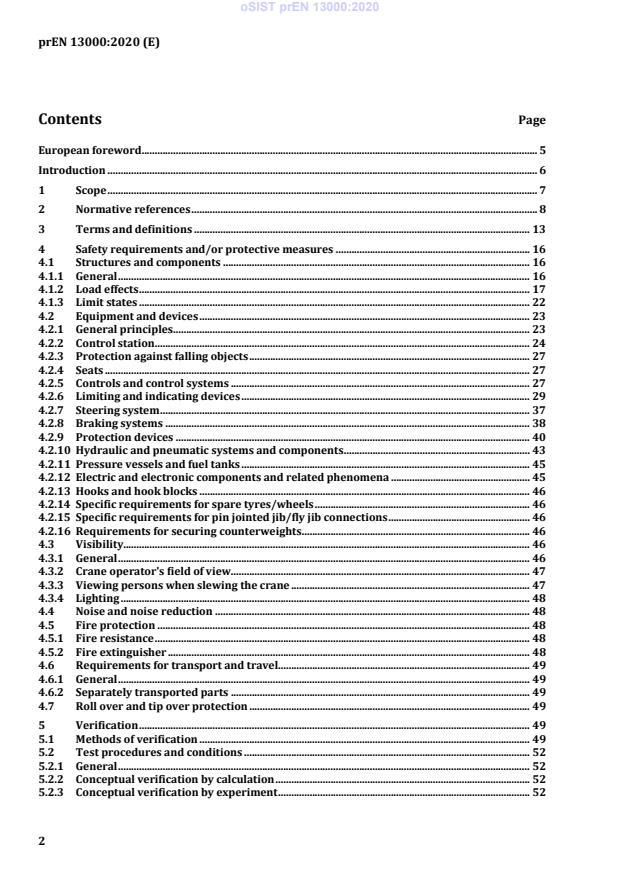
Contents Page
European foreword . 5
Introduction . 6
1 Scope . 7
2 Normative references . 8
3 Terms and definitions . 13
4 Safety requirements and/or protective measures . 16
4.1 Structures and components . 16
4.1.1 General . 16
4.1.2 Load effects . 17
4.1.3 Limit states . 22
4.2 Equipment and devices . 23
4.2.1 General principles . 23
4.2.2 Control station . 24
4.2.3 Protection against falling objects . 27
4.2.4 Seats . 27
4.2.5 Controls and control systems . 27
4.2.6 Limiting and indicating devices . 29
4.2.7 Steering system . 37
4.2.8 Braking systems . 38
4.2.9 Protection devices . 40
4.2.10 Hydraulic and pneumatic systems and components . 43
4.2.11 Pressure vessels and fuel tanks . 45
4.2.12 Electric and electronic components and related phenomena . 45
4.2.13 Hooks and hook blocks . 46
4.2.14 Specific requirements for spare tyres/wheels . 46
4.2.15 Specific requirements for pin jointed jib/fly jib connections . 46
4.2.16 Requirements for securing counterweights . 46
4.3 Visibility. 46
4.3.1 General . 46
4.3.2 Crane operator's field of view. 47
4.3.3 Viewing persons when slewing the crane . 47
4.3.4 Lighting . 48
4.4 Noise and noise reduction . 48
4.5 Fire protection . 48
4.5.1 Fire resistance . 48
4.5.2 Fire extinguisher . 48
4.6 Requirements for transport and travel. 49
4.6.1 General . 49
4.6.2 Separately transported parts . 49
4.7 Roll over and tip over protection . 49
5 Verification . 49
5.1 Methods of verification . 49
5.2 Test procedures and conditions . 52
5.2.1 General . 52
5.2.2 Conceptual verification by calculation . 52
5.2.3 Conceptual verification by experiment . 52
5.2.4 Examination after test . 52
5.2.5 Test report . 52
5.3 Verification based on noise emission values . 53
6 Information for use . 53
6.1 Format of instruction . 53
6.1.1 General . 53
6.1.2 Noise reduction by information . 53
6.1.3 Technical data and information . 53
6.2 Instructions for use . 55
6.2.1 General . 55
6.2.2 Crane operator instructions . 55
6.3 Instructions for assembly, erection, disassembly and transport . 58
6.4 Instructions for maintenance and inspection . 59
6.4.1 General . 59
6.4.2 Instructions for maintenance . 59
6.4.3 Instructions for inspection . 60
6.5 Instructions for training . 62
6.6 Instructions for spare parts . 62
6.7 Instructions for disposal . 62
7 Marking . 62
7.1 Machine marking . 62
7.2 Information and warning . 63
7.3 Graphic symbols . 63
7.4 Marking of crane parts. 63
7.5 Marking of outriggers . 63
7.6 Marking event recorder . 63
Annex A (normative) Examples of mobile crane types . 64
Annex B (informative) Major parts . 69
B.1 Major parts of telescopic cranes . 69
B.2 Major parts of lattice boom cranes . 71
Annex C (normative) List of hazards . 73
Annex D (normative) Visibiliy . 82
Annex E (normative) Crane operator's seat dimensions . 84
E.1 General . 84
E.2 Dimensions of crane operator's seat . 84
E.3 Other dimensions or adjustments . 84
Annex F (normative) Outdoor noise testing . 86
F.1 Noise test code for mobile cranes . 86
F.1.1 Introduction. 86
F.1.2 Normative references . 86
F.1.3 Terms and definitions . 86
F.1.4 Description of machinery family . 86
F.1.5 Configuration . 86
F.1.6 Sound power level determination . 87
F.1.7 Emission sound pressure level determination . 90
F.1.8 Information on measurement uncertainties . 91
F.1.9 Information to be recorded . 91
F.1.10 Information to be reported . 91
F.2 Test report . 91
F.2.1 General data . 92
F.2.2 Measurements per motion . 93
Annex G (normative) Limit values for structural and fine grain steel types . 95
Annex H (informative) Slew angle related capacities . 96
Annex I (normative) Proof of competence . 97
I.1 General . 97
I.2 Proof of competence for steel structures . 97
I.3 Proof of competence for non-steel structures . 98
I.4 Proof of competence for load bearing components . 98
I.4.1 General . 98
I.4.2 Proof of competence for mechanisms. 98
I.4.3 Proof of competence for ropes . 98
I.4.4 Proof of competence for chains . 98
I.4.5 Proof of competence for other components . 99
I.5 Proof of competence of stability against tipping of the crane . 99
I.6 Proof of competence – experimental . 99
I.6.1 Structural tests . 99
I.6.2 Rigid body stability tests . 99
Annex J (normative) Test of steering systems for off-road mobile cranes . 100
J.1 Test conditions . 100
J.2 Test procedure . 100
J.3 Permitted steering control effort . 100
Annex K (informative) Wind speed as a function of elevation . 101
Annex L (informative) Impact pressure as a function of elevation . 103
Annex M (normative) Simplified method to determine the maximum allowed wind speed . 105
Annex N (informative) Typical shapes and corresponding c values . 107
w
Annex O (normative) Efficiency of sheave sets. 108
Annex P (informative) Test procedures: Selection of load cases . 109
Annex Q (normative) Test certificate. 110
Annex R (normative) Load assumption for elements of access and egress . 111
Annex S (informative) Selection of a suitable set of crane standards for a given application . 112
Annex ZA (informative) Relationship between this European Standard and the essential
requirements of Directive 2006/42/EC aimed to be covered . 114
Bibliography . 122
European foreword
This document (prEN 13000:2020) has been prepared by Technical Committee CEN/TC 147 “Cranes -
Safety”, the secretariat of which is held by BSI.
This document is currently submitted to the CEN Enquiry.
This document will supersede EN 13000:2010+A1:2014.
This document has been prepared under a standardization request given to CEN by the European
Commission and the European Free Trade Association, and supports essential requirements of
EU Directive(s).
For relationship with EU Directive(s), see informative Annex ZA, which is an integral part of this
document.
For relationship with other European Standards for cranes, see Annex S.
This document has been prepared by Product Working Group CEN/TC 147/WG 11, Mobile Cranes, the
secretariat of which is held by DIN.
CEN/TC 147 WG 11 has completely reviewed EN 13000:2010+A1:2014 to adapt the standard to the
technical progress, to new requirements and to changes in standards referenced; the main changes of this
new edition prEN 13000:2020 are:
— the scope has been reviewed with the intent to differentiate clearly in between different products
and their related standards;
— the definition of mobile crane was clarified, a definition for mobile harbour crane was added;
— references to FEM standards for calculation have been transferred to references to the EN 13001
family, related Annexes have been deleted accordingly;
— the content of several FEM guidelines has been reviewed and additional requirements have been
introduced into this document as appropriate (e.g. access and egress, inspection of hoses);
— the concept of the tipping angle was extended to 360° around the crane to cover sideways stability
for long and slender boom systems;
— requirements related to slew angle related capacities have been introduced;
— safety functions shall be designed according to EN ISO 13849 instead of EN 954;
— addition of requirements for position monitoring of moveable outriggers and crawlers;
— new requirements for counterweight indication for certain crane types as operational aid;
— new requirements for securing counterweights;
— introduction of remote controls for operation of outriggers;
— new requirements on visibility when operating the crane;
— Annex ZA and Annex C has been substantially revised.
Introduction
This document is a type C standard.
This document has been prepared to provide one means for mobile cranes to conform to the essential
health and safety requirements of the Machinery Directive.
The machinery concerned and the extent to which hazards, hazardous situations and events are covered
are indicated in the scope of this document.
When provisions of this type C standard are different from those which are stated in type A or
B standards, the provisions of this type C standard take precedence over the provisions of the other
standards, for machines that have been designed and built according to the provisions of this
type C standard.
1 Scope
This document applies to mobile cranes as defined in 3.16, with following characteristics:
— mobile cranes can operate on tyres, crawlers or with other mobile arrangements. In fixed positions,
they can be supported by outriggers or other accessories increasing their stability;
— the superstructure of mobile cranes can be of the type of full circle slewing, of limited slewing or non-
slewing. It is normally equipped with one or more hoists and/or hydraulic cylinders for lifting and
lowering the boom and the load;
— mobile cranes can be equipped either with telescopic booms, with articulated booms, with lattice
booms – or a combination of these – of such a design that they can readily be lowered;
— loads can be handled by hook block assemblies or other load-lifting attachments for special services.
This document is applicable to the design, build, installation of safety devices, information for use,
maintenance and testing of mobile cranes.
This document is not applicable for the additional hazards related to the mounting a mobile crane on
other chassis (e.g. railcars, portals, pontoons). Examples of mobile crane types and their major
components are given in Annex A, B.1 and B.2.
This document is not applicable to:
— loader cranes (see EN 12999);
— off-shore cranes (see EN 13852-1);
— floating cranes (see EN 13852-2);
— slewing jib crane (see EN 14985);
— variable reach truck (see EN 1459);
NOTE 1 Variable Reach Trucks are commonly known as telehandlers.
— to cranes, installed on an agricultural tractor, intended to tow a trailer which has capability to carry
goods;
— mobile self-erecting tower cranes (see EN 14439);
— earth-moving machinery used for object handling (see EN 474-series).
This document does not cover hazards related to the lifting of persons.
NOTE 2 The use of mobile cranes for the lifting of persons is subject to specific national regulations.
This document does not cover hazards related to the combination of a mobile crane with other
machinery.
This document does not cover hazards related to the use of the mobile crane in potential explosive
atmosphere.
For duty cycle work such as grab, magnet, piling or similar work, additional provisions are required which
are outside the scope of this document.
The hazards covered by this document are identified by Annex C.
This document is not applicable to mobile cranes which are manufactured before the date of publication
of this document by CEN.
2 Normative references
The following documents are referred to in the text in such a way that some or all of their content
constitutes requirements of this document. For dated references, only the edition cited applies. For
undated references, the latest edition of the referenced document (including any amendments) applies.
1)
EN 2:1992, Classification of fires
EN 547-1:1996+A1:2008, Safety of machinery — Human body measurements — Part 1: Principles for
determining the dimensions required for openings for whole body access into machinery
EN 614-1:2006+A1:2009, Safety of machinery — Ergonomic design principles — Part 1: Terminology and
general principles
EN 842:1996+A1:2008, Safety of machinery — Visual danger signals — General requirements, design and
testing
EN 853:2015, Rubber hoses and hose assemblies — Wire braid reinforced hydraulic type — Specification
EN 854:2015, Rubber hoses and hose assemblies — Textile reinforced hydraulic type — Specification
EN 856:2015+AC:2019, Rubber hoses and hose assemblies — Rubber-covered spiral wire reinforced
hydraulic type — Specification
EN 894-2:1997+A1:2008, Safety of machinery — Ergonomics requirements for the design of displays and
control actuators — Part 2: Displays
EN 894-3:2000+A1:2008, Safety of machinery — Ergonomics requirements for the design of displays and
control actuators — Part 3: Control actuators
EN 1005-3:2002+A1:2008, Safety of machinery — Human physical performance — Part 3: Recommended
force limits for machinery operation
EN 1837:1999+A1:2009, Safety of machinery — Integral lighting of machines
2)
EN 1993-1-6:2007, Eurocode 3 — Design of steel structures — Part 1-6: Strength and Stability of Shell
Structures
3)
EN 1993-1-8:2005, Eurocode 3: Design of steel structures — Part 1-8: Design of joints
EN 10025-2:2019, Hot rolled products of structural steels — Part 2: Technical delivery conditions for non-
alloy structural steels
1)
As impacted by EN 2:1992/A1:2004.
2)
As impacted by EN 1993-1-6:2007/AC:2009 and EN 1993-1-6:2007/A1:2017.
)
As impacted by EN 1993-1-8:2005/AC:2009.
EN 10025-3:2019, Hot rolled products of structural steels — Part 3: Technical delivery conditions for
normalized/normalized rolled weldable fine grain structural steels
EN 10025-6:2019, Hot rolled products of structural steels — Part 6: Technical delivery conditions for flat
products of high yield strength structural steels in the quenched and tempered condition
EN 10149-2:2013, Hot rolled flat products made of high yield strength steels for cold forming — Part 2:
Technical delivery conditions for thermomechanically rolled steels
EN 12644-1:2001+A1:2008, Cranes — Information for use and testing — Part 1: Instructions
EN 13001-1:2015, Cranes — General design — Part 1: General principles and requirements
EN 13001-3-1:2012+A2:2018, Cranes — General Design — Part 3-1: Limit States and proof competence of
steel structure
EN 13586:2004+A1:2008, Cranes — Access
EN 14502-2:2005+A1:2008, Cranes — Equipment for the lifting of persons — Part 2: Elevating control
stations
EN 60204-32:2008, Safety of machinery — Electrical equipment of machines — Part 32: Requirements for
hoisting machines (IEC 60204-32:2008)
EN IEC 61000-6-2:2019, Electromagnetic compatibility (EMC) — Part 6-2: Generic standards — Immunity
for industrial environments (IEC 61000-6-2:2016)
4)
EN 61000-6-4:2007, Electromagnetic compatibility (EMC) — Part 6-4: Generic standards — Emission
standard for industrial environments (IEC 61000-6-4:2006)
EN 61310-1:2008, Safety of machinery — Indication, marking and actuation — Part 1: Requirements for
visual, acoustic and tactile signals (IEC 61310-1:2007)
EN 61310-2:2008, Safety of machinery — Indication, marking and actuation — Part 2: Requirements for
marking (IEC 61310-2:2007)
EN ISO 3411:2007, Earth-moving machinery — Physical dimensions of operators and minimum operator
space envelope (ISO 3411:2007)
EN ISO 3744:2010, Acoustics — Determination of sound power levels and sound energy levels of noise
sources using sound pressure — Engineering methods for an essentially free field over a reflecting plane
(ISO 3744:2010)
EN ISO 4413:2010, Hydraulic fluid power — General rules and safety requirements for systems and their
components (ISO 4413:2010)
EN ISO 4414:2010, Pneumatic fluid power — General rules and safety requirements for systems and their
components
)
As impacted by EN 61000-6-4:2007/A11:2011.
EN ISO 4871:2009, Acoustics — Declaration and verification of noise emission values of machinery and
equipment (ISO 4871:1996)
EN ISO 5349-1:2001, Mechanical vibration — Measurement and evaluation of human exposure to hand-
transmitted vibration — Part 1: General requirements (ISO 5349-1:2001)
5)
EN ISO 5349-2:2001, Mechanical vibration — Measurement and evaluation of human exposure to hand-
transmitted vibration — Part 2: Practical guidance for measurement at the workplace (ISO 5349-2:2001)
EN ISO 5353:1998, Earth-moving machinery, and tractors and machinery for agriculture and forestry —
Seat index point (ISO 5353:1995)
EN ISO 6385:2016, Ergonomics principles in the design of work systems (ISO 6385:2016)
EN ISO 6683:2008, Earth-moving machinery — Seat belts and seat belt anchorages — Performance
requirements and tests (ISO 6683:2005)
EN ISO 7096:2020, Earth-moving machinery — Laboratory evaluation of operator seat vibration
(ISO 7096:2020)
EN ISO 7250-1:2017, Basic human body measurements for technological design — Part 1: Body
measurement definitions and landmarks (ISO 7250-1:2017)
EN ISO 7731:2008, Ergonomics — Danger signals for public and work areas — Auditory danger signals
(ISO 7731:2003)
EN ISO 11201:2010, Acoustics — Noise emitted by machinery and equipment — Determination of emission
sound pressure levels at a work station and at other specified positions in an essentially free field over a
reflecting plane with negligible environmental corrections (ISO 11201:2010)
EN ISO 11688-1:2009, Acoustics — Recommended practice for the design of low-noise machinery and
equipment — Part 1: Planning (ISO/TR 11688-1:1995)
EN ISO 12100:2010, Safety of machinery — General principles for design — Risk assessment and risk
reduction (ISO 12100:2010)
EN ISO 13732-1:2008, Ergonomics of the thermal environment — Methods for the assessment of human
responses to contact with surfaces — Part 1: Hot surfaces (ISO 13732-1:2006)
EN ISO 13849-1:2015, Safety of machinery — Safety-related parts of control systems — Part 1: General
principles for design (ISO 13849-1:2015)
EN ISO 13849-2:2012, Safety of machinery — Safety-related parts of control systems — Part 2: Validation
(ISO 13849-2:2012)
EN ISO 13850:2015, Safety of machinery — Emergency stop function — Principles for design
(ISO 13850:2015)
EN ISO 13854:2019, Safety of machinery — Minimum gaps to avoid crushing of parts of the human body
(ISO 13854:2017)
)
As impacted by EN ISO 5349-2:2001/A1:2015.
EN ISO 13857:2019, Safety of machinery — Safety distances to prevent hazard zones being reached by
upper and lower limbs (ISO 13857:2019)
EN ISO 14118:2018, Safety of machinery — Prevention of unexpected start-up (ISO 14118:2017)
EN ISO 14120:2015, Safety of machinery — Guards — General requirements for the design and
construction of fixed and movable guards (ISO 14120:2015)
EN ISO 14123-1:2015, Safety of machinery — Reduction of risks to health resulting from hazardous
substances emitted by machinery — Part 1: Principles and specifications for machinery manufacturers
(ISO 14123-1:2015)
EN ISO 19353:2019, Safety of machinery — Fire prevention and fire protection (ISO 19353:2019)
)
ISO 2631-1:1997, Mechanical vibration and shock — Evaluation of human exposure to whole-body
vibration — Part 1: General requirements
ISO 3795:1989, Road vehicles, and tractors and machinery for agriculture and forestry — Determination of
burning behaviour of interior materials
ISO 3864-1:2011, Graphical symbols — Safety colours and safety signs — Part 1: Design principles for
safety signs and safety markings
ISO 4301-1:2016, Cranes — Classification — Part 1: General
ISO 4301-2:2009, Cranes — Classification — Part 2: Mobile cranes
7)
ISO 4305:2014, Mobile cranes — Determination of stability
ISO 4309:2017, Cranes — Wire ropes — Care and maintenance, inspection and discard
ISO 4310:2009, Cranes — Test code and procedures
ISO 7000:2019, Graphical symbols for use on equipment — Registered symbols
)
ISO 7010:2019, Graphical symbols — Safety colours and safety signs — Registered safety signs
)
ISO 7296-1:1991, Cranes — Graphic symbols — Part 1: General
ISO 7296-2:2020, Cranes — Graphic symbols — Part 2: Mobile cranes
ISO 7752-2:2011, Cranes — Control layout and characteristics — Part 2: Basic arrangement and
requirements for mobile cranes
ISO 8566-2:2016, Cranes — Cabins and control stations — Part 2: Mobile cranes
6)
As impacted by ISO 2631-1:1997/Amd 1:2010.
7)
As impacted by ISO 4305:2014/Amd 1:2016.
8)
As impacted by ISO 7010:2019/Amd 1:2020.
)
As impacted by ISO 7296-1:1991/Amd 1:1996.
ISO 8686-2:2018, Cranes — Design principles for loads and load combinations — Part 2: Mobile cranes
)
ISO 10245-2:2014, Cranes — Limiting and indicating devices — Part 2: Mobile cranes
ISO 11660-2:2015, Cranes — Access, guards and restraints — Part 2: Mobile cranes
ISO 11662-1:1995, Mobile cranes— Experimental determination of crane performance — Part 1: Tipping
loads and radii
ISO 11662-2:2014, Mobile cranes — Experimental determination of crane performance — Part 2:
Structural competence under static loading
ISO 12480-1:1997, Cranes — Safe use — Part 1: General
ISO 13200:1995, Cranes — Safety signs and hazard pictorials — General principles
ISO 16625:2013, Cranes and hoists — Selection of wire ropes, drums and sheaves
IEC 62745:2017, Safety of machinery — Requirements for cableless control systems of machinery
)
As impacted by ISO 10245-2:2014/Amd 1:2015.
3 Terms and definitions
For the purposes of this document, the following terms and definitions apply.
ISO and IEC maintain terminological databases for use in standardization at the following addresses:
— ISO Online browsing platform: available at http://www.iso.org/obp
— IEC Electropedia: available at http://www.electropedia.org/
3.1
angle indicator
device to display the actual angle of parts of the crane
EXAMPLES Boom angle indicator, fixed fly jib angle indicator, luffing fly jib indicator and/or mast angle
indicator
3.2
angle limiter
device to limit the motion of parts of the crane regarding their angles
EXAMPLES Boom angle limiter, fly jib angle limiter and/or mast angle limiter
3.3
boom length indicator
device to display the actual boom length
3.4
cabin
control station with protective enclosure
Note 1 to entry: See 3.6, 3.9 and 3.10.
3.5
configuration
combination of structural members, counterweights, support or outrigger position, hook block reeving
and similar items assembled, positioned and erected according to manufacturer's instructions and ready
for operation
3.6
control station
permanent position of controls on or off the crane
3.7
crane
machine for cyclic lifting or cyclic lifting and handling of loads suspended on hooks or other load handling
devices, whether manufactured to an individual design, in series or from prefabricated components
Note 1 to entry: Suspended may include additional means fitted to prevent swinging, rotation of the load, etc.
3.8
crane level indicator
device to indicate the levelled position of the crane
3.9
crane operator cabin
cabin provided for the operation of the crane motions to move the load
3.10
crane driver cabin
cabin provided for driving the crane on public roads
3.11
derricking (luffing) limiter
device to prevent derricking (luffing) motions of the boom and/or fly jib beyond specified limits
3.12
hoisting limiter
device either to prevent the fixed load lifting attachment from being raised such that it strikes the crane
structure, or to prevent any other specified upper limitation of the load lifting attachment from being
exceeded
3.13
indicator
device which provides warnings and/or data to facilitate the competent control of the crane within its
design parameters
3.14
load bearing component
single part or assembly of parts of a crane, which are directly subjected to load effects
EXAMPLES Hooks, ropes (stationary or running), traverse beams, pendant bars, wheels, axles, gears,
couplings, brakes, hoists, hydraulic cylinders, shafts and pins
3.15
lowering limiter
device to ensure that the specified minimum number of turns of rope on the hoist drum is maintained at
all times during operation
3.16
mobile crane
self-powered crane mounted on a chassis, equipped with a boom, which may be fitted on a mast (tower),
and capable of travelling laden or unladen, without the need for fixed runways and which relies on gravity
for stability, the chassis of the crane not having any capability to carry goods other than crane parts or
equipment whilst travelling on public roads
3.17
mobile harbour crane
mobile crane as defined in 3.16 without on-road approval. The main purpose of the mobile harbour crane
is cargo-, bulk-handling with a moderate to very heavy number of load cycles in accordance to
ISO 4301-2:2009 or heavy lift operation
3.18
off-road mobile crane
mobile crane which travels on site
EXAMPLES Rough terrain crane, crawler crane
3.19
on-road mobile crane
mobile crane which has the necessary equipment to travel on public roads and on the job site
EXAMPLES All terrain crane, truck crane
3.20
out-of-service
a mobile crane is in the out-of-service condition if the crane is fully or partially erected, or in a permitted
parking position according to the instruction manual and the crane is not working (no movements) and
there is no operator on the crane
3.21
partial safety factor
safety margin for the method of limit states chosen as described in EN 13001-2:2014, Clause 4
Note 1 to entry: See partial Partial safety factor γ
P
3.22
performance limiter
device which automatically prevents a design performance characteristic from being exceeded
3.23
radius indicator
device to display the actual radius of the load
3.24
rated capacity
load that the crane is designed to lift for a given operating condition (e.g. configuration, position of the
load)
3.25
rated capacity indicator
device which gives, within specified tolerance limits, at least a continuous indication that the rated
capacity is exceeded, and another continuous indication of the approach to the rated capacity
3.26
rated capacity limiter
device that automatically prevents the crane from handling loads in excess of its rated capacity, taking
into account the dynamic effects during normal operational use
3.27
slack rope limiter
device to automatically prevent dangers from slack rope situations
3.28
slew angle related capacity
rated capacities changing with the orientation of the super structure in relation to the carrier (slew angle)
3.29
slew position indicator
device to indicate to the crane operator the actual slew position
oSIST prEN 13000:20
...