


EN ISO/IEC 9646-6:1996
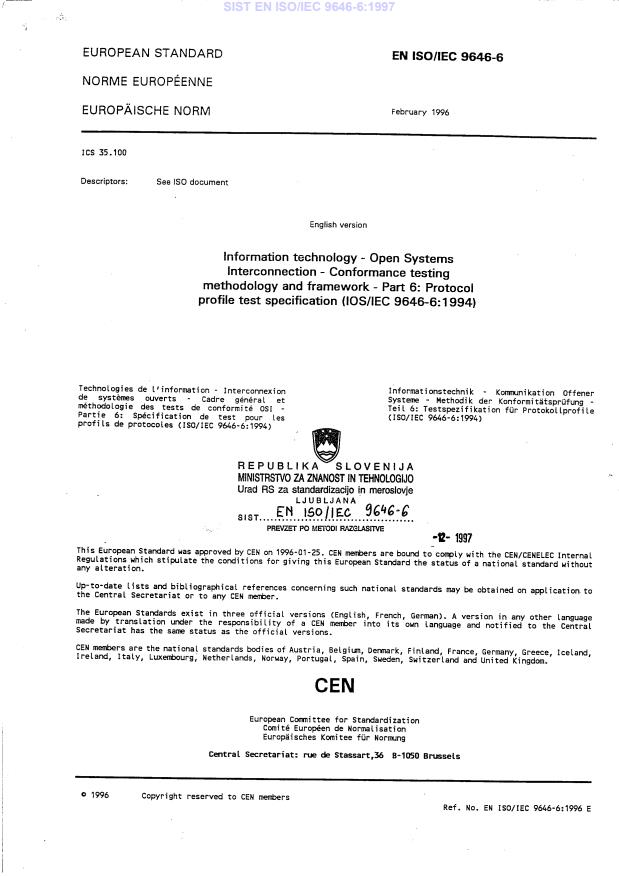
(Main)Information technology - Open Systems Interconnection - Conformance testing methodology and framework - Part 6: Protocol profile test specification (ISO/IEC 9646-6:1994)
Information technology - Open Systems Interconnection - Conformance testing methodology and framework - Part 6: Protocol profile test specification (ISO/IEC 9646-6:1994)
Informationstechnik - Kommunikation Offener Systeme - Methodik der Konformitätsprüfung - Teil 6: Testspezifikation für Protokollprofile (ISO/IEC 9646-6:1994)
Technologies de l'information - Interconnexion de systèmes ouverts - Cadre général et méthodologie des tests de conformité OSI - Partie 6: Spécification de test pour les profils de protocoles (ISO/IEC 9646-6:1994)
Information technology - Open Systems Interconnection - Conformance testing methodology and framework - Part 6: Protocol profile test specification (ISO/IEC 9646-6:1994)
General Information
- Status
- Withdrawn
- Publication Date
- 20-Feb-1996
- Withdrawal Date
- 27-Oct-1998
- Technical Committee
- CEN/SS F12 - Information processing systems
- Drafting Committee
- CEN/SS F12 - Information processing systems
- Current Stage
- 9960 - Withdrawal effective - Withdrawal
- Start Date
- 28-Oct-1998
- Completion Date
- 28-Oct-1998
Relations
- Effective Date
- 09-Feb-2026
- Effective Date
- 09-Feb-2026
- Effective Date
- 09-Feb-2026
- Effective Date
- 09-Feb-2026
- Effective Date
- 09-Feb-2026

Get Certified
Connect with accredited certification bodies for this standard

BSI Group
BSI (British Standards Institution) is the business standards company that helps organizations make excellence a habit.

NYCE
Mexican standards and certification body.
Sponsored listings
Frequently Asked Questions
EN ISO/IEC 9646-6:1996 is a standard published by the European Committee for Standardization (CEN). Its full title is "Information technology - Open Systems Interconnection - Conformance testing methodology and framework - Part 6: Protocol profile test specification (ISO/IEC 9646-6:1994)". This standard covers: Information technology - Open Systems Interconnection - Conformance testing methodology and framework - Part 6: Protocol profile test specification (ISO/IEC 9646-6:1994)
Information technology - Open Systems Interconnection - Conformance testing methodology and framework - Part 6: Protocol profile test specification (ISO/IEC 9646-6:1994)
EN ISO/IEC 9646-6:1996 is classified under the following ICS (International Classification for Standards) categories: 35.100.01 - Open systems interconnection in general. The ICS classification helps identify the subject area and facilitates finding related standards.
EN ISO/IEC 9646-6:1996 has the following relationships with other standards: It is inter standard links to EN 61850-10:2013, EN 61375-3-1:2012, EN 61375-2-5:2015, EN 61400-25-5:2017, EN 61375-2-1:2012. Understanding these relationships helps ensure you are using the most current and applicable version of the standard.
EN ISO/IEC 9646-6:1996 is available in PDF format for immediate download after purchase. The document can be added to your cart and obtained through the secure checkout process. Digital delivery ensures instant access to the complete standard document.
Standards Content (Sample)
SLOVENSKI STANDARD
01-december-1997
Information technology - Open Systems Interconnection - Conformance testing
methodology and framework - Part 6: Protocol profile test specification (ISO/IEC
9646-6:1994)
Information technology - Open Systems Interconnection - Conformance testing
methodology and framework - Part 6: Protocol profile test specification (ISO/IEC 9646-
6:1994)
Informationstechnik - Kommunikation Offener Systeme - Methodik der
Konformitätsprüfung - Teil 6: Testspezifikation für Protokollprofile (ISO/IEC 9646-6:1994)
Technologies de l'information - Interconnexion de systemes ouverts - Cadre général et
méthodologie des tests de conformité OSI - Partie 6: Spécification de test pour les profils
de protocoles (ISO/IEC 9646-6:1994)
Ta slovenski standard je istoveten z: EN ISO/IEC 9646-6:1996
ICS:
35.100.01 Medsebojno povezovanje Open systems
odprtih sistemov na splošno interconnection in general
2003-01.Slovenski inštitut za standardizacijo. Razmnoževanje celote ali delov tega standarda ni dovoljeno.
INTERNATIONAL
ISO/IEC
STANDARD
9646-6
First edition
1994-l 2-l 5
Information technology - Open Systems
Interconnection - Conformance testing
methodology and framework -
Part 6:
Protocol profile test specification
Technologies de I’informa tion - lnterconnexion de systkmes ouverts -
Cadre g&&al et mkthodologie des tests de conformit OS/ -
Partie 6: Spbcification de test pour les pro fils de protocoles
ISO/IEC 9646-6: 1994 (E)
Page
Contents
Foreword. .i v
.......................................................
Introduction. . . V
1 Scope .l
..........................................................
2 Normative references. .l
..............................................
3 Definitions .2
.......................................................
4 Abbreviations .2
...................................................
5 Compliance .3
......................................................
6 The meaning of conformance to a profile .3
...............................
6.1 Principles of profile contents and profile conformance. . .3
6.2 Profile conformance requirements. . .3
6.3 Expression of profile extra information for testing . .4
7 General testing principles .4
...........................................
7.1 Profile Test Specification (PTS) .4
..................................
7.2 Rules to develop the elements of a Profile Test Specification (PTS) . .4
7.3 Relationship with base specification testing . .5
7.4 Abstract Test Methods (ATMs) .6
...................................
7.5 System Under Test (SUT) configuration. .6
...........................
The Profile Test Specification Surnmary (PTS-Summary) .6
8 .
..G
8.1 Introduction .
.6
8.2 Contents of a PTS-Summary .
Profile Specific Test Specification (PSTS) .8
9 .
10 The Profile Test Specification (PTS) development process .8
.................
Introduction .8
10.1 .
10.2 The profile Implementation Conformance Statement (profile ICS) proforma 8
10.3 The conformance testing specification for each component . .9
10.4 Profile specific elements of the Profile Test Specification (PTS) . .lO
10.5 Minimum status for standardization . .lO
10.6 Packaging of the PTS-Summary and Profile Specific Test Specification
(PSTS) .lO
.....................................................
0 ISO/IEC 1994
All rights reserved. Unless otherwise specified, no part of this publication may be
reproduced or utilized in any form or by any means, electronic or mechanical, including
photocopying and microfilm, without permission in writing from the publisher.
ISO/IEC Copyright Office l Case Postale 56 l CH-1211 Geneve 20 l Switzerland
Printed in Switzerland
ii
ISO/IEC 9646-6: 1994 (E)
0 ISOAEC
Annex
A PTS-Summary template . .l3
A.lIntroduction.l 3
ummary to this template . .13
A.2 Conformance of a PTS-S
A.3 PTS-Summary . .13
. . .
ISODEC 9646-6: 1994 (E) 0 ISO/IEC
Foreword
IS0 (the International Organization for Standardization) and IEC (the Inter-
national Electrotechnical Commission) form the specialized system for worldwide
standardization. National bodies that are members of IS0 or IEC participate in the
development of International Standards through technical committees established
by the respective organization to deal with particular fields of technical activity.
IS0 and IEC technical committees collaborate in fields of mutual interest. Other
international organizations, governmental and non-governmental, in liaison with
IS0 and IEC, also take part in the work.
In the field of information technology, IS0 and IEC have established a joint
technical committee, ISO/IEC JTC 1. Draft International Standards adopted by the
joint technical committee are circulated to national bodies for voting. Publication
as an International Standard requires approval by at least 75 % of the national
bodies casting a vote.
International Standard ISO/IEC 9646-6 was prepared by Joint Technical
Committee ISO/IEC JTC 1, Znformation technology, Subcommittee 21, Open
Systems Interconnection, data management and open distributed processing.
ISO/IEC 9646 consists of the following parts, under the general title Information
technology - Open Systems Interconnection - Conformance testing methodol-
ogy and framework:
- Part 1: General concepts
- Part 2: Abstract Test Suite specification
- Part 3: The Tree and Tabular Combined Notation
- Part 4: Test realization
- Part 5: Requirements on test laboratories and clients for the conformance
assessment process
- Part 6: Protocol profile test specification
- Part 7: Implementation conformance statements
Annex A forms an integral part of this part of ISO/IEC 9646.
0 ISO/IEC
ISO/IEC 9646-6: 1994 (E)
Introduction
This part of ISO/IEC 9646 provides OS1 protocol profile testing methodology
based on the protocol testing methodology specified in ISO/IEC 9646-2.
ISO/IEC 9646-l defines terminology and introduces general concepts for both
protocol and profile testing. ISO/IEC 9646-4 places requirements on test realization
and ISO/IEC 9646-5 places requirements on the conformance assessment process,
both of which are applicable to profile testing. ISO/IEC 9646-7 describes how
profile requirements are documented in Implementation Conformance Statements
(ICSs) and profile Requirements Lists (RLs).
A profile specification is a document containing one or more profiles. An
International Standardized Profile (ISP) is an example of a standardized profile
specification.
A profile is defined as the selection of one or more base specifications and the
identification of the chosen classes, common subsets, options and parameters of
those base specifications necessary for accomplishing a particular function. Profiles
are defined to facilitate interworking between systems implementing the same
profile.
A profile implementation is tested for conformance to the relevant profile
specification in order to give confidence that interworking can be achieved, and to
verify that the implementation conforms to the profile specification.
The meaning of conformance to a profile and the method of expressing profile
conformance requirements are described in clause 6.
Profile testing principles, based on the methodology defined for the base protocol
specifications, are described in clause 7.
The Profile Test Specification (PTS) is the complete set of documents needed to
specify conformance testing for a profile. The PTS is based on the Abstract Test
Suite (ATS) specifications of the protocols referenced by the profile. The PTS is
described in clause 7.
The PTS-Surnmary provides, in a single document, references to all the elements of
the PTS. The PTS-Summary is described in clause 8 and a template for a PTS-
Summary is described in annex A.
The Profile Specific Test Specification (PSTS) contains any changes to the ATS
specifications relevant to the base specifications and the additional test cases
required for the profile testing. The PSTS is described in clause 9.
This part of ISO/IEC 9646 is also published by ITU as ITU-T Recommendation
X.295, but not identical texts.
V
ISO/IEC 9646-6: 1994 (E)
0 ISO/IEC
ISO/IEC 9646-6: 1994 (E)
INTERNATIONAL STANDARD 0 ISO/IEC
Information technology - Open Systems Interconnection -
Conformance testing methodology and framework - Part 6:
Protocol profile test specification
1 Scope
This part of ISO/IEC 9646 specifies the requirements and provides guidance for the production of Profile Test Specifications
(PTSs) for conformance testing of OS1 protocol profiles. This part of ISO/IEC 9646 also specifies requirements concerning
the expression of conformance requirements in protocol profile specifications.
This part of ISO/IEC 9646 is applicable to testing the conformance of a profile implementation to the static and dynamic
conformance requirements of each protocol and any information objects included in the profile, by controlling and observing
Protocol Data Unit (PDU) exchanges.
Testing requirements that go beyond conformance are outside the scope of this part of ISO/IEC 9646.
2 Normative references
The following standards contain provisions which, through reference in this text, constitute provisions of this part of ISO/IEC
9646. At the time of publication, the editions indicated were valid. All standards are subject to revision, and parties to
agreements based on this part of ISO/IEC 9646 are encouraged to investigate the possibility of applying the most recent
editions of the standards listed below. Members of IEC and IS0 maintain registers of currently valid International Standards.
- Open Systems Interconnection - Basic Reference Model.
IS0 7498: 1984, Information processing systems
(See also ITU-T Recommendation X.200 (1984)).
Open Systems Interconnection - Service conventions.
ISO/TR 8509: 1987, Information processing systems -
(See also ITU-T Recommendation X.209 (1988)).
Conformance testing methodology and
ISO/IEC 9646-l: 1994, Information technology - Open Systems Interconnection -
framework - Part 1: General concepts.
(See also ITU-T Recommendation X.290 ‘)).
Conformance testing methodology and
ISOfIEC 9646-2: 1994, Information technology - Open Systems Interconnection -
m
flamework - Part 2: Abstract Test Suite specification.
(See also ITU-T Recommendation X.291 ‘)).
ISO/IEC 9646-3: 1992, Information technology - Open Systems Interconnection - Conformance testing methodology and
Famework - Part 3: The Tree and Tabular Combined Notation (VCN}.
(See also ITU-T Recommendation X.292 (1993)).
- Conformance testing methodology
ISO/IEC 9646-3 Amd 1: -l) Information technology - Open Systems Interconnection
.
TTCN extensions.
andpamework - Part 3: Thl Tree and Tabular Combined Notation (7TCN) - Amendment 1:
ISO/IEC 9646-4: 1994, Information technology - Open Systems Interconnection - Conformance testing methodology and
ffamework - Part 4: Test realization
(See also ITU-T Recommendation X.293 ‘j).
Conformance testing methodology and
ISO/IEC 9646-5: 1994, lIzformation technology - Open Systems Interconnection -
.
j?amework - Part 5: Requirements on test laboratories and clients for the conformance assessment process.
(See also ITU-T Recommendation X.294 “).
1) To be published
0 ISOLIEC
ISO/IEC 9646-6: 1994 (E)
ISO/IEC 9646-7: - ‘), Jnfortnution technology - Open Systems Interconnection - Conformance testing methodology and
flamework - Part 7:Implementation Conformance Statements
(See also ITU-T Recommendation X.296 ‘I).
ISO/IEC TR 10000-l : 1990, Information technology - Framework and Taxonomy of International Standardized Profiles. Part 1:
Framework.
ISOIIEC TR 10000-2: 1990, Information technology - Framework and Taxonomy of International Standardized Profiles. Part 2:
Taxonomy.
3 Definitions
For the purposes of this part of ISO/IEC 9646, all the definitions in ISO/IEC 9646-l apply.
In addition, the following definition applies to this part:
component (of a profile): A component of a profile is a single protocol or a combination of one or more protocols with zero or
more information objects upon which a profile is based and which are to be tested in combination.
4 Abbreviations
For the purposes of this part of ISO/IEC 9646, the following abbreviations defined in ISOIIEC 9646-l apply:
abstract test method
ATM:
abstract test suite
ATS:
ETS: executable test suite
implementation conformance statement
ICS:
ISP: international standardized profile
IUT: implementation under test
IXIT: implementation extra information for testing
MOT: means of testing
OSI: open systems interconnection
PCTR: protocol conformance test report
PIGS: protocol implementation conformance statement
PSTS: profile specific test specification
PTS: profile test specification
RL: requirements list
system conformance statement
scs:
system conformance test report
SCTR:
system under test
SUT:
test management protocol
TMP:
TSS&TP: test suite structure and test purposes
XRL: profile IXIT requirements list
NOTE - The following abbreviations were defined for ISPs in ISO/IEC TR lOOOO- 1 but are superseded in ISO/IEC 9646 by more general terms:
IPRL: ISP requirements list (general tern1 is profile RL)
ISP implementation conformance statement (general term is profile ICS)
ISPICS:
ISPIXIT: ISP implementation extra information for testing (general term is profile IXIT).
1) To be published
ISO/IEC 9646-6: 1994 (E)
0 ISO/IEC
5 Compliance
A protocol profile specification which complies with this part of ISO/IEC 9646 shall satisfy all the requirements stated in
clause 6. A Profile Test Specification Summary (PTS-summary) which complies with this part of ISO/IEC 9646 shall satisfy
all the requirements stated in clause 8 and annex A. All the referenced conformance testing specifications shall comply with
ISOIIEC 9646-2.
A Profile Specific Test Specification (PSTS) which complies with this part of ISO/IEC 9646 shall satisfy all the requirements
stated in clause 9 and shall be the only internationally harmonized PSTS for the given profile.
If a PTS-Summary in compliance with this part of ISO/IEC 9646, references a PSTS, the PSTS shall comply with this part of
ISO/IEC 9646.
A Profile Test Specification (PTS) which complies with this part of ISO/IEC 9646 shall satisfy all the requirements stated in
clause 10.
6 The meaning of conformance to a profile
6.1 Principles of profile contents and profile conformance
A profile makes explicit the relationships between a set of base specifications used together
to accomplish a particular
being used.
function, and may also specify particular details related to each base specification
It follows that a profile:
a) shall restrict the choice of base specification options to the extent necessary to maximise the probability of interworking
between systems implementing the profile; thus a profile may retain base specification options as options of the profile
provided that they do not affect intenvorking;
requirements
b) shall not specify any that would contradict or cause non conformance to the base specificati ons to which
it refers;
c) may contain conformance requirements which are more specific and limited in scope than those of the base specifica-
tions to which it refers.
For example, when a feature is associated with an allowed parameter value range, the profile shall only adopt the same value
range as that allowed by the base specification, or a subset of that range.
Therefore, conformance to that set of base specifications does not necessarily imply conformance to the profile. However,
conformance to a profile implies by definition conformance to the set of base specifications which it references.
6.2 Profile conformance requirements
6.2.1 Introduction
The concepts of static confommnce and dynamic conformance apply also to profiles.
6.2.2 Static conformance requirements clause
In order to ensure consistency between profiles and base specifications, the static conformance requirements of a profile shall
be specified, where possible, by reference to the conformance requirements of the referenced base specifications.
There shall be a static conformance requirements clause in a profile, structured as follows:
provides an overall rationale for the
a) an overview of the major subsets or implementati on categories more detailed
selection of classes and options made in the profile;
b) the conformance requirements which relate to these subsets or implementation categories;
c) for each base specification selected in the profile, a reference to the base specification static conformance requirements
and a specification of the choices made for the profile;
d) any additional static conformance requirements of the profile which involve interdependencies of related services and
protocols.
For general guidance on conformance clauses, see ISO/IEC 9646-2, annex B, B.5.
6.2.3 Relationship between profile and base specification static conformance requirements
The static conformance requirements of an OS1 protocol profile shall relate to the static conformance requirements in the base
specifications as defined in ISO/IEC 9646-7.
0 ISO/IEC
ISO/IEC 9646-6: 1994 (E)
6.2.4 Expression of profile static conformance requirements
Profile static conformance requirements are expressed in the profile Implementation Conformance Statement (ICS) profoxma.
See ISO/IEC 9646-7 for requirements and guidance regarding the specification of the profile ICS proforma.
6.2.5 Dynamic conformance requirements
Given the implementation choices stated in the profile ICS, the dynamic conformance requirements for a profile are, for the most
part, specified by the referenced base specifications.
Hence, a profile shall specify dynamic conformance requirements by reference to those base specifications, together with any
further constraining requirements necessary to fulfil the stated purposes of the profile.
Restrictions by a profile on dynamic conformance requirements of a base specification are exceptions, and shall only apply to
transmission. Restrictions shall not apply to reception. Consequently, it is possible that receipt of an excluded option may cause
the receiving system to operate outside the profile, but still in accordance with the base specification.
6.3 Expression of profile extra information for testing
Extra information for testing a profile is expressed in the profile IXIT. See ISO/IEC 9646-1, subclause 6.2.3 for the scope and
the role of a profile IXIT proforma and profile IXIT and see ISO/IEC 9646-5, subclause 6.4.5 for more details.
7 General testing principles
7.1 Profile Test Specification (PTS)
The PTS is the set of all the conformance testing specifications needed to assess conformance to a profile.
The contents of a PTS are specified in a standardized document called a PTS-Summary. The PTS-Summary is a part of the PTS.
The PTS-Summary does not contain the fill1 text of any conformance testing specification, but only contains references to them.
The PTS-Summary references
base specifications;
1)
specific material created for a profile or a family of related profiles, called a PSTS.
2)
The users of the PTS are
a) the test realizers who develop Executable Test Suites (ETSs) for the profile;
b) the test laboratories which carry out the conformance assessment process of an implementation of a profile;
c) the clients of the test laboratories who need to know the specifications by which their profile implementations will be tested.
Profile specifiers may utilize the concept of a common profile or common subprofile, hereafter called a ‘kommon (sub)profile”,
to define a common part of a profile which can be used by one or more other profiles. A common (sub)profile may be incomplete
in itself. An example of such a common (sub)profile is the Common Upper Layer Requirements profile containing the protocols:
Session, Presentation and Association Control Service Element.
In the case of such profiles, the PTS-Summary for a complete profile may reference the PTS-Summary for a common
(sub)profile, to allow the PTS of the common (sub)profile to be incorporated within the PTS of the referencing profile.
A common (sub)profile may reference another cornrnon (sub)profile.
7.2 Rules to develop the elements of a Profile Test Specification (PTS)
The PTS shall provide testing coverage for each conformance requirement of the profile.
The contents of a PTS are based on the existence of conformance testing specifications, each one containing a Test Suite Structure
and Test Purposes (TSWTP), a partial Implementation Extra Information for Testing (IXIT) proforma and one or more Abstract
Test Suites (ATSs) plus Test Management Protocol (TMP) if any, applicable to a component of the profile (i.e. to one or more
protocols and/or information objects). The PTS shall avoid duplication of the conformance testing specifications and shall only
contain references to them.
If no conformance testing specification exists for some component of the profile, one shall be developed in compliance with ISO/
IEC 9646-2, in the context of the profile and submitted to the relevant standardization organization, for standardization of the
conformance testing specification for the relevant base specification(s) (albeit that the coverage provided by the ATS may be
incomplete).
If a profile has profile specific conformance requirements, then test purposes and corresponding abstract test cases shall be
created for these requirements.
ISO/IEC 9646-6: 1994 (E)
0 ISO/IEC
7.3 Relationship with base specification testing
7.3.1 Introduction
The conformance testing specification for each component of a profile is ideally a subset of the one for the base
specification(s), in the same way as the profile itself specifies a subset of the base specifications.
7.3.2 Options excluded by a profile
In some exceptional circumstances, a profile may include a requirement to exclude certain dynamic behaviour allowed in the
base specification (i.e. prohibiting the use of an optional capability, or restricting value ranges of parameters, allowed in the
base specification).
When designing conformance testing specifications to test such requirements, there shall be no provocative tests designed to
deliberately make the implementation operate outside the profile; thus the Means of Testing (MOT) shall at all times stay
within the limits of the profile. If the implementation exhibits out of profile behaviour which is detected when it is being tested
within the profile, a fail verdict shall be recorded for that test case.
When testing a profile implementation, the values given to parameters may need to be adapted to fit profile requirements. All
chosen parameter values shall be within the range allowed by the profile (to test the valid behaviour) or outside the range
allowed by the base specification (to test the invalid behaviour).
7.3.3 Options out-of-scope of a profile
In some circumstances, a profile may specify that a certain capability or a certain parameter value is out-of-scope.
When testing a profile implementation, the presence of an out-of-scope parameter value may become a requirement in order
to correctly encode the complete Protocol Data Unit (PDU) (e.g. if just one element of a sub-structure is out-of-scope).
However the semantics behind such a parameter shall not be tested within the PTS for that profile.
An out-of-scope parameter which is not needed to correctly encode the PDU shall not be the subject of profile testing. An
out-of-scope capability shall not be the subject of profile testing. There shall be no test cases that test the implementation with
a value that is outside the range specified in the profile, but inside the range specified in the base specification. However,
invalid behaviour test cases are needed to probe the Implementation Under Test’s response to behaviour which is invalid with
respect to the base specification.
7.3.4 Profile testing of the IUT as receiver
Systems may support more than one profile and may have the ability to correctly respond to PDUs which contain parameters
which are either out-of-scope or excluded by the profile being tested. Therefore, when testing an Implementation Under Test
(IUT) as a receiver, the MOT shall only exhibit “in profile” behaviour and shall not attempt to coerce the receiving IUT to
operate outside the profile.
The test suite specifier shall only specify valid behaviour test cases that restrain their beha viour to that allowed within the
profile. This applies to a parameter value range, where a profil e limit s the range allowed by the base specification
The implementer should not need to modify the implementation to reject the values in the wider range if they are sent to it.
Also the implementer should have the possibility to constrain the implementation to the profile specification, thus rejecting
values in the wider range. So the behaviour of profile implementations for values in the wider range cannot be uniquely
defined.
7.3.5 Profile testing of the IUT as Sender
During connection negotiation, the MOT shall at all times act as a system having implemented the profile and be prepared to
negotiate all the options available in the base specification.
Systems vary in their ability to be specifically configured for profile testing and may, upon connection establishment, offer
options outside the scope of the profile. However, as the MOT is required to behave as an implementation of the profile, those
...
Questions, Comments and Discussion
Ask us and Technical Secretary will try to provide an answer. You can facilitate discussion about the standard in here.
Loading comments...