

EN 10325:2006
(Main)Steel - Determination of yield strength increase by the effect of heat treatment [Bake-Hardening-Index]
- Abstract
This document specifies the method for the determination of yield strength increase by the effect of heat treatment (Bake-Hardening-Index) for steel.
NOTE This test is applied in particular, to steels showing a mechanism of bake hardening, which are specially intended for automotive industry.
- Status
- Published
- Publication Date
- 08-Aug-2006
- Withdrawal Date
- 27-Feb-2007
- Technical Committee
- ECISS/TC 101 - Test methods for steel (other than chemical analysis)
- Drafting Committee
- ECISS/TC 1/WG 3 - Method of measuring the BH-value
- Current Stage
- 9093 - Decision to confirm - Review Enquiry
- Start Date
- 15-May-2025
- Completion Date
- 07-Oct-2026


Overview
EN 10325:2006 defines a standardized method to determine the increase in yield strength of steel caused by heat treatment used in industrial paint processes - the Bake-Hardening-Index (BH2). The procedure quantifies how a 2 % plastic pre-strain followed by a controlled oven cycle (simulating automotive paint baking) raises yield or proof strength. This test is particularly relevant for steels that exhibit bake-hardening behavior and are commonly used in the automotive industry.
Key topics and technical requirements
- Scope: Measurement of yield strength increase (BH2) for steels showing bake-hardening mechanisms.
- Reference standard: Tensile testing and test-piece geometry in accordance with EN 10002-1.
- Pre-strain: A plastic pre-strain of (2 ± 0.05) % is applied under a constant testing rate.
- Heat treatment (simulation of paint-bake):
- Test-piece temperature must reach 170 °C within 7 minutes.
- Holding time is (20 ± 0.5) minutes starting when the test-piece reaches 168 °C.
- Oven control: test-piece temperature maintained at 170 °C ± 2 °C.
- Temperature measurement device: resolution ≤ 1 °C and measuring uncertainty ± 2 °C.
- After hold, test piece is air-cooled to room temperature (23 ± 5 °C).
- Measurement:
- BH2 is defined as the difference between the yield/proof strength before and after the specified heat treatment.
- Relevant symbols: Rp2,r (stress at 2 % pre-strain), ReL,t (lower yield after heat treatment), Rp0,2,t (0.2 % proof after heat treatment).
- Elastic modulus assumption: 200 000 MPa (for calculation context given in the standard).
- Testing conditions: Tensile testing follows EN 10002-1 procedures; the initial testing rate is controlled until ReL or Rp0.2 is determined; all tensile tests for a given steel must use the same actual testing rate.
- Test report: When BH2 testing is combined with conventional tensile tests, include BH2 in the report. If performed separately, report must reference EN 10325 and provide test-piece identification, sampling location/direction and the BH2 result.
Applications and users
- Primary users: Metallurgical laboratories, materials testing laboratories, automotive OEMs, tier suppliers, quality/verification engineers, and R&D teams working on steels with bake-hardening characteristics.
- Practical applications:
- Evaluating formability and post-painting strength of automotive body steels.
- Material selection and specification for panels that undergo paint-bake cycles.
- Quality control and supplier acceptance testing for bake-hardenable steels.
- Research into alloy and processing effects on bake-hardening response.
Related standards
- EN 10002-1:2001 - Metallic materials - Tensile testing - Method of test at ambient temperature (normative reference used for tensile methods and test-piece geometry).
Keywords: EN 10325:2006, Bake-Hardening-Index, BH2, steel, heat treatment, tensile testing, EN 10002-1, yield strength, bake hardening, automotive industry.
Relations
- Effective Date
- 28-Jan-2026
- Effective Date
- 28-Jan-2026
- Referred By
EN 10346:2009 - Continuously hot-dip coated steel flat products - Technical delivery conditions - Effective Date
- 28-Jan-2026
- Effective Date
- 28-Jan-2026
- Effective Date
- 28-Jan-2026
- Effective Date
- 28-Jan-2026
Get Certified
Connect with accredited certification bodies for this standard

ECOCERT
Organic and sustainability certification.

Element Materials Technology
Materials testing and product certification.

Eurofins Food Testing Global
Global leader in food, environment, and pharmaceutical product testing.
Sponsored listings
Frequently Asked Questions
EN 10325:2006 is a standard published by the European Committee for Standardization (CEN). Its full title is "Steel - Determination of yield strength increase by the effect of heat treatment [Bake-Hardening-Index]". This standard covers: This document specifies the method for the determination of yield strength increase by the effect of heat treatment (Bake-Hardening-Index) for steel. NOTE This test is applied in particular, to steels showing a mechanism of bake hardening, which are specially intended for automotive industry.
This document specifies the method for the determination of yield strength increase by the effect of heat treatment (Bake-Hardening-Index) for steel. NOTE This test is applied in particular, to steels showing a mechanism of bake hardening, which are specially intended for automotive industry.
EN 10325:2006 is classified under the following ICS (International Classification for Standards) categories: 71.080.20 - Halogenated hydrocarbons; 77.040.10 - Mechanical testing of metals. The ICS classification helps identify the subject area and facilitates finding related standards.
EN 10325:2006 has the following relationships with other standards: It is inter standard links to EN 10002-1:2001, EN 10346:2015, EN 10346:2009, EN 10268:2006+A1:2013, EN 10338:2015, EN 10268:2006. Understanding these relationships helps ensure you are using the most current and applicable version of the standard.
EN 10325:2006 is available in PDF format for immediate download after purchase. The document can be added to your cart and obtained through the secure checkout process. Digital delivery ensures instant access to the complete standard document.
Standards Content (Sample)
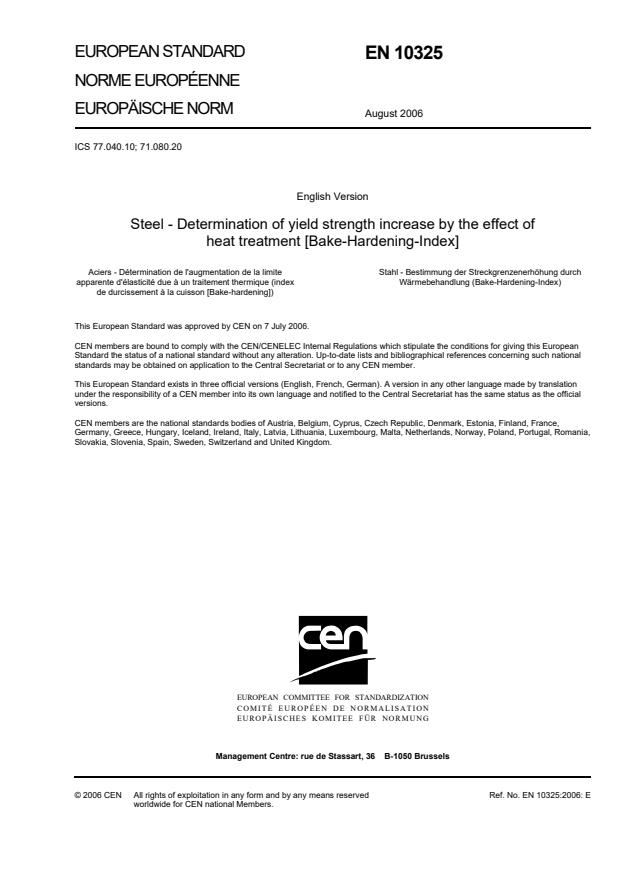
2003-01.Slovenski inštitut za standardizacijo. Razmnoževanje celote ali delov tega standarda ni dovoljeno.Steel - Determination of yield strength increase by the effect of heat treatment [Bake-Hardening-Index]+DUGHQLQJ,QGH[Aciers - Détermination de l'augmentation de la limite apparente d'élasticité due a un traitement thermique (index de durcissement a la cuisson [Bake-hardening])Stahl - Bestimmung der Streckgrenzenerhöhung durch Wärmebehandlung (Bake-Hardening-Index)Ta slovenski standard je istoveten z:EN 10325:2006SIST EN 10325:2007en77.080.20JeklaSteels77.040.10Mehansko preskušanje kovinMechanical testing of metalsICS:SLOVENSKI
STANDARDSIST EN 10325:200701-januar-2007
EUROPEAN STANDARDNORME EUROPÉENNEEUROPÄISCHE NORMEN 10325August 2006ICS 77.040.10; 71.080.20 English VersionSteel - Determination of yield strength increase by the effect ofheat treatment [Bake-Hardening-Index]Aciers - Détermination de l'augmentation de la limiteapparente d'élasticité due à un traitement thermique (indexde durcissement à la cuisson [Bake-hardening])Stahl - Bestimmung der Streckgrenzenerhöhung durchWärmebehandlung (Bake-Hardening-Index)This European Standard was approved by CEN on 7 July 2006.CEN members are bound to comply with the CEN/CENELEC Internal Regulations which stipulate the conditions for giving this EuropeanStandard the status of a national standard without any alteration. Up-to-date lists and bibliographical references concerning such nationalstandards may be obtained on application to the Central Secretariat or to any CEN member.This European Standard exists in three official versions (English, French, German). A version in any other language made by translationunder the responsibility of a CEN member into its own language and notified to the Central Secretariat has the same status as the officialversions.CEN members are the national standards bodies of Austria, Belgium, Cyprus, Czech Republic, Denmark, Estonia, Finland, France,Germany, Greece, Hungary, Iceland, Ireland, Italy, Latvia, Lithuania, Luxembourg, Malta, Netherlands, Norway, Poland, Portugal, Romania,Slovakia, Slovenia, Spain, Sweden, Switzerland and United Kingdom.EUROPEAN COMMITTEE FOR STANDARDIZATIONCOMITÉ EUROPÉEN DE NORMALISATIONEUROPÄISCHES KOMITEE FÜR NORMUNGManagement Centre: rue de Stassart, 36
B-1050 Brussels© 2006 CENAll rights of exploitation in any form and by any means reservedworldwide for CEN national Members.Ref. No. EN 10325:2006: E
...