


EN 14142-1:2011
(Main)Postal services - Address databases - Part 1: Components of postal addresses
General Information
- Abstract
This European Standard provides a dictionary of the possible ) components of postal addresses, together with examples of and constraints on their use.
This European Standard defines three hierarchical levels of postal address component:
- segments, such as addressee specification, which correspond to major logical portions of a postal address;
- constructs, such as organisation identification, which group elements within segments into units which are meaningful for human interpretation;
- elements, such as organisation name or legal status, which correspond to the lowest level of constructs, i.e. those which are not themselves made up of subordinate elements, though they may be sub-divided for technical purposes.
To cover multiple occurrences and locations of elements in an address, and to be able where necessary to work with sub-divisions of element content, the standard defines a fourth level:
- element sub-types, such as door type or door indicator, representing parts of conceptual elements, such as door, for database storage or to facilitate presentation, or representing multiple instances of conceptual elements for use in defining address element structures or templates.
NOTE The underlying point is that elements are conceptual whereas sub-types are defined to meet technical needs such as template construction, rendition requirements, accurate representation of address instances, and matching to postal database fields.
This European Standard further provides a methodology for the specification of postal address templates, which stipulate how a postal address is to be written, including the order in which postal address elements are to appear, required and optional elements, and the presentation or rendition of the elements, subject to constraints on the space available for that task. Languages suitable for human comprehension and computer processing of postal address templates are defined and described.
It also defines a number of useful terms, such as delivery address, forwarding address, mailee and mail originator. By providing a standard dictionary of postal address components, this European Standard is expected to greatly facilitate the formal description of actual address representations and the definition of procedures for mapping between them.
In practice, many address representations, whether in computer databases, in electronic messages or in printed or written form, combine several of the postal address components defined herein into single fields or lines. ) Considerable intelligence may be required in mapping between different representations, particularly where these are subject to a degree of ambiguity. )
This European Standard does not specify the length or value range of components.
This European Standard does not cover the topic of data protection. Users of this European Standard are nevertheless reminded that the storage and exchange of personal data are subject to legislation in many countries. This European Standard may be applied only to the extent that this is compliant with such legislation.
- Status
- Withdrawn
- Publication Date
- 09-Aug-2011
- Withdrawal Date
- 16-Sep-2026
- Technical Committee
- CEN/TC 331 - Postal services
- Drafting Committee
- CEN/TC 331/WG 1 - Quality of service
- Current Stage
- 9960 - Withdrawal effective - Withdrawal
- Start Date
- 13-Dec-2017
- Completion Date
- 17-Sep-2026
- Directive
- Harmonized Standard97/67/EC - Common rules for the development of the internal market of Community postal services and the improvement of quality of serviceOJ Ref: C, C 159 OJ Date: 13-May-2015



Relations
- Replaces
EN 14142-1:2003 - Postal services - Address databases - Part 1: Components of postal addresses - Effective Date
- 08-Jun-2022
- Effective Date
- 20-Dec-2017
- Effective Date
- 28-Jan-2026
- Effective Date
- 28-Jan-2026
Get Certified
Connect with accredited certification bodies for this standard

Great Wall Tianjin Quality Assurance Center
Established 1993, first batch to receive national accreditation with IAF recognition.
Hong Kong Quality Assurance Agency (HKQAA)
Hong Kong's leading certification body.

Innovative Quality Certifications Pvt. Ltd. (IQCPL)
Known for integrity, providing ethical & impartial Assessment & Certification. CMMI Institute Partner.
Sponsored listings
Frequently Asked Questions
EN 14142-1:2011 is a standard published by the European Committee for Standardization (CEN). Its full title is "Postal services - Address databases - Part 1: Components of postal addresses". This standard covers: This European Standard provides a dictionary of the possible ) components of postal addresses, together with examples of and constraints on their use. This European Standard defines three hierarchical levels of postal address component: - segments, such as addressee specification, which correspond to major logical portions of a postal address; - constructs, such as organisation identification, which group elements within segments into units which are meaningful for human interpretation; - elements, such as organisation name or legal status, which correspond to the lowest level of constructs, i.e. those which are not themselves made up of subordinate elements, though they may be sub-divided for technical purposes. To cover multiple occurrences and locations of elements in an address, and to be able where necessary to work with sub-divisions of element content, the standard defines a fourth level: - element sub-types, such as door type or door indicator, representing parts of conceptual elements, such as door, for database storage or to facilitate presentation, or representing multiple instances of conceptual elements for use in defining address element structures or templates. NOTE The underlying point is that elements are conceptual whereas sub-types are defined to meet technical needs such as template construction, rendition requirements, accurate representation of address instances, and matching to postal database fields. This European Standard further provides a methodology for the specification of postal address templates, which stipulate how a postal address is to be written, including the order in which postal address elements are to appear, required and optional elements, and the presentation or rendition of the elements, subject to constraints on the space available for that task. Languages suitable for human comprehension and computer processing of postal address templates are defined and described. It also defines a number of useful terms, such as delivery address, forwarding address, mailee and mail originator. By providing a standard dictionary of postal address components, this European Standard is expected to greatly facilitate the formal description of actual address representations and the definition of procedures for mapping between them. In practice, many address representations, whether in computer databases, in electronic messages or in printed or written form, combine several of the postal address components defined herein into single fields or lines. ) Considerable intelligence may be required in mapping between different representations, particularly where these are subject to a degree of ambiguity. ) This European Standard does not specify the length or value range of components. This European Standard does not cover the topic of data protection. Users of this European Standard are nevertheless reminded that the storage and exchange of personal data are subject to legislation in many countries. This European Standard may be applied only to the extent that this is compliant with such legislation.
This European Standard provides a dictionary of the possible ) components of postal addresses, together with examples of and constraints on their use. This European Standard defines three hierarchical levels of postal address component: - segments, such as addressee specification, which correspond to major logical portions of a postal address; - constructs, such as organisation identification, which group elements within segments into units which are meaningful for human interpretation; - elements, such as organisation name or legal status, which correspond to the lowest level of constructs, i.e. those which are not themselves made up of subordinate elements, though they may be sub-divided for technical purposes. To cover multiple occurrences and locations of elements in an address, and to be able where necessary to work with sub-divisions of element content, the standard defines a fourth level: - element sub-types, such as door type or door indicator, representing parts of conceptual elements, such as door, for database storage or to facilitate presentation, or representing multiple instances of conceptual elements for use in defining address element structures or templates. NOTE The underlying point is that elements are conceptual whereas sub-types are defined to meet technical needs such as template construction, rendition requirements, accurate representation of address instances, and matching to postal database fields. This European Standard further provides a methodology for the specification of postal address templates, which stipulate how a postal address is to be written, including the order in which postal address elements are to appear, required and optional elements, and the presentation or rendition of the elements, subject to constraints on the space available for that task. Languages suitable for human comprehension and computer processing of postal address templates are defined and described. It also defines a number of useful terms, such as delivery address, forwarding address, mailee and mail originator. By providing a standard dictionary of postal address components, this European Standard is expected to greatly facilitate the formal description of actual address representations and the definition of procedures for mapping between them. In practice, many address representations, whether in computer databases, in electronic messages or in printed or written form, combine several of the postal address components defined herein into single fields or lines. ) Considerable intelligence may be required in mapping between different representations, particularly where these are subject to a degree of ambiguity. ) This European Standard does not specify the length or value range of components. This European Standard does not cover the topic of data protection. Users of this European Standard are nevertheless reminded that the storage and exchange of personal data are subject to legislation in many countries. This European Standard may be applied only to the extent that this is compliant with such legislation.
EN 14142-1:2011 is classified under the following ICS (International Classification for Standards) categories: 01.040.03 - Services. Company organization, management and quality. Administration. Transport. Sociology. (Vocabularies); 03.240 - Postal services. The ICS classification helps identify the subject area and facilitates finding related standards.
EN 14142-1:2011 has the following relationships with other standards: It is inter standard links to EN 14142-1:2003, EN ISO 19160-4:2017, EN ISO 3166-1:2020, CEN/TR 14142-2:2011. Understanding these relationships helps ensure you are using the most current and applicable version of the standard.
EN 14142-1:2011 is associated with the following European legislation: EU Directives/Regulations: 97/67/EC; Standardization Mandates: M/240. When a standard is cited in the Official Journal of the European Union, products manufactured in conformity with it benefit from a presumption of conformity with the essential requirements of the corresponding EU directive or regulation.
EN 14142-1:2011 is available in PDF format for immediate download after purchase. The document can be added to your cart and obtained through the secure checkout process. Digital delivery ensures instant access to the complete standard document.
Standards Content (Sample)
2003-01.Slovenski inštitut za standardizacijo. Razmnoževanje celote ali delov tega standarda ni dovoljeno.Poštne storitve - Baze naslovov - 1. del: Sestavni deli poštnih naslovovPostalische Dienstleistungen - Adressdatenbanken - Teil 1: Bestandteile der postalischen AnschriftServices postaux - Bases de données d'adresse - Partie 1: Composants des adresses postalesPostal services - Address databases - Part 1: Components of postal addresses03.240Poštne storitvePostal servicesICS:Ta slovenski standard je istoveten z:EN 14142-1:2011SIST EN 14142-1:2011en01-oktober-2011SIST EN 14142-1:2011SLOVENSKI
STANDARDSIST EN 14142-1:20041DGRPHãþD
EUROPEAN STANDARD NORME EUROPÉENNE EUROPÄISCHE NORM
EN 14142-1
August 2011 ICS 03.240 Supersedes EN 14142-1:2003English Version
Postal services - Address databases - Part 1: Components of postal addresses
Services postaux - Bases de données d'adresse -Partie 1: Composants des adresses postales
Postalische Dienstleistungen - Adressdatenbanken -Teil 1: Bestandteile der postalischen Anschrift This European Standard was approved by CEN on 18 June 2011.
CEN members are bound to comply with the CEN/CENELEC Internal Regulations which stipulate the conditions for giving this European Standard the status of a national standard without any alteration. Up-to-date lists and bibliographical references concerning such national standards may be obtained on application to the CEN-CENELEC Management Centre or to any CEN member.
This European Standard exists in three official versions (English, French, German). A version in any other language made by translation under the responsibility of a CEN member into its own language and notified to the CEN-CENELEC Management Centre has the same status as the official versions.
CEN members are the national standards bodies of Austria, Belgium, Bulgaria, Croatia, Cyprus, Czech Republic, Denmark, Estonia, Finland, France, Germany, Greece, Hungary, Iceland, Ireland, Italy, Latvia, Lithuania, Luxembourg, Malta, Netherlands, Norway, Poland, Portugal, Romania, Slovakia, Slovenia, Spain, Sweden, Switzerland and United Kingdom.
EUROPEAN COMMITTEE FOR STANDARDIZATION
COMITÉ EUROPÉEN DE NORMALISATION EUROPÄISCHES KOMITEE FÜR NORMUNG
Management Centre:
Avenue Marnix 17,
B-1000 Brussels © 2011 CEN All rights of exploitation in any form and by any means reserved worldwide for CEN national Members. Ref. No. EN 14142-1:2011: ESIST EN 14142-1:2011
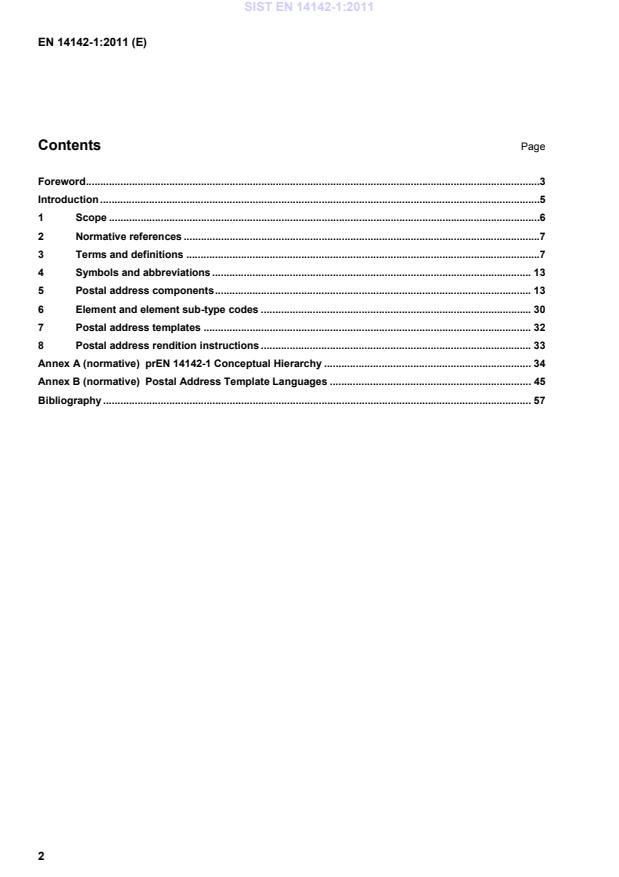
prEN 14142-1 Conceptual Hierarchy . 34Annex B (normative)
Postal Address Template Languages . 45Bibliography . 57 SIST EN 14142-1:2011
1) The Universal Postal Union (UPU) is the specialized institution of the United Nations that regulates the universal postal service. The postal services of its 189 member countries form the largest physical distribution network in the world. Some 5 million postal employees working in over 660 000 post offices all over the world handle an annual total of 425 billion letters-post items in the domestic service and almost 6,7 billion in the international service. Some 4,5 billion parcels are sent by post annually. Keeping pace with the changing communications market, posts are increasingly using new communication and information technologies to move beyond what is traditionally regarded as their core postal business. They are meeting higher customer expectations with an expanded range of products and value-added services. 2) The UPU's Standards Board develops and maintains a growing number of standards to improve the exchange of postal-related information between posts, and promotes the compatibility of UPU and international postal initiatives. It works closely with posts, customers, suppliers and other partners, including various international organizations. The Standards Board ensures that coherent standards are developed in areas such as electronic data interchange (EDI), mail encoding, postal forms and meters. UPU standards are published in accordance with the rules given in Part VII of the General information on UPU standards, which may be freely downloaded from the UPU world-wide web site (www.upu.int). SIST EN 14142-1:2011
According to the CEN/CENELEC Internal Regulations, the national standards organizations of the following countries are bound to implement this European Standard: Austria, Belgium, Bulgaria, Croatia, Cyprus, Czech Republic, Denmark, Estonia, Finland, France, Germany, Greece, Hungary, Iceland, Ireland, Italy, Latvia, Lithuania, Luxembourg, Malta, Netherlands, Norway, Poland, Portugal, Romania, Slovakia, Slovenia, Spain, Sweden, Switzerland and the United Kingdom.
3) The Brazilian postcode, for example, is saved in the format 99999999 in a database. However, in an address, the postcode should be printed in the format 99999–999. The rendition instructions therefore state that the Brazilian postcode is printed with a dash between the 5th and 6th digits. SIST EN 14142-1:2011
4) Terms in bold are defined either in Clause 3, Terms and Definitions or Clause 5, Postal Address Components. SIST EN 14142-1:2011
It also defines a number of useful terms, such as delivery address, forwarding address, mailee and mail originator. By providing a standard dictionary of postal address components, this standard is expected to greatly facilitate the formal description of actual address representations and the definition of procedures for mapping between them. In practice, many address representations, whether in computer databases, in electronic messages or in printed or written form, combine several of the postal address components defined herein into single fields or lines.6) Considerable intelligence may be required in mapping between different representations, particularly where these are subject to a degree of ambiguity.7)
5) Note that an individual postal address, or a class of postal addresses (such as the addresses used in a given country) may require only a subset of the possible components. For example, Irish postal addresses do not at this time include postcodes. 6)
Note that practical databases (and even printed addresses) may also combine postal address components, as defined herein, with other relevant data. For example, a company's customer database may include a customer reference or identification number along with each customer's address. Such additional data are not considered, for the purpose of this standard, as part of the address, but they obviously need to be taken into account in the design of the database and the applications which use it. 7)
For example, in the individual name John Smith, it is reasonably evident that Smith is the individual's surname and that John is a given name. But James Joyce is rather more ambiguous: does this represent Mr. Joyce, with given name James, or Ms James, with given name Joyce? SIST EN 14142-1:2011
This standard does not cover the topic of data protection. Users of this standard are nevertheless reminded that the storage and exchange of personal data are subject to legislation in many countries. This standard may be applied only to the extent that this is compliant with such legislation. 2 Normative references The following referenced documents are indispensable for the application of this document. For dated references, only the edition cited applies. For undated references, the latest edition of the referenced document (including any amendments) applies. EN ISO 3166–1, Codes for the representation of names of countries and their subdivisions — Part 1: Country codes (ISO 3166-1:2006) UPU Standards Glossary 3 Terms and definitions For the purposes of this document, the terms and definitions in the UPU Standards Glossary and the following additions and exceptions apply. NOTE This clause of the standard defines a number of general terms and concepts which are referred to in this standard. This clause does not include definitions of individual postal address components, which are separately defined in Clause 5. 3.1 address see postal address 3.2 addressee party who is the intended ultimate recipient of a postal item NOTE 1 The addressee may be explicitly defined as part of the postal address, or may be implicit. For example, in certain countries, omission of addressee information is taken as implying that delivery is to be to an individual or legal entity having legal access to the delivery point. NOTE 2 An address may contain multiple addressee specifications. For example, Mr. or Mrs. Smith specifies that the addressee is either one of two individuals, whilst Mr. Jones and Mrs. Smith denotes that the addressee is a group of two individuals. See also addressee role descriptor. NOTE 3 The use made by the postal operator of addressee and mailee data might be dependent on the postal service applicable to the postal item. For some services, such as registered mail, the postal operator’s responsibility might include ensuring that the addressee, or a duly authorised representative, acknowledges receipt of the postal item. In other cases, addressee data could be purely informative or used by the postal operator only for consistency checking and/or for the activation of forwarding services. In still other cases, it might be used for sorting or sequencing purposes prior to delivery (e.g. in the case of business mail being pre-sequenced by department or individual company official). NOTE 4 When the addressee is explicitly defined (see NOTE 1), there is always one addressee in a syntactically correct postal address, whereas the mailee information does not have to be present. In some countries, the addressee may be an abstraction such as "Postal Customer". 3.3 component see postal address component SIST EN 14142-1:2011
NOTE Clause 5 of this standard defines the postal address components which may occur in an actual postal address. It should be noted that not all components are necessarily used in a specific instance or class of postal addresses. 3.19 postal address construct combination of postal address elements which together form a logical portion of a postal address NOTE 1 Some constructs are defined hierarchically. That is, a construct may comprise a logical grouping of postal address elements, a logical grouping of lower level constructs, or a combination of elements and lower level constructs. NOTE 2 5.3 of this standard defines the constructs which may occur in a postal address. It should be noted that not all constructs are necessarily used in a specific instance or class of postal addresses. see postal address component, postal address segment 3.20 postal address element basic entity of a postal address that has a well-defined conceptual meaning and representation and has significance for customer or postal processing purposes NOTE
A thoroughfare name which may comprise one or more words is an example of a postal address construct, but that does not imply that the individual words of which it is comprised are also constructs. For example, with Pine Grove Avenue, there are at most two postal address constructs. So Pine Grove might be considered as a postal address element, the thoroughfare name. On the other hand, it is part of a larger thoroughfare construct that includes thoroughfare type and thoroughfare qualifier. These entities can precede or follow the thoroughfare name. This makes it helpful to have separate placeholders for each possible sequential ordering of components in designing postal address templates, and since the meaning of an element is independent of the position, this shows the need for element sub-types alongside elements.
So is thoroughfare name an element sub-type, an element, or a larger construct made up of elements? EN 14142-1 approaches this by defining those components needed to represent instances or parts of constructs as element sub-types. SIST EN 14142-1:2011
On the segment level, though not the construct level, it is possible to replicate a group of elements and have them recognized in the templates. This provides a way to solve certain problems in designing address database, such as multiple addressees at one address, or multiple addresses for one addressee. Leaving aside the cases of representations and replication, EN 14142-1:2011 handles multiplicity and subdivision of elements by defining element sub-types. It uses two levels of sub-type in the notation, one for instances and one for parts. Instances can be levels, positions, or occurrences, and parts can be physical or logical. This approach keeps the number of postal address elements limited. Elements should have meaning in a general rather than only a specialized postal context, while this is not always the case with element sub-types, particularly those representing parts of elements. Some cases could be decided either way, but this approach results in combining some previously defined elements, including the components of thoroughfare and the components of delivery service identifier, into single elements, while leaving others such as surname prefix and name qualifier to retain their status as elements. 5.4 of this standard defines the elements which may occur in a postal address. It should be noted that not all elements are necessarily used in a specific instance or class of postal addresses. 3.21 postal address element and element sub-type code alternate representation for a postal address element or element sub-type which uses a condensed notation that conforms to specified conventions, is suitable for use in templates, and is relatively language independent when compared with the element and element sub-type names NOTE Clause 6 of this standard further explains element and element sub-type codes. 3.22 postal address element sub-type sub-division of a postal address element representing parts or instances of the root element, used to facilitate template design, address rendition, address database storage and related technical needs
NOTE Postal address element sub-types are further described in 5.5. 3.23 postal address segment named group of related postal address constructs and/or postal address elements with a specific defined function NOTE 5.2 defines the postal address segments. see postal address component
3.24 postal address structure manner in which postal address components are or can be combined to form a postal address NOTE Postal address structures may differ from country to country, from region to region or even from operator to operator within a country. see syntactically correct postal address, valid postal address, postal address template SIST EN 14142-1:2011
Figure 1 — Postal Address Components – Segments, Constructs & Elements SIST EN 14142-1:2011
Figure 2 — Postal Address Components – Segments, Constructs & Elements SIST EN 14142-1:2011
Figure 3 — Postal Address Components – Segments, Constructs & Elements 5.2 Postal address segments This sub-clause defines the segments which may occur in a postal address. Terms in bold font correspond to postal address constructs or postal address elements which are defined in 5.3 and 5.4 respectively; terms defined in Clause 3 and in 5.5 are printed in normal font. 5.2.1 addressee specification postal address segment which specifies the addressee NOTE 1 Addressee specification is composed of either individual identification or organisation identification, possibly combined with addressee role descriptor. NOTE 2 Specification of the addressee may be optional or mandatory, depending on the particular postal service for which a postal address is to be used. For example, for normal letter mail, a delivery point specification is sufficient in many countries, and in this case, the addressee is considered as being any party which has legal access to the delivery point. In contrast, registered mail should normally carry an explicit specification of the addressee. SIST EN 14142-1:2011
5.3.4 individual identification postal address construct identifying, for the purpose of establishing the addressee or mailee of a postal item, either a single individual or a group of individuals, from which the postal operator may select one NOTE Individual identification is a component of addressee specification and mailee specification. It comprises form of address, given name, compound surname, name qualifier and qualification in which each element may occur none, one or more times. 5.3.5 locality postal address construct identifying the geographical area in or adjacent to which a delivery point is located NOTE 1
...