

EN 16222:2012
(Main)Cathodic protection of ship hulls
- Abstract
1.1 General
This European Standard defines the general criteria and recommendations for cathodic protection of immersed external ship hulls and appurtenances.
This European Standard does not cover safety and environmental protection aspects associated with cathodic protection. Relevant national or international regulations and classification society requirements apply.
1.2 Structures
This European Standard covers the cathodic protection of the underwater hulls of ships, boats and other self propelled floating vessels generally used in seawater together with their appurtenances such as rudders, propellers, shafts and stabilisers.
It also covers the cathodic protection of thrusters, sea chests and water intakes (up to the first valve).
It does not cover the protection of internal surfaces such as ballast tanks.
It does not cover steel offshore floating structures which are covered in EN 13173.
1.3 Materials
This European Standard covers the cathodic protection of ship hulls fabricated principally from carbon manganese steels including appurtenances of other ferrous or non-ferrous alloys such as stainless steels and copper alloys, etc.
This European Standard applies to both coated and bare hulls; most hulls are coated.
The cathodic protection system should be designed to ensure that there is a complete control over any galvanic coupling.
This European Standard does not cover the cathodic protection of hulls principally made of other materials such as aluminium alloys, stainless steels or concrete.
1.4 Environment
This European Standard is applicable to the hull and appurtenances in seawater and all waters which could be found during a ship’s world-wide deployment.
- Status
- Published
- Publication Date
- 16-Oct-2012
- Withdrawal Date
- 29-Apr-2013
- Technical Committee
- CEN/TC 219 - Cathodic protection (provisional)
- Drafting Committee
- CEN/TC 219/WG 3 - Cathodic protection of steel structures in sea-water
- Current Stage
- 9060 - Closure of 2 Year Review Enquiry - Review Enquiry
- Start Date
- 03-Mar-2024
- Completion Date
- 03-Mar-2024


Overview
EN 16222:2012 - Cathodic protection of ship hulls (CEN) defines general criteria and recommendations for protecting immersed external ship hulls and associated appurtenances against corrosion in seawater. The standard is intended for hulls fabricated principally from carbon‑manganese steel (most coated), and for appurtenances made from other ferrous or non‑ferrous alloys (e.g., stainless steels, copper alloys). It applies to worldwide seawater environments and covers both galvanic (sacrificial) anode and impressed current systems. Safety, environmental regulations and classification society requirements are not replaced by this standard and remain applicable.
Key topics and requirements
- Scope and coverage
- Underwater hulls of ships, boats and self‑propelled vessels and appurtenances: rudders, propellers, shafts, stabilisers, thrusters, sea chests and water intakes (up to first valve).
- Excludes internal surfaces (e.g., ballast tanks) and steel offshore floating structures (covered by EN 13173). Not intended for hulls principally made of aluminium alloys, stainless steel hulls or concrete.
- Design principles
- Deliver sufficient current to maintain structure‑to‑electrolyte potentials within protection criteria; distribute current uniformly across submerged surfaces.
- Systems may be designed for the ship’s life or by dry‑docking interval basis.
- Control of galvanic coupling and interactions (e.g., with electrochemical anti‑fouling systems, box coolers) is required.
- System types
- Guidance on galvanic anode systems (selection, placement, anode life, current output).
- Guidance on impressed current systems (objectives, design and equipment considerations).
- Installation, commissioning & maintenance
- Measurement procedures, commissioning checks for both system types, operation, monitoring, and dry‑docking considerations.
- Documentation and full recording of design, installation, commissioning and operation.
- Competence
- Personnel competence must be demonstrated (EN 15257 recommended). Quality management and documented quality plans (e.g., EN ISO 9001) are recommended.
- Informative annexes
- Design current guidance, formulas for anode resistance and life, bonding and monitoring guidance, and example layouts.
Applications and users
- Practical use cases:
- Designing cathodic protection for newbuild hulls and retrofits
- Specifying anode systems for shipyards, repair yards and naval dockyards
- Commissioning and maintenance planning for ship owners and operators
- Risk assessment of interactions between CP systems and onboard systems (sea chests, box coolers)
- Typical users:
- Naval architects, shipbuilders, marine engineers
- Cathodic protection designers and specialists
- Ship owners/operators, classification societies, maintenance teams
- Marine corrosion consultants
Related standards
- EN 12473 - General principles of cathodic protection in seawater
- EN 12496 - Galvanic anodes for cathodic protection in seawater
- EN 13509 - Cathodic protection measurement techniques
- EN 50162 - Protection against stray current from DC systems
- EN ISO 8044 - Corrosion terms and definitions
- EN 15257 - Certification of competence for cathodic protection personnel
- EN 13173 - Cathodic protection for offshore floating steel structures
Keywords: cathodic protection, ship hulls, galvanic anodes, impressed current, seawater corrosion, hull coating, sea chests, propeller protection, cathodic protection design, EN 16222.
Relations
- Effective Date
- 09-Feb-2026
- Effective Date
- 28-Jan-2026
- Effective Date
- 28-Jan-2026
- Effective Date
- 28-Jan-2026
- Effective Date
- 28-Jan-2026
Get Certified
Connect with accredited certification bodies for this standard

DNV
DNV is an independent assurance and risk management provider.

Lloyd's Register
Lloyd's Register is a global professional services organisation specialising in engineering and technology.

Element Materials Technology
Materials testing and product certification.
Sponsored listings
Frequently Asked Questions
EN 16222:2012 is a standard published by the European Committee for Standardization (CEN). Its full title is "Cathodic protection of ship hulls". This standard covers: 1.1 General This European Standard defines the general criteria and recommendations for cathodic protection of immersed external ship hulls and appurtenances. This European Standard does not cover safety and environmental protection aspects associated with cathodic protection. Relevant national or international regulations and classification society requirements apply. 1.2 Structures This European Standard covers the cathodic protection of the underwater hulls of ships, boats and other self propelled floating vessels generally used in seawater together with their appurtenances such as rudders, propellers, shafts and stabilisers. It also covers the cathodic protection of thrusters, sea chests and water intakes (up to the first valve). It does not cover the protection of internal surfaces such as ballast tanks. It does not cover steel offshore floating structures which are covered in EN 13173. 1.3 Materials This European Standard covers the cathodic protection of ship hulls fabricated principally from carbon manganese steels including appurtenances of other ferrous or non-ferrous alloys such as stainless steels and copper alloys, etc. This European Standard applies to both coated and bare hulls; most hulls are coated. The cathodic protection system should be designed to ensure that there is a complete control over any galvanic coupling. This European Standard does not cover the cathodic protection of hulls principally made of other materials such as aluminium alloys, stainless steels or concrete. 1.4 Environment This European Standard is applicable to the hull and appurtenances in seawater and all waters which could be found during a ship’s world-wide deployment.
1.1 General This European Standard defines the general criteria and recommendations for cathodic protection of immersed external ship hulls and appurtenances. This European Standard does not cover safety and environmental protection aspects associated with cathodic protection. Relevant national or international regulations and classification society requirements apply. 1.2 Structures This European Standard covers the cathodic protection of the underwater hulls of ships, boats and other self propelled floating vessels generally used in seawater together with their appurtenances such as rudders, propellers, shafts and stabilisers. It also covers the cathodic protection of thrusters, sea chests and water intakes (up to the first valve). It does not cover the protection of internal surfaces such as ballast tanks. It does not cover steel offshore floating structures which are covered in EN 13173. 1.3 Materials This European Standard covers the cathodic protection of ship hulls fabricated principally from carbon manganese steels including appurtenances of other ferrous or non-ferrous alloys such as stainless steels and copper alloys, etc. This European Standard applies to both coated and bare hulls; most hulls are coated. The cathodic protection system should be designed to ensure that there is a complete control over any galvanic coupling. This European Standard does not cover the cathodic protection of hulls principally made of other materials such as aluminium alloys, stainless steels or concrete. 1.4 Environment This European Standard is applicable to the hull and appurtenances in seawater and all waters which could be found during a ship’s world-wide deployment.
EN 16222:2012 is classified under the following ICS (International Classification for Standards) categories: 47.020.01 - General standards related to shipbuilding and marine structures; 77.060 - Corrosion of metals. The ICS classification helps identify the subject area and facilitates finding related standards.
EN 16222:2012 has the following relationships with other standards: It is inter standard links to EN 50162:2004, EN ISO 9351:2025, EN 13509:2003, EN 12473:2014, EN ISO 8044:2025. Understanding these relationships helps ensure you are using the most current and applicable version of the standard.
EN 16222:2012 is available in PDF format for immediate download after purchase. The document can be added to your cart and obtained through the secure checkout process. Digital delivery ensures instant access to the complete standard document.
Standards Content (Sample)
2003-01.Slovenski inštitut za standardizacijo. Razmnoževanje celote ali delov tega standarda ni dovoljeno.Kathodischer Korrosionsschutz von SchiffenProtection cathodique des coques de bateauxCathodic protection of ships47.020.01Splošni standardi v zvezi z ladjedelništvom in konstrukcijami na morjuGeneral standards related to shipbuilding and marine structures25.220.40Kovinske prevlekeMetallic coatingsICS:Ta slovenski standard je istoveten z:EN 16222:2012SIST EN 16222:2014en,fr,de01-julij-2014SIST EN 16222:2014SLOVENSKI
STANDARD
EUROPEAN STANDARD NORME EUROPÉENNE EUROPÄISCHE NORM
EN 16222
October 2012 ICS 47.020.01; 77.060 English Version
Cathodic protection of ship hulls
Protection cathodique des coques de bateaux
Kathodischer Korrosionsschutz von Schiffen This European Standard was approved by CEN on 25 August 2012.
CEN members are bound to comply with the CEN/CENELEC Internal Regulations which stipulate the conditions for giving this European Standard the status of a national standard without any alteration. Up-to-date lists and bibliographical references concerning such national standards may be obtained on application to the CEN-CENELEC Management Centre or to any CEN member.
This European Standard exists in three official versions (English, French, German). A version in any other language made by translation under the responsibility of a CEN member into its own language and notified to the CEN-CENELEC Management Centre has the same status as the official versions.
CEN members are the national standards bodies of Austria, Belgium, Bulgaria, Croatia, Cyprus, Czech Republic, Denmark, Estonia, Finland, Former Yugoslav Republic of Macedonia, France, Germany, Greece, Hungary, Iceland, Ireland, Italy, Latvia, Lithuania, Luxembourg, Malta, Netherlands, Norway, Poland, Portugal, Romania, Slovakia, Slovenia, Spain, Sweden, Switzerland, Turkey and United Kingdom.
EUROPEAN COMMITTEE FOR STANDARDIZATION
COMITÉ EUROPÉEN DE NORMALISATION EUROPÄISCHES KOMITEE FÜR NORMUNG
Management Centre:
Avenue Marnix 17,
B-1000 Brussels © 2012 CEN All rights of exploitation in any form and by any means reserved worldwide for CEN national Members. Ref. No. EN 16222:2012: ESIST EN 16222:2014
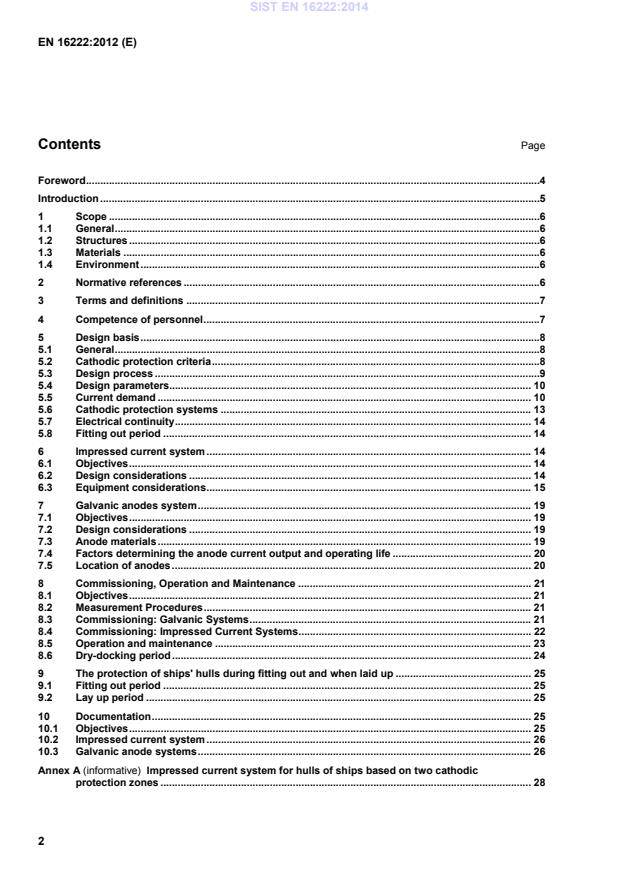
Impressed current system for hulls of ships based on two cathodic protection zones . 28SIST EN 16222:2014
Guidance on design current values for cathodic protection of hulls of ships . 29B.1Typical design current densities for the cathodic protection of bare steel (Jb) . 29B.2Coating breakdown of conventional paint systems (fc) . 29B.3Typical current densities for global approach of the cathodic protection of coated ships (Jg) . 30Annex C (informative)
Anode resistance, current and life duration formulae . 31C.1Anode resistance formulae . 31C.2Calculation of the anode resistance at the end of life . 32C.3Electrolyte resistivity . 33C.4Galvanic anode current output . 35C.5Anode life . 35C.6Minimum Net Weight Requirement . 35Annex D (informative)
Electrical bonding systems . 37Annex E (informative)
Monitoring of electrical bonding of a ship's propeller . 39Annex F (informative)
Impressed current system for ships based on an aft (stern) system only . 40Annex G (informative)
Location of galvanic anodes in the stern area . 41Annex H (informative)
Electrochemical characteristics of impressed current anodes . 42Annex I (informative)
Cofferdam arrangements . 43Annex J (informative)
Cathodic protection of a moored ship using suspended galvanic anodes . 45Bibliography . 46 SIST EN 16222:2014
This European Standard does not cover safety and environmental protection aspects associated with cathodic protection. Relevant national or international regulations and classification society requirements apply. 1.2 Structures This European Standard covers the cathodic protection of the underwater hulls of ships, boats and other self propelled floating vessels generally used in seawater together with their appurtenances such as rudders, propellers, shafts and stabilisers. It also covers the cathodic protection of thrusters, sea chests and water intakes (up to the first valve). It does not cover the protection of internal surfaces such as ballast tanks.
It does not cover steel offshore floating structures which are covered in EN 13173. 1.3 Materials This European Standard covers the cathodic protection of ship hulls fabricated principally from carbon manganese steels including appurtenances of other ferrous or non-ferrous alloys such as stainless steels and copper alloys, etc.
This European Standard applies to both coated and bare hulls; most hulls are coated. The cathodic protection system should be designed to ensure that there is a complete control over any galvanic coupling. This European Standard does not cover the cathodic protection of hulls principally made of other materials such as aluminium alloys, stainless steels or concrete. 1.4 Environment This European Standard is applicable to the hull and appurtenances in seawater and all waters which could be found during a ship’s world-wide deployment. 2 Normative references The following documents, in whole or in part, are normatively referenced in this document and are indispensable for its application. For dated references, only the edition cited applies. For undated references, the latest edition of the referenced document (including any amendments) applies. EN 12473, General principles of cathodic protection in sea water EN 12496, Galvanic anodes for cathodic protection in seawater and saline mud
EN 13509, Cathodic protection measurement techniques EN 50162, Protection against corrosion by stray current from direct current systems SIST EN 16222:2014
Basic terms and definitions (ISO 8044) 3 Terms and definitions For the purposes of this document, the terms and definitions given in EN ISO 8044, EN 12473 and the following apply. 3.1 immersed zone zone located below the water line at draught corresponding to normal working conditions 3.2 underwater hull part of the hull vital for its stability and buoyancy of a ship Note 1 to entry: Part of the underwater hull might include that below the light water line. 3.3 boot topping section of the hull between light and fully loaded conditions which may be intermittently immersed 3.4 cathodic protection zone
part of the structure which can be considered independently with respect to cathodic protection design Note 1 to entry: A single zone may comprise a variety of components with differing design parameters. 3.5 submerged zone zone including the immersed zone and the boot topping 3.6 driving voltage difference between the structure/electrolyte potential and the anode/electrolyte potential when the cathodic protection is operating 3.7 closed circuit potential potential measured at a galvanic anode when a current is flowing in between the anode and the surface being protected 4 Competence of personnel Personnel who undertake the design, supervision of installation, commissioning, supervision of operation, measurements, monitoring and supervision of maintenance of cathodic protection systems shall have the appropriate level of competence for the tasks undertaken. This competence should be independently assessed and documented. EN 15257 constitutes a suitable method of assessing and certifying competence of cathodic protection personnel which may be utilised.
Competence of cathodic protection personnel to the appropriate level for tasks undertaken should be demonstrated by certification in accordance with EN 15257 or by another equivalent prequalification procedure. SIST EN 16222:2014
EN ISO 9001 constitutes a suitable Quality Management Systems Standard which may be utilised.
Each element of the work shall be undertaken in accordance with a fully documented quality plan.
Each stage of the design shall be checked and the checking shall be documented. Each stage of the installation, energising, commissioning and operation shall be the subject of appropriate visual, mechanical and/or electrical testing and all testing shall be documented. All test instrumentation shall have valid calibration certificates traceable to national or European Standards of calibration. The documentation shall constitute part of the permanent records for the works. 5.2 Cathodic protection criteria The criteria for cathodic protection are detailed in EN 12473. To achieve an adequate cathodic protection level, steel structures should have potentials as follows. The accepted criterion for protection of steel in aerated seawater is a protection potential more negative than – 0,80 V measured with respect to Ag/AgCl/seawater reference electrode. This corresponds approximately to + 0,23 V when measured with respect to pure zinc electrode (e.g. alloy type Z2 as defined in EN 12496) or SIST EN 16222:2014
Where there is a possibility of hydrogen embrittlement of steels or other metals which may be adversely affected by cathodic protection to excessively negative values, an additional less negative potential limit shall be adopted. If insufficient documentation is available for a given material, this specific negative potential limit relative to the metallurgical and mechanical conditions shall be determined by mechanical testing at the limit polarised potential. For conventional steels, this limit is – 1,10 V (Ag/AgCl/seawater reference electrode). Refer to EN 12473 for more details. The above potential criteria and limit values are “polarised” and are expressed without IR errors. IR errors, due to cathodic protection current flowing though resistive electrolyte and surface films on the protected surface, are generally considered insignificant in marine applications. Potential measurements using “Instant OFF” techniques or “coupon Instant OFF” techniques may be necessary in applications described in this European Standard in order to adequately demonstrate the achievement of the above protection criteria (see EN 13509). Particular attention should be given to this in brackish waters and close to impressed current anodes. 5.3 Design process The design of a cathodic protection system shall be conducted according to the following different stages: a) the structure is divided into various cathodic protection zones which will be considered independently with respect to cathodic protection design (see 5.4.2); b) each component included in a cathodic protection zone is fully described (see 5.4.3); c) the service conditions are well established (see 5.4.4); d) the current demand is determined for each cathodic protection zone from (see 5.5): 1) areas of components; 2) current densities regarding the state of components and service conditions; Two different approaches may be considered concerning the choice of current densities: 3) From current densities of bare metal (see 5.5.2) introducing a breakdown factor for the coating (see 5.5.3) taking into consideration physicochemical ageing and mechanical damage versus time; 4) From a global approach (see 5.5.3) based on experience. When the first approach is selected, two types of current demands are determined (see 5.5.4): 5) maximum current demand (Imax); 6) mean current demand (Imean), e) the cathodic protection system is determined for each cathodic protection zone (see 5.6); f) an electrical continuity is planned between all components of a cathodic protection zone (see 5.7); g) the appropriate cathodic protection system dedicated to a cathodic protection zone is designed (see Clauses 6 and 7). SIST EN 16222:2014
c) Operating conditions The average and the maximum speeds should be considered combined with the percentages of lifetime associated to static (berthed) and dynamic (sailing) conditions. 5.5 Current demand 5.5.1 General To achieve protection criteria for the conditions outlined in 5.2 it is necessary to select the appropriate design current density for each component with respect to the environmental and service conditions. SIST EN 16222:2014
maximum current demand Imean : mean current demand Imean is used to calculate the minimum mass of galvanic anode material or life of impressed current anodes necessary to maintain cathodic protection throughout the design period. Imax corresponds to the most severe working conditions (e.g. dynamic conditions, end of life coating breakdown factor and worst case environmental conditions) and is used to design the maximum current capacity of the cathodic protection system. So, for each component these two protection current demands can be determined according to the following formulae: bdceeJfSI.maxmax= ()[]bsbdcmeanemeaneJtJtfSI−+=1. where Ie max : maximum protection current demand for a component (A); Ie mean : mean protection current demand for a component (A); Se : area of the submerged zone (component under full load conditions including the underwater hull and boot topping) (m2); fc max : maximum coating breakdown factor for the concerned period; fc mean : mean coating breakdown factor for the concerned period; Jbd : current density for bare metal in dynamic conditions (A/m2); Jbs : current density for bare metal in static conditions (A/m2); t : fraction of time associated to dynamic conditions. Consequently, for each cathodic protection zone, both values of protection current demand are given by the sum of the respective elements, i.e. emaxIIΣ=max SIST EN 16222:2014
For cathodic protection system using galvanic anodes, the optimum anode dimensions are determined using Ohm's law: R/UI∆= where I is the current output in amps ∆U is the driving voltage, in volts. R is the circuit resistance, in ohms. The circuit resistance is assumed to be approximately equal to the electrolyte resistance, which is called “anode resistance” as the cathode (structure) resistance to the electrolyte is generally very small. The anode resistance is a function of the resistivity of the electrolyte [anode environment] and of the geometry (form and dimensions) of the anode. Empirical formulae may be used to calculate the anode resistance such as those given in C.1. For an impressed current system, the DC output voltage of the power source shall be higher than the sum of the voltage drops in all the components of the circuit: cables, electrolyte (generally considered as the anode resistance) and the anode/cathode back EMF (i.e. the potential difference between anode and cathode in the electrolyte without current).
The voltage between anode and electrolyte should not exceed a maximum acceptable value depending on the material of the anode. NOTE Recommended figures for maximum acceptable voltages are given in Annex H. Minimum anodic current densities may be necessary in some cases (see Annex H). The number and location of the anodes shall produce as far as practicable an electrical current distribution achieving the protection potential level over the whole steel structure surface. If anodes are grouped close to each other, mutual interference between anodes should be considered when calculating the anode resistance. SIST EN 16222:2014
Rudders and stabilisers shall be bonded by means of flexible cables connected to adjacent hull surface (generally by welded studs) (see Annex D). 5.8 Fitting out period Precautions should be considered at the design stage to assure adequate protection during the fitting out period (see 9.1). 6 Impressed current system 6.1 Objectives An impressed current system provides the protection using direct current (DC) delivered by connecting the hull to the negative terminal and the positive terminal to the anodes of an adjustable DC power source. The electrical current output delivered by the DC power source (normally a transformer-rectifier) is controlled during the lifetime of the cathodic protection system in order to obtain and maintain an adequate protection electrochemical potential level over the whole ship’s hull, incorporating all the cathodic protection zones protected by impressed current systems. 6.2 Design considerations The design calculations and specifications shall include detailed information on the following: design basis; sizing of equipment; general arrangement of the equipment; SIST EN 16222:2014
The components of the impressed current system shall include: power source; monitoring and control systems; anodes; dielectric shields; reference electrodes; cables, connections; cofferdams; bonding. 6.3 Equipment considerations 6.3.1 Power source, monitoring and control systems All power source, monitoring and control systems shall be housed in control cubicles. The cubicle shall be mounted to reduce the effects of vibrations to an acceptable level. SIST EN 16222:2014
The transformer rectifier delivers the protective current to the anodes and shall be equipped with the following minimal monitoring and control equipment: a voltmeter for the measurement of the DC output voltage; an ammeter for the measurement of the DC output current, possibly connected to a switch allowing the measurement of the electrical current output of each anode; a monitoring panel allowing the measurement of potentials with each of the reference electrodes and the selection of controlling reference electrode(s); a regulation system for the potential settings of the controlling reference electrode(s);
protection devices against over-voltages and short-circuits. An hour meter may be installed for recording the operational periods of the DC power source. Suitable control circuits shall be included to detect and control the conditions listed below: over polarisation of the hull or appurtenance; under polarisation of the hull or appurtenance; over current to anodes; A remote warning indicating that one of these parameters is out of limit may be provided at the ship control centre to show that a system malfunction has occurred. Provisions for automatic or manual recording of system parameters, including as a minimum, output voltage, total output current, individual anode current, and hull or appurtenance / reference electrode potential shall be provided. The transformer-rectifier shall be able to deliver It (see 6.2) to the cathodic protection zone that it is intended to protect. The transformer-rectifier output voltage shall take into account the resistance of the electric circuit (cables, anodes and back emf) and the recommended operating voltage of the anodes. The AC ripple shall be limited to 100mV RMS (Root Mean Square) in order to limit impact on the wear rate of platinum coated anodes (see Annex H). The transformer-rectifier shall have automatic control which automatically delivers variable electrical current in order that the steel to electrolyte potential measured by the reference electrodes used for the control is maintained within the protection limits (see 5.2). In the event of a reference electrode fault, the system may be designed to automatically ignore the defective reference electrode signal or revert to a pre-set current value. In any case, the equipment should be designed
to be switched off if the operator judges it to be necessary. A facility to limit the output current to each anode to a maximum value shall be provided. 6.3.2 Anodes Anodes should be designed for the design life of the ships but shall be replaceable units. SIST EN 16222:2014
Typical electrochemical characteristics of impressed current anodes are given in Annex H. Generally few anodes are involved for high current outputs. Therefore the loss of an anode may significantly reduce the performance of the system. The anode assembly and its attachment shall be designed to have a high resistance to mechanical damage. Anodes shall not be located in areas where they can cause problems in the normal operation of the ship. Anodes should not be installed in high stress areas or areas subject to high fatigue loads.
Anodes should not be located in areas where they could be damaged (craft coming alongside, anchor chains or cables). They should be located at half minimum light ballast draught. Precautions shall be taken in order to prevent any direct electrical contact (short-circuit of the cathodic protection circuitry) between the anodes and the structure. Similarly, precautions shall be taken to prevent any leakage at the through hull penetration. The number, dimensions and location of anodes shall be determined in order to be able to deliver the maximum protection current demand Imax or the maximum current It distributed by the transformer-rectifier to which the anodes are connected and to achieve the cathodic protection criteria (see 5.2) for the entire cathodic protection zone protected by that cathodic protection system. 6.3.3 Dielectric shields Materials selected shall be suitable for the intended service. They shall be resistant to cathodic disbonding and to corrosive chemicals produced at the anodes (notably nascent chlorine) and not be prone to significant deterioration or ageing. They should be supplied with documented satisfactory service experience or with appropriate data. Additional coatings applied on the yard, fibreglass reinforced plastic, prefabricated plastic or elastomeric sheets may be used as dielectric shields. Dielectric shields may be constituted by a thick (e.g. 4 mm) primary shield generally provided with the anode and a secondary shield comprising a high cathodic disbonding resistance coating.
The sizing of dielectric shields shall be a part of the cathodic protection design. Dielectric shields shall be sized in order that the conventional hull coating does not suffer cathodic disbondment and the hull materials do not suffer hydrogen damage at maximum anode current output. This matter may require detailed testing and / or modelling and should be determined in part by the properties of the hull coating and hull construction materials. In absence of specific study and for conventional steels and well maintained coatings, the minimum distance between the anode edge and the conventional hull coating may be as given in Table 1.
Typical minimum distance from anode edge to conventional coating Anode current output (A) < 20 ≥ 20 and < 50 ≥ 50 and < 150 ≥ 150 and < 300 Distance (m) 0,5 1 1,5 2
6.3.4 Permanent electrodes Reference electrodes are used to measure the metal to seawater potential and are generally used to allow the control of the electrical current delivered by impressed current cathodic protection systems. Electrodes are generally zinc or silver/silver chloride/seawater (see EN 12473). Zinc electrodes are more robust whereas silver/silver chloride/seawater reference
...