


EN 12077-2:2024
(Main)Cranes safety - Requirements for health and safety - Part 2: Limiting and indicating devices
Cranes safety - Requirements for health and safety - Part 2: Limiting and indicating devices
This document specifies general requirements for limiting and indicating devices used in cranes. These devices restrict operation or provide operational information for the operator or other persons. Specific requirements for particular types of cranes are given in the appropriate European Standard for the particular crane type.
This document does not cover erection, dismantling, or changing the configuration of a crane.
The hazards covered by this document are identified in Annex A.
This document is not applicable to cranes manufactured before the date of its publication.
Sicherheit von Kranen - Gesundheits- und Sicherheitsanforderungen - Teil 2: Begrenzungs- und Anzeigeeinrichtungen
Dieses Dokument legt allgemeine Anforderungen für Begrenzungs- und Anzeigeeinrichtungen fest, die in Kranen verwendet werden. Diese Geräte schränken den Betrieb ein oder liefern betriebliche Informationen für den Bediener oder andere Personen. Spezielle Anforderungen für einzelne Kranarten sind in den entsprechenden Europäischen Normen für die einzelnen Kranarten angegeben.
Dieses Dokument behandelt nicht die Montage, Demontage oder den Wechsel des Rüstzustandes eines Kranes.
Die in diesem Dokument behandelten Gefährdungen sind in Anhang A angegeben.
Dieses Dokument ist nicht anwendbar für Krane, die vor dem Datum seiner Veröffentlichung hergestellt wurden.
Sécurité des appareils de levage à charge suspendue - Prescriptions relatives à l'hygiène et à la sécurité - Partie 2: Limiteurs et indicateurs
Le présent document spécifie les prescriptions générales relatives aux limiteurs et indicateurs utilisés sur les appareils de levage à charge suspendue. Ces dispositifs limitent le fonctionnement ou fournissent des informations nécessaires au fonctionnement à l’opérateur ou à d’autres personnes. Les prescriptions spécifiques liées à des types particuliers d’appareils de levage à charge suspendue sont données dans la Norme européenne correspondant au type particulier d’appareil de levage à charge suspendue.
Le présent document ne couvre pas les opérations de montage, de démontage ou le changement de configuration d’un appareil de levage à charge suspendue.
Les phénomènes dangereux couverts par le présent document sont identifiés à l’Annexe A.
Le présent document ne s’applique pas aux appareils de levage à charge suspendue fabriqués avant la date de publication.
Varnost žerjavov - Zahteve za zdravje in varnost - 2. del: Naprave za omejevanje in zaznavanje
Ta dokument določa splošne zahteve za naprave za omejevanje in zaznavanje, ki se uporabljajo v žerjavih. Te naprave omejujejo obratovanje in upravljavcu ali drugim osebam zagotavljajo informacije o obratovanju. Posebne zahteve za posamezne vrste žerjavov so navedene v ustreznem evropskem standardu za posamezno vrsto žerjava.
Ta dokument ne zajema gradbenih in razstavljalnih del ali spreminjanja konfiguracije žerjava.
Nevarnosti, ki jih zajema ta dokument, so opredeljene v dodatku A.
Ta dokument se uporablja za žerjave, ki so bili proizvedeni po datumu, ko je CEN sprejel ta dokument.
General Information
- Status
- Published
- Publication Date
- 16-Jul-2024
- Technical Committee
- CEN/TC 147 - Cranes - Safety
- Drafting Committee
- CEN/TC 147/WG 3 - Design - Requirements for equipment
- Current Stage
- 6060 - Definitive text made available (DAV) - Publishing
- Start Date
- 17-Jul-2024
- Due Date
- 10-Feb-2025
- Completion Date
- 17-Jul-2024
Relations
- Effective Date
- 19-Jan-2023
- Effective Date
- 09-Feb-2026
- Effective Date
- 09-Feb-2026
- Effective Date
- 28-Jan-2026
- Effective Date
- 28-Jan-2026
- Effective Date
- 28-Jan-2026
- Effective Date
- 28-Jan-2026
- Referred By
EN 16851:2017 - Cranes - Light crane systems - Effective Date
- 28-Jan-2026
- Effective Date
- 28-Jan-2026
- Effective Date
- 28-Jan-2026
- Effective Date
- 28-Jan-2026
- Referred By
EN 14439:2025 - Cranes - Tower cranes - Effective Date
- 28-Jan-2026
- Effective Date
- 28-Jan-2026
- Effective Date
- 28-Jan-2026
- Effective Date
- 28-Jan-2026
Overview
EN 12077-2:2024 - Cranes safety: Limiting and indicating devices (CEN) is the European (CEN) harmonized standard that specifies general health and safety requirements for limiting and indicating devices used on cranes. It covers devices that restrict crane operation or provide operational information to the operator or other personnel. The standard applies to cranes manufactured on or after its publication date and explicitly does not cover erection, dismantling or changes of crane configuration. Significant hazards addressed are listed in Annex A and the standard supports conformity with the Machinery Directive (see informative Annex ZA).
Key topics and technical requirements
The standard defines mandatory and practical requirements for limiting and indicating systems used on cranes, including:
- Scope triggers: Rated capacity limiters/indicators are required on cranes with rated capacity ≥ 1 000 kg or overturning moment ≥ 40 000 Nm.
- Types of devices covered: Rated capacity limiters and indicators, motion limiters, performance limiters, hoisting/derricking/telescoping/slewing limiters, slack rope limiters and working space limiters.
- Design and selection: Manufacturers must select devices compatible with the crane’s intended use and environment (temperature, humidity, vibration, EMC), rated capacity and crane characteristics.
- Durability and marking: Devices must withstand shock and vibration (including during erection and maintenance), retain settings after power interruptions, and have legible, durable markings (preferably symbolic).
- Safety-related control systems: Limiters that form part of safety-related controls shall comply with EN ISO 13849-1:2023; performance levels and categories are determined by the relevant crane-type standard.
- Configuration management: Indicators/limiters must operate across all documented crane configurations. Configuration selection must be clear (description or coded) and protected against unintentional change.
- Testing & verification: Systems must allow periodic functional checks and overload testing without dismantling or permanently affecting device performance. Provisions are required to check/reset devices when parts are disconnected for tests.
Applications and who uses this standard
EN 12077-2:2024 is intended for:
- Crane manufacturers (design, selection and installation of limiting/indicating devices)
- Health & safety bodies, regulators and market surveillance (assessment of conformity)
- Machine users, employers and site safety managers (understanding required safety features)
- Service providers and maintenance teams (testing, calibration and verification of devices)
This standard is especially relevant where safe lifting limits, motion control and operator information are critical to prevent overloads, collisions, tip-over and other crane hazards.
Related standards
- EN ISO 12100 (risk assessment & design principles)
- EN ISO 13849-1:2023 (safety-related parts of control systems)
- EN 614-2 (ergonomic interaction)
- EN 60204-32 (electrical equipment for hoisting machines)
- EN 61310-1 (indication, marking and actuation)
Keywords: EN 12077-2:2024, cranes safety, limiting and indicating devices, rated capacity limiter, rated capacity indicator, motion limiter, performance limiter, CEN, harmonized standard.

Frequently Asked Questions
EN 12077-2:2024 is a standard published by the European Committee for Standardization (CEN). Its full title is "Cranes safety - Requirements for health and safety - Part 2: Limiting and indicating devices". This standard covers: This document specifies general requirements for limiting and indicating devices used in cranes. These devices restrict operation or provide operational information for the operator or other persons. Specific requirements for particular types of cranes are given in the appropriate European Standard for the particular crane type. This document does not cover erection, dismantling, or changing the configuration of a crane. The hazards covered by this document are identified in Annex A. This document is not applicable to cranes manufactured before the date of its publication.
This document specifies general requirements for limiting and indicating devices used in cranes. These devices restrict operation or provide operational information for the operator or other persons. Specific requirements for particular types of cranes are given in the appropriate European Standard for the particular crane type. This document does not cover erection, dismantling, or changing the configuration of a crane. The hazards covered by this document are identified in Annex A. This document is not applicable to cranes manufactured before the date of its publication.
EN 12077-2:2024 is classified under the following ICS (International Classification for Standards) categories: 53.020.20 - Cranes. The ICS classification helps identify the subject area and facilitates finding related standards.
EN 12077-2:2024 has the following relationships with other standards: It is inter standard links to EN 12077-2:1998+A1:2008, EN 60204-32:2008, EN 61310-1:2008, EN ISO 12100:2010, EN 614-2:2000+A1:2008, EN ISO 13849-1:2023, EN 840-3:2012, EN 16851:2017, EN 14238:2004+A1:2009, EN 13135:2013, EN 13852-2:2004, EN 14439:2025, EN 13135-1:2003+A1:2010, EN 14033-2:2017, EN 13852-1:2004. Understanding these relationships helps ensure you are using the most current and applicable version of the standard.
EN 12077-2:2024 is associated with the following European legislation: EU Directives/Regulations: 2006/42/EC; Standardization Mandates: M/008, M/396. When a standard is cited in the Official Journal of the European Union, products manufactured in conformity with it benefit from a presumption of conformity with the essential requirements of the corresponding EU directive or regulation.
EN 12077-2:2024 is available in PDF format for immediate download after purchase. The document can be added to your cart and obtained through the secure checkout process. Digital delivery ensures instant access to the complete standard document.
Standards Content (Sample)
SLOVENSKI STANDARD
01-november-2024
Nadomešča:
SIST EN 12077-2:1999+A1:2008
Varnost žerjavov - Zahteve za zdravje in varnost - 2. del: Naprave za omejevanje in
zaznavanje
Cranes safety - Requirements for health and safety - Part 2: Limiting and indicating
devices
Sicherheit von Kranen - Gesundheits- und Sicherheitsanforderungen - Teil 2:
Begrenzungs- und Anzeigeeinrichtungen
Sécurité des appareils de levage à charge suspendue - Prescriptions relatives à
l'hygiène et à la sécurité - Partie 2: Dispositifs limiteurs et indicateurs
Ta slovenski standard je istoveten z: EN 12077-2:2024
ICS:
53.020.20 Dvigala Cranes
2003-01.Slovenski inštitut za standardizacijo. Razmnoževanje celote ali delov tega standarda ni dovoljeno.
EN 12077-2
EUROPEAN STANDARD
NORME EUROPÉENNE
July 2024
EUROPÄISCHE NORM
ICS 53.020.20 Supersedes EN 12077-2:1998+A1:2008
English Version
Cranes safety - Requirements for health and safety - Part 2:
Limiting and indicating devices
Sécurité des appareils de levage à charge suspendue - Sicherheit von Kranen - Gesundheits- und
Prescriptions relatives à l'hygiène et à la sécurité - Sicherheitsanforderungen - Teil 2: Begrenzungs- und
Partie 2: Limiteurs et indicateurs Anzeigeeinrichtungen
This European Standard was approved by CEN on 17 June 2024.
CEN members are bound to comply with the CEN/CENELEC Internal Regulations which stipulate the conditions for giving this
European Standard the status of a national standard without any alteration. Up-to-date lists and bibliographical references
concerning such national standards may be obtained on application to the CEN-CENELEC Management Centre or to any CEN
member.
This European Standard exists in three official versions (English, French, German). A version in any other language made by
translation under the responsibility of a CEN member into its own language and notified to the CEN-CENELEC Management
Centre has the same status as the official versions.
CEN members are the national standards bodies of Austria, Belgium, Bulgaria, Croatia, Cyprus, Czech Republic, Denmark, Estonia,
Finland, France, Germany, Greece, Hungary, Iceland, Ireland, Italy, Latvia, Lithuania, Luxembourg, Malta, Netherlands, Norway,
Poland, Portugal, Republic of North Macedonia, Romania, Serbia, Slovakia, Slovenia, Spain, Sweden, Switzerland, Türkiye and
United Kingdom.
EUROPEAN COMMITTEE FOR STANDARDIZATION
COMITÉ EUROPÉEN DE NORMALISATION
EUROPÄISCHES KOMITEE FÜR NORMUNG
CEN-CENELEC Management Centre: Rue de la Science 23, B-1040 Brussels
© 2024 CEN All rights of exploitation in any form and by any means reserved Ref. No. EN 12077-2:2024 E
worldwide for CEN national Members.
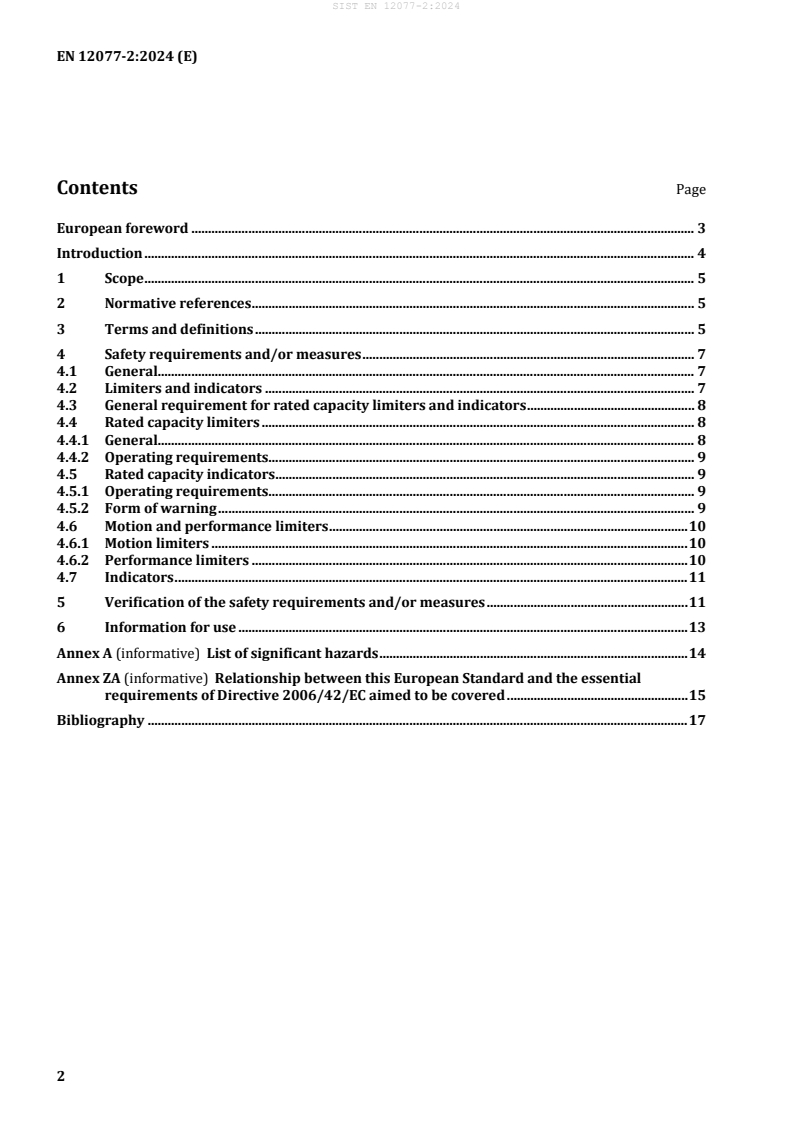
Contents Page
European foreword . 3
Introduction . 4
1 Scope . 5
2 Normative references . 5
3 Terms and definitions . 5
4 Safety requirements and/or measures . 7
4.1 General. 7
4.2 Limiters and indicators . 7
4.3 General requirement for rated capacity limiters and indicators . 8
4.4 Rated capacity limiters . 8
4.4.1 General. 8
4.4.2 Operating requirements. 9
4.5 Rated capacity indicators . 9
4.5.1 Operating requirements. 9
4.5.2 Form of warning . 9
4.6 Motion and performance limiters . 10
4.6.1 Motion limiters . 10
4.6.2 Performance limiters . 10
4.7 Indicators . 11
5 Verification of the safety requirements and/or measures . 11
6 Information for use . 13
Annex A (informative) List of significant hazards . 14
Annex ZA (informative) Relationship between this European Standard and the essential
requirements of Directive 2006/42/EC aimed to be covered . 15
Bibliography . 17
European foreword
This document (EN 12077-2:2024) has been prepared by Technical Committee CEN/TC 147 “Cranes -
Safety”, the secretariat of which is held by DIN.
This European Standard shall be given the status of a national standard, either by publication of an
identical text or by endorsement, at the latest by January 2025 and conflicting national standards shall
be withdrawn at the latest by January 2025.
Attention is drawn to the possibility that some of the elements of this document may be the subject of
patent rights. CEN shall not be held responsible for identifying any or all such patent rights.
This document supersedes EN 12077-2:1998+A1:2008.
In comparison with the previous edition, the following technical modifications have been made:
— updated reference documents and cross-references;
— revised grammar and linguistic consistency;
— revised the list of significant hazards and moved it to Annex A;
— revised Annex ZA and added a Bibliography;
— revised and updated Clause 3;
— revised and updated subclauses 4.2.6, 4.2.7, 4.2.9, 4.3.1, 4.3.2, 4.3.4, 4.3.5, 4.4.1.1, 4.4.1.2, 4.5.1.1,
4.5.1.3, 4.5.1.4, 4.6.1.1, 4.6.1.2, 4.7.2;
— removed subclauses 4.5.3, 4.6.2.3, 4.7.2;
— revised and updated Table 1.
This document has been prepared under a standardization request addressed to CEN by the European
Commission. The Standing Committee of the EFTA States subsequently approves these requests for its
Member States.
For the relationship with EU Legislation, see informative Annex ZA, which is an integral part of this
document.
Any feedback and questions on this document should be directed to the users’ national standards body.
A complete listing of these bodies can be found on the CEN website.
According to the CEN-CENELEC Internal Regulations, the national standards organizations of the
following countries are bound to implement this European Standard: Austria, Belgium, Bulgaria, Croatia,
Cyprus, Czech Republic, Denmark, Estonia, Finland, France, Germany, Greece, Hungary, Iceland, Ireland,
Italy, Latvia, Lithuania, Luxembourg, Malta, Netherlands, Norway, Poland, Portugal, Republic of North
Macedonia, Romania, Serbia, Slovakia, Slovenia, Spain, Sweden, Switzerland, Türkiye and the United
Kingdom.
Introduction
This document is a harmonized standard to provide one means for limiting and indicating devices for
cranes to conform with the essential health and safety requirements of the Machinery Directive, as
mentioned in Annex ZA.
This document is a type-C standard as stated in EN ISO 12100:2010.
This document is of relevance, in particular, for the following stakeholder groups representing the market
players with regard to machinery safety:
— machine manufacturers (small, medium and large enterprises);
— health and safety bodies (regulators, accident prevention organizations, market surveillance, etc.).
Others can be affected by the level of machinery safety achieved with the means of the document by the
above-mentioned stakeholder groups:
— machine users/employers (small, medium and large enterprises);
— service providers, e.g. for maintenance (small, medium and large enterprises).
The above-mentioned stakeholder groups have been given the possibility to participate at the drafting
process of this document.
The machinery concerned and the extent to which hazards are covered are indicated in the scope of this
standard.
When requirements of this type-C standard are different from those which are stated in type-A or type-B
standards, the requirements of this type-C standard take precedence over the requirements of the other
standards for machines that have been designed and built according to the requirements of this type-C
standard.
1 Scope
This document specifies general requirements for limiting and indicating devices used in cranes. These
devices restrict operation or provide operational information for the operator or other persons. Specific
requirements for particular types of cranes are given in the appropriate European Standard for the
particular crane type.
This document does not cover erection, dismantling, or changing the configuration of a crane.
The hazards covered by this document are identified in Annex A.
This document is not applicable to cranes manufactured before the date of its publication.
2 Normative references
The following documents are referred to in the text in such a way that some or all of their content
constitutes requirements of this document. For dated references, only the edition cited applies. For
undated references, the latest edition of the referenced document (including any amendments) applies.
EN 614-2:2000+A1:2008, Safety of machinery — Ergonomic design principles — Part 2: Interactions
between the design of machinery and work tasks
EN 60204-32:2008, Safety of machinery — Electrical equipment of machines — Part 32: Requirements for
hoisting machines (IEC 60204-32:2008)
EN 61310-1:2008, Safety of machinery — Indication, marking and actuation — Part 1: Requirements for
visual, acoustic and tactile signals (IEC 61310-1:2007)
EN ISO 12100:2010, Safety of machinery — General principles for design — Risk assessment and risk
reduction (ISO 12100:2010)
EN ISO 13849-1:2023, Safety of machinery — Safety-related parts of control systems — Part 1: General
principles for design (ISO 13849-1:2023)
ISO 4306-1:2007, Cranes — Vocabulary — Part 1: General
3 Terms and definitions
For the purposes of this document the terms and definitions given in EN ISO 12100:2010,
ISO 4306-1:2007 and the following apply.
ISO and IEC maintain terminology databases for use in standardization at the following addresses:
— ISO Online browsing platform: available at https://www.iso.org/obp/
— IEC Electropedia: available at https://www.electropedia.org/
3.1
configuration
combination of structural members, counterweights, support or outrigger position, hook block reeving
and similar items assembled, positioned and erected according to manufacturers’ instructions and ready
for operation
3.2
continuous warning
warning that is given visually by either a flashing or uninterrupted light, or acoustic by either a pulsing
or uninterrupted sound, and persists throughout the time the condition being indicated exists
3.3
control station position limiter
device to prevent movement of the powered control station beyond specified limits
3.4
derricking limiter
device to prevent the raising or lowering of a boom, jib, fly jib, “A-frame” or mast beyond specified limits
3.5
hoisting limiter
device to prevent either the load lifting attachment from being raised such that it inadvertently strikes
the crane structure, or any other specified upper limitation of the load lifting attachment from being
exceeded
3.6
indicator
device to provide warnings and/or data to facilitate control of the crane within its design parameters
3.7
motion limiter
device to initiate the stopping of motion or restrict crane movement
Note 1 to entry: See examples in 4.6.1.1.
3.8
overturning moment
mathematical product of the load and horizontal distance between a vertical line through the centre of
gravity of a load and the corresponding tipping line
3.9
performance limiter
device to prevent a design performance characteristic from being exceeded
3.10
rated capacity
maximum net load or, for mobile cranes, hoist medium load that the crane is designed to lift for a given
crane configuration and load location during operation
3.11
rated capacity indicator
device to indicate that the lifted load exceeds the rated capacity and that, in particular crane types, the
lifted load approaches the rated capacity
3.12
rated capacity limiter
device to prevent the crane from handling loads in excess of its rated capacity
Note 1 to entry: Rated capacity limiter is also called a load limiter or lifting force limiter.
3.13
slack rope limiter
device to stop motion(s) in the event of the rope becoming slack
3.14
slewing limiter
device to prevent slewing beyond specified limits
3.15
telescoping limiter
device to prevent the extension or retraction of a part beyond specified limits
3.16
working space limiter
device to prevent any part of the crane from entering a prohibited space
Note 1 to entry: Working space limitation is often achieved by a combination of different limiters.
4 Safety requirements and/or measures
4.1 General
Machinery shall comply with the safety requirements and measures of Clause 4. In addition, the machine
shall be designed according to the principles of EN ISO 12100:2010 for hazards relevant but not
significant which are not dealt with by this standard.
4.2 Limiters and indicators
4.2.1 The crane manufacturer shall select a device compatible with the intended use of the crane, taking
the following into account:
a) operating environment, e.g. temperature, relative humidity, condensation, vibration;
b) rated capacity;
c) crane characteristics;
d) electromagnetic compatibility.
4.2.2 The installation of limiters and indicators shall be carried out in a manner that does not reduce
the strength of the crane.
4.2.3 The effects (e.g. forces, stopping distances) resulting from the operation of the limiter shall be
within the design constraints of the crane.
4.2.4 Systems shall enable periodic functional checks to be carried out to verify that indicators are
operating correctly.
4.2.5 If interruption of the power supply occurs, the settings of limiters and indicators shall be retained.
4.2.6 Limiters and indicators shall be capable of withstanding the shock loads and vibrations
transmitted to them during operation, erection, dismantling and maintenance of the crane.
4.2.7 Limiters and indicators shall have legible and durable markings on or adjacent to them, preferably
with symbols to indicate their function and mode of operation, and all indicators shall be compatible with
ergonomic principles in accordance with EN 614-2:2000+A1:2008.
4.2.8 Painting or other corrosion protection shall not affect the functioning of limiters and indicators.
4.2.9 Limiters forming a part of a safety related control system shall be in accordance with
EN ISO 13849-1:2023. The performance levels and categories used shall be those specified by the
European Standards for particular crane types.
4.3 General requirement for rated capacity limiters and indicators
4.3.1 Rated capacity limiters and indicators shall be provided on all cranes having a rated capacity of
1 000 kg or above, or an overturning moment of 40 000 Nm or above due to the rated capacity (see 3.10).
4.3.2 The rated capacity limiter and indicator shall perform in accordance with this standard for all
rated capacities and all the configurations described in the information for use of the crane.
4.3.3 If a crane can be operated with different configurations there shall be an indication of the crane
configuration for which the rated capacity limiter and indicator has been set. Where a configuration
selecting device is provided, a direct description of the configuration selected shall be
...
Questions, Comments and Discussion
Ask us and Technical Secretary will try to provide an answer. You can facilitate discussion about the standard in here.
Loading comments...