

EN 1090-2:2018+A1:2024
(Main + Amendment)Execution of steel structures and aluminium structures - Part 2: Technical requirements for steel structures
- Abstract
This European Standard specifies requirements for execution of structural steelwork as structures or as manufactured components, produced from:
- hot rolled, structural steel products up to and including grade S700;
- cold formed components and sheeting up to and including grade S700 (unless coming within the scope of prEN 1090-4);
- hot finished or cold formed austenitic, austenitic-ferritic and ferritic stainless steel products;
- hot finished or cold formed structural hollow sections, including standard range and custom-made rolled products and hollow sections manufactured by welding.
For components produced from cold formed components, and cold formed structural hollow sections that are within the scope of prEN 1090-4, the requirements of prEN 1090-4 take precedence over corresponding requirements in this European Standard.
This European Standard can also be used for structural steel grades up to and including S960, provided that conditions for execution are verified against reliability criteria and any necessary additional requirements are specified.
This European Standard specifies requirements, which are mostly independent of the type and shape of the steel structure (e.g. buildings, bridges, plated or latticed components) including structures subjected to fatigue or seismic actions. Certain requirements are differentiated in terms of execution classes.
This European Standard applies to structures designed according to the relevant part of the EN 1993 series. Sheet piling, displacement piles and micropiles designed to EN 1993-5 are intended to be executed in accordance with respectively EN 12063, EN 12699 and EN 14199. This European Standard only applies to the execution of waling, bracing, and connections.
This European Standard applies to steel components in composite steel and concrete structures designed according to the relevant part of the EN 1994 series.
This European Standard can be used for structures designed according to other design rules provided that conditions for execution comply with them and any necessary additional requirements are specified.
This European Standard includes the requirements for the welding of reinforcing steels to structural steels. This European Standard does not include requirements for the use of reinforcing steels for reinforced concrete applications.
- Status
- Published
- Publication Date
- 30-Apr-2024
- Technical Committee
- CEN/TC 135 - Execution of steel structures
- Current Stage
- 6060 - Definitive text made available (DAV) - Publishing
- Start Date
- 01-May-2024
- Due Date
- 20-Feb-2024
- Completion Date
- 01-May-2024

Overview
EN 1090-2:2018+A1:2024 - published by CEN - defines the technical requirements for execution of steel structures. It applies to structural steelwork and manufactured components produced from hot‑rolled and cold‑formed structural steels (up to grade S700, and optionally up to S960 under verified conditions), stainless steels and structural hollow sections (welded or seamless). The standard was approved with Amendment 1 (Feb 2024) and complements design rules in the EN 1993 series (Eurocode 3).
Keywords: EN 1090-2, execution of steel structures, technical requirements for steel structures, structural steelwork, S700, S960
Key Topics
- Scope and applicability
- Execution requirements for buildings, bridges, plated and latticed components, including fatigue and seismic cases.
- Rules for composite steel–concrete components designed to EN 1994.
- Note: some cold‑formed items fall under prEN 1090‑4 - where applicable, prEN 1090‑4 takes precedence.
- Execution classes
- Differentiated requirements based on complexity, safety and intended use.
- Constituent products
- Steel grades, castings, welding consumables, mechanical fasteners, studs, grouting materials and bearings - traceability and documentation requirements.
- Preparation, assembly and tolerances
- Handling, cutting, shaping, holing, full contact bearing, assembly checks and geometrical tolerances.
- Welding
- Welding plans, qualified procedures and personnel, preheating, protection, acceptance criteria and special provisions (e.g., stud welding, orthotropic decks).
- Includes welding of reinforcing steels to structural steels (not rules for reinforcement in concrete).
- Quality & documentation
- Execution Specification, constructor’s quality documentation, quality plans and erection safety records.
- Corrosion protection & testing
- Surface preparation, protective systems and testing/inspection requirements during fabrication and erection.
Practical Applications
- Ensures consistent fabrication and erection quality for steel structures used in:
- Buildings and industrial structures
- Bridges and transport infrastructure
- Steel components for composite construction
- Used to develop shop drawings, welding procedures, QA/QC plans, and procurement specifications.
- Supports regulatory compliance and CE marking when combined with EN 1090‑1 (conformity assessment).
Who uses this standard
- Structural engineers and designers (to align execution with EN 1993/EN 1994)
- Fabricators and welding coordinators (welding plans, personnel qualification)
- Quality managers, inspectors and certification bodies
- Contractors, bridge builders and asset owners specifying execution requirements
Related Standards
- EN 1090‑1 (conformity assessment and CE marking)
- prEN 1090‑4 (cold‑formed components)
- EN 1993 series (Eurocode 3 - design of steel structures)
- EN 1994 (composite steel and concrete structures)
- EN 12063, EN 12699, EN 14199 (special piling/micropile execution as referenced)
Relations
- Effective Date
- 31-Jan-2024
- Effective Date
- 31-Jan-2024
- Effective Date
- 21-Oct-2026
- Effective Date
- 25-Aug-2026
- Effective Date
- 25-Aug-2026
- Effective Date
- 25-Aug-2026
- Effective Date
- 25-Aug-2026
- Effective Date
- 08-Jul-2026
- Effective Date
- 27-May-2026
- Effective Date
- 27-May-2026
- Effective Date
- 09-Feb-2026
- Effective Date
- 09-Feb-2026
- Effective Date
- 28-Jan-2026
- Effective Date
- 28-Jan-2026
- Effective Date
- 28-Jan-2026
Get Certified
Connect with accredited certification bodies for this standard

DIBt (Deutsches Institut für Bautechnik)
German Institute for Building Technology.
DIN CERTCO
DIN Group product certification.

Aboma Certification B.V.
Specialized in construction, metal, and transport sectors.
Sponsored listings
Frequently Asked Questions
EN 1090-2:2018+A1:2024 is a standard published by the European Committee for Standardization (CEN). Its full title is "Execution of steel structures and aluminium structures - Part 2: Technical requirements for steel structures". This standard covers: This European Standard specifies requirements for execution of structural steelwork as structures or as manufactured components, produced from: - hot rolled, structural steel products up to and including grade S700; - cold formed components and sheeting up to and including grade S700 (unless coming within the scope of prEN 1090-4); - hot finished or cold formed austenitic, austenitic-ferritic and ferritic stainless steel products; - hot finished or cold formed structural hollow sections, including standard range and custom-made rolled products and hollow sections manufactured by welding. For components produced from cold formed components, and cold formed structural hollow sections that are within the scope of prEN 1090-4, the requirements of prEN 1090-4 take precedence over corresponding requirements in this European Standard. This European Standard can also be used for structural steel grades up to and including S960, provided that conditions for execution are verified against reliability criteria and any necessary additional requirements are specified. This European Standard specifies requirements, which are mostly independent of the type and shape of the steel structure (e.g. buildings, bridges, plated or latticed components) including structures subjected to fatigue or seismic actions. Certain requirements are differentiated in terms of execution classes. This European Standard applies to structures designed according to the relevant part of the EN 1993 series. Sheet piling, displacement piles and micropiles designed to EN 1993-5 are intended to be executed in accordance with respectively EN 12063, EN 12699 and EN 14199. This European Standard only applies to the execution of waling, bracing, and connections. This European Standard applies to steel components in composite steel and concrete structures designed according to the relevant part of the EN 1994 series. This European Standard can be used for structures designed according to other design rules provided that conditions for execution comply with them and any necessary additional requirements are specified. This European Standard includes the requirements for the welding of reinforcing steels to structural steels. This European Standard does not include requirements for the use of reinforcing steels for reinforced concrete applications.
This European Standard specifies requirements for execution of structural steelwork as structures or as manufactured components, produced from: - hot rolled, structural steel products up to and including grade S700; - cold formed components and sheeting up to and including grade S700 (unless coming within the scope of prEN 1090-4); - hot finished or cold formed austenitic, austenitic-ferritic and ferritic stainless steel products; - hot finished or cold formed structural hollow sections, including standard range and custom-made rolled products and hollow sections manufactured by welding. For components produced from cold formed components, and cold formed structural hollow sections that are within the scope of prEN 1090-4, the requirements of prEN 1090-4 take precedence over corresponding requirements in this European Standard. This European Standard can also be used for structural steel grades up to and including S960, provided that conditions for execution are verified against reliability criteria and any necessary additional requirements are specified. This European Standard specifies requirements, which are mostly independent of the type and shape of the steel structure (e.g. buildings, bridges, plated or latticed components) including structures subjected to fatigue or seismic actions. Certain requirements are differentiated in terms of execution classes. This European Standard applies to structures designed according to the relevant part of the EN 1993 series. Sheet piling, displacement piles and micropiles designed to EN 1993-5 are intended to be executed in accordance with respectively EN 12063, EN 12699 and EN 14199. This European Standard only applies to the execution of waling, bracing, and connections. This European Standard applies to steel components in composite steel and concrete structures designed according to the relevant part of the EN 1994 series. This European Standard can be used for structures designed according to other design rules provided that conditions for execution comply with them and any necessary additional requirements are specified. This European Standard includes the requirements for the welding of reinforcing steels to structural steels. This European Standard does not include requirements for the use of reinforcing steels for reinforced concrete applications.
EN 1090-2:2018+A1:2024 is classified under the following ICS (International Classification for Standards) categories: 91.080.13 - Steel structures. The ICS classification helps identify the subject area and facilitates finding related standards.
EN 1090-2:2018+A1:2024 has the following relationships with other standards: It is inter standard links to EN 1090-2:2018, EN 1090-2:2018/FprA1, EN 10346:2026, ISO 2859-5:2005, ISO 4463-1:1989, ISO 4463-2:1995, ISO 4997:2015, EN 10365:2026, EN ISO 18275:2026, EN ISO 8504-5:2026, ISO 19840:2012, ISO 4463-3:1995, EN 1011-3:2018, EN ISO 15611:2024, EN 10060:2003. Understanding these relationships helps ensure you are using the most current and applicable version of the standard.
EN 1090-2:2018+A1:2024 is available in PDF format for immediate download after purchase. The document can be added to your cart and obtained through the secure checkout process. Digital delivery ensures instant access to the complete standard document.
Standards Content (Sample)
SLOVENSKI STANDARD
01-julij-2024
Izvedba jeklenih in aluminijastih konstrukcij - 2. del: Tehnične zahteve za izvedbo
jeklenih konstrukcij
Execution of steel structures and aluminium structures - Part 2: Technical requirements
for steel structures
Ausführung von Stahltragwerken und Aluminiumtragwerken - Teil 2: Technische Regeln
für die Ausführung von Stahltragwerken
Exécution des structures en acier et des structures en aluminium - Partie 2: Exigences
techniques pour les structures en acier
Ta slovenski standard je istoveten z: EN 1090-2:2018+A1:2024
ICS:
91.080.13 Jeklene konstrukcije Steel structures
2003-01.Slovenski inštitut za standardizacijo. Razmnoževanje celote ali delov tega standarda ni dovoljeno.
EN 1090-2:2018+A1
EUROPEAN STANDARD
NORME EUROPÉENNE
May 2024
EUROPÄISCHE NORM
ICS 91.080.13 Supersedes EN 1090-2:2018
English Version
Execution of steel structures and aluminium structures -
Part 2: Technical requirements for steel structures
Exécution des structures en acier et des structures en Ausführung von Stahltragwerken und
aluminium - Partie 2: Exigences techniques pour les Aluminiumtragwerken - Teil 2: Technische Regeln für
structures en acier die Ausführung von Stahltragwerken
This European Standard was approved by CEN on 22 January 2018 and includes Amendment 1 approved by CEN on 19 February
2024.
CEN members are bound to comply with the CEN/CENELEC Internal Regulations which stipulate the conditions for giving this
European Standard the status of a national standard without any alteration. Up-to-date lists and bibliographical references
concerning such national standards may be obtained on application to the CEN-CENELEC Management Centre or to any CEN
member.
This European Standard exists in three official versions (English, French, German). A version in any other language made by
translation under the responsibility of a CEN member into its own language and notified to the CEN-CENELEC Management
Centre has the same status as the official versions.
CEN members are the national standards bodies of Austria, Belgium, Bulgaria, Croatia, Cyprus, Czech Republic, Denmark, Estonia,
Finland, France, Germany, Greece, Hungary, Iceland, Ireland, Italy, Latvia, Lithuania, Luxembourg, Malta, Netherlands, Norway,
Poland, Portugal, Republic of North Macedonia, Romania, Serbia, Slovakia, Slovenia, Spain, Sweden, Switzerland, Türkiye and
United Kingdom.
EUROPEAN COMMITTEE FOR STANDARDIZATION
COMITÉ EUROPÉEN DE NORMALISATION
EUROPÄISCHES KOMITEE FÜR NORMUNG
CEN-CENELEC Management Centre: Rue de la Science 23, B-1040 Brussels
© 2024 CEN All rights of exploitation in any form and by any means reserved Ref. No. EN 1090-2:2018+A1:2024 E
worldwide for CEN national Members.
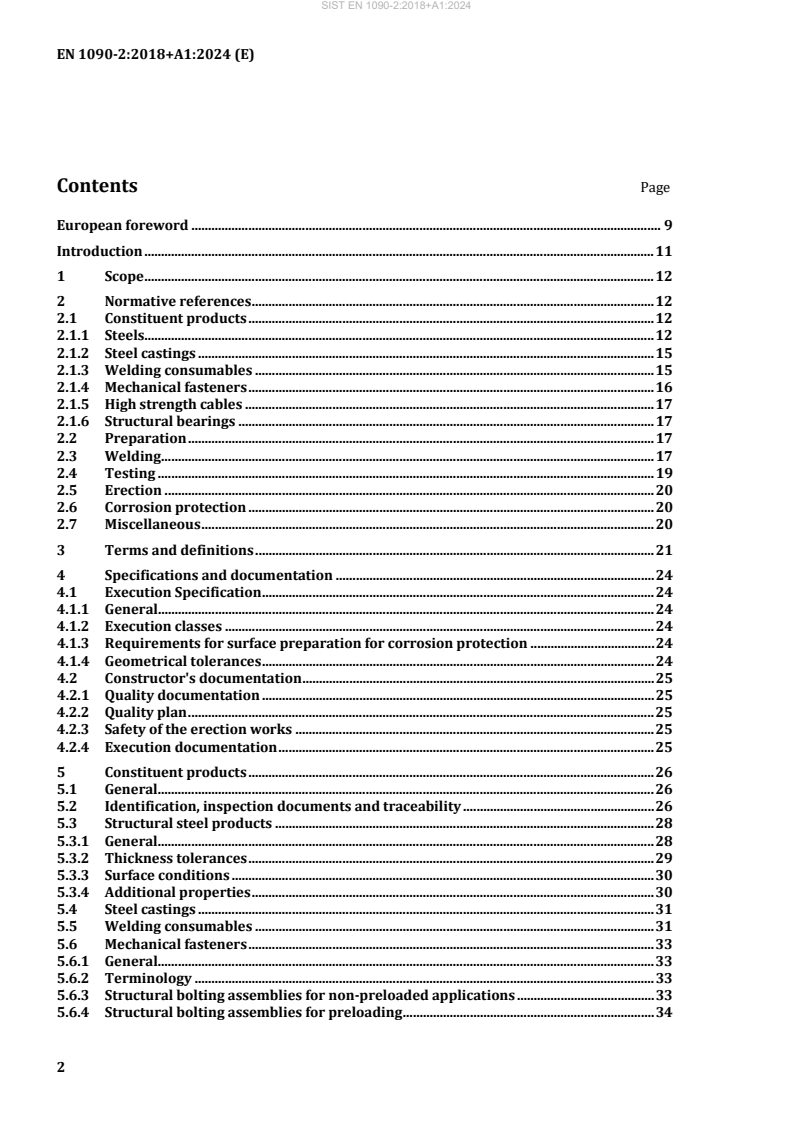
Contents Page
European foreword . 9
Introduction . 11
1 Scope . 12
2 Normative references . 12
2.1 Constituent products . 12
2.1.1 Steels. 12
2.1.2 Steel castings . 15
2.1.3 Welding consumables . 15
2.1.4 Mechanical fasteners . 16
2.1.5 High strength cables . 17
2.1.6 Structural bearings . 17
2.2 Preparation . 17
2.3 Welding . 17
2.4 Testing . 19
2.5 Erection . 20
2.6 Corrosion protection . 20
2.7 Miscellaneous . 20
3 Terms and definitions . 21
4 Specifications and documentation . 24
4.1 Execution Specification . 24
4.1.1 General. 24
4.1.2 Execution classes . 24
4.1.3 Requirements for surface preparation for corrosion protection . 24
4.1.4 Geometrical tolerances . 24
4.2 Constructor's documentation . 25
4.2.1 Quality documentation . 25
4.2.2 Quality plan . 25
4.2.3 Safety of the erection works . 25
4.2.4 Execution documentation . 25
5 Constituent products . 26
5.1 General. 26
5.2 Identification, inspection documents and traceability . 26
5.3 Structural steel products . 28
5.3.1 General. 28
5.3.2 Thickness tolerances . 29
5.3.3 Surface conditions . 30
5.3.4 Additional properties . 30
5.4 Steel castings . 31
5.5 Welding consumables . 31
5.6 Mechanical fasteners . 33
5.6.1 General. 33
5.6.2 Terminology . 33
5.6.3 Structural bolting assemblies for non-preloaded applications . 33
5.6.4 Structural bolting assemblies for preloading . 34
5.6.5 Direct tension indicators . 34
5.6.6 Weather resistant assemblies . 34
5.6.7 Foundation bolts . 34
5.6.8 Locking devices . 35
5.6.9 Washers . 35
5.6.10 Solid rivets for hot riveting . 35
5.6.11 Special fasteners . 35
5.6.12 Delivery and identification . 35
5.7 Studs and shear connectors . 36
5.8 Reinforcing steel welded to structural steel . 36
5.9 Grouting materials . 36
5.10 Expansion joints for bridges . 36
5.11 High strength cables, rods and terminations . 36
5.12 Structural bearings . 37
6 Preparation and assembly . 37
6.1 General . 37
6.2 Identification . 37
6.3 Handling and storage . 37
6.4 Cutting. 39
6.4.1 General . 39
6.4.2 Shearing and nibbling . 39
6.4.3 Thermal cutting . 39
6.4.4 Hardness of free edge surfaces . 40
6.5 Shaping . 40
6.5.1 General . 40
6.5.2 Hot forming . 41
6.5.3 Flame straightening . 41
6.5.4 Cold forming . 42
6.6 Holing . 43
6.6.1 Dimensions of holes . 43
6.6.2 Tolerances on hole diameter for bolts and pins . 44
6.6.3 Execution of holing . 45
6.7 Cut outs . 46
6.8 Full contact bearing surfaces . 46
6.9 Assembly . 46
6.10 Assembly check . 47
7 Welding . 47
7.1 General . 47
7.2 Welding plan . 47
7.2.1 Requirements for a welding plan. 47
7.2.2 Content of a welding plan . 48
7.3 Welding processes . 48
7.4 Qualification of welding procedures and welding personnel . 49
7.4.1 Qualification of welding procedures . 49
7.4.2 Welders and welding operators . 51
7.4.3 Welding coordination . 52
7.5 Preparation and execution of welding . 54
7.5.1 Joint preparation . 54
7.5.2 Storage and handling of welding consumables . 55
7.5.3 Weather protection . 55
7.5.4 Assembly for welding . 55
7.5.5 Preheating . 56
7.5.6 Temporary attachments . 56
7.5.7 Tack welds . 56
7.5.8 Fillet welds . 56
7.5.9 Butt welds . 57
7.5.10 Welds on steels with improved atmospheric corrosion resistance . 58
7.5.11 Branch connections . 58
7.5.12 Stud welding . 58
7.5.13 Slot and plug welds . 59
7.5.14 Other weld types . 59
7.5.15 Post-weld heat treatment . 59
7.5.16 Execution of welding . 59
7.5.17 Welding of orthotropic bridge decks . 59
7.6 Acceptance criteria. 59
7.6.1 Routine requirements . 59
7.6.2 Fatigue requirements . 60
7.6.3 Orthotropic bridge decks . 60
7.7 Welding of stainless steels . 60
8 Mechanical fastening . 60
8.1 General. 60
8.2 Use of bolting assemblies . 61
8.2.1 General. 61
8.2.2 Bolts . 61
8.2.3 Nuts . 62
8.2.4 Washers . 62
8.3 Tightening of non-preloaded bolting assemblies . 63
8.4 Preparation of contact surfaces in slip resistant connections . 63
8.5 Tightening of preloaded bolting assemblies . 65
8.5.1 General. 65
8.5.2 Torque reference values . 66
8.5.3 Torque method . 67
8.5.4 Combined method . 67
8.5.5 HRC method . 68
8.5.6 Direct tension indicator method . 69
8.6 Fit bolts . 69
8.7 Hot riveting . 69
8.7.1 Rivets . 69
8.7.2 Installation of rivets . 69
8.7.3 Acceptance criteria. 70
8.8 Use of special fasteners and fastening methods . 70
8.9 Galling and seizure of stainless steels . 71
9 Erection . 71
9.1 General. 71
9.2 Site conditions . 71
9.3 Erection method . 72
9.3.1 Design basis for the erection method . 72
9.3.2 Constructor's erection method . 73
9.4 Survey. 74
9.4.1 Reference system . 74
9.4.2 Position points . 74
9.5 Supports, anchors and bearings . 74
9.5.1 Inspection of supports . 74
9.5.2 Setting out and suitability of supports . 74
9.5.3 Maintaining suitability of supports . 75
9.5.4 Temporary supports . 75
9.5.5 Grouting and sealing. 75
9.5.6 Anchoring . 76
9.6 Erection and work at site . 76
9.6.1 Erection drawings . 76
9.6.2 Marking . 76
9.6.3 Handling and storage on site . 76
9.6.4 Trial erection . 77
9.6.5 Erection works . 77
10 Surface treatment . 79
10.1 General . 79
10.2 Preparation of steel substrates for paints and related products . 79
10.3 Weather resistant steels . 80
10.4 Galvanic coupling . 80
10.5 Hot dip galvanizing . 80
10.6 Sealing of spaces . 81
10.7 Surfaces in contact with concrete . 81
10.8 Inaccessible surfaces . 81
10.9 Repairs after cutting or welding . 81
10.10 Cleaning of stainless steel components . 82
11 Geometrical tolerances. 82
11.1 Tolerance types . 82
11.2 Essential tolerances . 82
11.2.1 General . 82
11.2.2 Manufacturing tolerances . 82
11.2.3 Erection tolerances . 83
11.3 Functional tolerances . 84
11.3.1 General . 84
11.3.2 Tabulated values . 85
11.3.3 Alternative criteria . 85
12 Inspection, testing and correction . 85
12.1 General . 85
12.2 Constituent products and components . 85
12.2.1 Constituent products . 85
12.2.2 Components . 86
12.2.3 Non-conforming products . 86
12.3 Manufacturing: geometrical dimensions of manufactured components . 86
12.4 Welding . 87
12.4.1 General . 87
12.4.2 Inspection after welding . 87
12.4.3 Inspection and testing of welded shear studs for composite steel and concrete
structures . 92
12.4.4 Production tests on welding . 92
12.4.5 Inspection and testing of welding of reinforcing steel . 92
12.5 Mechanical fastening . 92
12.5.1 Inspection of non-preloaded bolted connections . 92
12.5.2 Inspection and testing of preloaded bolted connections . 93
12.5.3 Inspection and repairs of solid rivets for hot riveting . 96
12.5.4 Special fasteners and fastening methods . 96
12.6 Surface treatment and corrosion protection . 97
12.7 Erection . 97
12.7.1 Inspection of trial erection . 97
12.7.2 Inspection of the erected structure . 97
12.7.3 Survey of geometrical position of connection nodes . 97
12.7.4 Other acceptance tests . 99
Annex A (normative) Additional information, options and requirements related to the
execution classes . 100
A.1 Additional information . 100
A.2 Options . 103
A.3 Requirements related to the execution classes . 108
Annex B (normative) Geometrical tolerances . 112
B.1 General. 112
B.2 Manufacturing tolerances . 112
B.3 Erection tolerances . 139
Annex C (informative) Check-list for the content of a quality plan . 156
C.1 General. 156
C.2 Content . 156
C.2.1 Management . 156
C.2.2 Specification review . 156
C.2.3 Documentation . 156
C.2.4 Inspection and testing procedures . 158
Annex D (informative) Procedure for checking capability of automated thermal cutting
processes. 159
D.1 General. 159
D.2 Description of the procedure. 159
D.2.1 General. 159
D.2.2 Average surface roughness R . 160
Z5
D.2.3 Perpendicularity and angularity tolerance . 161
D.2.4 Hardness test . 161
D.3 Range of qualification. 162
D.3.1 Material groups . 162
D.3.2 Material thickness . 163
D.3.3 Pressures of gases . 163
D.3.4 Cutting speed and height . 163
D.3.5 Preheat temperature . 163
D.4 Test report . 163
Annex E (informative) Welded joints in hollow sections . 167
E.1 General. 167
E.2 Guidance for start and stop positions . 167
E.3 Preparation of joint faces . 167
E.4 Assembly for welding . 168
E.5 Fillet welded joints . 175
Annex F (normative) Corrosion protection . 176
F.1 General . 176
F.1.1 Field of application . 176
F.1.2 Performance specification . 176
F.1.3 Prescriptive requirements . 176
F.1.4 Work method . 177
F.2 Surface preparation of carbon steels . 177
F.2.1 Surface preparation of carbon steels prior to painting or metal spraying . 177
F.2.2 Surface preparation of carbon steels prior to hot dip galvanizing . 178
F.3 Welds and surfaces for welding . 178
F.4 Surfaces in preloaded connections . 178
F.5 Preparation of fasteners . 178
F.6 Coating methods . 179
F.6.1 Painting . 179
F.6.2 Metal spraying . 179
F.6.3 Hot dip galvanizing . 179
F.7 Inspection and checking . 179
F.7.1 General . 179
F.7.2 Routine checking . 179
F.7.3 Reference areas . 180
F.7.4 Hot dip galvanized components . 180
Annex G (normative) Determination of slip factor . 181
G.1 General . 181
G.2 Significant variables . 181
G.3 Test specimens . 181
G.4 Slip test procedure and evaluation of results. 184
G.5 Extended creep test procedure and evaluation . 186
G.6 Test results. 186
Annex H (normative) Calibration test for preloaded bolting assemblies under site
conditions . 188
H.1 General . 188
H.2 Symbols and units. 188
H.3 Principle of the test . 189
H.4 Test apparatus . 189
H.5 Test assemblies.
...