

EN 12977-5:2018
(Main)Thermal solar systems and components - Custom built systems - Part 5: Performance test methods for control equipment
- Abstract
This European Standard specifies performance test methods for control equipment. Furthermore, this document contains requirements on accuracy, durability and reliability of control equipment.
The tests described in this document are limited to electrically activated components delivered with or for the system by the final supplier. For the purposes of this document controller and control equipment for solar heating systems and auxiliary heaters, if part of the system, are restricted to the following:
a) Controllers as:
1) system clocks, timers and counters;
2) differential thermostats;
3) multi-function controllers.
b) Sensors as:
1) temperature sensors;
2) irradiance sensors (for short wave radiation);
3) pressure sensors;
4) level sensors;
5) flow meters;
6) heat meters.
c) Actuators as:
1) pumps;
2) solenoid and motor valves;
3) relays.
d) Combinations of controllers, sensors and actuators listed above.
An additional objective of the procedures described in this document is to verify control algorithms and, together with the accuracy of sensors, to determine control parameters. In addition to verifying the functioning of a controller, its equipment and actuators, the determined parameters may be used for numerical system simulations.
Typically, electrical anodes are not part of the control equipment and are not controlled by the control equipment. However, because they are electrical appliances, electrical anodes are included in this document.
This document is valid for control equipment of solar heating systems for the purpose of hot water preparation and/or space heating. If the solar system is connected to or part of a conventional heating system, the validity is extended to the entire system. In combination with the standards EN 12976-1, EN 12976-2 as well as EN 12977-1, EN 12977-2, EN 12977-3 and EN 12977-4, this document is valid for
e) factory made solar heating systems,
f) small custom built solar heating systems,
g) large custom built solar heating systems,
h) auxiliary heater equipment used in connection with e), f) and g).
- Status
- Published
- Publication Date
- 03-Apr-2018
- Withdrawal Date
- 30-Oct-2018
- Technical Committee
- CEN/TC 312 - Thermal solar systems and components
- Current Stage
- 9093 - Decision to confirm - Review Enquiry
- Start Date
- 24-Oct-2024
- Completion Date
- 07-Oct-2026


Overview
EN 12977-5:2018 is a CEN European Standard that specifies performance test methods for control equipment used in thermal solar systems (custom built systems). The standard defines requirements and test procedures to assess the accuracy, durability and reliability of electrically activated controllers, sensors and actuators supplied with or for solar hot‑water and/or space‑heating systems. It also supports verification of control algorithms and the derivation of control parameters for numerical system simulations.
Key topics and requirements
- Scope of equipment tested
- Controllers: system clocks, timers, counters, differential thermostats, multi‑function controllers
- Sensors: temperature, irradiance (short‑wave), pressure, level, flow meters, heat meters
- Actuators: pumps, solenoid/motor valves, relays
- Combinations of the above; electrical anodes are included where relevant
- Performance attributes covered
- Accuracy testing (sensors, clocks, timers, counters)
- Durability and reliability (resistance to extreme operating conditions, high temperature, freeze, lightning)
- Functional testing of differential thermostats and multi‑function controllers
- Electrical safety and power‑consumption measurement of actuators
- Documentation and marking, initial commissioning and required test reports
- Test methods and facilities
- Laboratory procedures for sensor accuracy and high‑temperature resistance
- Simulation approaches: simulation box, tempering/calibration baths, input/output emulator
- Test sequences, data acquisition, processing and reporting
- Annex covering electrical supply voltage dependence testing
Practical applications
- Ensures control equipment meets performance expectations in solar hot water and solar space‑heating systems
- Provides validated input parameters for numerical system simulations (performance modelling)
- Supports product development, quality control and compliance testing for:
- Solar controller and sensor manufacturers
- Independent testing laboratories and certification bodies
- System integrators and OEMs supplying custom built solar systems
- Designers and simulation engineers verifying control strategies
Who uses this standard
- Manufacturers (controllers, sensors, actuators) for product validation and claims
- Test labs for accredited product testing and certification
- Installers and system designers for commissioning and performance verification
- Regulators and procurement bodies requiring verified performance data
Related standards
- EN 12977 series (Parts 1–4) - other aspects of custom built solar systems
- EN 12976‑1 / EN 12976‑2 - factory‑made solar heating systems
- Use together with EN 12977‑1 to EN 12977‑4 for comprehensive testing across factory‑made, small and large custom built solar heating systems and associated auxiliary heaters
Keywords: EN 12977‑5:2018, thermal solar systems, control equipment testing, sensor accuracy, multi‑function controllers, differential thermostats, irradiance sensors, solar heating system standards.
Relations
- Effective Date
- 11-Apr-2018
- Effective Date
- 25-Aug-2026
- Effective Date
- 28-Jul-2026
- Effective Date
- 07-Jul-2026
- Effective Date
- 07-Jul-2026
- Effective Date
- 09-Jun-2026
- Effective Date
- 20-Feb-2026
- Effective Date
- 09-Feb-2026
- Effective Date
- 09-Feb-2026
- Effective Date
- 09-Feb-2026
- Effective Date
- 09-Feb-2026
- Effective Date
- 09-Feb-2026
- Effective Date
- 09-Feb-2026
- Effective Date
- 09-Feb-2026
- Effective Date
- 09-Feb-2026
Get Certified
Connect with accredited certification bodies for this standard

DNV
DNV is an independent assurance and risk management provider.

Lloyd's Register
Lloyd's Register is a global professional services organisation specialising in engineering and technology.
DNV Energy Systems
Energy and renewable energy certification.
Sponsored listings
Frequently Asked Questions
EN 12977-5:2018 is a standard published by the European Committee for Standardization (CEN). Its full title is "Thermal solar systems and components - Custom built systems - Part 5: Performance test methods for control equipment". This standard covers: This European Standard specifies performance test methods for control equipment. Furthermore, this document contains requirements on accuracy, durability and reliability of control equipment. The tests described in this document are limited to electrically activated components delivered with or for the system by the final supplier. For the purposes of this document controller and control equipment for solar heating systems and auxiliary heaters, if part of the system, are restricted to the following: a) Controllers as: 1) system clocks, timers and counters; 2) differential thermostats; 3) multi-function controllers. b) Sensors as: 1) temperature sensors; 2) irradiance sensors (for short wave radiation); 3) pressure sensors; 4) level sensors; 5) flow meters; 6) heat meters. c) Actuators as: 1) pumps; 2) solenoid and motor valves; 3) relays. d) Combinations of controllers, sensors and actuators listed above. An additional objective of the procedures described in this document is to verify control algorithms and, together with the accuracy of sensors, to determine control parameters. In addition to verifying the functioning of a controller, its equipment and actuators, the determined parameters may be used for numerical system simulations. Typically, electrical anodes are not part of the control equipment and are not controlled by the control equipment. However, because they are electrical appliances, electrical anodes are included in this document. This document is valid for control equipment of solar heating systems for the purpose of hot water preparation and/or space heating. If the solar system is connected to or part of a conventional heating system, the validity is extended to the entire system. In combination with the standards EN 12976-1, EN 12976-2 as well as EN 12977-1, EN 12977-2, EN 12977-3 and EN 12977-4, this document is valid for e) factory made solar heating systems, f) small custom built solar heating systems, g) large custom built solar heating systems, h) auxiliary heater equipment used in connection with e), f) and g).
This European Standard specifies performance test methods for control equipment. Furthermore, this document contains requirements on accuracy, durability and reliability of control equipment. The tests described in this document are limited to electrically activated components delivered with or for the system by the final supplier. For the purposes of this document controller and control equipment for solar heating systems and auxiliary heaters, if part of the system, are restricted to the following: a) Controllers as: 1) system clocks, timers and counters; 2) differential thermostats; 3) multi-function controllers. b) Sensors as: 1) temperature sensors; 2) irradiance sensors (for short wave radiation); 3) pressure sensors; 4) level sensors; 5) flow meters; 6) heat meters. c) Actuators as: 1) pumps; 2) solenoid and motor valves; 3) relays. d) Combinations of controllers, sensors and actuators listed above. An additional objective of the procedures described in this document is to verify control algorithms and, together with the accuracy of sensors, to determine control parameters. In addition to verifying the functioning of a controller, its equipment and actuators, the determined parameters may be used for numerical system simulations. Typically, electrical anodes are not part of the control equipment and are not controlled by the control equipment. However, because they are electrical appliances, electrical anodes are included in this document. This document is valid for control equipment of solar heating systems for the purpose of hot water preparation and/or space heating. If the solar system is connected to or part of a conventional heating system, the validity is extended to the entire system. In combination with the standards EN 12976-1, EN 12976-2 as well as EN 12977-1, EN 12977-2, EN 12977-3 and EN 12977-4, this document is valid for e) factory made solar heating systems, f) small custom built solar heating systems, g) large custom built solar heating systems, h) auxiliary heater equipment used in connection with e), f) and g).
EN 12977-5:2018 is classified under the following ICS (International Classification for Standards) categories: 27.160 - Solar energy engineering. The ICS classification helps identify the subject area and facilitates finding related standards.
EN 12977-5:2018 has the following relationships with other standards: It is inter standard links to EN 12977-5:2012, ISO 15218:2003, EN IEC 60730-2-24:2026, EN IEC 60730-2-9:2026, EN IEC 60730-2-15:2026, EN IEC 60730-2-5:2026, EN IEC 60730-2-12:2026, EN IEC 60730-1:2024/A11:2024, EN IEC 60730-2-9:2019, EN IEC 60255-27:2025, EN 60730-2-5:2015/A1:2019, EN 60730-2-9:1995/A13:2004, EN 60255-121:2014, EN 60255-151:2009, EN 60255-127:2014. Understanding these relationships helps ensure you are using the most current and applicable version of the standard.
EN 12977-5:2018 is associated with the following European legislation: EU Directives/Regulations: 812/2013, 814/2013; Standardization Mandates: M/495, M/534. When a standard is cited in the Official Journal of the European Union, products manufactured in conformity with it benefit from a presumption of conformity with the essential requirements of the corresponding EU directive or regulation.
EN 12977-5:2018 is available in PDF format for immediate download after purchase. The document can be added to your cart and obtained through the secure checkout process. Digital delivery ensures instant access to the complete standard document.
Standards Content (Sample)
2003-01.Slovenski inštitut za standardizacijo. Razmnoževanje celote ali delov tega standarda ni dovoljeno.Thermische Solaranlagen und ihre Bauteile - Kundenspezifisch gefertigte Anlagen - Teil 5: Prüfmethoden für die RegeleinrichtungenInstallations solaires thermiques et leurs composants - Installations assemblées à façon - Partie 5 : Méthodes d'essai de performances pour systèmes de régulationThermal solar systems and components - Custom built systems - Part 5: Performance test methods for control equipment91.140.65Oprema za ogrevanje vodeWater heating equipment91.140.10Sistemi centralnega ogrevanjaCentral heating systems27.160Solar energy engineeringICS:Ta slovenski standard je istoveten z:EN 12977-5:2018SIST EN 12977-5:2018en,fr,de01-september-2018SIST EN 12977-5:2018SLOVENSKI
STANDARDSIST EN 12977-5:20121DGRPHãþD
EUROPEAN STANDARD NORME EUROPÉENNE EUROPÄISCHE NORM
EN 12977-5
April
t r s z ICS
t yä s x r Supersedes EN
s t { y yæ wã t r s tEnglish Version
Thermal solar systems and components æ Custom built systems æ Part
wã Performance test methods for control equipment Installations solaires thermiques et leurs composants æInstallations assemblées à façon æ Partie
w ã Méthodes d 5essai de performances pour systèmes de régulation Thermische Solaranlagen und ihre Bauteile æ Kundenspezifisch gefertigte Anlagen æ Teil
wã Prüfmethoden für die Regeleinrichtungen This European Standard was approved by CEN on
t { October
t r s yä
egulations which stipulate the conditions for giving this European Standard the status of a national standard without any alterationä Upætoædate lists and bibliographical references concerning such national standards may be obtained on application to the CENæCENELEC Management Centre or to any CEN memberä
translation under the responsibility of a CEN member into its own language and notified to the CENæCENELEC Management Centre has the same status as the official versionsä
CEN members are the national standards bodies of Austriaá Belgiumá Bulgariaá Croatiaá Cyprusá Czech Republicá Denmarká Estoniaá Finlandá Former Yugoslav Republic of Macedoniaá Franceá Germanyá Greeceá Hungaryá Icelandá Irelandá Italyá Latviaá Lithuaniaá Luxembourgá Maltaá Netherlandsá Norwayá Polandá Portugalá Romaniaá Serbiaá Slovakiaá Sloveniaá Spainá Swedená Switzerlandá Turkey and United Kingdomä
EUROPEAN COMMITTEE FOR STANDARDIZATION COMITÉ EUROPÉEN DE NORMALISATION EUROPÄISCHES KOMITEE FÜR NORMUNG
CEN-CENELEC Management Centre:
Rue de la Science 23,
B-1040 Brussels
t r s z CEN All rights of exploitation in any form and by any means reserved worldwide for CEN national Membersä Refä Noä EN
s t { y yæ wã t r s z ESIST EN 12977-5:2018
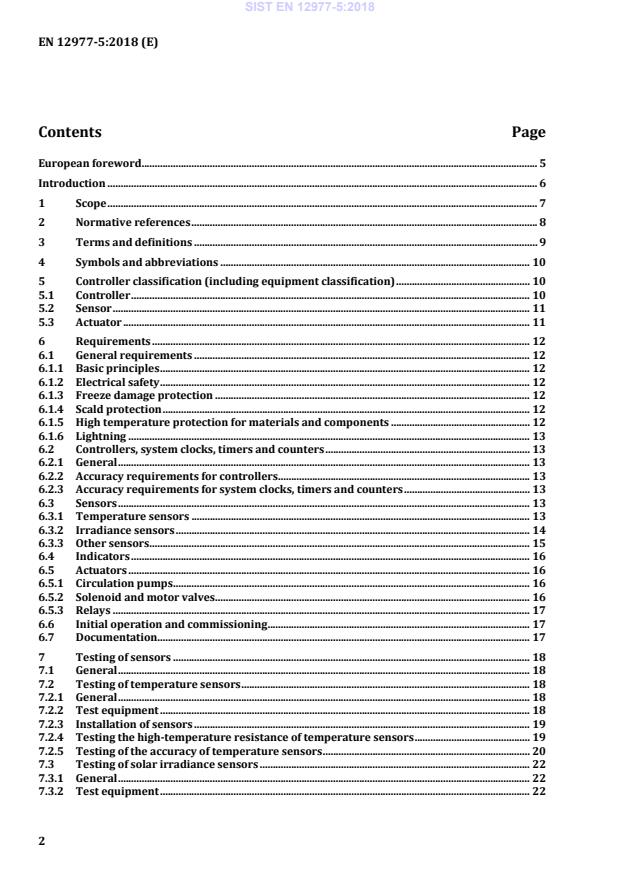
Testing the electrical supply voltage dependence of control equipment . 43 A.1 General . 43 A.2 Test equipment . 43 A.3 Test procedure . 43 A.4 Data processing . 44 Bibliography . 45
Controller C1 System clock, timer and counter Controlling the operation of one or more actuators by means of real or relative time. Timers and counters can be connected to different kinds of sensors influencing their behaviour by superposition of the commands. Beside time intervals counter can count and sum up events or quantities. C2 Differential thermostat Control of one or more actuators by means of a temperature difference between two temperature sensors. In most cases, a hysteresis between switching ON and OFF is present. Differential controllers are sometimes used with other signals, e.g. solar irradiation, pressure or level sensors. C3 Multi-function controller Controller designed to control one or more actuators based on measured quantities delivered by different kinds of sensors, real time or relative time and/or control concepts including specific control algorithms. With regard to this document multi-function controllers are used to control and operate a solar heating system, and may also control a combination of hot water preparation, space heating, heat distribution or any kind of back-up heating. Multi-function controllers may use more than one differential algorithm in one unit or at least one operation is caused by more than a simple differential algorithm. If a device operates its output(s) depending on more than one (temperature) difference or not simply in an ON/OFF mode, then a controller incorporating such differential algorithm (thermostat) should be treated as a multi-function controller. If this is not the case, the unit shall be treated as a differential thermostat. SIST EN 12977-5:2018
Sensor S1 Temperature sensor Sensing of temperatures of different parts in the system. In connection with the electronic layout of a controller or accessory measuring device determination of temperatures, e.g. in degrees Celsius. S2 Irradiance sensor Instrument measuring the hemispherical solar irradiance in the plane of the radiation sensor within a spectral range of approx. 0,3 µm to 3 µm. To control a (solar) heating system irradiance sensors and accessory control equipment can have special designs to meet the specific requirements to solar energy utilization. With respect to this document both, irradiance sensors with thermoelectric sensor and irradiance sensors based on the photoelectrical effect are included. Supplementary photocells or other devices used to measure the solar irradiance are treated equate to solar irradiance sensor. S3 Flow/circulation sensors Sensing of the flow/circulation of a fluid, both in general and measuring of the quantity. In connection with the electronic layout of a controller or accessory measuring device determination of the volume and/or mass flow. S4 Pressure sensor Sensing of absolute or relative pressure. In connection with the electronic layout of a controller or accessory measuring device determination of pressure or pressure differences. S5 Level sensor Sensing of the level of a fluid within a vessel or a store. NOTE 1 The controller or accessory-measuring devices shall enable the conversion of sensor signals to values suitable to serve as control criterion for functioning and supervising of the system. NOTE 2 Values serving as control criterion should be displayed by a control device or, at least, a read back of data should be possible. NOTE 3 If other physical quantities or conditions than listed under S1, S2, S3, S4 or S5 are measured, the use of those sensors and the data processing can be in a similar manner to S1, S2, S3, S4 or S5. 5.3 Actuator Table 3 gives a selection of the most common actuators that can be found in solar heating systems. Table 3 — Most common actuators for solar heating systems
Actuator A1 Pump Device to circulate a heat transfer medium and/or water in a forced-circulation system, e.g. a collector circuit, a circuit for space heating/cooling and/or hot water preparation. A2 Solenoid and motor valve Electric driven device to start and/or to stop flow/circulation as well as to join, divide and/or to divert flow streams. SIST EN 12977-5:2018
Actuator A3 Relay / Contactor Device to connect and/or to switch electrical loads and/or actuators, e.g. when using a low-level signal (voltage and/or current) of a controller to start and stop a high voltage/power pump. 6 Requirements 6.1 General requirements 6.1.1 Basic principles Any part of the control equipment has to be suitable for the application it is applied to and also suitable for all relevant conditions. Any part of the control equipment mounted outdoors shall be resistant to UV radiation and ozone. For indoor and outdoor mounted control equipment, harmful impact and mechanical damage, e.g. caused by birds or rodents and other operating conditions shall be prevented (see EN 60730 (all parts)). If any maintenance or replacement of the control equipment is required in order to maintain the system working, this shall be clearly stated in the documents for the user. The durability to withstand all operating conditions, which can occur during operation and depending on the mounting location, is mandatory. All equipment, particularly parts installed outside, have to be protected against corrosion and mechanical impact at least over the prescribed lifetime or maintenance interval specified by the manufacturer or final supplier. 6.1.2 Electrical safety The control equipment shall fulfil general safety requirements. See EN 60335-1, EN 60335-2-21, EN 60730 (all parts). 6.1.3 Freeze damage protection If the control equipment includes algorithms and/or devices for freeze damage protection, e.g. preventing heat transfer medium in the collector circuit to freeze, those algorithms and/or devices shall be reliable. 6.1.4 Scald protection If the control equipment includes algorithms and/or devices for scald protection, the algorithms and/or control equipment shall be reliable. The default value of the temperature for domestic hot water delivered to the user shall be at a maximum level of 60 °C. If the temperature of the domestic hot water delivered to the user exceeds 60 °C, an external, automatic cold water mixing device or any other device to limit the temperature to a maximum level of 60 °C shall be installed. 6.1.5 High temperature protection for materials and components If the control equipment includes algorithms and/or devices to avoid overheating of materials and/or components, e.g. stopping the collector loop pump(s) and possibly draining down the heat transfer medium from the collector, these algorithms and/or control equipment shall be reliable. If an upper temperature limit for materials and/or components specified by the manufacturer or final supplier is reached, the control equipment should stop the circulation pump(s) of the collector loop. With regard to restarting the circulation pump(s), the control strategies shall be designed in a way to prevent damage to the system, the components and materials. If the control equipment includes algorithms and/or devices for limitation of the flow temperature, e.g. to a floor heating circuit, these algorithms and/or control equipment shall be reliable. SIST EN 12977-5:2018
«20 °C to 70 °C ±1,0 K > 70 °C to 100 °C ±1,5 K > 100 °C to 150 °C ±1,5 % of temperature value > 150 °C to maximum operating temperature (to be specified by final supplier) ±2,0 % of temperature value 6.3.1.3 High-temperature resistance The requirements for the capability of temperature sensors to resist extreme operating conditions depend on where the sensor is mounted. The minimum requirements are listed in Table 6. Table 6 — Requirements of high-temperature resistance of temperature sensors For all kinds of temperature sensors installed within a solar heating system or auxiliary heater,
if the auxiliary heater is part of a solar heating system Minimum required temperature Maximum temperature declared by the manufacturer or final supplier plus 10 K Time of exposure At least 6 h 6.3.1.4 Reduction of temperature sensor accuracy caused by extreme operating conditions All kinds of temperature sensors installed within a solar heating system or auxiliary heater, if the auxiliary heater is part of a solar heating system, shall withstand extreme operating conditions as specified in Table 6, without reduction of the accuracy by more than 1 K. In addition, the accuracy requirements as specified in Table 5 shall be kept. 6.3.2 Irradiance sensors 6.3.2.1 General For control purposes, the solar irradiance sensor shall at least be sensitive to wavelength in the range of approximately 0,4 µm to 0,8 µm. 6.3.2.2 High irradiance resistance The irradiance sensors shall resist any extreme solar irradiance that may occur during operation within the prescribed lifetime or maintenance period specified by the manufacturer or final supplier. The capability requirements of an irradiance sensor to resist extreme irradiance conditions are listed in Table 7. SIST EN 12977-5:2018
...