

EN ISO 3095:2005
(Main)Railway applications - Acoustics - Measurement of noise emitted by railbound vehicles (ISO 3095:2005)
- Abstract
ISO 3095:2005 specifies the conditions for obtaining reproducible and comparable measurement results of levels and spectra of noise emitted by all kinds of vehicles operating on rails or other types of fixed track, except for track maintenance vehicles in operation.
It is applicable to type testing and periodic monitoring testing.
The results may be used, for example, to characterize the noise emitted by these trains, to compare the noise emission of various vehicles on a particular track section, and to collect basic source data for trains.
The test procedures specified in ISO 3095:2005 are of engineering grade (grade 2, with a precision of 2 dB), that is the preferred one for noise declaration purposes, as defined in ISO 12001.
The procedures specified for accelerating and decelerating tests are of survey grade.
- Status
- Withdrawn
- Publication Date
- 14-Aug-2005
- Withdrawal Date
- 06-Aug-2013
- Technical Committee
- CEN/TC 256 - Railway applications
- Drafting Committee
- CEN/TC 256/WG 3 - Noise emission
- Current Stage
- 9960 - Withdrawal effective - Withdrawal
- Start Date
- 07-Aug-2013
- Completion Date
- 07-Aug-2013
96/48/EC - Interoperability of the trans-European high-speed rail systemOJ Ref: C, C 68 OJ Date: 21-Mar-2006

Relations
- Effective Date
- 14-Aug-2013
- Effective Date
- 25-Aug-2026
- Effective Date
- 09-Feb-2026
- Effective Date
- 09-Feb-2026
- Effective Date
- 09-Feb-2026
- Effective Date
- 09-Feb-2026
- Effective Date
- 09-Feb-2026
- Effective Date
- 09-Feb-2026
- Effective Date
- 28-Jan-2026
- Consolidated By
ISO 3095:2005 - Railway applications — Acoustics — Measurement of noise emitted by railbound vehicles - Effective Date
- 12-Feb-2026
Get Certified
Connect with accredited certification bodies for this standard

IRIS Certification (UNIFE)
International Railway Industry Standard certification.

TÜV SÜD Rail GmbH
TÜV SÜD railway certification services.
BSMI (Bureau of Standards, Metrology and Inspection)
Taiwan's standards and inspection authority.
Sponsored listings
Frequently Asked Questions
EN ISO 3095:2005 is a standard published by the European Committee for Standardization (CEN). Its full title is "Railway applications - Acoustics - Measurement of noise emitted by railbound vehicles (ISO 3095:2005)". This standard covers: ISO 3095:2005 specifies the conditions for obtaining reproducible and comparable measurement results of levels and spectra of noise emitted by all kinds of vehicles operating on rails or other types of fixed track, except for track maintenance vehicles in operation. It is applicable to type testing and periodic monitoring testing. The results may be used, for example, to characterize the noise emitted by these trains, to compare the noise emission of various vehicles on a particular track section, and to collect basic source data for trains. The test procedures specified in ISO 3095:2005 are of engineering grade (grade 2, with a precision of 2 dB), that is the preferred one for noise declaration purposes, as defined in ISO 12001. The procedures specified for accelerating and decelerating tests are of survey grade.
ISO 3095:2005 specifies the conditions for obtaining reproducible and comparable measurement results of levels and spectra of noise emitted by all kinds of vehicles operating on rails or other types of fixed track, except for track maintenance vehicles in operation. It is applicable to type testing and periodic monitoring testing. The results may be used, for example, to characterize the noise emitted by these trains, to compare the noise emission of various vehicles on a particular track section, and to collect basic source data for trains. The test procedures specified in ISO 3095:2005 are of engineering grade (grade 2, with a precision of 2 dB), that is the preferred one for noise declaration purposes, as defined in ISO 12001. The procedures specified for accelerating and decelerating tests are of survey grade.
EN ISO 3095:2005 is classified under the following ICS (International Classification for Standards) categories: 17.140.30 - Noise emitted by means of transport; 45.060.01 - Railway rolling stock in general. The ICS classification helps identify the subject area and facilitates finding related standards.
EN ISO 3095:2005 has the following relationships with other standards: It is inter standard links to EN ISO 3095:2013, ISO 266:1997, EN 61672-2:2013, EN IEC 60942:2018, EN 61260-1:2014, EN 61260-3:2016, EN 61260-2:2016, EN 61672-1:2013, EN 27490:1991, ISO 3095:2005. Understanding these relationships helps ensure you are using the most current and applicable version of the standard.
EN ISO 3095:2005 is associated with the following European legislation: EU Directives/Regulations: 2001/16/EC, 93/38/EEC, 96/48/EC; Standardization Mandates: M/024, M/275. When a standard is cited in the Official Journal of the European Union, products manufactured in conformity with it benefit from a presumption of conformity with the essential requirements of the corresponding EU directive or regulation.
EN ISO 3095:2005 is available in PDF format for immediate download after purchase. The document can be added to your cart and obtained through the secure checkout process. Digital delivery ensures instant access to the complete standard document.
Standards Content (Sample)
SLOVENSKI STANDARD
01-november-2005
Železniške naprave – Akustika – Merjenje hrupa, ki ga oddajajo tirna vozila (ISO
3095:2005)
Railway applications - Acoustics - Measurement of noise emitted by railbound vehicles
(ISO 3095:2005)
Bahnanwendungen - Akustik - Messung der Geräuschemission von spurgebundenen
Fahrzeugen (ISO 3095:2005)
Applications ferroviaires - Acoustique - Mesurage du bruit émis par les véhicules
circulant sur rails (ISO/FDIS 3095:2005)
Ta slovenski standard je istoveten z: EN ISO 3095:2005
ICS:
17.140.30
45.060.01
2003-01.Slovenski inštitut za standardizacijo. Razmnoževanje celote ali delov tega standarda ni dovoljeno.
EUROPEAN STANDARD
EN ISO 3095
NORME EUROPÉENNE
EUROPÄISCHE NORM
August 2005
ICS 17.140.30; 45.060.01
English Version
Railway applications - Acoustics - Measurement of noise emitted
by railbound vehicles (ISO 3095:2005)
Applications ferroviaires - Acoustique - Mesurage du bruit Bahnanwendungen - Akustik - Messung der
émis par les véhicules circulant sur rails (ISO/FDIS Geräuschemission von spurgebundenen Fahrzeugen (ISO
3095:2005) 3095:2005)
This European Standard was approved by CEN on 19 May 2005.
CEN members are bound to comply with the CEN/CENELEC Internal Regulations which stipulate the conditions for giving this European
Standard the status of a national standard without any alteration. Up-to-date lists and bibliographical references concerning such national
standards may be obtained on application to the Central Secretariat or to any CEN member.
This European Standard exists in three official versions (English, French, German). A version in any other language made by translation
under the responsibility of a CEN member into its own language and notified to the Central Secretariat has the same status as the official
versions.
CEN members are the national standards bodies of Austria, Belgium, Cyprus, Czech Republic, Denmark, Estonia, Finland, France,
Germany, Greece, Hungary, Iceland, Ireland, Italy, Latvia, Lithuania, Luxembourg, Malta, Netherlands, Norway, Poland, Portugal, Slovakia,
Slovenia, Spain, Sweden, Switzerland and United Kingdom.
EUROPEAN COMMITTEE FOR STANDARDIZATION
COMITÉ EUROPÉEN DE NORMALISATION
EUROPÄISCHES KOMITEE FÜR NORMUNG
Management Centre: rue de Stassart, 36 B-1050 Brussels
© 2005 CEN All rights of exploitation in any form and by any means reserved Ref. No. EN ISO 3095:2005: E
worldwide for CEN national Members.
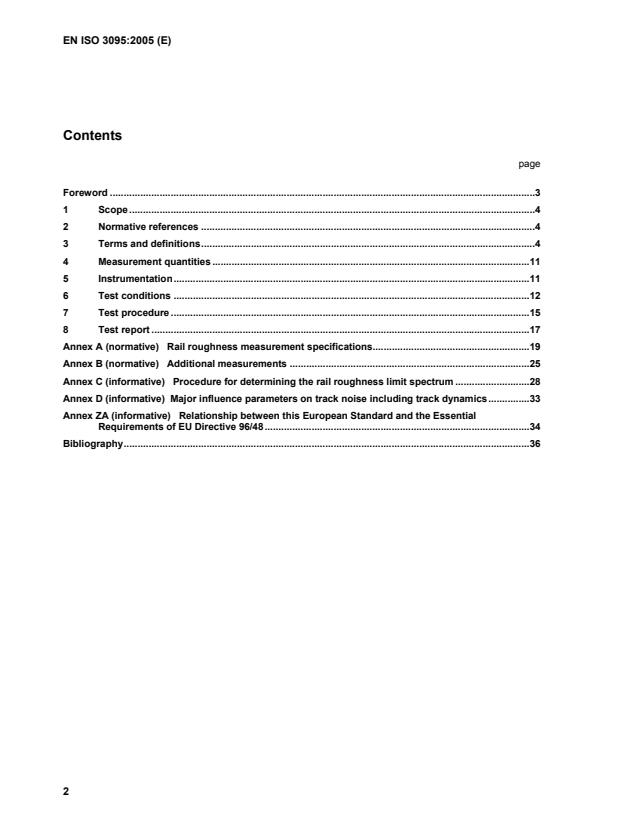
Contents
page
Foreword .3
1 Scope .4
2 Normative references .4
3 Terms and definitions.4
4 Measurement quantities .11
5 Instrumentation.11
6 Test conditions .12
7 Test procedure .15
8 Test report .17
Annex A (normative) Rail roughness measurement specifications.19
Annex B (normative) Additional measurements .25
Annex C (informative) Procedure for determining the rail roughness limit spectrum .28
Annex D (informative) Major influence parameters on track noise including track dynamics.33
Annex ZA (informative) Relationship between this European Standard and the Essential
Requirements of EU Directive 96/48.34
Bibliography.36
Foreword
This European Standard (EN ISO 3095:2005) has been prepared by Technical Committee CEN/TC 256
“Railway applications”, the secretariat of which is held by DIN, in collaboration with Technical Committee
ISO/TC 43 "Acoustics".
This European Standard shall be given the status of a national standard, either by publication of an identical
text or by endorsement, at the latest by February 2006, and conflicting national standards shall be withdrawn
at the latest by February 2006.
This document has been prepared under a mandate given to CEN/CENELEC/ETSI by the European
Commission and the European Free Trade Association, and supports essential requirements of EU Directive
96/48.
For relationship with EU Directive(s), see informative Annex ZA, which is an integral part of this document.
According to the CEN/CENELEC Internal Regulations, the national standards organizations of the following
countries are bound to implement this European Standard: Austria, Belgium, Cyprus, Czech Republic,
Denmark, Estonia, Finland, France, Germany, Greece, Hungary, Iceland, Ireland, Italy, Latvia, Lithuania,
Luxembourg, Malta, Netherlands, Norway, Poland, Portugal, Slovakia, Slovenia, Spain, Sweden, Switzerland
and United Kingdom.
1 Scope
This European Standard specifies the conditions for obtaining reproducible and comparable measurement
results of levels and spectra of noise emitted by all kinds of vehicles operating on rails or other types of fixed
track, hereinafter conventionally called “train”, except for track maintenance vehicles in operation.
This standard is applicable for:
type testing;
periodic monitoring testing.
The results may be used, for example:
to characterise the noise emitted by these trains;
to compare the noise emission of various vehicles on a particular track section;
to collect basic source data for trains.
The test procedures specified in this European Standard are of engineering grade (grade 2, with a precision of
± 2 dB), that is the preferred one for noise declaration purposes, as defined in EN ISO 12001.
The procedures specified for accelerating and decelerating tests are of survey grade.
NOTE 1 Although this standard is for characterising noise emission for vehicles, the wheel-rail rolling noise often contains
a significant and sometimes dominant noise contribution from the track.
NOTE 2 This Standard aims to specify the conditions for obtaining reproducible and comparable measurement results
of noise emitted by railbound vehicles and the method described may also be used to monitor the noise emissions in
ordinary traffic. In the latter case it is not necessary that track and vehicle conditions fulfil the requirements described in
the standard. Therefore the results of such tests are only representative of a “particular” situation.
2 Normative references
The following referenced documents are indispensable for the application of this document. For dated
references, only the edition cited applies. For undated references the latest edition of the referenced
document (including any amendments) applies.
EN 60942, Electroacoustics — Sound calibrators (IEC 60942:2003)
EN 61260, Electroacoustics — Octave-band and fractional-octave-band filters (IEC 61260:1995)
EN 61672-1, Electroacoustics — Sound level meters — Part 1: Specifications (IEC 61672-1:2002)
EN 61672-2, Electroacoustics — Sound level meters — Part 2: Pattern evaluation tests (IEC 61672-2:2003)
EN ISO 266, Acoustics — Preferred frequencies (ISO 266:1997)
3 Terms and definitions
NOTE Definitions from 3.7 to 3.14 apply to values measured either as a frequency spectrum or in a particular
frequency band of centre f (expressed in Hz).
For the purposes of this European Standard, the following terms and definitions apply.
3.1
train
single vehicle or a number of coupled vehicles/units operating on a guided ground transport system
[EN 13452-1]
3.2
type test for noise emission of railbound vehicles
type test
measurement performed to prove that, or to check if, a vehicle delivered by the manufacturer complies with
the noise specifications
3.3
monitoring test for noise emission of railbound vehicles
monitoring test
measurement performed to check if the noise of a vehicle has changed since initial delivery or after
modification
3.4
environmental assessment test
measurement performed for collecting data to be utilised in prediction method for environmental assessment
3.5
roughness
r
root mean square (RMS) value of the amplitude variation of the running surface of a rail in the direction of
motion (longitudinal level) measured over a rail length, expressed in µm
3.6
roughness level
L
r
level given by the equation:
L = 10 lg (r/r )dB (1)
r 0
where
L is the roughness level in dB;
r
r is the RMS roughness in µm;
r the reference roughness; r = 1 µm.
0 0
This definition applies to values measured either as a wavelength spectrum or in a particular wavelength band
centred at λ (expressed in m)
3.7
sound pressure
p(t)
root mean square (RMS) value of a fluctuating pressure superimposed on the static atmospheric pressure
measured over a certain time period, expressed in Pa
3.8
sound pressure level
L
p
level given by the equation:
L = 10 lg ( p(t)/p )dB (2)
p 0
where
L is the sound pressure level in dB;
p
p(t) is the RMS sound pressure in Pa;
p the reference sound pressure; p = 20 µPa
0 0
NOTE Adapted from ISO 1996-1:2003.
3.9
A-weighted sound pressure level
L
pA
sound pressure level obtained by using the frequency weighting A (see EN 61672 –1 and EN 61672-2), given
by the following equation:
L = 10 lg ( p (t)/p )dB (3)
pA A 0
where
L is the A-weighted sound pressure level in dB;
pA
p (t) is the RMS A-weighted sound pressure in Pa;
A
p the reference sound pressure; p = 20 µPa.
0 0
3.10
AF-weighted maximum sound pressure level
L
pAFmax
maximum value of the A-weighted sound pressure level determined during the measurement time interval T
by using time weighting F (fast)
[EN 61672-1]
3.11
A-weighted equivalent continuous sound pressure level
L
pAeq,T
A-weighted sound pressure level given by the following equation:
T
1 p ()t
A
L = 10 lg dtdB
pAeq,T
∫ 2
T p
0
(4)
where
L is the A-weighted equivalent continuous sound pressure level in dB;
pAeq,T
T is the measurement time interval in s;
p (t) is the A-weighted instantaneous sound pressure in Pa;
A
p the reference sound pressure; p = 20 µPa.
0 0
NOTE Adapted from ISO 1996-1:2003.
3.12
A-weighted equivalent continuous sound pressure level on the pass-by time
L
pAeq,Tp
A-weighted sound pressure level given by the following equation:
T
2 2
1 p ()t
A
L = 10 lg dtdB (5)
pAeq,T
∫ 2
p
T − T p
2 1 T 0
1
where
L is the A-weighted equivalent continuous sound pressure level on the pass-by time
pAeq,Tp
in dB;
T = T - T is the measurement pass-by time interval beginning at T and ending at T in s, see
p 2 1 1 2
Figure 1;
p (t) is the A-weighted instantaneous sound pressure in Pa;
A
p the reference sound pressure; p = 20 µPa.
0 0
3.13
single event level
SEL
A-weighted sound level of a single event measured for a time interval T and normalised to T = 1 s. The time
interval T will be long enough to include all the acoustic energy related to the event, considering at least the
points at - 10 dB below the lower L during T. SEL is given by the following equation:
pA
T
1 p ()t
A
SEL = 10 lg dtdB (6)
∫ 2
T p
0 0
0
where
SEL is the A-weighted sound exposure level in dB;
T = 1 s is the reference time interval;
T is the measurement time interval in s;
p (t) is the A-weighted instantaneous sound pressure in Pa;
A
p the reference sound pressure; p = 20 µPa.
0 0
single event level, SEL, is related to the A-weighted equivalent continuous sound pressure level, L , by the
pAeq,T
following equation:
SEL = L + 10 lg (T/T ) dB (7)
pAeq,T 0
3.14
transit exposure level
TEL
A-weighted sound level of a train passage, measured for a time interval T and normalised to the pass-by time
T . The time interval T will be long enough to include all the acoustic energy related to the event, considering
p
at least the points at - 10 dB below the lower L during T . TEL is given by the following equation:
pA p
T
1 p ()t
A
TEL = 10 lg dtdB (8)
∫
T p
p 0
where
TEL is the A-weighted transit exposure level in dB;
T is the measurement time interval in s;
T is the pass-by time of the train in seconds which is the overall length of the train divided by the
p
train speed;
p (t) is the A-weighted instantaneous sound pressure in Pa;
A
p the reference sound pressure; p = 20 µPa.
0 0
transit exposure level, TEL, is related to single event level, SEL, and to the A-weighted equivalent continuous
sound pressure level, L by the following equations:
pAeq,T
TEL = SEL + 10 lg (T /T ) (9)
0 p
and
TEL = L +10 lg (T / T ) (10)
pAeq,T p
where T = 1s is the reference time interval
3.15
measurement time interval T, and train pass-by time
T
p
measurement time interval, T, is chosen, so the measurement starts when the A-weighted sound pressure
level is 10 dB lower than found when the front of the train is opposite the microphone position. The
measurement is stopped when the A-weighted sound pressure level is 10 dB lower than found when the rear
of the train is opposite the microphone position.
Key
1 A-weighted sound pressure level, dB
2 Time
Figure 1 — Example of selection of measuring time interval, T, for a whole train
NOTE The example illustrates the need for an independent device for measuring the train passage time, as the time
cannot be deduced from the sound pressure level versus time.
For measurement of vehicle(s), which form part of a train, the measurement time interval T is the passing time
T of the vehicle(s) under test.
p
For the measurement of un-powered vehicles, the measurement time interval T begins when the centre of the
first vehicle under test passes in front of the microphone position and ends when the centre of the last vehicle
under test passes in front of the microphone position. Figure 2 shows the required measurement time interval
T or the measurement of a single un-powered vehicle. Furthermore, it shows an example of the
A-weighted sound pressure level, L , time history for the passage of a train.
pA
Key
1 A-weighted sound pressure level, dB
2 Time
Figure 2 — Example of selection of measuring time interval, T, for parts of a train
3.16
noise with impulsive character
noise which contains an isolated event or a series of such events. The impulsive character is conventionally
confirmed if the difference between L and L is greater than 3 dB
p T p T
Aleq, Aeq,
[EN ISO 12001]
3.17
noise with tonal character
noise which contains audible tones
4 Measurement quantities
4.1 General
The quantities to be measured at all microphone positions are specified below.
4.2 The measurement quantities for trains moving at constant speed are:
a) for whole trains (this includes single vehicle trains), the Transit Exposure Level, TEL, or the A-Weighted
equivalent continuous sound pressure level on the pass by time, L as the case may be.
pAeq,Tp
b) for parts of trains, the A-weighted equivalent continuous sound pressure level on the pass-by time, L .
pAeq,Tp
4.3 The measurement quantity for stationary vehicles is the A-weighted equivalent continuous sound
pressure level, L .
pAeq,T
The measurement quantity for accelerating or braking tests shall be the maximum AF-weighted sound
4.4
pressure L .
pAFmax
4.5 If frequency analysis is required, it shall be made at least in one third octave bands according to
EN ISO 266: a typical frequency range could be 31,5 Hz to 8 kHz. It is important, however, that the lower
frequency limit is chosen to ensure that the product of the lowest bandwidth and signal duration exceeds unity.
4.6 In presence of noise with suspected tonal character, at each microphone position it is suggested to make
frequency analysis measurements according to 4.5.
Currently no method exists to measure simply the tonal character of the noise from passing trains:
conventionally, if the level of one frequency band exceeds the level of the arithmetic mean of its adjacent
bands by more than 5 dB the tonal character may be confirmed; this method should be used when there are
no other national methods for the evaluation of pure tones.
4.7 For measurements on stationary vehicles, in presence of noise with suspected impulsive character, at
each microphone position it is suggested to make two measurements: one with time weighting S (slow), the
other with time weighting I (impulse) (see EN 61672-1).
Currently no method exists to measure impulsiveness of the noise from passing trains: conventionally, if the
difference between the two is more than 5 dB the impulsive character may be confirmed; this method should
be used when there are no other national methods for the evaluation of impulsiveness.
4.8 Additional measurements on stationary vehicles, at platforms and stopping points and on bridges are
described in Annex B.
5 Instrumentation
The instrumentation system, including the microphones, cables and recording devices shall meet the
requirements for a type 1 instrument specified in EN 61672-1.
The microphones shall have an essentially flat frequency response in a free sound field.
The 1/3 octave band filters shall meet the requirements of class 1 according to EN 61260.
A suitable windscreen shall always be used.
Before and after each series of measurements a sound calibrator meeting the requirements of class 1
according to EN 60942 shall be applied to the microphone(s) for verifying the calibration of the entire
measuring system at one or more frequencies over the frequency range of interest. If the difference between
the two calibrations is more than 0,5 dB all the measurement results shall be rejected.
The compliance of the calibrator with the requirements of EN 60942 shall be verified at least once a year. The
compliance of the instrumentation system with the requirements of EN 61672-1 and EN 61672-2 shall be
verified at least every 2 years.
The date of the last verification of the compliance with the relevant European Standards shall be recorded.
6 Test conditions
6.1 Deviations from the requirements
The conditions prescribed for each test shall be complied with as closely as possible. Slight deviations from the
specified test conditions for type tests are permissible, but shall be described in the test report and, in general,
will lower the reproducibility.
6.2 Test environment
6.2.1 Acoustical environment
The test site should be such that free sound propagation exists; to achieve this result, the ground needs to be
essentially flat and within a level from 0 m to -1 m, relative to the top of rail.
An area around the microphones having a radius which is at least 3 times the measurement distance on both
sides shall be free of large reflecting objects like barriers, hills, rocks, bridges or buildings.
In the vicinity of the microphones, there shall be no obstacles which could disturb the sound field. Therefore,
no person shall be between the microphones and the sound source, and the observer shall be in a position
that does not influence the measured sound pressure level significantly.
The area between the vehicle and the microphones shall not be saturated and shall be as free as possible of
sound absorbing matter (e.g. snow, tall vegetation, other tracks) or reflective covering (e.g. water, ice). The
ground cover shall be described in the test report.
NOTE In practice, the suitability of a test site may be checked with a relatively small sound source generating wide
band noise. If the free field assumption is verified, the measured sound level should decrease by about 6 dB at the
microphone height if the microphone distance is doubled.
6.2.2 Meteorological conditions
Measurements shall be made only if the wind speed measured at the microphone height is below 5 m/s and
there is no falling rain or snow. Temperature, humidity, barometric pressure, wind speed and direction shall be
described (possibly with measured values) in the test report.
6.2.3 Background sound pressure level
Care shall be taken to ensure that the noise from other sources (for example other vehicles or industrial plants
and due to wind) does not influence significantly the measurements.
For type tests, the A-weighted background sound pressure level shall be at least 10 dB below the reading of
the A-weighted sound pressure level obtained when measuring the noise from the vehicle in the presence of
background noise. For frequency analysis this difference shall be at least 10 dB in each frequency band of
interest.
For monitoring tests, the A-weighted background sound pressure level shall be at least 5 dB below the
reading of the A-weighted sound pressure level obtained when measuring the noise from the vehicle in the
presence of background noise. If this difference is less than 10 dB the reading shall be corrected according to
Table 1.
Table 1 — Background noise correction for monitoring tests
Difference between the A-weighted sound Correction to be added to the A-weighted
pressure level obtained when measuring the sound pressure level obtained when
noise from the vehicle in the presence of measuring the noise from the vehicle in
background noise and the A-weighted back- the presence of background noise
ground sound pressure level alone
dB dB
>10 0
6 to 9 –1
5 –2
6.3 Microphone positions
6.3.1 General
The microphone axis shall always be horizontal and directed perpendicularly to the track. The available
standard microphone positions are shown in Figure 3. It may not always be possible or necessary to measure
at all the positions, but the microphone positions selected shall be one or more of those defined. The
permitted microphone positions are on both sides at a distance of 7,5 m from the track axis, at a height of
1,2 m ± 0,2 m above the top of rail, and on both sides at a distance of 25 m from the track axis, at a height of
3,5 m ± 0,2 m above the top of rail. If important sound sources (for example exhaust pipes or pantographs)
are present in the upper part of the vehicle under test, additional microphone positions are on both sides at a
distance of 7,5 m from the track axis and at a height of 3,5 m ± 0,2 m above the top of rail.
6.3.2 Measurement on stationary vehicles
The microphone shall be placed at a distance of 7,5 m from the centre line of the track at a height of 1,2 m ±
0,2 m above the upper surface of the rail and opposite the centre of the vehicle. (See Annex B)
6.3.3 Measurement on vehicles with constant speed
Where measurements on both sides are specified for type tests (e.g. for non-symmetric distribution of train
noise sources), they do not need to be made at the same time.
Dimensions in metres
Figure 3 — Lateral microphone positions for measurements on vehicles with constant speed
6.3.4 Measurements on accelerating from standstill or decelerating vehicles
The vertical and lateral positions of the set of microphones are identical for all types of accelerating from
standstill and decelerating tests and are identical to the positions described in 6.3.1 at 7,5 m from the track
axis only.
The number of sets and their longitudinal position, i.e. the distance ahead of the front of the train at the
moment when it starts accelerating or braking, depend on the type of train.
Given L the distance between the bogie centres of the vehicle, the sets of microphones will be placed:
a) one set 20 m ahead of the front of the train in the case of an individual power unit accelerating;
b) two sets, one at the front of the train and the other at L/2 m ahead of the front of the train, in the case of
accelerating trains with distributed power or of decelerating trains of any kind.
The measurement shall end when the end of the unit is 20 m past the last set of microphones. For
acceleration test, the measurement shall be stopped when either the rear of the power unit is 20 m past the
last set of microphones or the speed exceeds 30 km/h.
6.4 Vehicle conditions
6.4.1 General
The vehicle shall be in its normal operating conditions and, for test with constant speed, its wheels shall have
run in normal conditions at least 3 000 km (or 1 000 km for tramways and metros) on track with normal traffic.
For vehicles with tread brakes and block/tread pair shall be in ground conditions (a run-in condition where
block and tread have ground themselves sufficiently). The wheel treads shall be as free as possible from
irregularities, such as flats.
When trailed vehicles are to be tested, all efforts shall be made to ensure that the measurements are not
influenced by noise from other parts of the train, like power unit adjacent vehicles.
6.4.2 Loading or operating conditions
The vehicles shall be unloaded or unoccupied except for the train crew. For power units (for example
locomotives), their normal load under working conditions (tractive effort) shall be used.
6.4.3 Doors, windows, auxiliary equipment
During the measurements, the doors and windows of the vehicle shall be kept closed.
Auxiliary equipment on the test vehicle that normally operates during the run shall be in action. However, if the
auxiliary equipment noise appears infrequently for only a short time (less than 2 % of the operating time) and if
it affects the sound pressure level from other sources by less than 5 dB, it shall not be considered in the
measurements.
The test report shall describe the state of the auxiliary equipments during the test.
6.5 Track conditions
6.5.1 General
For conventional vehicles, the measurements shall be made with ballast bed and wooden or reinforced
concrete sleepers, or with the track normally used by the train. The track shall be dry and not frozen. These
tests shall be done on a rail section and sleeper design in common use on the particular railway network. If
other track designs are integral with the operation of vehicles, they should be used for the tests.
The track shall be well maintained. The level gradient at the track shall be 3:1 000 at the most and the radius
of curvature r shall be:
a) r ≥ 1 000 m for tests at train speed v ≤ 70 km/h;
b) r ≥ 3 000 m for tests at train speed 70 < v ≤ 120 km/h;
c) r ≥ 5 000 m for tests at train speeds v > 120 km/h.
The track at the measuring section shall be laid without rail joints (welded rail) and free of visible surface
defects such as rail burns or pits and spikes caused by the compression of external material between wheel
and rail: no audible impact noise due to welds or loose sleepers should be present.
NOTE Noise generated by rolling stock is influenced by surface roughness of rail head and track dynamic
characteristics. While the track roughness has to be measured at the measurement section by using this standard, track
dynamic characteristics are still under study (see Annex D).
6.5.2 Rail roughness
The condition of the rail shall be considered suitable for type test measurements if the 1/3 octave band
roughness levels throughout the test section fulfils the requirements of Annex A.
6.5.3 Special conditions
For non-conventional vehicles tested on their tracks, the track construction shall be described in the test report.
7 Test procedure
7.1 General
7.1.1 The measurement quantities according to Clause 4 and the associated time interval T shall be
measured for each microphone position. The train pass-by time, T , shall be measured with an independent
p
device, such as a light barrier or a wheel detector.
7.1.2 For type tests, at least three measurements shall be made at each microphone position and for each
measuring condition. The arithmetic mean value of each set of measurements shall be determined and used
as the test result and shall be rounded to the nearest integer decibel. If the spread of the readings is larger
than 3 dB, a new series of measurements shall be made.
For monitoring tests, it is sufficient to perform one measurement.
7.1.3 If the sound pressure levels measured on each side of the vehicle are different; the higher sound
pressure level shall be retained as measurement results.
7.1.4 For the measurement of a single trailed vehicle, there shall be at least one acoustically similar
vehicle after the power unit, followed by at least two vehicles under test, and at least one acoustically similar
vehicle.
7.1.5 All vehicle auxiliary equipment shall be in operation at its normal load during the test.
7.2 Measurement on vehicles with constant speed
7.2.1 The preferred speeds of testing are 20 km/h, 40 km/h, 60 km/h, 80 km/h, 100 km/h, 120 km/h,
140 km/h, 160 km/h, 200 km/h, 250 km/h, 300 km/h, 320 km/h and 350 km/h. Three cases apply:
a) type testing of trains with v ≥ 200 km/h: tests shall be performed at v = 160 km/h and at v , or,
max max
preferably, at the highest possible speed of the train corresponding to one of the preferred speeds.
Whenever possible, tests should be performed also at v = 80 km/h;
b) type testing of trains with 80 km/h < v < 200 km/h: tests shall be performed at v = 80 km/h and at v ,
max max
or, preferably, at the highest possible speed of the train corresponding to one of the preferred speeds;
c) type testing of trains with v ≤ 80 km/h: testing shall be performed at v = 40 km/h and at v .
max max
Additional tests should be performed at one or more of the preferred speeds.
Periodic monitoring testing shall be performed at the preferred speeds except when otherwise agreed by the
owner of the rolling stock and the authority defining the measurement.
Over the measurement section of the track, the vehicle under test shall be run at the chosen speeds stabilised
within ± 5 %. The speed shall be measured by a device with an accuracy better than 3 %. The speedometer of
the train may be used, provided a calibration with accuracy better than 3 % is performed.
7.2.2 For measurement of trailed vehicle(s) which form part of a train, the measurement time interval T
shall be the passing time of the vehicle(s) under test measured with an independent device, such as a light
barrier or a wheel detector.
The meas
...