

EN 1991-1-2:2024/prA1
(Amendment)Eurocode 1 - Actions on structures - Part 1-2: Actions on structures exposed to fire
- Abstract
1.1 Scope of EN 1991 1 2
(1) The methods given in this Eurocode are applicable to buildings and civil engineering works, with a fire load related to the building and its occupancy.
(2) EN 1991 1 2 deals with thermal and mechanical actions on structures exposed to fire. It is intended to be used in conjunction with the fire design Parts of EN 1992 to EN 1996 and EN 1999 which give rules for designing structures for fire resistance.
(3) EN 1991 1 2 contains thermal actions either nominal or physically based. More data and models for physically based thermal actions are given in annexes.
(4) EN 1991 1 2 does not cover the assessment of the damage of a structure after a fire.
(5) EN 1991 1 2 does not cover supplementary requirements concerning, for example:
- the possible installation and maintenance of sprinkler systems;
- conditions on occupancy of building or fire compartment;
- the use of approved insulation and coating materials, including their maintenance.
1.2 Assumptions
(1) In addition to the general assumptions of EN 1990 the following assumptions apply:
- any active and passive fire protection systems taken into account in the design will be adequately maintained;
- the choice of the relevant design fire scenario is made by appropriate qualified and experienced personnel, or is given by the relevant national regulation.
- Status
- Not Published
- Publication Date
- 06-Jan-2028
- Technical Committee
- CEN/TC 250 - Structural Eurocodes
- Drafting Committee
- CEN/TC 250/SC 1/WG 4 - Actions on structures exposed to fire
- Current Stage
- 4060 - Closure of enquiry - Enquiry
- Start Date
- 27-Aug-2026
- Due Date
- 17-Dec-2026
- Completion Date
- 17-Dec-2026

EN 1991-1-2:2024/prA1 is a CEN draft amendment to Eurocode 1, Part 1-2, for actions on structures exposed to fire. It updates the rules for thermal and mechanical actions on buildings and civil engineering works exposed to fire, and it is intended to be used with the fire design parts of EN 1992 to EN 1996 and EN 1999.
What does EN 1991-1-2:2024/prA1 specify?
EN 1991-1-2:2024/prA1 specifies changes to EN 1991-1-2:2024. The base document deals with fire-related actions on structures, using either nominal thermal actions or physically based thermal actions, and it is written for structures whose fire load is related to the building and its occupancy.
The amendment keeps the same overall structure and updates the text in the introduction, Clauses 2, 3, 4 and 6, and Annexes A, B, C, E, F and H. It also preserves the scope limits of the base standard, including the exclusion of post-fire damage assessment and supplementary building-operations requirements such as sprinkler maintenance and coating maintenance.
| Annex | What it covers |
|---|---|
| A | Parametric fire curves |
| B | Thermal actions for external members - simplified calculation method |
| C | Localized fires |
| E | Fire load densities, fire growth rates and rate of heat releases |
| F | Equivalent time of fire exposure |
| H | Thermal actions for structural fire loads of timber structures |
What are the key requirements of EN 1991-1-2:2024/prA1?
EN 1991-1-2:2024/prA1 mainly updates how fire design calculations are identified, referenced and applied. In practice, the amendment tells users which fire model to use, which companion standards to follow, and which parameters and symbols have been revised.
Fire design procedure
Clause 4 updates the structural fire design procedure. EN 1991-1-2:2024/prA1 distinguishes between a nominal fire curve, where the temperature analysis is carried out for a specified time without a cooling phase, and a physically based fire model, where the analysis covers the full fire duration including cooling.
For design work, this means the engineer must match the analysis method to the chosen design fire scenario in Clause 5 and then check whether the relevant time periods come from the National Annex or national regulations.
Updated reference framework
Clause 2 updates the normative reference to EN 1990:2023+A1:2026, and the foreword updates internal references from EN 1990 to EN 1990-1 in most places. This matters because the fire design procedure sits on top of the general basis of structural design, so the referenced version has to be consistent.
The introduction also updates the cross-reference to EN 19100, Eurocode 10 - Design of glass structures, and clarifies the wording on seismic design by referring to EN 1998 (all parts).
Revised terms and symbols
Clause 3 updates key definitions used in fire compartment calculations. The amendment replaces the term absorptivity with effusivity in one definition, revises the meaning of W, and updates the definitions of Γ and Γ_lim so they are tied to opening factor O and thermal effusivity b.
In practice, this means the symbols in the calculation formulas should be read with the revised thermal-property and geometry definitions, not older wording.
Annex calculations and figures
Annex A revises the definitions used for parametric fire curves, including thermal effusivity for the enclosure and the time-limit expression. Annex B updates the simplified method for external members, including the D/W ratio, Figure B.3, and the way flame geometry is represented using equivalent rectangles from EN 1993-1-2:2024.
Annex C updates the figure keys for localized fires. Annex E revises the fire load density material, including Table E.1 for occupancy examples, and clarifies wording about combustible parts of the construction. Annex F and Annex H also receive reference and wording updates.
What terms does EN 1991-1-2:2024/prA1 define?
- Effusivity - a thermal property used in fire calculations; in this amendment it replaces absorptivity in one definition.
- Opening factor O - the parameter used with thermal effusivity to describe fire compartment ventilation effects.
- Thermal effusivity b - the thermal property used in the time-factor functions for fire development calculations.
- W - the width of the wall of the fire compartment, measured perpendicular to wall 1.
- Γ - a time factor function of opening factor O and thermal effusivity b.
- Γ_lim - the limiting time factor function of opening factor O and thermal effusivity b.
Who uses EN 1991-1-2:2024/prA1?
EN 1991-1-2:2024/prA1 is used by structural engineers, fire engineers, and designers working on buildings and civil engineering works that need fire-resistant design. It is also used by checking authorities, code consultants, and technical teams who review fire load assumptions, compartment fire scenarios, and structural temperature analyses.
Manufacturers and material specialists may use it when their products are part of a fire design calculation, especially where the document is applied together with material-specific fire design Parts of EN 1992 to EN 1996 and EN 1999.
What changed in EN 1991-1-2:2024/prA1 from the previous edition?
EN 1991-1-2:2024/prA1 will modify EN 1991-1-2:2024. The amendment updates references, terminology, procedures and annex calculations, and the foreword notes that some changes are editorial.
The main changes named in the document are:
- updated references from EN 1990 to EN 1990-1 in most places
- an updated normative reference to EN 1990:2023+A1:2026
- revised terminology in Clause 3, including effusivity and the symbols W, Γ and Γ_lim
- revised guidance in Clause 4 on nominal fire curves and physically based fire models
- revised clause wording in Clause 6
- updates to Annexes A, B, C, E, F and H, including formulas, figure keys, table values and cross-references
- added and revised references to EN 19100, EN 1993-1-2:2024 and EN 1995-1-2:2025
Which standards are used with EN 1991-1-2:2024/prA1?
- EN 1990:2023+A1:2026 - the basis of structural and geotechnical design used as the general design reference.
- EN 1993-1-2:2024 - used in Annex B for the geometry of equivalent flame rectangles around columns and beams.
- EN 1995-1-2:2025, Annex A - used in Annex H for timber-related fire load actions.
- EN 1992 to EN 1996 and EN 1999 fire design parts - the companion Eurocode parts that provide material-specific fire resistance design rules.
What does the EN 1991-1-2:2024/prA1 document contain?
EN 1991-1-2:2024/prA1 contains a foreword, a contents list, and a set of modification instructions spread across the main text and selected annexes. The amendment text revises formulas in Annex A, a simplified calculation method and figure in Annex B, figure keys in Annex C, a fire-load table in Annex E, the equivalent time of fire exposure procedure in Annex F, and timber-structure references in Annex H.
It also changes cross-references in the introduction, the normative references clause, the terms and definitions clause, and the structural fire design procedure. For users, that means calculations, diagrams and internal references need to be checked against the amended wording before the document is applied in design or review work.
Get Certified
Connect with accredited certification bodies for this standard

DIBt (Deutsches Institut für Bautechnik)
German Institute for Building Technology.

DIN CERTCO
DIN Group product certification.

Kiwa BDA Testing
Building and construction product certification.
Sponsored listings
Frequently Asked Questions
EN 1991-1-2:2024/prA1 is a draft published by the European Committee for Standardization (CEN). Its full title is "Eurocode 1 - Actions on structures - Part 1-2: Actions on structures exposed to fire". This standard covers: 1.1 Scope of EN 1991 1 2 (1) The methods given in this Eurocode are applicable to buildings and civil engineering works, with a fire load related to the building and its occupancy. (2) EN 1991 1 2 deals with thermal and mechanical actions on structures exposed to fire. It is intended to be used in conjunction with the fire design Parts of EN 1992 to EN 1996 and EN 1999 which give rules for designing structures for fire resistance. (3) EN 1991 1 2 contains thermal actions either nominal or physically based. More data and models for physically based thermal actions are given in annexes. (4) EN 1991 1 2 does not cover the assessment of the damage of a structure after a fire. (5) EN 1991 1 2 does not cover supplementary requirements concerning, for example: - the possible installation and maintenance of sprinkler systems; - conditions on occupancy of building or fire compartment; - the use of approved insulation and coating materials, including their maintenance. 1.2 Assumptions (1) In addition to the general assumptions of EN 1990 the following assumptions apply: - any active and passive fire protection systems taken into account in the design will be adequately maintained; - the choice of the relevant design fire scenario is made by appropriate qualified and experienced personnel, or is given by the relevant national regulation.
1.1 Scope of EN 1991 1 2 (1) The methods given in this Eurocode are applicable to buildings and civil engineering works, with a fire load related to the building and its occupancy. (2) EN 1991 1 2 deals with thermal and mechanical actions on structures exposed to fire. It is intended to be used in conjunction with the fire design Parts of EN 1992 to EN 1996 and EN 1999 which give rules for designing structures for fire resistance. (3) EN 1991 1 2 contains thermal actions either nominal or physically based. More data and models for physically based thermal actions are given in annexes. (4) EN 1991 1 2 does not cover the assessment of the damage of a structure after a fire. (5) EN 1991 1 2 does not cover supplementary requirements concerning, for example: - the possible installation and maintenance of sprinkler systems; - conditions on occupancy of building or fire compartment; - the use of approved insulation and coating materials, including their maintenance. 1.2 Assumptions (1) In addition to the general assumptions of EN 1990 the following assumptions apply: - any active and passive fire protection systems taken into account in the design will be adequately maintained; - the choice of the relevant design fire scenario is made by appropriate qualified and experienced personnel, or is given by the relevant national regulation.
EN 1991-1-2:2024/prA1 is classified under the following ICS (International Classification for Standards) categories: 13.220.50 - Fire-resistance of building materials and elements; 91.010.30 - Technical aspects. The ICS classification helps identify the subject area and facilitates finding related standards.
EN 1991-1-2:2024/prA1 is available in PDF format for immediate download after purchase. The document can be added to your cart and obtained through the secure checkout process. Digital delivery ensures instant access to the complete standard document.
Standards Content (Sample)
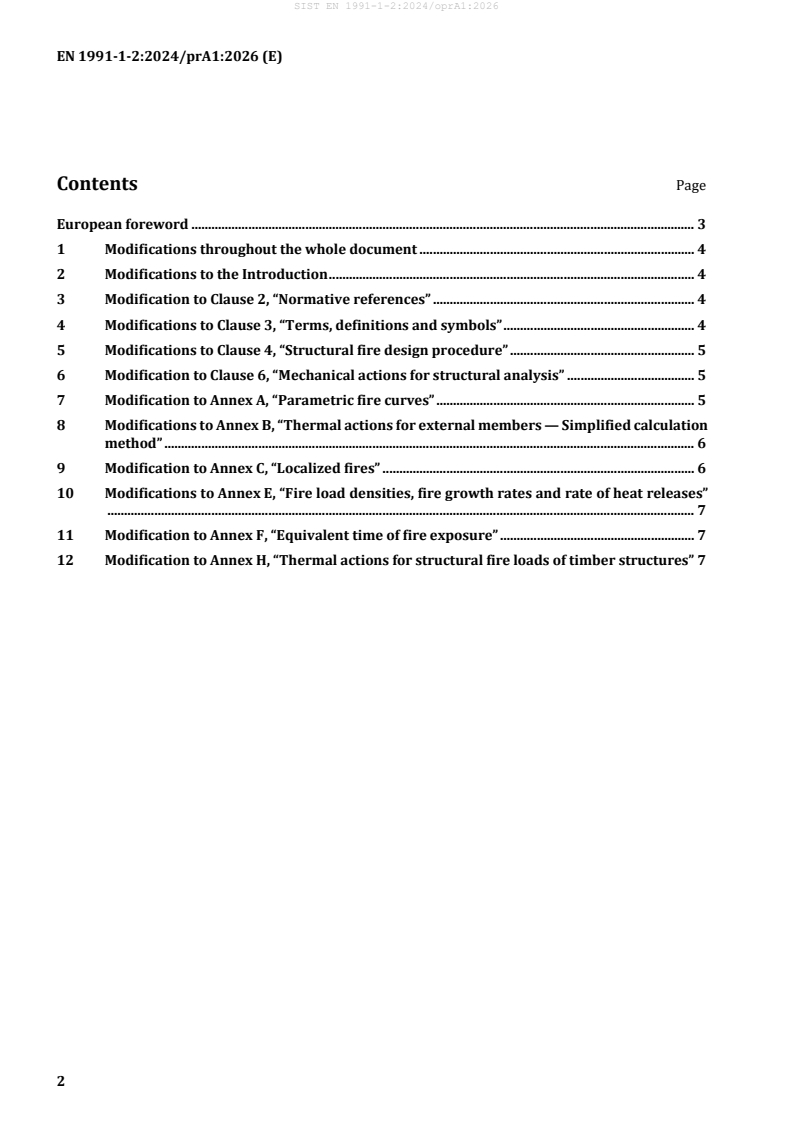
Contents
- European foreword
- 1 Modifications throughout the whole document
- 2 Modifications to the Introduction
- 3 Modification to Clause 2, “Normative references”
- 4 Modifications to Clause 3, “Terms, definitions and symbols”
- 5 Modifications to Clause 4, “Structural fire design procedure”
- 6 Modification to Clause 6, “Mechanical actions for structural analysis”
- 7 Modification to Annex A, “Parametric fire curves”
- 8 Modifications to Annex B, “Thermal actions for external members —
- 9 Modification to Annex C, “Localized fires”
- 10 Modifications to Annex E, “Fire load densities, fire growth rates and rate of
- 11 Modification to Annex F, “Equivalent time of fire exposure”
- 12 Modification to Annex H, “Thermal actions for structural fire loads of timber
European foreword
This document (EN 1991-1-2:2024/prA1:2026) has been prepared by Technical Committee CEN/TC 250 “Structural Eurocodes”, the secretariat of which is held by BSI. This document is currently submitted to the CEN Enquiry.
This document will amend EN 1991-1-2:2024.
NOTE Some modifications are purely editorial corrections to improve the quality of the document and these will not be tagged in the consolidated publication, as noted after the modification. The first generation of EN Eurocodes was published between 2002 and 2007. This document forms part of the second generation of the Eurocodes, which have been prepared under Mandate M/515 issued to CEN by the European Commission and the European Free Trade Association. The Eurocodes have been drafted to be used in conjunction with relevant execution, material, product and test standards, and to identify requirements for execution, materials, products and testing that are relied upon by the Eurocodes.
The Eurocodes recognize the responsibility of each Member State and have safeguarded their right to determine values related to regulatory safety matters at national level through the use of National Annexes.
SIST EN 1991-1-2:2024/oprA1:2026 EN 1991-1-2:2024/prA1:2026 (E)
1 Modifications throughout the whole document
Replace “EN 1990:2023” with “EN 1990-1:2023+A1:2026”.
Replace “EN 1990” with “EN 1990-1” except for the reference to “EN 1990” in subclause 0.1.
2 Modifications to the Introduction
Replace in 0.1 “New Eurocodes under development, e.g. Eurocode for design of structural glass” with “EN 19100, Eurocode 10 — Design of glass structures”.
Add in 0.1 the following new list item: “— New parts are under development, e.g. Eurocode for design of fibre-polymer composite structures and for design of tensioned membrane structures”. In 0.2, replace “EN 1990” with “EN 1990-1”.
Add in 0.2, NOTE 1 “, see EN 1990-2” at the end of the existing NOTE 1 after “In these cases additional or amended provisions can be necessary.”.
Delete in 0.2 the paragraph “EN 1991 does not cover the specific requirements of actions for seismic design. Provisions related to such requirements are given in EN 1998 (all parts), which complement and are consistent with EN 1991.”.
...