

EN 15346:2024
(Main)Plastics - Recycled plastics - Characterization of poly(vinyl chloride) (PVC) recyclates
- Abstract
This document specifies the main characteristics and associated test methods for assessing of poly(vinyl chloride) (PVC) recyclates intended for use in the production of semi-finished/finished products.
This document is intended to support parties involved in the use of PVC recyclates to agree on specifications for specific and generic applications.
This document does not cover the characterization of plastics wastes, which is covered by the EN 153471(series), nor traceability topics which are covered by EN 15343.
This document is applicable without prejudice to any existing legislation.
- Status
- Published
- Publication Date
- 06-Aug-2024
- Technical Committee
- CEN/TC 249 - Plastics
- Drafting Committee
- CEN/TC 249/WG 11 - Plastics recycling
- Current Stage
- 6060 - Definitive text made available (DAV) - Publishing
- Start Date
- 07-Aug-2024
- Due Date
- 10-Oct-2023
- Completion Date
- 07-Aug-2024

Overview
EN 15346:2024 - Plastics - Recycled plastics - Characterization of poly(vinyl chloride) (PVC) recyclates is a CEN standard that defines the main characteristics and associated test methods for assessing PVC recyclates intended for use in semi‑finished and finished products. Approved June 2024 and superseding EN 15346:2014, this document helps suppliers and customers agree on batch specifications and quality criteria for PVC recyclates (rPVC, PVC‑R, PVC(REC)). It is applicable without prejudice to legislation and does not cover waste‑stream characterization (EN 15347 series) or traceability (EN 15343).
Key topics and requirements
- Scope and purpose: Specifies required and optional characteristics to be reported for each homogeneous batch of recyclate and supports specification agreements between parties.
- Batch control: Defines a “single batch” as a homogeneous quantity and recommends provision of a certificate of analysis on request.
- Required vs optional characteristics: Table 1 divides measurements into those mandatory for all recyclates and those optional for specific applications.
- Physical and material tests (normative references and annexes):
- Bulk density (Annex A / EN ISO 60)
- Particle size and distribution for micronized material and crushes (Annex C, D; sieving or alternative agreed methods)
- Ash content (EN ISO 3451‑5) and impurities (Annex B)
- Water/volatile content and residual humidity (EN 12099, EN ISO 1269)
- Mechanical properties: tensile stress/strain, modulus, flexural modulus, Charpy impact (EN ISO 527, EN ISO 178, EN ISO 179)
- Thermal properties: Vicat softening temperature (EN ISO 306) and thermal stability / HCl evolution (ISO 182 series)
- Processability: Basic fitness for calendering and extrusion (Annex E, F)
- Quality assurance: Guidance for agreeing additional tests and reporting results; alternative methods can be used if mutually agreed.
Applications and who uses this standard
EN 15346:2024 is practical for:
- Recyclers and material suppliers - to characterize output, set batch acceptance criteria, and prepare certificates of analysis.
- Converters and compounders (calendering, extrusion) - to verify fitness for processing and adjust formulations.
- Product designers and OEMs - to specify recycled PVC input requirements for semi‑finished/finished goods.
- Procurement, QC and compliance teams - for incoming material inspection, supplier audits and contract specifications.
- Standards developers and regulators - as a harmonized reference for recycled plastics quality.
Using EN 15346:2024 supports circular economy goals by enabling consistent quality assessment of recycled PVC, reducing processing risk and facilitating market uptake.
Related standards
- EN 15343 - Plastics recycling traceability and assessment of conformity and recycled content
- EN 15347 (series) - Sorted plastics wastes (waste characterization)
- EN 15342, EN 15344, EN 15345, EN 15348, EN 18067 - Characterization of PS, PE, PP, PET, ABS recyclates respectively
- CEN/TR 15353 - Guidelines for development of standards for recycled plastics
Keywords: EN 15346:2024, PVC recyclates, recycled plastics, characterization, CEN standard, material specification, certificate of analysis.
Relations
- Effective Date
- 19-Jan-2023
- Effective Date
- 25-Aug-2026
- Effective Date
- 25-Aug-2026
- Effective Date
- 01-Apr-2026
- Effective Date
- 28-Jan-2026
- Effective Date
- 28-Jan-2026
- Effective Date
- 28-Jan-2026
- Effective Date
- 28-Jan-2026
- Effective Date
- 28-Jan-2026
- Effective Date
- 28-Jan-2026
- Effective Date
- 28-Jan-2026
- Effective Date
- 28-Jan-2026
- Effective Date
- 28-Jan-2026
- Effective Date
- 28-Jan-2026
- Effective Date
- 28-Jan-2026
Get Certified
Connect with accredited certification bodies for this standard

DIN CERTCO
DIN Group product certification.
CIS Institut d.o.o.
Personal Protective Equipment (PPE) certification body. Notified Body NB-2890 for EU Regulation 2016/425 PPE.

Kiwa BDA Testing
Building and construction product certification.
Sponsored listings
Frequently Asked Questions
EN 15346:2024 is a standard published by the European Committee for Standardization (CEN). Its full title is "Plastics - Recycled plastics - Characterization of poly(vinyl chloride) (PVC) recyclates". This standard covers: This document specifies the main characteristics and associated test methods for assessing of poly(vinyl chloride) (PVC) recyclates intended for use in the production of semi-finished/finished products. This document is intended to support parties involved in the use of PVC recyclates to agree on specifications for specific and generic applications. This document does not cover the characterization of plastics wastes, which is covered by the EN 153471(series), nor traceability topics which are covered by EN 15343. This document is applicable without prejudice to any existing legislation.
This document specifies the main characteristics and associated test methods for assessing of poly(vinyl chloride) (PVC) recyclates intended for use in the production of semi-finished/finished products. This document is intended to support parties involved in the use of PVC recyclates to agree on specifications for specific and generic applications. This document does not cover the characterization of plastics wastes, which is covered by the EN 153471(series), nor traceability topics which are covered by EN 15343. This document is applicable without prejudice to any existing legislation.
EN 15346:2024 is classified under the following ICS (International Classification for Standards) categories: 13.030.50 - Recycling; 83.080.20 - Thermoplastic materials. The ICS classification helps identify the subject area and facilitates finding related standards.
EN 15346:2024 has the following relationships with other standards: It is inter standard links to EN 15346:2014, ISO 565:1990, ISO 182-1:1990, EN ISO 179-1:2026, EN ISO 21306-2:2019, EN ISO 1269:2006, EN ISO 868:2003, EN ISO 179-2:2020, EN ISO 182-3:2025, EN ISO 1183-1:2025, CEN/TR 15353:2007, EN 17615:2022, EN ISO 60:2023, EN ISO 1043-1:2011, EN ISO 182-2:1999. Understanding these relationships helps ensure you are using the most current and applicable version of the standard.
EN 15346:2024 is associated with the following European legislation: Standardization Mandates: M/584. When a standard is cited in the Official Journal of the European Union, products manufactured in conformity with it benefit from a presumption of conformity with the essential requirements of the corresponding EU directive or regulation.
EN 15346:2024 is available in PDF format for immediate download after purchase. The document can be added to your cart and obtained through the secure checkout process. Digital delivery ensures instant access to the complete standard document.
Standards Content (Sample)
SLOVENSKI STANDARD
01-oktober-2024
Polimerni materiali - Reciklirani polimerni materiali - Karakterizacija reciklatov
polivinilklorida (PVC)
Plastics - Recycled plastics - Characterization of poly(vinyl chloride) (PVC) recyclates
Kunststoffe - Kunststoff-Rezyklate - Charakterisierung von Polyvinylchlorid (PVC)-
Rezyklaten
Plastiques - Plastiques recyclés - Caractérisation des recyclats de poly(chlorure de
vinyle) (PVC)
Ta slovenski standard je istoveten z: EN 15346:2024
ICS:
13.030.50 Recikliranje Recycling
83.080.20 Plastomeri Thermoplastic materials
2003-01.Slovenski inštitut za standardizacijo. Razmnoževanje celote ali delov tega standarda ni dovoljeno.
EN 15346
EUROPEAN STANDARD
NORME EUROPÉENNE
August 2024
EUROPÄISCHE NORM
ICS 13.030.50; 83.080.20 Supersedes EN 15346:2014
English Version
Plastics - Recycled plastics - Characterization of poly(vinyl
chloride) (PVC) recyclates
Plastiques - Plastiques recyclés - Caractérisation des Kunststoffe - Kunststoff-Rezyklate - Charakterisierung
recyclats de poly(chlorure de vinyle) (PVC) von Polyvinylchlorid (PVC)-Rezyklaten
This European Standard was approved by CEN on 3 June 2024.
CEN members are bound to comply with the CEN/CENELEC Internal Regulations which stipulate the conditions for giving this
European Standard the status of a national standard without any alteration. Up-to-date lists and bibliographical references
concerning such national standards may be obtained on application to the CEN-CENELEC Management Centre or to any CEN
member.
This European Standard exists in three official versions (English, French, German). A version in any other language made by
translation under the responsibility of a CEN member into its own language and notified to the CEN-CENELEC Management
Centre has the same status as the official versions.
CEN members are the national standards bodies of Austria, Belgium, Bulgaria, Croatia, Cyprus, Czech Republic, Denmark, Estonia,
Finland, France, Germany, Greece, Hungary, Iceland, Ireland, Italy, Latvia, Lithuania, Luxembourg, Malta, Netherlands, Norway,
Poland, Portugal, Republic of North Macedonia, Romania, Serbia, Slovakia, Slovenia, Spain, Sweden, Switzerland, Türkiye and
United Kingdom.
EUROPEAN COMMITTEE FOR STANDARDIZATION
COMITÉ EUROPÉEN DE NORMALISATION
EUROPÄISCHES KOMITEE FÜR NORMUNG
CEN-CENELEC Management Centre: Rue de la Science 23, B-1040 Brussels
© 2024 CEN All rights of exploitation in any form and by any means reserved Ref. No. EN 15346:2024 E
worldwide for CEN national Members.
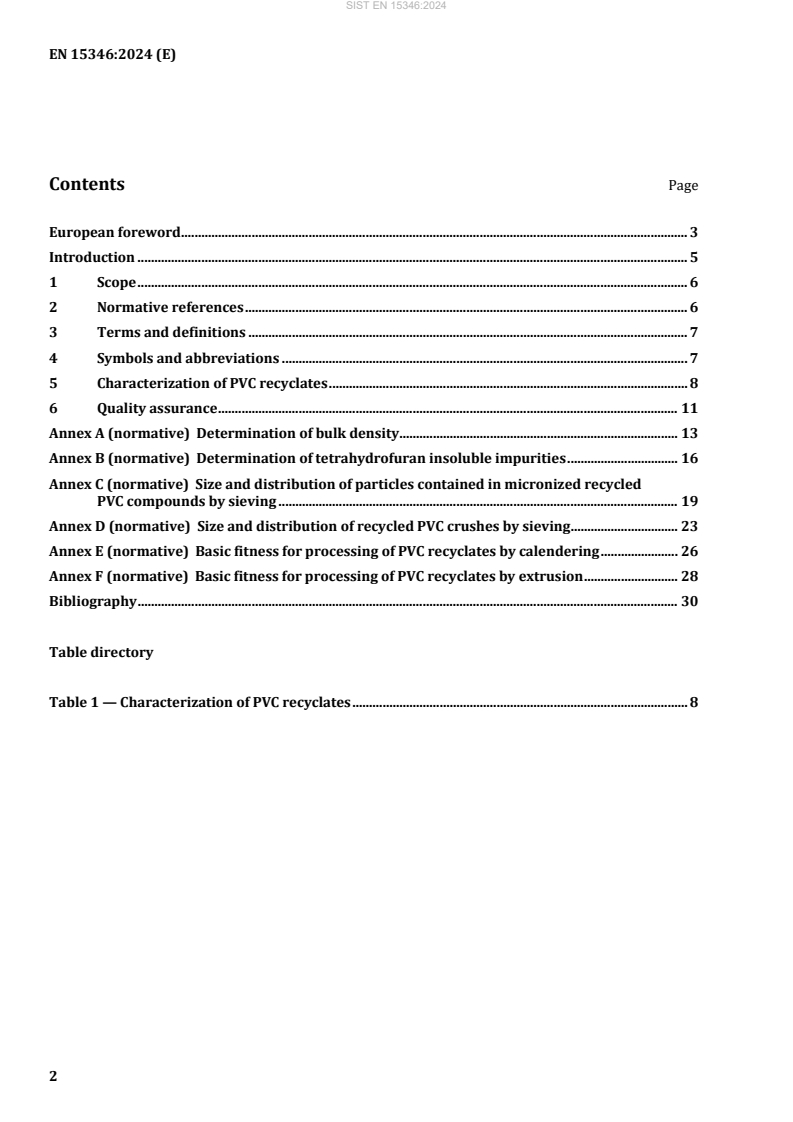
Contents Page
European foreword . 3
Introduction . 5
1 Scope . 6
2 Normative references . 6
3 Terms and definitions . 7
4 Symbols and abbreviations . 7
5 Characterization of PVC recyclates . 8
6 Quality assurance . 11
Annex A (normative) Determination of bulk density . 13
Annex B (normative) Determination of tetrahydrofuran insoluble impurities . 16
Annex C (normative) Size and distribution of particles contained in micronized recycled
PVC compounds by sieving . 19
Annex D (normative) Size and distribution of recycled PVC crushes by sieving . 23
Annex E (normative) Basic fitness for processing of PVC recyclates by calendering . 26
Annex F (normative) Basic fitness for processing of PVC recyclates by extrusion . 28
Bibliography . 30
Table directory
Table 1 — Characterization of PVC recyclates . 8
European foreword
This document (EN 15346:2024) has been prepared by Technical Committee CEN/TC 249 “Plastics”,
the secretariat of which is held by SIS.
This European Standard shall be given the status of a national standard, either by publication of an
identical text or by endorsement, at the latest by February 2025, and conflicting national standards
shall be withdrawn at the latest by February 2025.
Attention is drawn to the possibility that some of the elements of this document may be the subject of
patent rights. CEN shall not be held responsible for identifying any or all such patent rights.
This document supersedes EN 15346:2014.
— The scope has been clarified;
— The introduction has been harmonized with EN 15342, EN 15344, EN 15345, EN 15348 and
EN 18067;
— Clause 2 “Normative references” was updated;
— in Clause 3 “Terms and definitions” term 3.1 was removed;
— in Clause 5 Table 1 “Characterization of PVC recyclates” was revised;
— Clause 6 was clarified;
— Annex A “Typical compositions of PVC compounds” was removed;
— Annex C “Size and distribution of particles contained in micronized recycled PVC compounds by
sieving” and Annex D “Size and distribution of recycled PVC crushes by sieving” were revised;
— Annex E and F: the titles were clarified.
This document is one part of series of CEN publications on Plastics Recycling, which is structured as
follows:
— EN 15342, Plastics — Recycled Plastics — Characterization of polystyrene (PS) recyclates
— EN 15343, Plastics — Recycled Plastics — Plastics recycling traceability and assessment of conformity
and recycled content
— EN 15344, Plastics — Recycled Plastics — Characterization of Polyethylene (PE) recyclates
— EN 15345, Plastics — Recycled Plastics — Characterization of Polypropylene (PP) recyclates
— EN 15346, Plastics — Recycled plastics — Characterization of poly(vinyl chloride) (PVC) recyclates
— EN 15347 , (series), Plastics — Sorted plastics wastes
— EN 15348, Plastics — Recycled plastics — Characterization of poly(ethylene terephthalate) (PET)
recyclates
— EN 18067 , Plastics — Recycled plastics — Characterization of acrylonitrile-butadiene-styrene
(ABS) recyclates
— CEN/TR 15353, Plastics — Recycled plastics — Guidelines for the development of standards for
recycled plastics
Any feedback and questions on this document should be directed to the users’ national standards body.
A complete listing of these bodies can be found on the CEN website.
According to the CEN-CENELEC Internal Regulations, the national standards organisations of the
following countries are bound to implement this European Standard: Austria, Belgium, Bulgaria,
Croatia, Cyprus, Czech Republic, Denmark, Estonia, Finland, France, Germany, Greece, Hungary, Iceland,
Ireland, Italy, Latvia, Lithuania, Luxembourg, Malta, Netherlands, Norway, Poland, Portugal, Republic of
North Macedonia, Romania, Serbia, Slovakia, Slovenia, Spain, Sweden, Switzerland, Türkiye and the
United Kingdom.
Under preparation. Current stage is: prEN 15437-X:2023.
Under preparation. Current stage is: prEN 18067:2024.
Introduction
Recycling of plastic waste is one type of material recovery process intended to save resources (virgin
raw materials, water, and energy), while minimizing harmful emissions into air, water and soil as well
as any impacts on human health. The environmental impact of recycling needs to be assessed over the
whole life cycle of the recycling system (from the waste generation point to the disposal of final
residues). To ensure that recycling constitutes the best environmental option for treating the available
waste, some prerequisites should preferably be met:
— recycling scheme being contemplated should generate lower environmental impacts than
alternative recovery options;
— existing or potential market outlets should be identified that will secure a sustainable industrial
recycling operation;
— collection and sorting schemes should be properly designed to deliver recyclable plastics waste
fractions fitting reasonably well with the available recycling technologies and with the (changing)
needs of the identified market outlets, preferably at minimum costs to society.
This document has been produced in accordance with the guidance produced by CEN on Environmental
Aspects and in accordance with CEN/TR 15353.
NOTE CEN/TR 15353 considers the general environmental aspects which are specific to the recycling
process.
During their life, products are temporarily out of industrial control. Consequently, at the end user stage,
it is often impossible to trace back each individual product and to check whether the product has been
used correctly through its life cycle.
1 Scope
This document specifies the main characteristics and associated test methods for assessing of
poly(vinyl chloride) (PVC) recyclates intended for use in the production of semi-finished/finished
products.
This document is intended to support parties involved in the use of PVC recyclates to agree on
specifications for specific and generic applications.
This document does not cover the characterization of plastics wastes, which is covered by the
EN 15347 (series), nor traceability topics which are covered by EN 15343.
This document is applicable without prejudice to any existing legislation.
2 Normative references
The following documents are referred to in the text in such a way that some or all of their content
constitutes requirements of this document. For dated references, only the edition cited applies. For
undated references, the latest edition of the referenced document (including any amendments) applies.
CEN/TR 15353, Plastics — Recycled plastics — Guidelines for the development of standards for recycled
plastics
EN 12099, Plastics piping systems — Polyethylene piping materials and components — Determination of
volatile content
EN 15343, Plastics — Recycled Plastics — Plastics recycling traceability and assessment of conformity and
recycled content
EN 17615, Plastics — Environmental Aspects — Vocabulary
EN ISO 60, Plastics — Determination of apparent density of material that can be poured from a specified
funnel (ISO 60)
EN ISO 1043-1, Plastics — Symbols and abbreviated terms — Part 1: Basic polymers and their special
characteristics (ISO 1043-1)
EN ISO 179-1, Plastics — Determination of Charpy impact properties — Part 1: non-instrumented impact
test (ISO 179-1)
EN ISO 179-2, Plastics — Determination of Charpy impact properties — Part 2: instrumented impact test
(ISO 179-2)
EN ISO 182-2, Plastics — Determination of the tendency of compounds and products based on vinyl
chloride homopolymers and copolymers to evolve hydrogen chloride and any other acidic products at
elevated temperatures — Part 2: pH method (ISO 182-2)
EN ISO 182-3, Plastics — Determination of the tendency of compounds and products based on vinyl
chloride homopolymers and copolymers to evolve hydrogen chloride and any other acidic products at
elevated temperatures — Part 3: Conductometric method (ISO 182-3)
EN ISO 182-4, Plastics — Determination of the tendency of compounds and products based on vinyl
chloride homopolymers and copolymers to evolve hydrogen chloride and any other acidic products at
elevated temperatures — Part 4: Potentiometric method (ISO 182-4)
EN ISO 306, Plastics — Thermoplastic materials — Determination of Vicat softening temperature (VST)
(ISO 306)
EN ISO 472, Plastics — Vocabulary (ISO 472)
EN ISO 527-1, Plastics — Determination of tensile properties — Part 1: General principles (ISO 527-1)
EN ISO 527-2, Plastics — Determination of tensile properties — Part 2: Test conditions for moulding and
extrusion plastics (ISO 527-2)
EN ISO 868, Plastics and ebonite — Determination of indentation hardness by means of a durometer
(Shore hardness) (ISO 868)
EN ISO 1183-1, Plastics — Methods for determining the density of non-cellular plastics — Part 1:
Immersion method, liquid pycnometer method and titration method (ISO 1183-1)
EN ISO 1269, Plastics — Homopolymer and copolymer resins of vinyl chloride — Determination of volatile
matter (including water) (ISO 1269)
EN ISO 3451-5, Plastics — Determination of ash — Part 5: Poly(vinyl chloride) (ISO 3451-5)
EN ISO 6186, Plastics — Determination of pourability (ISO 6186)
EN ISO 21306-2, Plastics — Unplasticized poly(vinyl chloride) (PVC-U) moulding and extrusion materials
— Part 2: preparation of test specimens and determination of properties (ISO 21306-2)
EN ISO/CIE 11664-4, Colorimetry — Part 4: CIE 1976 L*a*b* colour space (ISO/CIE 11664-4)
ISO 182-1, Plastics — Determination of the tendency of compounds and products based on vinyl chloride
homopolymers and copolymers to evolve hydrogen chloride and any other acidic products at elevated
temperatures — Part 1: Congo red method
ISO 565, Test sieves — Metal wire cloth, perforated metal plate and electroformed sheet — Nominal sizes
of openings
3 Terms and definitions
For the purposes of this document, the terms and definitions given in EN ISO 472, EN 17615 and
CEN/TR 15353 apply.
ISO and IEC maintain terminological databases for use in standardization at the following addresses:
— IEC Electropedia: available at https://www.electropedia.org/
— ISO Online browsing platform: available at https://www.iso.org/obp
4 Symbols and abbreviations
For the purposes of this document, the symbols and abbreviations related to recyclates are given in
EN ISO 1043-1.
NOTE In addition to the abbreviation “rPVC”, “PVC-R” or “R-PVC” or “PVC(REC)” are also used.
5 Characterization of PVC recyclates
A single batch is the quantity of recyclate that has homogeneous characteristics within the specified
tolerances.
The characteristics of PVC recyclates, which shall be met for every batch of PVC recyclate are shown in
Table 1, and divided into two types:
a) required characteristics needed to characterize PVC recyclates in general, and required for all
recyclates;
b) optional characteristics needed to characterize PVC recyclates according to customer specifications
and applications.
These characteristics shall be assessed by using the test methods given in Table 1.
A certificate of analysis giving the test results for each batch of recyclates shall be provided by the
supplier to the customer upon request.
Additional tests may be carried out by agreement between the customer and the supplier and results
reported.
The customer may require additional information on recyclate composition from the recycler in order
to facilitate the legally compliant use of the recyclate.
Table 1 — Characterization of PVC recyclates
Characteristic Units Test method PVC-U PVC-P Comments
Non Micro- Non Micro-
micro- nized micro- nized
nized nized
** **
General information
Product name M M M M
Visual M M M M
appearance
Origin of O O O O Indicate the type of
material products which are
composing the incoming
material and the source:
Agriculture, Building and
Construction, Packaging –
Household, Packaging -
Transport and Industry,
“Housewares, Leisure,
Sports etc”, Mixed origin,
Others (specify)
Shape Visual M M M M e.g. micronized material,
pellets, particles
Density and particle size
Bulk density Annex A or O M O M
kg/m
EN ISO 60
Characteristic Units Test method PVC-U PVC-P Comments
Non Micro- Non Micro-
micro- nized micro- nized
nized nized
** **
Density EN ISO 1183-1 O O O O
kg/m
Method A
Dry flow rate s EN ISO 6186 - O O O Recommended for
micronized materials or
small particle size
recyclates
a
Particle size g, % O M O M An alternative method
Annex C
agreed by both parties may
b
Annex D
also be used (for example
using a laser particle size
equipment)
a
Particle size g, % O O O O An alternative method
Annex C
distribution agreed by both parties may
b
Annex D
also be used (for example
using a laser particle size
equipment)
Colour
Colour L*a*b* value O O O O
according to
EN ISO/CIE
11664-4 if a
specific colour
is required
Composition
Ash content % EN ISO 3451-5 O O O O Linked with filler and
Method A mineral content
Impurities % Annex B - O O O An alternative method
agreed by both parties may
also be used (for example
visual evaluation after
extrusion on strips)
Water/volatiles
c
Residual % O O O O Weight loss, 105 °C
EN 12099
humidity
Any alternative method (e.g.
halogen heated oven…) may
be used upon common
approval with the customer
through a specification
Volatile content % EN ISO 1269 O O O O Linked to moisture content
Mechanical properties
Characteristic Units Test method PVC-U PVC-P Comments
Non Micro- Non Micro-
micro- nized micro- nized
nized nized
** **
Tensile stress at MPa EN ISO 527-1 O O M O
yield
EN ISO 527-2
EN ISO 21306-
Tensile strain at % EN ISO 527-1 O O O O Elongation
break
EN ISO 527-2
EN ISO 21306-
Tensile MPa EN ISO 527-1 O O O O
modulus
EN ISO 527-2
EN ISO 21306-
Flexural MPa EN ISO 178 M * O O O
modulus EN ISO 21306-
Charpy impact EN ISO 179−1 O O O O
kJ/m
Strength
EN ISO 179-2
EN ISO 21306-
Hardness EN ISO 868 - - M M For calendering stiffness
may be evaluated instead of
hardness. See Annex E.
Thermal properties
Vicat softening °C EN ISO 306 M * O O O
temperature Method B50
EN ISO 21306-
Thermal min ISO 182-1 O O O O Linked to stabilizer content
stability
EN ISO 182-2 Specify which is used.
EN ISO 182-3
EN ISO 182-4
Processeability
Characteristic Units Test method PVC-U PVC-P Comments
Non Micro- Non Micro-
micro- nized micro- nized
nized nized
** **
Basic fitness of Annex E O O O O An alternative method
processing of agreed by both parties may
Annex F O O O O
PVC recyclates also be used.
— by
calendaring
or
— by
extrusion
Key
M/O The characteristic is mandatory (M) or optional (O).
PVC-U unplasticized poly(vinyl chloride)
PVC–P plasticized polyvinylchloride
- Does not apply.
* Required when the recycler is selling a compound ready to use.
** E.g. pellets, PVC crushes.
Other tests may be carried out by an agreement between the customer and the supplier. The test results should be
reported.
a
Only applicable for micronized recycled PVC compounds.
b
Only applicable for recycled PVC crushes.
c
Although the scope of EN 12099 is limited, it is considered relevant.
6 Quality assurance
In order that the customer of the recyclate can have confidence in the quality of the product, the
supplier shall maintain records of the quality control carried out, including incoming materials,
processes, and finished products. The retention period is defined through a quality management system
and agreed between the supplier and the customer.
NOTE A quality management system certified to EN ISO 9001 [15] can be a suitable guarantee of consistent
recyclate quality but not the recycled content.
The specification and the standard deviation or range of values within and between batches of material
shall be agreed between the supplier and the customer.
Where a statement of recycled content, or the previous history of the material, is requested,
documentary evidence shall be provided. Where there is an analytical method available, it may be used
instead of documentation. These records should be available to the customer on request.
Where a recyclate has been produced via a melt process, the supplier may choose to state the level of
filtration applied during that process. This will determine the maximum size of any non-melting
contaminants present in the recyclate. The statement of filtration level shall include details of the filter.
Recyclates which have not passed through a melt process cannot be quantified in the same way, and the
supplier may state this.
Traceability shall be ensured according to EN 15343, that describes a qualified recycling process and
gives details of traceability and the assessment of recycled content.
Annex A
(normative)
Determination of bulk density
A.1 General
This test method specifies a method of determining the bulk density, i.e. the mass per unit of volume, of
loose material (powder or granular material) that can be poured from a funnel of specific design.
When the method is applied to relatively coarse materials, rather variable results might be obtained,
owing to the error introduced when a straightedge blade is drawn across the top of the cylinder.
A knowledge of bulk density is of limited value in estimating the relative fluffiness or bulk of moulding
materials, unless their densities in the moulded condition are approximately the same.
It therefore gives a fairly good idea of stability of mixing, presence of humidity and stability between
batches (consistency).
Key
1 volume of approximately 2 500 ml, diameter of orifice at base 55 mm ± 0,25 mm
2 inner height: 200 mm ± 0,2 mm, Inner diameter: 113 mm ± 0,2 mm, Volume: 2 000 ml
3 angle approximately 65°
4 diameter of hole approximately 60 mm
5 distance of 100 mm ± 0,5 mm
Figure A.1 — Typical apparatus for determining bulk density
A.2 Material
Powder or granular material.
A.3 Apparatus
A.3.1 Weighing scale, with a maximum permissible error of ± 0,1 g.
A.3.2 Measuring cylinder, smoothly finished inside, which shall be constructed of metal, of a capacity
of 2 000 ml (inner height 200 mm and inner diameter 113 mm).
A.3.3 Conical funnel, of the form and dimensions shown in Figure A.1, of a capacity of 2 500 ml,
internal diameter at base 55 mm, equipped with a metal trap plate for the lower orifice. Diameter of the
orifice in trap plate 60 mm.
A.4 Preparation of test sample
Mix the sample well before the test.
A.5 Procedure
A.5.1 Support the funnel (A.3.3) vertically with its lower orifice 100 mm above the measuring cylinder
(A.3.2) and coaxial with it. Mix the sample of the powder or granular material well before testing. With
the lower orifice of the funnel closed by means of the trap, place a quantity of 2 200 ml to 2 400 ml of
the sample material in the funnel.
A.5.2 Open the trap quickly and allow the sample to flow into the measuring cylinder.
When the measuring cylinder is full, draw a straightedge blade across the top of the measuring cylinder
to remove any excess of the sample. Weigh the contents of the measuring cylinder to the nearest 0,1 g,
using the weighing scale (A.3.1).
A.5.3 Repeat procedure A.5.1 and A.5.2 to complete at least two determinations of the sample under
test.
A.6 Expression of results
The bulk density, d, of the material under test is given, in grams per millilitre, by Formula (A.1):
m
d = (A.1)
V
where
m is the mass, in grams, of the contents of the measuring cylinder;
V is the volume, in millilitre, of the measuring cylinder.
Take as the result the arithmetic mean of the results of the determinations obtained by following the
procedure A.5.
A.7 Test report
The test report shall include at least the following inf
...