

EN ISO 868:2003
(Main)Plastics and ebonite - Determination of indentation hardness by means of a durometer (Shore hardness) (ISO 868:2003)
- Abstract
ISO 868:2003 specifies a method for the determination of the indentation hardness of plastics and ebonite by means of durometers of two types: type A is used for softer materials and type D for harder materials. The method permits measurement either of the initial indentation or of the indentation after a specified period of time, or both.
This method is an empirical method intended primarily for control purposes. No simple relationship exists between indentation hardness determined by this method and any fundamental property of the material tested. For specification purposes, it is recommended that ISO 48, Rubber, vulcanized or thermoplastic -- Determination of hardness (hardness between 10 IRHD and 100 IRHD), be used for the softer materials.
- Status
- Published
- Publication Date
- 28-Feb-2003
- Withdrawal Date
- 29-Sep-2003
- Technical Committee
- CEN/TC 249 - Plastics
- Drafting Committee
- CEN/TC 249 - Plastics
- Current Stage
- 6060 - Definitive text made available (DAV) - Publishing
- Start Date
- 01-Mar-2003
- Completion Date
- 01-Mar-2003

Overview
EN ISO 868:2003 is a widely recognized European and International Standard that specifies the method for determining the indentation hardness of plastics and ebonite using a durometer, commonly known as Shore hardness measurement. Developed and published by CEN in alignment with ISO 868:2003, this standard provides a reliable empirical testing procedure for assessing the hardness of polymeric materials through indentation, employing two durometer types:
- Type A: Designed for softer plastics and ebonite materials.
- Type D: Intended for harder plastics and ebonite materials.
This method measures the depth of penetration of an indenter under specified conditions, offering essential insights for quality control and material evaluation in plastics manufacturing and research sectors.
Key Topics
Method Principle
The Shore hardness test method applies an indenter with calibrated force to the surface of the test specimen and measures the extent of indentation. Indentation hardness is inversely proportional to the penetration depth. Factors influencing results include:
- Indenter shape and size (Type A and Type D have distinct indenters)
- Applied force magnitude
- Duration of load application
Test Apparatus
The equipment consists of a durometer with these components:
- Presser Foot: With a specific hole diameter centered suitably to ensure contact.
- Indenter: Hardened steel rod with precise dimensions differing for Type A and Type D.
- Indicating Device: Measures the protrusion or indentation depth and provides a numerical Shore hardness reading.
- Calibrated Spring: Applies a specified force related to the hardness value, ensuring accuracy.
Specimen Requirements
- Minimum thickness: 4 mm to avoid substrate effects.
- Surface must be flat, smooth, and large enough to accommodate the presser foot contact area and ensure readings taken at least 9 mm from edges.
- Composite specimens are allowed but may influence readings due to layer interfaces.
Conditioning and Testing Atmosphere
Specimens and durometer must be conditioned at the test temperature, typically for one hour or more, ensuring stable and repeatable measurements. For materials sensitive to humidity, conditioning follows ISO 291 or relevant specifications.
Calibration
Calibration of the durometer spring is critical and involves comparing applied forces to calculated values within narrow tolerances, guaranteeing consistent force application during testing.
Procedure
- Position the test specimen on a hard, flat surface.
- Apply the durometer perpendicular to the specimen with minimal delay and pressure to ensure firm contact.
- Record the hardness value typically after 15 seconds; instantaneous readings may also be taken.
- Take at least five measurements spaced adequately apart to determine an average hardness value.
Reporting
Test reports must include:
- Reference to EN ISO 868:2003 standard
- Material identification details
- Test specimen description and thickness
- Conditioning temperature and humidity
- Durometer type used (A or D)
- Time elapsed between specimen preparation and testing
- Individual reading values with time intervals
Applications
The EN ISO 868:2003 standard is essential in industries and laboratories that deal with plastics and ebonite products, providing:
- Quality Control: Monitoring hardness to ensure material consistency during production.
- Material Specification: Helping define mechanical properties relevant to usage conditions.
- Research and Development: Evaluating new materials or formulations based on hardness.
- Product Comparison: Benchmarking materials in terms of firmness and wear resistance.
- Compliance and Certification: Demonstrating conformity to recognized hardness measurement procedures.
This standard is especially relevant for manufacturers of plastic components, rubber-like materials, electrical insulation, automotive parts, and consumer goods where hardness can impact performance and durability.
Related Standards
EN ISO 868:2003 is part of a family of plastic and rubber hardness tests and should be considered alongside other standards:
- ISO 48 – Rubber, vulcanized or thermoplastic – Determination of hardness (particularly for softer materials with hardness between 10 IRHD and 100 IRHD).
- ISO 291 – Plastics – Standard atmospheres for conditioning and testing, ensuring equilibrium moisture and temperature during hardness testing.
- Other durometer-related standards defining test conditions, calibration, and instrumentation.
Using EN ISO 868:2003 in conjunction with these related standards ensures comprehensive material characterization and testing procedure harmonization globally.
Keywords: EN ISO 868:2003, Shore hardness, durometer test, plastics hardness test, indentation hardness, type A durometer, type D durometer, plastics testing standards, ebonite hardness, polymer hardness measurement, ISO 868, material quality control.
Relations
- Effective Date
- 22-Dec-2008
- Effective Date
- 28-Jan-2026
- Effective Date
- 09-Feb-2026
- Effective Date
- 09-Feb-2026
- Effective Date
- 09-Feb-2026
- Effective Date
- 09-Feb-2026
- Effective Date
- 09-Feb-2026
- Effective Date
- 09-Feb-2026
- Effective Date
- 09-Feb-2026
- Effective Date
- 09-Feb-2026
- Effective Date
- 09-Feb-2026
- Effective Date
- 09-Feb-2026
- Effective Date
- 09-Feb-2026
- Effective Date
- 09-Feb-2026
- Effective Date
- 09-Feb-2026
Get Certified
Connect with accredited certification bodies for this standard

DIN CERTCO
DIN Group product certification.

Smithers Quality Assessments
US management systems and product certification.
Sponsored listings
Frequently Asked Questions
EN ISO 868:2003 is a standard published by the European Committee for Standardization (CEN). Its full title is "Plastics and ebonite - Determination of indentation hardness by means of a durometer (Shore hardness) (ISO 868:2003)". This standard covers: ISO 868:2003 specifies a method for the determination of the indentation hardness of plastics and ebonite by means of durometers of two types: type A is used for softer materials and type D for harder materials. The method permits measurement either of the initial indentation or of the indentation after a specified period of time, or both. This method is an empirical method intended primarily for control purposes. No simple relationship exists between indentation hardness determined by this method and any fundamental property of the material tested. For specification purposes, it is recommended that ISO 48, Rubber, vulcanized or thermoplastic -- Determination of hardness (hardness between 10 IRHD and 100 IRHD), be used for the softer materials.
ISO 868:2003 specifies a method for the determination of the indentation hardness of plastics and ebonite by means of durometers of two types: type A is used for softer materials and type D for harder materials. The method permits measurement either of the initial indentation or of the indentation after a specified period of time, or both. This method is an empirical method intended primarily for control purposes. No simple relationship exists between indentation hardness determined by this method and any fundamental property of the material tested. For specification purposes, it is recommended that ISO 48, Rubber, vulcanized or thermoplastic -- Determination of hardness (hardness between 10 IRHD and 100 IRHD), be used for the softer materials.
EN ISO 868:2003 is classified under the following ICS (International Classification for Standards) categories: 83.080.01 - Plastics in general. The ICS classification helps identify the subject area and facilitates finding related standards.
EN ISO 868:2003 has the following relationships with other standards: It is inter standard links to EN ISO 868:1997, EN 291:1992, HD 631.1 S2:2007, EN 50368:2003, EN IEC 62677-3-101:2018, EN 62631-3-1:2016, EN 50290-2-35:2016, EN 50290-2-38:2016, EN IEC 60455-2:2023, EN 50290-2-37:2016, EN IEC 61854:2020, EN 60544-2:2012, EN IEC 60282-4:2020, EN 62852:2015/A1:2020, EN IEC 62217:2025. Understanding these relationships helps ensure you are using the most current and applicable version of the standard.
EN ISO 868:2003 is available in PDF format for immediate download after purchase. The document can be added to your cart and obtained through the secure checkout process. Digital delivery ensures instant access to the complete standard document.
Standards Content (Sample)
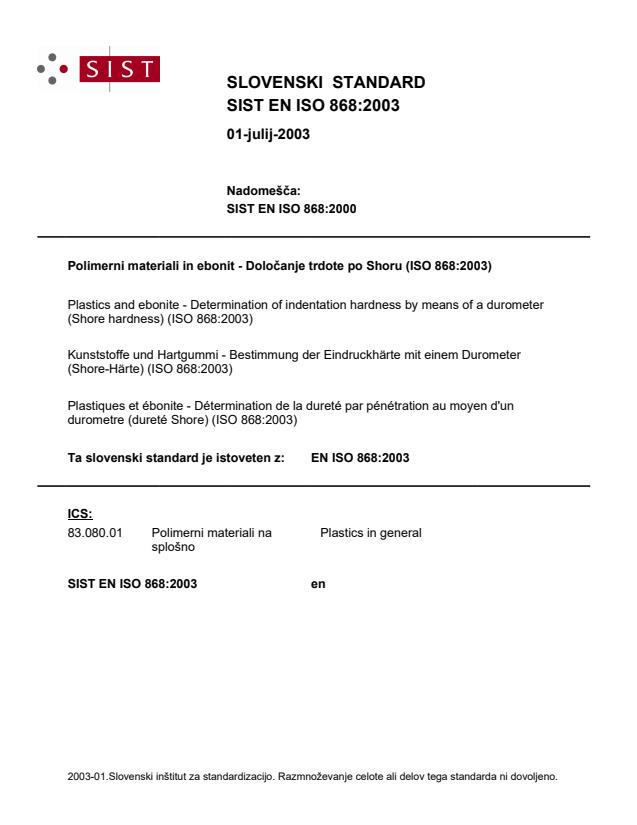
SLOVENSKI STANDARD
01-julij-2003
Nadomešča:
SIST EN ISO 868:2000
Polimerni materiali in ebonit - Določanje trdote po Shoru (ISO 868:2003)
Plastics and ebonite - Determination of indentation hardness by means of a durometer
(Shore hardness) (ISO 868:2003)
Kunststoffe und Hartgummi - Bestimmung der Eindruckhärte mit einem Durometer
(Shore-Härte) (ISO 868:2003)
Plastiques et ébonite - Détermination de la dureté par pénétration au moyen d'un
durometre (dureté Shore) (ISO 868:2003)
Ta slovenski standard je istoveten z: EN ISO 868:2003
ICS:
83.080.01 Polimerni materiali na Plastics in general
splošno
2003-01.Slovenski inštitut za standardizacijo. Razmnoževanje celote ali delov tega standarda ni dovoljeno.
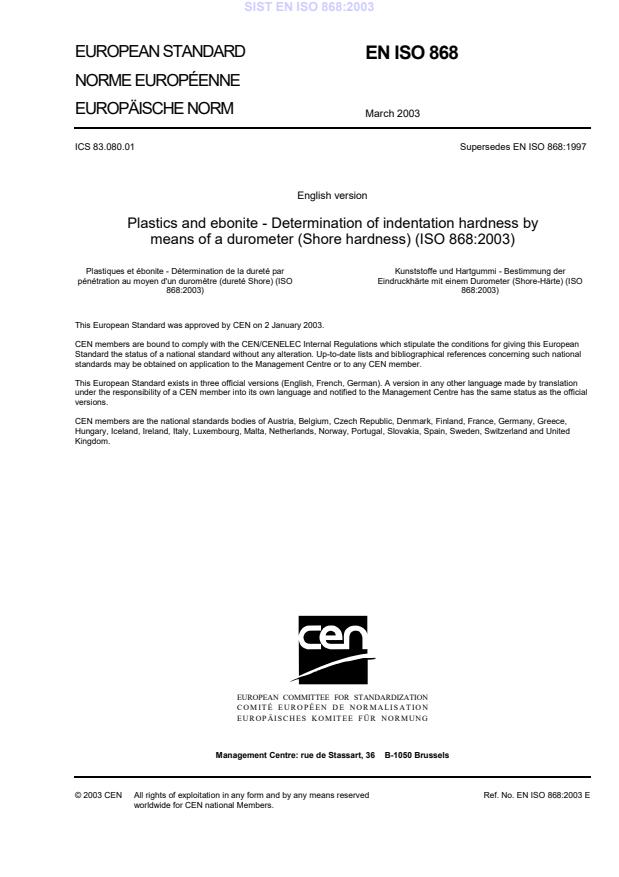
EUROPEAN STANDARD
EN ISO 868
NORME EUROPÉENNE
EUROPÄISCHE NORM
March 2003
ICS 83.080.01 Supersedes EN ISO 868:1997
English version
Plastics and ebonite - Determination of indentation hardness by
means of a durometer (Shore hardness) (ISO 868:2003)
Plastiques et ébonite - Détermination de la dureté par Kunststoffe und Hartgummi - Bestimmung der
pénétration au moyen d'un duromètre (dureté Shore) (ISO Eindruckhärte mit einem Durometer (Shore-Härte) (ISO
868:2003) 868:2003)
This European Standard was approved by CEN on 2 January 2003.
CEN members are bound to comply with the CEN/CENELEC Internal Regulations which stipulate the conditions for giving this European
Standard the status of a national standard without any alteration. Up-to-date lists and bibliographical references concerning such national
standards may be obtained on application to the Management Centre or to any CEN member.
This European Standard exists in three official versions (English, French, German). A version in any other language made by translation
under the responsibility of a CEN member into its own language and notified to the Management Centre has the same status as the official
versions.
CEN members are the national standards bodies of Austria, Belgium, Czech Republic, Denmark, Finland, France, Germany, Greece,
Hungary, Iceland, Ireland, Italy, Luxembourg, Malta, Netherlands, Norway, Portugal, Slovakia, Spain, Sweden, Switzerland and United
Kingdom.
EUROPEAN COMMITTEE FOR STANDARDIZATION
COMITÉ EUROPÉEN DE NORMALISATION
EUROPÄISCHES KOMITEE FÜR NORMUNG
Management Centre: rue de Stassart, 36 B-1050 Brussels
© 2003 CEN All rights of exploitation in any form and by any means reserved Ref. No. EN ISO 868:2003 E
worldwide for CEN national Members.
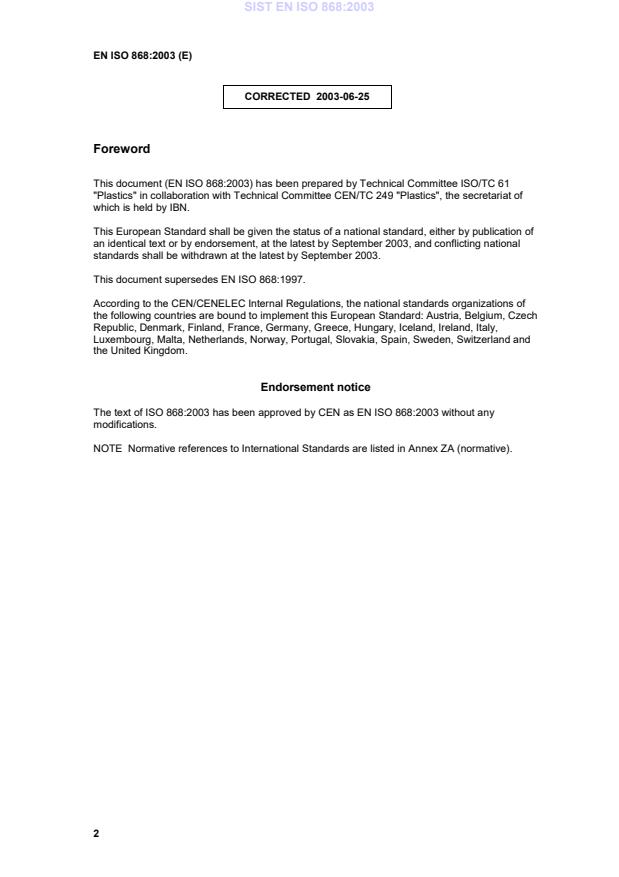
CORRECTED 2003-06-25
Foreword
This document (EN ISO 868:2003) has been prepared by Technical Committee ISO/TC 61
"Plastics" in collaboration with Technical Committee CEN/TC 249 "Plastics", the secretariat of
which is held by IBN.
This European Standard shall be given the status of a national standard, either by publication of
an identical text or by endorsement, at the latest by September 2003, and conflicting national
standards shall be withdrawn at the latest by September 2003.
This document supersedes EN ISO 868:1997.
According to the CEN/CENELEC Internal Regulations, the national standards organizations of
the following countries are bound to implement this European Standard: Austria, Belgium, Czech
Republic, Denmark, Finland, France, Germany, Greece, Hungary, Iceland, Ireland, Italy,
Luxembourg, Malta, Netherlands, Norway, Portugal, Slovakia, Spain, Sweden, Switzerland and
the United Kingdom.
Endorsement notice
The text of ISO 868:2003 has been approved by CEN as EN ISO 868:2003 without any
modifications.
NOTE Normative references to International Standards are listed in Annex ZA (normative).
Annex ZA
(normative)
Normative references to international publications
with their relevant European publications
This European Standard incorporates by dated or undated reference, provisions from other
publications. These normative references are cited at the appropriate places in the text and the
publications are listed hereafter. For dated references, subsequent amendments to or revisions of
any of these publications apply to this European Standard only when incorporated in it by
amendment or revision. For undated references the latest edition of the publication referred to
applies (including amendments).
NOTE Where an International Publication has been modified by common modifications, indicated
by (mod.), the relevant EN/HD applies.
Publication Year Title EN Year
ISO 291 1997 Plastics - Standard atmospheres for EN ISO 291 1997
conditioning and testing
INTERNATIONAL ISO
STANDARD 868
Third edition
2003-03-01
Plastics and ebonite — Determination of
indentation hardness by means of a
durometer (Shore hardness)
Plastiques et ébonite — Détermination de la dureté par pénétration au
moyen d'un duromètre (dureté Shore)
Reference number
ISO 868:2003(E)
ISO 868:2003(E)
PDF disclaimer
This PDF file may contain embedded typefaces. In accordance with Adobe's licensing policy, this file may be printed or viewed but shall not be
edited unless the typefaces which are embedded are licensed to and installed on the computer performing the editing. In downloading this file,
parties accept therein the responsibility of not infringing Adobe's licensing policy. The ISO Central Secretariat accepts no liability in this area.
Adobe is a trademark of Adobe Systems Incorporated.
Details of the software products used to create this PDF file can be found in the General Info relative to the file; the PDF-creation parameters
were optimized for printing. Every care has been taken to ensure that the file is suitable for use by ISO member bodies. In the unlikely event
that a problem relating to it is found, please inform the Central Secretariat at the address given below.
All rights reserved. Unless otherwise specified, no part of this publication may be reproduced or utilized in any form or by any means,
electronic or mechanical, including photocopying and microfilm, without permission in writing from either ISO at the address below or ISO's
member body in the country of the requester.
ISO copyright office
Case postale 56 CH-1211 Geneva 20
Tel. + 41 22 749 01 11
Fax + 41 22 749 09 47
E-mail copyright@iso.ch
Web www.iso.ch
Printed in Switzerland
©
ii ISO 2003 – All rights reserved
ISO 868:2003(E)
Contents Page
1 Scope . 1
2 Normative reference . 1
3 Principle . 1
4 Apparatus . 1
5 Test specimens . 4
6 Calibration . 4
7 Conditioning and testing atmospheres . 4
8 Procedure . 5
9 Test report . 5
©
ISO 2003 – All rights reserved iii
ISO 868:2003(E)
Foreword
ISO (the International Organization for Standardization) is a worldwide federation of national standards bodies (ISO
member bodies). The work of preparing International Standards is normally carried out through ISO technical
committees. Each member body interested in a subject for which a technical committee has been established has
the right to be represented on that committee. International organizations, governmental and non-governmental, in
liaison with ISO, also take part in the work. ISO collaborates closely with the International Electrotechnical
Commission (IEC) on all matters of electrotechnical standardization.
International Standards are drafted in accordance with the rules given in the ISO/IEC Directives, Part 3.
Draft International Standards adopted by the technical committees are circulated to the member bodies for voting.
Publication as an International Standard requires approval by at least 75 % of the member bodies casting a vote.
Attention is drawn to the possibility that some of the elements of this International Standard may be the subject of
patent rights. ISO shall not be held responsible for identifying any or all such patent rights.
International Standard ISO 868 was prepared by Technical Committee ISO/TC 61, Plastics, Subcommittee SC 2,
Mechanical properties.
This third edition cancels and replaces the second edition (ISO 868:1985), which has been technically revised.
©
iv ISO 2003 – All rights reserved
INTERNATIONAL STANDARD ISO 868:2003(E)
Plastics and ebonite — D
...