


EN 15657:2017
(Main)Acoustic properties of building elements and of buildings - Laboratory measurement of structure-borne sound from building service equipment for all installation conditions
Acoustic properties of building elements and of buildings - Laboratory measurement of structure-borne sound from building service equipment for all installation conditions
This European Standard specifies methods for estimating the structure-borne sound power produced in buildings by services equipment (sources) from measurements under laboratory conditions. The data can be used as explained in Annex D, as input for EN 12354-5, or under certain conditions for EN ISO 12354 2, to calculate the sound pressure levels produced by the same equipment when installed in buildings. The data can also be used to compare the performance of products as explained in Annex E.
As for the document predicting the structure-borne sound levels produced in the buildings by service equipment (EN 12354-5), this European Standard covers water supply and sanitary installations, mechanical ventilation, heating and cooling devices, service equipment, lifts, rubbish chutes, boilers, blowers, pumps, motors and other auxiliary service equipment, such as motor driven car park doors; it can also be applied to other vibrating equipment attached to or installed in buildings. This standard is so far restricted to steady-state vibrating sources.
This revised European Standard:
- specifies laboratory measuring methods for determining the source input data required to calculate the source installed power, i.e. the equipment free velocity, the equipment blocked force and the equipment mobility;
- applies to equipment, which can be connected to isolated plates in the laboratory. For equipment, such as pipe systems or impacted lightweight stairs [16], which are connected to at least two building elements (wall and floor), a coupled reception plate system is specified, which requires the use of a power substitution method. The later method can also be used in situ when the equipment, such as lifts, can only be tested in situ;
- defines the expression of the source installed structure-borne power for any source-receiver mobility conditions, including lightweight and heavyweight receiving building elements. This power is used as input data in EN 12354-5, which predicts the sound pressure level generated by the source installed in situ in a building;
- defines a method to calculate the total structure-borne sound power generated by the equipment fictively mounted on two sets of reference test plates (respectively of low mobility and of high mobility); the two results will inform the manufacturers on the difference in the equipment performance between these two common but very different situations;
- does not specify any method for the measurement of the source airborne sound power. If measurements of the equipment airborne sound power are required, then refer to EN ISO 3740 to EN ISO 3747 and use the same source mounting conditions and operating conditions as in measuring using EN 15657.
Akustische Eigenschaften von Bauteilen und von Gebäuden - Messung des Körperschalls von haustechnischen Anlagen im Prüfstand für alle Installationsbedingungen
Diese Europäische Norm legt Verfahren für die Schätzung der in Gebäuden durch haustechnische Anlagen (Quellen) erzeugten Körperschallleistung aus Messungen unter Laborbedingungen fest. Die Daten können, wie in Anhang D erklärt, als Eingaben für EN 12354 5 oder unter bestimmten Bedingungen für EN ISO 12354 2 verwendet werden, um die Schalldruckpegel zu berechnen, die von denselben in Gebäuden installierten Anlagen erzeugt werden. Die Daten können auch, wie in Anhang E dargelegt, zum Vergleich der Leistung von Produkten verwendet werden.
Hinsichtlich der Voraussage des Dokuments von in Gebäuden durch haustechnische Anlagen erzeugten Körperschallpegeln (EN 12354 5) deckt diese Europäische Norm Wasserversorgungs- und Sanitär-installationen, mechanische Belüftung, Heiz- und Kühlgeräte, haustechnische Anlagen, Aufzüge, Müllschlucker, Heizkessel, Gebläse, Pumpen, Motoren und weiteres Zubehör zu haustechnischen Anlagen wie z. B. Garagentüren mit Motorantrieb ab; sie kann auch auf weitere schwingende Anlagen angewendet werden, die an Gebäuden angebracht oder in diesen installiert sind. Diese Norm ist bisher auf Schwingungsquellen mit Gleichgewichtszustand beschränkt.
Die überarbeitete Europäische Norm:
- legt Prüfstandsmessverfahren zur Bestimmung der quellenbezogenen Eingangsdaten fest, die zur Berechnung der installierten Schallleistung der Quelle erforderlich sind, d. h. die freie Schnelle, die blockierte Kraft und die Admittanz der Anlage;
- gilt für Anlagen, die im Prüfstand mit isolierten Platten verbunden werden können. Bei Anlagen wie Rohrsystemen oder leichten Treppen [16], die mit mindestens zwei Bauteilen (Wand und Boden) verbunden sind, wird ein System mit verbundener Empfängerplatte festgelegt, das die Anwendung eines Verfahrens des Schallleistungsersatzes erforderlich macht. Letzteres Verfahren kann auch in situ verwendet werden, wenn die Anlage, wie zum Beispiel Fahrstühle, nur vor Ort geprüft werden kann;
- legt die Angabe der installierten Körperschallleistung der Quelle für jegliche Bedingungen der Quellen und Empfängeradmittanz fest, einschließlich leichter und schwerer Empfängerbauteile. Diese Schallleistung wird in EN 12354 5, die den durch die in situ in einem Gebäude installierte Quelle erzeugten Schalldruckpegel voraussagt, als Eingabegröße verwendet;
- legt ein Verfahren zur Berechnung der Gesamtkörperschallleistung fest, die durch fiktiv auf zwei Sätzen von Bezugsprüfplatten (mit niedriger bzw. hoher Admittanz) montierten Anlagen erzeugt wird; die beiden Ergebnisse dienen der Information der Hersteller hinsichtlich der Leistungsdifferenz der Anlage zwischen diesen beiden üblichen, jedoch äußerst unterschiedlichen Situationen;
legt kein Verfahren zur Messung der Quellen-Luftschallleistung fest. Sofern Messungen der Luftschallleistung der Anlage erforderlich sind, wird auf EN ISO 3740 bis EN ISO 3747 verwiesen, wobei die gleichen Montagebedingungen der Quelle und Betriebsbedingungen wie bei der Messung nach EN 15657 anzuwenden sind.
Propriétés acoustiques des éléments de construction et des bâtiments - Mesurage en laboratoire des bruits structuraux des équipements de bâtiment pour toute condition d’installation
La présente Norme européenne spécifie des méthodes permettant d'estimer la puissance structurale dans les bâtiments due aux équipements techniques (sources) à partir de mesurages réalisés dans des conditions de laboratoire. Les données peuvent être utilisées comme expliqué à l'Annexe D, comme données d'entrée pour l'EN 12354-5, ou dans certaines conditions pour l’EN ISO 12354 2, pour calculer les niveaux de pression acoustique produits par les mêmes équipements lorsqu'ils sont installés dans des bâtiments. Les données peuvent également être utilisées pour comparer les performances de produits, comme expliqué à l'Annexe E.
Comme le document permettant d'estimer les niveaux de bruit structural dans les bâtiments dus aux équipements techniques (EN 12354 5), la présente Norme européenne couvre les installations de distribution d'eau et sanitaires, la ventilation mécanique, les dispositifs de chauffage et de refroidissement, les équipements techniques, les ascenseurs, les vide-ordures, les chaudières, les soufflantes, les pompes, les moteurs et autres équipements techniques auxiliaires, tels que les portes de garage motorisées ; elle peut également s'appliquer à d'autres équipements vibrants fixés aux bâtiments ou installés dans ceux-ci. La présente norme est jusqu'à présent limitée aux sources vibrantes stationnaires.
La présente Norme européenne révisée :
- spécifie des méthodes de mesurage en laboratoire permettant de déterminer les données d'entrée relatives à la source requises pour calculer la puissance installée de la source, c'est-à-dire la vitesse libre de l'équipement, la force bloquée de l'équipement et la mobilité de l'équipement ;
- s'applique à un équipement qui peut être raccordé à des plaques isolées en laboratoire. Pour des équipements tels que des systèmes de tuyauteries ou des escaliers légers soumis à des chocs [16], qui sont raccordés à au moins deux éléments de construction (mur et plancher), un système de plaques réceptrices couplées nécessitant une méthode de substitution de puissance est spécifié. Cette dernière méthode peut également être utilisée in situ lorsque l'équipement, par exemple des ascenseurs, ne peut être soumis à essai que sur site ;
- définit l'expression de la puissance structurale installée de la source pour toute condition de mobilité source-récepteur, y compris des éléments de construction récepteurs légers et lourds. Cette puissance est utilisée comme donnée d'entrée dans l'EN 12354 5, qui estime le niveau de pression acoustique produit par la source installée in situ dans un bâtiment ;
- définit une méthode de calcul de la puissance structurale totale produite par l'équipement monté fictivement sur deux ensembles de plaques d'essai de référence (respectivement à faible mobilité et à mobilité élevée) ; les deux résultats informeront les fabricants sur la différence de performance de l'équipement entre ces deux situations courantes, mais très différentes ;
- ne spécifie par de méthode de mesurage de la puissance acoustique de la source. Lorsque des mesurages de la puissance acoustique de l'équipement sont requis, se reporter aux EN ISO 3740 à EN ISO 3747, et utiliser les mêmes conditions de montage de la source et les mêmes conditions de fonctionnement que pour le mesurage selon l’EN 15657.
Akustične lastnosti gradbenih elementov in stavb - Laboratorijsko merjenje strukturalnega zvoka v gradbenih elementih servisne opreme za vse načine namestitve
Kot dokument, ki predvideva ravni strukturalnega zvoka v stavbah zaradi servisne opreme (EN 12354 5:2009), ta evropski standard obravnava sanitarne inštalacije, mehansko prezračevanje, ogrevanje in hlajenje, obratovalno opremo, dvigala, jaške za smeti, kotle, ventilatorje, črpalke in drugo pomožno obratovalno opremo ter parkirna vrata na mehaniziran pogon za avtomobile; lahko se uporablja tudi za drugo pritrjeno ali vgrajeno opremo v stavbi. Vendar ta standard je bil do zdaj omejen na nepremične vire.
Ta revidiran standard:
– določa laboratorijske merilne metode za določanje vhodnih podatkov vira, ki so potrebni za izračun inštalirane moči vira, tj. proste hitrosti opreme, blokirane sile opreme in mobilnosti opreme;
– določa izražanje inštalirane moči vira v kakršnih koli pogojih mobilnosti vira-prejemnika, vključno z lahkimi in težkimi sprejemnimi gradbenimi elementi. Ta moč se uporablja kot vhodni podatki v standardu EN 12354 5:2009, ki predvideva raven tlaka strukturnega zvoka, ki ga povzroča vir na mestu namestitve v stavbi;
– določa metodo za izračun moči strukturalnega zvoka, ki ga povzroča oprema, namišljeno pritrjena na dveh referenčnih merilnih mestih (lahkem in težkem); na podlagi teh rezultatov bodo proizvajalci spoznali razlike o zmogljivosti opreme v teh dveh običajnih, a zelo različnih situacijah;
– ne določa nobene metode za merjenje zvočne moči vira v zraku. Če so potrebne meritve zvočne moči opreme v zraku, je treba uporabiti standard EN ISO 3740, 47 z enakimi pogoji pritrjevanja virov in obratovalnimi pogoji kot pri merjenju na podlagi standarda prEN 15657.
V tem standardu je frekvenčno območje omejeno na 21 1/3 oktavnih pasov s srednjimi frekvencami od 50 Hz do 5000 Hz.
General Information
- Status
- Published
- Publication Date
- 18-Jul-2017
- Withdrawal Date
- 30-Jan-2018
- Technical Committee
- CEN/TC 126 - Acoustic properties of building products and of buildings
- Current Stage
- 9093 - Decision to confirm - Review Enquiry
- Start Date
- 22-Jun-2023
- Completion Date
- 11-Feb-2026
Relations
- Effective Date
- 26-Jul-2017
- Effective Date
- 09-Feb-2026
- Effective Date
- 09-Feb-2026
- Effective Date
- 09-Feb-2026
- Effective Date
- 28-Jan-2026
- Effective Date
- 28-Jan-2026
- Effective Date
- 28-Jan-2026
- Effective Date
- 28-Jan-2026
- Effective Date
- 28-Jan-2026
- Effective Date
- 28-Jan-2026
- Effective Date
- 28-Jan-2026
Overview
EN 15657:2017 - "Acoustic properties of building elements and of buildings - Laboratory measurement of structure-borne sound from building service equipment for all installation conditions" - is a CEN European Standard that defines laboratory methods to characterise structure-borne sound sources (building service equipment). The standard specifies how to measure the source input data needed to estimate the installed structure-borne sound power of equipment when mounted in buildings. Measured laboratory data feed sound prediction models (notably EN 12354-5) and help manufacturers compare product performance.
Key topics and technical requirements
- Measured quantities: the standard defines laboratory procedures to obtain the equipment’s free velocity, single equivalent blocked force, and mobility - key source parameters for structure-borne sound prediction.
- Measurement methods:
- Direct measurement procedures (Clause 6) for free velocity and mobility.
- Indirect reception plate method (Clause 7) for blocked force and other source quantities.
- Power substitution method (Annex C) and a coupled reception-plate system for equipment connected to two or more building elements (e.g., pipe systems or stairs).
- Reference conditions: procedures to calculate structure-borne sound power for two reference test rigs - low mobility and high mobility plates - to illustrate performance differences across common installation scenarios.
- Scope of equipment: covers water/sanitary installations, HVAC, pumps, motors, lifts, boilers, blowers, rubbish chutes, motor-driven doors and similar vibrating equipment. The standard is limited to steady-state vibrating sources.
- Results and reporting: specifies how to express results, test report content and links to prediction models (Annex D) and product comparison methods (Annex E).
- Exclusions: airborne sound power measurement is not included - refer to EN ISO 3740 - EN ISO 3747 for airborne sound testing using the same mounting and operating conditions.
Practical applications
- Use laboratory source data from EN 15657:2017 as input to acoustic prediction models (especially EN 12354-5) to estimate in-situ sound pressure levels from installed equipment.
- Support product development and quality control by comparing structure-borne sound performance between designs and between low vs high mobility installation situations.
- Provide standardised test data for acoustic specifications in building design, tender documents and compliance demonstrations related to impact and vibration transmission.
Who should use this standard
- Acoustic consultants and researchers performing structure-borne sound prediction and laboratory testing.
- Manufacturers of building services equipment (pumps, fans, boilers, lifts) seeking standardised source characterisation.
- Test laboratories that deliver source data for EN 12354-5 computations.
- Building designers and specifiers needing reliable input data for noise control and building acoustic design.
Related standards
- EN 12354-5 (prediction of structure-borne sound from services)
- EN ISO 12354-2 (under certain conditions)
- EN ISO 3740 - EN ISO 3747 (airborne sound power measurement)
- ISO 7626 / ISO 18312 series (mobility and vibration measurement methods)
Keywords: EN 15657:2017, structure-borne sound, building service equipment, blocked force, free velocity, mobility, reception plate, power substitution, EN 12354-5, laboratory measurement, building acoustics.

Get Certified
Connect with accredited certification bodies for this standard

ICC Evaluation Service
Building products evaluation and certification.

QAI Laboratories
Building and construction product testing and certification.

Aboma Certification B.V.
Specialized in construction, metal, and transport sectors.
Sponsored listings
Frequently Asked Questions
EN 15657:2017 is a standard published by the European Committee for Standardization (CEN). Its full title is "Acoustic properties of building elements and of buildings - Laboratory measurement of structure-borne sound from building service equipment for all installation conditions". This standard covers: This European Standard specifies methods for estimating the structure-borne sound power produced in buildings by services equipment (sources) from measurements under laboratory conditions. The data can be used as explained in Annex D, as input for EN 12354-5, or under certain conditions for EN ISO 12354 2, to calculate the sound pressure levels produced by the same equipment when installed in buildings. The data can also be used to compare the performance of products as explained in Annex E. As for the document predicting the structure-borne sound levels produced in the buildings by service equipment (EN 12354-5), this European Standard covers water supply and sanitary installations, mechanical ventilation, heating and cooling devices, service equipment, lifts, rubbish chutes, boilers, blowers, pumps, motors and other auxiliary service equipment, such as motor driven car park doors; it can also be applied to other vibrating equipment attached to or installed in buildings. This standard is so far restricted to steady-state vibrating sources. This revised European Standard: - specifies laboratory measuring methods for determining the source input data required to calculate the source installed power, i.e. the equipment free velocity, the equipment blocked force and the equipment mobility; - applies to equipment, which can be connected to isolated plates in the laboratory. For equipment, such as pipe systems or impacted lightweight stairs [16], which are connected to at least two building elements (wall and floor), a coupled reception plate system is specified, which requires the use of a power substitution method. The later method can also be used in situ when the equipment, such as lifts, can only be tested in situ; - defines the expression of the source installed structure-borne power for any source-receiver mobility conditions, including lightweight and heavyweight receiving building elements. This power is used as input data in EN 12354-5, which predicts the sound pressure level generated by the source installed in situ in a building; - defines a method to calculate the total structure-borne sound power generated by the equipment fictively mounted on two sets of reference test plates (respectively of low mobility and of high mobility); the two results will inform the manufacturers on the difference in the equipment performance between these two common but very different situations; - does not specify any method for the measurement of the source airborne sound power. If measurements of the equipment airborne sound power are required, then refer to EN ISO 3740 to EN ISO 3747 and use the same source mounting conditions and operating conditions as in measuring using EN 15657.
This European Standard specifies methods for estimating the structure-borne sound power produced in buildings by services equipment (sources) from measurements under laboratory conditions. The data can be used as explained in Annex D, as input for EN 12354-5, or under certain conditions for EN ISO 12354 2, to calculate the sound pressure levels produced by the same equipment when installed in buildings. The data can also be used to compare the performance of products as explained in Annex E. As for the document predicting the structure-borne sound levels produced in the buildings by service equipment (EN 12354-5), this European Standard covers water supply and sanitary installations, mechanical ventilation, heating and cooling devices, service equipment, lifts, rubbish chutes, boilers, blowers, pumps, motors and other auxiliary service equipment, such as motor driven car park doors; it can also be applied to other vibrating equipment attached to or installed in buildings. This standard is so far restricted to steady-state vibrating sources. This revised European Standard: - specifies laboratory measuring methods for determining the source input data required to calculate the source installed power, i.e. the equipment free velocity, the equipment blocked force and the equipment mobility; - applies to equipment, which can be connected to isolated plates in the laboratory. For equipment, such as pipe systems or impacted lightweight stairs [16], which are connected to at least two building elements (wall and floor), a coupled reception plate system is specified, which requires the use of a power substitution method. The later method can also be used in situ when the equipment, such as lifts, can only be tested in situ; - defines the expression of the source installed structure-borne power for any source-receiver mobility conditions, including lightweight and heavyweight receiving building elements. This power is used as input data in EN 12354-5, which predicts the sound pressure level generated by the source installed in situ in a building; - defines a method to calculate the total structure-borne sound power generated by the equipment fictively mounted on two sets of reference test plates (respectively of low mobility and of high mobility); the two results will inform the manufacturers on the difference in the equipment performance between these two common but very different situations; - does not specify any method for the measurement of the source airborne sound power. If measurements of the equipment airborne sound power are required, then refer to EN ISO 3740 to EN ISO 3747 and use the same source mounting conditions and operating conditions as in measuring using EN 15657.
EN 15657:2017 is classified under the following ICS (International Classification for Standards) categories: 91.120.20 - Acoustics in building. Sound insulation. The ICS classification helps identify the subject area and facilitates finding related standards.
EN 15657:2017 has the following relationships with other standards: It is inter standard links to EN 15657-1:2009, ISO 18312-1:2012, ISO 7626-5:1994, ISO 7626-1:2011, EN ISO 3950:2009, EN ISO 10848-1:2017, EN ISO 19085-9:2020, EN ISO 10140-3:2021, EN 17823:2024, EN 12354-5:2023, EN 14366-1:2023. Understanding these relationships helps ensure you are using the most current and applicable version of the standard.
EN 15657:2017 is available in PDF format for immediate download after purchase. The document can be added to your cart and obtained through the secure checkout process. Digital delivery ensures instant access to the complete standard document.
Standards Content (Sample)
2003-01.Slovenski inštitut za standardizacijo. Razmnoževanje celote ali delov tega standarda ni dovoljeno.QDPHVWLWYHAkustische Eigenschaften von Bauteilen und von Gebäuden - Messung des Körperschalls von haustechnischen Anlagen im Prüfstand für alle InstallationsbedingungenPropriétés acoustiques des éléments de construction et des bâtiments - Mesurage en laboratoire des bruits structuraux des équipements de bâtiment pour toute condition d’installationAcoustic properties of building elements and of buildings - Laboratory measurement of structure-borne sound from building service equipment for all installation conditions91.120.20L]RODFLMDAcoustics in building. Sound insulation17.140.01Acoustic measurements and noise abatement in generalICS:Ta slovenski standard je istoveten z:EN 15657:2017SIST EN 15657:2017en,fr,de01-september-2017SIST EN 15657:2017SLOVENSKI
STANDARDSIST EN 15657-1:20091DGRPHãþD
EUROPEAN STANDARD NORME EUROPÉENNE EUROPÄISCHE NORM
EN 15657
July
t r s y ICS
{ sä s t rä t r Supersedes EN
s w x w yæ sã t r r {English Version
Acoustic properties of building elements and of buildings æLaboratory measurement of structureæborne sound from building service equipment for all installation conditionsPropriétés acoustiques des éléments de construction et des bâtiments æ Mesurage en laboratoire des bruits structuraux des équipements de bâtiment pour toute condition d 5installation
Akustische Eigenschaften von Bauteilen und von Gebäuden æ Messung des Körperschalls von haustechnischen Anlagen im Prüfstand für alle Installationsbedingungen This European Standard was approved by CEN on
s s May
t r s yä
egulations which stipulate the conditions for giving this European Standard the status of a national standard without any alterationä Upætoædate lists and bibliographical references concerning such national standards may be obtained on application to the CENæCENELEC Management Centre or to any CEN memberä
translation under the responsibility of a CEN member into its own language and notified to the CENæCENELEC Management Centre has the same status as the official versionsä
CEN members are the national standards bodies of Austriaá Belgiumá Bulgariaá Croatiaá Cyprusá Czech Republicá Denmarká Estoniaá Finlandá Former Yugoslav Republic of Macedoniaá Franceá Germanyá Greeceá Hungaryá Icelandá Irelandá Italyá Latviaá Lithuaniaá Luxembourgá Maltaá Netherlandsá Norwayá Polandá Portugalá Romaniaá Serbiaá Slovakiaá Sloveniaá Spainá Swedená Switzerlandá Turkey and United Kingdomä
EUROPEAN COMMITTEE FOR STANDARDIZATION COMITÉ EUROPÉEN DE NORMALISATION EUROPÄISCHES KOMITEE FÜR NORMUNG
CEN-CENELEC Management Centre:
Avenue Marnix 17,
B-1000 Brussels
t r s y CEN All rights of exploitation in any form and by any means reserved worldwide for CEN national Membersä Refä Noä EN
s w x w yã t r s y ESIST EN 15657:2017
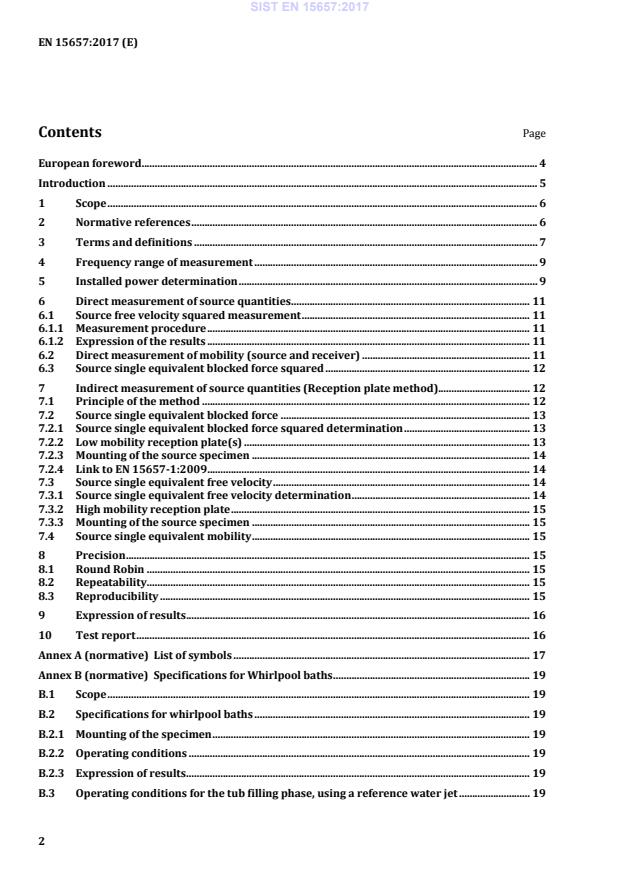
List of symbols . 17 Annex B (normative)
Specifications for Whirlpool baths . 19 B.1 Scope . 19 B.2 Specifications for whirlpool baths . 19 B.2.1 Mounting of the specimen . 19 B.2.2 Operating conditions . 19 B.2.3 Expression of results . 19 B.3 Operating conditions for the tub filling phase, using a reference water jet . 19 SIST EN 15657:2017
Power substitution method . 22 C.1 General . 22 C.2 Principle of the method . 22 C.3 Measuring procedure . 22 C.4 Specifications for low mobility plates . 23 C.5 Specifications for high mobility plates. 23 Annex D (informative)
Link to models predicting structure borne sound pressure levels . 24 D.1 General . 24 D.2 Link to EN 12354-5 . 24 D.2.1 General . 24 D.2.2 Low mobility receiver . 24 D.2.3 High mobility receiver . 25 D.3 Link to EN ISO 12354-2 . 25 Annex E (informative)
Reference structure borne sound power calculation . 26 E.1 General . 26 E.2 Low mobility reference test rig . 26 E.3 High mobility reference test rig . 26 Annex F (informative)
Example of existing test rigs . 27 F.1 Low mobility reception plates . 27 F.2 High mobility reception plate . 29 Bibliography . 30
Yi ratio of the complex (magnitude and phase) vibrational velocity that a point force produces at its point of application i, to the complex force applied, both force and velocity being normal to the receiver 3.8 single equivalent mobility
Yeq quantity approximated as the mean value of the point mobility at each contact i, averaged over the N contacts, which for the magnitude, is according to: ≈∑Neqii1YYN (3) and for the real part, is according to: ≈∑Neqii1Re()Re()YYN (4) Note 1 to entry: For receiver structures, the mean values are over the contact locations, if known. If the contact locations are not known, then the mean values are over the plate area. 3.9 mobility in 1/3 octave bands
Y1/3 oct value obtained from direct measurement in narrow frequency bands (see 6.2); 1/3 octave values of both mobility magnitude and real part are obtained as the mean value of the narrow band data averaged over the frequencies within the band considered (assuming M frequency components k): SIST EN 15657:2017
Y point mobility of an infinite plate having the same thickness and made of the same material as the plate considered ∞=⋅18/()YmB (7) Note 1 to entry: The characteristic input mobility is a real value, independent of frequency and dependent on the mass per unit area m and the bending stiffness B of the plate. 3.11 installed power P inst calculated structural power injected to each building element to which the equipment is connected; this power is the equipment input data for the prediction according to EN 12354-5 Note 1 to entry: The characterization of equipment connected to two or three building elements (e.g. pipes connected to floor and walls) will lead to two or three installed power components respectively. 4 Frequency range of measurement The measurements and calculation shall be performed using the one-third octave bands having the following centre frequencies in Hz: Table 1 — Centre frequencies in Hz 50 63 80 100 125 160 200 250 315 400 500 630 800 1 000 1 250 1 600 2 000 2 500 3 150
The frequency bands where measured values show signal to noise ratio problems, shall be reported in the test report. 5 Installed power determination For all installation conditions, the installed power level in dB re 10 «12 Watt is approximated from the single equivalent free velocity level in dB re 10 «9 m/s of the source and the single equivalent mobilities of the source and the receiver, using Y0 = 1m/(Ns) as reference, and all quantities being evaluated in 1/3 octave bands, according to: SIST EN 15657:2017
Key 1 source 2 vibration isolator Figure 1 — Source mounted on vibration isolators NOTE As an alternative way, the source can be freely suspended. 6.1.2 Expression of the results For each frequency band, the velocity levels Lvf,i are energetically summed over N contact points, leading to the source single equivalent free velocity level Lvf,eq: =∑vf,iNL/10vf,eqi10 10lg()L (10) Formula (10) corresponds to Formula (1) when expressed in dB. 6.2 Direct measurement of mobility (source and receiver) The recommendations for direct measurement apply to both sources and receivers. However, sources should be isolated according to ISO 9611 (as shown in Figure 1) or freely suspended, and receivers should be dynamically unloaded, when measuring their mobility. Point mobility measurements at the contact points are required for estimating the source equivalent mobility magnitude according to Formula (3), the receiver equivalent mobility magnitude according to Formula (3), and the receiver equivalent mobility real part according to Formula (4). The measurements are performed according to ISO 7626-1 and limited to single point translational excitation (normal to the receiving plate) according to ISO 7626-2; impact excitation is allowed, according to ISO 7626-5. The ISO 7626- series considers mobility measurements in narrow frequency bands. 1/3 octave band values are then obtained according to 3.10. SIST EN 15657:2017
...
Questions, Comments and Discussion
Ask us and Technical Secretary will try to provide an answer. You can facilitate discussion about the standard in here.
Loading comments...