

CEN/TR 15226:2025
(Main)Building products - Treatment of acoustics in product technical specifications
- Abstract
This document specifies the method for declaring the technical classification relating to acoustics for a Product Standard including DoP, or European assessment document (EAD) including European Technical Approval (ETA) for a specific building product or equipment, or a family of building products or equipment. In particular, it gives advice on how to write technical specifications in response to the mandated characteristics on acoustics under the Construction Products Regulation.
NOTE 1 In the remainder of this document, the terms used relate to CEN and product standards. The concepts are, however, equally applicable to the European Organisation for Technical Approvals (EOTA).
The purpose of this document is to assist the Technical Committees in preparing acoustic clauses to ensure that such product standards:
- are as homogeneous as possible, with each individual product standard having the same basic structure;
- are in full accordance with the standards for the measurement and declaration of acoustic properties;
- reflect the latest technical knowledge of methods of determining the acoustical properties from the specific family of building products or equipment under consideration.
NOTE 2 Annex A lists the European and International Standards to be used in the drafting of acoustic provisions standards. Annex B contains guidance on choosing appropriate properties. Annex C describes the relevant measured acoustic properties for common products.
- Status
- Published
- Publication Date
- 30-Sep-2025
- Technical Committee
- CEN/TC 126 - Acoustic properties of building products and of buildings
- Drafting Committee
- CEN/TC 126/WG 5 - Coordination working group
- Current Stage
- 6060 - Definitive text made available (DAV) - Publishing
- Start Date
- 01-Oct-2025
- Due Date
- 22-Apr-2026
- Completion Date
- 01-Oct-2025

Overview
CEN/TR 15226:2025 - "Building products - Treatment of acoustics in product technical specifications" - is a CEN Technical Report providing a harmonized method for declaring acoustic classifications in product standards, Declarations of Performance (DoP), European Assessment Documents (EAD) and European Technical Approvals (ETA). It guides Technical Committees, manufacturers, test laboratories and specifiers on how to write acoustic clauses that comply with the Construction Products Regulation (CPR) and reflect current measurement practice. The concepts are also applicable to the European Organisation for Technical Approvals (EOTA).
Key topics and requirements
- Scope and purpose: Method for declaring technical classification relating to acoustics for specific building products, equipment or product families.
- Terminology and definitions: Comprehensive acoustic terms (airborne and impact sound insulation, rating quantities, rainfall noise, flanking transmission, etc.) to ensure consistent use across product standards.
- Declaration of acoustic properties: Advice on what to declare in product standards, including single-number ratings (e.g., Rw, DnT,w, L’n,w) and measured quantities.
- Mounting and operating conditions: Guidance on laboratory and field testing setups so test results are reproducible and applicable to intended installation conditions.
- Selection of standards: Direction on which European and international measurement and estimation standards to reference when drafting acoustic provisions (see Annex A).
- Recorded information & test reports: Required information to include in test reports and the Product Standard/DoP to support declared values.
- Uncertainty and value types: Treatment of uncertainty for standardized, laboratory, tabulated and estimated values.
- Extension rules: Rules for direct and extended field of application of test results, including interpolation and extrapolation limitations (Annex D examples).
- Annexes: Annex A lists relevant standards; Annex B helps choose appropriate acoustic properties; Annex C details measured acoustic properties for common products.
Practical applications and users
- Technical Committees drafting product standards or clauses that include acoustic characteristics.
- Manufacturers preparing Declarations of Performance (DoP), ETAs or product literature with compliant acoustic classifications.
- Test laboratories and acoustic consultants that perform laboratory and field measurements and produce reports supporting declarations.
- Specifiers, architects and regulators who need consistent, comparable acoustic data to meet CPR requirements and building performance targets.
Related standards / keywords
Related standards are listed in Annex A; typical referenced standards include measurement and rating standards for airborne and impact sound insulation and rainfall noise. Useful SEO keywords: CEN/TR 15226:2025, acoustics, building products, product technical specifications, Declaration of Performance (DoP), Construction Products Regulation, airborne sound insulation, impact sound insulation, flanking transmission, EAD, ETA.
Relations
- Replaces
CEN/TR 15226:2006 - Building products - Treatment of acoustics in product technical specifications - Effective Date
- 04-Dec-2024
Get Certified
Connect with accredited certification bodies for this standard

BSI Group
BSI (British Standards Institution) is the business standards company that helps organizations make excellence a habit.

TÜV Rheinland
TÜV Rheinland is a leading international provider of technical services.

TÜV SÜD
TÜV SÜD is a trusted partner of choice for safety, security and sustainability solutions.
Sponsored listings
Frequently Asked Questions
CEN/TR 15226:2025 is a technical report published by the European Committee for Standardization (CEN). Its full title is "Building products - Treatment of acoustics in product technical specifications". This standard covers: This document specifies the method for declaring the technical classification relating to acoustics for a Product Standard including DoP, or European assessment document (EAD) including European Technical Approval (ETA) for a specific building product or equipment, or a family of building products or equipment. In particular, it gives advice on how to write technical specifications in response to the mandated characteristics on acoustics under the Construction Products Regulation. NOTE 1 In the remainder of this document, the terms used relate to CEN and product standards. The concepts are, however, equally applicable to the European Organisation for Technical Approvals (EOTA). The purpose of this document is to assist the Technical Committees in preparing acoustic clauses to ensure that such product standards: - are as homogeneous as possible, with each individual product standard having the same basic structure; - are in full accordance with the standards for the measurement and declaration of acoustic properties; - reflect the latest technical knowledge of methods of determining the acoustical properties from the specific family of building products or equipment under consideration. NOTE 2 Annex A lists the European and International Standards to be used in the drafting of acoustic provisions standards. Annex B contains guidance on choosing appropriate properties. Annex C describes the relevant measured acoustic properties for common products.
This document specifies the method for declaring the technical classification relating to acoustics for a Product Standard including DoP, or European assessment document (EAD) including European Technical Approval (ETA) for a specific building product or equipment, or a family of building products or equipment. In particular, it gives advice on how to write technical specifications in response to the mandated characteristics on acoustics under the Construction Products Regulation. NOTE 1 In the remainder of this document, the terms used relate to CEN and product standards. The concepts are, however, equally applicable to the European Organisation for Technical Approvals (EOTA). The purpose of this document is to assist the Technical Committees in preparing acoustic clauses to ensure that such product standards: - are as homogeneous as possible, with each individual product standard having the same basic structure; - are in full accordance with the standards for the measurement and declaration of acoustic properties; - reflect the latest technical knowledge of methods of determining the acoustical properties from the specific family of building products or equipment under consideration. NOTE 2 Annex A lists the European and International Standards to be used in the drafting of acoustic provisions standards. Annex B contains guidance on choosing appropriate properties. Annex C describes the relevant measured acoustic properties for common products.
CEN/TR 15226:2025 is classified under the following ICS (International Classification for Standards) categories: 01.040.91 - Construction materials and building (Vocabularies); 03.120.10 - Quality management and quality assurance; 11.020 - Medical sciences and health care facilities in general; 91.120.20 - Acoustics in building. Sound insulation. The ICS classification helps identify the subject area and facilitates finding related standards.
CEN/TR 15226:2025 has the following relationships with other standards: It is inter standard links to CEN/TR 15226:2006. Understanding these relationships helps ensure you are using the most current and applicable version of the standard.
CEN/TR 15226:2025 is available in PDF format for immediate download after purchase. The document can be added to your cart and obtained through the secure checkout process. Digital delivery ensures instant access to the complete standard document.
Standards Content (Sample)
SLOVENSKI STANDARD
01-december-2025
Nadomešča:
SIST-TP CEN/TR 15226:2006
Gradbeni proizvodi - Opredlitev akustičnih lastnosti v tehničnih specifikacijah
proizvodov
Building products - Treatment of acoustics in product technical specifications
Bauprodukte - Behandlung der Akustik in technischen Produktspezifikationen
Produits de construction - Traitement de l’acoustique dans les spécifications techniques
produits
Ta slovenski standard je istoveten z: CEN/TR 15226:2025
ICS:
01.110 Tehnična dokumentacija za Technical product
izdelke documentation
91.120.20 Akustika v stavbah. Zvočna Acoustics in building. Sound
izolacija insulation
2003-01.Slovenski inštitut za standardizacijo. Razmnoževanje celote ali delov tega standarda ni dovoljeno.
CEN/TR 15226
TECHNICAL REPORT
RAPPORT TECHNIQUE
October 2025
TECHNISCHER REPORT
ICS 11.020; 03.120.10 Supersedes CEN/TR 15226:2006
English Version
Building products - Treatment of acoustics in product
technical specifications
Produits de construction - Traitement de l'acoustique Bauprodukte - Behandlung der Akustik in technischen
dans les spécifications techniques produits Produktspezifikationen
This Technical Report was approved by CEN on 8 September 2025. It has been drawn up by the Technical Committee CEN/TC
126.
CEN members are the national standards bodies of Austria, Belgium, Bulgaria, Croatia, Cyprus, Czech Republic, Denmark, Estonia,
Finland, France, Germany, Greece, Hungary, Iceland, Ireland, Italy, Latvia, Lithuania, Luxembourg, Malta, Netherlands, Norway,
Poland, Portugal, Republic of North Macedonia, Romania, Serbia, Slovakia, Slovenia, Spain, Sweden, Switzerland, Türkiye and
United Kingdom.
EUROPEAN COMMITTEE FOR STANDARDIZATION
COMITÉ EUROPÉEN DE NORMALISATION
EUROPÄISCHES KOMITEE FÜR NORMUNG
CEN-CENELEC Management Centre: Rue de la Science 23, B-1040 Brussels
© 2025 CEN All rights of exploitation in any form and by any means reserved Ref. No. CEN/TR 15226:2025 E
worldwide for CEN national Members.
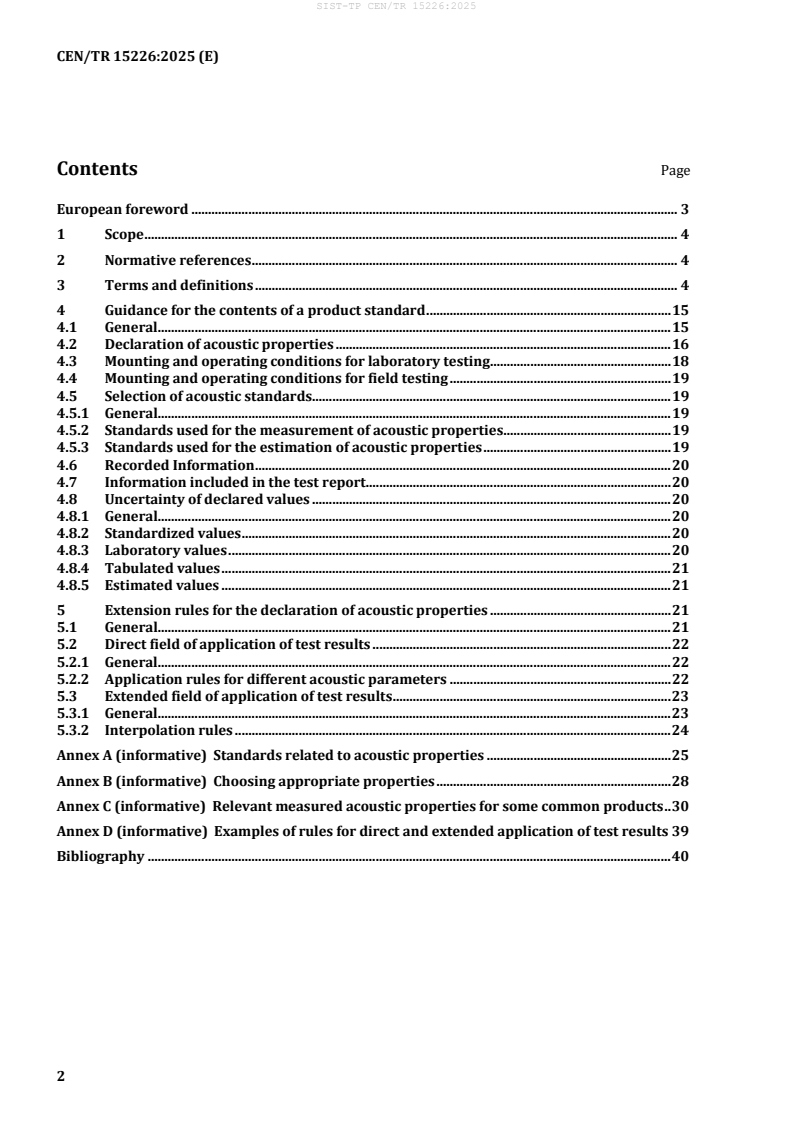
Contents Page
European foreword . 3
1 Scope . 4
2 Normative references . 4
3 Terms and definitions . 4
4 Guidance for the contents of a product standard . 15
4.1 General. 15
4.2 Declaration of acoustic properties . 16
4.3 Mounting and operating conditions for laboratory testing . 18
4.4 Mounting and operating conditions for field testing . 19
4.5 Selection of acoustic standards . 19
4.5.1 General. 19
4.5.2 Standards used for the measurement of acoustic properties . 19
4.5.3 Standards used for the estimation of acoustic properties . 19
4.6 Recorded Information . 20
4.7 Information included in the test report. 20
4.8 Uncertainty of declared values . 20
4.8.1 General. 20
4.8.2 Standardized values . 20
4.8.3 Laboratory values . 20
4.8.4 Tabulated values . 21
4.8.5 Estimated values . 21
5 Extension rules for the declaration of acoustic properties . 21
5.1 General. 21
5.2 Direct field of application of test results . 22
5.2.1 General. 22
5.2.2 Application rules for different acoustic parameters . 22
5.3 Extended field of application of test results . 23
5.3.1 General. 23
5.3.2 Interpolation rules . 24
Annex A (informative) Standards related to acoustic properties . 25
Annex B (informative) Choosing appropriate properties . 28
Annex C (informative) Relevant measured acoustic properties for some common products . 30
Annex D (informative) Examples of rules for direct and extended application of test results 39
Bibliography . 40
European foreword
This document (CEN/TR 15226:2025) has been prepared by Technical Committee CEN/TC 126 “Acoustic
properties of building elements and of buildings”, the secretariat of which is held by AFNOR.
Attention is drawn to the possibility that some of the elements of this document may be the subject of
patent rights. CEN shall not be held responsible for identifying any or all such patent rights.
This document supersedes CEN/TR 15226:2006.
In comparison with the previous version, this revision has mainly been focused on:
— updating the normative references (Clause 2) and adding an Annex listing the standards related to
relevant acoustic properties;
— reviewing the acoustic terms and definitions (Clause 3);
— reviewing Annex on relevant measured acoustic properties for some common products.
Any feedback and questions on this document should be directed to the users’ national standards body.
A complete listing of these bodies can be found on the CEN website.
1 Scope
This document specifies the method for declaring the technical classification relating to acoustics for a
Product Standard including DoP, or European assessment document (EAD) including European Technical
Approval (ETA) for a specific building product or equipment, or a family of building products or
equipment. In particular, it gives advice on how to write technical specifications in response to the
mandated characteristics on acoustics under the Construction Products Regulation.
NOTE 1 In the remainder of this document, the terms used relate to CEN and product standards. The concepts
are, however, equally applicable to the European Organisation for Technical Approvals (EOTA).
The purpose of this document is to assist the Technical Committees in preparing acoustic clauses to
ensure that such product standards:
— are as homogeneous as possible, with each individual product standard having the same basic
structure;
— are in full accordance with the standards for the measurement and declaration of acoustic properties;
— reflect the latest technical knowledge of methods of determining the acoustical properties from the
specific family of building products or equipment under consideration.
NOTE 2 Annex A lists the European and International Standards to be used in the drafting of acoustic provisions
standards. Annex B contains guidance on choosing appropriate properties. Annex C describes the relevant
measured acoustic properties for common products.
2 Normative references
There are no normative references in this document.
3 Terms and definitions
For the purposes of this document, the following terms and definitions apply.
ISO and IEC maintain terminology databases for use in standardization at the following addresses:
— ISO Online browsing platform: available at https://www.iso.org/obp/
— IEC Electropedia: available at https://www.electropedia.org/
3.1
general terms
3.1.1
equivalent continuous sound pressure level, L (dB)
eq,T
value of the sound pressure level in decibels of a continuous, steady sound, that within a specified time
interval, T, has the same mean squared sound pressure as the sound under consideration that varies with
time
3.1.2
octave band
band of frequencies in which the upper limit of the band is twice the frequency of the lower limit
3.1.3
one third octave band
1/3
band of frequencies in which the upper limit of the band is 2 times the frequency of the lower limit
3.2
airborne sound insulation
ability of building elements or buildings to reduce sound transmission when the excitation is in the air,
expressed in terms of several related quantities
[SOURCE: EN ISO 12354-1:2017, modified]
3.2.1
sound reduction index, R (dB)
ten times the common logarithm of the ratio of the sound power W1 incident on a test specimen to the
sound power W2 transmitted through the specimen, representing a laboratory measurement
3.2.2
sound reduction improvement index, ΔR (dB)
difference in sound reduction index between a basic structural element with an additional layer (e.g. a
resilient wall skin, a suspended ceiling, a floating floor) and the basic structural element without this
layer, representing a laboratory measurement
3.2.3
apparent sound reduction index, R’ (dB)
minus 10 times the common logarithm of the ratio of the total sound power W transmitted into the
tot
receiving room to the sound power W which is incident on a separating element, representing a field
measurement
3.2.4
intensity sound reduction index, R (dB)
I
laboratory measurement of the sound reduction index using sound intensity measurements in a stated
frequency band, representing a laboratory measurement
3.2.5
level difference, D (dB)
difference in the space and time average sound pressure levels produced in two rooms by one or more
sound source in one of them
3.2.6
normalized level difference, D (dB)
n
difference in the space and time average sound pressure levels produced in two rooms by one or more
sound sources in one of them, corresponding to the reference equivalent sound absorption area in the
receiving room, representing a field measurement
3.2.7
element-normalized level difference, D (dB)
n,e
difference in the space and time average sound pressure level produced in two rooms by a source in one
room, where sound transmission is only due to a small technical element (e.g. transfer air devices,
electrical cable ducts, transit sealing systems), representing a laboratory measurement
3.2.8
standardized level difference, D (dB)
nT
difference in the space and time average sound pressure levels produced in two rooms by one or more
sound sources in one of them, corresponding to a reference value of the reverberation time of 0,5 s in the
receiving room level, representing a field measurement
3.2.9
normalized flanking level difference D (dB)
n,f
difference in the space and time average sound pressure level produced in two rooms by a source in one
of them, for transmission via a specified flanking path, representing a laboratory measurement
3.3
rating of airborne sound insulation
single number quantity rating of the airborne sound insulation, expressed in terms of several related
quantities
[SOURCE: EN ISO 717-1:2020, modified]
3.3.1
C (dB)
spectrum adaptation term to be added to the single-number quantity to take account of spectrum No.1
3.3.2
C (dB)
tr
spectrum adaptation term to be added to the single-number quantity to take account of spectrum No.2
3.3.3
(dB)
weighted sound reduction index, Rw
single-number quantity that characterizes the airborne sound insulation of a product or building element,
representing a laboratory measurement
3.3.4
weighted sound reduction improvement index, ΔR (dB)
w
single-number quantity that characterizes the improvement in the sound reduction index, representing
a laboratory measurement
3.3.5
weighted intensity sound reduction index, R (dB)
I,w
single-number quantity that characterizes the airborne sound insulation of a product or building element
over a range of frequencies using an intensity technique, representing a laboratory measurement
3.3.6
weighted apparent sound reduction index, R' (dB)
w
single-number quantity that characterizes the airborne sound insulation between rooms in a building,
representing a field measurement
3.3.7
weighted element-normalized level difference, D (dB)
n,e,w
single-number quantity that characterizes the airborne sound insulation of a small technical building
element, representing a laboratory measurement
3.3.8
(dB)
weighted standardized level difference, DnT,w
single-number quantity that characterizes the airborne sound insulation between rooms in a building,
representing a field measurement
3.3.9
weighted normalized flanking level difference, D (dB)
n,f,w
single-number quantity that characterizes the airborne sound insulation for sound transmission via a
specified flanking path over a range of frequencies, representing a laboratory measurement
3.4
impact sound insulation
ability of building elements or buildings to reduce impact sound transmission in terms of several related
quantities
[SOURCE: EN ISO 12354-2:2017, modified]
3.4.1
impact sound pressure level, L (dB)
i
average sound pressure level in a room below a floor, when it is excited by the standard tapping machine
3.4.2
normalized impact sound pressure level L (dB)
n
impact sound pressure level corresponding to the reference equivalent sound absorption area in the
receiving room, representing a laboratory measurement
3.4.3
reduction of impact sound pressure level, ΔL (dB)
reduction in normalized impact sound pressure level resulting from installation of, for example, a test
floor covering, representing a laboratory measurement
3.4.4
standardized impact sound pressure level, L’ (dB)
nT
impact sound pressure level corresponding to a reference value of the reverberation time of 0,5 s in the
receiving room, representing a field measurement
3.4.5
normalized flanking impact sound pressure level L (dB)
n,f
space and time average sound pressure level in the receiving room produced by a standardized tapping
machine operating at different positions on the element in the source room, normalized to the reference
equivalent sound absorption area of 10 m in the receiving room, for transmission via a specified flanking
path, representing a laboratory measurement
3.5
rating of impact sound insulation
single number quantity rating of the impact sound insulation, expressed in terms of several related
quantities
[SOURCE: EN ISO 717-2:2020, modified]
3.5.1
C (dB)
I
spectrum adaptation term to be added to the single-number quantity to take account of the un-weighted
impact sound level
3.5.2
weighted normalized impact sound pressure level, L (dB)
n,w
single-number quantity used to characterize the impact sound insulation of floors, representing a
laboratory measurement
3.5.3
weighted reduction in impact sound pressure level, ΔL (dB)
w
single-number quantity used to characterize the reduction in the impact sound pressure level,
representing a laboratory measurement
3.5.4
weighted standardized impact sound pressure level, L’ (dB)
nT,w
single-number-quantity used to characterize the impact sound insulation of floors in buildings,
representing a field measurement
3.5.5
weighted normalized flanking impact sound pressure level L (dB)
n,f,w
single-number quantity used to characterize the impact sound insulation of floors for transmission via a
specified flanking path, representing a laboratory measurement
3.5.6
A-weighted walking sound pressure level L (dB)
n,walk,A
single-number quantity used to characterize the sound level of floors radiated in the same room,
representing a laboratory measurement
[SOURCE: EN 16205:2020, modified]
3.6
rainfall sound
ability of building elements to radiate sound due to rain drops impact of several related quantities
[SOURCE: EN ISO 10140-1:2021, Annex K]
3.6.1
rainfall sound intensity level, L (dB)
I
radiated sound intensity level in a room below a roof, roof/ceiling systems, roof windows/skylights or
rooflights, when it is excited by standard rainfall type, representing a laboratory measurement
3.6.2
A-weighted rainfall sound intensity level, L (dB)
IA
single-number quantity used to characterize the rainfall sound intensity level radiated below a roof,
roof/ceiling systems, roof windows/skylights or rooflights, when it is excited by standard rainfall type,
representing a laboratory measurement
3.7
flanking transmission
ability of junction between building elements to reduce vibrational transmission in terms of several
related quantities
[SOURCE: EN ISO 12354-1:2017]
3.7.1
vibration reduction index, K (dB)
ij
quantity related to the vibrational power transmission over a junction between structural elements,
normalized in order to make it an invariant quantity, which is determined by normalizing the direction
averaged velocity level difference over the junction, to the junction length and the equivalent sound
absorption length, if relevant, of both elements, representing a laboratory measurement.
3.7.2
normalized direction-averaged vibration level difference, D (dB)
v,ij ,n
difference in velocity level between elements i and j, averaged over the excitation from i and excitation
from j, and normalized to the junction length and the measurement areas on both elements, representing
a laboratory measurement
3.8
rating of flanking transmission
single number quantity rating of flanking transmission in terms of several related quantities
[SOURCE: EN ISO 10848-1:2017]
3.8.1
(dB)
vibration reduction index, K
ij
single-number quantity that characterizes the vibration reduction index and calculated as the arithmetic
average of K within the frequency range 200 Hz to 1 250 Hz (one-third octave bands), representing a
ij
laboratory measurement
3.8.2
normalized direction-averaged vibration level difference, (dB)
D
v,ij ,n
single-number quantity that characterizes normalized direction-averaged vibration level difference and
calculated as the arithmetic average of D within the frequency range 200 Hz to 1 250 Hz (one-third
v,ij ,n
octave bands), representing a laboratory measurement
3.9
sound absorption
ability of building elements to absorb sound in terms of several related quantities
[SOURCE: EN ISO 354:2003, modified]
3.9.1
equivalent sound absorption area of a room, A (m )
hypothetical area of a totally absorbing surface without diffraction effects which, if it were the only
absorbing element in the room, would give the same reverberation time as the room under consideration
3.9.2
sound absorption area of an object A (m )
obj
difference between the equivalent sound absorption area of the reverberation room with and without
the test object, representing a laboratory measurement
3.9.3
sound absorption coefficient, α
s
ratio of the equivalent sound absorption area of a test specimen divided by the area in m of the test
specimen; it is only defined for a plane test specimen, representing a laboratory measurement
3.9.4
sound absorption coefficient at normal incidence, α
ratio of non-reflected-to-incident sound energy if a plane wave strikes a plane wall at normal incidence,
representing a laboratory measurement
[SOURCE: EN ISO 10534-2:2023, modified]
3.10
rating of sound absorption
single number quantity rating of sound absorption in terms of several related quantities
[SOURCE: EN ISO 11654:1997, modified]
3.10.1
weighted sound absorption coefficient, α
w
single-number frequency-independent value used to characterize the sound absorption coefficient,
representing a laboratory measurement
3.10.2
practical sound absorption coefficient, α
p
frequency-dependent value of the sound absorption coefficient which is based on measurements on one-
third octave bands, and which is calculated in octave bands, representing a laboratory measurement
3.11
acoustic performance of screens, enclosures and cabins
ability of an acoustic protection device to reduce noise
Note 1 to entry: EN ISO 11821 for moveable screens, EN ISO 11546-1 and EN ISO 11546-2 for small machine
enclosures, EN ISO 11957 for sound-protecting cabins, and in ISO 23351 for speech attenuation.
3.11.1
sound attenuation, D (dB)
p
reduction in sound pressure level at a specified position due to an
enclosure or a screen, representing either a laboratory or field measurement
3.11.2
sound attenuation, D (dB)
p
difference between the sound pressure level of an external reverberant sound
field and the sound pressure level inside a cabin located in the field, representing a field measurement
3.11.3
A-weighted in situ sound attenuation, D (dB)
pA
reduction in A-weighted sound pressure level at a specified position due to an enclosure or a screen,
representing a laboratory or field measurement
3.11.4
sound power insulation, D (dB)
W
reduction in sound power level obtained due to an enclosure, representing a laboratory or field
measurement
3.11.5
A-weighted sound power insulation, D (dB)
WA
reduction in A-weighted sound power level obtained due to an enclosure, representing a laboratory or
field measurement
3.11.6
apparent A-weighted sound pressure insulation, D’ (dB)
pA
difference in A-weighted sound pressure levels measured in the room and in the cabin, respectively when
the actual environmental noise in used as the sound source, representing a field measurement
3.11.7
apparent weighted sound pressure insulation, D’ (dB)
p,w
single-number value for the sound insulation of a cabin determined in accordance with the method stated
in EN ISO 717-1, representing a field measurement
3.11.8
weighted sound pressure insulation, D (dB)
p,w
single-number value for the sound insulation of a cabin determined in accordance with the method stated
in EN ISO 717-1, representing a laboratory or field measurement
3.11.9
speech level reduction, D (dB)
S,A
reduction of A-weighted sound power level of speech caused by the test specimen, representing a
laboratory measurement
3.12
noise emission from appliances and service equipment
ability of building appliances and service equipment elements to produce sound in terms of several
related quantities
[SOURCE: EN 15657:2017 and EN 14366-1:2023, modified]
3.12.1
airborne sound power level, L (dB)
Wa
airborne sound power level contribution, representing a laboratory measurement
3.12.2
A-weighted airborne sound power level, L (dB)
Wa,A
A-weighted airborne sound power level contribution, representing a laboratory measurement
3.12.3
single equivalent free velocity level, L (dB)
vf,eq
expression of the source activity, in terms of free RMS velocity level at contact points, with the source
either freely suspended or connected to a much higher mobility receiver, representing a laboratory
measurement
3.12.4
single equivalent blocked force level, L (dB)
Fb,eq
expression of the source activity, in terms of RMS blocked force level at contact points, with the source
connected to a much lower mobility receiver, representing a laboratory measurement
3.12.5
single equivalent mobility magnitude, |Y | (m/sN)
S,eq
source single equivalent mobility, representing a laboratory measurement
3.12.6
single equivalent mobility magnitude, |Y | (m/sN)
R,eq
receiving element single equivalent mobility, representing a laboratory or field measurement
3.12.7
installed power level, L (dB)
Winst
structural power level injected to each building element to which the equipment is connected, calculated
for laboratory or field situations
3.13
material and product properties
physical properties of material and products related to their acoustic behaviour in terms of several
related quantities
3.13.1
airflow resistivity, σ (Pa·s/m )
specific airflow resistance divided by the thickness of the test specimen (for homogeneous materials),
representing a laboratory measurement
[SOURCE: EN ISO 9053-1:2018 and EN ISO 9053-2:2020]
3.13.2
density, ρ (kg/m )
mass per unit volume
Note 1 to entry: Some building products are formed with voids or slots, the density of such products can be quoted
as either the density or the solid density, depending on what volume has been used (i.e. with or without the void).
3.13.3
dynamic stiffness per unit area, s' (MN/m )
ratio of dynamic force to dynamic displacement, representing a laboratory measurement
[SOURCE: EN 29052-1:1992]
3.13.4
longitudinal wavespeed, c (m/s)
L
speed of propagation of longitudinal waves (i.e. particle motion in the same direction as wave
propagation)
3.13.5
specific airflow resistance, R (Pa·s/m)
s
product of the airflow resistance and the cross-sectional area of the test specimen, representing a
laboratory measurement
3.13.6
Young’s modulus, E (N/m )
ratio of stress to strain, representing a laboratory measurement
3.13.7
bending stiffness, B (Nm)
product of the Young’s modulus and the moment of inertia, representing a laboratory measurement
3.14
declared values
3.14.1
derived laboratory value
value derived from the laboratory value or from the reference laboratory value using a calculation
procedure prescribed by the product standard for the situation where a product differs in its product
parameters or end use parameters from the tested product
3.14.2
calculated field value
calculated value that the product or element will have in the field
3.14.3
calculated laboratory value
calculated value that the product or element will have in the laboratory
3.14.4
measured field value
value determined from a field measurement of an element, product or material
3.14.5
measured laboratory value
value determined from a laboratory measurement of an element or product with actual dimensions
3.14.6
reference laboratory value
value determined from a laboratory test of an element, product or material with reference dimensions
3.14.7
tabulated laboratory value
value determined from laboratory measurement results for a group of elements or products
3.15
other definitions
3.15.1
actual dimensions
dimensions of an element or product as placed on the market
3.15.2
component (see also material)
part which when combined with one or more parts, makes up a kit
Note 1 to entry: A component may be a construction product in the sense of the Construction Products Regulation.
Note 2 to entry: Examples are mineral wool used in a prefabricated partition, screws or nails in a prefabricated
partition and sprinklers used in a fire extinguishing kit.
3.15.3
construction works
entire construction that may be made up of e.g. components, construction products and elements
EXAMPLES Complete buildings and roads.
3.15.4
direct field of application of test results
outcome of a process (involving the application of defined rules) whereby a test result is deemed to be
conservative and equally valid for variations in one or more of the product properties and/or intended
end use application(s)
3.15.5
element
part of the construction works but may also refer to the construction works as a whole; an element may
comprise more than one part
Note 1 to entry: Examples are walls, floors and roofs.
Note 2 to entry: Two types (A and B) of element are defined in EN ISO 10848-1 as follows:
— type A element: element with a structural reverberation time that is primarily determined by the connected
elements (up to at least the 1 000 Hz one-third octave band) and a decrease in vibration level of less than 6dB
across the element in the direction perpendicular to the junction line (up to at least the 1 000 Hz one-third
octave band).
— type B element: element that is not a Type A element
Examples of Type A elements include cast in situ concrete, solid wood (including cross laminated timber panels),
glass, plastic, metal, bricks/blocks/slabs with a finish/topping (e.g. plaster, parge coat, screed, concrete) that
mechanically connects them together. Examples of Type B elements typically include plasterboard/timber cladding
on timber or metal frames.
3.15.6
extended field of application of test results
outcome of a process allowing to predict a test result, for a variation of a product property and/or its
intended end use application(s), as though the product had been tested to the test method in question, a
test result can be derived as though the product had been tested to the test method in question
Note 1 to entry: If the process gives a rule or method extended application is in this case used to derive a direct
application rule.
3.15.7
enclosure
structure enveloping a noise source designed to protect the environment from this noise source
3.15.8
end-use parameter
aspect of the mounting and fixing arrangement of a product simulating its end use (for example fixing
method, position and type of joints) which can affect the acoustic performance
3.15.9
kit
set of at least two separate components that need to be combined before permanent installation in the
construction works.
Note 1 to entry: A kit is the equivalent of a construction product.
3.15.10
material (see also component)
substance that either alone or with other materials constitutes a product
Note 1 to entry: Examples are clay for bricks, concrete for concrete blocks and paper facing for plasterboard.
3.15.11
product group or product family
set of products which, because of similarities between them, are tested in the same way to obtain the
same acoustic characteristics
Note 1 to entry: Examples are glazing of different thicknesses and composition and doors of the same construction
but different sizes. The rules for mounting and fixing can, therefore, be written for all products within a group.
3.15.12
product parameter
aspect of a product (for example thickness, composition, density) which may vary, and which can have
an influence on the product's acoustic performance
3.15.13
reference dimensions
dimensions of an element or product as prescribed by the product standard for laboratory tests
3.15.14
small elements
elements, defined in EN ISO 10140-2, excluding windows and doors, that have an area less than 1 m
which occur in a certain number of discrete sizes with well-defined lateral dimensions, and which
transmit sound between two adjacent rooms or between one room and the open-air independently of the
adjoining building elements
Note 1 to entry: Examples are transfer air devices, airing panels (ventilators), outdoor air intakes, air vents,
electrical raceways (cable ducts), shutter boxes, transit sealing systems.
Note 2 to entry: The method is not primarily intended for components that constitute part of an integrated unit for
which the associated sound transmission can only be defined when the components are fully connected.
4 Guidance for the contents of a product standard
4.1 General
The purpose of a product standard reference to acoustics is to ensure that the acoustic performance of a
product is determined using test and assessment and declaration methods common to other products in
the same product group, and hence ensure that comparable test results are obtained. The level of
comparison depends on the type of product and its intended end use. For example, when testing an
external wall, the overall performance of the wall as a whole should be comparable with other external
walls irrespective of their construction.
The acoustic quantities described in a product standard are also useful for acoustic specifications in
private contracts and for planning.
Some products have measurable acoustic properties whereas others have to be combined before an
acoustic property can be measured.
The product standard describes how the appropriate acoustic properties are to be determined. Acoustic
properties include the needed performance quantities corresponding to one or several of the following:
a) airborne sound reduction index;
b) impact sound level;
c) flanking transmission;
d) sound absorption coefficient;
e) airborne sound power level;
f) equivalent free velocity level,
g) single equivalent blocked force level,
h) single equivalent mobility magnitude,
i) sound pressure level
j) rainfall sound intensity level
Parameters used to estimate acoustic properties include the needed quantities corresponding to one or
several of the following:
k) dimensions;
l) density;
m) dynamic stiffness;
n) airflow resistivity / specific airflow resistance;
o) Young’s modulus / longitudinal wavespeed / bending stiffness;
p) damping.
NOTE At present, measurement standards are not available to determine all of these parameters for building
products.
In writing acoustic clauses, product Technical Committees are supposed to be aware of the possibilities
of using established data and/or tabulated values. The former may be a list of products/elements,
common to several manufacturers, for which acoustic testing has already been performed and therefore
manufacturers of these products/elements may use the results given in the standard without the need to
perform tests. In this case, the declared acoustic performance is expected to be conservative and based
upon the statistics of gathered test data. However, manufacturers have the possibility to perform one or
more tests if they wish to declare a different value
Product Technical Committees can also use output values from calculations, in addition to, or instead of
testing. An example is the calculation of the normal incidence absorption coefficient from the measured
airflow resistivity for unfaced mineral wool. Another example is the calculation of the airborne sound
insulation from glazing's using a calculation tool validated following procedure described in EN 17839.
Acoustic clauses are sometimes contained in the product standard itself, or included in a separate
standard to which the product standard refers. The latter is likely to be useful when, for example, the end
use and testing conditions are common for a group of products covered by different product standards.
4.2 Declaration of acoustic properties
The declaration of the acoustic properties is the sole responsibility of the manufacturer. The
manufacturer states which of the following values is/are being declared:
a) reference laboratory value;
For example: Acoustic performance (reference laboratory value) R : 34 dB
w
b) tabulated laboratory value;
For example: Acoustic performance (tabulated laboratory value) R : 30 dB
w
c) measured laboratory value;
For example: Acoustic performance (measured laboratory value) α : 0.7
w
d) derived laboratory value;
For example: Acoustic performance (derived laboratory value) ΔR : 15 dB
w
e) calculated laboratory value;
For example: Acoustic performance (calculated laboratory value) ΔL : 10 dB
w
f) field value;
For example: Acoustic performance (field value) L’ : 55 dB
nT,w
g) calculated field value.
For example: Acoustic performance (calculated field value) D : 60 dB
nT,w
The declaration-preferably uses values a), b) or c) unless this is not feasible, in which case, values d), e),
f) or g) are declared. The declaration also states the uncertainty associated with the declared values as
described in 4.8.
Because the Construction Products Regulation applies to products before they are installed in works, it
is not appropriate to use f) or g) in harmonized product standards.
The product standard:
— specifies which acoustic properties, or parameters used to determine the acoustic properties, are to
be declared by the manufacturer, see Annex C;
— states that: “The acoustic properties declaration shall explicitly state that the acoustic properties
have been obtained according to the provisions of this product standard.” If this statement is not true,
the declaration indicates clearly all deviations from the product standard;
— states in a note that “additional acoustic properties may also be given in the declaration”;
— states that "the declaration shall contain the following":
1) identification of the element, product, or material with sufficient detail to determine the
applicability of the declared acoustic properties;
2) identification of the respective product standard, and the measurement or estimation standards;
3) the words “Declared acoustic properties in accordance with EN xyz”, followed by one or more of
the values described in paragraph **.
The following examples show the preferred format of the declaration wording.
EXAMPLE 1 Window.
Declared acoustic properties in accordance with EN 14351-1.
Reference laboratory value for airborne sound insulation is R (C;C ) = 36 (-1;-4) dB, measured in
w tr
accordance with EN ISO 10140 series and rated according to EN ISO 717-1.
EXAMPLE 2 Insulating Glass Unit.
Declared acoustic properties in accordance with EN 1279-5.
Tabulated laboratory value of a 4/16/4 IGU for airborne sound insulation is R (C;C ) = 29 (-1;-4) dB,
w tr
according to EN 12758.
EXAMPLE 3 Suspended ceiling.
Declared acoustic properties in accordance with EN 13964.
Laboratory value for room to room airborne sound flanking difference is D (C;C ) = 39 (-1;-6) dB,
n,f,w tr
measured in accordance with EN ISO 10848-2 and rated according to EN ISO 717-1.
Laboratory value for sound absorption is α = 0,80 (depth of construction is 200 mm) measured in
w
accordance with EN ISO 354 and rated according to EN ISO 11654.
EXAMPLE 4 Carpet.
Declared acoustic properties in accordance with EN 1307.
Laboratory value for the improvement of impact sound insulation is ΔL = 19 dB, measured in accordance
w
with EN ISO 10140-1 and rated according to EN ISO 717-2.
Laboratory value for sound absorption is α = 0,15 (H) measured in accordance with EN ISO 354 and
w
rated according to EN ISO 11654.
EXAMPLE 5 Floor covering
Declared acoustic properties in accordance with EN 16205.
The A-weighted walking sound pressure level is L = 80 dB(A) (79,7 dB(A) ± 1,2 dB(A)).
n,walk,A
EXAMPLE 6 Roof windows
Declared acoustic properties in accordance with EN 14351-1.
Laboratory A-weighted rainfall sound intensity level is L = 63 dB(A), measured in accordance with the
IA
EN ISO 10140 series and rated according to EN ISO 10140-1.
4.3 Mounting and operating conditions for laboratory testing
In general, acoustic test method standards describe the mounting and fixing conditions appropriate for a
given acoustic test apparatus, for example, how to fit a test frame into a chamber or how to seal gaps
between the test specimen and the edges of the laboratory. The product standard, on the other hand,
describes how the test specimen itself is prepared.
Where any acoustic measurement standard requires certain mounting and/or operating conditions for
the specific element, product or material, these are followed and stated in the test report due the
dependence of acoustic performance on mounting conditions and operating conditions.
Where any acoustic measurement standard does not require certain mounting and/or operating
conditions, detailed descriptions of mounting and operating conditions for the specific element, product,
or material are described in the acoustic clauses. These clauses also request that this information is
included in the test report due the dependence of acoustic performance on mounting conditions and
operating conditions.
In general, the mounting and operating conditions are chosen to be representative of the product in its
intended end use, and are chosen to give the maximum field of application of results.
The standard describes the mounting, fixing and installation conditions (as appropriate) of each product
group or sub-group covered by the standard. To allow comparability between products, a 'standardized'
set of mounting and fixing conditions are specified, but with the possibility for a manufacturer to use non-
standardized conditions where these corresponds to the intended end use conditions.
4.4 Mounting and operating conditions for field testing
The mounting and/or operating conditions for the specific element, product or material are stated in the
test report, due to the dependence of the acoustic performance on mounting conditions as well as
operating conditions.
4.5 Selection of acoustic standards
4.5.1 General
Those responsible for preparing a product standard select those acoustic standards according to Annex A,
from the measurement and/or estimation methods available, that are most appropriate for the specific
element, product or material. See Annex A for a list of
...