

EN 15459:2007
(Main)Energy performance of buildings - Economic evaluation procedure for energy systems in buildings
- Abstract
This standard provides a calculation method for the economical issues of heating systems and other systems that are involved in the energy demand and energy consumption of the building. This standard applies to all types of buildings.
The fundamental principles and terminology are explained in this standard.
The main items of the standard are:
- definitions and structure of the types of costs, which shall be taken into account for calculation of the economical efficiency of saving options in buildings;
- data needed for definition of costs related to systems under consideration;
- calculation method(s);
- expression of the result of the economic calculation;
- informative annexes indicating default values of e.g. lifetime, costs for repair, costs for maintenance, in order to introduce default values for calculations.
This standard is applicable to calculation of economic performance of energy saving options in buildings (e.g. insulation, better performing generators and distribution systems, efficient lighting, renewable sources, combined heat and power).
The scope of this standard is to standardise:
- required inputs;
- calculation methods;
- required outputs
for economic calculations of energy systems related to the energy performance of buildings.
NOTE Sensitivity of results increases with the number of parameters under consideration (e.g. lifetime, interest rates, development of different types of costs). The more parameters one changes when comparing different solutions, the more difficult it is to draw conclusions from the economic results of the calculations.
Economical results are closely related to the specific project under consideration, and no general conclusions should be drawn from any such results.
- Status
- Withdrawn
- Publication Date
- 06-Nov-2007
- Withdrawal Date
- 06-Oct-2026
- Technical Committee
- CEN/TC 228 - Heating systems in buildings
- Current Stage
- 9960 - Withdrawal effective - Withdrawal
- Start Date
- 31-May-2017
- Completion Date
- 07-Oct-2026

Relations
- Effective Date
- 07-Jun-2017
- Effective Date
- 09-Feb-2026
- Effective Date
- 09-Feb-2026
- Effective Date
- 09-Feb-2026
- Referred By
EN 14471:2005 - Chimneys - System chimneys with plastic flue liners - Requirements and test methods - Effective Date
- 28-Jan-2026
- Effective Date
- 28-Jan-2026
- Effective Date
- 28-Jan-2026
- Effective Date
- 28-Jan-2026
- Effective Date
- 28-Jan-2026
- Effective Date
- 28-Jan-2026
- Effective Date
- 28-Jan-2026
- Effective Date
- 28-Jan-2026
- Effective Date
- 28-Jan-2026
- Effective Date
- 28-Jan-2026
- Effective Date
- 28-Jan-2026
Get Certified
Connect with accredited certification bodies for this standard

DIBt (Deutsches Institut für Bautechnik)
German Institute for Building Technology.
DIN CERTCO
DIN Group product certification.

Aboma Certification B.V.
Specialized in construction, metal, and transport sectors.
Sponsored listings
Frequently Asked Questions
EN 15459:2007 is a standard published by the European Committee for Standardization (CEN). Its full title is "Energy performance of buildings - Economic evaluation procedure for energy systems in buildings". This standard covers: This standard provides a calculation method for the economical issues of heating systems and other systems that are involved in the energy demand and energy consumption of the building. This standard applies to all types of buildings. The fundamental principles and terminology are explained in this standard. The main items of the standard are: - definitions and structure of the types of costs, which shall be taken into account for calculation of the economical efficiency of saving options in buildings; - data needed for definition of costs related to systems under consideration; - calculation method(s); - expression of the result of the economic calculation; - informative annexes indicating default values of e.g. lifetime, costs for repair, costs for maintenance, in order to introduce default values for calculations. This standard is applicable to calculation of economic performance of energy saving options in buildings (e.g. insulation, better performing generators and distribution systems, efficient lighting, renewable sources, combined heat and power). The scope of this standard is to standardise: - required inputs; - calculation methods; - required outputs for economic calculations of energy systems related to the energy performance of buildings. NOTE Sensitivity of results increases with the number of parameters under consideration (e.g. lifetime, interest rates, development of different types of costs). The more parameters one changes when comparing different solutions, the more difficult it is to draw conclusions from the economic results of the calculations. Economical results are closely related to the specific project under consideration, and no general conclusions should be drawn from any such results.
This standard provides a calculation method for the economical issues of heating systems and other systems that are involved in the energy demand and energy consumption of the building. This standard applies to all types of buildings. The fundamental principles and terminology are explained in this standard. The main items of the standard are: - definitions and structure of the types of costs, which shall be taken into account for calculation of the economical efficiency of saving options in buildings; - data needed for definition of costs related to systems under consideration; - calculation method(s); - expression of the result of the economic calculation; - informative annexes indicating default values of e.g. lifetime, costs for repair, costs for maintenance, in order to introduce default values for calculations. This standard is applicable to calculation of economic performance of energy saving options in buildings (e.g. insulation, better performing generators and distribution systems, efficient lighting, renewable sources, combined heat and power). The scope of this standard is to standardise: - required inputs; - calculation methods; - required outputs for economic calculations of energy systems related to the energy performance of buildings. NOTE Sensitivity of results increases with the number of parameters under consideration (e.g. lifetime, interest rates, development of different types of costs). The more parameters one changes when comparing different solutions, the more difficult it is to draw conclusions from the economic results of the calculations. Economical results are closely related to the specific project under consideration, and no general conclusions should be drawn from any such results.
EN 15459:2007 is classified under the following ICS (International Classification for Standards) categories: 91.140.10 - Central heating systems. The ICS classification helps identify the subject area and facilitates finding related standards.
EN 15459:2007 has the following relationships with other standards: It is inter standard links to EN 15459-1:2017, EN 60674-3-8:2011, EN 60684-3-247:2011, EN 60674-3-1:1998/A1:2011, EN 14471:2005, EN ISO 1873-2:2007, EN 1504-5:2004, EN ISO 8986-2:2009, EN 15330-1:2007, EN ISO 12086-2:2006, EN ISO 10350-1:2008, EN 15860:2010, EN ISO 15103-2:2007, EN ISO 10350-2:2011, EN 14889-2:2006. Understanding these relationships helps ensure you are using the most current and applicable version of the standard.
EN 15459:2007 is associated with the following European legislation: Standardization Mandates: M/343. When a standard is cited in the Official Journal of the European Union, products manufactured in conformity with it benefit from a presumption of conformity with the essential requirements of the corresponding EU directive or regulation.
EN 15459:2007 is available in PDF format for immediate download after purchase. The document can be added to your cart and obtained through the secure checkout process. Digital delivery ensures instant access to the complete standard document.
Standards Content (Sample)
2003-01.Slovenski inštitut za standardizacijo. Razmnoževanje celote ali delov tega standarda ni dovoljeno.Energy performance of buildings - Economic evaluation procedure for energy systems in buildingsGrelni sistemi v stavbah - Postopek ekonomskega vrednotenja stavbnih energijskih sistemovPerformance energétique des bâtiments - Méthode d'évaluation économique des systemes énergétiques des bâtimentsEnergieeffizienz von Gebäuden - Wirtschaftlichkeitsberechnungsverfahren für Energiesysteme in GebäudenTa slovenski standard je istoveten z:EN 15459:2007SIST EN 15459:2008en91.140.10Sistemi centralnega ogrevanjaCentral heating systemsICS:SLOVENSKI
STANDARDSIST EN 15459:200801-januar-2008
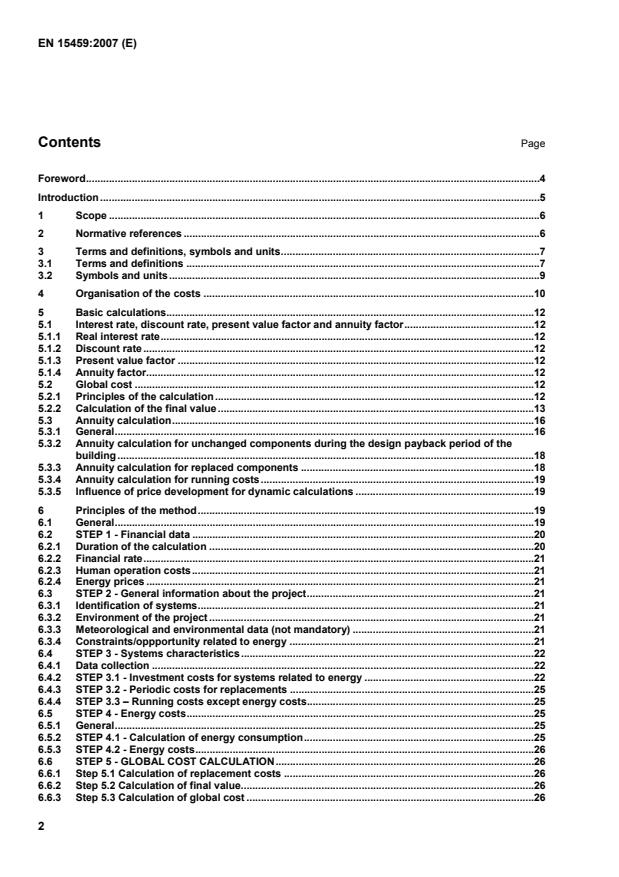
EUROPEAN STANDARDNORME EUROPÉENNEEUROPÄISCHE NORMEN 15459November 2007ICS 91.140.10 English VersionEnergy performance of buildings - Economic evaluationprocedure for energy systems in buildingsPerformance énergétique des bâtiments - Procédured'évaluation économique des systèmes énergétiques desbâtimentsEnergieeffizienz von Gebäuden -Wirtschaftlichkeitsberechnungen für Energiesysteme inGebäudenThis European Standard was approved by CEN on 11 August 2007.CEN members are bound to comply with the CEN/CENELEC Internal Regulations which stipulate the conditions for giving this EuropeanStandard the status of a national standard without any alteration. Up-to-date lists and bibliographical references concerning such nationalstandards may be obtained on application to the CEN Management Centre or to any CEN member.This European Standard exists in three official versions (English, French, German). A version in any other language made by translationunder the responsibility of a CEN member into its own language and notified to the CEN Management Centre has the same status as theofficial versions.CEN members are the national standards bodies of Austria, Belgium, Bulgaria, Cyprus, Czech Republic, Denmark, Estonia, Finland,France, Germany, Greece, Hungary, Iceland, Ireland, Italy, Latvia, Lithuania, Luxembourg, Malta, Netherlands, Norway, Poland, Portugal,Romania, Slovakia, Slovenia, Spain, Sweden, Switzerland and United Kingdom.EUROPEAN COMMITTEE FOR STANDARDIZATIONCOMITÉ EUROPÉEN DE NORMALISATIONEUROPÄISCHES KOMITEE FÜR NORMUNGManagement Centre: rue de Stassart, 36
B-1050 Brussels© 2007 CENAll rights of exploitation in any form and by any means reservedworldwide for CEN national Members.Ref. No. EN 15459:2007: E
Systems description.32 Annex C (informative) Calculation sheet for global cost calculation.38 Annex D (informative) Annuity calculation, organisation of data and results.39 Annex E (informative)
Example 1 –
Dwelling 100 m² with gas heating system.40 E.1 STEP 1 - Financial Data.40 E.2 STEP 2 - General information about project.40 E.2.1 Identification of systems.40 E.2.2 Environment of the project.40 E.2.3 Meteorological and environmental data (for information).40 E.3 STEP 3 - System characteristics.41 E.3.1 STEP 3.1 – Investment costs for building construction and systems related to energy.41 E.3.2 STEP 3.2 – Periodic costs for replacements.42 E.3.3 Step 3.3 – Running costs except energy costs.44 E.4 STEP 4 – Energy costs.44 E.4.1 STEP 4.1 - Energy consumption.44 E.4.2 Step 4.2 - Energy costs.45 E.5 STEP 5 - Global costs.47 E.5.1 Step 5.1 and 5.2 - Calculation of replacement costs and final value.47 E.5.2 Step 5.3 - Global cost report.48 E.6 STEP 6 – Annuity calculation costs.49 Bibliography.50
Where possible, reference is made to other European or International Standards, a.o. product standards. However, use of products complying with relevant product standards is no guarantee of compliance with the system requirements. The requirements are mainly expressed as functional requirements, i.e. requirements dealing with the function of the system and not specifying shape, material, dimensions or the like.
The guidelines describe ways to meet the requirements, but other ways to fulfil the functional requirements might be used if fulfilment can be proved. Heating systems differ among the member countries due to climate, traditions and national regulations. In some cases requirements are given as classes so national or individual needs may be accommodated. In cases where the standards contradict with national regulations, the latter should be followed. According to the CEN/CENELEC Internal Regulations, the national standards organizations of the following countries are bound to: Austria, Belgium, Bulgaria, Cyprus, Czech Republic, Denmark, Estonia, Finland, France, Germany, Greece, Hungary, Iceland, Ireland, Italy, Latvia, Lithuania, Luxembourg, Malta, Netherlands, Norway, Poland, Portugal, Romania, Slovakia, Slovenia, Spain, Sweden, Switzerland and United Kingdom.
This method can be used, fully or partly, for the following applications: consider economic feasibility of energy saving options in buildings; compare different solutions of energy saving options in buildings (e.g. plant types, fuels);
evaluate economic performance of an overall design of the building (e.g. trade-off between energy demand and energy efficiency of heating systems); assess the effect of possible energy conservation measures on an existing heating system, by economic calculation of the cost of energy use with and without the energy conservation measure. The user shall refer to other European Standards or to national documents for input data and detailed calculation procedures not provided by this standard, especially regarding dynamic economical calculations, which are not detailed in this standard. The methods to calculate the building heating energy demand are provided by CEN/TC 89 (EN 832, EN ISO 13790) and CEN/TC 228 (EN 15316 series of standards) related to the EPBD (see prCEN/TR 15615).
The main items of the standard are: definitions and structure of the types of costs, which shall be taken into account for calculation of the economical efficiency of saving options in buildings; data needed for definition of costs related to systems under consideration; calculation method(s); expression of the result of the economic calculation; informative annexes indicating default values of e.g. lifetime, costs for repair, costs for maintenance, in order to introduce default values for calculations. This standard is applicable to calculation of economic performance of energy saving options in buildings (e.g. insulation, better performing generators and distribution systems, efficient lighting, renewable sources, combined heat and power). The scope of this standard is to standardise:
required inputs; calculation methods; required outputs for economic calculations of energy systems related to the energy performance of buildings. NOTE Sensitivity of results increases with the number of parameters under consideration (e.g. lifetime, interest rates, development of different types of costs). The more parameters one changes when comparing different solutions, the more difficult it is to draw conclusions from the economic results of the calculations.
Economical results are closely related to the specific project under consideration, and no general conclusions should be drawn from any such results.
2 Normative references The following referenced documents are indispensable for the application of this standard. For dated references, only the edition cited applies. For undated references, the latest edition of the referenced document (including any amendments) applies. Not applicable.
costs to be considered when the building (or the specified equipment) is delivered to the customer, ready to use. These costs include design, purchase of systems and components, connection to suppliers, installation and commissioning process. The initial investment costs are the costs presented to the customer 3.1.3 running costs [Cr] comprise maintenance costs, operational costs, energy costs and added costs NOTE Running costs are annual costs. 3.1.4 maintenance costs [Cm] annual costs for measures for preserving and restoring the desired quality of the installation. This includes annual costs for inspection, cleaning, adjustments, repair under preventive maintenance, consumable items
3.1.5 operational costs [Co] annual costs for operators
3.1.6 energy costs [Ce] annual costs for energy and standing charges for energy (and other consumables as well as costs) NOTE Contracts for energy delivered are included in energy costs. Use of energy implies external costs, which are not included in the official price. It is considered good practice to include the external costs and metering costs in economic calculations and to specify them. 3.1.7 added costs [Cad] annual costs for insurance, other standing charges, taxes (including environmental taxes for energy). Subsidies for renewable energy delivered or produced locally are considered as benefits and are taken into account as negative annual costs 3.1.8 periodic costs of year i [Cp(i)] substitute investment, which is necessary for ageing reasons (corresponds to replacement costs for components (or systems), according to their lifespan) 3.1.9 replacement costs for component or system [CR,i(j)] comprise periodic costs for component j at time i= 2n, 2 2n, etc. (where 2n corresponds to the lifespan of the component) 3.1.10 annual costs [Ca(i) sum of running costs and periodic costs or replacement costs paid in the year i
3.1.12 discount rate [Rd]
definite value for comparison of the value of money at different times 3.1.13 market interest rate [R] interest rate agreed by lender expressed in % 3.1.14 real interest rate [RR] market interest rate adjusted according to inflation rate. Real interest rate may vary during the calculation period (dynamic calculation) 3.1.15 annuity factor [a(n)] factor by which any annual costs and annual incomes are to be divided in order to be referred to the starting year 3.1.16 price development for energy, human operation, products, maintenance and added costs development of the prices for energy, human operation, products, maintenance and added costs may differ from the inflation rate. The subsequent rates (expressed in %) can be introduced in the calculation process: Re,k
rate of development of the price for energy type k (the rate may be different for different types of energy) Ro
rate of development of the price for human operation Rp
rate of development of the price for products Rm
rate of development of the price for maintenance Rad
rate of development of added costs 3.1.17 lifespan [2n(j)] expected lifetime for component j (or system) normally specified in years
3.1.18 present value factor [fpv(n)] factor by which any annual costs and annual incomes are to be multiplied in order to be referred to the starting year NOTE fpv(n) = 1/a(n) , where a(n) = annuity factor 3.1.19 design payback period of building [2_Building] period decided by the owner to complete the payback of the building 3.1.20 starting year [20] date on which any calculation is based 3.1.21 calculation period [2]
time period considered for the calculation
…
€
Ca,i (j) Annual costs for component or system j of the year i (nominal value) €
Cad Added costs (annual) € Ce Energy costs (annual) € Cm Maintenance costs (annual) € Co Operational costs (annual) € Cp (i) Periodic costs of the year i €
Cr Running costs (annual) € fpv (n) Present value factor (for year n) - n2 (j) Number of replacements of component or system j within the calculation period - (Integer) R(i) Market interest rate (for year i) % RR (i) Real interest rate (for year i) % Rd (i) Discount rate (for year i) - Ri (i) Inflation rate (for year i) % Rad Rate of development of the price for added costs % Re,k Rate of development of the price for energy type k % Rm Rate of development of the price for maintenance % Ro Rate of development of the price for human operation % Rp Rate of development of the price for products % 2 Calculation period Year 2_Building Design payback period of building Year 2n (j) Lifespan or design duration for component or system j Year 20 Starting year for the calculation Year Vf,2 (j) Final value of component or system j (corre-sponding to calculation period 2) € 4 Organisation of the costs The approach of the calculation method is according to a global point of view (overall costs). However, depending on the objectives of the investor, the calculation method may be applied considering only selected specific cost items. For example, calculations concerning alternative solutions for heating systems may be performed considering only costs for the domestic hot water system and the space heating system. Costs are separated into investment costs (including periodic replacement of components) and running costs. Organisation of the various types of costs is given in Figure 1.
Building
Insulation parts
Building
Construction related to energy losses and savings
Other parts related to energy systems
Initial invest-ment costs and replacement costs
Space heating EN 12828
Domestic hot water
HVAC + DHW SYSTEMS Installation
Costs presentation Ventilation EN 13779
ANNUITY METHOD Space heating
EN 15316
Global costs Domestic hot water
EN 15316 -3-x
Annual costs related to energy consumption
Ventilation EN 13779
Other uses for energy
Running costs
Energy contracts
Maintenance
Other annual costs
Metering
Operation
Figure 1 — Organisation of costs.
% (1) 5.1.2 Discount rate The discount rate depends on the real interest rate RR and on the timing of the considered costs (i.e. number of years after the starting year) pRdRpR+=100/11)(
(-)
(2) 5.1.3 Present value factor The present value factor depends on the real interest rate RR and on the number of years n considered for the annual costs: 100/)100/1(1)(RnRpvRRnf−+−=
(-) (3) 5.1.4 Annuity factor
The annuity factor is the inverse value of the present value factor: )(1)(nfnapv= (4) 5.2 Global cost 5.2.1 Principles of the calculation Calculation of global cost may be performed by a component or system approach, considering the initial investment CI and – for every component or system j – the annual costs for every year i (referred to the starting year) and the final value. Global cost is directly linked to the duration of the calculation period 2. ∑∑−×+==jfdiiaIGjViRjCCC)())()(()(,1,τττ
(€) (5) where: CG (2) global cost (referred to starting year 20) CI
initial investment costs
Key: Ci initial investment costs Cr running costs Cp periodic costs Vf final value T calculation period Figure 2 – Illustration of final value concept If the calculation period 2 exceeds the lifespan 2n (j) of the considered component (j), the last replacement cost is considered for the straight-line depreciation: ())()()(1)()100/1()()()(*)(0,ττττττττdnnjjnpfRjjjnRjVjVn×−×+×+×=
(6) where: )(*)(0)100/1()(jjnpnRjVττ+× represents the last replacement cost (at the time of replacement), when taking into account the rate of development of the price for products (Rp)
Total costs for replacement of component j during the calculation period considered (including initial investment), is the sum of:
initial investment V0; replacement costs (A’0, A’’0, etc.): any time the lifespan of the component is reached, the component shall be replaced, the cost of which shall take into account the rate of development of the price for products and the discount rate. Figure 3 illustrates an example of this principle with the calculation period (2 = T = e.g. 30 years) and lifespan of the component (2n = Tn = e.g. 12 years).
Key: V0 investment cost A0’ nominal cost of replacement of the component at Tn A0’’ nominal cost of replacement of the component at 2Tn Vpv,1 present value of replacement of the component at Tn Vpv,2 present value of replacement of the component at 2Tn Vf,2 final value Tn life span of component T calculation period Figure 3 — Development of value during the calculation period The total cost is determined by V0 + Vpv,1 + Vpv,2, where: )('01,ndpvRAVτ×=
and
()npRVAτ100/1'00+×= )2(''02,ndpvRAVτ×= and
()npRVAτ200100/1''+×= The final value is calculated by linear depreciation of the last replacement cost, thus: ()nndpnndfRRVRAVnττττττττττ−×××+×=−×××=3)(100/13)(''200,
Cr represents the total running costs (see 5.3.4.) ∑∑×ijjVia))(()((0 represents the total annualized costs related to replacement of the components or systems j, for which the lifespan is less than the design payback period of the building (see 5.3.3) ))(()(0_∑×jjVaBuildingτ represents the total annualized costs for the components or systems j, that remain unchanged during the lifetime of the building (see 5.3.2)
no. Initial
value
2 3
n
2_Building (components unchanged)
1 V0(1)
0 1 0 0 0
(line) = 1
0 0 1 0 0
0 1 j V0 (j)
0 0 0 1 0
0 1 k V0 (k)
0 0 0 1 0
0 1 l V0 (l)
0 0 0 0 1
0 1
0 0 0 0 1
0 1 y V0 (y)
0 0 0 0 0
1 1 Sum
a(2)
a(3)
a(n)
a(2_Building)
Key: CI initial investment costs Cr running costs CR j replacement costs T design payback period of building (50 years) A Cost repartition B
CRj on 8 years C CI on 50 years Y year Figure 4 — Annuity cost presentation 5.3.2 Annuity calculation for unchanged components during the design payback period of the building All initial costs of the components or part of the systems that remain unchanged during the design payback period of the building are multiplied by the corresponding annuity factor a(2_Building). For Ri = 2 %, R = 4,5 % and 2_Building = 50 years, the annuity factor a(2_Building) is 0,0349 (see Annex E Step 6). 5.3.3 Annuity calculation for replaced components The initial replacement costs shall be multiplied by the corresponding annuity factor depending on Rp (rate of development of the price for products) and the lifespan of the considered component (See Annex A). For Rp = 2 %, R = 4,5 % and 2n (Boiler) = 15 years, the corresponding annuity factor is 0,0805 (see Annex E step 6).
Figure 5 — Flowchart of the different stages of the method 6.2 STEP 1 - Financial data 6.2.1 Duration of the calculation
Duration of the calculation can be fixed according to the objectives of the calculation (or be given by the owner of the building). Default value could be the expected lifetime of the building. But it may also be interesting to perform the calculation for a shorter calculation period, e.g. for evaluation of the costs during the mortgaging period subscribed.
NOTE
Supplementary information about costs of supplied water to the building can be added for annual costs. 6.3 STEP 2 - General information about the project 6.3.1 Identification of systems In this step, the systems to be considered in the economic calculations are identified and project data necessary to perform the calculations are provided. Information is obtained from the design project and from the contractors. 6.3.2 Environment of the project
These data are given for information as they are necessary in order to identify the constraints that could define or influence the energy consumption and the choices between the alternative solutions, which are being analysed: country or region; location of the building, e.g. city center, urban zone; construction constraints on the external aspects of the building (roof, envelope); type of buildings (e.g. row house, detached house, co-housing, multistory building); noise. 6.3.3 Meteorological and environmental data (not mandatory) These data are given for information. 6.3.4 Constraints/oppportunity related to energy Official energy requirements on building fabric and systems (these data are necessary in order to identify the constraints/opportunities on HVAC systems related to energy): forbidden fuels;
Comparison between 2 heating systems
X
X
New building Estimation of the annualized cost X X X X X X Existing building Comparison between 2 heating systems with reduction of heat demand (insulation of the building)
X
X
X
X Existing building Balancing between better performing heating system and
X
X
Descriptions of systems are given as examples in Annex B. Lists given in 6.4.2.2 to 6.4.2.8 are meant for information and shall be completed according to the objectives of the calculation. 6.4.2.2 Investment cost for building construction Indicates part of the structure that is related to energy efficiency or energy consumption (e.g. building fabrics, insulation, openings, glazing, doors, solar protection). The calculation may be performed with all of the building structure taken into account, but in this case, the influence of the energy system will be reduced. 6.4.2.3 Space Heating
Generation and storage:
includes boiler or heat pump or substation with control and heat exchanger; solar collectors; others (e.g. district heating, combined heat and power production, fuel cells); includes storage tank and control system (valve, sensor, heat exchanger, pump). Distribution: main piping, pump(s) and equilibrium valves; wiring for control; wiring for electrical emitters. Emission: radiators;
embedded systems (floor emission, wall emission) should be considered as part of the heat emission system and not part of the building construction; electrical emitters (includes radiators, convectors and storage emitters with their control system). Control: consider functions and products which are necessary to control heating in an efficient way (cf. EN 12098 series).
Domestic hot water systems include: generation (e.g. boiler, heat pump, heat exchanger, electric storage water heater); storage (intermediary storage heater); distribution (e.g. piping, mixing valve, thermostatic valve); emission (thermostatic valve, mixing valve); control (temperature, charge control for storage). 6.4.2.5 Ventilation Ventilation systems include: air supply; distribution (ducts, fans); emission; control (includes filters, room control). NOTE Natural ventilation is directly linked to the conception of the building, but specific items needed for air inlet and air outlet should appear in this part. 6.4.2.6 Space cooling Space cooling systems include: generation (related to heating or specific chiller); storage (if necessary); distribution (piping, equilibrium valves); emission; control. 6.4.2.7 Lighting type of lighting and associated control system; solar protection and closing may be concerned if natural lighting is enhanced. 6.4.2.8 Connection to energy supplies consider the specific cost to be connected to energy network and the specific protection in the electric board; storage tank for fuel oil, gas or biomass.
...