


EN 15330-1:2007
(Main)Surfaces for sports areas - Synthetic turf and needle-punched surfaces primarily designed for outdoor use - Part 1: Specification for synthetic turf
General Information
- Abstract
This European Standard specifies performance and durability characteristics for synthetic turf sports surfaces used primarily outdoors. Five categories of surface are covered, each based on the principal sporting use of the surface, as follows:
surfaces designed primarily for hockey;
surfaces designed primarily for association football;
surfaces designed primarily for rugby union for training purposes;
NOTE Under the Laws of the Game of Rugby Union, surfaces for rugby union matches have to comply with IRB Regulation 22.
surfaces designed primarily for tennis; and
surfaces designed for multi-sports use.
The requirements are intended to apply to surfaces used for community, educational and recreational sport. For professional and elite levels of competition, many sports governing bodies have published their own specifications; the requirements of the sports governing bodies might differ from those detailed in this European Standard and facility developers are advised to ensure that they select surfaces offering the correct level of performance for the level of competition played on the pitch or court.
This European Standard is based on type approval testing of products in the laboratory. Selected requirements may also be used on site to assess the suitability of installed surfaces. Guidance on the testing of installations is given in Annex A.
Some of the surfaces covered by this European Standard are designed to allow users to wear footwear fitted with studs. An example of a typical stud is given in EN 15306. For the purposes of this European Standard, multi-dimpled shoe profiles often found on footwear used on sand-filled or non-filled synthetic turfs are not considered to be studs.
- Status
- Withdrawn
- Publication Date
- 27-Mar-2007
- Withdrawal Date
- 03-Sep-2013
- Technical Committee
- CEN/TC 217 - Surfaces for sport areas
- Drafting Committee
- CEN/TC 217/WG 6 - Synthetic turf areas
- Current Stage
- 9960 - Withdrawal effective - Withdrawal
- Start Date
- 04-Sep-2013
- Completion Date
- 04-Sep-2013

Relations
- Effective Date
- 07-Mar-2023
- Effective Date
- 11-Sep-2013
- Effective Date
- 25-Aug-2026
- Effective Date
- 25-Aug-2026
- Effective Date
- 25-Aug-2026
- Effective Date
- 25-Aug-2026
- Effective Date
- 25-Aug-2026
- Effective Date
- 25-Aug-2026
- Effective Date
- 28-Jan-2026
- Effective Date
- 28-Jan-2026
- Effective Date
- 28-Jan-2026
- Effective Date
- 28-Jan-2026
- Refers
EN 1969:2000 - Surfaces for sports areas - Determination of thickness of synthetic sports surfaces - Effective Date
- 28-Jan-2026
- Effective Date
- 28-Jan-2026
- Effective Date
- 28-Jan-2026
Frequently Asked Questions
EN 15330-1:2007 is a standard published by the European Committee for Standardization (CEN). Its full title is "Surfaces for sports areas - Synthetic turf and needle-punched surfaces primarily designed for outdoor use - Part 1: Specification for synthetic turf". This standard covers: This European Standard specifies performance and durability characteristics for synthetic turf sports surfaces used primarily outdoors. Five categories of surface are covered, each based on the principal sporting use of the surface, as follows: surfaces designed primarily for hockey; surfaces designed primarily for association football; surfaces designed primarily for rugby union for training purposes; NOTE Under the Laws of the Game of Rugby Union, surfaces for rugby union matches have to comply with IRB Regulation 22. surfaces designed primarily for tennis; and surfaces designed for multi-sports use. The requirements are intended to apply to surfaces used for community, educational and recreational sport. For professional and elite levels of competition, many sports governing bodies have published their own specifications; the requirements of the sports governing bodies might differ from those detailed in this European Standard and facility developers are advised to ensure that they select surfaces offering the correct level of performance for the level of competition played on the pitch or court. This European Standard is based on type approval testing of products in the laboratory. Selected requirements may also be used on site to assess the suitability of installed surfaces. Guidance on the testing of installations is given in Annex A. Some of the surfaces covered by this European Standard are designed to allow users to wear footwear fitted with studs. An example of a typical stud is given in EN 15306. For the purposes of this European Standard, multi-dimpled shoe profiles often found on footwear used on sand-filled or non-filled synthetic turfs are not considered to be studs.
This European Standard specifies performance and durability characteristics for synthetic turf sports surfaces used primarily outdoors. Five categories of surface are covered, each based on the principal sporting use of the surface, as follows: surfaces designed primarily for hockey; surfaces designed primarily for association football; surfaces designed primarily for rugby union for training purposes; NOTE Under the Laws of the Game of Rugby Union, surfaces for rugby union matches have to comply with IRB Regulation 22. surfaces designed primarily for tennis; and surfaces designed for multi-sports use. The requirements are intended to apply to surfaces used for community, educational and recreational sport. For professional and elite levels of competition, many sports governing bodies have published their own specifications; the requirements of the sports governing bodies might differ from those detailed in this European Standard and facility developers are advised to ensure that they select surfaces offering the correct level of performance for the level of competition played on the pitch or court. This European Standard is based on type approval testing of products in the laboratory. Selected requirements may also be used on site to assess the suitability of installed surfaces. Guidance on the testing of installations is given in Annex A. Some of the surfaces covered by this European Standard are designed to allow users to wear footwear fitted with studs. An example of a typical stud is given in EN 15306. For the purposes of this European Standard, multi-dimpled shoe profiles often found on footwear used on sand-filled or non-filled synthetic turfs are not considered to be studs.
EN 15330-1:2007 is classified under the following ICS (International Classification for Standards) categories: 97.220.10 - Sports facilities. The ICS classification helps identify the subject area and facilitates finding related standards.
EN 15330-1:2007 has the following relationships with other standards: It is inter standard links to prEN 15330, EN 15330-1:2013, ISO 48:1994, ISO 4919:1978, ISO 2549:1972, ISO 8543:1998, ISO 11357-3:1999, ISO 1763:1986, EN ISO 13934-1:2013, EN 13369:2001, EN 14809:2005, EN 13865:2017, EN 1969:2000, EN 13180:2001, EN 15301-1:2007. Understanding these relationships helps ensure you are using the most current and applicable version of the standard.
EN 15330-1:2007 is available in PDF format for immediate download after purchase. The document can be added to your cart and obtained through the secure checkout process. Digital delivery ensures instant access to the complete standard document.
Standards Content (Sample)
2003-01.Slovenski inštitut za standardizacijo. Razmnoževanje celote ali delov tega standarda ni dovoljeno.Surfaces for sports areas - Synthetic turf and needle-punched surfaces primarily designed for outdoor use - Part 1: Specification for synthetic turfPodloge za športne dejavnosti – Umetne travnate podloge in iglane podloge predvsem za zunanjo uporabo – 1. del: Specifikacija za umetne travnate podlogeSols sportifs - Surfaces en gazon synthétique et surfaces aiguilletées principalement destinées a l'usage en extérieur - Partie 1: Spécifications pour le gazon synthétiqueSportböden - Überwiegend für den Außenbereich hergestellte Kunststoffrasenflächen und vernadelte Beläge - Teil 1: Festlegungen für KunststoffrasenTa slovenski standard je istoveten z:EN 15330-1:2007SIST EN 15330-1:2007en97.220.10Športni objektiSports facilitiesICS:SLOVENSKI
STANDARDSIST EN 15330-1:200701-julij-2007
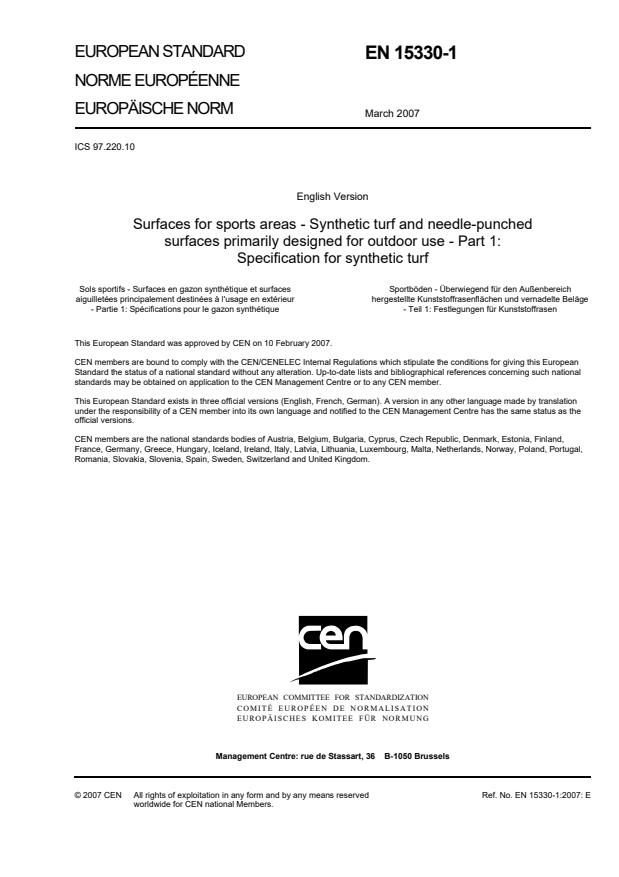
EUROPEAN STANDARDNORME EUROPÉENNEEUROPÄISCHE NORMEN 15330-1March 2007ICS 97.220.10 English VersionSurfaces for sports areas - Synthetic turf and needle-punchedsurfaces primarily designed for outdoor use - Part 1:Specification for synthetic turfSols sportifs - Surfaces en gazon synthétique et surfacesaiguilletées principalement destinées à l'usage en extérieur- Partie 1: Spécifications pour le gazon synthétiqueSportböden - Überwiegend für den Außenbereichhergestellte Kunststoffrasenflächen und vernadelte Beläge- Teil 1: Festlegungen für KunststoffrasenThis European Standard was approved by CEN on 10 February 2007.CEN members are bound to comply with the CEN/CENELEC Internal Regulations which stipulate the conditions for giving this EuropeanStandard the status of a national standard without any alteration. Up-to-date lists and bibliographical references concerning such nationalstandards may be obtained on application to the CEN Management Centre or to any CEN member.This European Standard exists in three official versions (English, French, German). A version in any other language made by translationunder the responsibility of a CEN member into its own language and notified to the CEN Management Centre has the same status as theofficial versions.CEN members are the national standards bodies of Austria, Belgium, Bulgaria, Cyprus, Czech Republic, Denmark, Estonia, Finland,France, Germany, Greece, Hungary, Iceland, Ireland, Italy, Latvia, Lithuania, Luxembourg, Malta, Netherlands, Norway, Poland, Portugal,Romania, Slovakia, Slovenia, Spain, Sweden, Switzerland and United Kingdom.EUROPEAN COMMITTEE FOR STANDARDIZATIONCOMITÉ EUROPÉEN DE NORMALISATIONEUROPÄISCHES KOMITEE FÜR NORMUNGManagement Centre: rue de Stassart, 36
B-1050 Brussels© 2007 CENAll rights of exploitation in any form and by any means reservedworldwide for CEN national Members.Ref. No. EN 15330-1:2007: E
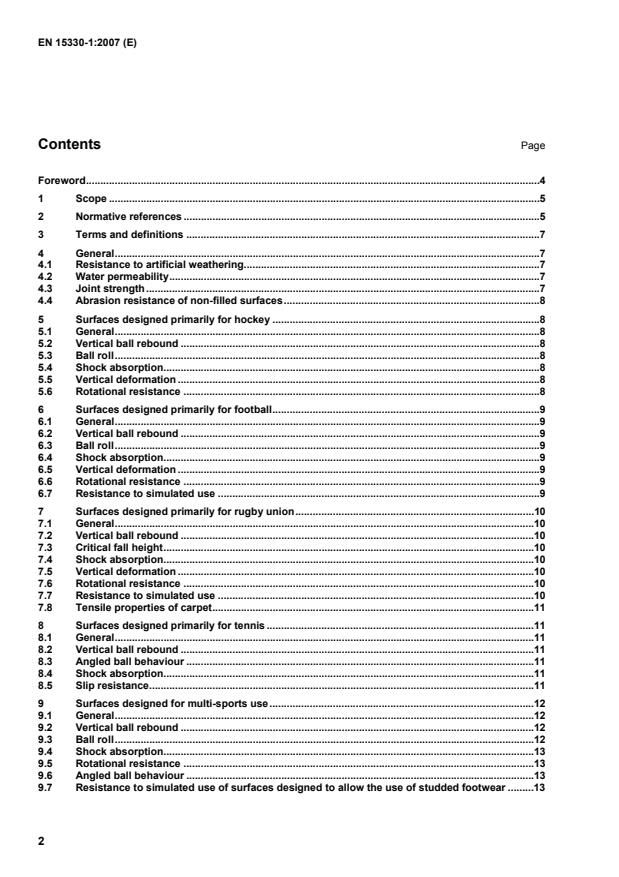
Site tests.15 A.1 General.15 A.2 Hockey pitches.16 A.3 Football pitches.17 A.4 Combined hockey and football pitches.18 A.5 Rugby pitches.18 A.6 Tennis courts.19 Annex B (informative)
Surfaces for multi-sports use.21 Annex C (normative)
Preparation of wet test pieces.26 Annex D (informative)
Ball rebound.27 Annex E (normative)
Information to be supplied by the manufacturer or supplier regarding maintenance.28 Annex F (normative)
Product identification.29 Annex G (normative)
Surface regularity.30 Bibliography.31
Part 1: Specification for synthetic turf
Part 2: Specification for needle-punched surfaces According to the CEN/CENELEC Internal Regulations, the national standards organizations of the following countries are bound to implement this European Standard: Austria, Belgium, Bulgaria, Cyprus, Czech Republic, Denmark, Estonia, Finland, France, Germany, Greece, Hungary, Iceland, Ireland, Italy, Latvia, Lithuania, Luxembourg, Malta, Netherlands, Norway, Poland, Portugal, Romania, Slovakia, Slovenia, Spain, Sweden, Switzerland and United Kingdom.
1 Scope This European Standard specifies performance and durability characteristics for synthetic turf sports surfaces used primarily outdoors. Five categories of surface are covered, each based on the principal sporting use of the surface, as follows: surfaces designed primarily for hockey; surfaces designed primarily for association football; surfaces designed primarily for rugby union for training purposes;
NOTE Under the Laws of the Game of Rugby Union, surfaces for rugby union matches have to comply with IRB Regulation 22. surfaces designed primarily for tennis; and surfaces designed for multi-sports use. The requirements are intended to apply to surfaces used for community, educational and recreational sport. For professional and elite levels of competition, many sports governing bodies have published their own specifications; the requirements of the sports governing bodies might differ from those detailed in this European Standard and facility developers are advised to ensure that they select surfaces offering the correct level of performance for the level of competition played on the pitch or court. This European Standard is based on type approval testing of products in the laboratory. Selected requirements may also be used on site to assess the suitability of installed surfaces. Guidance on the testing of installations is given in Annex A. Some of the surfaces covered by this European Standard are designed to allow users to wear footwear fitted with studs. An example of a typical stud is given in EN 15306.
For the purposes of this European Standard, multi-dimpled shoe profiles often found on footwear used on sand-filled or non-filled synthetic turfs are not considered to be studs.
2 Normative references The following referenced documents are indispensable for the application of this document. For dated references, only the edition cited applies. For undated references, the latest edition of the referenced document (including any amendments) applies. EN 430, Resilient floor coverings – Determination of mass per unit area EN 933-1, Tests for geometrical properties of aggregates – Part 1: Determination of particle size distribution – Sieving method EN 1097-3, Tests for mechanical and physical properties of aggregates – Part 3: Determination of loose bulk density and voids EN 1177, Impact absorbing playground surfacing – Safety requirements and test methods EN 1969, Surfaces for sports areas – Determination of thickness of synthetic sports surfaces EN 12230, Surfaces for sports areas – Determination of tensile properties of synthetic sports surfaces
EN 14808, Surfaces for sports areas – Determination of shock absorption EN 14809, Surfaces for sports areas – Determination of vertical deformation EN 14836, Synthetic surfaces for outdoor sports areas - Exposure to artificial weathering EN 14955, Surfaces for sports areas – Determination of composition and particle shape of unbound mineral surfaces for outdoor sports areas EN 15301-1, Surfaces for sports areas – Part 1: Determination of rotational resistance EN 15306, Surfaces for outdoor sports areas — Exposure of synthetic turf to simulated wear EN 20105-A02, Textiles – Tests for colour fastness – Part A02: Grey scale for assessing change in colour (ISO 105-A02:1993) EN ISO 13934-1, Textiles – Tensile properties of fabrics – Part 1: Determination of maximum force and elongation at maximum force using the strip method (ISO 13934-1:1999) ISO 48, Rubber, vulcanized or thermoplastic – Determination of hardness (hardness between 10 IRHD and 100 IRHD) ISO 1763, Carpets – Determination of number of tufts and/or loops per unit length and per unit area ISO 2549, Textile floor coverings – Hand-knotted carpets – Determination of tuft leg length above the woven ground ISO 4919, Textile floor coverings – Determination of tuft withdrawal force ISO 8543, Textile floor coverings – Methods for determination of mass ISO 11357-3, Plastics – Differential scanning calorimetry (DSC) – Part 3: Determination of temperature and enthalpy of melting and crystallization
synthetic turf surface sports surface comprised of a carpet of tufted, knitted or woven construction whose pile is designed to replicate the appearance of natural grass
NOTE not necessarily in colour 3.2
non-filled synthetic turf synthetic turf surface that does not contain any form of unbound particulate fill within the pile of the carpet 3.3
filled synthetic turf synthetic turf surface whose pile is either totally filled or partly filled with an unbound particulate material
NOTE typically sand, rubber or sand and rubber mixes 3.4
surface for multi-sports
synthetic turf surface designed to be used for more than one sport
NOTE For further information see Annex B. 4 General 4.1 Resistance to artificial weathering 4.1.1 Colour fastness When tested in accordance with EN 20105-A02 following artificial weathering in accordance with EN 14836, the change in colour of the weathered synthetic turf compared with an unaged test specimen of the synthetic turf shall be Grey Scale 4 or greater. 4.1.2 Tensile strength When tested in accordance with EN 13864 following artificial weathering in accordance with EN 14836, the tensile strength of the pile yarn(s) used to form the synthetic turf pile shall be within 50 % of the tensile strength of the unaged yarn. 4.2 Water permeability When tested in accordance with EN 12616, the water infiltration rate of surfaces designed to be permeable shall be equal to or greater than 180 mm/h. 4.3 Joint strength 4.3.1 Stitched joints When tested in accordance with Method 1 of EN 12228:2002, following immersion in hot water in accordance with EN 13744, the strength of stitched joints shall be equal to or greater than 1 000 N/100 mm.
...