


EN 13369:2001
(Main)Common rules for precast concrete products
Common rules for precast concrete products
This European Standard specifies the terminology, requirements, basic performance criteria, test methods and evaluation of conformity that will be referred to by specific product standards unless they are not appropriate. It may also be used to specify products for which there is no standard. Not all of the requirements (clause 4) of this standard are relevant to all precast products.
If a specific precast concrete product standard exists it takes precedence over this standard.
The precast products dealt with in this standard are factory produced for buildings and civil engineering works. This standard may also be applied to products manufactured in temporary plants on site if the production is protected against adverse weather conditions and controlled following clause 6 provisions.
The analysis and design of precast concrete products is not within the scope of this standard but it does offer information about :
- the choice of partial safety factors defined by the Eurocode;
- the rules for applying calculations to high strength concrete ;
- the definition of requirements for prestressed concrete products.
This standard applies to concrete compacted so as to retain no appreciable amount of entrapped air other than entrained air and with a dry density equal to or greater than 800 kg/m3.
Allgemeine Regeln für Betonfertigteile
Anwendungsbereich
Diese Europäische Norm legt Begriffe, Anforderungen, grundlegende Leistungskriterien, Prüfverfahren
sowie Verfahren zur Konformitätsbewertung fest, auf die in speziellen Produktnormen Bezug zu nehmen
ist, sofern diese geeignet sind. Diese Norm kann auch für spezielle Produkte, für die es keine Produkt-
norm gibt, verwendet werden. Nicht alle Anforderungen dieser Norm (Abschnitt 4) sind für sämtliche
Betonfertigteile zutreffend.
Wenn eine spezielle Produktnorm für ein Betonfertigteil vorliegt, hat sie Vorrang gegenüber dieser Norm.
Die in der vorliegenden Norm behandelten Betonfertigteile sind werkmäßig hergestellte Teile für den
Hoch- und Ingenieurbau. Diese Norm kann auch für Produkte angewendet werden, die in temporären
Anlagen auf der Baustelle hergestellt werden, wenn die Herstellung gegen ungünstige Witterungs-
einflüsse geschützt ist und nach den Festlegungen in Abschnitt 6 kontrolliert wird.
Die Berechnung und Bemessung von Betonfertigteilen gehören nicht zum Anwendungsbereich der vor-
liegenden Norm. Es werden jedoch Informationen gegeben zu:
- Auswahl der Teilsicherheitsbeiwerte, die im Eurocode festgelegt sind;
- Regeln für die Durchführung von Berechnungen für hochfesten Beton;
- Festlegung der Anforderungen für vorgespannte Betonfertigteile.
Diese Norm gilt für Beton, der so verdichtet wurde, dass er außer den Luftporen keine nennenswerten
Lufteinschlüsse und eine Trockenrohdichte von U 800 kg=m 3 aufweist.
EN 13369:2001 (D)
Règles communes pour les produits préfabriqués en béton
La présente Norme indique la terminologie, les prescriptions, les critères relatifs aux performances de base, les méthodes de vérification et d'évaluation de la conformité qui doivent servir aux normes de produits spécifiques sauf si elles ne sont pas appropriées. Elle peut aussi être utilisée pour spécifier des produits pour lesquels il n'existe pas de norme. Les prescriptions (chapitre 4) de la norme ne sont pas toutes applicables à l'ensemble des produits préfabriqués en béton.
Si une norme spécifique pour un produit préfabriqué en béton existe déjà, elle a priorité sur la présente norme.
Les produits préfabriqués considérés dans la présente norme sont fabriqués en usine et destinés à des bâtiments ou des ouvrages de génie civil. La présente norme peut également être appliquée à des éléments fabriqués dans des usines temporaires sur un chantier, si la fabrication est protégée contre les conditions environnementales néfastes et contrôlée suivant les exigences du chapitre 6.
L'analyse et la conception de produits préfabriqués en béton ne sont pas inclus dans cette norme mais elle donne des informations sur :
- le choix de coefficients de sécurité partiels définis par l'Eurocode ;
- les règles à appliquer pour les calculs concernant le béton à haute résistance ;
- la définition de prescriptions pour les produits en béton précontraint.
La présente norme s'applique au béton de densité sèche égale ou supérieure à 800 kg/m3, compacté de manière à ne pas retenir une quantité significative d'air autre que l'air occlus.
Skupna pravila za betonske izdelke
General Information
- Status
- Withdrawn
- Publication Date
- 31-Jul-2001
- Withdrawal Date
- 08-Jun-2004
- Technical Committee
- CEN/TC 229 - Precast concrete products
- Current Stage
- 9960 - Withdrawal effective - Withdrawal
- Start Date
- 09-Jun-2004
- Completion Date
- 09-Jun-2004
- Directive
- 89/106/EEC - Construction products
Relations
- Effective Date
- 22-Dec-2008
- Effective Date
- 28-Jan-2026
- Referred By
EN 14215:2003 - Textile floor coverings - Classification of machine-made pile rugs and runners - Effective Date
- 28-Jan-2026
- Effective Date
- 28-Jan-2026
- Effective Date
- 28-Jan-2026

Get Certified
Connect with accredited certification bodies for this standard

ICC Evaluation Service
Building products evaluation and certification.

QAI Laboratories
Building and construction product testing and certification.

Aboma Certification B.V.
Specialized in construction, metal, and transport sectors.
Sponsored listings
Frequently Asked Questions
EN 13369:2001 is a standard published by the European Committee for Standardization (CEN). Its full title is "Common rules for precast concrete products". This standard covers: This European Standard specifies the terminology, requirements, basic performance criteria, test methods and evaluation of conformity that will be referred to by specific product standards unless they are not appropriate. It may also be used to specify products for which there is no standard. Not all of the requirements (clause 4) of this standard are relevant to all precast products. If a specific precast concrete product standard exists it takes precedence over this standard. The precast products dealt with in this standard are factory produced for buildings and civil engineering works. This standard may also be applied to products manufactured in temporary plants on site if the production is protected against adverse weather conditions and controlled following clause 6 provisions. The analysis and design of precast concrete products is not within the scope of this standard but it does offer information about : - the choice of partial safety factors defined by the Eurocode; - the rules for applying calculations to high strength concrete ; - the definition of requirements for prestressed concrete products. This standard applies to concrete compacted so as to retain no appreciable amount of entrapped air other than entrained air and with a dry density equal to or greater than 800 kg/m3.
This European Standard specifies the terminology, requirements, basic performance criteria, test methods and evaluation of conformity that will be referred to by specific product standards unless they are not appropriate. It may also be used to specify products for which there is no standard. Not all of the requirements (clause 4) of this standard are relevant to all precast products. If a specific precast concrete product standard exists it takes precedence over this standard. The precast products dealt with in this standard are factory produced for buildings and civil engineering works. This standard may also be applied to products manufactured in temporary plants on site if the production is protected against adverse weather conditions and controlled following clause 6 provisions. The analysis and design of precast concrete products is not within the scope of this standard but it does offer information about : - the choice of partial safety factors defined by the Eurocode; - the rules for applying calculations to high strength concrete ; - the definition of requirements for prestressed concrete products. This standard applies to concrete compacted so as to retain no appreciable amount of entrapped air other than entrained air and with a dry density equal to or greater than 800 kg/m3.
EN 13369:2001 is classified under the following ICS (International Classification for Standards) categories: 91.100.30 - Concrete and concrete products. The ICS classification helps identify the subject area and facilitates finding related standards.
EN 13369:2001 has the following relationships with other standards: It is inter standard links to EN 13369:2004, EN 13748-1:2004, EN 14215:2003, EN 13198:2003, EN 15330-1:2007. Understanding these relationships helps ensure you are using the most current and applicable version of the standard.
EN 13369:2001 is associated with the following European legislation: EU Directives/Regulations: 305/2011, 89/106/EEC. When a standard is cited in the Official Journal of the European Union, products manufactured in conformity with it benefit from a presumption of conformity with the essential requirements of the corresponding EU directive or regulation.
EN 13369:2001 is available in PDF format for immediate download after purchase. The document can be added to your cart and obtained through the secure checkout process. Digital delivery ensures instant access to the complete standard document.
Standards Content (Sample)
2003-01.Slovenski inštitut za standardizacijo. Razmnoževanje celote ali delov tega standarda ni dovoljeno.Skupna pravila za betonske izdelkeAllgemeine Regeln für BetonfertigteileRegles communes pour les produits préfabriqués en bétonCommon rules for precast concrete products91.100.30Beton in betonski izdelkiConcrete and concrete productsICS:Ta slovenski standard je istoveten z:EN 13369:2001SIST EN 13369:2002en01-september-2002SIST EN 13369:2002SLOVENSKI
STANDARD
EUROPEAN STANDARDNORME EUROPÉENNEEUROPÄISCHE NORMEN 13369August 2001ICS 91.100.30English versionCommon rules for precast concrete productsRègles communes pour les produits préfabriqués en bétonAllgemeine Regeln für BetonfertigteileThis European Standard was approved by CEN on 24 December 2000.CEN members are bound to comply with the CEN/CENELEC Internal Regulations which stipulate the conditions for giving this EuropeanStandard the status of a national standard without any alteration. Up-to-date lists and bibliographical references concerning such nationalstandards may be obtained on application to the Management Centre or to any CEN member.This European Standard exists in three official versions (English, French, German). A version in any other language made by translationunder the responsibility of a CEN member into its own language and notified to the Management Centre has the same status as the officialversions.CEN members are the national standards bodies of Austria, Belgium, Czech Republic, Denmark, Finland, France, Germany, Greece,Iceland, Ireland, Italy, Luxembourg, Netherlands, Norway, Portugal, Spain, Sweden, Switzerland and United Kingdom.EUROPEAN COMMITTEE FOR STANDARDIZATIONCOMITÉ EUROPÉEN DE NORMALISATIONEUROPÄISCHES KOMITEE FÜR NORMUNGManagement Centre: rue de Stassart, 36
B-1050 Brussels© 2001 CENAll rights of exploitation in any form and by any means reservedworldwide for CEN national Members.Ref. No. EN 13369:2001 ESIST EN 13369:2002
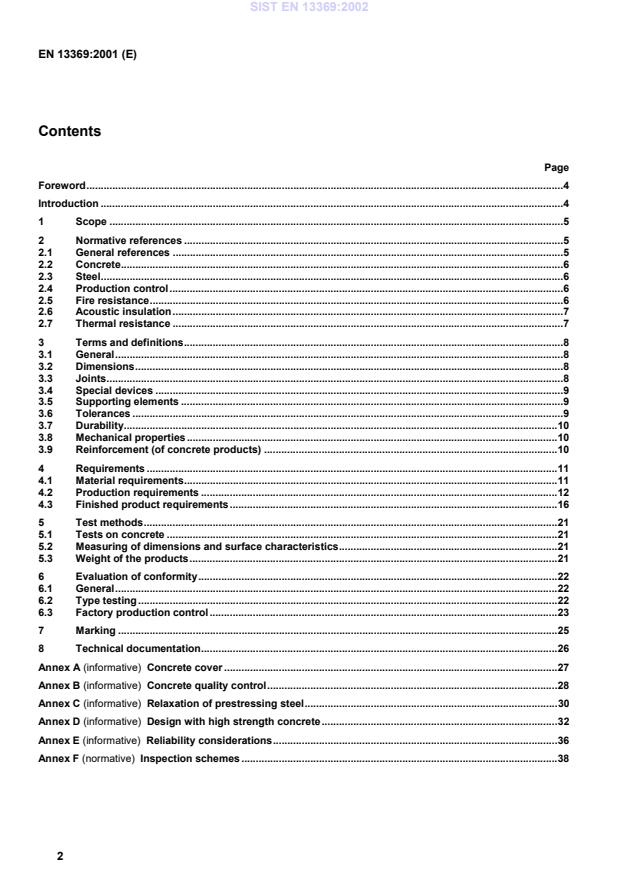
Concrete cover.27Annex B (informative)
Concrete quality control.28Annex C (informative)
Relaxation of prestressing steel.30Annex D (informative)
Design with high strength concrete.32Annex E (informative)
Reliability considerations.36Annex F (normative)
Inspection schemes.38SIST EN 13369:2002
Assessment of compliance by a third party.46Annex H (informative)
Acceptance testing of a consignment at delivery.48Annex J (informative)
Test of water absorption.49Annex K (informative)
Shape correlation factors for specimens and cores.51Annex L (informative)
Measurement of dimensions.52Annex M
(informative)
Prestressing losses.55Annex N (informative)
Tables of thermal conductivity of concrete.58Annex O (informative)
Technical documentation.60Bibliography.61SIST EN 13369:2002
1)Presently under preparation.SIST EN 13369:2002
products of medium and low thermalresistance.EN ISO 6946, Building components and building elements - Thermal resistance and thermal transmittance -Calculation method (ISO 6946:1996).EN ISO 8990, Thermal insulation - Determination of steady-state thermal transmission properties - Calibrated andguarded hot box (ISO 8990:1994).EN ISO 10456:1999, Building materials and products - Procedures for determining declared and design thermalvalues (ISO 10456:1999).
2)Presently under preparation.SIST EN 13369:2002
3) Presently under preparation.SIST EN 13369:2002
85 °C ;- When T > 70 °C initial tests shall have demonstrated that the required strengthis fulfilled at 90 days ;- When T > 85 °C suitability of higher temperature treatment than 85 °C shallhave been demonstrated by long term positive experience with the durability ofthe concrete under the specified environment.All classeswhen wet and cyclic-wet- T
65 °C.- When T > 65 °C suitability of higher temperature treatment than 65 °C shallhave been demonstrated by long term experience with the durability of theconcrete under the specified environment ;In case of no long term positive experience, the suitability of the highertemperature treatment shall be demonstrated, the following limits b may be abasis for this demonstration (concrete: Na2Oeq
3,5 kg/m3, cement : SO3content
3,5 %).aT is the mean maximum temperature within the concrete, individual values may be 5 °C higher.bThe limits for Na2Oeq and SO3 content, may be changed in value or to limitation for other constituents according to theresults of scientific or technical experience; the latest knowledge should be taken into account for the product standards.4.2.2 Hardened concrete4.2.2.1 Strength classesFor compressive strength classes of concrete 4.3.1 of EN 206-1:2000 applies. For design purposes the propertiesof concrete strength classes up to C50/60 are given in Table 3.1 of ENV 1992-1-1:1991. Table 3.101 of ENV 1992-1-3:1994 gives the properties for the classes C55/67 and C60/75. Conditions for use of classes C70/85 and C80/95are given in 4.3.3.1.The producer can select intermediate classes, in 1,0 N/mm2 steps of the characteristic cylinder strength. In thiscase the concrete properties are obtained by linear interpolation.For reinforced or prestressed precast products the minimum grade of concrete shall be : C20/25 for reinforced products ; C30/37 for prestressed products.4.2.2.2 Compressive strengthThe compressive strength to verify the class of concrete is determined from the potential strength; the manufacturermay alternatively use direct structural strength or indirect structural strength at his discretion.4.2.2.2.1 Potential strengthThe compressive potential strength of concrete is tested at 28 days. Supplementary tests of early strengths may bemade before 28 days, when required by special operations of the production process (prestressing, demoulding,lifting, .).The manufacturer may perform tests of compressive potential strength before 28 days.For determination of potential strength EN 206-1:2000, 5.5.1.1 and 5.5.1.2 apply. 5.1.1 of this standard givesadditional requirements.SIST EN 13369:2002
= 0,85 which is included in part of the value of the safety factor c given in ENV 1992-1-3, for the fundamental combination (see also annex E).When tested structural strength is used, comparison with the required strength class is made multiplying the testvalue by 1/.4.2.3 Structural reinforcement4.2.3.1 Processing of reinforcing steelReinforcing steel for structural purposes that is straightened or welded in the factory shall remain in compliancewith 4.1.1 after this treatment.Welded connection of reinforcing bars may only be used when the weldability of the steel is fully documented.4.2.3.2 Tensioning and prestressing4.2.3.2.1 Initial tensioning stressesThe maximum tensioning stress Omax applied to a tendon immediately after release shall satisfy the followingconditions : absence of uncontrolled longitudinal cracking, spalling, bursting of the concrete ; the stress in the concrete does not lead to excessive loss of prestress or deformation of the product.When the manufacturer demonstrates compliance of the product with the relevant requirements of the productstandard by initial type testing and factory production control, the maximum value of Omax can be taken as :Omax = min (0,85 fpk; 0,95 fp0,1k)(in accordance with 4.2.3.5.4 of ENV 1992-1-3:1994)If the conditions mentioned in the previous paragraph are not met, 4.2.3.5.4 of ENV 1992-1-1:1991 shall apply :Omax = min (0,80 fpk; 0,90 fp0,1k)SIST EN 13369:2002
5 %.4.2.3.2.3 Minimum concrete strength at transferAt transfer of the prestress force, the concrete shall have a minimum structural strength fcm,p of 1,5 times themaximum compressive stress in the concrete and not less than 25 N/mm2.4.2.3.2.4 Slippage of tendonsSlippage, which is the shortening of the tendon after transfer of the prestress force, shall be limited to the followingvalues : for individual tendons (strands or wires) : 1,3 L ; for the mean value of all tendons in an element : L.For strands the average value of three diametrically positioned wires shall be taken into account.The value of L, in millimetres, shall be calculated from :L = 0,4 lbpd ppmoE where :lbpdis the upper bound value of transmission length = 1,2 lbp, in millimetres ;pmois the initial stress in the prestressing steel just immediately after release, in newtons per squaremillimetre ;Epis the modulus of elasticity of the prestressing steel, in newtons per square millimetre.4.3 Finished product requirements4.3.1 Geometrical properties4.3.1.1 Production tolerancesValues for tolerances may be specified in the project specifications or taken from specific product standards. Ifsuch information is not available, the following production tolerances may be assumed for structural purposes. Forother aspects than structural strength different tolerances may be specified.For cross-sectional dimensions L the permitted deviation is L, and for position of reinforcing steel, prestressingsteel and for the design cover c the permitted deviation is c.SIST EN 13369:2002
Permitted deviations of cross-sections.Target dimension of the cross-section in the direction to be checkedL (mm)c (mm)L
150 mm+ 10 5 5L = 400 mm 15+ 15 10L
2500 mm 30+ 30 10Linear interpolation for intermediate values.NOTE 1L and the positive values for c (upper permitted deviation) are given to ensure that deviations incross-sectional dimensions and in the position of the reinforcement do not exceed values covered by therelevant safety factors in the Eurocodes.NOTE 2The negative values for c (lower permitted deviation) are given for durability purposes.NOTE 3The given values are recommendations, and may be modified depending on the product andproduction process.The upper permitted deviation for the location of the reinforcement may be determined as the mean value of thebars or strands in a cross-section over a width of 1 m (e.g. slabs and walls).The design cover c of the reinforcement shall be at least the minimum cover cmin plus the lower permitted deviationc.For principal dimensions other than cross-sectional dimensions :L =
(10 + L / 1 000)
40 mmwhere :Lis the target size of the linear measure.4.3.1.2 Minimum dimensionsThe geometrical characteristics of precast structural products shall comply with the required minimum dimensions.The values of the minimum dimensions shall be taken from relevant clauses of ENV 1992-1-1 and ENV 1992-1-3.These values may be reduced provided there is fully documented justification for the use of smaller values.4.3.2 Surface characteristicsFor the specification of the surface characteristics of a finished product, reference shall be made to L.4.4.3.3 Mechanical resistance4.3.3.1 GeneralAll relevant structural properties of the product shall be considered in both ultimate and serviceability limit states.Design with concrete strength classes above C50/60 may be done in accordance to the rules valid in the place ofuse of the product or following informative annex D.For prestressing losses, reference may be made to informative annex M, in cases specified in that annex.NOTEActions and safety factors for actions are subject to national regulations or other rules valid in the place of use of theproduct. Design loads are assumed to be given values, depending on the intended use of the product.SIST EN 13369:2002
...
Questions, Comments and Discussion
Ask us and Technical Secretary will try to provide an answer. You can facilitate discussion about the standard in here.
Loading comments...