

EN 15459-1:2017
(Main)Energy performance of buildings - Economic evaluation procedure for energy systems in buildings - Part 1: Calculation procedures, Module M1-14
- Abstract
This European Standard provides a calculation method for the economic issues of heating systems and other systems that are involved in the energy demand and consumption of the building. It applies to all types of new and existing buildings.
The fundamental principles and terminology are explained in the standard.
The main items of the standard will be:
- the definitions and the structure of the types of costs which should be taken into account for the calculation of the economic efficiency of saving options in buildings;
- data needed for definition of costs related to systems under consideration;
- the calculation method(s);
- expression of the result of the economic study.
This European Standard is part of the method for calculation of economic performance of energy saving options in buildings (e.g. insulation, better performing generators and distribution systems, efficient lighting, renewable sources, combined heat and power...).
The scope of this specific part is to standardize:
- the required inputs;
- the required outputs;
- the calculation formulas;
- the type of energy systems concerned with the energy performance of the building.
NOTE 1 This is the revision of EN 15459:2007. The revision has been made consistent with the EU regulation on cost-optimal. This revision includes the definition of payback for investment, and inclusion of the costs due to the deconstruction of the building. The method presenting annualized costs has been suppressed.
NOTE 2 This standard does not consider financial advantages for higher productivity, higher attractiveness for tenants due to higher indoor comfort, when relevant for comparison of different options.
Table 1 shows the relative position of this standard within the set of EPB standards in the context of the modular structure as set out in EN ISO 52000-1.
NOTE 3 In CEN ISO/TR 52000-2 the same table can be found, with, for each module, the numbers of the relevant EPB standards and accompanying technical reports that are published or in preparation.
NOTE 4 The modules represent EPB standards, although one EPB standard may cover more than one module and one module may be covered by more than one EPB standard, for instance a simplified and a detailed method respectively. See also Clause 2 and Tables A.1 and B.1.
(...)
- Status
- Published
- Publication Date
- 30-May-2017
- Withdrawal Date
- 29-Nov-2017
- Technical Committee
- CEN/TC 228 - Heating systems in buildings
- Current Stage
- 9060 - Closure of 2 Year Review Enquiry - Review Enquiry
- Start Date
- 02-Dec-2022
- Completion Date
- 02-Dec-2022

Overview - EN 15459-1:2017 (Module M1-14)
EN 15459-1:2017, published by CEN, defines a standardized economic evaluation procedure for energy systems in buildings (Module M1-14). The standard applies to all new and existing buildings and provides calculation procedures for assessing the economic performance of heating and other systems that affect building energy demand and consumption. This part standardizes required inputs, outputs and calculation formulas and is aligned with the EU cost-optimal framework. It supersedes EN 15459:2007 and introduces payback definitions and end-of-life / deconstruction costs (the annualized-cost method was removed).
Key topics and technical requirements
- Scope & terminology: Fundamental principles, definitions and the modular position within the EPB (Energy Performance of Buildings) standards.
- Cost structure: Clear breakdown of initial costs, annual costs, and final costs to be included in economic evaluations.
- Economic parameters: Use of discount rate / present value factors, and other financial inputs required for present-value calculations.
- Calculation method: Step-by-step procedure covering financial/project data, component and system costs (investment, replacement), energy costs, global cost calculation, and payback period computation.
- Inputs and outputs: Normative templates in Annex A (required inputs) and informative default choices in Annex B.
- Quality control & reporting: Requirements for calculation reporting and for comparing different retrofit or design options.
- Limitations: Non-financial benefits such as increased productivity or tenant attractiveness from improved comfort are explicitly excluded.
Practical applications and users
EN 15459-1:2017 is intended for professionals and stakeholders involved in building energy and economic assessments:
- Energy consultants and assessors performing cost-optimal or life-cycle economic studies
- Building services engineers evaluating heating, distribution and renewable integration options
- Architects and designers comparing envelope vs. system trade-offs
- Policy makers and regulators implementing national/regional annexes to meet EU directives
- Facility managers and developers planning investments, replacements or decommissioning
Use cases include economic feasibility of insulation, efficient generators, lighting upgrades, renewable systems, CHP integration, and retrofit decision-making.
Related standards
- EN 15603 - methods for building energy demand (referenced for energy calculations)
- EN ISO 52000-1 - modular EPB structure context
- CEN/TR 15459-2 - explanation and justification accompanying EN 15459-1
- EN 15459:2007 - superseded by this revision
Keywords: EN 15459-1:2017, energy performance of buildings, economic evaluation, payback, cost-optimal, heating systems, EPB standards, CEN.
Relations
- Effective Date
- 07-Jun-2017
- Effective Date
- 28-Jan-2026
- Effective Date
- 28-Jan-2026
Get Certified
Connect with accredited certification bodies for this standard

DIBt (Deutsches Institut für Bautechnik)
German Institute for Building Technology.
DIN CERTCO
DIN Group product certification.

Aboma Certification B.V.
Specialized in construction, metal, and transport sectors.
Sponsored listings
Frequently Asked Questions
EN 15459-1:2017 is a standard published by the European Committee for Standardization (CEN). Its full title is "Energy performance of buildings - Economic evaluation procedure for energy systems in buildings - Part 1: Calculation procedures, Module M1-14". This standard covers: This European Standard provides a calculation method for the economic issues of heating systems and other systems that are involved in the energy demand and consumption of the building. It applies to all types of new and existing buildings. The fundamental principles and terminology are explained in the standard. The main items of the standard will be: - the definitions and the structure of the types of costs which should be taken into account for the calculation of the economic efficiency of saving options in buildings; - data needed for definition of costs related to systems under consideration; - the calculation method(s); - expression of the result of the economic study. This European Standard is part of the method for calculation of economic performance of energy saving options in buildings (e.g. insulation, better performing generators and distribution systems, efficient lighting, renewable sources, combined heat and power...). The scope of this specific part is to standardize: - the required inputs; - the required outputs; - the calculation formulas; - the type of energy systems concerned with the energy performance of the building. NOTE 1 This is the revision of EN 15459:2007. The revision has been made consistent with the EU regulation on cost-optimal. This revision includes the definition of payback for investment, and inclusion of the costs due to the deconstruction of the building. The method presenting annualized costs has been suppressed. NOTE 2 This standard does not consider financial advantages for higher productivity, higher attractiveness for tenants due to higher indoor comfort, when relevant for comparison of different options. Table 1 shows the relative position of this standard within the set of EPB standards in the context of the modular structure as set out in EN ISO 52000-1. NOTE 3 In CEN ISO/TR 52000-2 the same table can be found, with, for each module, the numbers of the relevant EPB standards and accompanying technical reports that are published or in preparation. NOTE 4 The modules represent EPB standards, although one EPB standard may cover more than one module and one module may be covered by more than one EPB standard, for instance a simplified and a detailed method respectively. See also Clause 2 and Tables A.1 and B.1. (...)
This European Standard provides a calculation method for the economic issues of heating systems and other systems that are involved in the energy demand and consumption of the building. It applies to all types of new and existing buildings. The fundamental principles and terminology are explained in the standard. The main items of the standard will be: - the definitions and the structure of the types of costs which should be taken into account for the calculation of the economic efficiency of saving options in buildings; - data needed for definition of costs related to systems under consideration; - the calculation method(s); - expression of the result of the economic study. This European Standard is part of the method for calculation of economic performance of energy saving options in buildings (e.g. insulation, better performing generators and distribution systems, efficient lighting, renewable sources, combined heat and power...). The scope of this specific part is to standardize: - the required inputs; - the required outputs; - the calculation formulas; - the type of energy systems concerned with the energy performance of the building. NOTE 1 This is the revision of EN 15459:2007. The revision has been made consistent with the EU regulation on cost-optimal. This revision includes the definition of payback for investment, and inclusion of the costs due to the deconstruction of the building. The method presenting annualized costs has been suppressed. NOTE 2 This standard does not consider financial advantages for higher productivity, higher attractiveness for tenants due to higher indoor comfort, when relevant for comparison of different options. Table 1 shows the relative position of this standard within the set of EPB standards in the context of the modular structure as set out in EN ISO 52000-1. NOTE 3 In CEN ISO/TR 52000-2 the same table can be found, with, for each module, the numbers of the relevant EPB standards and accompanying technical reports that are published or in preparation. NOTE 4 The modules represent EPB standards, although one EPB standard may cover more than one module and one module may be covered by more than one EPB standard, for instance a simplified and a detailed method respectively. See also Clause 2 and Tables A.1 and B.1. (...)
EN 15459-1:2017 is classified under the following ICS (International Classification for Standards) categories: 91.140.10 - Central heating systems. The ICS classification helps identify the subject area and facilitates finding related standards.
EN 15459-1:2017 has the following relationships with other standards: It is inter standard links to EN 15459:2007, EN ISO 7345:1995, CEN/TR 15459-2:2017. Understanding these relationships helps ensure you are using the most current and applicable version of the standard.
EN 15459-1:2017 is associated with the following European legislation: EU Directives/Regulations: 2010/31/EU; Standardization Mandates: M/480. When a standard is cited in the Official Journal of the European Union, products manufactured in conformity with it benefit from a presumption of conformity with the essential requirements of the corresponding EU directive or regulation.
EN 15459-1:2017 is available in PDF format for immediate download after purchase. The document can be added to your cart and obtained through the secure checkout process. Digital delivery ensures instant access to the complete standard document.
Standards Content (Sample)
2003-01.Slovenski inštitut za standardizacijo. Razmnoževanje celote ali delov tega standarda ni dovoljeno.UJLMVNLKEnergetische Bewertung von Gebäuden - Wirtschaftlichkeitsberechnungen für Energieanlagen in Gebäuden - Teil 1: Berechnungsverfahren, Modul M1-14Performance énergétique des bâtiments - Procédure d’évaluation économique des systèmes énergétiques des bâtiments - Partie 1 : Méthode de calcul, Module M1-14Energy performance of buildings - Economic evaluation procedure for energy systems in buildings - Part 1: Calculation procedures, Module M1-1491.140.10Sistemi centralnega ogrevanjaCentral heating systems91.120.10Toplotna izolacija stavbThermal insulation of buildings27.015VSORãQREnergy efficiency. Energy conservation in generalICS:Ta slovenski standard je istoveten z:EN 15459-1:2017SIST EN 15459-1:2018en,fr,de01-maj-2018SIST EN 15459-1:2018SLOVENSKI
STANDARDSIST EN 15459:20081DGRPHãþD
EUROPEAN STANDARD NORME EUROPÉENNE EUROPÄISCHE NORM
EN 15459-1
May
t r s y ICS
{ sä s v rä s r Supersedes EN
s w v w {ã t r r yEnglish Version
Energy performance of buildings æ Economic evaluation procedure for energy systems in buildings æ Part
sã Calculation proceduresá Module M sæ s v Performance énergétique des bâtiments æ Procédure d 5évaluation économique des systèmes énergétiques des bâtiments æ Partie
s ã Méthode de calculá Module M sæ s v
Energieeffizienz von Gebäuden æ Heizungsanlagen und wassergeführte Kühlanlagen in Gebäuden æ Teil
sã Wirtschaftlichkeitsberechnungen für Energieanlagen in Gebäudená Modul M sæ s v This European Standard was approved by CEN on
t y February
t r s yä
egulations which stipulate the conditions for giving this European Standard the status of a national standard without any alterationä Upætoædate lists and bibliographical references concerning such national standards may be obtained on application to the CENæCENELEC Management Centre or to any CEN memberä
translation under the responsibility of a CEN member into its own language and notified to the CENæCENELEC Management Centre has the same status as the official versionsä
CEN members are the national standards bodies of Austriaá Belgiumá Bulgariaá Croatiaá Cyprusá Czech Republicá Denmarká Estoniaá Finlandá Former Yugoslav Republic of Macedoniaá Franceá Germanyá Greeceá Hungaryá Icelandá Irelandá Italyá Latviaá Lithuaniaá Luxembourgá Maltaá Netherlandsá Norwayá Polandá Portugalá Romaniaá Serbiaá Slovakiaá Sloveniaá Spainá Swedená Switzerlandá Turkey and United Kingdomä
EUROPEAN COMMITTEE FOR STANDARDIZATION COMITÉ EUROPÉEN DE NORMALISATION EUROPÄISCHES KOMITEE FÜR NORMUNG
CEN-CENELEC Management Centre:
Avenue Marnix 17,
B-1000 Brussels
t r s y CEN All rights of exploitation in any form and by any means reserved worldwide for CEN national Membersä Refä Noä EN
s w v w {æ sã t r s y ESIST EN 15459-1:2018
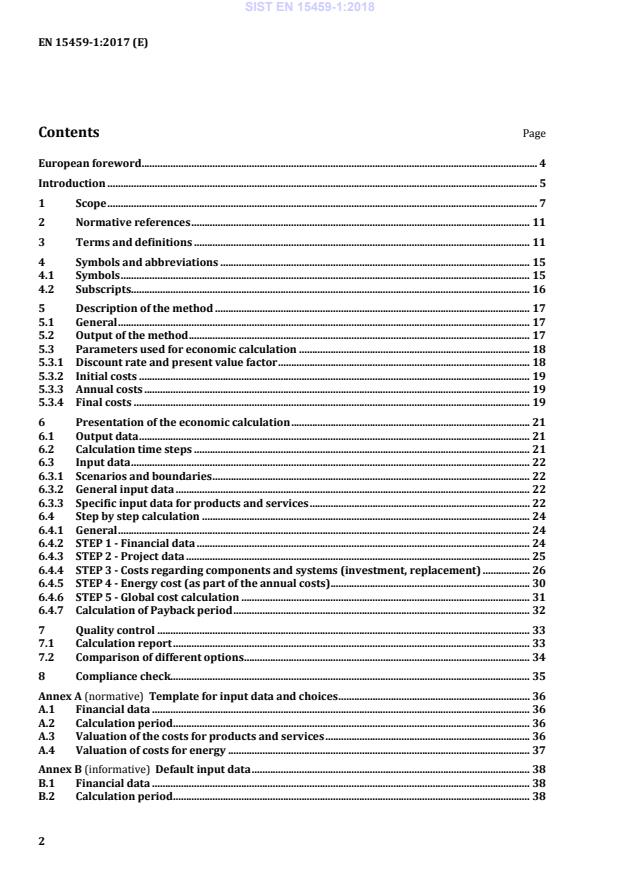
Template for input data and choices . 36 A.1 Financial data . 36 A.2 Calculation period . 36 A.3 Valuation of the costs for products and services . 36 A.4 Valuation of costs for energy . 37 Annex B (informative)
Default input data . 38 B.1 Financial data . 38 B.2 Calculation period . 38 SIST EN 15459-1:2018
Selection for methods . 41 C.1 General . 41 C.2 Selection between methods A and B . 41 Annex D (informative)
Data for components . 42 Annex E (informative)
Description of systems . 45 Bibliography . 52
Building (as such) Technical Building Systems
Descriptions
Descriptions
Descriptions Heating Cooling Ventilation Humidification Dehumidification Domestic Hot water Lighting Building automation and control Electricity production sub1
M1 sub1 M2 sub1
M3 M4 M5 M6 M7 M8 M9 M10 M11 1 General
1 General 1 General 15316–1
15316–1
2 Common terms and definitions; symbols, units and subscripts
2 Building Energy Needs 2 Needs
12831–3
3 Applications
3 (Free) Indoor Conditions without Systems 3 Maximum Load and Power 12831–1
12831–3
4 Ways to Express Energy
Performance
4 Ways to Express Energy Performance 4 Ways to Express Energy Performance 15316–1
15316–1
5 Building
Functions and Building Boundaries
5 Heat Transfer by Transmission 5 Emission and control 15316–2 15316–2
6 Building Occupancy and Operating Conditions
6 Heat Transfer by Infiltration and Ventilation 6 Distribution and control 15316–3 15316–3
15316–3
Building (as such) Technical Building Systems
Descriptions
Descriptions
Descriptions Heating Cooling Ventilation Humidification Dehumidification Domestic Hot water Lighting Building automation and control Electricity production sub1
M1 sub1 M2 sub1
M3 M4 M5 M6 M7 M8 M9 M10 M11 7 Aggregation of Energy Services and Energy Carriers
7 Internal
Heat Gains 7 Storage and control 15316–5
15316–5 15316–4–3
8 Building Partitioning
8 Solar
Heat Gains 8 Generation
8–1 Combustion boilers 15316–4–1
15316–4–1
8–2 Heat pumps 15316–4–2 15316–4–2
15316–4–2
8–3 Thermal solar Photovoltaics 15316–4–3
15316–4–3
15316–4–3
8–4 On-site cogeneration 15316–4–4
15316–4–4
15316–4–4
8–5 District heating and cooling 15316–4–5 15316–4–5
15316–4–5
8–6 Direct electrical heater 15316–4–9
15316–4–9
8–7 Wind turbines
15316–4–10
8–8 Radiant heating, stoves 15316–4–8
Building (as such) Technical Building Systems
Descriptions
Descriptions
Descriptions Heating Cooling Ventilation Humidification Dehumidification Domestic Hot water Lighting Building automation and control Electricity production sub1
M1 sub1 M2 sub1
M3 M4 M5 M6 M7 M8 M9 M10 M11 9 Calculated Energy Performance
9 Building Dynamics (thermal mass) 9 Load dispatching and operating conditions 15316–1
10 Measured
Energy
Performance
10 Measured Energy Performance 10 Measured Energy Performance 15378–3
15378–3
11 Inspection
11 Inspection 11 Inspection 15378–1
15378–1
12 Ways to Express Indoor Comfort
12 – 12 BMS
13 External Environment Conditions
14 Economic Calculation 15459–1
NOTE The shaded modules are not applicable.
Key 1 tTC calculation period (50 years for example) 2 COinv investment cost 3 COrun running costs 4 COrepl replacement costs Figure 1 — Global cost presentation SIST EN 15459-1:2018
This includes annual costs for inspection, cleaning, adjustments, repair under preventive maintenance, consumable items. 3.5 operational cost COOp cost linked to the operation of the building, including annual costs for insurance, utility charges and other standing charges and taxes 3.6 energy cost COen cost and fixed and peak charges for energy including national taxes Note 1 to entry: Conventionally, contracts for energy delivered are included in energy costs. It is considered good practice to include the external costs and metering costs in economic calculations and to specify them. 3.7 periodic costs of year i COper(i) substitute investment that is necessary for age reasons; that corresponds to cost replacement of all components (or system) according to their lifespan that occur on year i Note 1 to entry: Periodic costs include all replacement costs for any components or system that occur the same year. SIST EN 15459-1:2018
RATen _1 is the rate of development of prices for energy 1 (rate could be different depending on the energy considered) RATop is the rate of development of prices for human operation RATpr
is the rate of development of prices for products 3.13 discount rate RATdisc definite value for comparison of the value of money at different times expressed in real terms Note 1 to entry: Corresponds to the interest rate which is charged or paid for the use of money for the calculation period considered. SIST EN 15459-1:2018
Key 1 Time (a)
2 tTC calculation period (30 years for example) 3 COinv investment cost 4 COriun running costs 5 COper periodic costs (period is identical for all components or systems to be replaced) 6 VALfin residual value Figure 2 — Presentation of the final value 3.21 present value factor PVAL_f multiplying factor used for adjustment of the cost at year i to starting year of the calculation 3.22 global unitary cost GC_x cost obtained by the division of the global cost per the calculation period and the surface of the building Note 1 to entry: The definition of the surface of the building used to weight the global cost should be consistent with the one used for energy calculation or display of the performance of the building. 4 Symbols and abbreviations 4.1 Symbols For the purposes of this document, the symbols given in EN ISO 52000-1 and the specific symbols listed in Table 2 apply. SIST EN 15459-1:2018
4.2 Subscripts For the purposes of this document, the subscripts given in EN ISO 52000-1 and the specific subscripts listed in Table 3 apply. SIST EN 15459-1:2018
nEPus non EPB services INIT Initial BAC Building automation and control Inv Investment Tr Transport Ma Maintenance V Ventilation
C Cooling Op Operational XY combination of H, C, W Per Periodic DHU Dehumidification Pr Products H Heating Re Real TOT Total Rep Repair E Photovoltaic, wind Rpl Replacement W DHW Run Running HU Humidification Disp Disposal EN Energy
W Water En Energy WS Waste LC Life cycle
5 Description of the method 5.1 General This standard presents the calculation method that is used for aggregation of the past, present and future costs over a period of calculation. When this period includes the demolition of the building the disposal costs for deconstruction/demolition are also included. This calculation method is also named ‘global cost’. The time step of the output is yearly based, but can be adapted to a monthly period. 5.2 Output of the method The output of the calculation method is the value of the global cost. SIST EN 15459-1:2018
Maintenance RATma % As a percentage of the investment cost for the related product or system Products RATpr %
Hours RAThu % Different values could be used depending on purpose and skills Service RATser %
Energy RATen_1 % Different values could be used depending on the type of energy and energy provider
Costs could be annual (energy, maintenance, taxes, insurance) or periodic (replacement) depending on the lifespan of the products or the scheduled replacement for products or systems. 5.3.4 Final costs 5.3.4.1 Calculation of the residual (final) value The final value VALfin(j) of a component is determined by straight-line depreciation of the initial investment until the end of the calculation period and referred to the beginning of the calculation period (Formula (3)). If the calculation period TC exceeds the lifespan Tn(j) of the considered component (j), the last replacement cost is considered for the straight-line depreciation: SIST EN 15459-1:2018
Key 1 tTC calculation period 2 A0 initial cost 3 LS life time of the component 4 A1 net present value after 1 replacement 5 A2 net present value after 2 replacements 6 Vf net present value at the end of the calculation period 7 A’1 cost for the first replacement 8 A’2 cost for the second replacement Figure 3 — Development of value during calculation period Figure 3 illustrates such principles for products with 2 replacements during the calculation period TC. Total cost during the calculation period considered is the sum of: — initial investment A0 (value of the initial investment rises with time due to inflation rate); — cost for the first replacement ()=+10pr1'*LSAARAT SIST EN 15459-1:2018
The global cost for solution x is expressed as dependant of the time period of calculation TC. 6.2 Calculation time steps The calculation method described in Clause 7 is suitable for the following calculation time steps: — yearly; — monthly. If an input data are available with a shorter time step than the output or the calculation time step, the value or the cost is adapted in proportion with the periodic time of the specific input and the time step used for the calculation. Conventionally the values of the input data occurring during the time step of calculation are reported to the beginning of the time step of calculation without any adjustment. SIST EN 15459-1:2018
6.3.3 Specific input data for products and services For each cost item considered (product, category of products, service or system) Tables 7 and 8 describe the type of information needed. The costs occurring during the operation time of the building can be expressed either with their respective quantity or values (Table 7) or expressed as a percentage of the investment costs (Table 8). SIST EN 15459-1:2018
Added products b t € - € € € €
Service 2 Hours a t € - € € € € a Added products b t € - € € € €
a Different hourly rates for human operation can be defined depending on the qualification level. b Added products could be products that are used for the construction of installation of the product (hoses, glue, or other consumables). Table 8 — Specific product or service information data based on the investment costs Description Type Time when cost occurs Cost per unit Quantity Initial costs Maintenance Repair Cleaning Demolition Life span or periodicity Product 1 Product1 tpro € - € % % % LS_1 Service Hours t € - € % % % a Added products
€ - % % % %
For energy and water the costs for energy use during the construction stage and operation stage of the building are separated (see Table 9). Table 9 — Specific information for energy and water Description Symbol Unit Origin Module Cost per unit Quantity Initial costs Operation Energy 1 Edel,cr,1 kWh M1–1 €
€ € Energy 2 Edel,cr,2 kWh M1–10 €
€ € Water Mw m3
€
€ €
Organization of the various types of building only related costs is presented in Table 10. SIST EN 15459-1:2018
6.4 Step by step calculation 6.4.1 General Types of data and default values are presented respectively in Annex A and Annex B. 6.4.2 STEP 1 - Financial data In this step, the financial data needed for the calculations are identified. Duration of the calculation: — duration of mortgage subscribed; — or economic life cycle: — or duration given by the contractors. Inflation rate: — estimated from available economical (institute) data; — for information only as all rates are real rates reduced form the inflation rate). Discount rate: usually stated at the national level. Rate of development of human operation costs: — depends on the cost development due to staff in operation (usually the rate of development of human operation costs is higher than the inflation rate). SIST EN 15459-1:2018
...