

EN 15269-2:2024
(Main)Extended application of test results for fire resistance and/or smoke control for door, shutter and openable window assemblies, including their elements of building hardware - Part 2: Fire resistance of hinged and pivoted steel doorsets
General Information
- Abstract
This document covers single and double leaf, hinged and pivoted, steel based doorsets except steel doorsets with metal framed door leaves covered by EN 15269-5. It prescribes the methodology for extending the application of test results obtained from fire resistance test(s) conducted in accordance with EN 1634-1.
Subject to the completion of the appropriate test or tests, the extended application may cover all or some of the following examples:
- integrity (E), integrity and radiation (EW) or integrity and insulation (EI1 or EI2) classification;
- door leaf;
- side panels, transom panels, flush overpanels;
- air transfer grilles (e.g. ventilation grilles/louvres);
- components (e.g. frame/suspension system) fixed to the supporting construction (e.g. wall/ceiling);
- glazing within the doorset (e.g. for door leaf, side, transom and flush overpanels);
- items of building hardware;
- decorative and protective finishes;
- intumescent seals, strips and non-intumescent (smoke, draught or acoustic) seals;
- alternative supporting construction(s).
This document does not cover horizontally installed doorsets (e.g. traps).
The effect on the classification ‘C’ for the doorsets following an extended application process is not addressed in this document.
- Status
- Published
- Publication Date
- 29-Oct-2024
- Technical Committee
- CEN/TC 127 - Fire safety in buildings
- Drafting Committee
- CEN/TC 127/WG 3 - Fire Doors
- Current Stage
- 6060 - Definitive text made available (DAV) - Publishing
- Start Date
- 30-Oct-2024
- Due Date
- 02-Jan-2024
- Completion Date
- 30-Oct-2024

Overview
EN 15269-2:2024 - Extended application of test results for fire resistance and/or smoke control - Part 2: Fire resistance of hinged and pivoted steel doorsets.
This European standard sets the methodology for extending results from full-scale fire resistance tests conducted to EN 1634-1 so that one test (or a limited set of tests) can be applied to a wider range of single- and double-leaf hinged or pivoted steel doorsets. It supersedes EN 15269-2:2012 and explicitly excludes steel doorsets with metal‑framed door leaves covered by EN 15269-5 and horizontally installed doorsets (e.g., traps). The document defines how to prepare Extended Application Reports and Classification Reports based on test evidence and prescribes limits and procedures for additional testing where required.
Key topics and technical requirements
- Scope of extended application: Integrity (E), integrity and radiation (EW), or integrity and insulation (EI1 / EI2) classifications may be extended subject to completed tests.
- Elements covered: door leaf, side/transom/flush overpanels, glazing in leaf and panels, air transfer grilles (ventilation grilles/louvres), items of building hardware, decorative/protective finishes, intumescent and non‑intumescent seals, and alternative supporting constructions.
- Testing prerequisites: A baseline full‑scale test(s) in accordance with EN 1634-1 (basic tests) is required before any extended application is considered. If classification was achieved from one side only, extended application cannot create classification for the opposite side.
- Use of Annex A: Normative tables in Annex A provide construction‑parameter variation rules, indicate which variations are permitted without further testing (column 3), and identify where additional or alternative testing is required (column 4).
- Procedure guidance: Steps for determining the maximum field of extended application, selecting representative specimens, analysing test results and documenting outcomes (Extended Application Report, Classification Report). Hardware Performance Sheets (HPS, EN 16035) may assist documentation.
- Limitations: The standard does not address the effect on classification ‘C’ following extended application.
Practical applications
- Reduces testing burden for manufacturers by enabling wider product ranges to be covered from one or a small number of EN 1634-1 tests.
- Supports product development and configuration strategy (deciding which design features to include in initial test specimens to maximize coverage).
- Used to prepare formal Extended Application Reports and Classification Reports required for certification, CE marking, and regulatory compliance.
- Useful for fire safety engineers, test laboratories, certification bodies, architects and specifiers to determine acceptable variations and restrictions.
Who should use this standard
- Doorset manufacturers and designers of steel hinged/pivoted doorsets
- Fire test laboratories and conformity assessment bodies
- Product certification schemes and regulatory authorities
- Fire safety engineers, architects, and specifiers involved in selecting or specifying fire doors
Related standards (select)
- EN 1634-1 (fire resistance test for doorsets)
- EN 13501-2 (fire classification from test data)
- EN 15269-1 (general requirements for extended application)
- EN 1634-2 (hardware characterisation)
- EN 15725 (EXAP principles)
Keywords: EN 15269-2:2024, fire resistance, hinged steel doorsets, extended application, EN 1634-1, doorset classification, Annex A, intumescent seals.
Relations
- Effective Date
- 15-Feb-2017
- Effective Date
- 28-Jan-2026
- Effective Date
- 28-Jan-2026
- Effective Date
- 28-Jan-2026
- Effective Date
- 28-Jan-2026
- Effective Date
- 28-Jan-2026
- Effective Date
- 28-Jan-2026
- Effective Date
- 28-Jan-2026
- Effective Date
- 28-Jan-2026
- Effective Date
- 28-Jan-2026
- Effective Date
- 28-Jan-2026
- Effective Date
- 28-Jan-2026
- Effective Date
- 28-Jan-2026
- Effective Date
- 28-Jan-2026
- Effective Date
- 28-Jan-2026
Get Certified
Connect with accredited certification bodies for this standard

DIBt (Deutsches Institut für Bautechnik)
German Institute for Building Technology.
DIN CERTCO
DIN Group product certification.

Kiwa BDA Testing
Building and construction product certification.
Sponsored listings
Frequently Asked Questions
EN 15269-2:2024 is a standard published by the European Committee for Standardization (CEN). Its full title is "Extended application of test results for fire resistance and/or smoke control for door, shutter and openable window assemblies, including their elements of building hardware - Part 2: Fire resistance of hinged and pivoted steel doorsets". This standard covers: This document covers single and double leaf, hinged and pivoted, steel based doorsets except steel doorsets with metal framed door leaves covered by EN 15269-5. It prescribes the methodology for extending the application of test results obtained from fire resistance test(s) conducted in accordance with EN 1634-1. Subject to the completion of the appropriate test or tests, the extended application may cover all or some of the following examples: - integrity (E), integrity and radiation (EW) or integrity and insulation (EI1 or EI2) classification; - door leaf; - side panels, transom panels, flush overpanels; - air transfer grilles (e.g. ventilation grilles/louvres); - components (e.g. frame/suspension system) fixed to the supporting construction (e.g. wall/ceiling); - glazing within the doorset (e.g. for door leaf, side, transom and flush overpanels); - items of building hardware; - decorative and protective finishes; - intumescent seals, strips and non-intumescent (smoke, draught or acoustic) seals; - alternative supporting construction(s). This document does not cover horizontally installed doorsets (e.g. traps). The effect on the classification ‘C’ for the doorsets following an extended application process is not addressed in this document.
This document covers single and double leaf, hinged and pivoted, steel based doorsets except steel doorsets with metal framed door leaves covered by EN 15269-5. It prescribes the methodology for extending the application of test results obtained from fire resistance test(s) conducted in accordance with EN 1634-1. Subject to the completion of the appropriate test or tests, the extended application may cover all or some of the following examples: - integrity (E), integrity and radiation (EW) or integrity and insulation (EI1 or EI2) classification; - door leaf; - side panels, transom panels, flush overpanels; - air transfer grilles (e.g. ventilation grilles/louvres); - components (e.g. frame/suspension system) fixed to the supporting construction (e.g. wall/ceiling); - glazing within the doorset (e.g. for door leaf, side, transom and flush overpanels); - items of building hardware; - decorative and protective finishes; - intumescent seals, strips and non-intumescent (smoke, draught or acoustic) seals; - alternative supporting construction(s). This document does not cover horizontally installed doorsets (e.g. traps). The effect on the classification ‘C’ for the doorsets following an extended application process is not addressed in this document.
EN 15269-2:2024 is classified under the following ICS (International Classification for Standards) categories: 13.220.50 - Fire-resistance of building materials and elements; 91.060.50 - Doors and windows. The ICS classification helps identify the subject area and facilitates finding related standards.
EN 15269-2:2024 has the following relationships with other standards: It is inter standard links to EN 15269-2:2012, EN 1363-2:1999, EN 1158:1997, EN ISO 13943:2023, EN 15254-4:2018, EN 1125:2008, EN 15269-1:2019, EN 15725:2023, EN 13501-2:2023, EN 1155:1997, EN 1634-1:2014+A1:2018, EN 12519:2018, EN 1364-1:2015, EN 1634-2:2008, EN 179:2008. Understanding these relationships helps ensure you are using the most current and applicable version of the standard.
EN 15269-2:2024 is associated with the following European legislation: EU Directives/Regulations: 305/2011; Standardization Mandates: M/117. When a standard is cited in the Official Journal of the European Union, products manufactured in conformity with it benefit from a presumption of conformity with the essential requirements of the corresponding EU directive or regulation.
EN 15269-2:2024 is available in PDF format for immediate download after purchase. The document can be added to your cart and obtained through the secure checkout process. Digital delivery ensures instant access to the complete standard document.
Standards Content (Sample)
SLOVENSKI STANDARD
01-december-2024
Nadomešča:
SIST EN 15269-2:2013
Razširjena uporaba rezultatov preskusov požarne odpornosti in/ali dimotesnosti
za vrata, zaporne elemente in okna, ki se odpirajo, vključno z njihovim okovjem - 2.
del: Požarna odpornost jeklenih vrat z vrtljivim krilom
Extended application of test results for fire resistance and/or smoke control for door,
shutter and openable window assemblies, including their elements of building hardware -
Part 2: Fire resistance of hinged and pivoted steel doorsets
Erweiterter Anwendungsbereich von Prüfergebnissen zur Feuerwiderstandsfähigkeit
und/oder Rauchdichtigkeit von Türen, Toren und Fenstern einschließlich ihrer
Baubeschläge - Teil 2: Feuerwiderstandsfähigkeit von Drehflügeltüren aus Stahl
Application étendue des résultats d'essais en matière de résistance au feu et/ou
d'étanchéité à la fumée des blocs-portes, blocs-fermetures et fenêtres, y compris leurs
éléments de quincaillerie - Partie 2: Résistance au feu des blocs-portes battants et
pivotants en acier
Ta slovenski standard je istoveten z: EN 15269-2:2024
ICS:
13.220.50 Požarna odpornost Fire-resistance of building
gradbenih materialov in materials and elements
elementov
91.060.50 Vrata in okna Doors and windows
2003-01.Slovenski inštitut za standardizacijo. Razmnoževanje celote ali delov tega standarda ni dovoljeno.
EN 15269-2
EUROPEAN STANDARD
NORME EUROPÉENNE
October 2024
EUROPÄISCHE NORM
ICS 13.220.50; 91.060.50 Supersedes EN 15269-2:2012
English Version
Extended application of test results for fire resistance
and/or smoke control for door, shutter and openable
window assemblies, including their elements of building
hardware - Part 2: Fire resistance of hinged and pivoted
steel doorsets
Application étendue des résultats d'essais en matière Erweiterter Anwendungsbereich von Prüfergebnissen
de résistance au feu et/ou d'étanchéité à la fumée des zur Feuerwiderstandsfähigkeit und/oder
blocs-portes, blocs-fermetures et ouvrants de fenêtres, Rauchdichtigkeit von Türen, Toren und Fenstern
y compris leurs éléments de quincaillerie intégrés - einschließlich ihrer Baubeschläge - Teil 2:
Partie 2 : Résistance au feu des blocs-portes battants et Feuerwiderstandsfähigkeit von Drehflügeltüren aus
pivotants en acier Stahl
This European Standard was approved by CEN on 23 September 2024.
CEN members are bound to comply with the CEN/CENELEC Internal Regulations which stipulate the conditions for giving this
European Standard the status of a national standard without any alteration. Up-to-date lists and bibliographical references
concerning such national standards may be obtained on application to the CEN-CENELEC Management Centre or to any CEN
member.
This European Standard exists in three official versions (English, French, German). A version in any other language made by
translation under the responsibility of a CEN member into its own language and notified to the CEN-CENELEC Management
Centre has the same status as the official versions.
CEN members are the national standards bodies of Austria, Belgium, Bulgaria, Croatia, Cyprus, Czech Republic, Denmark, Estonia,
Finland, France, Germany, Greece, Hungary, Iceland, Ireland, Italy, Latvia, Lithuania, Luxembourg, Malta, Netherlands, Norway,
Poland, Portugal, Republic of North Macedonia, Romania, Serbia, Slovakia, Slovenia, Spain, Sweden, Switzerland, Türkiye and
United Kingdom.
EUROPEAN COMMITTEE FOR STANDARDIZATION
COMITÉ EUROPÉEN DE NORMALISATION
EUROPÄISCHES KOMITEE FÜR NORMUNG
CEN-CENELEC Management Centre: Rue de la Science 23, B-1040 Brussels
© 2024 CEN All rights of exploitation in any form and by any means reserved Ref. No. EN 15269-2:2024 E
worldwide for CEN national Members.
Contents Page
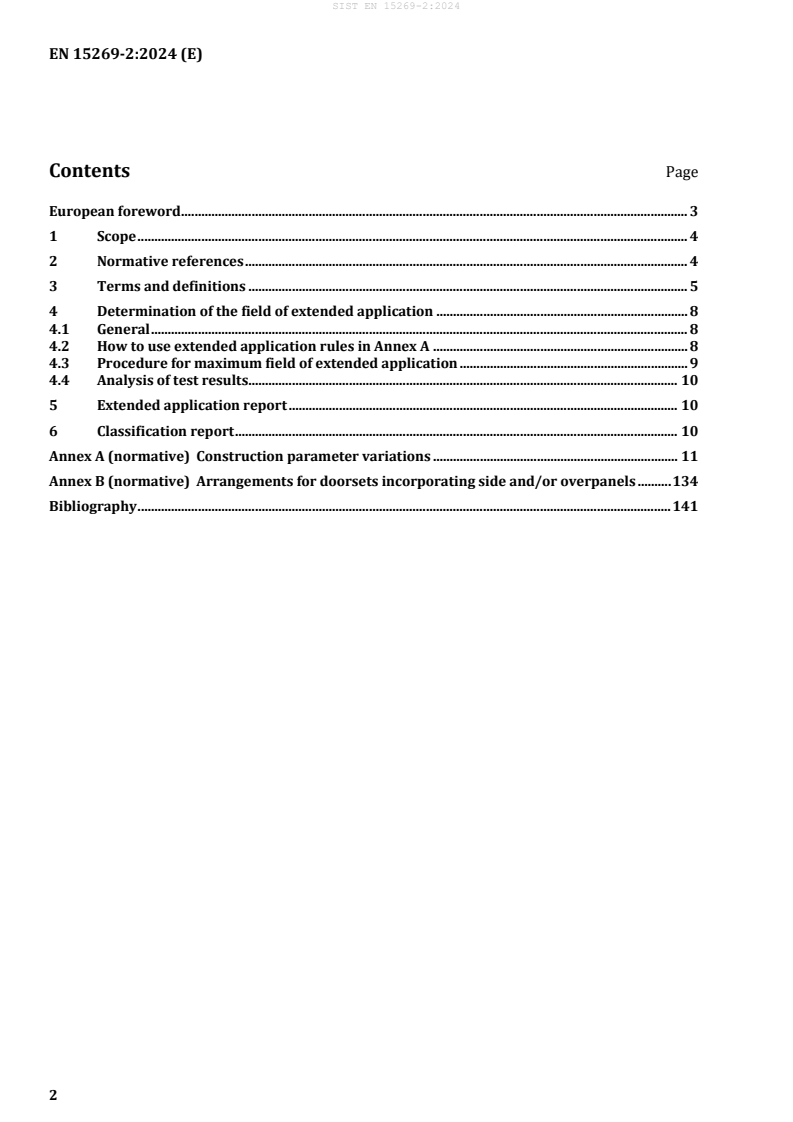
European foreword . 3
1 Scope . 4
2 Normative references . 4
3 Terms and definitions . 5
4 Determination of the field of extended application . 8
4.1 General . 8
4.2 How to use extended application rules in Annex A . 8
4.3 Procedure for maximum field of extended application . 9
4.4 Analysis of test results . 10
5 Extended application report . 10
6 Classification report . 10
Annex A (normative) Construction parameter variations . 11
Annex B (normative) Arrangements for doorsets incorporating side and/or overpanels . 134
Bibliography . 141
European foreword
This document (EN 15269-2:2024) has been prepared by Technical Committee CEN/TC 127 “Fire safety
in buildings”, the secretariat of which is held by BSI.
This European Standard shall be given the status of a national standard, either by publication of an
identical text or by endorsement, at the latest by April 2025, and conflicting national standards shall be
withdrawn at the latest by April 2025.
Attention is drawn to the possibility that some of the elements of this document may be the subject of
patent rights. CEN shall not be held responsible for identifying any or all such patent rights.
This document supersedes EN 15269-2:2012.
This document has been prepared under a standardization request addressed to CEN by the European
Commission.
A list of all parts in the EN 15269 series can be found on the CEN website.
Any feedback and questions on this document should be directed to the users’ national standards body.
A complete listing of these bodies can be found on the CEN website.
According to the CEN-CENELEC Internal Regulations, the national standards organisations of the
following countries are bound to implement this European Standard: Austria, Belgium, Bulgaria, Croatia,
Cyprus, Czech Republic, Denmark, Estonia, Finland, France, Germany, Greece, Hungary, Iceland, Ireland,
Italy, Latvia, Lithuania, Luxembourg, Malta, Netherlands, Norway, Poland, Portugal, Republic of North
Macedonia, Romania, Serbia, Slovakia, Slovenia, Spain, Sweden, Switzerland, Türkiye and the United
Kingdom.
1 Scope
This document covers single and double leaf, hinged and pivoted, steel based doorsets except steel
doorsets with metal framed door leaves covered by EN 15269-5. It prescribes the methodology for
extending the application of test results obtained from fire resistance test(s) conducted in accordance
with EN 1634-1.
Subject to the completion of the appropriate test or tests, the extended application may cover all or some
of the following examples:
— integrity (E), integrity and radiation (EW) or integrity and insulation (EI or EI ) classification;
1 2
— door leaf;
— side panels, transom panels, flush overpanels;
— air transfer grilles (e.g. ventilation grilles/louvres);
— components (e.g. frame/suspension system) fixed to the supporting construction (e.g. wall/ceiling);
— glazing within the doorset (e.g. for door leaf, side, transom and flush overpanels);
— items of building hardware;
— decorative and protective finishes;
— intumescent seals, strips and non-intumescent (smoke, draught or acoustic) seals;
— alternative supporting construction(s).
This document does not cover horizontally installed doorsets (e.g. traps).
The effect on the classification ‘C’ for the doorsets following an extended application process is not
addressed in this document.
2 Normative references
The following documents are referred to in the text in such a way that some or all of their content
constitutes requirements of this document. For dated references, only the edition cited applies. For
undated references, the latest edition of the referenced document (including any amendments) applies.
EN 179, Building hardware — Emergency exit devices operated by a lever handle or push pad, for use on
escape routes — Requirements and test methods
EN 1125, Building hardware — Panic exit devices operated by a horizontal bar, for use on escape routes —
Requirements and test methods
EN 1155, Building hardware — Electrically powered hold-open devices for swing doors — Requirements
and test methods
EN 1158, Building hardware — Door coordinator devices — Requirements and test methods
EN 1363-1, Fire resistance tests — Part 1: General requirements
EN 1363-2, Fire resistance tests — Part 2: Alternative and additional procedures
EN 1364-1:2015, Fire resistance tests for non-loadbearing elements — Part 1: Walls
EN 1634-1, Fire resistance and smoke control tests for door and shutter assemblies, openable windows and
elements of building hardware — Part 1: Fire resistance test for door and shutter assemblies and openable
windows
EN 1634-2, Fire resistance and smoke control tests for door, shutter and openable window assemblies and
elements of building hardware — Part 2: Fire resistance characterisation test for elements of building
hardware
EN 12519, Windows and pedestrian doors — Terminology
EN 13501-2, Fire classification of construction products and building elements — Part 2: Classification
using data from fire resistance tests, excluding ventilation services
EN 15254-4:2018, Extended application of results from fire resistance tests — Non-loadbearing walls —
Part 4. Glazed constructions
EN 15269-1, Extended application of test results for fire resistance and/or smoke control for door, shutter
and openable window assemblies, including their elements of building hardware — Part 1: General
requirements
EN 15725, Extended application on the fire performance of construction products and building elements:
Principle of EXAP standards and EXAP reports
EN ISO 13943, Fire safety — Vocabulary (ISO 13943)
3 Terms and definitions
For the purposes of this document, the terms and definitions given in EN 1363-1, EN 1363-2, EN 1634-1,
EN 1634-2, EN 12519, EN 15269-1, EN 15725 and EN ISO 13943 and the following apply.
ISO and IEC maintain terminological databases for use in standardization at the following addresses:
— IEC Electropedia: available at https://www.electropedia.org/
— ISO Online browsing platform: available at https://www.iso.org/obp
3.1
full scale test
test of a doorset in accordance with EN 1634-1
3.2
small scale test
test on items of building hardware in accordance with EN 1634-2
3.3
effective rebate depth
dimension of the door leaf thickness of overlapping adjacent edges of the door leaf relative to the door
frame, transom or side panel or flush overpanel as well as at door leaf meeting edges
Note 1 to entry: See Figure 1.
Dimensions in millimetres
a) b)
Key
x1 Example of effective rebate depth in doorset to be tested – 50mm
x2 Example of resulting effective rebate depth during testing after movement of 20mm – 30mm
y1 Example of distance between over rebate and frame face in doorset to be tested – 5mm
y2 Example of distance between over rebate and frame face in doorset after movement of 20mm –
25mm
Calculation: 20/50 × 100 = 40 % (60 % of the initial value is left)
Level of distortion according to Annex A: medium
Figure 1 — Effective rebate depth
3.4
panel
component of a door leaf separated from other elements by joints which break through the total door leaf
thickness
Note 1 to entry: A door leaf can consist of one or more panels.
3.5
decorative finishes
outer layer of material on the leaf or panel only used for decorative, not for structural purposes
3.6
protective finishes
outer layer of material on the leaf or panel only used for protective, not for structural purposes
3.7
representative specimen
doorset design that has ‘fundamentally the same’ or ‘similar’ construction as another doorset design for
the purpose of evaluating construction parameter variations providing the relevant aspects of tested
performance are considered
Note 1 to entry: See EN 15269-1 for further guidance on evaluation of similar/fundamentally the same.
3.8
faces and sides of a door leaf
faces and sides of a door leaf are shown in Figure 2
Key
1 opening face
2 closing face
3 lock side
4 hinge side
5 top side
6 bottom side
Figure 2 — Faces and sides of a door leaf
3.9
dog bolt / movement restrictor
additional part (e.g. a bolt) on the hinge side of the doorset which can bear forces such as those caused
by levering for burglary or by deflection in case of fire
4 Determination of the field of extended application
4.1 General
4.1.1 Before there can be any consideration for extended application, the doorset shall have been tested
in accordance with EN 1634-1 to achieve a test result which could generate a fire resistance classification
in accordance with EN 13501-2 at least equal to the fire resistance classification required from extended
application considerations. These tests are referred to in this document as basic tests.
NOTE If a doorset is classified from one side only (e.g. just opening face), the extended application rules cannot
lead to a classification of the opposite side or of both sides.
4.1.2 A review of the doorset construction parameters can indicate that one or more characteristics
may be improved by a particular parameter variation. All evaluations shall be made on the basis of
retaining the classifications obtainable from testing to EN 1634-1, including those lower than the test
duration. However, this shall never lead to an increased classification for any specific parameter beyond
that achieved during any one test unless specifically identified in the relevant construction parameter
variation tables.
4.1.3 If, when following the extended application procedure, any component of the classified product
cannot be covered by the extended application rules, a representative specimen incorporating the
particular construction parameter variation shall be tested on both sides or on one side, if the required
classification is from one side only. Otherwise, that part shall be omitted from the subsequent extended
application report and classification report.
4.1.4 A hardware performance sheet (HPS), according to EN 16035 may be part of the documentation
for the assessment and determination of the extended application.
4.2 How to use extended application rules in Annex A
4.2.1 Identify the variations from the original test specimen(s) which are required to be covered by an
extended application report.
4.2.2 Locate the variations in the appropriate parameter variation by reference to columns (1) and (2)
in the tables of Annex A.
4.2.3 Establish from the contents of column (3) in the tables of Annex A whether any extended
application is available beyond the direct application rules (DIAP) in EN 1634-1 without the need for
further testing.
4.2.4 Where this is deemed to be possible, it can be recorded in the extended application report
together with any appropriate restrictions and the stated rules from column (3) in the tables of Annex A.
4.2.5 Where the variations required can only be achieved from additional testing, the additional test
shall be made on a representative test specimen i.e. a doorset of the same or more onerous configuration.
Alternatively, column (4) in the tables of Annex A identifies an option for alternative testing and relevant
test parameters.
The most onerous configuration shall be the one with the lowest relevant performance in terms of mode
of failure and/or highest distortion, but shall also be evaluated taking the intended construction
parameter variation(s) into account. For example, if the construction parameter variation involves a
change to glazing of side panel and overpanel configurations then the previous result where these have
been tested would need to be used to make the evaluation of most onerous. The result for a single
unglazed doorset would not be suitable and can therefore be discounted when making the evaluation.
4.2.6 When an additional test according to column (4) in the tables of Annex A is performed and the
result of this additional test meets the provisions given in column (3), the possible extensions in column
(3) can be applied based on this additional test.
4.3 Procedure for maximum field of extended application
4.3.1 It is possible to provide an extended field of application from a single test. However, where a
manufacturer intends to produce a range of doorsets incorporating single leaf doorsets and also double
leaf doorsets, with or without side, transom or flush overpanels, with or without glazing, with or without
air transfer grilles (ventilation grilles/louvres), with alternative items of building hardware, etc., it is
recommended that careful consideration be given to the complete range of doorset designs and options
in order to minimize the testing required before testing commences.
4.3.2 Establish all the construction parameter variations which are required to be part of the product
range.
4.3.3 Determine which are the most important design and configuration requirements and incorporate
as many as possible into the specimen(s) for the first tests in the series.
4.3.4 Conduct the first fire resistance test or a series of tests and then establish which of the original
desired construction parameter variations have not been covered by the fire resistance tests, including
direct application possibilities.
4.3.5 Identify these construction parameter variations in Annex A and establish if any extended
application is possible without further testing.
4.3.6 Record this for the extended application report together with any restrictions and rules given in
column (3) in the tables in Annex A.
4.3.7 Evaluate which, if any, of the desired construction parameter variations have not been covered
by the field of direct application or the initial field of extended application derived from 4.3.5.
4.3.8 Determine if the product range is to include only single leaf doorsets, only double leaf doorsets or
both. Where only single leaf doorsets are to be part of the product range, the outstanding construction
parameter variations shall only be incorporated into specimens for single leaf doorsets. Where only
double leaf doorsets are to be part of the product range, the outstanding construction parameter
variations shall only be incorporated into specimens for double leaf doorsets. Where single leaf and
double leaf doorsets are to be included in the product range, the outstanding construction parameter
variations for the extended application of single leaf doorsets may be incorporated into either repeated
single leaf doorset tests or, in the weakest option, as defined in column (4) of the table in Annex A, double
leaf doorset configurations. See also Annex B.
4.3.9 Select the required outstanding construction parameter variations from column (1) and column
(2) in the tables of Annex A and observe from column (4) which are the most appropriate, weakest
specimen options for further testing.
4.3.10 If the complete selection of required construction parameter variations has not been covered by
the tests completed in accordance with 4.3.8 and 4.3.9 above, then an appropriate test or tests may be
repeated with the additional product variations incorporated.
4.4 Analysis of test results
4.4.1 In order to maximize the extended field of application, it is important that the test reports shall
record details of any premature integrity and/or insulation and/or radiation failure, also record details
of any significant distortion to evaluate low, medium and high distortion (see Annex A).
4.4.2 Where a series of tests forms the basis for the extended application, the field of extended
application shall be based on the lowest performance achieved from the complete series of tests unless
premature failure has been attributed to one or more specific construction parameter variations.
4.4.3 Where it has been possible to identify specific parameter failures, the extended application for all
other construction parameter variations can be based on the performance achieved after isolating the
premature failure(s), provided the requirements of subclause 4.1.1 are met. Where the specific
construction parameter variation requires category B performance (see EN 1634-1 for the corresponding
overrun times) and where failures can be identified as having no relevance to this aspect of the
construction, they can be disregarded and the failure time and associated category revised accordingly.
5 Extended application report
Prepare an extended application report in line with EN 15725 and in accordance with the requirements
of EN 15269-1, based on the results of evaluations in accordance with the above.
When additional test data based on similar designs are used to extend the field of application, the
rationale for using the test data should be mentioned in the EXAP report.
If the results of the extended application procedure lead to a classification that only covers one side (e.g.
either opening or closing face) of the doorset, this shall be unambiguously stated in the report.
6 Classification report
The classification report shall be determined from the results of the extended application report and shall
be presented in accordance with EN 13501-2.
Annex A
(normative)
Construction parameter variations
A.1 General
The tables below are designed to be used by experts competent in the field of fire resistance testing of
hinged or pivoted steel doorsets.
The tables shall only be used to assess a field of extended application when at least one positive test to
EN 1634-1 can generate a fire resistance classification according to EN 13501-2. Only results from tests
in accordance with European Standards can be used as basis for extended application.
For EI doorsets, EW doorsets and E doorsets with insulation inside with an intended classification from
both sides (opening into the furnace, opening away from the furnace) the following rules shall only be
considered, if the basic tests were performed in both directions.
The first two columns identify possible variations to the construction details of the specimen tested.
For some parameters, it is necessary to evaluate whether the specimen displayed a high, medium or low
level of distortion during the fire resistance test. Where this is the case, the following levels shall be used
to establish high, medium and low distortion doorsets as measured using the maximum relative
movement at any position between the edge of the door leaf and door frame or between the meeting
edges of door leaves or the relative movement of the framing members for panelled systems. The
measurements shall be taken from the start of the fire resistance test at any time during the complete
required classification period. The deflections shall be measured at the positions given in EN 1634-1:
— low < 40 % of effective rebate depth;
— medium ≥ 40 % and ≤ 85 % of effective rebate depth;
— high > 85 % of effective rebate depth.
Evaluations of the influence of a construction parameter variation on the fire resistance performance
characteristics (E/EW/EI) lead to the judgement of the possibility of extending the field of application,
the results of which are given in column (3) of the following tables. In certain cases in column (3), it is a
requirement to achieve category B.
Where additional fire resistance tests are deemed to be necessary, the type of specimen approved for
incorporation of the changed construction parameter is defined in column (4). Where it is possible to use
information from fire resistance tests performed on one configuration for evidence on a different
configuration, this allowance has been made in order to reduce the overall number of tests required for
extended application evaluation e.g. from single action doorsets to double action doorsets.
A.2 Guideline for the evaluation of the required orientation of the test specimens
(only for doorsets that are required to be tested from both directions)
Where an additional test is required in column (4) of the following tables, the orientation of the test
specimens shall be as follows unless otherwise specified in column (4):
a) If all basic test(s) achieved category B, both test directions are considered as being equal, so the
additional test may be performed opening into the furnace or opening away from the furnace.
b) If any specimen of the basic tests achieved category A only, the evaluation of the test direction for the
additional test shall follow the procedure below:
b.1 The test direction for the additional test shall be derived from the result of the basic test(s). The
orientation of the specimen on which the first integrity failure occurred during the basic test(s)
determines the face to be exposed for the additional test. If no integrity failure occurred during
the basic test period, follow items b.2 or b.3.
NOTE The required test period is the time given in EN 1634-1 for the corresponding classification period. The
test period for category B includes the corresponding overrun time.
b.2 For construction parameter variations which are critical in relation to deflection (e.g. size,
reduction of reinforcements), the following applies: face to be exposed is determined by the
direction with the higher deflection during the basic test(s) period. If both directions (opening
into the furnace or opening away from the furnace) behave nearly similar related to deflection,
follow items b.3 or b.4.
b.3 For construction parameter variations which are critical in relation to temperature and/or
radiation (e.g. changes in core material density): the face to be exposed is determined by the
direction with the higher temperature and/or radiation during the basic test(s) period
dependent on the intended construction parameter variation (e.g. if the intended variation is
related to the door leaf only, the temperature on the door frame is not relevant). In case both
directions (opening into the furnace or opening away from the furnace) are nearly similar in
temperature and/or radiation, follow items b.2 or b.4.
b.4 If the temperature and/or radiation and the deflection are nearly similar for both specimens
during the basic test(s) period, both test directions are considered as being equal, so the
orientation of the specimen for the additional test may be opening into the furnace or opening
away from the furnace.
In order to maximize the possible field of application from a minimum number of fire resistance tests, the
construction parameter variations have been spread over a series of test specimens. The recommended
tests for each parameter are dependent on the classification required and the preferred options.
Where more than one single parameter variation is required, the influence on other variations shall also
be taken into account.
Where an additional test is required in column 4 of the following tables, the fire resistance test shall be a
full scale test according to EN 1634-1 at least with the size of the initial test described in 4.1.1. or the
details changed are limited to the tested size unless it is otherwise specified. Where column 4 specifies
that the additional evidence required is “not size-dependent”, the specimen may be tested at any size as
long as the test is in accordance with EN 1634-1.
Interpolations between minimum and maximum size tested of any measure is possible if not otherwise
specified in Table A.1 to A.7.
In the Tables A.1 to A.7 below, clause numbers in brackets represent the number of rule in the previous version of EN 15269-2. These are added for information
only.
Table A.1 — Construction parameter variations — Section A — Door leaf
Construction Parameter Variation Possibility of extension Additional Evidence Required
(1) (2) (3) (4)
A Door leaf
In certain cases, the rules given in Section A are also appropriate to side, transom and flush overpanels or the door frame. Where this is the case, it is clearly indicated at
the beginning of the relevant section. For double leaf doorsets, both leaves shall be of the same basic construction.
The term “intumescent seal” includes both: intumescent strips and seals with intumescent characteristics.
A.1 General
A.1.1 Number of leaves — See Single leaf from double leaf Not possible. Basic test according to 4.1.1
Figure A.1 test required
A.1.2 Number of leaves — See Double leaf from single Not possible. Basic test according to 4.1.1
Figure A.1. leaf test required
A.1.3 Number of vertical panels Increase Possible if tested at least one leaf (single, primary or Additional test single leaf or
per leaf (primary or secondary) with the minimum of two panels and the double leaf doorset
(by one panel per leaf —
secondary) — See intended jointing technique centrally located in the door
on any leaf)
Figure A.2 a) leaf, providing the added panel size is not bigger then the
tested ones
otherwise
not possible without an additional test
A.1.4 Number of vertical panels Reduce Possible providing the tested width of the panel is not Additional test single leaf or
per leaf (primary or increased and a minimum of one joint remains in the door double leaf doorset
(down to a minimum of
secondary) — See leaf
two panels per leaf – on
Figure A.2 b)
any leaf) otherwise
not possible without an additional test
A.1.5 Intumescent seals between Location towards the Not possible without an additional test Additional test single leaf or
frame and door leaf/leaves frame rebate double leaf doorset
— See Figure A.3.
Construction Parameter Variation Possibility of extension Additional Evidence Required
(1) (2) (3) (4)
A.1.6 Intumescent seals between Location away from the Not possible without an additional test Additional test single leaf or
frame and door leaf/leaves frame rebate double leaf doorset
— See Figure A.4.
A.1.7 Intumescent seals between Location Not possible without an additional test(s) Additional test (s) double leaf
meeting edges of the door doorset (open outwards and
leaves inwards for EI doors, open
outwards for E or EW doors)
A.1.8 Non intumescent seals Location Any movement possible providing no modifications of the Additional test single or double
between frame and door construction are required leaf doorset
leaf/leaves
otherwise
(draught/smoke/acoustic
etc.) — Reaction to fire
not possible without an additional test
class A1, e.g. ceramic
products (fitted in leaf or
frame) — See Figure A.5
A.1.9 Non intumescent seals Location No movement possible without an additional test Additional test double leaf doorset
between meeting edges of
the door leaves
(draught/smoke/acoustic
etc.) — Reaction to fire
class A1, e.g. ceramic
products
A.1.10 Non-intumescent seals Location No movement possible without an additional test Additional test single or double
between frame and door leaf doorset, if the seal is
leaf/leaves positioned between the meeting
(draught/smoke/acoustic edges of the door leaves the
etc.) — < Reaction to fire additional test shall be a double
class A1 (fitted in leaf or leaf doorset
frame) — See Figure A.6
Construction Parameter Variation Possibility of extension Additional Evidence Required
(1) (2) (3) (4)
A.1.11 Non-intumescent seals Add Possible for doors without intumescent seals and providing Additional test single or double
between frame and door the gap between door leaf and door frame is not increased leaf doorset, if the seal is
leaf/leaves positioned between the meeting
otherwise
(draught/smoke/acoustic edges of the door leaves the
not possible without an additional test
etc.) - Reaction to fire class additional test shall be a double
A1, e.g. ceramic products leaf doorset
(fitted in leaf or frame). —
See Figure A.7
A.1.12 Non intumescent seals Remove Not possible without an additional test Additional test single or double
between door leaves leaf doorset, if the seal is
and/or frames positioned between the meeting
(draught/smoke/acoustic edges of the door leaves the
etc.) — Reaction to fire additional test shall be a double
class A1, e.g. ceramic leaf doorset
products (fitted in leaf or
frame) — See Figure A.8
A.1.13 Non-intumescent seals Add Not possible without an additional test Additional test single or double
between frame and door leaf doorset, if the seal is
leaf/leaves positioned between the meeting
(draught/smoke/acoustic edges of the door leaves the
etc.) — < Reaction to fire additional test shall be a double
class A1 (fitted in leaf or leaf doorset
frame) — See Figure A.9
A.1.14 Non-intumescent seals Remove Not possible without an additional test Additional test single or double
between frame and door leaf doorset, if the seal is
leaf/leaves positioned between the meeting
(draught/smoke/acoustic edges of the door leaves the
etc.) — < Reaction to fire additional test shall be a double
class A1 (fitted in leaf or leaf doorset
frame) — See Figure A.10
Construction Parameter Variation Possibility of extension Additional Evidence Required
(1) (2) (3) (4)
A.1.15 Rebate (door leaves to Add EI Additional test single or double
frames) — See Not possible without an additional test unless the original leaf doorset
Figure A.14a test had additional thermocouples positioned 100 mm for
EI or 25 mm for EI from the edge of the notional rebate
2 1
(i.e. 100-x) where x means the width of the added rebate
and dimension y (overlap) shall not be decreased by a
maximum of three times the steel thickness of the door leaf
E, EW
Possible providing no decrease of dimension y (overlap) or
leaf edge thickness by a maximum of three times the steel
thickness of the door leaf
otherwise
not possible without an additional test
A.1.16 Rebate (meeting edges) — Add Possible if the doorset included one rebate and the added Additional test double leaf doorset
See Figure A.14b rebate is of the same design/material as that tested (added rebate away from the fire)
(one rebate)
otherwise
not possible without an additional test
A.1.17 Rebate (door leaves to Remove Not possible without an additional test Additional test single or double
frames) — See Figure A.15 leaf doorset (opening into the
furnace)
Additional test double leaf doorset
A.1.18 Rebate (meeting edges) Remove Not possible without an additional test
(opening into the furnace)
A.1.19 Latched condition for Change in latching Possible in line with the relationship given in Table A.1.19 Additional test to include the
single and double leaf condition required latching condition
doorsets
Construction Parameter Variation Possibility of extension Additional Evidence Required
(1) (2) (3) (4)
Possible providing the door leaf has been tested with an
A.1.20 Overlap (rebate/astragal) Decrease overlap Additional test single or double
overlap without infill, the leaf thickness does not
between door leaves and thickness leaf doorset.
frame or between meeting change, the gaps between door leaf and frame remain
In case of meeting edge overlaps
edges — See Figure A.79
as tested
the additional test shall be a
double leaf doorset
otherwise
not possible without an additional test
A.1.21 Overlap (rebate/astragal) Increase overlap thickness Possible only for medium or low distortion, providing the Additional test single or double
between door leaves and overlap thickness shall not be increased by more than three leaf doorset.
frame or between meeting times the thickness of the steel sheet of the door leaf and
In case of meeting edge overlaps
edges — See Figure A.80 provided that the effective rebate depth is not reduced
the additional test shall be a
otherwise double leaf doorset
not possible without an additional test
Construction Parameter Variation Possibility of extension Additional Evidence Required
(1) (2) (3) (4)
A.2 Size variations/single or multiple panel construction
Possible in line with direct application
A.2.1 Size (area, width, height) Decrease For single leaf doorsets additional
test single leaf or double leaf
or for EI doors possible from the size tested down to the
doorset, for double leaf doorsets
size of a second test specimen in the same design using additional test double leaf doorset
direct application rules
otherwise
not possible without an additional test
A.2.2 Height - all distortions Increase Possible in line with direct application For single leaf doorsets additional
test single leaf or double leaf
or possible for doorsets which have achieved category B
doorset, for double leaf doorsets
with all distortions to a maximum addition equal to the
additional test double leaf doorset
tested dimension between the latch and top of the door leaf
providing an additional top hinge/dog bolt together with
additional latch in the area of the top free corner are
incorporated and additionally (for EW) an emitted radiation
calculation in accordance with EN 1363-2 is within the
15 kW/m limit
or possible for doorsets which have achieved category B
with
medium distortion: 20 % increase
or low distortion: 25 % increase,
providing overlap of door leaf to frame header is not
reduced and distance between top hinge and top of door leaf
is equal to or less than tested and additionally (for EW) an
emitted radiation calculation in accordance with EN 1363-2
is within the 15 kW/ m limit
otherwise
not possible without an additional test
Construction Parameter Variation Possibility of extension Additional Evidence Required
(1) (2) (3) (4)
A.2.3 Width- all distortions Increase Possible in line with direct application For single leaf doorsets additional
test single leaf or double leaf
or possible for doorsets which have achieved category B
doorset, for double leaf doorsets
with
additional test double leaf doorset
medium distortion: 20 % increase and
low distortion: 25 % increase providing overlap of door leaf
to frame jamb is not reduced and
additionally (for EW) an emitted radiation calculation in
accordance with EN 1363-2 is within the 15 kW/m limit
otherwise
not possible without an additional test
A.2.4 Area- all distortions Increase Possible in line with direct application Additional test see A.2.2 and/or
A.2.3
Possible for doorsets which have achieved category B
where height is achieved by additional latch and hinge / dog
bolt full width extension can be applied
or
medium distortion: 25 % increase and
low distortion: 30 % increase
providing overlap of door leaf to frame header and frame
jamb is not reduced and distance between top hinge and top
of door leaf is equal to or less than tested and
additionally (for EW) an emitted radiation calculation in
accordance with EN 1363-2 is within the 15 kW/ m limit.
otherwise
not possible without an additional test
Construction Parameter Variation Possibility of extension Additional Evidence Required
(1) (2) (3) (4)
A.2.5 Thickness of the door leaf Increase For all distortions: possible providing the increase results Additional test single or double
only from the increase of the thickness of the steel sheet. leaf doorset
Based on high distortion: Not possible without an additional
test
Based on medium distortion: Possible providing the same
increase of thickness of core material up to a maximum of
10 %
Based on low distortion: Possible providing the same
increase of thickness of core material up to a maximum of
25 %
otherwise
not possible without an additional test
A.2.6 Thickness of the door leaf Decrease Possible providing the decrease results only from the Additional test from both sides,
decrease of the thickness of the steel sheet single for single leaf doorsets or
double leaf for double leaf doorsets
otherwise
not possible without an additional test
A.3 Materials and constructions
Adhesives might be used for different applications, e.g. fixing of the core material to the steel sheet, fixing of internal components or for prefixing (e.g. before screwing)
only. For the amount of adhesives, each of the different applications shall be considered separately.
A.3.1 Density of core material Increase Possible up to a maximum of 15 % (nominal value) of each Additional test single or double
(organic or Reaction to fire core material of the door leaf leaf doorset
class A1)
otherwise
not possible without an additional test
A.3.2 Density of core material Decrease E Additional test single or double
(organic or Reaction to fire leaf doorset
Possible
class A1)
EI, EW
Not possible without an additional test
Construction Parameter Variation Possibility of extension Additional Evidence Required
(1) (2) (3) (4)
A.3.3 Thickness of core material Increase Based on high distortion: not possible without an additional Additional test single or double
— See Figure A.16 test leaf doorset
Based on medium distortion: possible up to a maximum of
10 % in accordance with thickness of door leaf and
providing that no single element of the core is reduced in
thickness
Based on low distortion: possible up to a maximum of 25 %
in accordance with thickness of door leaf and providing that
no single element of the core is reduced in thickness
otherwise
not possible without an additional test
A.3.4 Thickness of core material Decrease E Additional test single for single leaf
— See Figure A.17 doorsets or double leaf for double
...