

EN 1364-1:2015
(Main)Fire resistance tests for non-loadbearing elements - Part 1: Walls
- Abstract
This European standard specifies a method for determining the fire resistance of non-loadbearing walls.
This European Standard is used in conjunction with EN 1363-1.
It is applicable to partitions (non-loadbearing walls) with and without glazing, non-loadbearing walls consisting almost wholly of glazing (glazed non-loadbearing walls) and other non-loadbearing internal and external non-loadbearing walls with and without glazing.
The fire resistance of external non-loadbearing walls can be determined under internal or external exposure conditions. In the latter case the external fire exposure curve given in EN 1363-2 is used.
It is not applicable to:
a) curtain walls (external non-loadbearing walls suspended in front of the floor slab), unless explicitly permitted under EN 1364-3 or EN 1364-4 which shall contain details of the methodology to be used.
b) non-loadbearing walls containing door assemblies which shall be tested to EN 1634-1.
Specific requirements relating to the testing of glazing are given in Annex A.
Specific requirements relating to the testing of non-loadbearing external and internal walls designed to span horizontally between two independently proven fire resisting vertical structural elements are given in annex B.
- Status
- Published
- Publication Date
- 07-Jul-2015
- Withdrawal Date
- 30-Jan-2016
- Technical Committee
- CEN/TC 127 - Fire safety in buildings
- Drafting Committee
- CEN/TC 127/WG 1 - Structural and separating elements
- Current Stage
- 9092 - Decision on results of review/2YR ENQ - revise - Review Enquiry
- Start Date
- 15-Jul-2021
- Completion Date
- 14-Oct-2026



Overview
EN 1364-1:2015 - published by CEN - specifies a standardized method for determining the fire resistance of non-loadbearing walls (partitions), including walls with glazing and walls made almost wholly of glazing. The standard is intended to measure the ability of a representative wall specimen to resist fire spread from one face to the other. EN 1364-1:2015 is used in conjunction with EN 1363-1 (general fire resistance test conditions) and, for external exposure, may reference the external fire curve in EN 1363-2.
Key Topics
- Scope and applicability
- Tests for internal and external non-loadbearing walls, partitions, glazed and partly glazed walls.
- Not applicable to curtain walls (unless addressed in EN 1364-3/4) or to walls containing door assemblies (tested under EN 1634-1).
- Test specimen requirements
- Dimensions, number of specimens and representative construction details (joints, restraint, framing and glazing).
- Special provisions for glazed assemblies (Annex A) and for horizontally spanning walls between independent vertical elements (Annex B).
- Test equipment and instrumentation
- Furnace thermocouples, unexposed-face thermocouples, deflection and radiation measurements, pressure and impact monitoring as required.
- Locations and number of measuring points defined; additional thermocouples and deflection measurements for larger or glazed constructions.
- Test procedure and conditions
- Conditioning, installation, exposure regimes (including external exposure using EN 1363-2 when applicable) and test progression rules.
- Performance criteria and reporting
- Criteria for integrity, insulation and mechanical performance during the test and detailed test report requirements.
- Field of direct application
- Rules for extending test results to other dimensions, supporting constructions and configurations, with specific provisions for glazed elements.
Applications
EN 1364-1:2015 is used by:
- Test laboratories conducting standardized fire resistance tests.
- Manufacturers of partitions, glazed wall systems and façade components needing certified fire ratings.
- Fire safety engineers, architects, specifiers and building authorities for product selection, compliance assessment and design verification.
- Contractors and façade installers referencing tested configurations for on-site compliance and acceptance.
Practical uses include certifying partition systems for fire compartments, specifying glazed partition fire performance, and establishing allowable field-of-application limits for tested wall assemblies.
Related standards
- EN 1363-1 - General Fire Resistance Tests (required companion)
- EN 1363-2 - External Exposure Fire Curve
- EN 1364 (Parts 2–5) - Ceilings, curtain walling, air transfer grilles
- EN 1364-3 / EN 1364-4 - Curtain wall specific rules
- EN 1634-1 - Fire resistance of door assemblies
Keywords: EN 1364-1:2015, fire resistance tests, non-loadbearing walls, glazed partitions, EN 1363-1, EN 1363-2, fire test methods, CEN.
Relations
- Effective Date
- 23-Apr-2014
- Effective Date
- 28-Jan-2026
- Effective Date
- 28-Jan-2026
- Effective Date
- 07-Oct-2026
- Effective Date
- 10-Feb-2026
- Effective Date
- 28-Jan-2026
- Effective Date
- 28-Jan-2026
- Effective Date
- 28-Jan-2026
- Effective Date
- 28-Jan-2026
- Effective Date
- 28-Jan-2026
- Effective Date
- 28-Jan-2026
- Effective Date
- 28-Jan-2026
- Effective Date
- 28-Jan-2026
- Effective Date
- 28-Jan-2026
- Effective Date
- 28-Jan-2026
Get Certified
Connect with accredited certification bodies for this standard

DIBt (Deutsches Institut für Bautechnik)
German Institute for Building Technology.
DIN CERTCO
DIN Group product certification.

Kiwa BDA Testing
Building and construction product certification.
Sponsored listings
Frequently Asked Questions
EN 1364-1:2015 is a standard published by the European Committee for Standardization (CEN). Its full title is "Fire resistance tests for non-loadbearing elements - Part 1: Walls". This standard covers: This European standard specifies a method for determining the fire resistance of non-loadbearing walls. This European Standard is used in conjunction with EN 1363-1. It is applicable to partitions (non-loadbearing walls) with and without glazing, non-loadbearing walls consisting almost wholly of glazing (glazed non-loadbearing walls) and other non-loadbearing internal and external non-loadbearing walls with and without glazing. The fire resistance of external non-loadbearing walls can be determined under internal or external exposure conditions. In the latter case the external fire exposure curve given in EN 1363-2 is used. It is not applicable to: a) curtain walls (external non-loadbearing walls suspended in front of the floor slab), unless explicitly permitted under EN 1364-3 or EN 1364-4 which shall contain details of the methodology to be used. b) non-loadbearing walls containing door assemblies which shall be tested to EN 1634-1. Specific requirements relating to the testing of glazing are given in Annex A. Specific requirements relating to the testing of non-loadbearing external and internal walls designed to span horizontally between two independently proven fire resisting vertical structural elements are given in annex B.
This European standard specifies a method for determining the fire resistance of non-loadbearing walls. This European Standard is used in conjunction with EN 1363-1. It is applicable to partitions (non-loadbearing walls) with and without glazing, non-loadbearing walls consisting almost wholly of glazing (glazed non-loadbearing walls) and other non-loadbearing internal and external non-loadbearing walls with and without glazing. The fire resistance of external non-loadbearing walls can be determined under internal or external exposure conditions. In the latter case the external fire exposure curve given in EN 1363-2 is used. It is not applicable to: a) curtain walls (external non-loadbearing walls suspended in front of the floor slab), unless explicitly permitted under EN 1364-3 or EN 1364-4 which shall contain details of the methodology to be used. b) non-loadbearing walls containing door assemblies which shall be tested to EN 1634-1. Specific requirements relating to the testing of glazing are given in Annex A. Specific requirements relating to the testing of non-loadbearing external and internal walls designed to span horizontally between two independently proven fire resisting vertical structural elements are given in annex B.
EN 1364-1:2015 is classified under the following ICS (International Classification for Standards) categories: 13.220.50 - Fire-resistance of building materials and elements; 91.060.10 - Walls. Partitions. Facades. The ICS classification helps identify the subject area and facilitates finding related standards.
EN 1364-1:2015 has the following relationships with other standards: It is inter standard links to EN 1364-1:1999, EN 1363-1:2020, EN ISO 13943:2023, EN 1520:2026, CEN/TS 45545-3:2009, EN 357:2004, EN 1520:2011, EN 1363-2:1999, EN 15254-4:2008+A1:2011, EN 13381-2:2014, EN 15998:2020, EN 378-3:2016, EN 378-3:2016+A1:2020, EN 15269-2:2024, EN 13501-2:2007+A1:2009. Understanding these relationships helps ensure you are using the most current and applicable version of the standard.
EN 1364-1:2015 is associated with the following European legislation: EU Directives/Regulations: 305/2011; Standardization Mandates: M/117. When a standard is cited in the Official Journal of the European Union, products manufactured in conformity with it benefit from a presumption of conformity with the essential requirements of the corresponding EU directive or regulation.
EN 1364-1:2015 is available in PDF format for immediate download after purchase. The document can be added to your cart and obtained through the secure checkout process. Digital delivery ensures instant access to the complete standard document.
Standards Content (Sample)
2003-01.Slovenski inštitut za standardizacijo. Razmnoževanje celote ali delov tega standarda ni dovoljeno.Preskusi požarne odpornosti nenosilnih elementov - 1. del: SteneFeuerwiderstandsprüfungen für nichttragende Bauteile - Teil 1: WändeEssais de résistance au feu des éléments non porteurs - Partie 1 : MursFire resistance tests for non-loadbearing elements - Part 1: Walls91.060.10Stene. Predelne stene. FasadeWalls. Partitions. Facades13.220.50Požarna odpornost gradbenih materialov in elementovFire-resistance of building materials and elementsICS:Ta slovenski standard je istoveten z:EN 1364-1:2015SIST EN 1364-1:2015en,fr,de01-september-2015SIST EN 1364-1:2015SLOVENSKI
STANDARDSIST EN 1364-1:19991DGRPHãþD
EUROPEAN STANDARD NORME EUROPÉENNE EUROPÄISCHE NORM
EN 1364-1
July 2015 ICS 13.220.50; 91.060.10 Supersedes EN 1364-1:1999English Version
Fire resistance tests for non-loadbearing elements - Part 1: Walls
Essais de résistance au feu des éléments non porteurs - Partie 1 : Murs
Feuerwiderstandsprüfungen für nichttragende Bauteile - Teil 1: Wände This European Standard was approved by CEN on 30 April 2015.
CEN members are bound to comply with the CEN/CENELEC Internal Regulations which stipulate the conditions for giving this European Standard the status of a national standard without any alteration. Up-to-date lists and bibliographical references concerning such national standards may be obtained on application to the CEN-CENELEC Management Centre or to any CEN member.
This European Standard exists in three official versions (English, French, German). A version in any other language made by translation under the responsibility of a CEN member into its own language and notified to the CEN-CENELEC Management Centre has the same status as the official versions.
CEN members are the national standards bodies of Austria, Belgium, Bulgaria, Croatia, Cyprus, Czech Republic, Denmark, Estonia, Finland, Former Yugoslav Republic of Macedonia, France, Germany, Greece, Hungary, Iceland, Ireland, Italy, Latvia, Lithuania, Luxembourg, Malta, Netherlands, Norway, Poland, Portugal, Romania, Slovakia, Slovenia, Spain, Sweden, Switzerland, Turkey and United Kingdom.
EUROPEAN COMMITTEE FOR STANDARDIZATION
COMITÉ EUROPÉEN DE NORMALISATION EUROPÄISCHES KOMITEE FÜR NORMUNG
CEN-CENELEC Management Centre:
Avenue Marnix 17,
B-1000 Brussels © 2015 CEN All rights of exploitation in any form and by any means reserved worldwide for CEN national Members. Ref. No. EN 1364-1:2015 ESIST EN 1364-1:2015
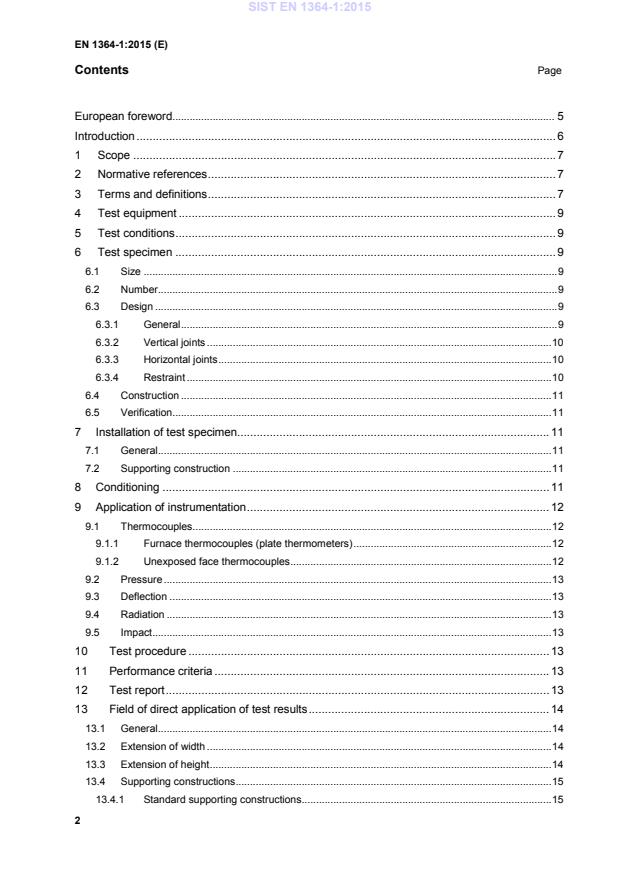
European foreword. 5 Introduction . 6 1 Scope . 7 2 Normative references . 7 3 Terms and definitions . 7 4 Test equipment . 9 5 Test conditions . 9 6 Test specimen . 9 6.1 Size . 9 6.2 Number . 9 6.3 Design . 9 6.3.1 General . 9 6.3.2 Vertical joints . 10 6.3.3 Horizontal joints . 10 6.3.4 Restraint . 10 6.4 Construction . 11 6.5 Verification . 11 7 Installation of test specimen. 11 7.1 General . 11 7.2 Supporting construction . 11 8 Conditioning . 11 9 Application of instrumentation . 12 9.1 Thermocouples. 12 9.1.1 Furnace thermocouples (plate thermometers) . 12 9.1.2 Unexposed face thermocouples . 12 9.2 Pressure . 13 9.3 Deflection . 13 9.4 Radiation . 13 9.5 Impact . 13 10 Test procedure . 13 11 Performance criteria . 13 12 Test report . 13 13 Field of direct application of test results . 14 13.1 General . 14 13.2 Extension of width . 14 13.3 Extension of height . 14 13.4 Supporting constructions . 15 13.4.1 Standard supporting constructions. 15 SIST EN 1364-1:2015
Specific requirements for testing glazed elements or non-loadbearing walls incorporating glazing . 36 A.1 General . 36 A.2 Test specimen design . 36 A.3 Test specimen instrumentation . 37 A.3.1 General . 37 A.3.2 Average temperature rise . 37 A.3.2.1 Fully glazed test specimen . 37 A.3.2.2 Partly glazed test specimen . 37 A.3.3 Maximum temperature rise . 37 A.3.4 Radiation measurement . 38 A.3.5 Deflection measurement . 38 A.4 Field of direct application of test results . 38 A.4.1 General . 38 A.4.2 Field of direct application rules not requiring overrun time. 38 A.4.2.1 Glazed element . 38 A.4.2.1.1 Installation angle . 38 A.4.2.1.2 Height of the glazed element . 39 A.4.2.1.3 Width of the glazed element . 39 A.4.2.2 Glazing system (see Figure 16) . 39 A.4.2.2.1 Linear dimensions . 39 A.4.2.2.2 Aspect ratio . 39 A.4.2.2.3 Glazing beads . 40 A.4.2.3 Framing system (see Figure 16) . 40 A.4.2.4 Supporting constructions . 40 A.4.2.4.1 General . 40 A.4.2.4.2 Standard supporting constructions . 40 A.4.2.4.3 Non-standard supporting construction . 41 A.4.3 Field of direct application rules requiring overrun time . 41 A.4.3.1 General . 41 A.4.3.2 Dimensions of the glazed element . 41 A.4.3.2.1 Height . 41 A.4.3.2.2 Width . 41 A.4.3.3 Dimensions and area of individual rectangular glass panes . 42 A.4.3.4 Aspect ratio . 42 A.4.3.5 Area of individual circular, triangular and four side non-rectangular glass panes . 42 Annex B (normative)
Specific requirements for testing non-loadbearing external and internal walls designed to span horizontally between two independently proven fire resisting vertical structural elements . 43 SIST EN 1364-1:2015
EN 1363-1, Fire resistance tests - Part 1: General Requirements EN 1363-2, Fire resistance tests - Part 2: Alternative and additional procedures EN ISO 13943, Fire safety - Vocabulary (ISO 13943) 3 Terms and definitions For the purposes of this document, the terms and definitions given in EN 1363-1 and EN ISO 13943, together with the following, apply: 3.1 non-loadbearing wall (partition) wall designed not to be subject to any load other than its self-weight 3.2 internal non-loadbearing wall (partition) wall, with or without glazing, which provides fire separation Note 1 to entry It may be exposed separately to a fire from either side. 3.3 external non-loadbearing wall wall forming the external envelope of a building Note 1 to entry It may be exposed separately to an internal or an external fire. SIST EN 1364-1:2015
Test specimens can incorporate both horizontal and vertical joints in the same test. If large dimension boards or panels e.g. 3 m high are used in practice, then this will necessitate two tests for a 3 m x 3 m furnace: one test to evaluate the effect of joints and another to evaluate the full height board or panel. An alternative is to use a 4 m high (or more) furnace in which both the full height board or panel together with the joints at the specified locations can be incorporated in one test. 6.3.4 Restraint The edges shall be restrained as in practice. When the width of the element in practice is larger than the front opening of the furnace, one vertical edge shall be left unrestrained and there shall be a gap of 25 mm to 50 mm between the free edge of the test specimen and the test frame. This gap shall be packed with a resilient non-combustible material, e.g. mineral fibre, to provide a seal without restricting freedom of movement. SIST EN 1364-1:2015
prevent as far as possible the leakage of hot gases from the furnace into the test specimen; b)
prevent as far as possible the leakage of gasses out of the test specimen; c)
have as minimal effect as possible on the deformations of the test specimen; d)
have as minimal effect as possible on the insulation rating of the test specimen. 6.4 Construction The test specimen shall be constructed as described in EN 1363-1. 6.5 Verification Verification of the test specimen shall be carried out as described in EN 1363-1. 7 Installation of test specimen 7.1 General The test specimen shall be installed in the test frame and, if used, the supporting construction, as in practice. The whole area of the test construction shall be exposed to the heating conditions. 7.2 Supporting construction If the size of the test specimen is smaller than the opening in the test frame then it shall be installed in the test frame using one of the following approaches: a) Where the height of the test specimen is smaller than the height of the test frame opening, then a plinth shall be provided to reduce the opening to the required height. The plinth shall possess sufficient stability for the test specimen and shall be selected from one of the rigid standard supporting constructions in EN 1363-1. b) Where the width of the test specimen is smaller, a standard supporting construction shall be provided on the vertical sides of the opening selected from either the rigid or flexible standard supporting constructions given in EN 1363-1. NOTE If the test specimen is mounted in a non-standard supporting construction, then the result will only be valid for non-loadbearing walls mounted in the construction as tested. 8 Conditioning The test construction shall be conditioned in accordance with EN 1363-1. SIST EN 1364-1:2015
at the top of the specimen at mid-width. b)
at the top of the specimen in line with a stud/mullion. c)
at the junction of a stud and a rail, or at the junction of horizontal and vertical joints in a non-loadbearing wall system. d)
at mid height of the fixed edge. e)
at mid height of the free edge, 150 mm in from the edge of test specimen. SIST EN 1364-1:2015
at mid width, where possible, adjacent to a horizontal joint (positive pressure zone). g)
at mid height, where possible, adjacent to a vertical joint (positive pressure zone). Thermocouples for evaluating insulation shall not be positioned closer than 100 mm from any discrete area that is not being evaluated for insulation. If electrical installation boxes, such as socket boxes are tested, the arrangement of the thermocouples is given in Figures 10 and 11. 9.2 Pressure Pressure measuring devices shall be located in accordance with EN 1363-1. 9.3 Deflection Appropriate instrumentation shall be provided to determine a history of all significant deflection (i.e. greater than 5 mm) of the test specimen during the test. One (1) deflection measurement shall be made at the centre of the test specimen. For a test specimen with a width larger than 3 meter, additional measurements shall be made at mid-height at ¼ and ¾ of the width of the specimen. For a test specimen with a height larger than 3 meter, additional measurements shall be made at mid-width at ¼ and ¾ of the height. See Figures 2, 4, 6, 9 and 12. The interval of measurement shall be adequate to present a history of movement during the test. Guidance on the application of deflection measurement is given in EN 1363-1. NOTE
Measurement of deflection is a mandatory requirement although there are no performance criteria associated with it. The deflection of the test specimen may be important in determining the direct field of application and may also be important in determining the extended field of application of the test result. 9.4 Radiation If radiation is to be measured, heat flux meter shall be positioned as described in EN 1363-2. 9.5 Impact If performance under the impact test is required, this shall be carried out as described in EN 1363-2. 10 Test procedure The test shall be carried out using the equipment and procedures in accordance with EN 1363-1 and if appropriate EN 1363-2. 11 Performance criteria The criteria by which the performance of the test specimen is judged are given in EN 1363-1. However, failure under all criteria shall be disregarded within 150 mm of the free edge, unless in practice the free edge is unrestrained. 12 Test report In addition to the items required by EN 1363-1, a reference that the test was carried out in accordance with EN 1364-1 shall also be included in the test report. SIST EN 1364-1:2015
increase in the number of vertical joints, of the type tested; i) the use of installations such as electrical sockets, switches, etc. when tested as illustrated in Figures 9, 10 and 11 with the installations not more than 500 mm from the top edge; j) horizontal and/or vertical joints, of the type tested. For framing systems or systems with visible profiles on the unexposed side, intended to be used for EI classification, no increase in width and depth is allowed in case no temperature measurements on the unexposed side of the profiles were made during the test. The field of direct application for glazed elements or non-loadbearing walls incorporating glazing is given in Annex A. The field of direct application for non-loadbearing external and internal walls designed to span horizontally between two independently proven fire resisting vertical structural elements is given in Annex B. 13.2 Extension of width For test specimens tested without a supporting construction, the width of an identical construction may be increased if the specimen was tested at a minimum of nominally 3 m wide with one vertical edge without restraint. For test specimens tested with a supporting construction, the width of an identical construction may be increased if the specimen was tested at a minimum of nominally 2,8 m wide with one vertical edge without restraint. In case of EW classification, an increase in width of an identical construction is only allowed when the average unexposed surface temperature of any discrete area of the test specimen remains below 300 °C or the measured radiation remains below 6 kW/m2. In any other case, no increase in width is allowed. 13.3 Extension of height The height of the construction may be increased by 1,0 m under the following conditions: SIST EN 1364-1:2015
minimum tested height is 3 m when tested without a supporting construction or 2,8 m when tested with a supporting construction b)
the maximum deflection of the test specimen was not in excess of 100 mm (see 9.3) c)
the expansion allowances are increased pro-rata In case of EW classification, an increase in height of an identical construction is only allowed when the average unexposed surface temperature of any discrete area of the test specimen remains below 300 °C or the measured radiation remains below 6 kW/m2. In any other case, no increase in height is allowed. 13.4 Supporting constructions The following rules for the field of application apply. 13.4.1 Standard supporting constructions a) For specimens tested in the test frame without any supporting construction, the result is applicable to high density rigid supporting constructions with at least the same fire resistance as the test specimen. b) For specimens tested with any standard supporting construction as defined in EN 1363-1, the result is applicable to any other supporting construction of the same type (flexible or rigid) that has the same or a greater classified fire resistance (thicker, denser, more layers of boards, as appropriate) than the one used in the test and the same horizontal and/or vertical orientation, i.e.: • only vertical if the specimen was tested with the standard supporting construction fixed along the vertical edge (see Figure 17, b1); • only horizontal if the specimen was tested with the standard supporting construction fixed along the horizontal edge (see Figure 17, b2); • both if the specimen was tested with the standard supporting construction fixed along both the horizontal and the vertical edge (see Figure 17, b3). 13.4.2 Non-standard supporting constructions The result of a test on a non-loadbearing wall tested in a non-standard supporting construction is only applicable to that construction. SIST EN 1364-1:2015
Key 1 full size panel/board 2 free edge 3
vertical / horizontal joint Figure 1 Position of free edge and joints (see 6.3.2 and 6.3.3 and A.2) SIST EN 1364-1:2015
Key positions for thermocouples for average temperature rise positions for thermocouples for maximum temperature rise
(letters refer to thermocouples denoted by letter in 9.1.2.3) x positions for deflection measurement 1 fixed edge 2 free edge 3 test frame A, B, C, D and E see Figure 3 Figure 2 Example of unexposed thermocouple positions and deflection measurement positions for masonry walls SIST EN 1364-1:2015
Key
positions for thermocouples for maximum temperature rise
(letters refer to thermocouples denoted by letter in 9.1.2.3)
For overall location of thermocouples see Figure 2 Figure 3 Example of unexposed thermocouple positions for masonry walls SIST EN 1364-1:2015
Key positions for thermocouples for average temperature rise positions for thermocouples for maximum temperature rise
(letters refer to thermocouples denoted by letter in 9.1.2.3) x positions for deflection
measurements 1 fixed edge 2 free edge 3 test frame
A, B, C, D and
E
see Figure 5 Figure 4 - Example of unexposed thermocouple positions and deflection measurement positions for walls made of prefabricated panels
Key
positions for thermocouples for maximum temperature rise
(letters refer to thermocouples denoted by letter in 9.1.2.3)
for overall location of thermocouples see Figure 4 Figure 5 - Example of unexposed thermocouple positions for walls made of prefabricated panels
positions for thermocouples for average temperature rise positions for thermocouples for maximum temperature rise
(letters refer to thermocouples denoted by letters in 9.1.2.3) x positions for deflection measurements 1 fixed edge 2 free edge 3 test frame
A, B, D, E, F and G see Figures 7 and 8 Figure 6 - Example of unexposed thermocouple positions and deflection measurement positions for hollow panel walls with metal or timber framework
Key
positions for thermocouples for maximum temperature rise
(letters refer to thermocouples denoted by letter in 9.1.2.3)
for overall location of thermocouples see Figure 6 Figure 7 - Example of unexposed thermocouple positions for hollow walls with metal framework
Key
positions of thermocouples for maximum temperature rise
letters refer to thermocouples denoted by letter in 9.1.2.3)
for overall location of thermocouples see Figure 6 Figure 8 - Example of unexposed thermocouple positions for walls with timber framework
Key positions for thermocouples for average temperature rise positions for thermocouples for maximum temperature rise
(letters refer to thermocouples denoted by letter in 9.1.2.3) x positions for deflection measurements 1 fixed edge 2 free edge 3 test frame
A, B, C, D, E, F and G see Figures 10 and 11 Figure 9 - Example of unexposed thermocouple positions and deflection measurement positions for hollow panel walls with metal or timber framework incorporating horizontal joints and electrical installations
Key positions of thermocouples for maximum temperature rise
(letters refer to thermocouples denoted by letter in 9.1.2.3) 1 electrical installation
for overall location of thermocouples see Figure 9 Figure 10 - Example of unexposed thermocouple positions for hollow panel walls with metal framework incorporating horizontal joints and electrical installations
Key positions of thermocouples for maximum temperature rise
(letters refer to thermocouples denoted by letter in 9.1.2.3) 1 electrical installation
for overall location of t
...