

EN 15269-2:2012
(Main)Extended application of test results for fire resistance and/or smoke control for door, shutter and openable window assemblies, including their elements of building hardware - Part 2: Fire resistance of hinged and pivoted steel doorsets
- Abstract
This European Standard covers single and double leaf, hinged and pivoted, steel based doorsets. It prescribes the methodology for extending the application of test results obtained from fire resistance test(s) conducted in accordance with EN 1634-1.
Subject to the completion of the appropriate test or tests, the extended application may cover all or some of the following examples:
- integrity (E), integrity/radiation (EW) or integrity/insulation (EI1 or EI2) classification;
- door leaf;
- ventilation grilles and/or louvres
- wall/ceiling fixed elements (frame/suspension system);
- glazing for door leaf, side, transom and flush over panels;
- items of building hardware;
- decorative finishes;
- intumescent, smoke, draught or acoustic seals;
- alternative supporting construction(s).
- Status
- Withdrawn
- Publication Date
- 25-Sep-2012
- Withdrawal Date
- 06-Oct-2026
- Technical Committee
- CEN/TC 127 - Fire safety in buildings
- Drafting Committee
- CEN/TC 127/WG 2 - Services
- Current Stage
- 9960 - Withdrawal effective - Withdrawal
- Start Date
- 30-Oct-2024
- Completion Date
- 07-Oct-2026

Relations
- Effective Date
- 15-Feb-2017
- Effective Date
- 28-Jan-2026
- Effective Date
- 28-Jan-2026
- Effective Date
- 28-Jan-2026
- Effective Date
- 28-Jan-2026
- Effective Date
- 28-Jan-2026
- Effective Date
- 28-Jan-2026
- Effective Date
- 28-Jan-2026
Get Certified
Connect with accredited certification bodies for this standard

DIBt (Deutsches Institut für Bautechnik)
German Institute for Building Technology.
DIN CERTCO
DIN Group product certification.

Kiwa BDA Testing
Building and construction product certification.
Sponsored listings
Frequently Asked Questions
EN 15269-2:2012 is a standard published by the European Committee for Standardization (CEN). Its full title is "Extended application of test results for fire resistance and/or smoke control for door, shutter and openable window assemblies, including their elements of building hardware - Part 2: Fire resistance of hinged and pivoted steel doorsets". This standard covers: This European Standard covers single and double leaf, hinged and pivoted, steel based doorsets. It prescribes the methodology for extending the application of test results obtained from fire resistance test(s) conducted in accordance with EN 1634-1. Subject to the completion of the appropriate test or tests, the extended application may cover all or some of the following examples: - integrity (E), integrity/radiation (EW) or integrity/insulation (EI1 or EI2) classification; - door leaf; - ventilation grilles and/or louvres - wall/ceiling fixed elements (frame/suspension system); - glazing for door leaf, side, transom and flush over panels; - items of building hardware; - decorative finishes; - intumescent, smoke, draught or acoustic seals; - alternative supporting construction(s).
This European Standard covers single and double leaf, hinged and pivoted, steel based doorsets. It prescribes the methodology for extending the application of test results obtained from fire resistance test(s) conducted in accordance with EN 1634-1. Subject to the completion of the appropriate test or tests, the extended application may cover all or some of the following examples: - integrity (E), integrity/radiation (EW) or integrity/insulation (EI1 or EI2) classification; - door leaf; - ventilation grilles and/or louvres - wall/ceiling fixed elements (frame/suspension system); - glazing for door leaf, side, transom and flush over panels; - items of building hardware; - decorative finishes; - intumescent, smoke, draught or acoustic seals; - alternative supporting construction(s).
EN 15269-2:2012 is classified under the following ICS (International Classification for Standards) categories: 13.220.50 - Fire-resistance of building materials and elements; 91.060.50 - Doors and windows. The ICS classification helps identify the subject area and facilitates finding related standards.
EN 15269-2:2012 has the following relationships with other standards: It is inter standard links to EN 15269-2:2024, EN ISO 13943:2023, EN 15254-4:2008+A1:2011, EN 13501-2:2023, EN 1634-1:2014+A1:2018, EN 15269-1:2010, EN 1363-1:2020, EN 1634-2:2008. Understanding these relationships helps ensure you are using the most current and applicable version of the standard.
EN 15269-2:2012 is associated with the following European legislation: EU Directives/Regulations: 305/2011, 89/106/EEC; Standardization Mandates: M/117. When a standard is cited in the Official Journal of the European Union, products manufactured in conformity with it benefit from a presumption of conformity with the essential requirements of the corresponding EU directive or regulation.
EN 15269-2:2012 is available in PDF format for immediate download after purchase. The document can be added to your cart and obtained through the secure checkout process. Digital delivery ensures instant access to the complete standard document.
Standards Content (Sample)
2003-01.Slovenski inštitut za standardizacijo. Razmnoževanje celote ali delov tega standarda ni dovoljeno.Erweiterter Anwendungsbereich von Prüfergebnissen zur Feuerwiderstandsfähigkeit und/oder Rauchdichtigkeit von Feuerschutzabschlüssen und Fenstern einschließlich ihrer Baubeschläge - Teil 2: Feuerwiderstandsfähigkeit von Drehflügeltüren aus StahlApplication étendue des résultats d'essais en matière de résistance au feu et/ou d'étanchéité à la fumée des blocs-portes, blocs-fermetures et fenêtres, y compris leurs éléments de quincaillerie - Partie 2 : Résistance au feu des blocs-portes battants et pivotants en acierExtended application of test results for fire resistance and/or smoke control for door, shutter and openable window assemblies, including their elements of building hardware - Part 2: Fire resistance of hinged and pivoted steel doorsets91.060.50Vrata in oknaDoors and windows13.220.50Požarna odpornost gradbenih materialov in elementovFire-resistance of building materials and elementsICS:Ta slovenski standard je istoveten z:EN 15269-2:2012SIST EN 15269-2:2013en,fr,de01-januar-2013SIST EN 15269-2:2013SLOVENSKI
STANDARD
EUROPEAN STANDARD NORME EUROPÉENNE EUROPÄISCHE NORM
EN 15269-2
September 2012 ICS 13.220.50; 91.060.50 English Version
Extended application of test results for fire resistance and/or smoke control for door, shutter and openable window assemblies, including their elements of building hardware - Part 2: Fire resistance of hinged and pivoted steel doorsets
Application étendue des résultats d'essais en matière de résistance au feu et/ou d'étanchéité à la fumée des blocs-portes, blocs-fermetures et fenêtres, y compris leurs éléments de quincaillerie - Partie 2: Résistance au feu des blocs-portes battants et pivotants en acier
Erweiterter Anwendungsbereich von Prüfergebnissen zur Feuerwiderstandsfähigkeit und/oder Rauchdichtigkeit von Türen, Toren und Fenstern einschließlich ihrer Baubeschläge - Teil 2: Feuerwiderstandsfähigkeit von Drehflügeltüren aus Stahl This European Standard was approved by CEN on 20 July 2012.
CEN members are bound to comply with the CEN/CENELEC Internal Regulations which stipulate the conditions for giving this European Standard the status of a national standard without any alteration. Up-to-date lists and bibliographical references concerning such national standards may be obtained on application to the CEN-CENELEC Management Centre or to any CEN member.
This European Standard exists in three official versions (English, French, German). A version in any other language made by translation under the responsibility of a CEN member into its own language and notified to the CEN-CENELEC Management Centre has the same status as the official versions.
CEN members are the national standards bodies of Austria, Belgium, Bulgaria, Croatia, Cyprus, Czech Republic, Denmark, Estonia, Finland, Former Yugoslav Republic of Macedonia, France, Germany, Greece, Hungary, Iceland, Ireland, Italy, Latvia, Lithuania, Luxembourg, Malta, Netherlands, Norway, Poland, Portugal, Romania, Slovakia, Slovenia, Spain, Sweden, Switzerland, Turkey and United Kingdom.
EUROPEAN COMMITTEE FOR STANDARDIZATION
COMITÉ EUROPÉEN DE NORMALISATION EUROPÄISCHES KOMITEE FÜR NORMUNG
Management Centre:
Avenue Marnix 17,
B-1000 Brussels © 2012 CEN All rights of exploitation in any form and by any means reserved worldwide for CEN national Members. Ref. No. EN 15269-2:2012: ESIST EN 15269-2:2013
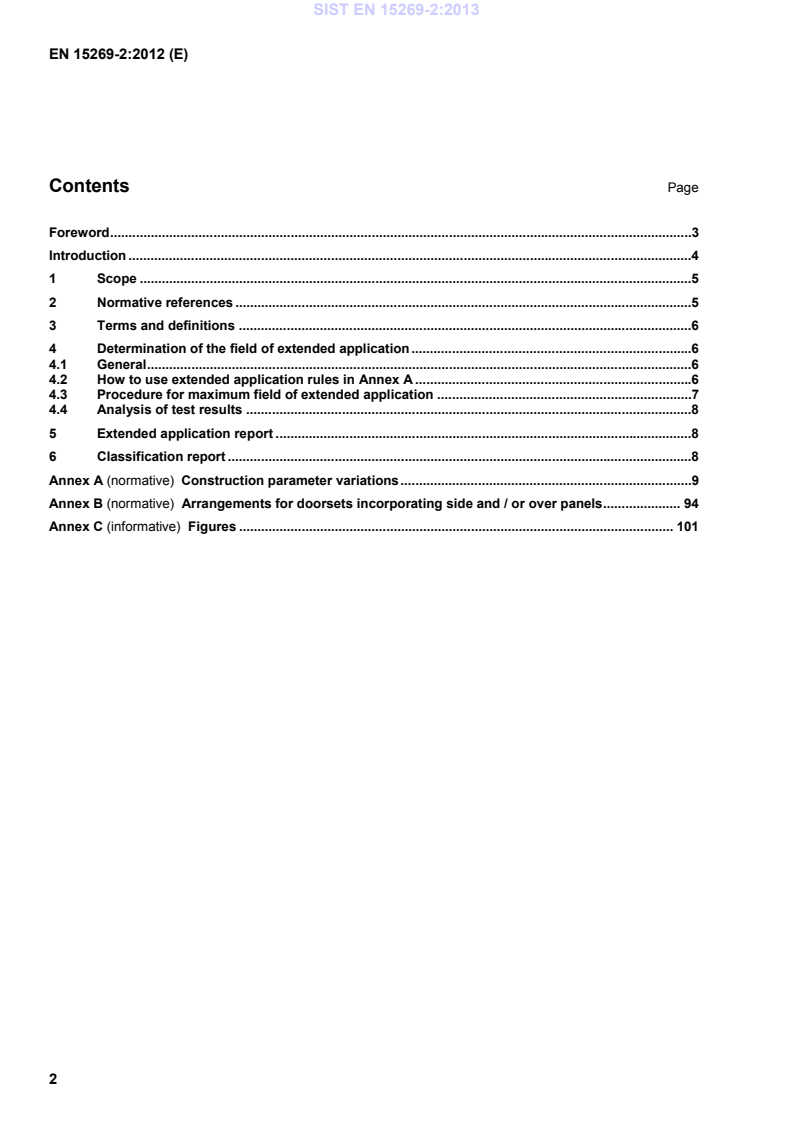
Construction parameter variations .9Annex B (normative)
Arrangements for doorsets incorporating side and / or over panels . 94Annex C (informative)
Figures . 101 SIST EN 15269-2:2013
Part 6: Fire resistance of sliding timber doorsets1) Part 7: Fire resistance of sliding steel doorsets Part 10: Fire resistance of steel rolling shutter assemblies
Part 11: Fire resistance of operable fabric curtains1) Part 20: Smoke control for hinged and pivoted steel, timber and metal framed glazed doorsets According to the CEN/CENELEC Internal Regulations, the national standards organisations of the following countries are bound to implement this European Standard: Austria, Belgium, Bulgaria, Croatia, Cyprus, Czech Republic, Denmark, Estonia, Finland, Former Yugoslav Republic of Macedonia, France, Germany, Greece, Hungary, Iceland, Ireland, Italy, Latvia, Lithuania, Luxembourg, Malta, Netherlands, Norway, Poland, Portugal, Romania, Slovakia, Slovenia, Spain, Sweden, Switzerland, Turkey and the United Kingdom.
1) In preparation. SIST EN 15269-2:2013
EN 13501-2, Fire classification of construction products and building elements — Part 2: Classification using data from fire resistance tests, excluding ventilation services
EN 15254-4:2008+A1:2011, Extended application of results from fire resistance tests — Non-loadbearing walls — Part 4. Glazed constructions EN 15269-1:2010, Extended application of test results for fire resistance and/or smoke control for door, shutter and openable window assemblies, including their elements of building hardware — Part 1: General requirements EN ISO 13943, Fire safety — Vocabulary (ISO 13943) SIST EN 15269-2:2013
4.1 General 4.1.1 Before there can be any consideration for extended application, a representative doorset shall have been tested and classified in accordance with EN1634-1 and EN 13501-2 respectively in order to establish a classification for the doorset. 4.1.2 A review of the doorset construction parameters can indicate that one or more characteristics may be improved by a particular parameter variation. All evaluations shall be made on the basis of retaining the classifications obtainable from testing to EN 1634-1, including those lower than the test duration. However, this shall never lead to an increased classification for any specific parameter beyond that achieved during any one test unless specifically identified in the relevant Construction Parameter Variation tables. 4.1.3 If, when following the extended application procedure, any part of the classified product cannot be covered by the extended application rules, that part shall be omitted from the subsequent extended application report and classification report. 4.2 How to use extended application rules in Annex A 4.2.1 Identify the variations from the original test specimen(s) which are required to be covered by an extended application report. 4.2.2 Locate the variations in the appropriate parameter variation by reference to columns (1) and (2) of Annex A. SIST EN 15269-2:2013
5 Extended application report Prepare an extended application report in accordance with the requirements of EN 15269-1:2010, Clause 6 based on the results of evaluations in accordance with the above. 6 Classification report The classification report shall be determined from the results of the extended application report and presented in accordance with EN 13501-2.
Construction parameter variations The table below
is designed to be used by experts competent in the field of fire resistance testing of hinged and pivoted steel doorsets. The table shall only be used to assess a field of extended application when at least one positive fire resistance test to EN 1634-1 has generated a classification according to EN 13501-2.
The first two columns identify possible variations to the construction details of the specimen tested.
The influence of variation on performance characteristic is identified from column (3) as integrity, insulation or radiation (E, I or W respectively). For some parameters, it is necessary to evaluate whether the specimen displayed a high, medium or low level of distortion during the test. Where this is the case, the following levels shall be used to establish high, medium and low distortion doorsets as measured using the maximum relative movement at any position between the edge of the door leaf and door frame or between the meeting edges of door leaves or the relative movement of the framing members for panelled systems. The measurements shall be taken from the start of the test at any time during the complete required classification period. The deflections shall be measured at the positions given in EN 1634-1: low <40 % of effective rebate depth; medium ≥ 40 % and ≤ 85 % of effective rebate depth; high >85 % of effective rebate depth. The effect of the change in each parameter is evaluated for each characteristic in column (3) under E for effects on integrity, I for effects on insulation (whether an I1 or I2) and W for the effects on radiation. These evaluations lead to the judgement of the possibility of extending the field of application, the results of which are given in column (4). In certain cases in column (4), it is a requirement to achieve Category B, the requirements for which are given in EN 1634-1. Where additional tests are deemed to be necessary, the type of specimen approved for incorporation of the changed parameter is defined in column (5). Where it is possible to use information from tests performed on one configuration for evidence on a different configuration, this allowance has been made in order to reduce the overall number of tests required for extended application evaluation e.g. single action doorsets to double action doorsets. Where an additional test is required in column (5), the test is a full scale test with the specimen opening outwards (away from the furnace) unless otherwise specified. In order to maximise the possible field of application from a minimum number of tests, the parameter changes have been spread over a series of test specimens. The recommended tests for each parameter is dependant upon the classification required and the preferred direction of testing as indicated in column (5). Where more than a single parameter variation is required, the influence on other variations shall also be taken into account.
Key to symbols in column (3) (which is informative only) >
-
higher performance anticipated <
-
lower performance anticipated =
- no significant change in performance anticipated ≥
- equal or higher performance anticipated
≤
- equal or lower performance anticipated >=< - the influence on performance could be worse, equal or better hence variations not possible unless specific, limited conditions are identified
Construction Parameter Variation Influence of variation on performance characteristic Possibility of extension
Additional Evidence Required (1) (2) (3) (4) (5)
E I W
A Door leaf In certain cases, the rules given in Section A are also appropriate to side, transom and flush over panels or the door frame. Where this is the case, it is clearly indicated at the beginning of the relevant section. For double leaf doorsets, both leaves shall be of the same basic construction. A.1 General A.1.1 Number of leaves - See Figure A.1 only applicable to doorsets tested without transom and/or flush over panels. See Annex B Single leaf from double leaf test ≤ ≥ ≥ Not possible without an additional test Additional test single leaf doorset A.1.2 Number of leaves only applicable to doorsets tested without transom and/or flush over panels. See Annex B Double leaf from single leaf test < ≤ ≤ Not possible without additional test (s) Additional test (s) double leaf doorset (open outwards and inwards for EI doors, open outwards for E or W doors) SIST EN 15269-2:2013
Additional Evidence Required (1) (2) (3) (4) (5)
E I W
A.1.3 Number of panels per leaf (primary or secondary) Add (one panel per leaf – on any leaf) = = = Possible if tested at least one leaf (single, primary or secondary) with the minimum of two panels, panel size not increased and the intended jointing technique centrally located in the door leaf otherwise not possible without an additional test Additional test single leaf or double leaf doorset A.1.4 Number of panels per leaf(primary or secondary) - See Figure A.2 Reduce (one panel per leaf) = = = Possible providing the tested width of the panel is not increased otherwise not possible without an additional test Additional test single leaf or double leaf doorset A.1.5 Intumescent seals between frame and door leaf/leaves - See Figure A.3 Location towards the frame rebate >=< >=< >=< Not possible without an additional test Additional test single leaf or double leaf doorset A.1.6 Intumescent seals between frame and door leaf/leaves – See Figure A.4 Location away from the frame rebate >=< >=< >=< Not possible without an additional test Additional test single leaf or double leaf doorset A.1.7 Intumescent seals between meeting edges of the door leaves Location >=< >=< >=< Not possible without additional test (s) Additional test (s) double leaf doorset (open outwards and inwards for EI doors, open outwards for E or W doors) A.1.8 Non-intumescent seals between frame and door leaf/leaves (draught/smoke/acoustic etc.) – Euroclass A1, e.g. ceramic products (fitted in leaf or frame) - See Figure A.5 Location = = = Any movement possible providing no modifications of the construction are required otherwise not possible without an additional test Additional test single or double leaf doorset if the seal is positioned between the meeting edges of the door leaves the additional test shall be a double leaf doorset A.1.9 Non-intumescent seals between meeting edges of the door leaves (draught/smoke/acoustic etc.) - Euroclass A1, e.g. ceramic products
Location >/=/< >/=/< >/=/< No movement possible without an additional test Additional test double leaf doorset
Additional Evidence Required (1) (2) (3) (4) (5)
E I W
A.1.10 Non-intumescent seals between door leaves and/or frames (draught/smoke/acoustic etc.) – < Euroclass A1 (fitted in leaf or frame) - See Figure A.6 Location >/=/< >/=/< >/=/< No movement possible without an additional test Additional test single or double leaf doorset, if the seal is positioned between the meeting edges of the door leaves the additional test shall be a double leaf doorset A.1.11 Non-intumescent seals between door leaves and/or frames (draught/smoke/acoustic etc.) - Euroclass A1, e.g. ceramic products (fitted in leaf or frame). - See Figure A.7 Add = = = Possible for doors without intumescent seals and providing the gap between door leaf and door frame is not increased otherwise not possible without an additional test Additional test single or double leaf doorset, if the seal is positioned between the meeting edges of the door leaves the additional test shall be a double leaf doorset A.1.12 Non-intumescent seals between door leaves and/or frames (draught/smoke/acoustic etc.) - Euroclass A1, e.g. ceramic products (fitted in leaf or frame) - See Figure A.8 Remove ≤ ≤ ≤ Not possible without an additional test Additional test single or double leaf doorset, if the seal is positioned between the meeting edges of the door leaves the additional test shall be a double leaf doorset A.1.13 Non-intumescent seals between door leaves and/or frames (draught/smoke/acoustic etc.) – < Euroclass A1 (fitted in leaf or frame) - See Figure A.9 Add ≤ ≤ ≤ Not possible without an additional test Additional test single or double leaf doorset, if the seal is positioned between the meeting edges of the door leaves the additional test shall be a double leaf doorset SIST EN 15269-2:2013
Additional Evidence Required (1) (2) (3) (4) (5)
E I W
A.1.14 Non-intumescent seals between door leaves and/or frames (draught/smoke/acoustic etc. – < Euroclass A1 (fitted in leaf or frame) - See Figure A.10 Remove >/=/< >/=/< = Not possible without an additional test Additional test single or double leaf doorset, if the seal is positioned between the meeting edges of the door leaves the additional test shall be a double leaf doorset A.1.15 Ventilation grilles (louvres) in door leaf tested without ventilation grille - See Figure A.11 a) Add ≤ ≤ ≤ Not possible without an additional test Additional test single or double leaf doorset A.1.16 Ventilation grilles (louvres) in door leaf - See Figure A.11 b)
Remove >/=/< ≥ ≥ Possible providing the cut out is less than 25 % of the door leaf area otherwise not possible without an additional test Additional test single or double leaf doorset A.1.17 Ventilation grilles (louvres) in door leaf tested with ventilation grille Location in vertical direction ≤ ≤ ≤ Possible for lower location than tested otherwise not possible without an additional test Additional test single or double leaf doorset A.1.18 Ventilation grilles (louvres) in door leaf tested with ventilation grille - See Figure A.12 Location in horizontal direction = = = Possible providing the distance between the edge of the louvre and the perimeter of the door leaf is not decreased and providing any internal stiffening elements are not affected otherwise not possible without an additional test Additional test single or double leaf doorset A.1.19 Ventilation grilles (louvres) in door leaf tested with ventilation grille- See Figure A.13 a) Smaller size ≥ ≥ ≥ Possible for one or more louvres smaller than that tested specimen providing the location is inside the perimeter of the tested louvre and minimum spacing between cut outs is not less than 100 mm otherwise not possible without an additional test Additional test single or double leaf doorset SIST EN 15269-2:2013
Additional Evidence Required (1) (2) (3) (4) (5)
E I W
- See Figure A.13 b) Larger size ≤ ≤ ≤ Not possible without an additional test Additional test single or double leaf doorset A.1.20 Rebate (door leaves to frames) - See Figure A.14 a) Add ≥ ≤ ≥ EI Not possible without an additional test unless the original test had additional thermocouples positioned 100 mm and/or 25 mm from the edge of the notional rebate (i.e. 100-x) where x means the width of the added rebate and dimension y (overlap) shall not be decreased by a maximum of three times the steel thickness of the door leaf
Additional test single or double leaf doorset E, EW Possible providing no decrease of dimension y (overlap) or leaf edge thickness by a maximum of three times the steel thickness of the door leaf otherwise not possible without an additional test
Additional test single or double leaf doorset A.1.21 Rebate (meeting edges) - See Figure A.14 b) Add (one rebate) ≥ ≥ ≥ Possible if the doorset included one rebate and the added rebate is of the same design/material as that tested otherwise not possible without an additional test Additional test double leaf doorset (added rebate away from the fire) A.1.22 Rebate (door leaves to frames) - See Figure A.15 Remove ≤ ≤ ≤ Not possible without an additional test Additional test single or double leaf doorset (open inwards) A.1.23 Rebate (meeting edges) Remove ≤ ≤ ≤ Not possible without an additional test Additional test double leaf doorset (open inwards) A.1.24 Latched condition for single and double leaf doorsets Change in latching >=< = = Possible in line with the following relationship: Additional test to include the SIST EN 15269-2:2013
Additional Evidence Required (1) (2) (3) (4) (5)
E I W
condition
tested without a latch/lock tested with a latch/lock but unlatched tested with a latch/lock latched required latching condition - extension to: without a lock/latch - possible not possibleextension to: with lock/latch but unlocked/ unlatched not possible - not possibleextension to: with a lock/latch, latched not possible possible - A.2 Size variations /single or multiple panel construction A.2.1 Size (area, width, height) all distortions Decrease ≥ ≤ ≥ Possible in line with direct application or for EI doors possible from the size tested down to the size of a second test specimen in the same design using direct application rules otherwise not possible without an additional test For single leaf doorsets additional test single leaf or double leaf doorset , for double leaf doorsets additional test double leaf doorset SIST EN 15269-2:2013
Additional Evidence Required (1) (2) (3) (4) (5)
E I W
A.2.2 Height – all distortions Increase ≤ = ≤ Possible in line with direct application or possible to a maximum addition equal to the tested dimension between the latch and top of the door leaf providing an additional top hinge/dog bolt together with additional latch in the area of the top free corner are incorporated and additionally (for EW) an emitted radiation calculation in accordance with EN 1363-2 within the 15 KW limit or possible for doorsets which have achieved category B up to: 15 % for high distortion
20 % for medium distortion and
25 % for low distortion providing overlap of door leaf to frame header is not reduced and distance between top hinge and top of door leaf is equal to or less than tested and additional (for EW) an emitted radiation calculation in accordance with EN 1363-2 within the 15 KW limit or new test to a taller door Door sizes beyond the direct application are based on testing of model specimen to maximum size that can be accomodated in a standard furnace
For single leaf doorsets additional test single leaf or double leaf doorset , for double leaf doorsets additional test double leaf doorset SIST EN 15269-2:2013
Additional Evidence Required (1) (2) (3) (4) (5)
E I W
A.2.3 Width - all distortions Increase ≤ = ≤ Possible in line with direct application or possible for doorsets which have achieved category B up to: 15 % for high distortion
20 % for medium distortion and
25 % for low distortion,
providing overlap of door leaf to frame jamb is not reduced
and additional (for EW) an emitted radiation calculation in accordance with EN 1363-2 within the 15 KW limit or new test to a wider door Door sizes beyond the direct application are based on testing of model specimen to maximum size that can be accomodated in a standard furnace
for single leaf doorsets additional test single leaf or double leaf doorset , for double leaf doorsets additional test double leaf doorset A.2.4 Area - all distortions Increase ≤ = ≤ Possible in line with direct application or where height is achieved by additional latch and hinge / dog bolt full width extension can be applied or possible for doorsets which have achieved category B up to: 20 % for high distortion
25 % for medium distortion and
30 % for low distortion, providing overlap of door leaf to frame header and frame jamb is not reduced and distance between top hinge and top of the door leaf is equal to or less than tested and additional (for EW) an emitted radiation calculation in accordance with EN 1363-2 from within the 15 KW limit or new test to a bigger door Additional test see A.2.2 and/or A.2.3 SIST EN 15269-2:2013
Additional Evidence Required (1) (2) (3) (4) (5)
E I W
A.2.5 Thickness of the door leaf
based on high distortion Increase >/=/< ≥ ≥ Not possible without an additional test Additional test single or double leaf doorset based on medium distortion
>/=/< ≥ ≥ Possible providing the same increase of thickness of core material by a maximum of 10 % otherwise not possible without an additional test Additional test single or double leaf doorset based on low distortion
>/=/< ≥ ≥ Possible providing the same increase of thickness of core material by a maximum of 25 % otherwise not possible without an additional test Additional test single or double leaf doorset A.2.6 Thickness of the door leaf - all distortions Decrease >/=/< ≤ ≤ E Possible by a maximum of 10 % otherwise not possible without an additional test
EI, EW not possible without an additional test
Additional test single for single leaf doorsets or double leaf for double leaf doorsets
additional test single for single leaf doorsets or double leaf for double leaf doorsets A.3. Materials and constructions A.3.1 Density of core material (organic or Euroclass A1) – all distortions Increase >/=/< ≥ ≥ Possible by a maximum of 15 % (nominal value) of each core material of the door leaf
above 15 % not possible without an additional test Additional test single or double leaf doorset A.3.2 Density of core material (organic or Euroclass A1) – all distortions Decrease >/=/< ≤ ≤ E possible EI, EW not possible without an additional test
Additional test single or double leaf doorset SIST EN 15269-2:2013
Additional Evidence Required (1) (2) (3) (4) (5)
E I W
A.3.3 Thickness of core material - See Figure A.16 based on high distortion Increase >/=/< ≥ ≥ Not possible without an additional test Additional test single or double leaf doorset based on medium distortion
>/=/< ≥ ≥ Possible by a maximum of 10 % in accordance with thickness of door leaf and providing that no single element of the core is reduced in thickness otherwise not possible without an additional test Additional test single or double leaf doorset based on low distortion
>/=/< ≥ ≥ Possible by a maximum of 25 % in accordance with thickness of door leaf and providing that no single element of the core is reduced in thickness otherwise not possible without an additional test Additional test single or double leaf doorset
A.3.4 Thickness of core material - See Figure A.17 Decrease >/=/< ≤ ≤ E Possible by a maximum of 10 % for a low distortion doorset otherwise not possible without an additional test EI, EW not possible without an additional test
Additional test single for single leaf doorsets or double leaf for double leaf doorsets A.3.5 Pattern of core material - See Figure A.18 Increase number of pieces >/=/< ≤ ≤ E Possible EI, EW Possible proportional to any size increase providing the original test specimen includes horizontal and / or vertical joint (s) between the core material pieces as appropriate otherwise not possible without an additional test
Additional test single or double leaf doorset SIST EN 15269-2:2013
Additional Evidence Required (1) (2) (3) (4) (5)
E I W
A.3.6 Pattern of core material - See Figure A.19 Decrease number of pieces ≥ ≥ ≥ Possible - A.3.7 Number of layers of identical and/or different materials - See Figure A.20 Increase >/=/< >/=/< >/=/< Not possible without an additional test Additional test single or double leaf doorset A.3.8 Number of layers of identical and/or different materials - See Figure A.21 Decrease >/=/< >/=/< >/=/< Not possible without an additional test Additional test single or double leaf doorset A.3.9 Type of core material (single thickness or in combination of different layers) Change of supplier/manufacturer of identical material with identical composition and properties
= = = Possible
- A.3.10 Type of core material (single thickness or in combination of different layers) Alternative composition >/=/< >/=/< >/=/< Not possible without an additional test Additional test single or double leaf doorset A.3.11 Amount of adhesive / m2 – organic based
(< Euroclass A1) Increase ≤ = = Not possible without an additional test Additional test single or double leaf doorset A.3.12 Amount of adhesive / m2 – organic based (< Euroclass A1) Decrease ≤ ≤ ≤ Possible - A.3.13 Amount of adhesive / m2 – inorganic based (Euroclass A1), Increase = = = Possible providing no intumescent content otherwise not possible without an additional test Additional test single or double leaf doorset A.3.14 amount of adhesive / m2 – inorganic based (Euroclass A1),
Decrease ≤ ≤ ≤ Not possible without an additional test Additional test single or double leaf doorset SIST EN 15269-2:2013
Additional Evidence Required (1) (2) (3) (4) (5)
E I W
A.3.15 Type of adhesive Change of manufacturer for identical composition = = = Possible for identical chemical composition otherwise not possible without an additional test Additional test single or double leaf doorset A.3.16 Type of adhesive Alternative composition >/=/< >/=/< >/=/< Not possible without an additional test Additional test single or double leaf doorset A.3.17 Metal armour sheet (internally mounted) - See Figure A.22 a) Add ≤ ≤ ≤ Not possible without an additional test Additional test single or double leaf doorset A.3.18 metal armour sheet (internally mounted) - See Figure A.22 b) Remove ≤ ≤ ≤ Not possible without an additional test Additional test single or double leaf doorset A.3.19 Electronic security mesh - See Figure A.23 a) Add = = = Possible for mesh thickness to a maximum of 1,0 mm with an inorganic coating – face fixed or internally mounted
otherwise not possible without an additional test
also not possible for organic coated mesh without additional test Additional test single or double leaf doorset A.3.20 Electronic security mesh - See Figure A.23 b) Remove = = = Possible - A.3.21 Thickness of steel sheet Increase ≤ ≤ ≤ Possible to a maximum of 10 % above 10 % not possible without an additional test Additional test single or double leaf doorset A.3.22 Thickness of steel sheet Decrease ≥ ≥ ≥ Possible to a maximum of 25 % above 25 % not possible without an additional test Additional test single or double leaf doorset SIST EN 15269-2:2013
Additional Evidence Required (1) (2) (3) (4) (5)
E I W
A.3.23 Type of steel sheet Mild to stainless >/=/< >/=/< >/=/< Possible only for low and medium distorsion latched door leaves providing that the material thickness shall not be increased but may be decreased up to a maximum of 20 % otherwise not possible without an additional test
Additional test single or double leaf doorset A.3.24 Type of steel sheet Stainless to mild >/=/< >/=/< >/=/< Possible only for latched door leaves providing that the material thickness shall not be decreased but may be increased up to a maximum of 25 % otherwise not possible without an additional test Additional test single or double leaf doorset A.3.25 Cross-section dimension of stiffening elements - See Figure A.24 a) Increase ≥ ≤ ≥ E & EW Possible up to a maximum increase of 50 % EI Not possible without an additional test
Additional test single or double leaf doorset A.3.26 Cross-section dimension of stiffening elements - See Figure A.24 b)
Decrease ≤ = = Not possible without an additional test Additional test single or double leaf doorset A.3.27 Number of intermediate stiffening elements - See Figure A.25 a)
Increase ≥ ≤ ≤ E Possible EI, EW Possible proportional to the increase of height or width of the panel, as appropriate, rounded to the nearest whole number of stiffeners
otherwise not possible without an additional test
Additional test single or double leaf doorset A.3.28 Number of intermediate stiffening elements - See Figure A.25 b)
Decrease ≤ ≥ ≥ Possible proportional to the decrease of height or width of the panel, as appropriate, rounded to the nearest whole number of stiffeners otherwise not possible without an additional test Additional test single or double leaf doorset SIST EN 15269-2:2013
Additional Evidence Required (1) (2) (3) (4) (5)
E I W
A.3.29 Stiffening elements - See Figure A.26 Location >/=/< = = Possible within a maximum of 10 % of original separating dimension otherwise not possible without an additional test Additional test single or double leaf doorset A.3.30 Number of stiffening element fixing points - See Figure A.27 a) Increase ≥ = = Possible - A.3.31 Number of stiffening element fixing points - See Figure A.27 b) Decrease ≤ = = Possible if proportionately in line with a leaf size decrease otherwise not possible without an additional test Additional test single or double leaf doorset A.3.32 Overlap dimension of leaf edge rebate (between leaf and frame) - See Figure A.28 a) Increase ≥ ≤ >/=/< E, EW Possible EI Possible providing the original test had additional thermocouples positioned 100mm or 25mm from the edge of the notional rebate otherwise not possible without an additional test
Additional test single or double leaf doorset (open outwards) A.3.33 Overlap dimension of panel edge rebate (meeting edges) - See Figure A.28 b) Increase ≤ ≥ >/=/< E, EW Possible EI Possible providing the original test had additional thermocouples positioned 100mm or 25mm from the edge of the notional rebate otherwise not possible without an additional test
Additional test double leaf doorset A.3.34 Overlap dimension of leaf edge rebate
...