

EN 1678:1998+A1:2010
(Main)Food processing machinery - Vegetable cutting machines - Safety and hygiene requirements
- Abstract
1.1 This European Standard specifies the safety and hygiene requirements for the design and manufacture of vegetable cutting machines which are transportable and have a maximum rated power less than 3 kW.
This European Standard deals with machines intended for cutting, shredding, dicing, chipping and grating of food products in which the product passes through the machine.
As described in 3.2.1, the types of machines in the scope are machines with a fixed chamber and rotating blade or cutting disc, with a rotating drum and fixed blades or machines with horizontal reciprocating cutters (mainly used for potato chipping).
1.2 This European Standard specifies all significant hazards, hazardous situations and events relevant to vegetable cutting machines, when they are used as intended and under conditions of misuse which are reasonably foreseeable by the manufacturer (see Clause 4).
This European Standard deals with the hazards which can arise during commissioning, operation, cleaning, removal of food blockages, feeding, changing the tools, maintenance and decommissioning of the machine.
1.3 This European Standard does not apply to:
- food processors (see EN 12852);
- vegetable peelers (see EN 13208);
- vegetable cutting attachments which are mounted onto machines having an auxiliary drive hub (see
EN 12851);
- planetary mixers (see EN 454);
- domestic machines.
1.4 This European Standard is not applicable to vegetable cutting machines which are manufactured before the date of its publication as EN.
- Status
- Published
- Publication Date
- 11-May-2010
- Withdrawal Date
- 29-Nov-2010
- Technical Committee
- CEN/TC 153 - Food processing machinery - Safety and hygiene specifications
- Drafting Committee
- CEN/TC 153/WG 4 - Catering equipment
- Current Stage
- 9060 - Closure of 2 Year Review Enquiry - Review Enquiry
- Start Date
- 02-Sep-2017
- Completion Date
- 02-Sep-2017
- Directive
- 2006/42/EC - Directive 2006/42/EC of the European Parliament and of the Council of 17 May 2006 on machinery, and amending Directive 95/16/EC (recast)OJ Ref: C, C 284 OJ Date: 20-Oct-2010

Overview
EN 1678:1998+A1:2010 is a CEN type C European standard for food processing machinery that sets safety and hygiene requirements for vegetable cutting machines that are transportable and have a maximum rated power of less than 3 kW. It covers machines used for cutting, shredding, dicing, chipping and grating where the product passes through the machine, including:
- machines with a fixed chamber and rotating blade/cutting disc
- machines with a rotating drum and fixed blades
- machines with horizontal reciprocating cutters (often for potato chipping)
The standard identifies significant hazards and prescribes design, manufacturing and verification requirements for safe and hygienic operation throughout the machine lifecycle (commissioning, operation, cleaning, removal of blockages, feeding, tool changes, maintenance and decommissioning).
Key topics and technical requirements
- Scope and machine types: transportable machines <3 kW; excludes domestic machines and specific categories (see Related Standards).
- Hazard coverage: mechanical (cutting, drawing-in, crushing), electrical shock, hygiene-related contamination risks, and ergonomic hazards.
- Safety measures:
- Guards and interlocks in accordance with EN 1088.
- Safety-related control parts: at least Performance Level c and Category 1 per EN ISO 13849-1:2008.
- Design for cleanability and hygienic construction (ref. EN 1672-2 principles).
- Electrical requirements per EN 60204-1 and enclosure protection per EN 60529 (IP code).
- Ergonomics and working distances per EN 614-1 and EN ISO 13857.
- Verification and documentation: tests, noise measurement code (Annex A), cleanability design principles (Annex B), test probes (Annex C) and information for use (marking and instruction handbook).
- Lifecycle hazards addressed: access through feed hoppers, delivery chutes, opening for cleaning/tool change, driving mechanisms, handling of cutting tools.
Applications and who uses it
This standard is essential for:
- Manufacturers and designers of industrial vegetable cutting machines to ensure compliance with EU safety and hygiene expectations.
- Safety and compliance engineers, CE marking teams and technical documentation authors preparing conformity assessments.
- Food processors, installers and maintenance personnel who need to understand machine safety, cleaning and ergonomic requirements.
- Testing laboratories and notified bodies verifying machine conformity and noise/hygiene test results.
Practical benefits include reduced injury risk, improved hygiene/cleanability, clearer maintenance procedures, and smoother regulatory compliance for equipment used in commercial food production.
Related standards (normative references)
Key referenced documents include: EN 1672-2, EN 1088, EN 60204-1, EN 60529, EN ISO 12100-1/2, EN ISO 13849-1, EN ISO 13857, EN 614-1, noise and surface texture standards. The standard explicitly excludes food processors (EN 12852), vegetable peelers (EN 13208), cutting attachments on auxiliary drive hubs (EN 12851), planetary mixers (EN 454) and domestic machines.
Keywords: EN 1678:1998+A1:2010, vegetable cutting machines, food processing machinery, safety and hygiene requirements, CEN, machine cleanability, industrial food equipment.
Relations
- Effective Date
- 18-Jan-2023
- Effective Date
- 09-Feb-2026
- Effective Date
- 28-Jan-2026
- Effective Date
- 28-Jan-2026
- Effective Date
- 28-Jan-2026
- Effective Date
- 28-Jan-2026
- Effective Date
- 28-Jan-2026
- Effective Date
- 28-Jan-2026
- Effective Date
- 28-Jan-2026
- Effective Date
- 28-Jan-2026
- Effective Date
- 28-Jan-2026
- Effective Date
- 28-Jan-2026
- Effective Date
- 28-Jan-2026
- Effective Date
- 28-Jan-2026
- Referred By
EN 1012-1:2010 - Compressors and vacuum pumps - Safety requirements - Part 1: Air compressors - Effective Date
- 28-Jan-2026
Get Certified
Connect with accredited certification bodies for this standard

BSI Group
BSI (British Standards Institution) is the business standards company that helps organizations make excellence a habit.

Bureau Veritas
Bureau Veritas is a world leader in laboratory testing, inspection and certification services.

DNV
DNV is an independent assurance and risk management provider.
Sponsored listings
Frequently Asked Questions
EN 1678:1998+A1:2010 is a standard published by the European Committee for Standardization (CEN). Its full title is "Food processing machinery - Vegetable cutting machines - Safety and hygiene requirements". This standard covers: 1.1 This European Standard specifies the safety and hygiene requirements for the design and manufacture of vegetable cutting machines which are transportable and have a maximum rated power less than 3 kW. This European Standard deals with machines intended for cutting, shredding, dicing, chipping and grating of food products in which the product passes through the machine. As described in 3.2.1, the types of machines in the scope are machines with a fixed chamber and rotating blade or cutting disc, with a rotating drum and fixed blades or machines with horizontal reciprocating cutters (mainly used for potato chipping). 1.2 This European Standard specifies all significant hazards, hazardous situations and events relevant to vegetable cutting machines, when they are used as intended and under conditions of misuse which are reasonably foreseeable by the manufacturer (see Clause 4). This European Standard deals with the hazards which can arise during commissioning, operation, cleaning, removal of food blockages, feeding, changing the tools, maintenance and decommissioning of the machine. 1.3 This European Standard does not apply to: - food processors (see EN 12852); - vegetable peelers (see EN 13208); - vegetable cutting attachments which are mounted onto machines having an auxiliary drive hub (see EN 12851); - planetary mixers (see EN 454); - domestic machines. 1.4 This European Standard is not applicable to vegetable cutting machines which are manufactured before the date of its publication as EN.
1.1 This European Standard specifies the safety and hygiene requirements for the design and manufacture of vegetable cutting machines which are transportable and have a maximum rated power less than 3 kW. This European Standard deals with machines intended for cutting, shredding, dicing, chipping and grating of food products in which the product passes through the machine. As described in 3.2.1, the types of machines in the scope are machines with a fixed chamber and rotating blade or cutting disc, with a rotating drum and fixed blades or machines with horizontal reciprocating cutters (mainly used for potato chipping). 1.2 This European Standard specifies all significant hazards, hazardous situations and events relevant to vegetable cutting machines, when they are used as intended and under conditions of misuse which are reasonably foreseeable by the manufacturer (see Clause 4). This European Standard deals with the hazards which can arise during commissioning, operation, cleaning, removal of food blockages, feeding, changing the tools, maintenance and decommissioning of the machine. 1.3 This European Standard does not apply to: - food processors (see EN 12852); - vegetable peelers (see EN 13208); - vegetable cutting attachments which are mounted onto machines having an auxiliary drive hub (see EN 12851); - planetary mixers (see EN 454); - domestic machines. 1.4 This European Standard is not applicable to vegetable cutting machines which are manufactured before the date of its publication as EN.
EN 1678:1998+A1:2010 is classified under the following ICS (International Classification for Standards) categories: 67.260 - Plants and equipment for the food industry. The ICS classification helps identify the subject area and facilitates finding related standards.
EN 1678:1998+A1:2010 has the following relationships with other standards: It is inter standard links to EN 1678:1998, EN 60529:1991, EN ISO 4871:1996, EN ISO 13849-1:2008, EN 1088:1995, EN ISO 12100-2:2003, EN 614-1:2006, EN ISO 4287:1998, EN ISO 14120:2015, EN 1672-2:2005, EN ISO 11201:1995, EN ISO 13857:2008, EN ISO 3744:1995, EN ISO 12100-1:2003, EN 1012-1:2010. Understanding these relationships helps ensure you are using the most current and applicable version of the standard.
EN 1678:1998+A1:2010 is associated with the following European legislation: EU Directives/Regulations: 2006/42/EC, 98/37/EC; Standardization Mandates: M/396. When a standard is cited in the Official Journal of the European Union, products manufactured in conformity with it benefit from a presumption of conformity with the essential requirements of the corresponding EU directive or regulation.
EN 1678:1998+A1:2010 is available in PDF format for immediate download after purchase. The document can be added to your cart and obtained through the secure checkout process. Digital delivery ensures instant access to the complete standard document.
Standards Content (Sample)
2003-01.Slovenski inštitut za standardizacijo. Razmnoževanje celote ali delov tega standarda ni dovoljeno.Nahrungsmittelmaschinen - Gemüseschneidemaschinen - Sicherheits- und HygieneanforderungenMachines pour les produits alimentaires - Coupe-légumes - Prescriptions relatives à la sécurité et à l'hygièneFood processing machinery - Vegetable cutting machines - Safety and hygiene requirements67.260Tovarne in oprema za živilsko industrijoPlants and equipment for the food industryICS:Ta slovenski standard je istoveten z:EN 1678:1998+A1:2010SIST EN 1678:2000+A1:2010en,fr,de01-oktober-2010SIST EN 1678:2000+A1:2010SLOVENSKI
STANDARD
EUROPEAN STANDARD NORME EUROPÉENNE EUROPÄISCHE NORM
EN 1678:1998+A1
May 2010 ICS 67.260 Supersedes EN 1678:1998English Version
Food processing machinery - Vegetable cutting machines - Safety and hygiene requirements
Machines pour les produits alimentaires - Coupe-légumes -Prescriptions relatives à la sécurité et à l'hygiène
Nahrungsmittelmaschinen - Gemüseschneidemaschinen - Sicherheits- und Hygieneanforderungen This European Standard was approved by CEN on 28 February 1998 and includes Amendment 1 approved by CEN on 9 April 2010.
CEN members are bound to comply with the CEN/CENELEC Internal Regulations which stipulate the conditions for giving this European Standard the status of a national standard without any alteration. Up-to-date lists and bibliographical references concerning such national standards may be obtained on application to the CEN Management Centre or to any CEN member.
This European Standard exists in three official versions (English, French, German). A version in any other language made by translation under the responsibility of a CEN member into its own language and notified to the CEN Management Centre has the same status as the official versions.
CEN members are the national standards bodies of Austria, Belgium, Bulgaria, Croatia, Cyprus, Czech Republic, Denmark, Estonia, Finland, France, Germany, Greece, Hungary, Iceland, Ireland, Italy, Latvia, Lithuania, Luxembourg, Malta, Netherlands, Norway, Poland, Portugal, Romania, Slovakia, Slovenia, Spain, Sweden, Switzerland and United Kingdom.
EUROPEAN COMMITTEE FOR STANDARDIZATION
COMITÉ EUROPÉEN DE NORMALISATION EUROPÄISCHES KOMITEE FÜR NORMUNG
Management Centre:
Avenue Marnix 17,
B-1000 Brussels © 2010 CEN All rights of exploitation in any form and by any means reserved worldwide for CEN national Members. Ref. No. EN 1678:1998+A1:2010: ESIST EN 1678:2000+A1:2010
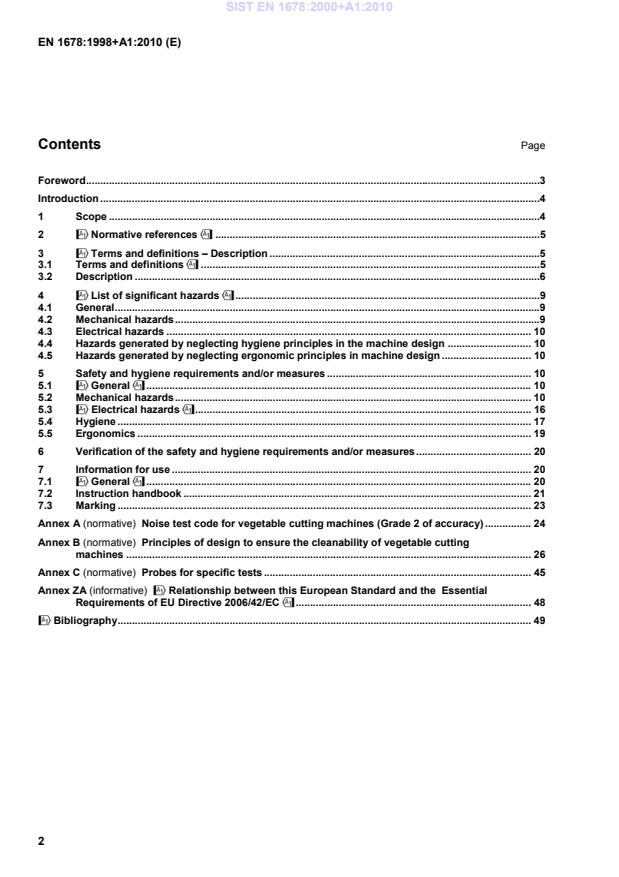
Noise test code for vegetable cutting machines (Grade 2 of accuracy) . 24Annex B (normative)
Principles of design to ensure the cleanability of vegetable cutting machines . 26Annex C (normative)
Probes for specific tests . 45Annex ZA (informative)
!Relationship between this European Standard and the
Essential Requirements of EU Directive 2006/42/EC" . 48!Bibliography . 49 SIST EN 1678:2000+A1:2010
EN 12851); planetary mixers (see EN 454); domestic machines. 1.4 This European Standard is not applicable to vegetable cutting machines which are manufactured before the date of its publication as EN." SIST EN 1678:2000+A1:2010
Key 1 Body 2 Electric motor 3 Delivery chute 4 Cutting device 5 Shaft 6 Plunger (removable) 7 Pusher device 8 Feed chute 9 Fixed plate 10 Ejector Figure 1 SIST EN 1678:2000+A1:2010
figure 2).
Key 1 Body 2 Motor 3 Delivery chute 4 Cutting device 5 Shaft 6 Rotating drum 7 Fixed grid 8 Feed hopper
Figure 2 3.2.1.3 Machines with horizontal reciprocating cutters These machines are used extensively for chipping potatoes. Raw potatoes are fed from a hopper into the cutting chamber containing fixed plates and reciprocating plates and cutting devices (see figure 3).
Key 1 Body 2 Feed hopper 3 Delivery chute 4 Reciprocating cutters 5 Fixed plate 6 Reciprocating plate 7 Baffles Figure 3 3.2.2 Elements of a machine (see figures 1, 2 and 3) All machines generally contain the following elements of design: a device for feeding product into the machine; one or several tools: cutting plates or blades, hereafter called "cutting devices". A cutting plate or blade consists of one or more cutting edges fixed to a frame. Fixed cutting blades may be installed in conjunction with moving plates; an ejector; a delivery chute; control devices. 3.2.3 Devices for feeding Three devices for feeding product are used: 3.2.3.1 Hopper feed The product is fed to the cutter from the hopper generally by gravity and/or by feeding devices. SIST EN 1678:2000+A1:2010
Figure 4 5.2.2.1.3.1 In all cases where b is less than or equal to 80 mm and where the table 1 is used: A plunger shall be supplied, with all machines having a feed tube; Where machines are not dedicated to be used with cutting devices the height of which is greater than 10 mm, a notice in the instruction handbook shall be given. 5.2.2.1.3.2 For the case where b > 80 mm machines shall have an interlocking control guard pusher device, the interlocking switch shall be designed to meet the opening and closing and stopping time required as below. Where a pusher device is used, this can restart the machine without operating the on/off switch. For those machines the stopping time shall be less than 2 s. It shall be measured when the machine is running without product at its maximum speed and equipped with the heaviest cutting device. The safety interlocked switch shall be actuated when the gap (x) between the top of the aperture and the edge of the pusher is as shown in figure 5, where: x ≤ 60 mm for a ≥ 150 mm x ≤ 45 mm for 130 mm ≤ a < 150 mm SIST EN 1678:2000+A1:2010
Key 1 Rotational motion 2 Translatory motion Figure 5a — Hinger pusher
Figure 5b — Sliding pusher Figure 5 5.2.2.1.4 Feeding by hopper !Designs which comply with 5.2 and 5.3 of EN ISO 12100-2:2003 and 4.2.3 of EN ISO 13857:2008 can be used, for example (see Figure 6):" baffles; sloping hopper; swan neck extension; ! fixed grids (opening to Table 4 of EN ISO 13857:2008);" interlocked hopper lid; SIST EN 1678:2000+A1:2010
Key a) Baffles b) Sloping hopper c) Swan neck extension d) Fixed grids e) Distributor plate Figure 6 SIST EN 1678:2000+A1:2010
Key 1 Blade 2 Ramp Figure 7 — Rotating disc In the case of rotating drum machines and horizontal reciprocating machines the design of the machine shall be such that only the underside of a fixed cutting device can be contacted and it is not possible to reach through this to the rotating drum or a moving cutter. 5.2.2.4 Zone 4 Safeguards against access to the danger zone shall be ensured by fixed guards complying with EN 953. 5.2.3 Stability The machine shall be stable when used as specified in the instruction handbook. The machine shall be preferably designed to be self-stable when fitted with each one of their attachments. SIST EN 1678:2000+A1:2010
3 4 5
Key 1 Feed hopper 2 Delivery chute 3 Food area 4 Splash area 5 Non food area Figure 8
Figure 9
3 4 5
Key 1 Feed hopper 2 Delivery chute 3 Food area 4 Splash area 5 Non food area Figure 10
The figures are examples only and other areas which become splashed with food under normal conditions of use shall also be designed and finished as a splash area. 5.4.5 Surface finish The maximum roughness values shall comply with the requirements of annex B. 5.4.6 Cleanability All food and splash areas shall be easily cleanable and where necessary capable of disinfection. Baffles shall be constructed in such a way that they are easily cleanable and self-draining and their under surfaces designed so that they can be cleaned. In food and splash areas, fasteners such as screws, bolts, rivets etc. shall be avoided unless technically necessary, in which case, these shall be easily cleanable. 5.5 Ergonomics Regard shall be given to the ergonomic principles set out !in 4.8 of EN ISO 12100-2:
...