

ASTM A313/A313M-18
(Specification)Standard Specification for Stainless Steel Spring Wire
General Information
- Abstract
ABSTRACT
This guide covers standard specification for austenitic and age-hardenable stainless steel round spring wire intended especially for the manufacture of springs. The steel shall conform to the required chemical composition for carbon, manganese, phosphorus, sulfur, silicon, chromium, nickel, molybdenum, nitrogen, and other elements. The material shall conform to the required tensile strengths following the prescribed heat treatment. Tensile strength requirements for hardened wires and stress-relieved materials shall be given. Mechanical tests such as wrap test, uniformity (coil test), and bend test hall be performed on the steel material.
SCOPE
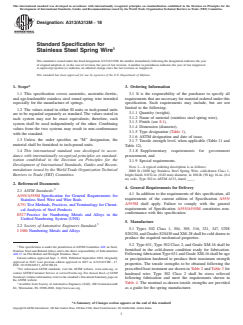
1.1 This specification covers austenitic, austenitic-ferritic, and age-hardenable stainless steel round spring wire intended especially for the manufacture of springs.
1.2 The values stated in either SI units or inch-pound units are to be regarded separately as standard. The values stated in each system may not be exact equivalents; therefore, each system shall be used independently of the other. Combining values from the two systems may result in non-conformance with the standard.
1.3 Unless the order specifies an “M” designation, the material shall be furnished to inch-pound units.
1.4 This international standard was developed in accordance with internationally recognized principles on standardization established in the Decision on Principles for the Development of International Standards, Guides and Recommendations issued by the World Trade Organization Technical Barriers to Trade (TBT) Committee.
- Status
- Published
- Publication Date
- 31-Aug-2018
- Technical Committee
- A01 - Steel, Stainless Steel and Related Alloys
- Drafting Committee
- A01.17 - Flat-Rolled and Wrought Stainless Steel
Overview
ASTM A313/A313M-18: Standard Specification for Stainless Steel Spring Wire is an internationally recognized standard developed by ASTM International. It defines the requirements for austenitic, austenitic-ferritic (duplex), and age-hardenable stainless steel round spring wire, specifically intended for the manufacture of springs. This standard provides guidelines on chemical composition, manufacturing processes, mechanical properties, and testing methods, ensuring consistent quality and performance for stainless steel spring wire used in demanding industrial applications.
Key Topics
- Scope of Application: Covers a wide array of stainless steel wire grades, including austenitic (e.g., Types 302, 304, 316, 321, 347), age-hardenable, and duplex (austenitic-ferritic) grades.
- Chemical Composition: Specifies maximum and minimum content levels for elements such as carbon, manganese, phosphorus, sulfur, silicon, chromium, nickel, molybdenum, nitrogen, and, for some grades, other elements like titanium or copper.
- Mechanical Properties: Establishes minimum and maximum tensile strength requirements for different wire diameters, contexts (cold-drawn, age-hardened, stress-relieved), and steel types.
- Manufacturing Methods: Outlines required processing, such as cold drawing and prescribed heat treatments, to achieve the necessary mechanical properties and performance.
- Testing Requirements: Requires a series of mechanical tests, including:
- Wrap test
- Uniformity (coil test)
- Bend test
- Surface examination (for certain applications)
- Ordering and Units: Allows for orders in either SI or inch-pound units, but mandates using only one system per transaction to avoid non-conformance.
Applications
Stainless steel spring wire manufactured according to ASTM A313/A313M-18 is essential for a variety of industries and applications that require high strength, corrosion resistance, and durability. Key uses include:
- Spring Manufacturing: Used for producing compression, extension, and torsion springs found in automotive, aerospace, industrial, and consumer products.
- Mechanical Assemblies: Incorporated in safety devices, fasteners, and retaining elements exposed to dynamic stresses.
- Medical Devices: Utilized where biocompatibility and resistance to corrosion are critical.
- Oil, Gas, and Marine Equipment: Employed in harsh environments thanks to superior resistance to corrosive media.
- Electronics and Precision Instruments: Applied in devices where mechanical reliability and resistance to environmental factors are essential.
Related Standards
For comprehensive compliance and compatibility, ASTM A313/A313M-18 references several other standards, including:
- ASTM A555/A555M: General Requirements for Stainless Steel Wire and Wire Rods; provides baseline criteria that complement the specific requirements of A313/A313M.
- ASTM A751: Test methods and definitions for chemical analysis of steel products.
- ASTM E527: Practice for the Unified Numbering System (UNS) for metals and alloys.
- SAE J 1086: Numbering system for metals and alloys, providing harmonized material identification.
Other related standards may govern testing, handling, and further processing of stainless steel wire products.
By adhering to ASTM A313/A313M-18, manufacturers and purchasers ensure that their stainless steel spring wire meets international expectations for quality, mechanical performance, consistency, and safety. This contributes to enhanced service life, reliable operation in critical assemblies, and broad material compatibility across numerous industrial sectors.
Relations
- Effective Date
- 01-Sep-2018
- Effective Date
- 01-Jan-2016
- Effective Date
- 01-Mar-2014
- Effective Date
- 01-Mar-2014
- Effective Date
- 01-May-2009
- Effective Date
- 01-Oct-2008
- Effective Date
- 01-Jun-2007
- Effective Date
- 01-Apr-2007
- Effective Date
- 01-May-2006
- Effective Date
- 01-Sep-2005
- Effective Date
- 10-Apr-2003
- Effective Date
- 10-Sep-2001
- Effective Date
- 10-Sep-2001
- Effective Date
- 10-Mar-1997
- Effective Date
- 10-Mar-1997
Get Certified
Connect with accredited certification bodies for this standard

Element Materials Technology
Materials testing and product certification.

Inštitut za kovinske materiale in tehnologije
Institute of Metals and Technology. Materials testing, metallurgical analysis, NDT.
Sponsored listings
Frequently Asked Questions
ASTM A313/A313M-18 is a technical specification published by ASTM International. Its full title is "Standard Specification for Stainless Steel Spring Wire". This standard covers: ABSTRACT This guide covers standard specification for austenitic and age-hardenable stainless steel round spring wire intended especially for the manufacture of springs. The steel shall conform to the required chemical composition for carbon, manganese, phosphorus, sulfur, silicon, chromium, nickel, molybdenum, nitrogen, and other elements. The material shall conform to the required tensile strengths following the prescribed heat treatment. Tensile strength requirements for hardened wires and stress-relieved materials shall be given. Mechanical tests such as wrap test, uniformity (coil test), and bend test hall be performed on the steel material. SCOPE 1.1 This specification covers austenitic, austenitic-ferritic, and age-hardenable stainless steel round spring wire intended especially for the manufacture of springs. 1.2 The values stated in either SI units or inch-pound units are to be regarded separately as standard. The values stated in each system may not be exact equivalents; therefore, each system shall be used independently of the other. Combining values from the two systems may result in non-conformance with the standard. 1.3 Unless the order specifies an “M” designation, the material shall be furnished to inch-pound units. 1.4 This international standard was developed in accordance with internationally recognized principles on standardization established in the Decision on Principles for the Development of International Standards, Guides and Recommendations issued by the World Trade Organization Technical Barriers to Trade (TBT) Committee.
ABSTRACT This guide covers standard specification for austenitic and age-hardenable stainless steel round spring wire intended especially for the manufacture of springs. The steel shall conform to the required chemical composition for carbon, manganese, phosphorus, sulfur, silicon, chromium, nickel, molybdenum, nitrogen, and other elements. The material shall conform to the required tensile strengths following the prescribed heat treatment. Tensile strength requirements for hardened wires and stress-relieved materials shall be given. Mechanical tests such as wrap test, uniformity (coil test), and bend test hall be performed on the steel material. SCOPE 1.1 This specification covers austenitic, austenitic-ferritic, and age-hardenable stainless steel round spring wire intended especially for the manufacture of springs. 1.2 The values stated in either SI units or inch-pound units are to be regarded separately as standard. The values stated in each system may not be exact equivalents; therefore, each system shall be used independently of the other. Combining values from the two systems may result in non-conformance with the standard. 1.3 Unless the order specifies an “M” designation, the material shall be furnished to inch-pound units. 1.4 This international standard was developed in accordance with internationally recognized principles on standardization established in the Decision on Principles for the Development of International Standards, Guides and Recommendations issued by the World Trade Organization Technical Barriers to Trade (TBT) Committee.
ASTM A313/A313M-18 is classified under the following ICS (International Classification for Standards) categories: 77.140.25 - Spring steels. The ICS classification helps identify the subject area and facilitates finding related standards.
ASTM A313/A313M-18 has the following relationships with other standards: It is inter standard links to ASTM A313/A313M-17, ASTM A555/A555M-16, ASTM A555/A555M-05(2014), ASTM A751-14, ASTM A555/A555M-05(2009), ASTM A751-08, ASTM A751-07a, ASTM A751-07, ASTM A751-01(2006), ASTM A555/A555M-05, ASTM E527-83(2003), ASTM A751-96, ASTM A751-01, ASTM E527-83(1997)e1, ASTM A555/A555M-97(2002). Understanding these relationships helps ensure you are using the most current and applicable version of the standard.
ASTM A313/A313M-18 is available in PDF format for immediate download after purchase. The document can be added to your cart and obtained through the secure checkout process. Digital delivery ensures instant access to the complete standard document.
Standards Content (Sample)
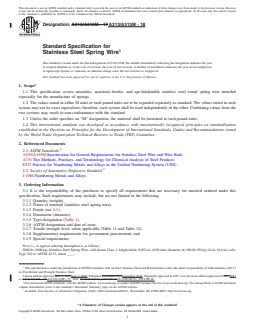
This international standard was developed in accordance with internationally recognized principles on standardization established in the Decision on Principles for the
Development of International Standards, Guides and Recommendations issued by the World Trade Organization Technical Barriers to Trade (TBT) Committee.
Designation: A313/A313M −18
Standard Specification for
Stainless Steel Spring Wire
This standard is issued under the fixed designationA313/A313M; the number immediately following the designation indicates the year
of original adoption or, in the case of revision, the year of last revision. A number in parentheses indicates the year of last reapproval.
A superscript epsilon (´) indicates an editorial change since the last revision or reapproval.
This standard has been approved for use by agencies of the U.S. Department of Defense.
1. Scope* 3. Ordering Information
1.1 This specification covers austenitic, austenitic-ferritic, 3.1 It is the responsibility of the purchaser to specify all
and age-hardenable stainless steel round spring wire intended requirements that are necessary for material ordered under this
especially for the manufacture of springs. specification. Such requirements may include, but are not
limited to the following:
1.2 The values stated in either SI units or inch-pound units
3.1.1 Quantity (weight),
are to be regarded separately as standard. The values stated in
3.1.2 Name of material (stainless steel spring wire),
each system may not be exact equivalents; therefore, each
3.1.3 Finish (see 8.1),
system shall be used independently of the other. Combining
3.1.4 Dimension (diameter),
values from the two systems may result in non-conformance
3.1.5 Type designation (Table 1),
with the standard.
3.1.6 ASTM designation and date of issue,
1.3 Unless the order specifies an “M” designation, the
3.1.7 Tensile strength level, when applicable (Table 11 and
material shall be furnished to inch-pound units.
Table 12),
1.4 This international standard was developed in accor- 3.1.8 Supplementary requirements for government
dance with internationally recognized principles on standard-
procurement, and
ization established in the Decision on Principles for the 3.1.9 Special requirements.
Development of International Standards, Guides and Recom-
NOTE 1—A typical ordering description is as follows:
mendations issued by the World Trade Organization Technical
2000 lb (1000 kg) Stainless Steel Spring Wire, cold-drawn Class 1,
Barriers to Trade (TBT) Committee.
bright finish, 0.032-in. (0.82 mm) diameter, in 100-lb (50 kg) 16-in. (0.4
m) coils, Type 302 to ASTM A313, dated ____.
2. Referenced Documents
4. General Requirements for Delivery
2.1 ASTM Standards:
4.1 In addition to the requirements of this specification, all
A555/A555M Specification for General Requirements for
requirements of the current edition of Specification A555/
Stainless Steel Wire and Wire Rods
A555M shall apply. Failure to comply with the general
A751 Test Methods, Practices, and Terminology for Chemi-
requirements of Specification A555/A555M constitutes non-
cal Analysis of Steel Products
conformance with this specification.
E527 Practice for Numbering Metals and Alloys in the
Unified Numbering System (UNS)
5. Manufacture
2.2 Society of Automotive Engineers Standard:
5.1 Types 302 Class 1, 304, 305, 316, 321, 347, UNS
J 1086 Numbering Metals and Alloys
S20230, and Grades S20430 and XM-28 shall be cold drawn to
produce the required mechanical properties.
5.2 Type 631, Type 302 Class 2, and Grade XM-16 shall be
This specification is under the jurisdiction of ASTM Committee A01 on Steel,
furnished in the cold-drawn condition ready for fabrication.
Stainless Steel and Related Alloys and is the direct responsibility of Subcommittee
A01.17 on Flat-Rolled and Wrought Stainless Steel.
Following fabricationType 631 and Grade XM-16 shall be age
Current edition approved Sept. 1, 2018. Published September 2018. Originally
or precipitation hardened to produce their maximum strength
approved in 1947. Last previous edition approved in 2017 as A313/A313M – 17.
properties. The tensile strengths to be obtained following the
DOI: 10.1520/A0313_A0313M-18.
prescribed heat treatment are shown in Table 2 and Table 3 for
For referenced ASTM standards, visit the ASTM website, www.astm.org, or
contact ASTM Customer Service at service@astm.org. For Annual Book of ASTM
hardened wire. Type 302 Class 2 shall be stress relieved
Standards volume information, refer to the standard’s Document Summary page on
following fabrication and meet the requirements shown in
the ASTM website.
Table 4. The nominal as-drawn tensile strengths are provided
Available from Society of Automotive Engineers (SAE), 400 Commonwealth
Dr., Warrendale, PA 15096-0001, http://www.sae.org. as a guide for the spring manufacturer.
*A Summary of Changes section appears at the end of this standard
Copyright © ASTM International, 100 Barr Harbor Drive, PO Box C700, West Conshohocken, PA 19428-2959. United States
A313/A313M − 18
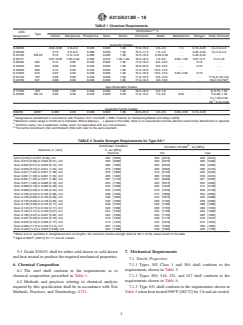
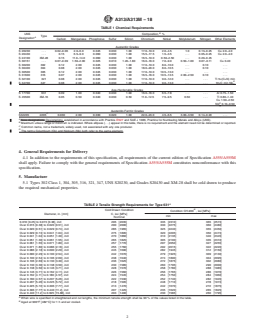
TABLE 1 Chemical Requirements
B
Composition, %
UNS
Type
A
Designation
Carbon Manganese Phosphorus Sulfur Silicon Chromium Nickel Molybdenum Nitrogen Other Elements
Austenitic Grades
S 20230 . . . 0.02–0.06 2.0–6.0 0.045 0.030 1.00 17.0–19.0 2.0–4.5 1.0 0.13–0.25 Cu 2.0–4.0
S 20430 . . . 0.15 6.5–9.0 0.060 0.030 1.00 15.5–17.5 1.5–3.5 . . . 0.05–0.25 Cu 2.0–4.0
S 24100 XM-28 0.15 11.0–14.0 0.060 0.030 1.00 16.5–19.0 0.50–2.50 . . . 0.20–0.45 . . .
S 30151 . . . 0.07–0.09 1.50–2.00 0.025 0.010 1.20–1.80 16.0–18.0 7.0–9.0 0.50–1.00 0.07–0.11 Cu 0.40
S 30200 302 0.12 2.00 0.045 0.030 1.00 17.0–19.0 8.0–10.0 . . . 0.10 . . .
S 30400 304 0.08 2.00 0.045 0.030 1.00 18.0–20.0 8.0–10.5 . . . 0.10 . . .
S 30500 305 0.12 2.00 0.045 0.030 1.00 17.0–19.0 10.5–13.0 . . . . . . . . .
S 31600 316 0.07 2.00 0.045 0.030 1.00 16.5–18.0 10.5–13.5 2.00–2.50 0.10 . . .
S 32100 321 0.08 2.00 0.045 0.030 1.00 17.0–19.0 9.0–12.0 . . Ti 5×(C+N) min
D
S 34700 347 0.08 2.00 0.045 0.030 1.00 17.0–19.0 9.0–13.0 . . 10×C min Nb
Age-Hardenable Grades
S 17700 631 0.09 1.00 0.040 0.030 1.00 16.0–18.0 6.5–7.8 . . . . . . Al 0.75–1.50
S 45500 XM-16 0.05 0.50 0.040 0.030 0.50 11.0–12.5 7.5–9.5 0.50 . . . Ti 0.80–1.40
Cu 1.50–2.50
D
Nb 0.10–0.50
Austenitic-Ferritic Grades
C
S32205 2205 0.030 2.00 0.030 0.020 1.00 22.0–23.0 4.5–6.5 3.00–3.50 0.14–0.20 . . .
A
Designations established in accordance with Practice E527 and SAE J 1086, Practice for Numbering Metals and Alloys (UNS).
B
Maximum unless range or minimum is indicated. Where ellipses (. . .) appear in this table, there is no requirement and the element need not be determined or reported.
C
Common name, not a trademark, widely used, not associated with any one producer.
D
The terms Columbium (Cb) and Niobium (Nb) both refer to the same element.
A
TABLE 2 Tensile Strength Requirements for Type 631
B
Cold Drawn Condition
Condition CH-900 , ksi [MPa]
Diameter, in. [mm] C, ksi [MPa]
min max
Nominal
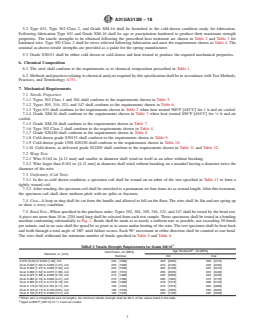
0.010 [0.25] to 0.015 [0.38], incl 295 [2035] 335 [2310] 365 [2515]
Over 0.015 [0.38] to 0.020 [0.51], incl 290 [2000] 330 [2275] 360 [2480]
Over 0.020 [0.51] to 0.029 [0.74], incl 285 [1965] 325 [2240] 355 [2450]
Over 0.029 [0.74] to 0.041 [1.04], incl 275 [1895] 320 [2205] 350 [2415]
Over 0.041 [1.04] to 0.051 [1.30], incl 270 [1860] 310 [2135] 340 [2345]
Over 0.051 [1.30] to 0.061 [1.55], incl 265 [1825] 305 [2100] 335 [2310]
Over 0.061 [1.55] to 0.071 [1.80], incl 257 [1770] 297 [2050] 327 [2255]
Over 0.071 [1.80] to 0.086 [2.18], incl 255 [1760] 292 [2015] 322 [2220]
Over 0.086 [2.18] to 0.090 [2.29], incl 245 [1690] 282 [1945] 312 [2150]
Over 0.090 [2.29] to 0.100 [2.54], incl 242 [1670] 279 [1925] 309 [2130]
Over 0.100 [2.54] to 0.106 [2.69], incl 238 [1640] 274 [1890] 304 [2095]
Over 0.106 [2.69] to 0.130 [3.30], incl 236 [1625] 272 [1875] 302 [2080]
Over 0.130 [3.30] to 0.138 [3.50], incl 230 [1585] 260 [1795] 290 [2000]
Over 0.138 [3.50] to 0.146 [3.71], incl 228 [1570] 258 [1780] 288 [1985]
Over 0.146 [3.71] to 0.162 [4.11], incl 226 [1560] 256 [1765] 286 [1970]
Over 0.162 [4.11] to 0.180 [4.57], incl 224 [1545] 254 [1750] 284 [1960]
Over 0.180 [4.57] to 0.207 [5.26], incl 222 [1530] 252 [1740] 282 [1945]
Over 0.207 [5.26] to 0.225 [5.72], incl 218 [1505] 248 [1710] 278 [1915]
Over 0.225 [5.72] to 0.306 [7.77], incl 213 [1470] 242 [1670] 272 [1875]
Over 0.306 [7.77] to 0.440 [11.2], incl 207 [1425] 235 [1620] 265 [1825]
Over 0.440 [11.2] to 0.625 [15.88], incl 203 [1400] 230 [1585] 260 [1795]
A
When wire is specified in straightened and cut lengths, the minimum tensile strength shall be 90 % of the values listed in the table.
B
Aged at 900°F [482°C] for 1 h and air cooled.
5.3 Grade S30151 shall be either cold drawn or cold drawn 7. Mechanical Requirements
and heat treated to produce the required mechanical properties.
7.1 Tensile Properties:
6. Chemical Composition
7.1.1 Types 302 Class 1 and 304 shall conform to the
requirements shown in Table 5.
6.1 The steel shall conform to the requirements as to
chemical composition prescribed in Table 1.
7.1.2 Types 305, 316, 321, and 347 shall conform to the
requirements shown in Table 6.
6.2 Methods and practices relating to chemical analysis
required by this specification shall be in accordance with Test 7.1.3 Type 631 shall conform to the requirements shown in
Methods, Practices, and Terminology A751. Table2whenheattreated900°F[482°C]for1handaircooled.
A313/A313M − 18
A
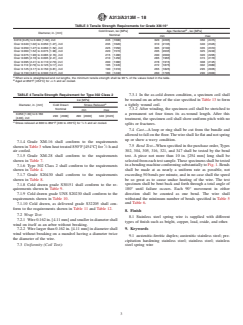
TABLE 3 Tensile Strength Requirements for Grade XM-16
B
Age Hardened , ksi [MPa]
Cold Drawn, ksi [MPa]
Diameter, in. [mm]
Nominal
min max
0.010 [0.25] to 0.040 [1.02], incl 245 [1690] 320 [2205] 350 [2415]
Over 0.040 [1.02] to 0.050 [1.27], incl 235 [1620] 310 [2135] 340 [2345]
Over 0.050 [1.27] to 0.060 [1.52], incl 225 [1550] 305 [2100] 335 [2310]
Over 0.060 [1.52] to 0.075 [1.90], incl 220 [1515] 295 [2035] 325 [2240]
Over 0.075 [1.90] to 0.085 [2.16], incl 215 [1480] 290 [2000] 320 [2205]
Over 0.085 [2.16] to 0.095 [2.41], incl 210 [1450] 285 [1965] 315 [2170]
Over 0.095 [2.41] to 0.110 [2.79], incl 200 [1380] 278 [1915] 308 [2125]
Over 0.110 [2.79] to 0.125 [3.17], incl 195 [1345] 272 [1875] 302 [2080]
Over 0.125 [3.17] to 0.150 [3.81], incl 190 [1310] 265 [1825] 295 [2035]
Over 0.150 [3.81] to 0.500 [12.7], incl 180 [1240] 260 [1795] 290 [2000]
A
When wire is straightened and cut lengths, the minimum tensile strength shall be 90 % of the values listed in the table.
B
Aged at 850°F [454°C] for ⁄2 h and air cooled.
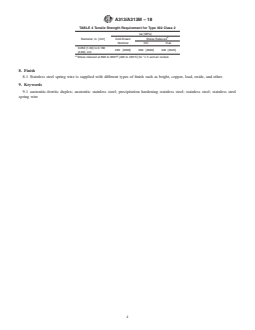
TABLE 4 Tensile Strength Requirement for Type 302 Class 2
7.3.1 In the as-cold drawn condition, a specimen coil shall
ksi [MPa] be wound on an arbor of the size specified in Table 13 to form
A
Diameter, in. [mm] Stress Relieved a tightly wound coil.
Cold Drawn
Nominal
min max 7.3.2 After winding, the specimen coil shall be stretched to
0.050 [1.30] to 0.160 a permanent set four times its as-wound length. After this
290 [2000] 290 [2000] 340 [2345]
[4.00], incl
treatment, the specimen coil shall show uniform pitch with no
A
Stress relieved at 800 to 850°F [430 to 455°C] for ⁄2 h and air cooled.
splits or fractures.
7.4 Cast—A loop or ring shall be cut from the bundle and
allowedtofallonthefloor.Thewireshalllieflatandnotspring
up or show a wavy condition.
7.1.4 Grade XM-16 shall conform to the requirements
shown in Table 3 when heat treated 850°F [454°C] for ⁄2 h and 7.5 Bend Test—When specified in the purchase order, Types
302, 304, 305, 316, 321, and 347 shall be tested by the bend
air cooled.
7.1.5 Grade XM-28 shall conform to the requirements test. A piece not more than 10 in. [254 mm] long shall be
selectedfromeachtestsample.Thesespecimensshallbetested
shown in Table 7.
inabendingmachineconformingsubstantiallytoFig.1.Bends
7.1.6 Type 302 Class 2 shall conform to the requirements
shall be made at as nearly a uniform rate as possible, not
shown in Table 4.
exceeding 50 bends per minute, and in no case shall the speed
7.1.7 Grade S20430 shall conform to the requirements
be so great as to cause undue heating of the wire. The test
shown in Table 8.
specimen shall be bent back and forth through a total angle of
7.1.8 Cold drawn grade S30151 shall conform to the re-
180° until failure occurs. Each 90° movement in either
quirements shown in Table 9.
direction shall be counted as one bend. The wire shall
7.1.9 Cold drawn grade UNS S20230 shall conform to the
withstand the minimum number of bends specified in Table 5
requirements shown in Table 10.
and Table 6.
7.1.10 Cold drawn, as delivered grade S32205 shall con-
form to the requirements shown in Table 11 and Table 12.
8. Finish
7.2 Wrap Test:
8.1 Stainless steel spring wire is supplied with different
7.2.1 Wire0.162in.[4.11mm]andsmallerindiametershall
types of finish such as bright, copper, lead, oxide, and other.
wind on itself as an arbor without breaking.
7.2.2 Wire larger than 0.162 in. [4.11 mm] in diameter shall 9. Keywords
wind without breaking on a mandrel having a diameter twice
9.1 austenitic-ferritic duplex; austenitic stainless steel; pre-
the diameter of the wire.
cipitation hardening stainless steel; stainless steel; stainless
7.3 Uniformity (Coil Test): steel spring wire
A313/A313M − 18
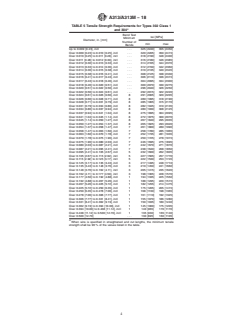
TABLE 5 Tensile Strength Requirements for Types 302 Class 1
A
and 304
Bend Test
ksi [MPa]
Minimum
Diameter, in. [mm]
Number of
min max
Bends
Up to 0.009 [0.23], incl . . . 325 [2240] 355 [2450]
Over 0.009 [0.23] to 0.010 [0.25], incl . . . 320 [2205] 350 [2415]
Over 0.010 [0.25] to 0.011 [0.28], incl . . . 318 [2190] 348 [2400]
Over 0.011 [0.28] to 0.012 [0.30], incl . . . 316 [2180] 346 [2385]
Over 0.012 [0.30] to 0.013 [0.33], incl . . . 314 [2165] 344 [2370]
Over 0.013 [0.33] to 0.014 [0.36], incl . . . 312 [2150] 342 [2360]
Over 0.014 [0.36] to 0.015 [0.38], incl . . . 310 [2135] 340 [2345]
Over 0.015 [0.38] to 0.016 [0.41], incl . . . 308 [2125] 338 [2330]
Over 0.016 [0.41] to 0.017 [0.43], incl . . . 306 [2110] 336 [2315]
Over 0.017 [0.43] to 0.018 [0.46], incl . . . 304 [2095] 334 [2300]
Over 0.018 [0.46] to 0.020 [0.51], incl . . . 300 [2070] 330 [2275]
Over 0.020 [0.51] to 0.022 [0.56], incl . . . 296 [2040] 326 [2250]
Over 0.022 [0.56] to 0.024 [0.61], incl . . . 292 [2015] 322 [2220]
Over 0.024 [0.61] to 0.026 [0.66], incl 8 291 [2005] 320 [2205]
Over 0.026 [0.66] to 0.028 [0.71], incl 8 289 [1995] 318 [2190]
Over 0.028 [0.71] to 0.031 [0.79], incl 8 285 [1965] 315 [2170]
Over 0.031 [0.79] to 0.034 [0.86], incl 8 282 [1945] 310 [2135]
Over 0.034 [0.86] to 0.037 [0.94], incl 8 280 [1930] 308 [2125]
Over 0.037 [0.94] to 0.041 [1.04], incl 8 275 [1895] 304 [2095]
Over 0.041 [1.04] to 0.045 [1.14], incl 8 272 [1875] 300 [2070]
Over 0.045 [1.14] to 0.050 [1.27], incl 8 267 [1840] 295 [2035]
Over 0.050 [1.27] to 0.054 [1.37], incl 8 265 [1825] 293 [2020]
Over 0.054 [1.37] to 0.058 [1.47], incl 7 261 [1800] 289 [1990]
Over 0.058 [1.47] to 0.063 [1.60],
...
This document is not an ASTM standard and is intended only to provide the user of an ASTM standard an indication of what changes have been made to the previous version. Because
it may not be technically possible to adequately depict all changes accurately, ASTM recommends that users consult prior editions as appropriate. In all cases only the current version
of the standard as published by ASTM is to be considered the official document.
Designation: A313/A313M − 17 A313/A313M − 18
Standard Specification for
Stainless Steel Spring Wire
This standard is issued under the fixed designation A313/A313M; the number immediately following the designation indicates the year
of original adoption or, in the case of revision, the year of last revision. A number in parentheses indicates the year of last reapproval.
A superscript epsilon (´) indicates an editorial change since the last revision or reapproval.
This standard has been approved for use by agencies of the U.S. Department of Defense.
1. Scope*
1.1 This specification covers austenitic, austenitic-ferritic, and age-hardenable stainless steel round spring wire intended
especially for the manufacture of springs.
1.2 The values stated in either SI units or inch-pound units are to be regarded separately as standard. The values stated in each
system may not be exact equivalents; therefore, each system shall be used independently of the other. Combining values from the
two systems may result in non-conformance with the standard.
1.3 Unless the order specifies an “M” designation, the material shall be furnished to inch-pound units.
1.4 This international standard was developed in accordance with internationally recognized principles on standardization
established in the Decision on Principles for the Development of International Standards, Guides and Recommendations issued
by the World Trade Organization Technical Barriers to Trade (TBT) Committee.
2. Referenced Documents
2.1 ASTM Standards:
A555/A555M Specification for General Requirements for Stainless Steel Wire and Wire Rods
A751 Test Methods, Practices, and Terminology for Chemical Analysis of Steel Products
E527 Practice for Numbering Metals and Alloys in the Unified Numbering System (UNS)
2.2 Society of Automotive Engineers Standard:
J 1086 Numbering Metals and Alloys
3. Ordering Information
3.1 It is the responsibility of the purchaser to specify all requirements that are necessary for material ordered under this
specification. Such requirements may include, but are not limited to the following:
3.1.1 Quantity (weight),
3.1.2 Name of material (stainless steel spring wire),
3.1.3 Finish (see 8.1),
3.1.4 Dimension (diameter),
3.1.5 Type designation (Table 1),
3.1.6 ASTM designation and date of issue,
3.1.7 Tensile strength level, when applicable (Table 11 and Table 12),
3.1.8 Supplementary requirements for government procurement, and
3.1.9 Special requirements.
NOTE 1—A typical ordering description is as follows:
2000 lb (1000 kg) Stainless Steel Spring Wire, cold-drawn Class 1, bright finish, 0.032-in. (0.82 mm) diameter, in 100-lb (50 kg) 16-in. (0.4 m) coils,
Type 302 to ASTM A313, dated ____.
This specification is under the jurisdiction of ASTM Committee A01 on Steel, Stainless Steel and Related Alloys and is the direct responsibility of Subcommittee A01.17
on Flat-Rolled and Wrought Stainless Steel.
Current edition approved Nov. 1, 2017Sept. 1, 2018. Published November 2017September 2018. Originally approved in 1947. Last previous edition approved in 20132017
as A313/A313M – 13.A313/A313M – 17. DOI: 10.1520/A0313_A0313M-17.10.1520/A0313_A0313M-18.
For referenced ASTM standards, visit the ASTM website, www.astm.org, or contact ASTM Customer Service at service@astm.org. For Annual Book of ASTM Standards
volume information, refer to the standard’s Document Summary page on the ASTM website.
Available from Society of Automotive Engineers (SAE), 400 Commonwealth Dr., Warrendale, PA 15096-0001, http://www.sae.org.
*A Summary of Changes section appears at the end of this standard
Copyright © ASTM International, 100 Barr Harbor Drive, PO Box C700, West Conshohocken, PA 19428-2959. United States
A313/A313M − 18
TABLE 1 Chemical Requirements
B
Composition, %
UNS
Type
A
Designation
Carbon Manganese Phosphorus Sulfur Silicon Chromium Nickel Molybdenum Nitrogen Other Elements
Austenitic Grades
S 20230 . . . 0.02–0.06 2.0–6.0 0.045 0.030 1.00 17.0–19.0 2.0–4.5 1.0 0.13–0.25 Cu 2.0–4.0
S 20430 . . . 0.15 6.5–9.0 0.060 0.030 1.00 15.5–17.5 1.5–3.5 . . . 0.05–0.25 Cu 2.0–4.0
S 24100 XM-28 0.15 11.0–14.0 0.060 0.030 1.00 16.5–19.0 0.50–2.50 . . . 0.20–0.45 . . .
S 30151 . . . 0.07–0.09 1.50–2.00 0.025 0.010 1.20–1.80 16.0–18.0 7.0–9.0 0.50–1.00 0.07–0.11 Cu 0.40
S 30200 302 0.12 2.00 0.045 0.030 1.00 17.0–19.0 8.0–10.0 . . . 0.10 . . .
S 30400 304 0.08 2.00 0.045 0.030 1.00 18.0–20.0 8.0–10.5 . . . 0.10 . . .
S 30500 305 0.12 2.00 0.045 0.030 1.00 17.0–19.0 10.5–13.0 . . . . . . . . .
S 31600 316 0.07 2.00 0.045 0.030 1.00 16.5–18.0 10.5–13.5 2.00–2.50 0.10 . . .
S 32100 321 0.08 2.00 0.045 0.030 1.00 17.0–19.0 9.0–12.0 . . . . . . Ti 5×(C+N) min
D
S 34700 347 0.08 2.00 0.045 0.030 1.00 17.0–19.0 9.0–13.0 . . . . . . 10×C min Nb
Age-Hardenable Grades
S 17700 631 0.09 1.00 0.040 0.030 1.00 16.0–18.0 6.5–7.8 . . . . . . Al 0.75–1.50
S 45500 XM-16 0.05 0.50 0.040 0.030 0.50 11.0–12.5 7.5–9.5 0.50 . . . Ti 0.80–1.40
Cu 1.50–2.50
D
Nb 0.10–0.50
Austenitic-Ferritic Grades
C
S32205 2205 0.030 2.00 0.030 0.020 1.00 22.0–23.0 4.5–6.5 3.00–3.50 0.14–0.20 . . .
A
New designations Designations established in accordance with Practice E527 and SAE J 1086, Practice for Numbering Metals and Alloys (UNS).
B
Maximum unless range or minimum is indicated. Where ellipses (. . .) appear in this table, there is no requirement and the element need not be determined or reported.
C
Common name, not a trademark, widely used, not associated with any one producer.
D
The terms Columbium (Cb) and Niobium (Nb) both refer to the same element.
4. General Requirements for Delivery
4.1 In addition to the requirements of this specification, all requirements of the current edition of Specification A555/A555M
shall apply. Failure to comply with the general requirements of Specification A555/A555M constitutes nonconformance with this
specification.
5. Manufacture
5.1 Types 302 Class 1, 304, 305, 316, 321, 347, UNS S20230, and Grades S20430 and XM-28 shall be cold drawn to produce
the required mechanical properties.
A
TABLE 2 Tensile Strength Requirements for Type 631
B
Cold Drawn Condition
Condition CH-900 , ksi [MPa]
Diameter, in. [mm] C, ksi [MPa]
min max
Nominal
0.010 [0.25] to 0.015 [0.38], incl 295 [2035] 335 [2310] 365 [2515]
Over 0.015 [0.38] to 0.020 [0.51], incl 290 [2000] 330 [2275] 360 [2480]
Over 0.020 [0.51] to 0.029 [0.74], incl 285 [1965] 325 [2240] 355 [2450]
Over 0.029 [0.74] to 0.041 [1.04], incl 275 [1895] 320 [2205] 350 [2415]
Over 0.041 [1.04] to 0.051 [1.30], incl 270 [1860] 310 [2135] 340 [2345]
Over 0.051 [1.30] to 0.061 [1.55], incl 265 [1825] 305 [2100] 335 [2310]
Over 0.061 [1.55] to 0.071 [1.80], incl 257 [1770] 297 [2050] 327 [2255]
Over 0.071 [1.80] to 0.086 [2.18], incl 255 [1760] 292 [2015] 322 [2220]
Over 0.086 [2.18] to 0.090 [2.29], incl 245 [1690] 282 [1945] 312 [2150]
Over 0.090 [2.29] to 0.100 [2.54], incl 242 [1670] 279 [1925] 309 [2130]
Over 0.100 [2.54] to 0.106 [2.69], incl 238 [1640] 274 [1890] 304 [2095]
Over 0.106 [2.69] to 0.130 [3.30], incl 236 [1625] 272 [1875] 302 [2080]
Over 0.130 [3.30] to 0.138 [3.50], incl 230 [1585] 260 [1795] 290 [2000]
Over 0.138 [3.50] to 0.146 [3.71], incl 228 [1570] 258 [1780] 288 [1985]
Over 0.146 [3.71] to 0.162 [4.11], incl 226 [1560] 256 [1765] 286 [1970]
Over 0.162 [4.11] to 0.180 [4.57], incl 224 [1545] 254 [1750] 284 [1960]
Over 0.180 [4.57] to 0.207 [5.26], incl 222 [1530] 252 [1740] 282 [1945]
Over 0.207 [5.26] to 0.225 [5.72], incl 218 [1505] 248 [1710] 278 [1915]
Over 0.225 [5.72] to 0.306 [7.77], incl 213 [1470] 242 [1670] 272 [1875]
Over 0.306 [7.77] to 0.440 [11.2], incl 207 [1425] 235 [1620] 265 [1825]
Over 0.440 [11.2] to 0.625 [15.88], incl 203 [1400] 230 [1585] 260 [1795]
A
When wire is specified in straightened and cut lengths, the minimum tensile strength shall be 90 % of the values listed in the table.
B
Aged at 900°F [482°C] for 1 h and air cooled.
A313/A313M − 18
5.2 Type 631, Type 302 Class 2, and Grade XM-16 shall be furnished in the cold-drawn condition ready for fabrication.
Following fabrication Type 631 and Grade XM-16 shall be age or precipitation hardened to produce their maximum strength
properties. The tensile strengths to be obtained following the prescribed heat treatment are shown in Table 2 and Table 3 for
hardened wire. Type 302 Class 2 shall be stress relieved following fabrication and meet the requirements shown in Table 4. The
nominal as-drawn tensile strengths are provided as a guide for the spring manufacturer.
5.3 Grade S30151 shall be either cold drawn or cold drawn and heat treated to produce the required mechanical properties.
6. Chemical Composition
6.1 The steel shall conform to the requirements as to chemical composition prescribed in Table 1.
6.2 Methods and practices relating to chemical analysis required by this specification shall be in accordance with Test Methods,
Practices, and Terminology A751.
7. Mechanical Requirements
7.1 Tensile Properties:
7.1.1 Types 302 Class 1 and 304 shall conform to the requirements shown in Table 5.
7.1.2 Types 305, 316, 321, and 347 shall conform to the requirements shown in Table 6.
7.1.3 Type 631 shall conform to the requirements shown in Table 2 when heat treated 900°F [482°C] for 1 h and air cooled.
7.1.4 Grade XM-16 shall conform to the requirements shown in Table 3 when heat treated 850°F [454°C] for ⁄2 h and air
cooled.
7.1.5 Grade XM-28 shall conform to the requirements shown in Table 7.
7.1.6 Type 302 Class 2 shall conform to the requirements shown in Table 4.
7.1.7 Grade S20430 shall conform to the requirements shown in Table 8.
7.1.8 Cold drawn grade S30151 shall conform to the requirements shown in Table 9.
7.1.9 Cold drawn grade UNS S20230 shall conform to the requirements shown in Table 10.
7.1.10 Cold drawn, as delivered grade S32205 shall conform to the requirements shown in Table 11 and Table 12.
7.2 Wrap Test:
7.2.1 Wire 0.162 in. [4.11 mm] and smaller in diameter shall wind on itself as an arbor without breaking.
7.2.2 Wire larger than 0.162 in. [4.11 mm] in diameter shall wind without breaking on a mandrel having a diameter twice the
diameter of the wire.
7.3 Uniformity (Coil Test):
7.3.1 In the as-cold drawn condition, a specimen coil shall be wound on an arbor of the size specified in Table 13 to form a
tightly wound coil.
7.3.2 After winding, the specimen coil shall be stretched to a permanent set four times its as-wound length. After this treatment,
the specimen coil shall show uniform pitch with no splits or fractures.
7.4 Cast—A loop or ring shall be cut from the bundle and allowed to fall on the floor. The wire shall lie flat and not spring up
or show a wavy condition.
7.5 Bend Test—When specified in the purchase order, Types 302, 304, 305, 316, 321, and 347 shall be tested by the bend test.
A piece not more than 10 in. [254 mm] long shall be selected from each test sample. These specimens shall be tested in a bending
machine conforming substantially to Fig. 1. Bends shall be made at as nearly a uniform rate as possible, not exceeding 50 bends
per minute, and in no case shall the speed be so great as to cause undue heating of the wire. The test specimen shall be bent back
and forth through a total angle of 180° until failure occurs. Each 90° movement in either direction shall be counted as one bend.
The wire shall withstand the minimum number of bends specified in Table 5 and Table 6.
A
TABLE 3 Tensile Strength Requirements for Grade XM-16
B
Age Hardened , ksi [MPa]
Cold Drawn, ksi [MPa]
Diameter, in. [mm]
Nominal
min max
0.010 [0.25] to 0.040 [1.02], incl 245 [1690] 320 [2205] 350 [2415]
Over 0.040 [1.02] to 0.050 [1.27], incl 235 [1620] 310 [2135] 340 [2345]
Over 0.050 [1.27] to 0.060 [1.52], incl 225 [1550] 305 [2100] 335 [2310]
Over 0.060 [1.52] to 0.075 [1.90], incl 220 [1515] 295 [2035] 325 [2240]
Over 0.075 [1.90] to 0.085 [2.16], incl 215 [1480] 290 [2000] 320 [2205]
Over 0.085 [2.16] to 0.095 [2.41], incl 210 [1450] 285 [1965] 315 [2170]
Over 0.095 [2.41] to 0.110 [2.79], incl 200 [1380] 278 [1915] 308 [2125]
Over 0.110 [2.79] to 0.125 [3.17], incl 195 [1345] 272 [1875] 302 [2080]
Over 0.125 [3.17] to 0.150 [3.81], incl 190 [1310] 265 [1825] 295 [2035]
Over 0.150 [3.81] to 0.500 [12.7], incl 180 [1240] 260 [1795] 290 [2000]
A
When wire is straightened and cut lengths, the minimum tensile strength shall be 90 % of the values listed in the table.
B
Aged at 850°F [454°C] for ⁄2 h and air cooled.
A313/A313M − 18
TABLE 4 Tensile Strength Requirement for Type 302 Class 2
ksi [MPa]
A
Diameter, in. [mm] Stress Relieved
Cold Drawn
Nominal
min max
0.050 [1.30] to 0.160
290 [2000] 290 [2000] 340 [2345]
[4.00], incl
A
Stress relieved at 800 to 850°F [430 to 455°C] for ⁄2 h and air cooled.
8. Finish
8.1 Stainless steel spring wire is supplied with different types of finish such as bright, copper, lead, oxide, and other.
9. Keywords
9.1 austenitic-ferritic duplex; austenitic stainless steel; precipitation hardening stainless steel; stainless steel; stainless steel
spring wire
A313/A313M − 18
TABLE 5 Tensile Strength Requirements for Types 302 Class 1
A
and 304
Bend Test
ksi [MPa]
Minimum
Diameter, in. [mm]
Number of
min max
Bends
Up to 0.009 [0.23], incl . . . 325 [2240] 355 [2450]
Over 0.009 [0.23] to 0.010 [0.25], incl . . . 320 [2205] 350 [2415]
Over 0.010 [0.25] to 0.011 [0.28], incl . . . 318 [2190] 348 [2400]
Over 0.011 [0.28] to 0.012 [0.30], incl . . . 316 [2180] 346 [2385]
Over 0.012 [0.30] to 0.013 [0.33], incl . . . 314 [2165] 344 [2370]
Over 0.013 [0.33] to 0.014 [0.36], incl . . . 312 [2150] 342 [2360]
Over 0.014 [0.36] to 0.015 [0.38], incl . . . 310 [2135] 340 [2345]
Over 0.015 [0.38] to 0.016 [0.41], incl . . . 308 [2125] 338 [2330]
Over 0.016 [0.41] to 0.017 [0.43], incl . . . 306 [2110] 336 [2315]
Over 0.017 [0.43] to 0.018 [0.46], incl . . . 304 [2095] 334 [2300]
Over 0.018 [0.46] to 0.020 [0.51], incl . . . 300 [2070] 330 [2275]
Over 0.020 [0.51] to 0.022 [0.56], incl . . . 296 [2040] 326 [2250]
Over 0.022 [0.56] to 0.024 [0.61], incl . . . 292 [2015] 322 [2220]
Over 0.024 [0.61] to 0.026 [0.66], incl 8 291 [2005] 320 [2205]
Over 0.026 [0.66] to 0.028 [0.71], incl 8 289 [1995] 318 [2190]
Over 0.028 [0.71] to 0.031 [0.79], incl 8 285 [1965] 315 [2170]
Over 0.031 [0.79] to 0.034 [0.86], incl 8 282 [1945] 310 [2135]
Over 0.034 [0.86] to 0.037 [0.94], incl 8 280 [1930] 308 [2125]
Over 0.037 [0.94] to 0.041 [1.04], incl 8 275 [1895] 304 [2095]
Over 0.041 [1.04] to 0.045 [1.14], incl 8 272 [1875] 300 [2070]
Over 0.045 [1.14] to 0.050 [1.27], incl 8 267 [1840] 295 [2035]
Over 0.050 [1.27] to 0.054 [1.37], in
...