

ASTM A230/A230M-19
(Specification)Standard Specification for Steel Wire, Carbon Valve Spring Quality
General Information
- Abstract
ABSTRACT
This specification deals with the highest quality of round carbon steel spring wire, uniform in quality and temper, intended especially for the manufacture of valve springs and other springs requiring high-fatigue properties. The steel wire shall be subjected to continuous casting, hardening, and tempering to produce the desired mechanical properties. The steel shall conform to the chemical requirements for carbon, manganese, phosphorus, sulfur, and silicon. Mechanical properties shall be determined by the tension test, wrap test, twist test, and special surface inspection. The material as represented by tension test specimens shall conform to the tensile requirements for tensile strength and reduction of area. Metallurgical characterization of steel shall include decarburization, surface condition, and microstructure.
SCOPE
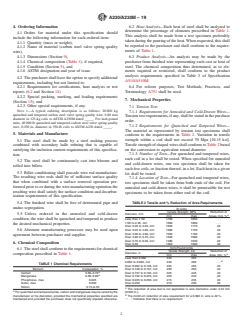
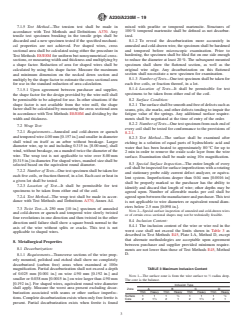
1.1 This specification covers the highest quality of round and shaped carbon steel spring wire, uniform in quality and temper, intended especially for the manufacture of valve springs and other springs requiring high-fatigue properties. It is similar to the grade VD (referenced in EN 10270-2) intended for high fatigue levels. This wire shall be either in the annealed and cold-drawn or quenched and tempered condition as specified by purchaser.
1.2 The values stated in either SI units or inch-pound units are to be regarded separately as standard. The values stated in each system may not be exact equivalents; therefore, each system shall be used independently of the other. Combining values from the two systems may result in non-conformance with the standard.
1.3 This international standard was developed in accordance with internationally recognized principles on standardization established in the Decision on Principles for the Development of International Standards, Guides and Recommendations issued by the World Trade Organization Technical Barriers to Trade (TBT) Committee.
- Status
- Published
- Publication Date
- 31-Aug-2019
- Technical Committee
- A01 - Steel, Stainless Steel and Related Alloys
- Drafting Committee
- A01.03 - Steel Rod and Wire
Buy Documents
ASTM A230/A230M-19 - Standard Specification for Steel Wire, Carbon Valve Spring Quality
REDLINE ASTM A230/A230M-19 - Standard Specification for Steel Wire, Carbon Valve Spring Quality
Overview
ASTM A230/A230M-19 is the international standard for steel wire, specifically designed to ensure the highest quality round and shaped carbon steel spring wire. Developed by ASTM International, this specification focuses on wire intended for the manufacture of valve springs and other high-fatigue applications, where uniform quality and temper are critical. The steel wire covered by ASTM A230/A230M-19 must demonstrate stringent compliance regarding chemical composition, mechanical properties, and surface condition, supporting industries that require precision and durability in spring components.
Key Topics
- Material Quality and Production
ASTM A230/A230M-19 specifies wire produced from carbon steel using continuous casting, hardening, and tempering processes, or supplied in annealed and cold-drawn condition as per customer requirements. - Chemical Requirements
The steel wire must conform to precise chemical composition limits for carbon, manganese, phosphorus, sulfur, and silicon. - Mechanical Properties
Properties are verified through tension, wrap, and twist tests, as well as special surface inspections. Each coil is tested to ensure adequate tensile strength and reduction of area, conforming to strict tolerances. - Metallurgical Characteristics
The standard mandates rigorous control over decarburization, microstructure, and inclusion content, ensuring the wire’s suitability for high-stress and fatigue-resistant spring applications. - Dimensional Tolerances
ASTM A230/A230M-19 provides detailed permissible variations in wire diameter and out-of-round limits for both SI and inch-pound units. - Packaging and Identification
The standard outlines requirements for packaging, marking, and labeling, including barcoding, to ensure traceability and compliance during shipment.
Applications
- Automotive Valve Springs
The most prominent use of ASTM A230/A230M-19-grade carbon steel wire is in the manufacture of valve springs for internal combustion engines, where fatigue resistance and consistent performance under cyclic loading are essential. - High-Fatigue Springs
The wire is ideal for other high-fatigue, precision springs used in automotive, industrial, and mechanical equipment, including clutch springs, suspension springs, and heavy-duty machinery components. - General Mechanical Springs
Any application requiring reliable, durable, and high-tensile round or shaped carbon steel wire, especially where conformance to international standards is required, benefits from this specification.
Related Standards
- ASTM A370: Test Methods and Definitions for Mechanical Testing of Steel Products
- ASTM A510/A510M: Specification for General Requirements for Wire Rods and Coarse Round Wire, Carbon Steel
- ASTM A700: Guide for Packaging, Marking, and Loading Methods for Steel Products for Shipment
- ASTM A941: Terminology Relating to Steel, Stainless Steel, Related Alloys, and Ferroalloys
- ASTM E8/E8M: Test Methods for Tension Testing of Metallic Materials
- ASTM E45: Test Methods for Determining the Inclusion Content of Steel
- EN 10270-2: Steel Wire for Mechanical Springs - Oil-Hardened and Tempered Spring Steel Wire
Practical Value
Manufacturers, suppliers, and end-users depend on ASTM A230/A230M-19 for assurance of material quality, mechanical strength, and consistent performance in demanding environments. Adherence to this standard supports international trade, meets critical safety requirements, and ensures compatibility with global engineering practices, making it vital for the production of reliable valve and mechanical springs in the automotive and industrial sectors.
Keywords: ASTM A230/A230M-19, carbon steel wire, valve spring quality, high-fatigue springs, mechanical properties, steel standards, automotive springs, spring wire specification
Relations
- Effective Date
- 01-Mar-2024
- Effective Date
- 01-Mar-2024
- Effective Date
- 01-Jan-2024
- Effective Date
- 01-Nov-2023
- Effective Date
- 01-Nov-2019
- Effective Date
- 01-Jul-2019
- Refers
ASTM A370-17a - Standard Test Methods and Definitions for Mechanical Testing of Steel Products - Effective Date
- 15-Nov-2017
- Effective Date
- 01-Sep-2017
- Effective Date
- 01-Jan-2017
- Effective Date
- 15-Jul-2016
- Effective Date
- 01-Nov-2015
- Effective Date
- 01-Nov-2015
- Effective Date
- 01-Feb-2015
- Effective Date
- 01-Nov-2014
- Effective Date
- 15-May-2014
Buy Documents
ASTM A230/A230M-19 - Standard Specification for Steel Wire, Carbon Valve Spring Quality
REDLINE ASTM A230/A230M-19 - Standard Specification for Steel Wire, Carbon Valve Spring Quality
Get Certified
Connect with accredited certification bodies for this standard

Element Materials Technology
Materials testing and product certification.

Inštitut za kovinske materiale in tehnologije
Institute of Metals and Technology. Materials testing, metallurgical analysis, NDT.
Sponsored listings
Frequently Asked Questions
ASTM A230/A230M-19 is a technical specification published by ASTM International. Its full title is "Standard Specification for Steel Wire, Carbon Valve Spring Quality". This standard covers: ABSTRACT This specification deals with the highest quality of round carbon steel spring wire, uniform in quality and temper, intended especially for the manufacture of valve springs and other springs requiring high-fatigue properties. The steel wire shall be subjected to continuous casting, hardening, and tempering to produce the desired mechanical properties. The steel shall conform to the chemical requirements for carbon, manganese, phosphorus, sulfur, and silicon. Mechanical properties shall be determined by the tension test, wrap test, twist test, and special surface inspection. The material as represented by tension test specimens shall conform to the tensile requirements for tensile strength and reduction of area. Metallurgical characterization of steel shall include decarburization, surface condition, and microstructure. SCOPE 1.1 This specification covers the highest quality of round and shaped carbon steel spring wire, uniform in quality and temper, intended especially for the manufacture of valve springs and other springs requiring high-fatigue properties. It is similar to the grade VD (referenced in EN 10270-2) intended for high fatigue levels. This wire shall be either in the annealed and cold-drawn or quenched and tempered condition as specified by purchaser. 1.2 The values stated in either SI units or inch-pound units are to be regarded separately as standard. The values stated in each system may not be exact equivalents; therefore, each system shall be used independently of the other. Combining values from the two systems may result in non-conformance with the standard. 1.3 This international standard was developed in accordance with internationally recognized principles on standardization established in the Decision on Principles for the Development of International Standards, Guides and Recommendations issued by the World Trade Organization Technical Barriers to Trade (TBT) Committee.
ABSTRACT This specification deals with the highest quality of round carbon steel spring wire, uniform in quality and temper, intended especially for the manufacture of valve springs and other springs requiring high-fatigue properties. The steel wire shall be subjected to continuous casting, hardening, and tempering to produce the desired mechanical properties. The steel shall conform to the chemical requirements for carbon, manganese, phosphorus, sulfur, and silicon. Mechanical properties shall be determined by the tension test, wrap test, twist test, and special surface inspection. The material as represented by tension test specimens shall conform to the tensile requirements for tensile strength and reduction of area. Metallurgical characterization of steel shall include decarburization, surface condition, and microstructure. SCOPE 1.1 This specification covers the highest quality of round and shaped carbon steel spring wire, uniform in quality and temper, intended especially for the manufacture of valve springs and other springs requiring high-fatigue properties. It is similar to the grade VD (referenced in EN 10270-2) intended for high fatigue levels. This wire shall be either in the annealed and cold-drawn or quenched and tempered condition as specified by purchaser. 1.2 The values stated in either SI units or inch-pound units are to be regarded separately as standard. The values stated in each system may not be exact equivalents; therefore, each system shall be used independently of the other. Combining values from the two systems may result in non-conformance with the standard. 1.3 This international standard was developed in accordance with internationally recognized principles on standardization established in the Decision on Principles for the Development of International Standards, Guides and Recommendations issued by the World Trade Organization Technical Barriers to Trade (TBT) Committee.
ASTM A230/A230M-19 is classified under the following ICS (International Classification for Standards) categories: 77.140.25 - Spring steels. The ICS classification helps identify the subject area and facilitates finding related standards.
ASTM A230/A230M-19 has the following relationships with other standards: It is inter standard links to ASTM A941-24, ASTM A370-24, ASTM E8/E8M-24, ASTM E45-18a(2023), ASTM A700-14(2019), ASTM A370-19, ASTM A370-17a, ASTM A941-17, ASTM A370-17, ASTM E8/E8M-16, ASTM A370-15, ASTM A941-15, ASTM E8/E8M-15, ASTM A700-14, ASTM A370-14. Understanding these relationships helps ensure you are using the most current and applicable version of the standard.
ASTM A230/A230M-19 is available in PDF format for immediate download after purchase. The document can be added to your cart and obtained through the secure checkout process. Digital delivery ensures instant access to the complete standard document.
Standards Content (Sample)
This international standard was developed in accordance with internationally recognized principles on standardization established in the Decision on Principles for the
Development of International Standards, Guides and Recommendations issued by the World Trade Organization Technical Barriers to Trade (TBT) Committee.
Designation:A230/A230M −19
Standard Specification for
Steel Wire, Carbon Valve Spring Quality
This standard is issued under the fixed designationA230/A230M; the number immediately following the designation indicates the year
of original adoption or, in the case of revision, the year of last revision.Anumber in parentheses indicates the year of last reapproval.
A superscript epsilon (´) indicates an editorial change since the last revision or reapproval.
This standard has been approved for use by agencies of the U.S. Department of Defense.
1. Scope* A941TerminologyRelatingtoSteel,StainlessSteel,Related
Alloys, and Ferroalloys
1.1 This specification covers the highest quality of round
E8/E8MTest Methods for Tension Testing of Metallic Ma-
and shaped carbon steel spring wire, uniform in quality and
terials
temper, intended especially for the manufacture of valve
E29Practice for Using Significant Digits in Test Data to
springsandotherspringsrequiringhigh-fatigueproperties.Itis
Determine Conformance with Specifications
similar to the grade VD (referenced in EN 10270-2) intended
E45Test Methods for Determining the Inclusion Content of
forhighfatiguelevels.Thiswireshallbeeitherintheannealed
Steel
and cold-drawn or quenched and tempered condition as speci-
fied by purchaser. 2.2 Federal Standard:
Fed. Std. No. 123Marking for Shipment (Civil Agencies)
1.2 The values stated in either SI units or inch-pound units
are to be regarded separately as standard. The values stated in 2.3 European Standard:
each system may not be exact equivalents; therefore, each EN 10270-2Steel Wire for Mechanical Springs Part 2:
system shall be used independently of the other. Combining Oil-Hardened and Tempered Spring Steel Wire of Unal-
values from the two systems may result in non-conformance loyed and Alloyed Steels
with the standard.
3. Terminology
1.3 This international standard was developed in accor-
dance with internationally recognized principles on standard-
3.1 Definitions:
ization established in the Decision on Principles for the
3.1.1 Refer to Terminology A941 for additional definitions
Development of International Standards, Guides and Recom-
of terms used in this standard.
mendations issued by the World Trade Organization Technical
3.2 Definitions of Terms Specific to This Standard:
Barriers to Trade (TBT) Committee.
3.2.1 billet, n—an as-cast or forged section, typically avail-
able for transport, inspection, and conditioning, that is used as
2. Referenced Documents
raw material for wire rod manufacture.
2.1 ASTM Standards:
3.2.2 bloom, n—an as-cast or forged section used as raw
A370Test Methods and Definitions for Mechanical Testing
material for billet manufacture.
of Steel Products
A510/A510MSpecification for General Requirements for
3.2.3 equivalent round diameter, n—diameter of a round
Wire Rods and Coarse Round Wire, Carbon Steel, and
wire having equivalent cross sectional area to a given shaped
Alloy Steel
wire.
A700Guide for Packaging, Marking, and Loading Methods
3.2.4 round wire, n—wire having a circular cross section.
for Steel Products for Shipment
A751Test Methods and Practices for Chemical Analysis of 3.2.5 shape factor, n—a value used to obtain cross sectional
Steel Products area for shaped wires when multiplied by measured width and
measured thickness
This specification is under the jurisdiction ofASTM Committee A01 on Steel,
3.2.6 shaped wire, n—wire having a non-circular cross
Stainless Steel and RelatedAlloys and is the direct responsibility of Subcommittee
section.
A01.03 on Steel Rod and Wire.
Current edition approved Sept. 1, 2019. Published September 2019. Originally
approved in 1939. Last previous edition approved in 2011 as A230/
ε1
A230M–05(2011) . DOI: 10.1520/A0230_A0230M-19.
2 3
For referenced ASTM standards, visit the ASTM website, www.astm.org, or Available from Standardization Documents Order Desk, DODSSP, Bldg. 4,
contact ASTM Customer Service at service@astm.org. For Annual Book of ASTM Section D, 700 Robbins Ave., Philadelphia, PA 19111-5098.
Standards volume information, refer to the standard’s Document Summary page on Available from European Committee for Standardization, CEN-CENELEC
the ASTM website. Management Centre Avenue Marnix 17-B-1000 Brussels, Belgium.
*A Summary of Changes section appears at the end of this standard
Copyright © ASTM International, 100 Barr Harbor Drive, PO Box C700, West Conshohocken, PA 19428-2959. United States
A230/A230M−19
4. Ordering Information 6.2 Heat Analysis—Each heat of steel shall be analyzed to
determine the percentage of elements prescribed in Table 1.
4.1 Orders for material under this specification should
This analysis shall be made from a test specimen preferably
include the following information for each ordered item:
takenduringthepouringoftheheat.Whenrequested,thisshall
4.1.1 Quantity (mass or weight),
be reported to the purchaser and shall conform to the require-
4.1.2 Name of material (carbon steel valve spring quality
ments of Table 1.
wire),
4.1.3 Dimensions (Section 9), 6.3 Product Analysis—An analysis may be made by the
4.1.4 Chemical composition (Table 1), if required, purchaser from finished wire representing each cast or heat of
4.1.5 Condition (Section 5), and steel. The chemical composition thus determined, as to ele-
4.1.6 ASTM designation and year of issue. ments required or restricted, shall conform to the product
analysis requirements specified in Table 3 of Specification
4.2 Thepurchasershallhavetheoptiontospecifyadditional
A510/A510M.
requirements, including but not limited to:
4.2.1 Requirements for certifications, heat analysis or test 6.4 For referee purposes, Test Methods, Practices, and
reports (6.2 and Section 14) Terminology A751 shall be used.
4.2.2 Special packing, marking, and loading requirements
7. Mechanical Properties
(Section 15), and
4.2.3 Other special requirements, if any.
7.1 Tension Test:
NOTE 1—A typical ordering description is as follows: 20000 kg
7.1.1 Requirements for Annealed and Cold-Drawn Wires—
quenched and tempered carbon steel valve spring quality wire, 6.00 mm
Tensiontestrequirements,ifany,shallbestatedinthepurchase
diameter in 125-kg coils to ASTM A230M dated _____. For inch-pound
order.
units, 40000 lb quenched and tempered carbon steel valve spring quality
7.1.2 Requirements for Quenched and Tempered Wires—
wire, 0.250 in. diameter in 350-lb coils to ASTM A230 dated _____.
The material as represented by tension test specimens shall
5. Materials and Manufacture
conform to the requirements in Table 2. Variation in tensile
strength within a coil shall not exceed 70 Mpa [10.15 ksi].
5.1 The steel shall be made by a steel making process
TensilestrengthofshapedwiresshallconformtoTable2based
combined with secondary ladle refining that is capable of
on the conversion to equivalent round diameter.
satisfying the inclusion content requirements of this specifica-
7.1.3 Number of Tests—For quenched and tempered wires,
tion.
each coil in a lot shall be tested. When specified for annealed
5.2 The steel shall be continuously cast into blooms and
and cold-drawn wires, one test specimen shall be taken for
rolled into billets.
eachfivecoils,orfractionthereof,inalot.Eachheatinagiven
5.3 Billet conditioning shall precede wire rod manufacture.
lot shall be tested.
The resulting wire rods shall be of sufficient surface quality
7.1.4 Location of Tests—For quenched and tempered wires,
that when combined with a surface removal operation per-
test specimens shall be taken from both ends of the coil. For
formedpriortoorduringthewiremanufacturingoperationthe
annealed and cold-drawn wires, it shall be permissible for test
resulting wire shall satisfy the surface condition and decarbur-
specimens to be taken from either end of the coil.
ization requirements of this specification.
5.4 The finished wire shall be free of detrimental pipe and
TABLE 2 Tensile and % Reduction of Area Requirements
undue segregation.
SI Units
Tensile Strength, MPa Reduction of
5.5 Unless ordered in the annealed and cold-drawn Diameter, mm
A
min max Areas, min, %
condition, the wire shall be quenched and tempered to produce
Less than 1.50 1700 1850 . . .
1.50 to 2.35, incl 1650 1800 . . .
the desired mechanical properties.
Over 2.35 to 3.25, incl 1620 1770 40
5.6 Alternate manufacturing processes may be used upon Over 3.25 to 4.00, incl 1580 1720 40
Over 4.00 to 4.90, incl 1550 1700 40
agreement between purchaser and supplier.
Over 4.90 to 5.70, incl 1520 1680 40
Over 5.70 to 6.35, incl 1480 1630 40
6. Chemical Composition
Over 6.35 1450 1600 40
Inch-Pound Units
6.1 Thesteelshallconformtotherequirementsforchemical
Tensile Strength, ksi Reduction of
Diameter, in.
A
composition prescribed in Table 1.
min max Area, min, %
Less than 0.062 245 265 . . .
B
0.062 to 0.092, incl 240 260 . . .
TABLE 1 Chemical Requirements
Over 0.092 to 0.128, incl 235 255 40
Element Composition, % Over 0.128 to 0.157, incl 230 250 40
A
Carbon 0.60–0.75 Over 0.157 to 0.192, incl 225 245 40
A
Manganese 0.60–0.90 Over 0.192 to 0.225, incl 220 240 40
Phosphorus, max 0.025 Over 0.225 to 0.250, incl 215 235 40
Sulfur, max 0.030 Over 0.250 210 230 40
Silicon 0.15–0.35
A
The reduction of area test is not applicable to wire diameters under 2.34 mm
A
For quenched and tempered wires, carbon and manganese may be varied by the [0.092 in.].
B
manufacturer at his discretion, provided the mechanical properties specified are The minimum reduction of area requirement for a 0.092 in. wire is 40 %.
maintained and provided the purchaser does not specifically stipulate otherwise. “. . .” Indicates that there is no requirement.
A230/A230M−19
7.1.5 Test Method—The tension test shall be made in mixed with pearlite or tempered martensite. Structures of
accordance with Test Methods and Definitions A370. Any 100% tempered martensite shall be defined as not decarbur-
tensile test specimen breaking in the tensile grips shall be ized.
discarded and a new specimen tested if the specified mechani- 8.1.2 To reveal the decarburization more accurately in
annealed and cold-drawn wire, the specimen shall be hardened
cal properties are not achieved. For shaped wires, cross
sectional area shall be calculated using either the procedure in and tempered before microscopic examination. Prior to
hardening, the specimen shall be filed flat on one side enough
Test Methods E8/E8M for uniform but nonsymmetrical cross-
sections, or measuring width and thickness and multiplying by to reduce the diameter at least 20%. The subsequent mounted
specimen shall show the flattened section, as well as the
a shape factor. Reduction of area for shaped wires shall be
original wire edge. Any decarburization on this flattened
calculated by using this shape factor. Measure the maximum
section shall necessitate a new specimen for examination.
and minimum dimension on the necked down section and
8.1.3 Number of Tests—Onetestspecimenshallbetakenfor
multiplybytheshapefactortoestimatethecrosssectionalarea
each five coils, or fraction thereof, in a lot.
for use in the standard reduction of area calculation.
8.1.4 Location of Tests—It shall be permissible for test
7.1.5.1 Upon agreement between purchaser and supplier,
specimens to be taken from either end of the coil.
the shape factor for the design provided by the wire mill shall
be permissible to be adopted for use. In other situations if the 8.2 Surface Condition:
shape factor is not available from the wire mill, the shape 8.2.1 Thesurfaceshallbesmoothandfreeof
...
This document is not an ASTM standard and is intended only to provide the user of an ASTM standard an indication of what changes have been made to the previous version. Because
it may not be technically possible to adequately depict all changes accurately, ASTM recommends that users consult prior editions as appropriate. In all cases only the current version
of the standard as published by ASTM is to be considered the official document.
´1
Designation: A230/A230M − 05 (Reapproved 2011) A230/A230M − 19
Standard Specification for
Steel Wire, Oil-Tempered Carbon Valve Spring Quality
This standard is issued under the fixed designation A230/A230M; the number immediately following the designation indicates the year
of original adoption or, in the case of revision, the year of last revision. A number in parentheses indicates the year of last reapproval.
A superscript epsilon (´) indicates an editorial change since the last revision or reapproval.
This standard has been approved for use by agencies of the U.S. Department of Defense.
ε NOTE—Changes were made editorially throughout in July 2011.
1. Scope*
1.1 This specification covers the highest quality of round and shaped carbon steel spring wire, uniform in quality and temper,
intended especially for the manufacture of valve springs and other springs requiring high-fatigue properties. It is similar to the
grade VD (referenced in EN 10270-2) intended for high fatigue levels. This wire shall be either in the annealed and cold-drawn
or quenched and tempered condition as specified by purchaser.
1.2 The values stated in either SI units or inch-pound units are to be regarded separately as standard. The values stated in each
system may not be exact equivalents; therefore, each system shall be used independently of the other. Combining values from the
two systems may result in non-conformance with the standard.
1.3 This international standard was developed in accordance with internationally recognized principles on standardization
established in the Decision on Principles for the Development of International Standards, Guides and Recommendations issued
by the World Trade Organization Technical Barriers to Trade (TBT) Committee.
2. Referenced Documents
2.1 ASTM Standards:
A370 Test Methods and Definitions for Mechanical Testing of Steel Products
A510A510/A510M Specification for General Requirements for Wire Rods and Coarse Round Wire, Carbon Steel (Metric)
A0510_A0510M Steel, and Alloy Steel
A510M Specification for General Requirements for Wire Rods and Coarse Round Wire, Carbon Steel (Metric) (Withdrawn
2011)
A700 Guide for Packaging, Marking, and Loading Methods for Steel Products for Shipment
A751 Test Methods, Practices, and Terminology for Chemical Analysis of Steel Products
A941 Terminology Relating to Steel, Stainless Steel, Related Alloys, and Ferroalloys
E8/E8M Test Methods for Tension Testing of Metallic Materials
E29 Practice for Using Significant Digits in Test Data to Determine Conformance with Specifications
E45 Test Methods for Determining the Inclusion Content of Steel
2.2 ANSI Standard:
B 32.4M Preferred Metric Sizes for Round, Square, Rectangle, and Hexagon Metal Products
2.3 Military Standard:
MIL-STD-163 Steel Mill Products, Preparation for Shipment and Storage
2.2 Federal Standard:
Fed. Std. No. 123 Marking for Shipment (Civil Agencies)
2.3 AIAG European Standard:
AIAG B-5EN 10270-2 02.00 Primary Metals Identification Tag Application StandardSteel Wire for Mechanical Springs Part 2:
Oil-Hardened and Tempered Spring Steel Wire of Unalloyed and Alloyed Steels
This specification is under the jurisdiction of ASTM Committee A01 on Steel, Stainless Steel and Related Alloys and is the direct responsibility of Subcommittee A01.03
on Steel Rod and Wire.
Current edition approved July 1, 2011Sept. 1, 2019. Published July 2011September 2019. Originally approved in 1939. Last previous edition approved in 20052011 as
ε1
A230/A230M – 05.A230/A230M – 05 (2011) . DOI: 10.1520/A0230_A0230M-05R11E01.10.1520/A0230_A0230M-19.
For referenced ASTM standards, visit the ASTM website, www.astm.org, or contact ASTM Customer Service at service@astm.org. For Annual Book of ASTM Standards
volume information, refer to the standard’s Document Summary page on the ASTM website.
Available from Standardization Documents Order Desk, DODSSP, Bldg. 4, Section D, 700 Robbins Ave., Philadelphia, PA 19111-5098.
Available from Automotive Industry Action Group (AIAG), 26200 Lahser Rd., Suite 200, Southfield, MI 48034.European Committee for Standardization,
CEN-CENELEC Management Centre Avenue Marnix 17-B-1000 Brussels, Belgium.
*A Summary of Changes section appears at the end of this standard
Copyright © ASTM International, 100 Barr Harbor Drive, PO Box C700, West Conshohocken, PA 19428-2959. United States
A230/A230M − 19
3. Terminology
3.1 Definitions:
3.1.1 Refer to Terminology A941 for additional definitions of terms used in this standard.
3.2 Definitions of Terms Specific to This Standard:
3.2.1 billet, n—an as-cast or forged section, typically available for transport, inspection, and conditioning, that is used as raw
material for wire rod manufacture.
3.2.2 bloom, n—an as-cast or forged section used as raw material for billet manufacture.
3.2.3 equivalent round diameter, n—diameter of a round wire having equivalent cross sectional area to a given shaped wire.
3.2.4 round wire, n—wire having a circular cross section.
3.2.5 shape factor, n—a value used to obtain cross sectional area for shaped wires when multiplied by measured width and
measured thickness
3.2.6 shaped wire, n—wire having a non-circular cross section.
4. Ordering Information
3.1 Material furnished under this specification shall conform to the applicable requirements of the current edition of either
Specification A510 or Specification A510M.
4.1 Orders for material under this specification should include the following information for each ordered item:
4.1.1 Quantity (mass or weight),
4.1.2 Name of material (oil-tempered carbon (carbon steel valve spring quality wire),
4.1.3 Dimensions (Section 89),
4.1.4 Chemical composition (Table 1), if required,
4.1.5 PackagingCondition (Section 145), and
3.2.6 Cast or heat analysis report, if desired (see 5.2),
3.2.7 Certification or test report, or both, if specified (Section 13), and
4.1.6 ASTM designation and dateyear of issue.
NOTE 1—A typical metric ordering description is as follows: For inch-pound units, 40 000 lb oil-tempered carbon steel valve spring quality wire, 0.250
in. diameter in 350-lb coils to ASTM A230 dated _____, or for SI units 20 000 kg oil-tempered carbon steel valve spring quality wire, 6.00 mm diameter
in 125-kg coils to ASTM A230M dated _____.
4.2 The purchaser shall have the option to specify additional requirements, including but not limited to:
4.2.1 Requirements for certifications, heat analysis or test reports (6.2 and Section 14)
4.2.2 Special packing, marking, and loading requirements (Section 15), and
4.2.3 Other special requirements, if any.
NOTE 1—A typical ordering description is as follows: 20 000 kg quenched and tempered carbon steel valve spring quality wire, 6.00 mm diameter in
125-kg coils to ASTM A230M dated _____. For inch-pound units, 40 000 lb quenched and tempered carbon steel valve spring quality wire, 0.250 in.
diameter in 350-lb coils to ASTM A230 dated _____.
TABLE 1 Chemical Requirements
Element Composition, %
A
Carbon 0.60–0.75
A
Manganese 0.60–0.90
Phosphorus, max 0.025
Sulfur, max 0.030
Silicon 0.15–0.35
TABLE 1 Chemical Requirements
Element Composition, %
A
Carbon 0.60–0.75
A
Manganese 0.60–0.90
Phosphorus, max 0.025
Sulfur, max 0.030
Silicon 0.15–0.35
A
Carbon and For quenched and tempered wires, carbon and manganese may be
varied by the manufacturer at his discretion, provided the mechanical properties
specified are maintained and provided the purchaser does not specifically stipulate
otherwise.
A230/A230M − 19
5. Materials and Manufacture
5.1 The steel mayshall be made by any commercially accepted steel-making process. The steel shall be continuously cast. a steel
making process combined with secondary ladle refining that is capable of satisfying the inclusion content requirements of this
specification.
5.2 The steel shall be continuously cast into blooms and rolled into billets.
5.3 Billet conditioning shall precede wire rod manufacture. The resulting wire rods shall be of sufficient surface quality that
when combined with a surface removal operation performed prior to or during the wire manufacturing operation the resulting wire
shall satisfy the surface condition and decarburization requirements of this specification.
5.4 The finished wire shall be free of detrimental pipe and undue segregation.
5.5 The Unless ordered in the annealed and cold-drawn condition, the wire shall be hardenedquenched and tempered to produce
the desired mechanical properties.
5.6 Alternate manufacturing processes may be used upon agreement between purchaser and supplier.
6. Chemical Composition
6.1 The steel shall conform to the requirements for chemical composition prescribed in Table 1.
6.2 Cast or Heat Analysis—Each cast or heat of steel shall be analyzed by the manufacturer to determine the percentage of
elements prescribed in Table 1. This analysis shall be made from a test specimen preferably taken during the pouring of the cast
or heat. When requested, this shall be reported to the purchaser and shall conform to the requirements of Table 1.
6.3 Product Analysis—An analysis may be made by the purchaser from finished wire representing each cast or heat of steel. The
chemical composition thus determined, as to elements required or restricted, shall conform to the product analysis requirements
specified in Table 103 of Specification A510A510/A510M or Specification A510M.
6.4 For referee purposes, Test Methods, Practices, and Terminology A751 shall be used.
7. Mechanical Properties
7.1 Tension Test:
7.1.1 Requirements for Annealed and Cold-Drawn Wires—Tension test requirements, if any, shall be stated in the purchase
order.
7.1.2 Requirements—Requirements for Quenched and Tempered Wires—The material as represented by tension test specimens
shall conform to the requirements prescribed in Table 2 or . Variation in tensile strength within a coil shall not exceed 70 Mpa
[10.15 ksi]. Tensile strength of shaped wires shall conform to Table 32.
A230/A230M − 19
TABLE 2 Tensile Requirements, SI Units
Diameter, mm Tensile Strength, MPa Reduction of
A
Areas, min, %
min max
Less than 1.50 1700 1850 . . .
1.50 to 2.50, incl 1650 1800 . . .
Over 2.50 to 3.50, incl 1600 1750 40
Over 3.50 to 4.00, incl 1580 1720 40
Over 4.00 to 4.80, incl 1550 1700 40
Over 4.80 to 5.50, incl 1520 1680 40
Over 5.50 to 6.50, incl 1500 1650 40
Over 6.50 1450 1600 40
A
The reduction of area test is not applicable to wire diameters under 2.34 mm.
TABLE 3 Tensile Requirements, Inch-Pound Units 2 Tensile and
% Reduction of Area Requirements
Tensile Strength, ksi
Reduction of
Diameter, in.
A
Area, min, %
min max
SI Units
Tensile Strength, MPa Reduction of
Diameter, mm
A
min max Areas, min, %
Less than 1.50 1700 1850 . . .
1.50 to 2.35, incl 1650 1800 . . .
Over 2.35 to 3.25, incl 1620 1770 40
Over 3.25 to 4.00, incl 1580 1720 40
Over 4.00 to 4.90, incl 1550 1700 40
Over 4.90 to 5.70, incl 1520 1680 40
Over 5.70 to 6.35, incl 1480 1630 40
Over 6.35 1450 1600 40
Inch-Pound Units
Tensile Strength, ksi Reduction of
Diameter, in.
A
min max Area, min, %
Less than 0.062 245 265 . . .
Less than 0.062 245 265 . . .
0.062 to 0.092, incl 240 260 . . .
B
0.062 to 0.092, incl 240 260 . . .
Over 0.092 to 0.128, incl 235 255 40
Over 0.128 to 0.162, incl 230 250 40
Over 0.128 to 0.157, incl 230 250 40
Over 0.162 to 0.192, incl 225 245 40
Over 0.157 to 0.192, incl 225 245 40
Over 0.192 to 0.225, incl 220 240 40
Over 0.225 to 0.250, incl 215 235 40
Over 0.250 210 230 40
A
The The reduction of area test is not applicable to wire diameters under 0.092
in.2.34 mm [0.092 in.].
B
The minimum reduction of area requirement for a 0.092 in. wire is 40 %.
“. . .” Indicates that there is no requirement.
based on the conversion to equivalent round diameter.
7.1.3 Number of Tests—One For quenched and tempered wires, each coil in a lot shall be tested. When specified for annealed
and cold-drawn wires, one test specimen shall be taken for each five coils, or fraction thereof, in a lot. Each cast or heat in a given
lot shall be tested.
7.1.4 Location of Tests—Test For quenched and tempered wires, test specimens shall be taken from both ends of the coil. For
annealed and cold-drawn wires, it shall be permissible for test specimens to be taken from either end of the coil.
7.1.5 Test Method—The tension test shall be made in accordance with Test Methods and Definitions A370. Any tensile test
specimen breaking in the tensile grips shall be discarded and a new specimen tested if the specified mechanical properties are not
achieved. For shaped wires, cross sectional area shall be calculated using either the procedure in Test Methods E8/E8M for uniform
but nonsymmetrical cross-sections, or measuring width and thickness and multiplying by a shape factor. Reduction of area for
shaped wires shall be calculated by using this shape factor. Measure the maximum and minimum dimension on the necked down
section and multiply by the shape factor to estimate the cross sectional area for use in the standard reduction of area calculation.
7.1.5.1 Upon agreement between purchaser and supplier, the shape factor for the design provided by the wire mill shall be
permissible to be adopted for use. In other situations if the shape factor is not available from the wire mill, the shape factor shall
be calculated by measuring the cross sectional area in accordance with Test Methods E8/E8M and dividing by the width and
thickness.
7.2 Wrap Test:
A230/A230M − 19
7.2.1 Requirements—Wire 0.162 in. [4.00 mm] and Annealed and cold-drawn or quench and tempered wire 4.00 mm [0.157 in.]
and smaller in diameter shall wind on itself as an arbor without breakage. Larger diameter wire, up to and including 0.2500.315
in. [6.50 mm], [8.00 mm], shall wind, without breakage, on a mandrel twice the diameter of the wire. The wrap test is not
applicable to wire over 8.00 mm [0.315 in.] in diameter. For shaped wires, mandrel size shall be selected based on the equivalent
round diameter.
7.2.2 Number of Tests—One test s
...