

ASTM A227/A227M-24
(Specification)Standard Specification for Steel Wire, Cold-Drawn for Mechanical Springs
General Information
- Abstract
ABSTRACT
This specification covers two classes of round cold-drawn steel spring wire having properties and quality for the manufacture of mechanical springs that are not subject to high stress or requiring high fatigue properties and wire forms. The steel specimens shall either be ingot cast or strand cast. Cast or heat and product analysis shall be performed wherein steel materials shall conform to the required chemical compositions of carbon, manganese, phosphorus, sulfur, and silicon. Specimens shall also undergo tension and wrap tests and shall conform to the requirements of tensile properties.
SCOPE
1.1 This specification covers two classes of round cold-drawn steel spring wire having properties and quality for the manufacture of mechanical springs, rings, and wire forms that are not subject to high stress or requiring high fatigue properties.
1.2 The values stated in either SI units or inch-pound units are to be regarded separately as standard. The values stated in each system may not be exact equivalents; therefore, each system shall be used independently of the other. Combining values from the two systems may result in non-conformance with the standard.
1.3 This international standard was developed in accordance with internationally recognized principles on standardization established in the Decision on Principles for the Development of International Standards, Guides and Recommendations issued by the World Trade Organization Technical Barriers to Trade (TBT) Committee.
- Status
- Published
- Publication Date
- 29-Feb-2024
- Technical Committee
- A01 - Steel, Stainless Steel and Related Alloys
- Drafting Committee
- A01.03 - Steel Rod and Wire
Buy Documents
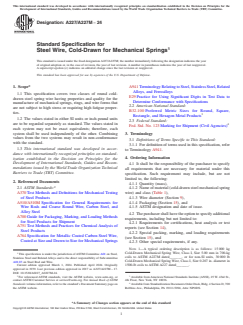
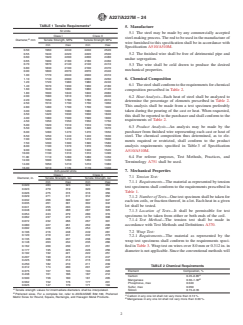
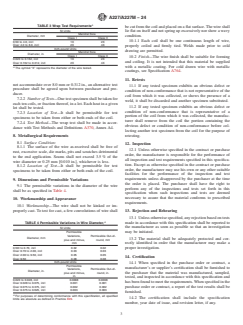

ASTM A227/A227M-24 - Standard Specification for Steel Wire, Cold-Drawn for Mechanical Springs
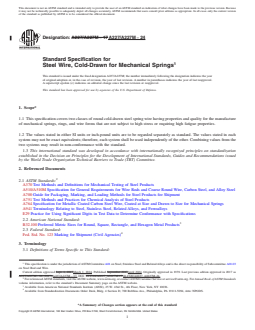
REDLINE ASTM A227/A227M-24 - Standard Specification for Steel Wire, Cold-Drawn for Mechanical Springs
Overview
ASTM A227/A227M-24 is the standard specification developed by ASTM International for round, cold-drawn steel wire intended for the manufacture of mechanical springs, wire forms, and rings that are not subject to high stress or demanding high fatigue properties. This standard ensures that steel spring wire exhibits suitable mechanical and chemical properties for reliable, general-purpose spring applications.
Steel wire to this standard may be either ingot cast or strand cast, and is cold drawn to achieve the required strength and surface conditions. The document establishes guidelines for wire ordering, manufacture, chemical composition, mechanical property testing, inspection, and shipment, making it a key reference for manufacturers and users of mechanical spring wire worldwide.
Key Topics
- Wire Classes: The standard covers two classes of steel spring wire, each specified by mechanical and chemical properties suited for general-purpose uses.
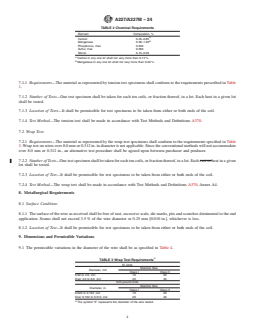
- Chemical Composition: Specifies required ranges for carbon, manganese, phosphorus, sulfur, and silicon to ensure suitable wire quality.
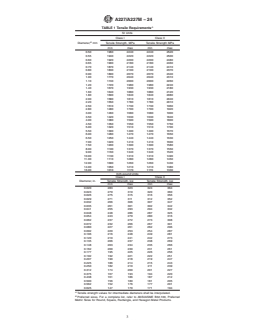
- Mechanical Properties: Details tensile strength ranges for a variety of diameters and includes mandatory tension and wrap tests for quality assurance.
- Dimensional Tolerances: Sets forth permissible diameter variations to ensure product consistency.
- Surface Quality: Requires finished wire to be free from rust, excessive scale, and surface defects detrimental to forming and spring performance.
- Ordering Information: Provides thorough guidance for purchasers to specify quantity, diameter, class, packaging, certification needs, and any special requirements.
- Packaging and Marking: Outlines accepted practices for identification and shipment of steel wire coils.
Applications
ASTM A227/A227M-24 cold-drawn steel wire is primarily used in the following applications:
- Mechanical springs: Compression, extension, and torsion springs for various light- to medium-duty industrial and consumer products.
- Wire forms: Parts shaped from steel wire for appliances, electronics, automotive uses, and general hardware.
- Rings: Fabricated rings used in assemblies, fasteners, or fittings that are not exposed to extreme cycling or heavy loads.
This standard is especially applicable for situations where springs do not endure high stress levels or require exceptional fatigue resistance. Its consistent requirements for surface quality, tensile strength, and dimensional control help manufacturers deliver wire that forms predictably and performs reliably, reducing rejection rates and ensuring end-product quality.
Related Standards
For a comprehensive approach to steel wire for mechanical components, refer to these related ASTM and industry standards:
- ASTM A228/A228M - High-carbon steel wire for mechanical springs subjected to higher stresses and fatigue.
- ASTM A370 - Test methods for mechanical testing of steel products.
- ASTM A510/A510M - General requirements for wire rods and coarse round wire, carbon steel, and alloy steel.
- ASTM A764 - Metallic coated carbon steel wire for mechanical springs.
- ASTM A751 - Test methods and practices for chemical analysis of steel products.
- ANSI B32.100 - Preferred metric sizes for metal products.
Summary
The ASTM A227/A227M-24 standard provides essential requirements and guidelines for manufacturers, quality assurance teams, spring designers, and purchasers working with cold-drawn steel wire for mechanical springs. Adherence to this standard ensures consistent wire quality, optimal spring performance, and smooth supply chain transactions in industries ranging from automotive to consumer appliances. For enhanced reliability and compliance, users should stay up-to-date with the latest edition and reference related standards as needed.
Keywords: ASTM A227, cold-drawn steel wire, mechanical spring wire, spring wire standard, steel wire specification, wire forms, spring manufacturing, tensile strength, surface quality, general-purpose springs.
Relations
- Replaces
ASTM A227/A227M-17 - Standard Specification for Steel Wire, Cold-Drawn for Mechanical Springs - Effective Date
- 01-Mar-2024
- Effective Date
- 01-Mar-2024
Buy Documents
ASTM A227/A227M-24 - Standard Specification for Steel Wire, Cold-Drawn for Mechanical Springs
REDLINE ASTM A227/A227M-24 - Standard Specification for Steel Wire, Cold-Drawn for Mechanical Springs
Get Certified
Connect with accredited certification bodies for this standard

Element Materials Technology
Materials testing and product certification.

Inštitut za kovinske materiale in tehnologije
Institute of Metals and Technology. Materials testing, metallurgical analysis, NDT.
Sponsored listings
Frequently Asked Questions
ASTM A227/A227M-24 is a technical specification published by ASTM International. Its full title is "Standard Specification for Steel Wire, Cold-Drawn for Mechanical Springs". This standard covers: ABSTRACT This specification covers two classes of round cold-drawn steel spring wire having properties and quality for the manufacture of mechanical springs that are not subject to high stress or requiring high fatigue properties and wire forms. The steel specimens shall either be ingot cast or strand cast. Cast or heat and product analysis shall be performed wherein steel materials shall conform to the required chemical compositions of carbon, manganese, phosphorus, sulfur, and silicon. Specimens shall also undergo tension and wrap tests and shall conform to the requirements of tensile properties. SCOPE 1.1 This specification covers two classes of round cold-drawn steel spring wire having properties and quality for the manufacture of mechanical springs, rings, and wire forms that are not subject to high stress or requiring high fatigue properties. 1.2 The values stated in either SI units or inch-pound units are to be regarded separately as standard. The values stated in each system may not be exact equivalents; therefore, each system shall be used independently of the other. Combining values from the two systems may result in non-conformance with the standard. 1.3 This international standard was developed in accordance with internationally recognized principles on standardization established in the Decision on Principles for the Development of International Standards, Guides and Recommendations issued by the World Trade Organization Technical Barriers to Trade (TBT) Committee.
ABSTRACT This specification covers two classes of round cold-drawn steel spring wire having properties and quality for the manufacture of mechanical springs that are not subject to high stress or requiring high fatigue properties and wire forms. The steel specimens shall either be ingot cast or strand cast. Cast or heat and product analysis shall be performed wherein steel materials shall conform to the required chemical compositions of carbon, manganese, phosphorus, sulfur, and silicon. Specimens shall also undergo tension and wrap tests and shall conform to the requirements of tensile properties. SCOPE 1.1 This specification covers two classes of round cold-drawn steel spring wire having properties and quality for the manufacture of mechanical springs, rings, and wire forms that are not subject to high stress or requiring high fatigue properties. 1.2 The values stated in either SI units or inch-pound units are to be regarded separately as standard. The values stated in each system may not be exact equivalents; therefore, each system shall be used independently of the other. Combining values from the two systems may result in non-conformance with the standard. 1.3 This international standard was developed in accordance with internationally recognized principles on standardization established in the Decision on Principles for the Development of International Standards, Guides and Recommendations issued by the World Trade Organization Technical Barriers to Trade (TBT) Committee.
ASTM A227/A227M-24 is classified under the following ICS (International Classification for Standards) categories: 77.140.25 - Spring steels. The ICS classification helps identify the subject area and facilitates finding related standards.
ASTM A227/A227M-24 has the following relationships with other standards: It is inter standard links to ASTM A227/A227M-17, ASTM F1508-96(2021). Understanding these relationships helps ensure you are using the most current and applicable version of the standard.
ASTM A227/A227M-24 is available in PDF format for immediate download after purchase. The document can be added to your cart and obtained through the secure checkout process. Digital delivery ensures instant access to the complete standard document.
Standards Content (Sample)
This international standard was developed in accordance with internationally recognized principles on standardization established in the Decision on Principles for the
Development of International Standards, Guides and Recommendations issued by the World Trade Organization Technical Barriers to Trade (TBT) Committee.
Designation: A227/A227M − 24
Standard Specification for
Steel Wire, Cold-Drawn for Mechanical Springs
This standard is issued under the fixed designation A227/A227M; the number immediately following the designation indicates the year
of original adoption or, in the case of revision, the year of last revision. A number in parentheses indicates the year of last reapproval.
A superscript epsilon (´) indicates an editorial change since the last revision or reapproval.
This standard has been approved for use by agencies of the U.S. Department of Defense.
1. Scope* A941 Terminology Relating to Steel, Stainless Steel, Related
Alloys, and Ferroalloys
1.1 This specification covers two classes of round cold-
E29 Practice for Using Significant Digits in Test Data to
drawn steel spring wire having properties and quality for the
Determine Conformance with Specifications
manufacture of mechanical springs, rings, and wire forms that
2.2 American National Standard:
are not subject to high stress or requiring high fatigue proper-
B32.100 Preferred Metric Sizes for Round, Square,
ties.
Rectangle, and Hexagon Metal Products
1.2 The values stated in either SI units or inch-pound units
2.3 Federal Standard:
are to be regarded separately as standard. The values stated in 4
Fed. Std. No. 123 Marking for Shipment (Civil Agencies)
each system may not be exact equivalents; therefore, each
system shall be used independently of the other. Combining
3. Terminology
values from the two systems may result in non-conformance
3.1 Definitions of Terms Specific to This Standard:
with the standard.
3.1.1 For definition of terms used in this specification, refer
1.3 This international standard was developed in accor-
to Terminology A941.
dance with internationally recognized principles on standard-
4. Ordering Information
ization established in the Decision on Principles for the
Development of International Standards, Guides and Recom-
4.1 It shall be the responsibility of the purchaser to specify
mendations issued by the World Trade Organization Technical
all requirements that are necessary for material under this
Barriers to Trade (TBT) Committee.
specification. Such requirement may include, but are not
limited to, the following:
2. Referenced Documents
4.1.1 Quantity (mass),
2.1 ASTM Standards: 4.1.2 Name of material (cold-drawn steel mechanical spring
A370 Test Methods and Definitions for Mechanical Testing wire) and class (Table 1),
of Steel Products 4.1.3 Wire diameter (Section 9),
A510/A510M Specification for General Requirements for 4.1.4 Packaging (Section 15), and
Wire Rods and Coarse Round Wire, Carbon Steel, and 4.1.5 ASTM designation and date of issue.
Alloy Steel
4.2 The purchaser shall have the option to specify additional
A700 Guide for Packaging, Marking, and Loading Methods
requirements, including but not limited to:
for Steel Products for Shipment
4.2.1 Requirements for certifications, heat analysis or test
A751 Test Methods and Practices for Chemical Analysis of
reports (see Section 14),
Steel Products
4.2.2 Special packing, marking, and loading requirements
A764 Specification for Metallic Coated Carbon Steel Wire,
(see Section 15), and
Coated at Size and Drawn to Size for Mechanical Springs
4.2.3 Other special requirements, if any.
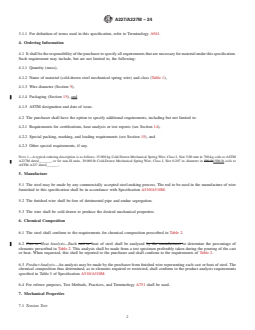
NOTE 1—A typical ordering description is as follows: 15 000 kg
1 Cold-Drawn Mechanical Spring Wire, Class I, Size 5.00 mm in 700-kg
This specification is under the jurisdiction of ASTM Committee A01 on Steel,
coils to ASTM A227M dated_______, or for non-SI units, 30 000 lb
Stainless Steel and Related Alloys and is the direct responsibility of Subcommittee
Cold-Drawn Mechanical Spring Wire, Class I, Size 0.207 in. diameter in
A01.03 on Steel Rod and Wire.
1500-lb coils to ASTM A227 dated_______.
Current edition approved March 1, 2024. Published April 2024. Originally
approved in 1939. Last previous edition approved in 2017 as A227/A227M – 17.
DOI: 10.1520/A0227_A0227M-24.
2 3
For referenced ASTM standards, visit the ASTM website, www.astm.org, or Available from American National Standards Institute (ANSI), 25 W. 43rd St.,
contact ASTM Customer Service at service@astm.org. For Annual Book of ASTM 4th Floor, New York, NY 10036.
Standards volume information, refer to the standard’s Document Summary page on Available from Standardization Documents Order Desk, Bldg. 4 Section D, 700
the ASTM website. Robbins Ave., Philadelphia, PA 19111-5094, Attn: NPODS.
*A Summary of Changes section appears at the end of this standard
Copyright © ASTM International, 100 Barr Harbor Drive, PO Box C700, West Conshohocken, PA 19428-2959. United States
A227/A227M − 24
A
TABLE 1 Tensile Requirements
5. Manufacture
SI Units
5.1 The steel may be made by any commercially accepted
Class I Class II
steel-making process. The rod to be used in the manufacture of
B
Diameter, mm Tensile Strength, MPa Tensile Strength MPa
wire furnished to this specification shall be in accordance with
min max min max
Specification A510/A510M.
0.50 1960 2240 2240 2520
0.55 1940 2220 2220 2500
5.2 The finished wire shall be free of detrimental pipe and
0.60 1920 2200 2200 2480
undue segregation.
0.65 1900 2180 2180 2460
0.70 1870 2140 2140 2410
5.3 The wire shall be cold drawn to produce the desired
0.80 1830 2100 2100 2370
mechanical properties.
0.90 1800 2070 2070 2340
1.00 1770 2040 2040 2310
1.10 1740 2000 2000 2260
6. Chemical Composition
1.20 1720 1980 1980 2240
6.1 The steel shall conform to the requirements for chemical
1.40 1670 1930 1930 2180
1.60 1640 1880 1880 2120
composition prescribed in Table 2.
1.80 1600 1840 1840 2080
2.00 1580 1810 1810 2040 6.2 Heat Analysis—Each heat of steel shall be analyzed to
2.20 1550 1780 1780 2010
determine the percentage of elements prescribed in Table 2.
2.50 1510 1730 1730 1960
This analysis shall be made from a test specimen preferably
2.80 1480 1700 1700 1920
3.00 1460 1680 1680 1900
taken during the pouring of the cast or heat. When requested,
3.50 1420 1630 1630 1840
this shall be reported to the purchaser and shall conform to the
4.00 1380 1590 1590 1800
requirements of Table 2.
4.50 1350 1550 1550 1750
5.00 1320 1510 1510 1700
6.3 Product Analysis—An analysis may be made by the
5.50 1300 1490 1490 1670
6.00 1280 1470 1470 1650 purchaser from finished wire representing each cast or heat of
6.50 1250 1440 1440 1630
steel. The chemical composition thus determined, as to ele-
7.00 1220 1410 1410 1600
ments required or restricted, shall conform to the product
7.50 1200 1390 1390 1580
analysis requirements specified in Table 3 of Specification
8.00 1190 1370 1370 1550
9.00 1160 1340 1340 1520
A510/A510M.
10.00 1130 1310 1310 1490
11.00 1110 1280 1280 1450
6.4 For referee purposes, Test Methods, Practices, and
12.00 1090 1260 1260 1430
Terminology A751 shall be used.
14.00 1050 1210 1210 1380
16.00 1010 1170 1170 1330
7. Mechanical Properties
Inch-pound Units
Class I Class II
7.1 Tension Test:
Diameter, in. Tensile Strength, ksi Tensile Strength, ksi
min max min max
7.1.1 Requirements—The material as represented by tension
0.020 283 323 324 364
test specimens shall conform to the requirements prescribed in
0.023 279 319 320 360
Table 1.
0.026 275 315 316 356
0.029 271 311 312 352
7.1.2 Number of Tests—One test specimen shall be taken for
0.032 266 306 307 347
each ten coils, or fraction thereof, in a lot. Each heat in a given
0.035 261 301 302 342
lot shall be tested.
0.041 255 293 294 332
0.048 248 286 287 325
7.1.3 Location of Tests—It shall be permissible for test
0.054 243 279 280 316
specimens to be taken from either or both ends of the coil.
0.062 237 272 273 308
7.1.4 Test Method—The tension test shall be made in
0.072 232 266 267 301
0.080 227 261 262 296
accordance with Test Methods and Definitions A370.
0.092 220 253 254 287
0.106 216 248 249 281 7.2 Wrap Test:
0.120 210 241 242 273
7.2.1 Requirements—The material as represented by the
0.135 206 237 238 269
wrap test specimens shall conform to the requirements speci-
0.148 203 234 235 266
0.162 200 230 231 261 fied in Table 3. Wrap test on wires over 8.0 mm or 0.312 in. in
0.177 19
...
This document is not an ASTM standard and is intended only to provide the user of an ASTM standard an indication of what changes have been made to the previous version. Because
it may not be technically possible to adequately depict all changes accurately, ASTM recommends that users consult prior editions as appropriate. In all cases only the current version
of the standard as published by ASTM is to be considered the official document.
Designation: A227/A227M − 17 A227/A227M − 24
Standard Specification for
Steel Wire, Cold-Drawn for Mechanical Springs
This standard is issued under the fixed designation A227/A227M; the number immediately following the designation indicates the year
of original adoption or, in the case of revision, the year of last revision. A number in parentheses indicates the year of last reapproval.
A superscript epsilon (´) indicates an editorial change since the last revision or reapproval.
This standard has been approved for use by agencies of the U.S. Department of Defense.
1. Scope*
1.1 This specification covers two classes of round cold-drawn steel spring wire having properties and quality for the manufacture
of mechanical springs, rings, and wire forms that are not subject to high stress or requiring high fatigue properties.
1.2 The values stated in either SI units or inch-pound units are to be regarded separately as standard. The values stated in each
system may not be exact equivalents; therefore, each system shall be used independently of the other. Combining values from the
two systems may result in non-conformance with the standard.
1.3 This international standard was developed in accordance with internationally recognized principles on standardization
established in the Decision on Principles for the Development of International Standards, Guides and Recommendations issued
by the World Trade Organization Technical Barriers to Trade (TBT) Committee.
2. Referenced Documents
2.1 ASTM Standards:
A370 Test Methods and Definitions for Mechanical Testing of Steel Products
A510/A510M Specification for General Requirements for Wire Rods and Coarse Round Wire, Carbon Steel, and Alloy Steel
A700 Guide for Packaging, Marking, and Loading Methods for Steel Products for Shipment
A751 Test Methods and Practices for Chemical Analysis of Steel Products
A764 Specification for Metallic Coated Carbon Steel Wire, Coated at Size and Drawn to Size for Mechanical Springs
A941 Terminology Relating to Steel, Stainless Steel, Related Alloys, and Ferroalloys
E29 Practice for Using Significant Digits in Test Data to Determine Conformance with Specifications
2.2 American National Standard:
B32.100 Preferred Metric Sizes for Round, Square, Rectangle, and Hexagon Metal Products
2.3 Federal Standard:
Fed. Std. No. 123 Marking for Shipment (Civil Agencies)
3. Terminology
3.1 Definitions of Terms Specific to This Standard:
This specification is under the jurisdiction of ASTM Committee A01 on Steel, Stainless Steel and Related Alloys and is the direct responsibility of Subcommittee A01.03
on Steel Rod and Wire.
Current edition approved Sept. 1, 2017March 1, 2024. Published September 2017April 2024. Originally approved in 1939. Last previous edition approved in 2017 as
A227/A227M – 06 (2017).A227/A227M – 17. DOI: 10.1520/A0227_A0227M-17.10.1520/A0227_A0227M-24.
For referenced ASTM standards, visit the ASTM website, www.astm.org, or contact ASTM Customer Service at service@astm.org. For Annual Book of ASTM Standards
volume information, refer to the standard’s Document Summary page on the ASTM website.
Available from American National Standards Institute (ANSI), 25 W. 43rd St., 4th Floor, New York, NY 10036.
Available from Standardization Documents Order Desk, Bldg. 4 Section D, 700 Robbins Ave., Philadelphia, PA 19111-5094, Attn: NPODS.
*A Summary of Changes section appears at the end of this standard
Copyright © ASTM International, 100 Barr Harbor Drive, PO Box C700, West Conshohocken, PA 19428-2959. United States
A227/A227M − 24
3.1.1 For definition of terms used in this specification, refer to Terminology A941.
4. Ordering Information
4.1 It shall be the responsibility of the purchaser to specify all requirements that are necessary for material under this specification.
Such requirement may include, but are not limited to, the following:
4.1.1 Quantity (mass),
4.1.2 Name of material (cold-drawn steel mechanical spring wire) and class (Table 1),
4.1.3 Wire diameter (Section 9),
4.1.4 Packaging (Section 15), and
4.1.5 ASTM designation and date of issue.
4.2 The purchaser shall have the option to specify additional requirements, including but not limited to:
4.2.1 Requirements for certifications, heat analysis or test reports (see Section 14),
4.2.2 Special packing, marking, and loading requirements (see Section 15), and
4.2.3 Other special requirements, if any.
NOTE 1—A typical ordering description is as follows: 15 000 kg Cold-Drawn Mechanical Spring Wire, Class I, Size 5.00 mm in 700-kg coils to ASTM
A227M dated_______, or for non-SI units, 30 000 lb Cold-Drawn Mechanical Spring Wire, Class I, Size 0.207 in. diameter in 500-lb1500-lb coils to
ASTM A227 dated_______.
5. Manufacture
5.1 The steel may be made by any commercially accepted steel-making process. The rod to be used in the manufacture of wire
furnished to this specification shall be in accordance with Specification A510/A510M.
5.2 The finished wire shall be free of detrimental pipe and undue segregation.
5.3 The wire shall be cold drawn to produce the desired mechanical properties.
6. Chemical Composition
6.1 The steel shall conform to the requirements for chemical composition prescribed in Table 2.
6.2 Cast or Heat Analysis—Each cast or heat of steel shall be analyzed by the manufacturer to determine the percentage of
elements prescribed in Table 2. This analysis shall be made from a test specimen preferably taken during the pouring of the cast
or heat. When requested, this shall be reported to the purchaser and shall conform to the requirements of Table 2.
6.3 Product Analysis—An analysis may be made by the purchaser from finished wire representing each cast or heat of steel. The
chemical composition thus determined, as to elements required or restricted, shall conform to the product analysis requirements
specified in Table 3 of Specification A510/A510M.
6.4 For referee purposes, Test Methods, Practices, and Terminology A751 shall be used.
7. Mechanical Properties
7.1 Tension Test:
A227/A227M − 24
A
TABLE 1 Tensile Requirements
SI Units
Class I Class II
B
Diameter, mm Tensile Strength, MPa Tensile Strength MPa
min max min max
0.50 1960 2240 2240 2520
0.55 1940 2220 2220 2500
0.60 1920 2200 2200 2480
0.65 1900 2180 2180 2460
0.70 1870 2140 2140 2410
0.80 1830 2100 2100 2370
0.90 1800 2070 2070 2340
1.00 1770 2040 2040 2310
1.10 1740 2000 2000 2260
1.20 1720 1980 1980 2240
1.40 1670 1930 1930 2180
1.60 1640 1880 1880 2120
1.80 1600 1840 1840 2080
2.00 1580 1810 1810 2040
2.20 1550 1780 1780 2010
2.50 1510 1730 1730 1960
2.80 1480 1700 1700 1920
3.00 1460 1680 1680 1900
3.50 1420 1630 1630 1840
4.00 1380 1590 1590 1800
4.50 1350 1550 1550 1750
5.00 1320 1510 1510 1700
5.50 1300 1490 1490 1670
6.00 1280 1470 1470 1650
6.50 1250 1440 1440 1630
7.00 1220 1410 1410 1600
7.50 1200 1390 1390 1580
8.00 1190 1370 1370 1550
9.00 1160 1340 1340 1520
10.00 1130 1310 1310 1490
11.00 1110 1280 1280 1450
12.00 1090 1260 1260 1430
14.00 1050 1210 1210 1380
16.00 1010 1170 1170 1330
Inch-pound Units
Class I Class II
Diameter, in. Tensile Strength, ksi Tensile Strength, ksi
min max min max
0.020 283 323 324 364
0.023 279 319 320 360
0.026 275 315 316 356
0.029 271 311 312 352
0.032 266 306 307 347
0.035 261 301 302 342
0.041 255 293 294 332
0.048 248 286 287 325
0.054 243 279 280 316
0.062 237 272 273 308
0.072 232 266 267 301
0.080 227 261 262 296
0.092 220 253 254 287
0.106 216 248 249 281
0.120 210 241 242 273
0.135 206 237 238 269
0.148 203 234 235 266
0.162 200 230 231 261
0.177 195 225 226 256
0.192 192 221 222 251
0.207 190 218 219 247
0.225 186 214 215 243
0.250 182 210 211 239
0.312 174 200 201 227
0.375 167 193 194 220
0.438 161 186 187 212
0.500 156 180 181 205
0.562 152 176 177 201
0.625 147 170 171 194
A
Tensile strength values for intermediate diameters shall be interpolated.
B
Preferred sizes. For a complete list, refer to ANSI/ASME B32.100, Preferred
Metric Sizes for Round, Square, Rectangle, and Hexagon Metal Products.
A227/A227M − 24
TABLE 2 Chemical Requirements
Element Composition, %
A
Carbon 0.45–0.85
B
Manganese 0.30–1.30
Phosphorus, max 0.040
Sulfur, max 0.050
Silicon 0.15–0.35
A
Carbon in any one lot shall not vary more than 0.13 %.
B
Manganese in any one lot shall not vary more than 0.30 %.
7.1.1 Requirements—The material as represented by tension test specimens shall conform to the requirements prescribed in Table
1.
7.1.2 Number of Tests—One test specimen shall be taken for each ten coils, or fraction thereof, in a lot. Each heat in a given lot
shall be tested.
7.1.3 Location of Tests—It shall be permissible for test specimens to be taken from either or both ends of the coil.
7.1.4 Test Method—The tension test shall be made in accordance with Test Methods and Definitions A370.
7.2 Wrap Test:
7.2.1 Requirements—The material as represented by the wrap test specimens shall conform to the requirements specified in Table
3. Wrap test on wires over
...