

ASTM A1000/A1000M-17(2023)
(Specification)Standard Specification for Steel Wire, Carbon and Alloy Specialty Spring Quality
General Information
- Abstract
ABSTRACT
This specification covers round, shaped and flat rolled plain carbon and alloy steel spring wires, uniform in quality and temper, intended for the manufacture of mechanical springs that can withstand moderate fatigue stresses over some relatively low number of cycles. This wire shall be either in the annealed and cold-drawn or oil-tempered conditions. The steel may be made by any commercially accepted steel making process in either ingot cast or strand cast form. The percentage of the following elements: carbon, manganese, phosphorus, sulfur, silicon, chromium, and vanadium, shall conform to the chemical composition requirements and be determined by heat analysis. Tensile and wrap tests shall conform to the mechanical requirements such as tensile strength. Metallurgical requirements including eddy current testing for etched surface, decarburization, and inclusion content are detailed.
SCOPE
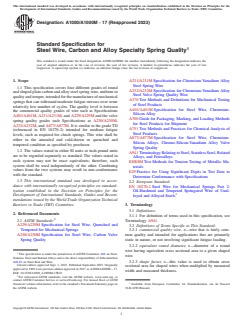
1.1 This specification covers four different grades of round and shaped plain carbon and alloy steel spring wire, uniform in quality and temper, intended for the manufacture of mechanical springs that can withstand moderate fatigue stresses over some relatively low number of cycles. The quality level is between the commercial quality grades of wire such as Specifications A401/A401M, A231/A231M, and A229/A229M and the valve spring quality grades such Specifications as A230/A230M, A232/A232M, and A877/A877M. It is similar to the grade TD (referenced in EN 10270-2) intended for medium fatigue levels, such as required for clutch springs. This wire shall be either in the annealed and cold-drawn or quenched and tempered condition as specified by purchaser.
1.2 The values stated in either SI units or inch-pound units are to be regarded separately as standard. The values stated in each system may not be exact equivalents; therefore, each system shall be used independently of the other. Combining values from the two systems may result in non-conformance with the standard.
1.3 This international standard was developed in accordance with internationally recognized principles on standardization established in the Decision on Principles for the Development of International Standards, Guides and Recommendations issued by the World Trade Organization Technical Barriers to Trade (TBT) Committee.
- Status
- Published
- Publication Date
- 31-Aug-2023
- Technical Committee
- A01 - Steel, Stainless Steel and Related Alloys
- Drafting Committee
- A01.03 - Steel Rod and Wire
Overview
ASTM A1000/A1000M-17(2023) is the internationally recognized standard specification for carbon and alloy steel wire of specialty spring quality. Published by ASTM International, this standard defines the requirements for round, shaped, and flat rolled plain carbon and alloy steel spring wires intended for the production of mechanical springs. These springs are expected to endure moderate fatigue stresses over a relatively low number of cycles, making this standard suitable for applications that require a balance of strength, ductility, and fatigue performance.
ASTM A1000/A1000M applies to steel wires supplied in either annealed and cold-drawn or oil-quenched and tempered conditions. It establishes requirements for chemical composition, mechanical properties, metallurgical quality, surface condition, and dimensional tolerances, ensuring the resulting wire is uniform in quality and temper.
Key Topics
- Material Types and Grades: Covers four grades of plain carbon and alloy steel spring wire, each with specific chemical and mechanical property requirements.
- Manufacturing Conditions: Wire can be supplied in annealed and cold drawn or quenched and tempered states as specified by the purchaser.
- Mechanical Properties: Details tensile strength, reduction of area, and minimum wrap test requirements to verify wire durability and performance.
- Chemical Composition: Strict guidelines for elements such as carbon, manganese, phosphorus, sulfur, silicon, chromium, and vanadium to ensure performance and reliability.
- Surface and Metallurgical Quality: Requirements for surface finish, decarburization, and inclusion content to maintain consistent spring performance and longevity.
- Dimensional Tolerances: Specifies permissible variations in wire diameter, width, and thickness for both round and shaped wires.
Applications
ASTM A1000/A1000M-17(2023) is widely used for steel wires intended for manufacturing mechanical springs exposed to moderate fatigue cycles. Typical application areas include:
- Automotive Components: Clutch, suspension, and brake springs
- Industrial Machinery: Springs for medium-load or moderate fatigue service
- Appliances and Tools: Springs in static or infrequently loaded products
- General Engineering: Custom springs where commercial or valve spring quality is not required, but higher reliability than basic commercial grades is needed
The standard is especially relevant for applications that demand a material quality level intermediate between the commercial quality grades (such as ASTM A401/A401M, A231/A231M, A229/A229M) and higher-end valve spring grades (such as ASTM A230/A230M, A232/A232M, A877/A877M), as well as those similar to TD grades in EN 10270-2.
Related Standards
ASTM A1000/A1000M-17(2023) references and is complemented by several related ASTM and international standards, including:
- ASTM A229/A229M - Quenched and tempered steel wire for mechanical springs
- ASTM A230/A230M - Carbon valve spring quality steel wire
- ASTM A231/A231M - Chromium-vanadium alloy steel spring wire
- ASTM A232/A232M - Chromium-vanadium alloy steel valve spring wire
- ASTM A401/A401M - Chromium-silicon alloy steel spring wire
- ASTM A877/A877M - Chrome-silicon-vanadium alloy valve spring wire
- EN 10270-2 - Steel wire for mechanical springs, covering oil-hardened and tempered spring steel wire
- ASTM A370, E8/E8M, A751, A700, and A941 - Standards for mechanical testing, terminology, packaging, and analysis
These standards provide additional methods, definitions, and specifications for steel wire properties and testing to ensure complete conformity and quality assurance in industrial applications.
By complying with ASTM A1000/A1000M-17(2023), manufacturers and purchasers can ensure reliable, high-quality specialty spring steel wire for engineered spring components, optimizing performance and lifespans in moderate fatigue environments. This standard supports consistent product quality, international trade, and alignment with globally recognized practices.
Relations
- Effective Date
- 01-Mar-2024
- Effective Date
- 01-Mar-2024
- Effective Date
- 01-Jan-2024
- Effective Date
- 01-Nov-2019
- Effective Date
- 01-Jul-2019
- Effective Date
- 01-Sep-2018
- Effective Date
- 01-Sep-2018
- Effective Date
- 01-Sep-2018
- Refers
ASTM A370-17a - Standard Test Methods and Definitions for Mechanical Testing of Steel Products - Effective Date
- 15-Nov-2017
- Effective Date
- 01-Sep-2017
- Effective Date
- 01-Sep-2017
- Effective Date
- 01-Jan-2017
- Effective Date
- 15-Jul-2016
- Effective Date
- 01-May-2016
- Effective Date
- 01-Nov-2015
Get Certified
Connect with accredited certification bodies for this standard

Element Materials Technology
Materials testing and product certification.

Inštitut za kovinske materiale in tehnologije
Institute of Metals and Technology. Materials testing, metallurgical analysis, NDT.
Sponsored listings
Frequently Asked Questions
ASTM A1000/A1000M-17(2023) is a technical specification published by ASTM International. Its full title is "Standard Specification for Steel Wire, Carbon and Alloy Specialty Spring Quality". This standard covers: ABSTRACT This specification covers round, shaped and flat rolled plain carbon and alloy steel spring wires, uniform in quality and temper, intended for the manufacture of mechanical springs that can withstand moderate fatigue stresses over some relatively low number of cycles. This wire shall be either in the annealed and cold-drawn or oil-tempered conditions. The steel may be made by any commercially accepted steel making process in either ingot cast or strand cast form. The percentage of the following elements: carbon, manganese, phosphorus, sulfur, silicon, chromium, and vanadium, shall conform to the chemical composition requirements and be determined by heat analysis. Tensile and wrap tests shall conform to the mechanical requirements such as tensile strength. Metallurgical requirements including eddy current testing for etched surface, decarburization, and inclusion content are detailed. SCOPE 1.1 This specification covers four different grades of round and shaped plain carbon and alloy steel spring wire, uniform in quality and temper, intended for the manufacture of mechanical springs that can withstand moderate fatigue stresses over some relatively low number of cycles. The quality level is between the commercial quality grades of wire such as Specifications A401/A401M, A231/A231M, and A229/A229M and the valve spring quality grades such Specifications as A230/A230M, A232/A232M, and A877/A877M. It is similar to the grade TD (referenced in EN 10270-2) intended for medium fatigue levels, such as required for clutch springs. This wire shall be either in the annealed and cold-drawn or quenched and tempered condition as specified by purchaser. 1.2 The values stated in either SI units or inch-pound units are to be regarded separately as standard. The values stated in each system may not be exact equivalents; therefore, each system shall be used independently of the other. Combining values from the two systems may result in non-conformance with the standard. 1.3 This international standard was developed in accordance with internationally recognized principles on standardization established in the Decision on Principles for the Development of International Standards, Guides and Recommendations issued by the World Trade Organization Technical Barriers to Trade (TBT) Committee.
ABSTRACT This specification covers round, shaped and flat rolled plain carbon and alloy steel spring wires, uniform in quality and temper, intended for the manufacture of mechanical springs that can withstand moderate fatigue stresses over some relatively low number of cycles. This wire shall be either in the annealed and cold-drawn or oil-tempered conditions. The steel may be made by any commercially accepted steel making process in either ingot cast or strand cast form. The percentage of the following elements: carbon, manganese, phosphorus, sulfur, silicon, chromium, and vanadium, shall conform to the chemical composition requirements and be determined by heat analysis. Tensile and wrap tests shall conform to the mechanical requirements such as tensile strength. Metallurgical requirements including eddy current testing for etched surface, decarburization, and inclusion content are detailed. SCOPE 1.1 This specification covers four different grades of round and shaped plain carbon and alloy steel spring wire, uniform in quality and temper, intended for the manufacture of mechanical springs that can withstand moderate fatigue stresses over some relatively low number of cycles. The quality level is between the commercial quality grades of wire such as Specifications A401/A401M, A231/A231M, and A229/A229M and the valve spring quality grades such Specifications as A230/A230M, A232/A232M, and A877/A877M. It is similar to the grade TD (referenced in EN 10270-2) intended for medium fatigue levels, such as required for clutch springs. This wire shall be either in the annealed and cold-drawn or quenched and tempered condition as specified by purchaser. 1.2 The values stated in either SI units or inch-pound units are to be regarded separately as standard. The values stated in each system may not be exact equivalents; therefore, each system shall be used independently of the other. Combining values from the two systems may result in non-conformance with the standard. 1.3 This international standard was developed in accordance with internationally recognized principles on standardization established in the Decision on Principles for the Development of International Standards, Guides and Recommendations issued by the World Trade Organization Technical Barriers to Trade (TBT) Committee.
ASTM A1000/A1000M-17(2023) is classified under the following ICS (International Classification for Standards) categories: 77.140.25 - Spring steels. The ICS classification helps identify the subject area and facilitates finding related standards.
ASTM A1000/A1000M-17(2023) has the following relationships with other standards: It is inter standard links to ASTM A370-24, ASTM A941-24, ASTM E8/E8M-24, ASTM A700-14(2019), ASTM A370-19, ASTM A231/A231M-18, ASTM A232/A232M-18, ASTM A401/A401M-18, ASTM A370-17a, ASTM A229/A229M-17, ASTM A941-17, ASTM A370-17, ASTM E8/E8M-16, ASTM A877/A877M-16, ASTM A370-15. Understanding these relationships helps ensure you are using the most current and applicable version of the standard.
ASTM A1000/A1000M-17(2023) is available in PDF format for immediate download after purchase. The document can be added to your cart and obtained through the secure checkout process. Digital delivery ensures instant access to the complete standard document.
Standards Content (Sample)
This international standard was developed in accordance with internationally recognized principles on standardization established in the Decision on Principles for the
Development of International Standards, Guides and Recommendations issued by the World Trade Organization Technical Barriers to Trade (TBT) Committee.
Designation: A1000/A1000M − 17 (Reapproved 2023)
Standard Specification for
Steel Wire, Carbon and Alloy Specialty Spring Quality
This standard is issued under the fixed designation A1000/A1000M; the number immediately following the designation indicates the
year of original adoption or, in the case of revision, the year of last revision. A number in parentheses indicates the year of last
reapproval. A superscript epsilon (´) indicates an editorial change since the last revision or reapproval.
1. Scope A231/A231M Specification for Chromium-Vanadium Alloy
Steel Spring Wire
1.1 This specification covers four different grades of round
A232/A232M Specification for Chromium-Vanadium Alloy
and shaped plain carbon and alloy steel spring wire, uniform in
Steel Valve Spring Quality Wire
quality and temper, intended for the manufacture of mechanical
A370 Test Methods and Definitions for Mechanical Testing
springs that can withstand moderate fatigue stresses over some
of Steel Products
relatively low number of cycles. The quality level is between
A401/A401M Specification for Steel Wire, Chromium-
the commercial quality grades of wire such as Specifications
Silicon Alloy
A401/A401M, A231/A231M, and A229/A229M and the valve
A700 Guide for Packaging, Marking, and Loading Methods
spring quality grades such Specifications as A230/A230M,
for Steel Products for Shipment
A232/A232M, and A877/A877M. It is similar to the grade TD
A751 Test Methods and Practices for Chemical Analysis of
(referenced in EN 10270-2) intended for medium fatigue
Steel Products
levels, such as required for clutch springs. This wire shall be
A877/A877M Specification for Steel Wire, Chromium-
either in the annealed and cold-drawn or quenched and
Silicon Alloys, Chrome-Silicon-Vanadium Alloy Valve
tempered condition as specified by purchaser.
Spring Quality
1.2 The values stated in either SI units or inch-pound units
A941 Terminology Relating to Steel, Stainless Steel, Related
are to be regarded separately as standard. The values stated in
Alloys, and Ferroalloys
each system may not be exact equivalents; therefore, each
E8/E8M Test Methods for Tension Testing of Metallic Ma-
system shall be used independently of the other. Combining
terials
values from the two systems may result in non-conformance
E29 Practice for Using Significant Digits in Test Data to
with the standard.
Determine Conformance with Specifications
1.3 This international standard was developed in accor-
2.2 European Standard:
dance with internationally recognized principles on standard-
EN 10270-2 Steel Wire for Mechanical Springs Part 2:
ization established in the Decision on Principles for the
Oil-Hardened and Tempered Springsteel Wire of Unal-
Development of International Standards, Guides and Recom-
loyed and Alloyed Steels
mendations issued by the World Trade Organization Technical
Barriers to Trade (TBT) Committee. 3. Terminology
3.1 Definitions:
2. Referenced Documents
3.1.1 For definition of terms used in this specification, see
2.1 ASTM Standards:
Terminology A941.
A229/A229M Specification for Steel Wire, Quenched and
3.2 Definitions of Terms Specific to This Standard:
Tempered for Mechanical Springs
3.2.1 commercial quality wire, n—wire that is fairly com-
A230/A230M Specification for Steel Wire, Carbon Valve
mon quality and intended for applications that are primarily
Spring Quality
static in nature, or not involving significant fatigue loading.
3.2.2 equivalent round diameter, n—diameter of a round
wire having equivalent cross sectional area to a given shaped
This specification is under the jurisdiction of ASTM Committee A01 on Steel,
wire.
Stainless Steel and Related Alloys and is the direct responsibility of Subcommittee
A01.03 on Steel Rod and Wire. 3.2.3 shape factor, n—this value is used to obtain cross
Current edition approved Sept. 1, 2023. Published September 2023. Originally
sectional area for shaped wires when multiplied by measured
approved in 1999. Last previous edition approved in 2017 as A1000/A1000M – 17.
width and measured thickness.
DOI: 10.1520/A1000_A1000M-17R23.
For referenced ASTM standards, visit the ASTM website, www.astm.org, or
contact ASTM Customer Service at service@astm.org. For Annual Book of ASTM
Standards volume information, refer to the standard’s Document Summary page on Available from European Committee for Standardization, rue de Stassart
the ASTM website. 36,B-1050 Brussels
Copyright © ASTM International, 100 Barr Harbor Drive, PO Box C700, West Conshohocken, PA 19428-2959. United States
A1000/A1000M − 17 (2023)
TABLE 1 Permissible Variations in Wire Dimensions (Round and
3.2.4 round wire, n—wire having a circular cross section.
A
Flat)
3.2.5 flat wire, n—wire having two parallel flats, with either
SI Units
round or square edges.
Permissible Varia- Permissible Out-Of-
Dimension, mm
tions, ± mm Round, mm
3.2.6 shaped wire, n—wire other than round wire and flat
0.5 to 2.0, incl 0.02 0.02
wire.
Over 2.0 to 4.0, incl 0.03 0.03
Over 4.0 to 9.5, incl 0.04 0.04
Over 9.5 0.05 0.05
4. Ordering Information
Inch-Pound Units
Permissible Varia- Permissible Out-Of-
4.1 It shall be the responsibility of the purchaser to specify
Dimension, in.
tions, ± in. Round, in.
all requirements that are necessary for material under this
0.020 to 0.075, incl 0.0008 0.0008
specification. Such requirements are permitted to include, but
Over 0.075 to 0.148, incl 0.001 0.001
Over 0.148 to 0.375, incl 0.0015 0.0015
are not limited to the following,
Over 0.375 0.002 0.002
4.1.1 Quantity (mass),
A
Permissible Variations in Wire Dimensions (Flat)
4.1.2 Name of material (chromium-silicon alloy steel spe-
SI Units
Thickness Width
cialty spring quality wire) and grade (Table 2 and Section 6),
Dimension, mm Permissible Varia- Permissible Varia-
4.1.3 Dimensions (Table 1 and Section 9),
tions, ± mm tions, ± mm
4.1.4 Condition—Annealed and Cold Drawn, or Quench
All 0.05 0.120
Inch-Pound Units
and Tempered (Section 7),
Thickness Width
4.1.5 Packaging (Section 15), and
Dimension, in. Permissible Varia- Permissible Varia-
4.1.6 ASTM designation and year of issue.
tions, ± in. tions, ± in.
All 0.002 0.005
4.2 The purchaser shall have the option to specify additional
A
For purposes of determining conformance with this specification, all specified
requirements, including but not limited to:
limits are absolute as defined in Practice E29.
4.2.1 Requirements for certifications, heat analysis or test
reports (see Sections 6.2 and 14),
4.2.2 Special packing, marking, and loading requirements
(see Section 15), and
4.2.3 Other special requirements, if any. 6.2 Heat Analysis—Each heat of steel shall be analyzed by
the supplier to determine the percentage of elements prescribed
NOTE 1—A typical ordering description is as follows: 20 000 kg
in Table 2. This analysis shall be made from a test specimen
quenched and tempered chromium-silicon alloy steel specialty spring
quality wire, size 6.00 mm in 1500 kg coils to Specification A1000/ preferably taken during the pouring of the heat. When
A1000M, Grade A dated _______, or for inch-pound units, or for
requested, this shall be reported to the purchaser and shall
inchpound units, 40 000 lb. quenched and tempered chromium-silicon
conform to the requirements of Table 2.
alloy steel specialty spring quality wire, size 0.250 in. in 3000 lb coils to
Specification A1000/A1000M, Grade A dated _______. 6.3 Product Analysis—An analysis may be made by the
purchaser from finished wire representing each heat of steel.
5. Materials and Manufacture
The average of all the separate determinations made shall be
within the limits specified in the analysis column.
5.1 The steel may be made by any commercially accepted
steel making process. The steel may be either ingot cast or
6.4 For referee purposes, Test Methods, Practices, and
strand cast.
Terminology A751 shall be used.
5.2 The finished wire shall be free from detrimental pipe
7. Mechanical Properties
and undue segregation.
7.1 Annealed and Cold Drawn—When purchased in the
6. Chemical Composition
annealed and cold-drawn condition, the wire shall have been
6.1 The steel shall conform to the requirements for chemical given a sufficient amount of cold working to meet the purchas-
composition specified in Table 2.
er’s coiling requirements and shall be in a suitable condition to
TABLE 2 Chemical Requirements
Analysis, %
Grade C Grade D
Grade A Grade B
Chromium- Chromium-Silicon-
Chromium-Silicon Carbon
Vanadium Vanadium
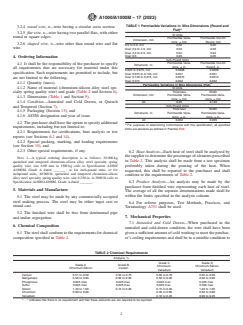
Carbon 0.51 to 0.59 0.55 to 0.75 0.60 to 0.70 0.55 to 0.68
Manganese 0.50 to 0.80 0.60 to 0.90 0.50 to 0.90 0.50 to 0.90
Phosphorus 0.025 max 0.025 max 0.025 max 0.025 max
Sulfur 0.025 max 0.025 max 0.025 max 0.025 max
Silicon 1.20 to 1.60 0.15 to 0.30 0.15 to 0.30 1.20 to 1.65
Chromium 0.60 to 0.80 . . . 0.35 to 0.60 0.50 to 0.80
Vanadium . . . . . . 0.10 to 0.25 0.08 to 0.25
“. . .” indicates that there is no requirement and that these elements are not required to be reported.
A1000/A1000M − 17 (2023)
A
TABLE 4 Tensile and % Reduction of Area Requirements
respond properly to heat treatment. In special cases the tensile
(Carbon) Grade B
strength or hardness, if desired, shall be stated in the purchase
SI Units
order.
% Reduction of area,
Diameter, mm MPa, min MPa, max
B
min
7.2 Quenched and Tempered:
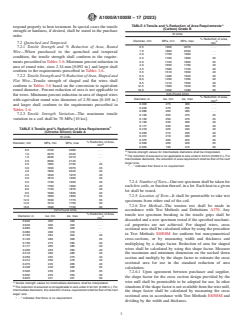
7.2.1 Tensile Strength and % Reduction of Area, Round 0.5 1900 2070 . . .
1.0 1860 2030 . . .
Wire—When purchased in the quenched and tempered
2.0 1790 1960 . . .
condition, the tensile strength shall conform to the require-
2.5 1760 1900 45
3.0 1720 1860 45
ments prescribed in Tables 3-6. Minimum percent reduction in
4.0 1650 1790 40
area of round wire, sizes 2.34 mm [0.092 in.] and larger shall
4.5 1580 1720 40
conform to the requirements prescribed in Tables 3-6.
5.5 1510 1650 40
6.5 1480 1620 40
7.2.2 Tensile Strength and % Reduction of Area, Shaped and
8.0 1450 1590 40
Flat Wire—Tensile strength of shaped and flat wires shall
9.5 1410 1550 40
conform to Tables 3-6 based on the conversion to equivalent
12.5 1380 1520 35
16.0 1350 1490 30
round diameter. Percent reduction of area is not applicable to
Inch-Pound Units
flat wires. Minimum percent reduction in area of shaped wires
% Reduction of area,
Diameter, in. ksi, min ksi, max
B
with equivalent round wire diameters of 2.50 mm [0.105 in.]
min
0.020 275 300 . . .
and larger shall conform to the requirements prescribed in
0.040 270 295 . . .
Tables 3-6.
0.080 260 285 . . .
7.2.3 Tensile Strength Variation—The maximum tensile
0.105 255 275 45
0.120 250 270 45
variation in a coil shall be 70 MPa [10 ksi].
0.156 240 260 40
0.177 235 255 40
A
TABLE 3 Tensile and % Reduction of Area Requirements
0.218 225 245 40
(Chrome Silicon) Grade A
0.250 215 235 40
0.312 210 230 40
SI Units
0.375 205 225 40
% Reduction of Area,
Diameter, mm MPa, min MPa, max 0.500 200 220 35
B
min
0.625 195 215 30
0.5 2100 2280 . . .
A
Tensile strength values for intermediate diameters shall be interpolated.
1.0 2070 2240 . . .
B
The reduction of area test is not applicable to wire under 2.34 mm (0.092 in.). For
1.5 2030 2210 . . .
intermediate diameters, the reduction of area requirement shall be that of the next
2.0 2000 2140 . . .
larger wire.
2.5 1965 2105 45
“. . .” indicates that there is no requirement.
3.0 1930 2070 45
4.0 1900 2040 40
4.5 1830 1970 40
5.0 1810 1950 40
7.2.4 Number of Tests—One test specimen shall be taken for
5.5 1790 1930 40
6.5 1760 1900 40
each five coils, or fraction thereof, in a lot. Each heat in a given
8.0 1730 1870 40
lot shall be tested.
9.5 1690 1830 40
7.2.5 Location of Tests—It shall be permissible to take test
11.0 1660 1800 35
12.5 1630 1770 35
specimens from either end of the coil.
14.0 1610 1750 30
7.2.6 Test Method—The tension test shall be made in
16.0 1590 1730 30
Inch-Pound Units accordance with Test Methods and Definitions A370. Any
% Reduction of Area,
tensile test specimen breaking in the tensile grips shall be
Diameter, in. ksi, min ksi, max
B
min
discarded and a new specimen tested if the specified mechani-
0.020 305 330 . . .
0.040 300 325 . . . cal properties are not achieved. For shaped wires, cross
0.060 295 320 . . .
sectional area shall be calculated either by using the procedure
0.080 290 310 . . .
in Test Methods E8/E8M for uniform but nonsymmetrical
0.105 284 304 45
0.120 280 300 45 cross-sections, or by measuring width and thickness and
0.156 275 295 40
multiplying by a shape factor. Reduction of area for shaped
0.177 265 285 40
wires shall be calculated by using this shape factor. Measure
0.200 263 283 40
0.218 260 280 40 the maximum and minimum dimension on the necked down
0.250 255 275 40
section and multiply by the shape factor to estimate the cross
0.312 250 270 40
sectional area for use in the standard reduction of area
0.375 245 265 40
0.438 240 260 35 calculation.
0.500 235 255 35
7.2.6.1 Upon agreement between purchaser and supplier,
0.562 233 253 30
the shape factor for the cross section design provided by the
0.625 231 251 30
wire mill shall be permissible to be adopted for use. In other
A
Tensile strength values for intermediate diameters shall be interpolated.
B
situations if the shape factor is not available from th
...