

ASTM F2990-12(2018)
(Test Method)Standard Test Method for Commercial Coffee Brewers
General Information
- Abstract
SIGNIFICANCE AND USE
5.1 The measured maximum energy input rate is used to confirm that the coffee brewer is operating in accordance with its nameplate rating.
5.2 If applicable and accessible, the boiler or internal tank temperature is measured to ensure that the water is maintained at a ready-to-brew temperature. This can also be used later to normalize coffee brewer energy consumption to a standard temperature.
5.3 The Preheat Test can be used to gauge the amount of time and energy required for the coffee brewer to reach a ready-to-brew state from the ambient room and incoming water temperatures.
5.4 Ready-to-Brew and Energy Save Mode energy can be used by end users to estimate the amount of energy consumed while coffee is not being brewed.
5.5 Heavy-use energy consumption can be used to estimate how much energy is consumed by the coffee brewer when brewing coffee. Along with preheat and ready-to-brew (standby) energy, this value can be used by end users to model their machine energy use.
5.6 Production capacity is a calculated measure, determined through testing, to define the performance of the coffee brewer. End users can use this value to specify a brewer that matches their production needs.
SCOPE
1.1 This test method covers the evaluation of the energy consumption, brewing, and holding performance of commercial coffee brewing machines (here after referred to as coffee brewers) used in commercial and institutional facilities. The operator can use this evaluation to select a coffee brewer and characterize its energy use and performance. This test method does not cover residential coffee brewers, “urn” coffee brewers (Type III), or espresso machines.
1.2 This test method applies to single cup (Type I) and batch (Type II) coffee brewers. The coffee brewer will be tested for the following (where applicable):
1.2.1 Maximum energy input rate,
1.2.2 Heavy use brewing energy consumption,
1.2.3 Production capacity,
1.2.4 “Ready-to-Brew” (Standby/Idle) energy rate, and
1.2.5 “Energy Save Mode” (Low power) energy rate.
1.3 The values stated in inch-pound units are to be regarded as standard. The values given in parentheses are mathematical conversions to SI units that are provided for information only and are not considered standard.
1.4 This standard does not purport to address all of the safety concerns, if any, associated with its use. It is the responsibility of the user of this standard to establish appropriate safety, health, and environmental practices and determine the applicability of regulatory limitations prior to use.
1.5 This international standard was developed in accordance with internationally recognized principles on standardization established in the Decision on Principles for the Development of International Standards, Guides and Recommendations issued by the World Trade Organization Technical Barriers to Trade (TBT) Committee.
- Status
- Published
- Publication Date
- 30-Sep-2018
- Technical Committee
- F26 - Food Service Equipment
- Drafting Committee
- F26.06 - Productivity and Energy Protocol
Overview
ASTM F2990-12(2018) - Standard Test Method for Commercial Coffee Brewers provides a comprehensive methodology for evaluating performance and energy consumption in commercial and institutional coffee brewers. This widely recognized ASTM standard ensures consistency in testing procedures for single cup (Type I) and batch (Type II) commercial coffee makers, allowing end users, manufacturers, and specifiers to make informed decisions about equipment selection, energy efficiency, and operational capability.
The standard focuses on objective measurement of crucial performance metrics including energy usage, brewing rates, production capacity, and energy-saving features. By providing consistent result criteria, the standard supports reduced operational costs and helps ensure sustainability in commercial kitchens, cafes, and food service operations.
Key Topics
Energy Consumption Evaluation
- Measures maximum energy input rates to confirm operation matches the nameplate specification
- Quantifies energy consumed during different operation states: preheat, ready-to-brew (standby/idle), energy save mode, and heavy-use (brewing)
Performance Measurements
- Assesses production capacity - the maximum beverage volume a brewer can produce per hour
- Defines and measures important operational parameters like brew cycle, recovery time, brew volume, and serving temperature
Applicability and Scope
- Applies only to non-residential, non-espresso, non-urn coffee brewers
- Focuses on single cup (Type I) and batch (Type II) machines used in commercial or institutional facilities
Test Procedures and Reporting
- Details required test apparatus and sample preparation standards
- Establishes precise monitoring and reporting protocols for energy and brewing performance, enabling reproducible and comparable results
Applications
ASTM F2990-12(2018) is used extensively in the following applications:
- Commercial and Institutional Kitchens: Facility managers use the standard to specify coffee brewers that meet their specific energy use and capacity requirements, aiding in equipment selection and procurement.
- Equipment Manufacturers: Coffee brewer producers rely on the standard for R&D, product testing, and performance claims, ensuring that marketed models are accurately rated.
- Comparative Energy Analysis: The standard’s consistent test methods allow users to compare energy efficiency across different commercial coffee brewing machines, supporting purchasing decisions and sustainability initiatives.
- Regulatory Compliance & Energy Programs: The prescribed procedures are utilized for documentation in energy audits, third-party certifications, and governmental or organizational energy consumption reduction programs.
- Maintenance and Troubleshooting: Measurement of temperature stability and energy rates can help technicians diagnose operational problems or validate repairs.
Related Standards
- ASTM F2988: Specification for Commercial Coffee Brewers. Provides foundational machine classification referenced throughout F2990-12.
- ASHRAE Guideline 2–1986 (RA90): Engineering Analysis of Experimental Data. Applied in calculating uncertainty and ensuring robust test results.
- Energy Star and Other Energy Efficiency Programs: Organizations may use data generated following ASTM F2990 for broader sustainability or efficiency certifications.
Keywords: commercial coffee brewers, ASTM F2990-12, energy consumption, coffee machine performance, brewing capacity, energy efficiency, institutional food service equipment, readiness testing, energy save mode, batch coffee brewers, single cup brewers, operational testing standards.
Relations
- Effective Date
- 01-Oct-2018
- Effective Date
- 01-Feb-2024
- Effective Date
- 01-Oct-2018
- Effective Date
- 01-Nov-2012
- Effective Date
- 01-Oct-2018
Get Certified
Connect with accredited certification bodies for this standard

BSI Group
BSI (British Standards Institution) is the business standards company that helps organizations make excellence a habit.

Bureau Veritas
Bureau Veritas is a world leader in laboratory testing, inspection and certification services.

DNV
DNV is an independent assurance and risk management provider.
Sponsored listings
Frequently Asked Questions
ASTM F2990-12(2018) is a standard published by ASTM International. Its full title is "Standard Test Method for Commercial Coffee Brewers". This standard covers: SIGNIFICANCE AND USE 5.1 The measured maximum energy input rate is used to confirm that the coffee brewer is operating in accordance with its nameplate rating. 5.2 If applicable and accessible, the boiler or internal tank temperature is measured to ensure that the water is maintained at a ready-to-brew temperature. This can also be used later to normalize coffee brewer energy consumption to a standard temperature. 5.3 The Preheat Test can be used to gauge the amount of time and energy required for the coffee brewer to reach a ready-to-brew state from the ambient room and incoming water temperatures. 5.4 Ready-to-Brew and Energy Save Mode energy can be used by end users to estimate the amount of energy consumed while coffee is not being brewed. 5.5 Heavy-use energy consumption can be used to estimate how much energy is consumed by the coffee brewer when brewing coffee. Along with preheat and ready-to-brew (standby) energy, this value can be used by end users to model their machine energy use. 5.6 Production capacity is a calculated measure, determined through testing, to define the performance of the coffee brewer. End users can use this value to specify a brewer that matches their production needs. SCOPE 1.1 This test method covers the evaluation of the energy consumption, brewing, and holding performance of commercial coffee brewing machines (here after referred to as coffee brewers) used in commercial and institutional facilities. The operator can use this evaluation to select a coffee brewer and characterize its energy use and performance. This test method does not cover residential coffee brewers, “urn” coffee brewers (Type III), or espresso machines. 1.2 This test method applies to single cup (Type I) and batch (Type II) coffee brewers. The coffee brewer will be tested for the following (where applicable): 1.2.1 Maximum energy input rate, 1.2.2 Heavy use brewing energy consumption, 1.2.3 Production capacity, 1.2.4 “Ready-to-Brew” (Standby/Idle) energy rate, and 1.2.5 “Energy Save Mode” (Low power) energy rate. 1.3 The values stated in inch-pound units are to be regarded as standard. The values given in parentheses are mathematical conversions to SI units that are provided for information only and are not considered standard. 1.4 This standard does not purport to address all of the safety concerns, if any, associated with its use. It is the responsibility of the user of this standard to establish appropriate safety, health, and environmental practices and determine the applicability of regulatory limitations prior to use. 1.5 This international standard was developed in accordance with internationally recognized principles on standardization established in the Decision on Principles for the Development of International Standards, Guides and Recommendations issued by the World Trade Organization Technical Barriers to Trade (TBT) Committee.
SIGNIFICANCE AND USE 5.1 The measured maximum energy input rate is used to confirm that the coffee brewer is operating in accordance with its nameplate rating. 5.2 If applicable and accessible, the boiler or internal tank temperature is measured to ensure that the water is maintained at a ready-to-brew temperature. This can also be used later to normalize coffee brewer energy consumption to a standard temperature. 5.3 The Preheat Test can be used to gauge the amount of time and energy required for the coffee brewer to reach a ready-to-brew state from the ambient room and incoming water temperatures. 5.4 Ready-to-Brew and Energy Save Mode energy can be used by end users to estimate the amount of energy consumed while coffee is not being brewed. 5.5 Heavy-use energy consumption can be used to estimate how much energy is consumed by the coffee brewer when brewing coffee. Along with preheat and ready-to-brew (standby) energy, this value can be used by end users to model their machine energy use. 5.6 Production capacity is a calculated measure, determined through testing, to define the performance of the coffee brewer. End users can use this value to specify a brewer that matches their production needs. SCOPE 1.1 This test method covers the evaluation of the energy consumption, brewing, and holding performance of commercial coffee brewing machines (here after referred to as coffee brewers) used in commercial and institutional facilities. The operator can use this evaluation to select a coffee brewer and characterize its energy use and performance. This test method does not cover residential coffee brewers, “urn” coffee brewers (Type III), or espresso machines. 1.2 This test method applies to single cup (Type I) and batch (Type II) coffee brewers. The coffee brewer will be tested for the following (where applicable): 1.2.1 Maximum energy input rate, 1.2.2 Heavy use brewing energy consumption, 1.2.3 Production capacity, 1.2.4 “Ready-to-Brew” (Standby/Idle) energy rate, and 1.2.5 “Energy Save Mode” (Low power) energy rate. 1.3 The values stated in inch-pound units are to be regarded as standard. The values given in parentheses are mathematical conversions to SI units that are provided for information only and are not considered standard. 1.4 This standard does not purport to address all of the safety concerns, if any, associated with its use. It is the responsibility of the user of this standard to establish appropriate safety, health, and environmental practices and determine the applicability of regulatory limitations prior to use. 1.5 This international standard was developed in accordance with internationally recognized principles on standardization established in the Decision on Principles for the Development of International Standards, Guides and Recommendations issued by the World Trade Organization Technical Barriers to Trade (TBT) Committee.
ASTM F2990-12(2018) is classified under the following ICS (International Classification for Standards) categories: 67.140.20 - Coffee and coffee substitutes; 97.040.50 - Small kitchen appliances. The ICS classification helps identify the subject area and facilitates finding related standards.
ASTM F2990-12(2018) has the following relationships with other standards: It is inter standard links to ASTM F2990-12, ASTM F2988-18(2024), ASTM F2988-18, ASTM F2988-12, ASTM F2687-13(2019). Understanding these relationships helps ensure you are using the most current and applicable version of the standard.
ASTM F2990-12(2018) is available in PDF format for immediate download after purchase. The document can be added to your cart and obtained through the secure checkout process. Digital delivery ensures instant access to the complete standard document.
Standards Content (Sample)
This international standard was developed in accordance with internationally recognized principles on standardization established in the Decision on Principles for the
Development of International Standards, Guides and Recommendations issued by the World Trade Organization Technical Barriers to Trade (TBT) Committee.
Designation: F2990 − 12 (Reapproved 2018) An American National Standard
Standard Test Method for
Commercial Coffee Brewers
This standard is issued under the fixed designation F2990; the number immediately following the designation indicates the year of
original adoption or, in the case of revision, the year of last revision.Anumber in parentheses indicates the year of last reapproval.A
superscript epsilon (´) indicates an editorial change since the last revision or reapproval.
1. Scope 2. Referenced Documents
1.1 This test method covers the evaluation of the energy 2.1 ASTM Standards:
consumption, brewing, and holding performance of commer- F2988Specification for Commercial Coffee Brewers
cial coffee brewing machines (here after referred to as coffee
2.2 ASHRAE Standard:
brewers) used in commercial and institutional facilities. The
ASHRAE Guideline 2–1986 (RA90)Engineering Analysis
operator can use this evaluation to select a coffee brewer and
of Experimental Data
characterize its energy use and performance. This test method
doesnotcoverresidentialcoffeebrewers,“urn”coffeebrewers
3. Terminology
(Type III), or espresso machines.
3.1 Definitions:
1.2 Thistestmethodappliestosinglecup(TypeI)andbatch
3.1.1 coffee brewer, n—commercial appliances designed to
(Type II) coffee brewers. The coffee brewer will be tested for
heat water and brew coffee.
the following (where applicable):
NOTE 1—Cold water is poured into a separate chamber (manually or
1.2.1 Maximum energy input rate,
automatically),whichisthenheateduptojustbelowtheboilingpoint,and
1.2.2 Heavy use brewing energy consumption,
directedthroughthefilter.Thisprocessisalsocalled automatic drip-brew.
1.2.3 Production capacity,
3.2 Definitions of Terms Specific to This Standard:
1.2.4 “Ready-to-Brew” (Standby/Idle) energy rate, and
3.2.1 brew cycle, n—the total time required to dispense a
1.2.5 “Energy Save Mode” (Low power) energy rate.
single cup (Type I) or batch (Type II) of coffee, starting with
1.3 The values stated in inch-pound units are to be regarded
the initiation of a brew event by the user, and including the
as standard. The values given in parentheses are mathematical time needed for the machine to recover to a “ready to brew”
conversions to SI units that are provided for information only
state.
and are not considered standard.
3.2.2 brew event, n—the sequence of brewing a single cup
1.4 This standard does not purport to address all of the
(Type I) or batch (Type II) of coffee, starting with initiation by
safety concerns, if any, associated with its use. It is the
theuser,andincludingthetimefortheremainingwatertodrip
responsibility of the user of this standard to establish appro-
through the filter.
priate safety, health, and environmental practices and deter-
3.2.3 brew energy, n—energy consumed by coffee brewer
mine the applicability of regulatory limitations prior to use.
during a brew cycle.
1.5 This international standard was developed in accor-
3.2.4 warmer energy, n—the energy consumed by the plate
dance with internationally recognized principles on standard-
warmer while maintaining the delivered brew volume at
ization established in the Decision on Principles for the
serving temperature.
Development of International Standards, Guides and Recom-
mendations issued by the World Trade Organization Technical
NOTE 2—Warmers may not be an applicable feature of single serving
Type I machines.
Barriers to Trade (TBT) Committee.
3.2.5 ready-to-brew (standby/idle) energy, n—energy re-
quired by the coffee brewer to maintain “ready to brew”
This test method is under the jurisdiction of ASTM Committee F26 on Food
Service Equipment and is the direct responsibility of Subcommittee F26.06 on
Productivity and Energy Protocol. For referenced ASTM standards, visit the ASTM website, www.astm.org, or
Current edition approved Oct. 1, 2018. Published November 2018. Originally contact ASTM Customer Service at service@astm.org. For Annual Book of ASTM
approved in 2012. Last previous edition approved in 2012 as F2990–12. DOI: Standards volume information, refer to the standard’s Document Summary page on
10.1520/F2990-12R18. the ASTM website.
Copyright © ASTM International, 100 Barr Harbor Drive, PO Box C700, West Conshohocken, PA 19428-2959. United States
F2990 − 12 (2018)
conditionsincludingenergyrequiredtokeepthereservoirtank at a ready-to-brew temperature. This can also be used later to
at the brew set temperature. normalize coffee brewer energy consumption to a standard
temperature.
3.2.6 energy save mode, n—an optional low power mode
(different from the ready-to-brew state) that is designed by the
5.3 The Preheat Test can be used to gauge the amount of
manufacturer to use less energy while the coffee brewer still
time and energy required for the coffee brewer to reach a
remains “on.”
ready-to-brewstatefromtheambientroomandincomingwater
temperatures.
NOTE 3—Energy Save Modes are typically specified by the manufac-
turer and outlined in the user manual. Some examples may include an
5.4 Ready-to-Brew and Energy Save Mode energy can be
automatic reduction of tank holding temperature (for example, 140°) or
used by end users to estimate the amount of energy consumed
burner temperature after a certain period of machine un-use. The manual
while coffee is not being brewed.
turning off of accessories is not considered to be an Energy Save Mode
unless specified by the manufacturer.
5.5 Heavy-use energy consumption can be used to estimate
3.2.7 production capacity, n—calculated maximum volume
how much energy is consumed by the coffee brewer when
of coffee that can potentially be brewed in one full hour and
brewing coffee. Along with preheat and ready-to-brew
expressed in gal/h (L/h).
(standby) energy, this value can be used by end users to model
their machine energy use.
3.2.8 brew volume, n—the substantive beverage portion
delivered during a single brew event, and specified in fluid
5.6 Productioncapacityisacalculatedmeasure,determined
ounces or gallons (millilitres or litres).
throughtesting,todefinetheperformanceofthecoffeebrewer.
End users can use this value to specify a brewer that matches
3.2.9 serving temperature, n—the temperature of the bever-
age delivered from a brewing machine, measured at the their production needs.
dispensing outlet, and expressed in degrees Farenheit (degrees
Celsius). 6. Apparatus
3.2.10 holding temperature, n—the measured average inter-
6.1 Watt-Hour Meter, for measuring the electrical energy
nal temperature of a volume of dispensed beverage as main-
consumption coffee brewer, shall have a resolution of at least
tainedbytheplatewarmersandexpressedindegreesFarenheit
0.1 Wh and a maximum uncertainty no greater than 1.5 % of
(degrees Celsius).
the measured value for any demand greater than 100 W. For
any demand less than 100 W, the meter shall have a resolution
3.2.11 recovery time, n—the time required for the machine
of at least 0.1 Wh and a maximum uncertainty no greater than
to return to brew set temperature (“ready to brew state”) after
1.5 %.
a completed brew event.
6.2 Analytical Balance Scale, for measuring weights up to
4. Summary of Test Method
15 lb (6.8 kg), with a resolution of 0.001 lb (0.5 g) and an
4.1 Alltestingisconductedusingdefaultfactorysettingsfor uncertainty of 0.001 lb (0.5 g).
brewers that feature programmable settings. If not specified by
6.3 Data Acquisition System, for receiving and saving data
the manufacturer, all plate warmers and accessories featuring
for energy and temperatures with an additional capability of
adjustable input rates shall be conducted with all accessories
displaying multiple temperature updating at least every two
and brewers at 100 % input ratings.
seconds.
4.2 The coffee brewer is connected to the appropriate
6.4 Stop Watch, with a 1-s resolution.
electricalandwatermeteringdevices.Ifapplicable,theinternal
6.5 Flow Meter, for measuring total water consumption of
water tank is evacuated prior to testing. The measured maxi-
the appliance. Shall have a resolution of 0.01 gal (0.04 L) and
mum energy input is determined and checked against the rated
an uncertainty of 0.01 gal (0.04 L) at a flow rate as low as 0.2
input before continuing with testing. Total volume of water
gpm (0.8 Lpm).
used to fill the tank will also be recorded.
6.6 Thermocouple Probe(s), industry standard type T or
4.3 The internal water tank temperature and energy con-
type K thermocouples capable of immersion, with a range of
sumption is monitored in the, preheating mode, ready-to-brew
from 50 to 400°F (10 to 204°C) and an uncertainty of 61°F
(idle) mode, energy save mode, and accessories (plate warm-
(60.5°C).
ers) on and off.
6.7 Carafe/Decanter(s),asuitablecontainer/receptacleshall
4.4 Energy consumption and time are monitored while the
be used to hold the brewed coffee volume for batch brewers
coffee brewer is used to brew coffee sequentially to replicate a
(Type II). The volume of the container shall be rated in fluid
heavy use period.
ounces (mL) or gallons (L) depending on volumetric capacity.
5. Significance and Use
6.8 Cup(s), appropriate size to accommodate the standard
5.1 The measured maximum energy input rate is used to brew volume of the single cup (Type I) coffee brewer being
tested. The volume of the container shall be rated in fluid
confirm that the coffee brewer is operating in accordance with
its nameplate rating. ounces (mL).
5.2 If applicable and accessible, the boiler or internal tank 6.9 When specified by manufacturer, installation of a water
temperature is measured to ensure that the water is maintained treatment device is required in hard-water areas for the
F2990 − 12 (2018)
incoming water supply. A tempering or pressure regulating voltage is within 61.0 % of the operating voltage specified by
device may also be needed to supply the manufacturer- the manufacturer while the elements are energized. Record the
specified incoming water temperature and pressure to the test voltage for each test.
NOTE 4—It is the intent of the testing procedure herein to evaluate the
coffee brewer.
performance of a coffee brewer at its rated electric voltage. If an electric
unit is rated dual voltage (that is, designed to operate at either 208 or 240
7. Reagents and Materials
V with no change in components), the voltage selected by the manufac-
7.1 Water Specs—Incoming water to the coffee brewer shall turer and/or tester shall be reported. If a coffee brewer is designed to
operate at two voltages without a change in the resistance of the heating
have a maximum hardness of three grains per gallon and shall
elements, the performance of the unit (for example, preheat time) may
be within 70 6 5°F (21 6 3°C). If the tester’s water supply
differ at the two voltages.
does not meet the specification, a water softener and/or
9.3 Connect the cold water supply to a calibrated low-flow
tempering kit may be required.
water meter for automatic-fill drip brewers (does not apply to
7.2 Coffee Grounds—Genericcoffeegroundwithaspecified
pour-over brewers).
serving size of 0.125 lb 6 0.005 lb for every 64 oz (0.057 6
9.4 Install a thermocouple in the supply waterline of the
0.002 kg for every 1.89 L) of hot water shall be used for batch
coffee machine to ensure incoming water temperature main-
(TypeII)brewers.Ifthecoffeebrewerdispensessingleserving
tains an average of 70 6 5°F (21 6 3°C).
portions (Type I) using prefabricated modules, the weight of
thespentcoffeemodulewillberecordedandusedforanalysis. 9.5 Positionandsecureabeadedthermocoupletothecenter
ofeachwarmingplate(ifapplicable).Securethethermocouple
7.3 Portafilter Basket—For single cup (Type I)coffee
using High Temperature Fiberglass/Silicone Tape, 500°F/
brewers, a 58-mm “Double” espresso portafilter basket is used
260°C.
to record the temperature of the beverage as it exits the
NOTE 5—Recommending the use of 24 gauge wire and hammer the
dispensing head of the machine.
beaded end flat to facilitate better contact with the surface.
7.4 CoffeeFilter(s)—Forbatch(TypeII)coffeebrewers,use
9.6 If the machine has an accessible internal tank, monitor
white paper coffee filters with a flat bottom and fit into the
the internal water tank temperature, using a beaded
manufacturer’s removable brew basket.The height of the filter
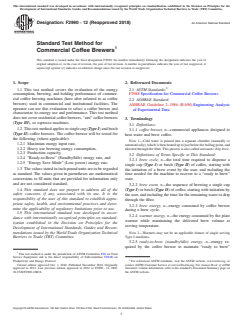
thermocouple, by placing it no closer than ⁄2 in. (1.27 cm)
paperisdependentontheamountofcoffeegroundorthebrew
from rear wall and bottom of the tank no closer than ⁄4 in.
basket dimensions so that coffee ground does not spill over the
(0.635 cm) from the heating element. See Fig. 1.
coffee filter during the brew process.
NOTE 6—Some machines may not have a heated tank.
7.5 High Temperature Fiberglass/Silicone Tape (500°F/
9.7 For single cup (Type I) brewers, install a 58 mm double
260°C)—Used to secure thermocouples, and other testing
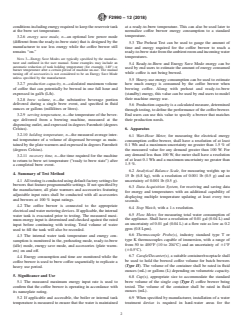
espresso portafilter no more than a ⁄4 in. (2.54 cm) directly
apparatus to regions of extremely high heat, up to 500°F
below the dispensing head and make sure that it is level. See
(260°C), on the coffee brewing equipment to be tested. This
Fig. 2. Temperature will be measured using a thermocouple
tape should always be used on warming plates.
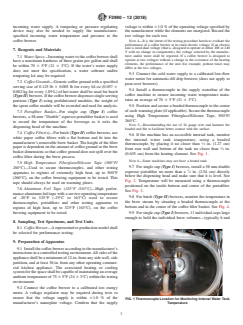
positioned on the inside bottom and center of the portafilter.
7.6 Aluminum Foil Tape (325°F /163°C)—High perfor-
See Fig. 3.
mancealuminumfoiltapewithaserviceoperatingtemperature
9.8 For batch (Type II) brewers, monitor the temperature in
of -20°F to 325°F (-29°C to 163°C) used to secure
the brew stream by situating a beaded thermocouple at the
thermocouples, portafilters and other testing apparatus to
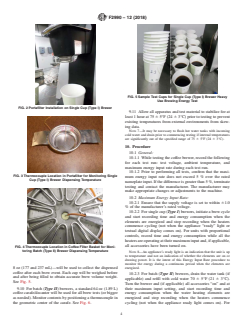
bottom and in the center of the coffee filter basket. See Fig. 4.
regions of high heat, up to 325°F (163°C), on the coffee
brewing equipment to be tested. 9.9 Forsinglecup(TypeI)brewers,11individualcupslarge
enough to hold the individual brew volumes—typically 6 and
8. Sampling, Test Specimens, and Test Units
8.1 Coffee Brewer—Arepresentativeproductionmodelshall
be selected for performance testing.
9. Preparation of Apparatus
9.1 Installthecoffeebreweraccordingtothemanufacturer’s
instructionsinacontrolledtestingenvironment.Allsidesofthe
applianceshallbeaminimumof12-in.fromanysidewall,side
partition, and at least 36 in. from any other operating commer-
cial kitchen appliance. The associated heating or cooling
systemforthespaceshallbecapableofmaintaininganaverage
ambienttemperatureof75 65°F(24 63°C)withinthetesting
environment.
9.2 Connect the coffee brewer to a calibrated test energy
meter. A voltage regulator may be required during tests to
ensure that the voltage supply is within 61.0 % of the
FIG. 1 Thermocouple Location for Monitoring Internal Water Tank
manufacturer’s nameplate voltage. Confirm that the supply Temperature
F2990 − 12 (2018)
FIG. 5 Sample Test Cups for Single Cup (Type I) Brewer Heavy
Use Brewing Energy Test
FIG. 2 Portafilter Installation on Single Cup (Type I) Brewer
9.11 Allow all apparatus and test material to stabilize for at
least 1 hour at 75 6 5°F (24 6 3°C) prior to testing to prevent
existing temperatures from external environments from skew-
ing data.
NOTE 7—It may be necessary to flush hot water tanks with incoming
cold water and drain prior to commencing testing if internal temperatures
are significantly out of the specified range of 75 6 5°F (24 6 3°C).
10. Procedure
10.1 General:
10.1.1 While testing the coffee brewer, record the following
for each test run: test voltage, ambient temperature, and
maximum energy input rate during each test run.
10.1.2 Prior to performing all tests, confirm that the maxi-
FIG. 3 Thermocouple Location in Portafilter for Monitoring Single
mum energy input rate does not exceed 5 % over the rated
Cup (Type I) Brewer Dispensing Temperature
nameplateinput.Ifthedifferenceisgreaterthan5%,terminate
testing and contact the manufacturer. The manufacturer may
make appropriate changes or adjustments to the machine.
10.2 Maximum Energy Input Rate:
10.2.1 Ensure that the supply voltage is set to within 61.0
% of the manufacturer’s rated voltage.
10.2.2 Forsinglecup(Type I)brewers,initiateabrewcycle
and start recording time and energy consumption when the
elements are energized and stop recording when the heaters
commence cycling (not when the appliance “ready” light or
textual digital display comes on). For units with proportional
controls, record time and energy consumption while all the
heatersareoperatingattheirmaximuminputand,ifapplicable,
all accessories have been turned on.
FIG. 4 Thermocouple Location in Coffee Filter Basket for Moni-
toring Batch (Type II) Brewer Dispensing Temperature
NOTE 8—An appliance’s ready light is an indication that the unit is up
to temperature and not an indication of whether the elements are on or
drawing power. It is the intent of this Energy Input Rate procedure to
monitor the energy during a continuous period when the elements are
8 oz (177 and 237 mL)—will be used to collect the dispensed
energized.
coffee after each brew event. Each cup will be weighed before
10.2.3 For batch (Type II) brewers, drain the water tank (if
and after being filled to obtain accurate brew volume weight.
applicable) and refill with cold water 70 6 5°F (21 6 3°C).
See Fig. 5.
Turn the brewer and (if applicable) all accessories “on” and at
9.10 For batch (Type II) brewers, a standard 64 oz (1.89 L) their maximum input setting, and start recording time and
coffee carafe/decanter will be used for all brew tests (or bigger energy consumption when the water heating elements are
as needed). Monitor contents by positioning a thermocouple in energized and stop recording when the heaters commence
the geometric center of the carafe. See Fig. 6. cycling (not when the appliance ready light comes on). For
F2990 − 12 (2018)
FIG. 6 Test Carafe Thermocouple Location for Batch (Type II) Brewer Heavy Use Brewing Energy Test
units with proportional controls, record time and energy manufacturer’s default “energy saver” or “low power” mode.
consumption while the heaters are operating at their maximum After the stabilization period has elapsed, monitor energy
input. consumption for an additional 2-h period.
10.2.4 Confirmthatthemeasuredinputratedoesnotexceed 10.5.2 At the end of the 2-h period, measure the time and
more than 5 % over the rated nameplate input (it is the intent
energy required to recover to a ready-to-brew state.
of the test procedure herein to evaluate the performance of a
10.6 Single Cup (Type I) Heavy Use Brewing Energy Test:
coffee brewer at its rated energy input rate). If the maximum
10.6.1 For batch (Type II) brewers, skip to 10.7.
measured energy input rate is more than 5 % over the rated
10.6.2 The brewing test shall be repeated a minimum of
input, contact the manufacturer. The manufacturer may make
threetimes.Additionaltestrunsmaybenecessarytoobtainthe
appropriate changes or adjustments to the test coffee brewer or
required precision for the reported test results. The reported
supply another coffee brewer for testing.
values of energy consumption, water consumption, and pro-
10.3 Preheat:
duction capacity shall be the average of the three (3) replica-
10.3.1 Determine whether the brewer requires preheating in
tions (runs).
order to achieve a ready-to-use state. Prior to testing, verify
10.6.3 Set aside 11 single cup coffee packets and weigh
that the brewer and supplemental equipment has stabilized to
each of the packets for each test run. The first brew event will
anaveragetemperatureof75 65°F(24 63°C)beforeturning
be stabilization and the successive 10 brew events will be
the coffee brewer on. If the brewer has an empty reservoir, the
counted toward energy efficiency testing.
cold water temperature entering the brewer will be the initial
10.6.4 Preheat the coffee brewer and stabilize in “ready to
temperature so long as it is within specified 70 6 5°F (21 6
brew” settings for 60 min. Stabilization is necessary before
3°C). Otherwise, the ambient temperature will serve as the
each test.
initial temperature.
10.6.5 Oncethe60-minstabilizationperiodhasended,brew
NOTE9—Waterwillbepreheatedfromtheinlettemperaturetothefinal thefirstcupbyfollowingthemanufacturerinstructions.Weigh
temperature. Therefore preheat rate will be dependent on incoming water
and record the weight of the full cup and the used individual
temperature and cannot be assumed 75°F.
packet and set aside.
10.3.2 Turn the coffee brewer on and start recording the
10.6.6 Weigh and record the weight of the full cup and the
time and energy consumption required to preheat the brewer.
used individual packet and set aside. Replace the single cup
This is from the time when the unit is turned on until when the
packetinthecoffeebrewerandbeginthenextbreweventafter
brewer achieves a ready-to-use state, as indicated by the
2 min of standby allowing the brewer to recover. Once 2 min
brewer’s display.
has elapsed or until the brewer is in a ready-to-brew state,
whichever is longer, begin the next brew cycle.As the second
10.4 “Ready to Brew”(Standby) Energy Rate:
load is initiated, start saving data.
10.4.1 After the coffee brewer has
...