

ASTM D5662-23
(Test Method)Standard Test Method for Determining Automotive Gear Oil Compatibility with Typical Oil Seal Elastomers
General Information
- Abstract
SIGNIFICANCE AND USE
5.1 There are several major causes of automotive lubricant-related seal failures. This test method addresses only those failures caused by excessive elastomer hardening, elongation loss, and volume swell and attempts to determine the likelihood that an oil might cause premature sealing system failures in field use. This test method may be used as a requirement of a performance specification, such as Specification D5760 and J2360.
5.2 Another major cause of seal failure is the formation of carbon, varnish, and sludge-like deposits on the seal lip. The deposit-forming characteristics of automotive gear oils are evaluated in Test Method D5704. That procedure is intended in part to evaluate the potential for oils to cause premature seal failure in field service.
SCOPE
1.1 This test method2 covers the determination of the compatibility of automotive gear oils with specific nitrile, polyacrylate, and fluoroelastomer oil seal materials.
1.2 Users of this test method should obtain Test Methods D412, D471, and D2240 and become familiar with their use before proceeding with this test method.
1.3 The values stated in SI units are to be regarded as standard. No other units of measurement are included in this standard.
1.4 This standard does not purport to address all of the safety concerns, if any, associated with its use. It is the responsibility of the user of this standard to establish appropriate safety, health, and environmental practices and determine the applicability of regulatory limitations prior to use.
1.5 This international standard was developed in accordance with internationally recognized principles on standardization established in the Decision on Principles for the Development of International Standards, Guides and Recommendations issued by the World Trade Organization Technical Barriers to Trade (TBT) Committee.
- Status
- Published
- Publication Date
- 31-Oct-2023
- Technical Committee
- D02 - Petroleum Products, Liquid Fuels, and Lubricants
- Drafting Committee
- D02.B0.03 - Automotive Gear Lubricants & Fluids
Buy Documents
ASTM D5662-23 - Standard Test Method for Determining Automotive Gear Oil Compatibility with Typical Oil Seal Elastomers
REDLINE ASTM D5662-23 - Standard Test Method for Determining Automotive Gear Oil Compatibility with Typical Oil Seal Elastomers
Overview
ASTM D5662-23: Standard Test Method for Determining Automotive Gear Oil Compatibility with Typical Oil Seal Elastomers is a key international standard developed by ASTM International. This test method establishes procedures for assessing the compatibility of automotive gear oils with commonly used oil seal elastomers, specifically nitrile, polyacrylate, and fluoroelastomer materials. The focus is on seal failures that occur due to excessive hardening, loss of elongation, and volume swell of these elastomeric materials when exposed to gear oil, ultimately identifying the likelihood of premature sealing system failure.
This standard plays a crucial role in quality assurance for automotive gear oils, helping manufacturers and users ensure reliable sealing and long service life in automotive transmissions and drivetrain components.
Key Topics
- Material Compatibility: The standard evaluates the effects of gear oil on specific elastomeric materials commonly used in oil seals, including nitrile (NI), polyacrylate (PA), and fluoroelastomer (FL).
- Failure Mechanisms Addressed: It assesses potential seal failures from oil-induced hardening, elongation loss, and volume swell-major contributors to seal degradation.
- Test Measurements: Quantitative changes in hardness (durometer Type A), elongation, and volume of elastomer specimens are measured before and after oil exposure.
- Reference Oils and Materials: The standard uses reference oils and elastomer batches, with strict requirements for batch consistency, calibration, and traceability.
- Performance Specifications: This test method is often referenced as part of broader gear lubricant specifications, such as ASTM D5760 and SAE J2360, ensuring standardized performance criteria.
- Quality Control and Traceability: Procedures for calibration, data reporting, and traceability to standards like those by the National Institute for Standards and Technology (NIST) are detailed to assure result reliability.
Applications
ASTM D5662-23 is widely used by:
- Automotive lubricants manufacturers to qualify and validate new gear oil formulations for compatibility with oil seal materials, reducing the risk of premature field failures.
- Seal elastomer producers to benchmark their products against standard gear oil formulations and ensure suitability for automotive applications.
- Automotive OEMs and Tier 1 suppliers during material selection, supplier quality audits, and technical validation of drivetrain and transmission components.
- Quality assurance and R&D labs for routine and investigational testing during product development, specification changes, or supplier evaluations.
By applying this test method, organizations can:
- Reduce warranty claims and maintenance costs caused by oil seal failures
- Ensure compliance with international automotive standards and customer requirements
- Improve the reliability and longevity of automotive drivetrain and transmission systems
Related Standards
ASTM D5662-23 should be considered alongside related standards for a comprehensive evaluation of seal and lubricant performance:
- ASTM D412 – Test Methods for Vulcanized Rubber and Thermoplastic Elastomers-Tension
- ASTM D471 – Test Method for Rubber Property-Effect of Liquids
- ASTM D2240 – Test Method for Rubber Property-Durometer Hardness
- ASTM D5704 – Test Method for Evaluation of Thermal and Oxidative Stability of Lubricating Oils (addresses deposit formation at the seal lip)
- ASTM D5760 – Specification for Performance of Manual Transmission Gear Lubricants
- SAE J2360 – Lubricating Oil, Gear Multipurpose (Metric) Military Use
Conclusion
ASTM D5662-23 is an essential standard for anyone involved in the formulation, production, or quality assessment of automotive gear oils and associated elastomeric oil seal materials. By following this test method, the industry ensures that gear oils are compatible with critical seal materials, thereby supporting automotive reliability, durability, and global compliance.
Keywords: gear oil compatibility, automotive lubricant standard, oil seal elastomers, ASTM D5662, elastomer hardening, elongation loss, volume swell, transmission seal testing, automotive gear lubricant specifications
Relations
- Effective Date
- 01-Nov-2023
- Referred By
ASTM D5760-19 - Standard Specification for Performance of Manual Transmission Gear Lubricants - Effective Date
- 01-Nov-2023
- Effective Date
- 01-Nov-2023
Buy Documents
ASTM D5662-23 - Standard Test Method for Determining Automotive Gear Oil Compatibility with Typical Oil Seal Elastomers
REDLINE ASTM D5662-23 - Standard Test Method for Determining Automotive Gear Oil Compatibility with Typical Oil Seal Elastomers
Get Certified
Connect with accredited certification bodies for this standard

TÜV Rheinland
TÜV Rheinland is a leading international provider of technical services.

TÜV SÜD
TÜV SÜD is a trusted partner of choice for safety, security and sustainability solutions.

DEKRA Certification Inc.
DEKRA US certification services.
Sponsored listings
Frequently Asked Questions
ASTM D5662-23 is a standard published by ASTM International. Its full title is "Standard Test Method for Determining Automotive Gear Oil Compatibility with Typical Oil Seal Elastomers". This standard covers: SIGNIFICANCE AND USE 5.1 There are several major causes of automotive lubricant-related seal failures. This test method addresses only those failures caused by excessive elastomer hardening, elongation loss, and volume swell and attempts to determine the likelihood that an oil might cause premature sealing system failures in field use. This test method may be used as a requirement of a performance specification, such as Specification D5760 and J2360. 5.2 Another major cause of seal failure is the formation of carbon, varnish, and sludge-like deposits on the seal lip. The deposit-forming characteristics of automotive gear oils are evaluated in Test Method D5704. That procedure is intended in part to evaluate the potential for oils to cause premature seal failure in field service. SCOPE 1.1 This test method2 covers the determination of the compatibility of automotive gear oils with specific nitrile, polyacrylate, and fluoroelastomer oil seal materials. 1.2 Users of this test method should obtain Test Methods D412, D471, and D2240 and become familiar with their use before proceeding with this test method. 1.3 The values stated in SI units are to be regarded as standard. No other units of measurement are included in this standard. 1.4 This standard does not purport to address all of the safety concerns, if any, associated with its use. It is the responsibility of the user of this standard to establish appropriate safety, health, and environmental practices and determine the applicability of regulatory limitations prior to use. 1.5 This international standard was developed in accordance with internationally recognized principles on standardization established in the Decision on Principles for the Development of International Standards, Guides and Recommendations issued by the World Trade Organization Technical Barriers to Trade (TBT) Committee.
SIGNIFICANCE AND USE 5.1 There are several major causes of automotive lubricant-related seal failures. This test method addresses only those failures caused by excessive elastomer hardening, elongation loss, and volume swell and attempts to determine the likelihood that an oil might cause premature sealing system failures in field use. This test method may be used as a requirement of a performance specification, such as Specification D5760 and J2360. 5.2 Another major cause of seal failure is the formation of carbon, varnish, and sludge-like deposits on the seal lip. The deposit-forming characteristics of automotive gear oils are evaluated in Test Method D5704. That procedure is intended in part to evaluate the potential for oils to cause premature seal failure in field service. SCOPE 1.1 This test method2 covers the determination of the compatibility of automotive gear oils with specific nitrile, polyacrylate, and fluoroelastomer oil seal materials. 1.2 Users of this test method should obtain Test Methods D412, D471, and D2240 and become familiar with their use before proceeding with this test method. 1.3 The values stated in SI units are to be regarded as standard. No other units of measurement are included in this standard. 1.4 This standard does not purport to address all of the safety concerns, if any, associated with its use. It is the responsibility of the user of this standard to establish appropriate safety, health, and environmental practices and determine the applicability of regulatory limitations prior to use. 1.5 This international standard was developed in accordance with internationally recognized principles on standardization established in the Decision on Principles for the Development of International Standards, Guides and Recommendations issued by the World Trade Organization Technical Barriers to Trade (TBT) Committee.
ASTM D5662-23 is classified under the following ICS (International Classification for Standards) categories: 43.060.30 - Cooling systems. Lubricating systems. The ICS classification helps identify the subject area and facilitates finding related standards.
ASTM D5662-23 has the following relationships with other standards: It is inter standard links to ASTM D5662-19a, ASTM D5760-19, ASTM D7216-23. Understanding these relationships helps ensure you are using the most current and applicable version of the standard.
ASTM D5662-23 is available in PDF format for immediate download after purchase. The document can be added to your cart and obtained through the secure checkout process. Digital delivery ensures instant access to the complete standard document.
Standards Content (Sample)
This international standard was developed in accordance with internationally recognized principles on standardization established in the Decision on Principles for the
Development of International Standards, Guides and Recommendations issued by the World Trade Organization Technical Barriers to Trade (TBT) Committee.
Designation: D5662 − 23
Standard Test Method for
Determining Automotive Gear Oil Compatibility with Typical
Oil Seal Elastomers
This standard is issued under the fixed designation D5662; the number immediately following the designation indicates the year of
original adoption or, in the case of revision, the year of last revision. A number in parentheses indicates the year of last reapproval. A
superscript epsilon (´) indicates an editorial change since the last revision or reapproval.
1. Scope* D2240 Test Method for Rubber Property—Durometer Hard-
2 ness
1.1 This test method covers the determination of the
D5704 Test Method for Evaluation of the Thermal and
compatibility of automotive gear oils with specific nitrile,
Oxidative Stability of Lubricating Oils Used for Manual
polyacrylate, and fluoroelastomer oil seal materials.
Transmissions and Final Drive Axles
1.2 Users of this test method should obtain Test Methods
D5760 Specification for Performance of Manual Transmis-
D412, D471, and D2240 and become familiar with their use
sion Gear Lubricants
before proceeding with this test method.
E29 Practice for Using Significant Digits in Test Data to
1.3 The values stated in SI units are to be regarded as Determine Conformance with Specifications
standard. No other units of measurement are included in this
2.2 SAE Standard:
standard.
J2360 Lubricating Oil, Gear Multipurpose (Metric) Military
1.4 This standard does not purport to address all of the Use
safety concerns, if any, associated with its use. It is the
responsibility of the user of this standard to establish appro- 3. Terminology
priate safety, health, and environmental practices and deter-
3.1 Definitions of Terms Specific to This Standard:
mine the applicability of regulatory limitations prior to use.
3.1.1 dumbbell, n—the specific cut shape (Die C) of an
1.5 This international standard was developed in accor-
elastomer as explained in the section on dumbbell specimens in
dance with internationally recognized principles on standard-
Test Methods D412.
ization established in the Decision on Principles for the
3.1.2 formulation, n—the specific chemical composition
Development of International Standards, Guides and Recom-
used in manufacturing a seal elastomer or a reference oil.
mendations issued by the World Trade Organization Technical
3.1.3 percent ultimate elongation, n—the stretch length at
Barriers to Trade (TBT) Committee.
rupture of an elastomer dumbbell oil-aged by running this
procedure minus the rupture stretch length of an untested
2. Referenced Documents
dumbbell, all divided by rupture stretch length of the untested
2.1 ASTM Standards:
dumbbell and then multiplied by 100.
D412 Test Methods for Vulcanized Rubber and Thermoplas-
3.1.4 percent volume change, n—the change in volume of a
tic Elastomers—Tension
test specimen as explained in the procedure for change in
D471 Test Method for Rubber Property—Effect of Liquids
volume in Test Method D471.
4. Summary of Test Method
This test method is under the jurisdiction of ASTM Committee D02 on
Petroleum Products, Liquid Fuels, and Lubricants and is the direct responsibility of
4.1 Non-reference oils are tested using a modified version of
Subcommittee D02.B0.03 on Automotive Gear Lubricants & Fluids.
Test Method D471 on specific elastomer compounds. Mea-
Current edition approved Nov. 1, 2023. Published November 2023. Originally
sured quantities are percent ultimate elongation changes (fur-
approved in 1995. Last previous edition approved in 2019 as D5662 – 19a. DOI:
10.1520/D5662-23. ther referred to as just percent elongation changes), durometer
Until the next revision of this test method, the ASTM Test Monitoring Center
Type A hardness changes, and percent volume changes. Ref-
will update changes in this test method by means of Information Letters; these can
erence oils are run concurrently in the same oil bath to measure
be obtained from the ASTM Test Monitoring Center, 203 Armstrong Drive,
consistency from one test to another.
Freeport, PA 16229. Director: Administrator. This edition incorporates revisions in
all Information Letters through No. 23-1.
For referenced ASTM standards, visit the ASTM website, www.astm.org, or
contact ASTM Customer Service at service@astm.org. For Annual Book of ASTM
Standards volume information, refer to the standard’s Document Summary page on Available from Society of Automotive Engineers (SAE), 400 Commonwealth
the ASTM website. Dr., Warrendale, PA 15096-0001, http://www.sae.org.
*A Summary of Changes section appears at the end of this standard
Copyright © ASTM International, 100 Barr Harbor Drive, PO Box C700, West Conshohocken, PA 19428-2959. United States
D5662 − 23
4.2 The duration of these tests is 240 h. The reference oils 6.1.4.1 Calibration—Calibrate the balance annually. Use an
are available from the ASTM Test Monitoring Center (TMC). outside source, with standards traceable to NIST for annual
The seal materials are available through a Central Parts calibration. Perform checks with internal standards monthly,
Distributor (CPD). using NIST traceable weights. The difference between the
weights and balance shall be <0.5 mg. Calibrate internal
5. Significance and Use
standards annually, using an outside source, with standards
traceable to NIST.
5.1 There are several major causes of automotive lubricant-
related seal failures. This test method addresses only those
7. Reagents and Materials
failures caused by excessive elastomer hardening, elongation
loss, and volume swell and attempts to determine the likeli-
7.1 Specific reference test oils are maintained and distrib-
hood that an oil might cause premature sealing system failures
uted by the TMC. To receive the test oils and seal materials,
in field use. This test method may be used as a requirement of
individual laboratories shall commit to furnishing the TMC
a performance specification, such as Specification D5760 and
with reference data developed using these reference materials.
J2360.
7.2 The CPD is responsible for maintaining the numbering
5.2 Another major cause of seal failure is the formation of
and tracking system for the seal elastomer batches used. The
carbon, varnish, and sludge-like deposits on the seal lip. The
Surveillance Panel is responsible for approval of elastomer
deposit-forming characteristics of automotive gear oils are
batches (see Appendix X1). Only approved elastomer batches
evaluated in Test Method D5704. That procedure is intended in
are to be used for reference tests and tests run to meet industry
part to evaluate the potential for oils to cause premature seal
specifications. Certain specific information concerning these
failure in field service.
reference materials is available only to the CPD. This infor-
mation is used to ensure batch-to-batch consistency.
6. Apparatus
7.2.1 Information and location of the current CPD is also
6.1 Specific test equipment as outlined in Test Methods
available from the TMC.
D412, D471, and D2240 is required.
7.3 Specific reference seal elastomers used are a nitrile (NI),
6.1.1 Hardness Durometer—See Test Method D2240.
a polyacrylate (PA), and a fluoroelastomer (FL). Notation of
6.1.1.1 Calibration—Calibrate the hardness durometer an-
the numbering system is established by the TMC as follows:
nually. Use an outside source, with standards traceable to
[Type] Y
National Institute for Standards Technology (NIST) for annual
calibration. Perform checks with internal standards weekly.
where:
Checks with internal standards shall be within 63 points.
Type = NI, PA, FL, and
Calibrate internal standards annually, using an outside source,
Y = Batch number of the particular formulation.
with standards traceable to NIST.
7.4 The shelf life for the PA and FL seal elastomers is five
6.1.2 Tension Testing Machine—See Test Methods D412.
years from the date the batch was cured. For NI seal elastomer,
Set the testing machine rate of grip separation for the percent
the shelf life is three years from the date the batch was cured.
elongation change determinations at 8.5 mm ⁄s 6 0.8 mm ⁄s.
Invalidate any test with a seal beyond its shelf life or not stored
Calibrate the tension testing machine in accordance with
according to 7.4.1. Consult the TMC for any approved excep-
manufacturer instructions. See Example Settings for Instron
tions to this lifespan. Place a note in the comments section of
Machine, available from the TMC website.
the test report where exceptions have been approved.
6.1.2.1 Calibration—Calibrate the tension testing machine
7.4.1 Store elastomers in a refrigerator maintained at
annually. The manufacturer shall perform an annual
3 °C to 6 °C.
calibration, using NIST traceable standards.
6.1.3 Glass Tubes, having an outside diameter of 38 mm and
7.5 The shelf life of reference oils is typically five years
an overall length of 300 mm. The tube is fitted loosely with an
unless the TMC, through their analysis, specifies otherwise.
aluminum foil-covered stopper.
7.6 Wetting Solution of Aerosol OT—0.1 % sodium diocytl
6.1.4 Balance—Use any commercially available balance
sulfosuccinate, made by a 1.0 % dilution of a 10 % solution
capable of weighing samples to the nearest 1.0 mg.
with reagent water.
8. Procedure
Reference oils are available from the ASTM Test Monitoring Center, 203
Armstrong Drive, Freeport, PA 16229.
8.1 The testing laboratory shall conduct reference oil tests
The Central Parts Distributor for this procedure is Test Engineering Inc., 12758
concurrently with the non-reference oil in the same oil bath.
Cimarron Path, Suite 102, San Antonio, TX 78249.
Trademark of Instron Worldwide. The sole source of supply of the apparatus Reference oils shall perform within a specific range prescribed
known to the committee at this time is Instron Worldwide Headquarters, 825
and evaluated by TMC for validity and updated as needed.
University Ave., Norwood, MA 02062–2643. If you are aware of alternative
suppliers, please provide this information to ASTM International Headquarters.
8.2 Prior to cutting specimens and prior to performing
Your comments will receive careful consideration at a meeting of the responsible
elongation tests for initial properties, allow 3 h for the elasto-
technical committee, which you may attend.
mer to warm to 23 °C 6 2 °C, as required by Test Methods
Available at
https://www.astmtmc.org/ftp/docs/gear/osct/procedure_and_ils/Instron_Settings.pdf. D412. Referring to the procedure in Test Methods D412, use
D5662 − 23
Die C to cut a set of twelve dumbbell specimens out of the
elastomer sheets as required for each reference and non-
reference oil tested.
8.2.1 Cut the dumbbells parallel to the grain using the same
unaltered dies for the entire lot. When cutting dumbbells, only
cut one thickness at a time to avoid any dimensional variations.
8.2.2 Cut all elastomer specimens, including those used for
measuring initial properties, from the same elastomer batch.
Use these dumbbells for measuring the percent elongation
changes.
8.2.3 Next, cut twelve rectangular specimens, 25 mm by
50 mm, for the percent volume change and hardness testing;
each specimen having a thickness of 1.9 mm 6 0.12 mm.
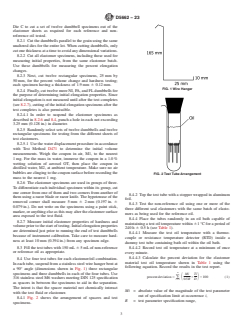
FIG. 1 Wire Hanger
8.2.4 Finally, cut twelve more NI, PA, and FL dumbbells for
the purpose of determining initial elongation properties. Since
initial elongation is not measured until after the test completes
(see 8.2.7), cutting of the initial elongation specimens after the
test completes is also permissible.
8.2.4.1 In order to suspend the elastomer specimens as
described in 8.2.6 and 8.4, punch a hole in each not exceeding
3.25 mm (0.128 in.) in diameter.
8.2.5 Randomly select sets of twelve dumbbells and twelve
rectangular specimens for testing from the different sheets of
test elastomers.
8.2.5.1 Use the water displacement procedure in accordance
with Test Method D471 to determine the initial volume
measurements. Weigh the coupon in air, M1, to the nearest
1 mg. For the mass in water, immerse the coupon in a 1.0 %
wetting solution of aerosol OT, then place the coupon in
distilled water, M2, at ambient temperature. Make sure no air
bubbles are clinging to the coupon surface before recording the
FIG. 2 Test Tube Arrangement
mass to the nearest 1 mg.
8.2.6 The elastomer specimens are used in groups of three.
To differentiate each individual specimen within its group, cut
one corner from one of them and two corners from another of
8.4.2 Top the test tube with a stopper wrapped in aluminum
them using a razor blade or razor knife. The hypotenuse of the
foil.
removed corner shall measure 5 mm 6 2 mm (0.197 in. 6
8.4.3 Test the non-reference oil using one or more of the
0.079 in.). Do not write on the specimens using a paint stick,
three different seal elastomers with the same batch of elasto-
marker, or anything else as this may alter the elastomer surface
mers as being used for the reference oil.
area exposed to the test fluid.
8.4.4 Place the tubes randomly in an oil bath capable of
8.2.7 Measure initial elastomer properties of hardness and
maintaining a test oil temperature within 61 °C for a period of
volume prior to the start of testing. Initial elongation properties
240 h 6 0.5 h (see Table 1).
are determined just prior to running the end of test dumbbells
8.4.4.1 Measure the test oil temperature with a thermo-
because of instrument calibration. Take care to measure hard-
couple or resistance temperature detector (RTD) inside a
ness at least 10 mm (0.394 in.) from any specimen edge.
dummy test tube containing bath oil within the oil bath.
8.3 Fill the test tubes with 150 mL 6 5 mL of non-reference 8.4.4.2 Record test oil temperature at a minimum of once
or reference oil as appropriate.
every minute.
8.4.4.3 Calculate the percent deviation for the elastomer
8.4 Use four test tubes for each elastomer/oil combination.
material test oil temperature shown in Table 1 using the
In each tube, suspend from a stainless steel wire hanger bent at
following equation. Record the results in the test report.
a 90° angle (dimensions shown in Fig. 1) three rectangular
n
specimens and three dumbbells in each of the four tubes. Use Mi Ti
percent deviation 5 × × 100 (1)
S D
(
316 stainless steel M6 washers meeting DIN 125 specification 0.5R D
i51
as spacers in between the specimens to aid in the separation.
The intent is that the spacer material not chemically interact
Mi = absolute value of the magnitude of the test parameter
with the test fluid or elastomer.
out of specification limit at occurrence i,
8.4.1 Fig. 2 shows the arrangement of spacers and test
R = test parameter specification range,
specimens.
D5662 − 23
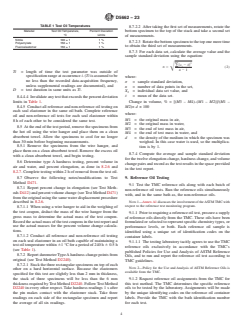
TABLE 1 Test Oil Temperatures
8.7.2.2 After taking the first set of measurements, rotate the
Material Test Oil Temperature, Percent Deviation bottom specimen to the top of the stack and take a second set
°C Limits
of measurements.
Nitrile 100 ± 1 1 %
8.7.2.3 Rotate the bottom specimen to the top one more time
Polyacrylate 150 ± 1 1 %
to obtain the third set of measurements.
Fluoroelastomer 150 ± 1 1 %
8.7.3 For each data set, calculate the average value and the
sample standard deviation using the equation:
~x 2 x¯!
( i
σ 5Œ (2)
n 2 1
Ti = length of time the test parameter was outside of
specification range at occurrence i. (Ti is assumed to be where:
no less than the recorded data-acquisition frequency,
σ = sample standard deviation,
unless supplemental readings are documented), and
n = number of data points in the set,
D = test duration in same units as Ti.
X = individual data set value, and
I
x¯ = mean of the data set.
8.4.4.4 Invalidate any test that exceeds the percent deviation
limits in Table 1.
Change in volume, % = [(M3 – M4)–(M1 – M2)]/(M1 –
8.4.5 Conduct all reference and non-reference oil testing on
M2)× d × 100
each seal elastomer in the same oil bath. Complete reference
where:
oil and non-reference oil tests for each seal elastomer within
M1 = the original mass in air,
8 h of each other to be considered the same test.
M2 = the original mass in water,
8.5 At the end of the test period, remove the specimens from
M3 = the end of test mass in air,
the hot oil using the wire hanger and place them on a clean
M4 = the end of test mass in water, and
absorbent towel. Allow the specimens to cool for no longer
d = the density of the medium in w
...
This document is not an ASTM standard and is intended only to provide the user of an ASTM standard an indication of what changes have been made to the previous version. Because
it may not be technically possible to adequately depict all changes accurately, ASTM recommends that users consult prior editions as appropriate. In all cases only the current version
of the standard as published by ASTM is to be considered the official document.
Designation: D5662 − 19a D5662 − 23
Standard Test Method for
Determining Automotive Gear Oil Compatibility with Typical
Oil Seal Elastomers
This standard is issued under the fixed designation D5662; the number immediately following the designation indicates the year of
original adoption or, in the case of revision, the year of last revision. A number in parentheses indicates the year of last reapproval. A
superscript epsilon (´) indicates an editorial change since the last revision or reapproval.
1. Scope*
1.1 This test method covers the determination of the compatibility of automotive gear oils with specific nitrile, polyacrylate, and
fluoroelastomer oil seal materials.
1.2 Users of this test method should obtain Test Methods D412, D471, and D2240 and become familiar with their use before
proceeding with this test method.
1.3 The values stated in SI units are to be regarded as standard. No other units of measurement are included in this standard.
1.4 This standard does not purport to address all of the safety concerns, if any, associated with its use. It is the responsibility
of the user of this standard to establish appropriate safety, health, and environmental practices and determine the applicability of
regulatory limitations prior to use.
1.5 This international standard was developed in accordance with internationally recognized principles on standardization
established in the Decision on Principles for the Development of International Standards, Guides and Recommendations issued
by the World Trade Organization Technical Barriers to Trade (TBT) Committee.
2. Referenced Documents
2.1 ASTM Standards:
D412 Test Methods for Vulcanized Rubber and Thermoplastic Elastomers—Tension
D471 Test Method for Rubber Property—Effect of Liquids
D2240 Test Method for Rubber Property—Durometer Hardness
D5704 Test Method for Evaluation of the Thermal and Oxidative Stability of Lubricating Oils Used for Manual Transmissions
and Final Drive Axles
D5760 Specification for Performance of Manual Transmission Gear Lubricants
E29 Practice for Using Significant Digits in Test Data to Determine Conformance with Specifications
2.2 SAE Standard:
J2360 Lubricating Oil, Gear Multipurpose (Metric) Military Use
This test method is under the jurisdiction of ASTM Committee D02 on Petroleum Products, Liquid Fuels, and Lubricants and is the direct responsibility of Subcommittee
D02.B0.03 on Automotive Gear Lubricants & Fluids.
Current edition approved Nov. 1, 2019Nov. 1, 2023. Published November 2019November 2023. Originally approved in 1995. Last previous edition approved in 2019 as
D5662 – 19.D5662 – 19a. DOI: 10.1520/D5662-19A.10.1520/D5662-23.
Until the next revision of this test method, the ASTM Test Monitoring Center will update changes in this test method by means of Information Letters; these can be
obtained from the ASTM Test Monitoring Center, 6555 Penn Ave., Pittsburgh, Pa 15206-4489. Attention:203 Armstrong Drive, Freeport, PA 16229. Director: Administrator.
This edition incorporates revisions in all Information Letters through No. 19-2.23-1.
For referenced ASTM standards, visit the ASTM website, www.astm.org, or contact ASTM Customer Service at service@astm.org. For Annual Book of ASTM Standards
volume information, refer to the standard’s Document Summary page on the ASTM website.
Available from Society of Automotive Engineers (SAE), 400 Commonwealth Dr., Warrendale, PA 15096-0001, http://www.sae.org.
*A Summary of Changes section appears at the end of this standard
Copyright © ASTM International, 100 Barr Harbor Drive, PO Box C700, West Conshohocken, PA 19428-2959. United States
D5662 − 23
3. Terminology
3.1 Definitions of Terms Specific to This Standard:
3.1.1 dumbbell, n—the specific cut shape (Die C) of an elastomer as explained in the section on dumbbell specimens in Test
Methods D412.
3.1.2 formulation, n—the specific chemical composition used in manufacturing a seal elastomer or a reference oil.
3.1.3 percent ultimate elongation, n—the stretch length at rupture of an elastomer dumbbell oil-aged by running this procedure
minus the rupture stretch length of an untested dumbbell, all divided by rupture stretch length of the untested dumbbell and then
multiplied by 100.
3.1.4 percent volume change, n—the change in volume of a test specimen as explained in the procedure for change in volume in
Test Method D471.
4. Summary of Test Method
4.1 Non-reference oils are tested using a modified version of Test Method D471 on specific elastomer compounds. Measured
quantities are percent ultimate elongation changes (further referred to as just percent elongation changes), durometer Type A
hardness changes, and percent volume changes. Reference oils are run concurrently in the same oil bath to measure consistency
from one test to another.
4.2 The duration of these tests is 240 h. The reference oils are available from the ASTM Test Monitoring Center (TMC). The seal
materials are available through a Central Parts Distributor (CPD).
5. Significance and Use
5.1 There are several major causes of automotive lubricant-related seal failures. This test method addresses only those failures
caused by excessive elastomer hardening, elongation loss, and volume swell and attempts to determine the likelihood that an oil
might cause premature sealing system failures in field use. This test method may be used as a requirement of a performance
specification, such as Specification D5760 and J2360.
5.2 Another major cause of seal failure is the formation of carbon, varnish, and sludge-like deposits on the seal lip. The
deposit-forming characteristics of automotive gear oils are evaluated in Test Method D5704. That procedure is intended in part to
evaluate the potential for oils to cause premature seal failure in field service.
6. Apparatus
6.1 Specific test equipment as outlined in Test Methods D412, D471, and D2240 is required.
6.1.1 Hardness Durometer—See Test Method D2240.
6.1.1.1 Calibration—Calibrate the hardness durometer annually. Use an outside source, with standards traceable to National
Institute for Standards Technology (NIST) for annual calibration. Perform checks with internal standards weekly. Checks with
internal standards shall be within 63 points. Calibrate internal standards annually, using an outside source, with standards traceable
to NIST.
Reference oils are available from the ASTM Test Monitoring Center, 6555 Penn Ave., Pittsburgh, PA 15206-4489.203 Armstrong Drive, Freeport, PA 16229.
The Central Parts Distributor for this procedure is Test Engineering Inc., 12758 Cimarron Path, Suite 102, San Antonio, TX 78249.
D5662 − 23
6.1.2 Tension Testing Machine—See Test Methods D412. Set the testing machine rate of grip separation for the percent elongation
change determinations at 8.5 mm ⁄s 6 0.8 mm ⁄s. Calibrate the tension testing machine in accordance with manufacturer
instructions. See Example Settings for Instron Machine, available from the TMC website.
6.1.2.1 Calibration—Calibrate the tension testing machine annually. The manufacturer shall perform an annual calibration, using
NIST traceable standards.
6.1.3 Glass Tubes, having an outside diameter of 38 mm and an overall length of 300 mm. The tube is fitted loosely with an
aluminum foil-covered stopper.
6.1.4 Balance—Use any commercially available balance capable of weighing samples to the nearest 1.0 mg.
6.1.4.1 Calibration—Calibrate the balance annually. Use an outside source, with standards traceable to NIST for annual
calibration. Perform checks with internal standards monthly, using NIST traceable weights. The difference between the weights and
balance shall be <0.5 mg. Calibrate internal standards annually, using an outside source, with standards traceable to NIST.
7. Reagents and Materials
7.1 Specific reference test oils are maintained and distributed by the TMC. To receive the test oils and seal materials, individual
laboratories shall commit to furnishing the TMC with reference data developed using these reference materials.
7.2 The CPD is responsible for maintaining the numbering and tracking system for the seal elastomer batches used. The
Surveillance Panel is responsible for approval of elastomer batches (see Appendix X1). Only approved elastomer batches are to
be used for reference tests and tests run to meet industry specifications. Certain specific information concerning these reference
materials is available only to the CPD. This information is used to ensure batch-to-batch consistency.
7.2.1 Information and location of the current CPD is also available from the TMC.
7.3 Specific reference seal elastomers used are a nitrile (NI), a polyacrylate (PA), and a fluoroelastomer (FL). Notation of the
numbering system is established by the TMC as follows:
[Type] Y
where:
Type = NI, PA, FL, and
Y = Batch number of the particular formulation.
7.4 The shelf life for the PA and FL seal elastomers is five years from the date the batch was cured. For NI seal elastomer, the
shelf life is three years from the date the batch was cured. Invalidate any test with a seal beyond its shelf life or not stored according
to 7.4.1. Consult the TMC for any approved exceptions to this lifespan. Place a note in the comments section of the test report
where exceptions have been approved.
7.4.1 Store elastomers in a refrigerator maintained at 3 °C to 6 °C.
7.5 The shelf life of reference oils is typically five years unless the TMC, through their analysis, specifies otherwise.
7.6 Wetting Solution of Aerosol OT—0.1 % sodium diocytl sulfosuccinate, made by a 1.0 % dilution of a 10 % solution with
reagent water.
Trademark of Instron Worldwide. The sole source of supply of the apparatus known to the committee at this time is Instron Worldwide Headquarters, 825 University
Ave., Norwood, MA 02062–2643. If you are aware of alternative suppliers, please provide this information to ASTM International Headquarters. Your comments will receive
careful consideration at a meeting of the responsible technical committee, which you may attend.
Available at
https://www.astmtmc.org/ftp/docs/gear/osct/procedure_and_ils/Instron_Settings.pdf.
D5662 − 23
8. Procedure
8.1 The testing laboratory shall conduct reference oil tests concurrently with the non-reference oil in the same oil bath. Reference
oils shall perform within a specific range prescribed and evaluated by TMC for validity and updated as needed.
8.2 Prior to cutting specimens and prior to performing elongation tests for initial properties, allow 3 h for the elastomer to warm
to 23 °C 6 2 °C, as required by Test Methods D412. Referring to the procedure in Test Methods D412, use Die C to cut a set of
twelve dumbbell specimens out of the elastomer sheets as required for each reference and non-reference oil tested.
8.2.1 Cut the dumbbells parallel to the grain using the same unaltered dies for the entire lot. When cutting dumbbells, only cut
one thickness at a time to avoid any dimensional variations.
8.2.2 Cut all elastomer specimens, including those used for measuring initial properties, from the same elastomer batch. Use these
dumbbells for measuring the percent elongation changes.
8.2.3 Next, cut twelve rectangular specimens, 25 mm by 50 mm, for the percent volume change and hardness testing; each
specimen having a thickness of 1.9 mm 6 0.12 mm.
8.2.4 Finally, cut twelve more NI, PA, and FL dumbbells for the purpose of determining initial elongation properties. Since initial
elongation is not measured until after the test completes (see 8.2.7), cutting of the initial elongation specimens after the test
completes is also permissible.
8.2.4.1 In order to suspend the elastomer specimens as described in 8.2.6 and 8.4, punch a hole in each not exceeding 3.25 mm
(0.128 in.) in diameter.
8.2.5 Randomly select sets of twelve dumbbells and twelve rectangular specimens for testing from the different sheets of test
elastomers.
8.2.5.1 Use the water displacement procedure in accordance with Test Method D471 to determine the initial volume
measurements. Weigh the coupon in air, M1, to the nearest 1 mg. For the mass in water, immerse the coupon in a 1.0 % wetting
solution of aerosol OT, then place the coupon in distilled water, M2, at ambient temperature. Make sure no air bubbles are clinging
to the coupon surface before recording the mass to the nearest 1 mg.
8.2.6 The elastomer specimens are used in groups of three. To differentiate each individual specimen within its group, cut one
corner from one of them and two corners from another of them using a razor blade or razor knife. The hypotenuse of the removed
corner shall measure 5 mm 6 2 mm (0.197 in. 6 0.079 in.). Do not write on the specimens using a paint stick, marker, or anything
else as this may alter the elastomer surface area exposed to the test fluid.
8.2.7 Measure initial elastomer properties of hardness and volume prior to the start of testing. Initial elongation properties are
determined just prior to running the end of test dumbbells because of instrument calibration. Take care to measure hardness at least
10 mm (0.394 in.) from any specimen edge.
8.3 Fill the test tubes with 150 mL 6 5 mL of non-reference or reference oil as appropriate.
8.4 Use four test tubes for each elastomer/oil combination. In each tube, suspend from a stainless steel wire hanger bent at a 90°
angle (dimensions shown in Fig. 1) three rectangular specimens and three dumbbells in each of the four tubes. Use 316 stainless
steel M6 washers meeting DIN 125 specification as spacers in between the specimens to aid in the separation. The intent is that
the spacer material not chemically interact with the test fluid or elastomer.
8.4.1 Fig. 2 shows the arrangement of spacers and test specimens.
8.4.2 Top the test tube with a stopper wrapped in aluminum foil.
8.4.3 Test the non-reference oil using one or more of the three different seal elastomers with the same batch of elastomers as being
used for the reference oil.
D5662 − 23
FIG. 1 Wire Hanger
FIG. 2 Test Tube Arrangement
8.4.4 Place the tubes randomly in an oil bath capable of maintaining a test oil temperature within 61 °C for a period of 240 h 6
0.5 h (see Table 1).
8.4.4.1 Measure the test oil temperature with a thermocouple or resistance temperature detector (RTD) inside a dummy test tube
containing bath oil within the oil bath.
8.4.4.2 Record test oil temperature at a minimum of once every minute.
8.4.4.3 Calculate the percent deviation for the elastomer material test oil temperature shown in Table 1 using the following
equation. Record the results in the test report.
n
Mi Ti
percent deviation 5 × ×100 (1)
S D
(
0.5R D
i51
Mi = absolute value of the magnitude of the test parameter out of specification limit at occurrence i,
R = test parameter specification range,
Ti = length of time the test parameter was outside of specification range at occurrence i. (Ti is assumed to be no less than the
recorded data-acquisition frequency, unless supplemental readings are documented), and
D = test duration in same units as Ti.
8.4.4.4 Invalidate any test that exceeds the percent deviation limits in Table 1.
D5662 − 23
TABLE 1 Test Oil Temperatures
Material Test Oil Temperature, Percent Deviation
°C Limits
Nitrile 100 ± 1 1 %
Polyacrylate 150 ± 1 1 %
Fluoroelastomer 150 ± 1 1 %
8.4.5 Conduct all reference and non-reference oil testing on each seal elastomer in the same oil bath. Complete reference oil and
non-reference oil tests for each seal elastomer within 8 h of each other to be considered the same test.
8.5 At the end of the test period, remove the specimens from the hot oil using the wire hanger and place them on a clean absorbent
towel. Allow the specimens to cool for no longer than 30 min before beginning measurements.
8.5.1 Remove the specimens from the wire hanger, and place them on a clean absorbent towel. Remove the excess oil with a clean
absorbent towel, and begin testing.
8.6 Determine type A hardness testing, percent volume in air and water, and percent elongation, as done in 8.2.6 and 8.2.7.
Complete testing within 2 h of removal from the test oil.
8.7 Observe the following notes/modifications to Test Method D471.
8.7.1 Report percent change in elongation (see Test Methods D412) and percent volume change (see Test Method D471) from the
original using the same water displacement procedure described in 8.2.6.
8.7.1.1 When using a wire hanger to aid in the weighing of the test coupon, deduct the mass of the wire hanger from the gross
mass to determine the actual mass of the test
...