

ASTM E2520-21
(Practice)Standard Practice for Measuring and Scoring Performance of Trace Explosive Chemical Detectors
General Information
- Abstract
SIGNIFICANCE AND USE
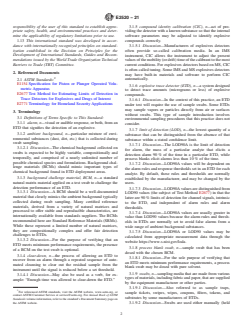
5.1 This practice may be used to accomplish several ends: to establish a worldwide frame of reference for terminology, metrics, and procedures for reliably determining trace detection performance of ETDs; as a demonstration by the vendor that the equipment is operating properly to a specified performance score; for a periodic verification by the user of detector performance after purchase; and as a generally-acceptable template adaptable by international agencies to specify performance requirements, analytes and dosing levels, background challenges, and operations.
5.2 It is expected that current ETD systems will exhibit wide ranges of performance across the diverse explosive types and compounds considered. As in previous versions, this practice establishes the minimum performance that is required for a detector to be considered effective in the detection of trace explosives. An explosives detector is considered to have “minimum acceptable performance” when it has attained a test score of at least 80.
SCOPE
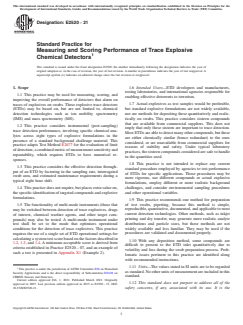
1.1 This practice may be used for measuring, scoring, and improving the overall performance of detectors that alarm on traces of explosives on swabs. These explosive trace detectors (ETDs) may be based on, but are not limited to, chemical detection technologies such as ion mobility spectrometry (IMS) and mass spectrometry (MS).
1.2 This practice considers instrumental (post-sampling) trace detection performance, involving specific chemical analytes across eight types of explosive formulations in the presence of a standard background challenge material. This practice adapts Test Method E2677 for the evaluation of limit of detection, a combined metric of measurement sensitivity and repeatability, which requires ETDs to have numerical responses.
1.3 This practice considers the effective detection throughput of an ETD by factoring in the sampling rate, interrogated swab area, and estimated maintenance requirements during a typical eight hour shift.
1.4 This practice does not require, but places extra value on, the specific identification of targeted compounds and explosive formulations.
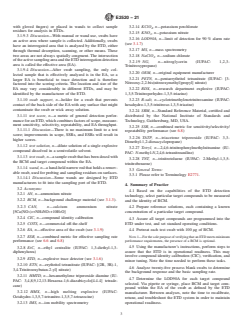
1.5 The functionality of multi-mode instruments (those that may be switched between detection of trace explosives, drugs of interest, chemical warfare agents, and other target compounds) may also be tested. A multi-mode instrument under test shall be set to the mode that optimizes operational conditions for the detection of trace explosives. This practice requires the use of a single set of ETD operational settings for calculating a system test score based on the factors described in 1.2, 1.3, and 1.4. A minimum acceptable score is derived from criteria established in Practice E2520 – 07, and an example of such a test is presented in Appendix X1 (Example 2).
1.6 Intended Users—ETD developers and manufacturers, testing laboratories, and international agencies responsible for enabling effective deterrents to terrorism.
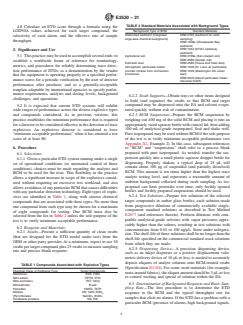
1.7 Actual explosives as test samples would be preferable, but standard explosive formulations are not widely available, nor are methods for depositing these quantitatively and realistically on swabs. This practice considers sixteen compounds that are available from commercial suppliers. This does not imply that only these sixteen are important to trace detection. Most ETDs are able to detect many other compounds, but these are either chemically similar (hence redundant) to the ones considered, or are unavailable from commercial suppliers for reasons of stability and safety. Under typical laboratory practices, the sixteen compounds considered are safe to handle in the quantities used.
1.8 This practice is not intended to replace any current standard procedure employed by agencies to test performance of ETDs for specific applications. Those procedures may be more rigorous, use different compounds or actual explosive formulations, employ different or more realistic background...
- Status
- Published
- Publication Date
- 31-Jan-2021
- Technical Committee
- E54 - Homeland Security Applications
- Drafting Committee
- E54.01 - CBRNE Detection and CBRN Protection
Buy Documents
ASTM E2520-21 - Standard Practice for Measuring and Scoring Performance of Trace Explosive Chemical Detectors
REDLINE ASTM E2520-21 - Standard Practice for Measuring and Scoring Performance of Trace Explosive Chemical Detectors
Overview
ASTM E2520-21: Standard Practice for Measuring and Scoring Performance of Trace Explosive Chemical Detectors provides a globally recognized framework for assessing the performance of Explosive Trace Detectors (ETDs). This ASTM standard is essential for establishing consistent terminology, metrics, and procedures in determining the sensitivity, selectivity, and overall effectiveness of chemical detectors used for identifying trace explosives on swabs. The practice is intended for ETDs using chemical detection technologies such as ion mobility spectrometry (IMS) and mass spectrometry (MS), supporting periodic verification and continual improvement of device performance.
Key Topics
- Trace Explosive Detection: Focuses on alarm detection of trace explosives present on swabs, accounting for post-sampling instrumental performance across various explosive types.
- Performance Metrics: Introduces a scoring system based on detection sensitivity (limit of detection), repeatability, selectivity, effective sampling rate, and overall test throughput.
- Terminology Standardization: Establishes uniform definitions for terms related to ETDs, such as alarm, background challenge material (BCM), swabs, process blanks, selectivity coefficient, and test score.
- Background Challenge Materials: Recommends use of standard reference materials to simulate environmental backgrounds typically encountered during real-world deployment.
- Testing Procedures: Describes a reproducible, quantitative method-primarily using pipetting-for sample preparation and application to swabs, ensuring robust evaluation of detection capabilities.
- Evaluation Scope: Emphasizes that while sixteen common commercial explosive compounds are used for standardized testing, the methodology is adaptable for other compounds as required by agencies or evolving detection technologies.
- Minimum Acceptable Performance: Defines the minimum passing score as 80, ensuring that detectors meet a baseline requirement for effectiveness in trace explosive detection.
Applications
- Detector Development and Validation: Used by manufacturers and developers to benchmark and enhance the capabilities of new and existing ETDs, ensuring they meet or exceed minimum global standards.
- Vendor Demonstrations and Procurement: Provides a transparent performance measure for vendors to demonstrate compliance and operational readiness of explosive trace detectors.
- Routine User Verification: Guides users-such as security personnel and laboratory staff-in periodic testing and verification of ETD functionality following purchase and throughout operational cycles.
- International Agency Deployment: Serves as a template for international agencies to specify detection requirements, analyte sets, testing dosages, background types, and operating procedures for security applications.
- Multi-Mode Instrument Assessment: Supports testing of devices capable of detecting a range of hazardous substances, ensuring optimal settings for explosive trace detection are identified and evaluated.
Related Standards
- ASTM E1154: Specification for Piston or Plunger Operated Volumetric Apparatus, relevant to liquid handling during sample preparation.
- ASTM E2677: Test Method for Estimating Limits of Detection in Trace Detectors, referenced for determination of measurement sensitivity and repeatability.
- ASTM E2771: Terminology for Homeland Security Applications, provides additional context and definitions for terms used within E2520-21.
Practical Value
The ASTM E2520-21 standard is vital for enhancing security, public safety, and operational confidence in trace explosive detection technology worldwide. Through robust testing criteria and standardized performance scoring, it supports interoperability between agencies, guides procurement decisions, and underpins technological innovation. Regular application of this practice leads to improved detection accuracy, fewer false alarms, and reliable performance of ETDs across a range of challenging environments and explosive types.
Keywords: explosive trace detectors, ETD performance evaluation, trace explosives, ASTM standards, security screening, ion mobility spectrometry, mass spectrometry, limit of detection, background challenge material, detector scoring, homeland security.
Relations
- Effective Date
- 01-Feb-2020
- Effective Date
- 01-Feb-2014
- Effective Date
- 15-Dec-2011
- Effective Date
- 15-Dec-2011
- Effective Date
- 15-Dec-2011
- Effective Date
- 15-Dec-2011
- Refers
ASTM E1154-89(2008) - Standard Specification for Piston or Plunger Operated Volumetric Apparatus - Effective Date
- 01-Nov-2008
- Refers
ASTM E1154-89(1997) - Standard Specification for Piston or Plunger Operated Volumetric Apparatus - Effective Date
- 01-Jan-1997
- Refers
ASTM E1154-89(2003) - Standard Specification for Piston or Plunger Operated Volumetric Apparatus - Effective Date
- 04-Apr-1989
Buy Documents
ASTM E2520-21 - Standard Practice for Measuring and Scoring Performance of Trace Explosive Chemical Detectors
REDLINE ASTM E2520-21 - Standard Practice for Measuring and Scoring Performance of Trace Explosive Chemical Detectors
Get Certified
Connect with accredited certification bodies for this standard

CIS Institut d.o.o.
Personal Protective Equipment (PPE) certification body. Notified Body NB-2890 for EU Regulation 2016/425 PPE.

Kiwa BDA Testing
Building and construction product certification.
Kmetijski inštitut Slovenije
Agricultural Institute of Slovenia. Soil testing, plant health, agricultural product analysis.
Sponsored listings
Frequently Asked Questions
ASTM E2520-21 is a standard published by ASTM International. Its full title is "Standard Practice for Measuring and Scoring Performance of Trace Explosive Chemical Detectors". This standard covers: SIGNIFICANCE AND USE 5.1 This practice may be used to accomplish several ends: to establish a worldwide frame of reference for terminology, metrics, and procedures for reliably determining trace detection performance of ETDs; as a demonstration by the vendor that the equipment is operating properly to a specified performance score; for a periodic verification by the user of detector performance after purchase; and as a generally-acceptable template adaptable by international agencies to specify performance requirements, analytes and dosing levels, background challenges, and operations. 5.2 It is expected that current ETD systems will exhibit wide ranges of performance across the diverse explosive types and compounds considered. As in previous versions, this practice establishes the minimum performance that is required for a detector to be considered effective in the detection of trace explosives. An explosives detector is considered to have “minimum acceptable performance” when it has attained a test score of at least 80. SCOPE 1.1 This practice may be used for measuring, scoring, and improving the overall performance of detectors that alarm on traces of explosives on swabs. These explosive trace detectors (ETDs) may be based on, but are not limited to, chemical detection technologies such as ion mobility spectrometry (IMS) and mass spectrometry (MS). 1.2 This practice considers instrumental (post-sampling) trace detection performance, involving specific chemical analytes across eight types of explosive formulations in the presence of a standard background challenge material. This practice adapts Test Method E2677 for the evaluation of limit of detection, a combined metric of measurement sensitivity and repeatability, which requires ETDs to have numerical responses. 1.3 This practice considers the effective detection throughput of an ETD by factoring in the sampling rate, interrogated swab area, and estimated maintenance requirements during a typical eight hour shift. 1.4 This practice does not require, but places extra value on, the specific identification of targeted compounds and explosive formulations. 1.5 The functionality of multi-mode instruments (those that may be switched between detection of trace explosives, drugs of interest, chemical warfare agents, and other target compounds) may also be tested. A multi-mode instrument under test shall be set to the mode that optimizes operational conditions for the detection of trace explosives. This practice requires the use of a single set of ETD operational settings for calculating a system test score based on the factors described in 1.2, 1.3, and 1.4. A minimum acceptable score is derived from criteria established in Practice E2520 – 07, and an example of such a test is presented in Appendix X1 (Example 2). 1.6 Intended Users—ETD developers and manufacturers, testing laboratories, and international agencies responsible for enabling effective deterrents to terrorism. 1.7 Actual explosives as test samples would be preferable, but standard explosive formulations are not widely available, nor are methods for depositing these quantitatively and realistically on swabs. This practice considers sixteen compounds that are available from commercial suppliers. This does not imply that only these sixteen are important to trace detection. Most ETDs are able to detect many other compounds, but these are either chemically similar (hence redundant) to the ones considered, or are unavailable from commercial suppliers for reasons of stability and safety. Under typical laboratory practices, the sixteen compounds considered are safe to handle in the quantities used. 1.8 This practice is not intended to replace any current standard procedure employed by agencies to test performance of ETDs for specific applications. Those procedures may be more rigorous, use different compounds or actual explosive formulations, employ different or more realistic background...
SIGNIFICANCE AND USE 5.1 This practice may be used to accomplish several ends: to establish a worldwide frame of reference for terminology, metrics, and procedures for reliably determining trace detection performance of ETDs; as a demonstration by the vendor that the equipment is operating properly to a specified performance score; for a periodic verification by the user of detector performance after purchase; and as a generally-acceptable template adaptable by international agencies to specify performance requirements, analytes and dosing levels, background challenges, and operations. 5.2 It is expected that current ETD systems will exhibit wide ranges of performance across the diverse explosive types and compounds considered. As in previous versions, this practice establishes the minimum performance that is required for a detector to be considered effective in the detection of trace explosives. An explosives detector is considered to have “minimum acceptable performance” when it has attained a test score of at least 80. SCOPE 1.1 This practice may be used for measuring, scoring, and improving the overall performance of detectors that alarm on traces of explosives on swabs. These explosive trace detectors (ETDs) may be based on, but are not limited to, chemical detection technologies such as ion mobility spectrometry (IMS) and mass spectrometry (MS). 1.2 This practice considers instrumental (post-sampling) trace detection performance, involving specific chemical analytes across eight types of explosive formulations in the presence of a standard background challenge material. This practice adapts Test Method E2677 for the evaluation of limit of detection, a combined metric of measurement sensitivity and repeatability, which requires ETDs to have numerical responses. 1.3 This practice considers the effective detection throughput of an ETD by factoring in the sampling rate, interrogated swab area, and estimated maintenance requirements during a typical eight hour shift. 1.4 This practice does not require, but places extra value on, the specific identification of targeted compounds and explosive formulations. 1.5 The functionality of multi-mode instruments (those that may be switched between detection of trace explosives, drugs of interest, chemical warfare agents, and other target compounds) may also be tested. A multi-mode instrument under test shall be set to the mode that optimizes operational conditions for the detection of trace explosives. This practice requires the use of a single set of ETD operational settings for calculating a system test score based on the factors described in 1.2, 1.3, and 1.4. A minimum acceptable score is derived from criteria established in Practice E2520 – 07, and an example of such a test is presented in Appendix X1 (Example 2). 1.6 Intended Users—ETD developers and manufacturers, testing laboratories, and international agencies responsible for enabling effective deterrents to terrorism. 1.7 Actual explosives as test samples would be preferable, but standard explosive formulations are not widely available, nor are methods for depositing these quantitatively and realistically on swabs. This practice considers sixteen compounds that are available from commercial suppliers. This does not imply that only these sixteen are important to trace detection. Most ETDs are able to detect many other compounds, but these are either chemically similar (hence redundant) to the ones considered, or are unavailable from commercial suppliers for reasons of stability and safety. Under typical laboratory practices, the sixteen compounds considered are safe to handle in the quantities used. 1.8 This practice is not intended to replace any current standard procedure employed by agencies to test performance of ETDs for specific applications. Those procedures may be more rigorous, use different compounds or actual explosive formulations, employ different or more realistic background...
ASTM E2520-21 is classified under the following ICS (International Classification for Standards) categories: 13.230 - Explosion protection. The ICS classification helps identify the subject area and facilitates finding related standards.
ASTM E2520-21 has the following relationships with other standards: It is inter standard links to ASTM E2677-20, ASTM E2677-14, ASTM E2771-11e3, ASTM E2771-11, ASTM E2771-11e1, ASTM E2771-11e2, ASTM E1154-89(2008), ASTM E1154-89(1997), ASTM E1154-89(2003). Understanding these relationships helps ensure you are using the most current and applicable version of the standard.
ASTM E2520-21 is available in PDF format for immediate download after purchase. The document can be added to your cart and obtained through the secure checkout process. Digital delivery ensures instant access to the complete standard document.
Standards Content (Sample)
This international standard was developed in accordance with internationally recognized principles on standardization established in the Decision on Principles for the
Development of International Standards, Guides and Recommendations issued by the World Trade Organization Technical Barriers to Trade (TBT) Committee.
Designation: E2520 − 21
Standard Practice for
Measuring and Scoring Performance of Trace Explosive
Chemical Detectors
This standard is issued under the fixed designation E2520; the number immediately following the designation indicates the year of
original adoption or, in the case of revision, the year of last revision.Anumber in parentheses indicates the year of last reapproval.A
superscript epsilon (´) indicates an editorial change since the last revision or reapproval.
1. Scope 1.6 Intended Users—ETD developers and manufacturers,
testing laboratories, and international agencies responsible for
1.1 This practice may be used for measuring, scoring, and
enabling effective deterrents to terrorism.
improving the overall performance of detectors that alarm on
1.7 Actual explosives as test samples would be preferable,
traces of explosives on swabs. These explosive trace detectors
(ETDs) may be based on, but are not limited to, chemical but standard explosive formulations are not widely available,
nor are methods for depositing these quantitatively and realis-
detection technologies such as ion mobility spectrometry
(IMS) and mass spectrometry (MS). tically on swabs. This practice considers sixteen compounds
that are available from commercial suppliers. This does not
1.2 This practice considers instrumental (post-sampling)
imply that only these sixteen are important to trace detection.
trace detection performance, involving specific chemical ana-
MostETDsareabletodetectmanyothercompounds,butthese
lytes across eight types of explosive formulations in the
are either chemically similar (hence redundant) to the ones
presence of a standard background challenge material. This
considered, or are unavailable from commercial suppliers for
practice adapts Test Method E2677 for the evaluation of limit
reasons of stability and safety. Under typical laboratory
ofdetection,acombinedmetricofmeasurementsensitivityand
practices, the sixteen compounds considered are safe to handle
repeatability, which requires ETDs to have numerical re-
in the quantities used.
sponses.
1.8 This practice is not intended to replace any current
1.3 This practice considers the effective detection through-
standard procedure employed by agencies to test performance
put of an ETD by factoring in the sampling rate, interrogated
of ETDs for specific applications. Those procedures may be
swab area, and estimated maintenance requirements during a
more rigorous, use different compounds or actual explosive
typical eight hour shift.
formulations, employ different or more realistic background
challenges, and consider environmental sampling procedures
1.4 Thispracticedoesnotrequire,butplacesextravalueon,
and other operational variables.
thespecificidentificationoftargetedcompoundsandexplosive
formulations.
1.9 This practice recommends one method for preparation
of test swabs, pipetting, because this method is simple,
1.5 The functionality of multi-mode instruments (those that
reproducible,quantitative,documented,andapplicabletomost
may be switched between detection of trace explosives, drugs
current detection technologies. Other methods, such as inkjet
of interest, chemical warfare agents, and other target com-
printing and dry transfer, may generate more realistic analyte
pounds) may also be tested. A multi-mode instrument under
distributions and particle sizes, but these methods are not
test shall be set to the mode that optimizes operational
widely available and less familiar. They may be used if the
conditions for the detection of trace explosives. This practice
procedures are validated and documented properly.
requires the use of a single set of ETD operational settings for
calculatingasystemtestscorebasedonthefactorsdescribedin
1.10 With any deposition method, some compounds are
1.2, 1.3, and 1.4.Aminimum acceptable score is derived from
difficult to present to the ETD inlet quantitatively due to
criteria established in Practice E2520–07, and an example of
volatility and loss during the swab preparation process. Prob-
such a test is presented in Appendix X1 (Example 2).
lematic issues pertinent to this practice are identified along
with recommended instructions.
1.11 Units—The values stated in SI units are to be regarded
This practice is under the jurisdiction ofASTM Committee E54 on Homeland
asstandard.Nootherunitsofmeasurementareincludedinthis
Security Applications and is the direct responsibility of Subcommittee E54.01 on
standard.
CBRNE Sensors and Detectors.
Current edition approved Feb. 1, 2021. Published March 2021. Originally
1.12 This standard does not purport to address all of the
approved in 2007. Last previous edition approved in 2015 as E2520–15. DOI:
10.1520/E2520-21. safety concerns, if any, associated with its use. It is the
Copyright © ASTM International, 100 Barr Harbor Drive, PO Box C700, West Conshohocken, PA 19428-2959. United States
E2520 − 21
responsibility of the user of this standard to establish appro- 3.1.5 compound identity calibration (CIC), n—act of pro-
priate safety, health, and environmental practices and deter- viding the detector with a known substance so that the internal
mine the applicability of regulatory limitations prior to use. software parameters may be adjusted to identify explosive
1.13 This international standard was developed in accor- compounds correctly.
dance with internationally recognized principles on standard-
3.1.5.1 Discussion—Manufacturers of explosives detectors
ization established in the Decision on Principles for the often provide so-called calibration media. In an IMS
Development of International Standards, Guides and Recom-
instrument, CIC allows the instrument to adjust the present
mendations issued by the World Trade Organization Technical valuesofthemobility(ordrift)timeofthecalibranttothemost
Barriers to Trade (TBT) Committee.
current conditions. For explosives detectors based on MS, CIC
is often called tuning. Some IMS and MS explosives detectors
2. Referenced Documents
may have built-in materials and software to perform CIC
automatically.
2.1 ASTM Standards:
E1154Specification for Piston or Plunger Operated Volu-
3.1.6 explosive trace detector (ETD), n—a system designed
metric Apparatus
to detect trace amounts (micrograms or less) of explosive
E2677Test Method for Estimating Limits of Detection in
compounds.
Trace Detectors for Explosives and Drugs of Interest
3.1.6.1 Discussion—In the context of this practice, an ETD
E2771Terminology for Homeland Security Applications
under test will require the use of sample swabs. Some ETDs
may sample vapors or particles directly from air or surfaces
3. Terminology
without swabs. This type of sample introduction involves
3.1 Definitions of Terms Specific to This Standard:
environmental sampling procedures that this practice does not
3.1.1 alarm, n—visualoraudibleresponse,orboth,froman
consider.
ETD that signifies the detection of an explosive.
3.1.7 limit of detection (LOD), n—the lowest quantity of a
3.1.2 ambient background, n—particular mixture of envi-
substance that can be distinguished from the absence of that
ronmental substances (dust, dirt, etc.) that is collected during
substance within a stated confidence limit.
swab sampling.
3.1.7.1 Discussion—The LOD90A is the limit of detection
3.1.2.1 Discussion—The chemical background collected on
for alarm, the mass of a particular analyte that elicits a
swabs is expected to be highly variable, compositionally and
detection alarm 90% of the time in a particular ETD, while
temporally, and comprised of a nearly unlimited number of
process blanks elicit alarms less than 10% of the time.
possible chemical species and formulations. Background chal-
3.1.7.2 Discussion—LOD90A values will be dependent on
lenge materials (BCMs) should mimic important types of
the alarm rules and response thresholds set in an ETD for each
chemical background found in ETD deployment areas.
analyte. By default, these rules and thresholds are normally
3.1.3 background challenge material, BCM, n—a standard
established by the manufacturer, and may be changed by the
natural matrix material applied on a test swab to challenge the
users.
detection performance of an ETD.
3.1.7.3 Discussion—LOD90Avaluesaredistinguishedfrom
3.1.3.1 Discussion—A BCM should be a well-documented
LOD90 values (the subject of Test Method E2677) in that the
material that closely mimics the ambient background typically
latter are 90% limits of detection for channel signals, intrinsic
collected during swab sampling. Many certified reference
to the ETD, and independent of alarm rules and alarm
materials, derived from a variety of natural matrices and
thresholds.
processed to offer stable and reproducible characteristics, are
3.1.7.4 Discussion—LOD90A values are usually greater in
internationally available from standards suppliers. The BCMs
value than LOD90 values because the alarm rules and thresh-
recommended here are Standard Reference Materials (SRMs).
olds in ETDs are normally set to avoid false alarms from a
While these represent a limited number of natural matrices,
wide range of ambient background substances.
they are compositionally complex and offer fair detection
3.1.7.5 Discussion—LOD90A or LOD90 values may be
challenges to ETDs.
calculated from appropriate measurement data through the
3.1.3.2 Discussion—For the purpose of verifying that an
website https://www-s.nist.gov/loda.
ETD meets minimum performance requirements, the presence
3.1.8 process blank swab, n—sample swab that has been
of a BCM on the test swab is optional.
dosed with the chosen BCM.
3.1.4 clear-down, n—the process of allowing an ETD to
3.1.8.1 Discussion—For the sole purpose of verifying that
recover from an alarm through a repeated sequence of auto-
an ETD meets minimum performance requirements, a process
mated cleansing to clear out the residual sample from the
blank swab may be dosed with pure solvent.
instrument until the signal is reduced below a set threshold.
3.1.9 swabs, n—samplingmediathataremadefromvarious
3.1.4.1 Discussion—May also be used as a verb, for ex-
typesofmaterials,includingfabricandpaper,thataresupplied
ample: “Enough time was allowed to clear-down the ETD.”
by the equipment manufacturer or other parties.
3.1.9.1 Discussion—Also referred to as sample traps,
For referenced ASTM standards, visit the ASTM website, www.astm.org, or
sample tickets, swipes, wipes, coupons, filters, tokens, and
contact ASTM Customer Service at service@astm.org. For Annual Book of ASTM
substrates by some manufacturers of ETDs.
Standards volume information, refer to the standard’s Document Summary page on
the ASTM website. 3.1.9.2 Discussion—Swabs are used either manually (held
E2520 − 21
with gloved fingers) or placed in wands to collect sample 3.2.14 KClO ,n—potassium perchlorate
residues for analysis in ETDs.
3.2.15 KNO ,n—potassium nitrate
3.1.9.3 Discussion—With manual or wand use, swabs have
3.2.16 LOD90A, n—limit of detection for 90% alarm rate
an active area where sample is collected. Additionally, swabs
(see 3.1.7)
have an interrogated area that is analyzed by the ETD, either
3.2.17 MS, n—mass spectrometry
through thermal desorption, scanning, or other means. These
two areas are not always spatially congruent. The intersection 3.2.18 NaClO ,n—sodium chlorate
oftheactivesamplingareaandtheETDinterrogationdetection
3.2.19 NG, n—nitroglycerin (IUPAC: 1,2,3-
area is called the effective area (EA).
Trinitroxypropane)
3.1.9.4 Discussion—After swab sampling, the only col-
3.2.20 OEM, n—original equipment manufacturer
lected sample that is effectively analyzed is in the EA, so a
3.2.21 PETN, n—pentaerythritol tetranitrate (IUPAC: [3-
larger EA is beneficial to trace detection and is therefore
Nitrooxy-2,2-bis(nitrooxymethyl)propyl] nitrate)
factored into the scoring criteria. The location and size of the
EA may vary considerably in different ETDs, and may be 3.2.22 RDX, n—research department explosive (IUPAC:
identified by the manufacturer of the ETD.
1,3,5-Trinitroperhydro-1,3,5-triazine)
3.1.10 swab support, n—holder for a swab that prevents 3.2.23 R-salt, n—cyclotrimethylenetrinitrosamine (IUPAC:
contact of the back side of the EAwith any surface that might
hexahydro-1,3,5-trinitroso-1,3,5-triazine)
contaminate the swab or wick away solution.
3.2.24 SRM, n—Standard Reference Material, certified and
3.1.11 test score, n—a metric of general detection perfor- distributed by the National Institute of Standards and
manceforanETD,whichcombinesfactorsofscope,measure- Technology, Gaithersburg, MD, USA.
ment sensitivity, selectivity, repeatability, and EA throughput.
3.2.25 SSR, n—combined metric for sensitivity/selectivity/
3.1.11.1 Discussion—There is no maximum limit to a test
repeatability performance (see 6.8)
score; improvements in scope, SSRs, and ESRs will result in
3.2.26 TATP, n—triacetone triperoxide (IUPAC: 3,3-
higher scores.
Dimethyl-1,2-dioxacyclopropane)
3.1.12 test solution, n—dilute solution of a single explosive
3.2.27 Tetryl, n—2,4,6-trinitrophenylmethylnitramine (IU-
compound dissolved in a semivolatile solvent.
PAC: N-methyl-N,2,4,6-tetranitroaniline)
3.1.13 test swab, n—asampleswabthathasbeendosedwith
3.2.28 TNT, n—trinitrotoluene (IUPAC: 2-Methyl-1,3,5-
the BCM and target compound within the EA.
trinitrobenzene)
3.1.14 wand, n—ahand-heldnarrowrodthatholdsaremov-
3.3 General Terms:
ableswab,usedforprobingandsamplingresiduesonsurfaces.
3.3.1 Please refer to Terminology E2771.
3.1.14.1 Discussion—Some wands are designed by ETD
manufacturers to fit into the sampling port of the ETD.
4. Summary of Practice
3.2 Acronyms:
4.1 Based on the capabilities of the ETD detection
3.2.1 AN, n—ammonium nitrate
technology, select particular target compounds to be measured
3.2.2 BCM, n—background challenge material (see 3.1.3).
and the identity of BCM.
3.2.3 CAN, n—calcium ammonium nitrate
4.2 Prepare reference solutions, each containing a known
[5Ca(NO ) +NH NO +10H O]
concentration of a particular target compound.
3 2 4 3 2
3.2.4 CIC, n—compound identity calibration
4.3 Assure all target compounds are programmed into the
ETD under test, and set standard operating conditions.
3.2.5 COTS, n—commercial off-the-shelf
4.4 Pretreat each test swab with 100 µg of BCM.
3.2.6 EA, n—effective area of the swab (see 3.1.9)
3.2.7 ESR, n—combined metric for effective sampling rate
NOTE1—ForthesolepurposeofverifyingthatanETDmeetsminimum
performance requirements, the presence of a BCM is optional.
performance (see 6.6 and 6.8)
4.5 Using the manufacturer’s instructions, perform steps to
3.2.8 EtC, n—ethyl centralite (IUPAC: 1,3-diethyl-1,3-
assure that the ETD is in operational readiness. This may
diphenylurea)
involve compound identity calibration (CIC), verification, and
3.2.9 ETD, n—explosive trace detector (see 3.1.6)
minor tuning. Note the time needed to perform these tasks.
3.2.10 ETN, n—erythritol tetranitrate (IUPAC: [(2R, 3R)-1,
4.6 Analyze twenty-five process blank swabs to determine
3,4-Trinitrooxybutan-2-yl] nitrate)
the background response and the basic sampling rate.
3.2.11 HMTD, n—hexamethylene triperoxide diamine (IU-
4.7 Determine the LOD90A for each target compound
PAC: 3,4,8,9,12,13-Hexaoxa-1,6-diazabicyclo[4.4.4] tetrade-
selected. Via pipette or syringe, place BCM and target com-
cane)
pound within the EA of the swab as defined by the ETD
3.2.12 HMX, n—high melting explosive (IUPAC:
manufacturer. Between analyses, note the time to recalibrate,
Octahydro-1,3,5,7-tetranitro-1,3,5,7-tetrazocine)
retune, and troubleshoot the ETD system in order to maintain
3.2.13 IMS, n—ion mobility spectrometry operational readiness.
E2520 − 21
TABLE 2 Standard Materials Associated with Background Types
4.8 Calculate an ETD score through a formula using the
LOD90A values achieved for each target compound, the Background Type of BCM Standard Materials
Watershed sediment (integrated SRM 2703 (Sediment for solid
selectivity of each alarm, and the effective rate of sample
large-area chemical background) sampling)
throughput.
SRM 1646a (Chesapeake Bay
sediment)
SRM 1944 (NY-NJ waterway
5. Significance and Use
sediment)
5.1 Thispracticemaybeusedtoaccomplishseveralends:to
Agricultural soil SRM 2709a (San Joaquin soil)
SRM 2586 (Garden soil)
establish a worldwide frame of reference for terminology,
Domestic dust SRM 2585 (House and hotel dust)
metrics, and procedures for reliably determining trace detec-
Atmospheric particulate matter SRM 1648 (St. Louis air particulate)
tion performance of ETDs; as a demonstration by the vendor (contain nitrates from combustion SRM 1649 (Washington DC urban
processes) dust)
that the equipment is operating properly to a specified perfor-
SRM 2975 (Diesel particulate matter,
mance score; for a periodic verification by the user of detector
industrial forklift)
performance after purchase; and as a generally-acceptable
template adaptable by international agencies to specify perfor-
mance requirements, analytes and dosing levels, background
6.2.2 Swab Supports—Obtain trays or other items designed
challenges, and operations.
to hold (and organize) the swabs so that BCM and target
5.2 It is expected that current ETD systems will exhibit compound may be dispensed onto the EA and solvent evapo-
rated quickly without risk of contamination.
wide ranges of performance across the diverse explosive types
and compounds considered. As in previous versions, this 6.2.3 BCM Suspension—Prepare the BCM suspension by
weighing out 400 mg of the solid BCM and placing it into an
practice establishes the minimum performance that is required
foradetectortobeconsideredeffectiveinthedetectionoftrace appropriatelysizedsqueezebottlewithconicallid,thenadding
explosives. An explosives detector is considered to have 100 mL of analytical-grade isopropanol. Seal and shake well.
PureisopropanolmaybeusedwithoutBCMifthesolepurpose
“minimum acceptable performance” when it has attained a test
score of at least 80. of the test is to verify minimum acceptable performance (see
Appendix X1, Example 2). In this case, subsequent references
6. Procedure
to “BCM” and “suspensions” shall refer to a process blank
prepared with pure isopropanol. As needed, transfer the sus-
6.1 Selections:
pension quickly into a small plastic squeeze dropper bottle for
6.1.1 Given a particular ETD system running under a single
dispensing. Properly shaken, a typical drop of 25 µL will
set of operational conditions (or automated control of those
contain about 100 µg of suspended (and partially dissolved)
conditions), choices must be made regarding the analytes and
BCM. This amount is ten times higher than the highest trace
BCM to be used for the tests. This flexibility in the practice
analyte testing level, and represents a reasonable amount of
allows a significant increase in scope of the explosives consid-
ambient background collected during swab sampling. As iso-
ered without requiring an excessive test workload, and also
propanol can form peroxides over time, only freshly opened
allowsavoidanceofanyparticularBCMthatcausesdifficulties
bottles and freshly prepared suspensions should be used.
with any particular detection technology. Eight types of explo-
6.2.4 Test Solutions—Prepare test solutions of the selected
sives are identified in Table 1, along with sixteen chemical
target compounds in amber glass bottles, each solution made
compounds that are associated with these types. No more than
from progressive dilutions of commercially available single-
one compound from each type may be chosen for a maximum
component standard solutions as described in Test Method
of eight compounds for testing. One BCM must also be
E2677 (and references therein). Perform dilutions with com-
selected from the list in Table 2 unless the sole purpose of the
patible analytical-grade solvents with vapor pressures appre-
test is to verify minimum acceptable performance.
ciably higher than the solutes, resulting in test solutions with
6.2 Reagents and Materials:
concentrations from 0.01 to 100 ng/µL. Store under refrigera-
6.2.1 Swabs—Procure a sufficient quantity of clean swabs
tion.Theshelf-lifeofthesesolutionsshallbenolongerthanthe
(that are designed for the ETD model under te
...
This document is not an ASTM standard and is intended only to provide the user of an ASTM standard an indication of what changes have been made to the previous version. Because
it may not be technically possible to adequately depict all changes accurately, ASTM recommends that users consult prior editions as appropriate. In all cases only the current version
of the standard as published by ASTM is to be considered the official document.
Designation: E2520 − 15 E2520 − 21
Standard Practice for
Measuring and Scoring Performance of Trace Explosive
Chemical Detectors
This standard is issued under the fixed designation E2520; the number immediately following the designation indicates the year of
original adoption or, in the case of revision, the year of last revision. A number in parentheses indicates the year of last reapproval. A
superscript epsilon (´) indicates an editorial change since the last revision or reapproval.
1. Scope
1.1 This practice may be used for measuring, scoring, and improving the overall performance of detectors that alarm on traces of
explosives on swabs. These explosive trace detectors (ETDs) may be based on, but are not limited to, chemical detection
technologies such as ion mobility spectrometry (IMS) and mass spectrometry (MS). Technologies that use thermodynamic or
optical detection are not specifically addressed, but may be adapted into future versions of this practice.
1.2 This practice considers instrumental (post-sampling) trace detection performance, involving specific chemical analytes across
eight types of explosive formulations in the presence of a standard background challenge material. This practice adapts Test
Method E2677 for the evaluation of limit of detection, a combined metric of measurement sensitivity and repeatability, which
requires ETDs to have numerical responses.
1.3 This practice considers the effective detection throughput of an ETD by factoring in the sampling rate, interrogated swab area,
and estimated maintenance requirements during a typical eight hour shift.
1.4 This practice does not require, but places extra value on, the specific identification of targeted compounds and explosive
formulations.
1.5 The functionality of multi-mode instruments (those that may be switched between detection of trace explosives, drugs of
interest, chemical warfare agents, and other target compounds) may also be tested. A multi-mode instrument under test shall be
set to the mode that optimizes operational conditions for the detection of trace explosives. This practice requires the use of a single
set of ETD operational settings for calculating a system test score based on the factors described in 1.2, 1.3, and 1.4. A minimum
acceptable score is derived from criteria established in Practice E2520 – 07.E2520 – 07, and an example of such a test is presented
in Appendix X1 (Example 2).
1.6 Intended Users—ETD developers and manufacturers, testing laboratories, and international agencies responsible for enabling
effective deterrents to terrorism.
1.7 Actual explosives as test samples would be preferable, but standard explosive formulations are not widely available, nor are
methods for depositing these quantitatively and realistically on swabs. This practice considers sixteen compounds that are available
from commercial suppliers. This does not imply that only these sixteen are important to trace detection. Most ETDs are able to
This practice is under the jurisdiction of ASTM Committee E54 on Homeland Security Applications and is the direct responsibility of Subcommittee E54.01 on CBRNE
Sensors and Detectors.
Current edition approved Feb. 1, 2015Feb. 1, 2021. Published February 2015March 2021. Originally approved in 2007. Last previous edition approved in 20072015 as
E2520 – 07.E2520 – 15. DOI: 10.1520/E2520-15.10.1520/E2520-21.
Copyright © ASTM International, 100 Barr Harbor Drive, PO Box C700, West Conshohocken, PA 19428-2959. United States
E2520 − 21
detect many other compounds, but these are either chemically similar (hence redundant) to the ones considered, or are unavailable
from commercial suppliers for reasons of stability and safety. Under typical laboratory practices, the sixteen compounds considered
are safe to handle in the quantities used.
1.8 This practice is not intended to replace any current standard procedure employed by agencies to test performance of ETDs for
specific applications. Those procedures may be more rigorous, use different compounds or actual explosive formulations, employ
different or more realistic background challenges, and consider environmental sampling procedures and other operational
variables.
1.9 This practice recommends one method for preparation of test swabs, pipetting, because this method is simple, reproducible,
quantitative, documented, and applicable to most current detection technologies. Other methods, such as inkjet printing and dry
transfer, may generate more realistic analyte distributions and particle sizes, but these methods are not widely available and less
familiar. They may be used if the procedures are validated and documented properly.
1.10 With any deposition method, some compounds are difficult to present to the ETD inlet quantitatively due to volatility and
loss during the swab preparation process. Problematic issues pertinent to this practice are identified along with recommended
instructions. The user should be aware of the possibility that untested scenarios may lead to failure in the determination of reliable
test scores.
1.11 Units—The values stated in SI units are to be regarded as standard. No other units of measurement are included in this
standard.
1.12 This standard does not purport to address all of the safety concerns, if any, associated with its use. It is the responsibility
of the user of this standard to establish appropriate safety safety, health, and healthenvironmental practices and determine the
applicability of regulatory limitations prior to use.
1.13 This international standard was developed in accordance with internationally recognized principles on standardization
established in the Decision on Principles for the Development of International Standards, Guides and Recommendations issued
by the World Trade Organization Technical Barriers to Trade (TBT) Committee.
2. Referenced Documents
2.1 ASTM Standards:
E1154 Specification for Piston or Plunger Operated Volumetric Apparatus
E2677 Test Method for Estimating Limits of Detection in Trace Detectors for Explosives and Drugs of Interest
E2771 Terminology for Homeland Security Applications
3. Terminology
3.1 Definitions of Terms Specific to This Standard:
3.1.1 alarm, n—visual or audible response, or both, from an ETD that signifies the detection of an explosive.
3.1.2 ambient background, n—particular mixture of environmental substances (dust, dirt, etc.) that is collected during swab
sampling.
3.1.2.1 Discussion—
The chemical background collected on swabs is expected to be highly variable, compositionally and temporally, and comprised
of a nearly unlimited number of possible chemical species and formulations. Background challenge materials (BCMs) should
mimic important types of chemical background found in ETD deployment areas.
3.1.3 background challenge material, BCM, n—a standard natural matrix material applied on a test swab to challenge the detection
performance of an ETD.
3.1.3.1 Discussion—
A BCM should be a well-documented material that closely mimics the ambient background typically collected during swab
sampling. Many certified reference materials, derived from a variety of natural matrices and processed to offer stable and
For referenced ASTM standards, visit the ASTM website, www.astm.org, or contact ASTM Customer Service at service@astm.org. For Annual Book of ASTM Standards
volume information, refer to the standard’s Document Summary page on the ASTM website.
E2520 − 21
reproducible characteristics, are internationally available from standards suppliers. The BCMs recommended here are Standard
Reference Materials (SRMs). While these represent a limited number of natural matrices, they are compositionally complex and
offer fair detection challenges to ETDs.
3.1.3.2 Discussion—
For the purpose of verifying that an ETD meets minimum performance requirements, the presence of a BCM on the test swab is
optional.
3.1.4 clear-down, n—the process of allowing an ETD to recover from an alarm through a repeated sequence of automated
cleansing to clear out the residual sample from the instrument until the signal is reduced below a set threshold.
3.1.4.1 Discussion—
May also be used as a verb, for example: “Enough time was allowed to clear-down the ETD.”
3.1.5 compound identity calibration (CIC), n—act of providing the detector with a known substance so that the internal software
parameters may be adjusted to identify explosive compounds correctly.
3.1.5.1 Discussion—
Manufacturers of explosives detectors often provide so-called calibration media. In an IMS instrument, CIC allows the instrument
to adjust the present values of the mobility (or drift) time of the calibrant to the most current conditions. For explosives detectors
based on MS, CIC is often called tuning. Some IMS and MS explosives detectors may have built-in materials and software to
perform CIC automatically.
3.1.6 explosive trace detector (ETD), n—a system designed to detect trace amounts (micrograms or less) of explosive compounds.
3.1.6.1 Discussion—
In the context of this practice, an ETD under test will require the use of sample swabs. Some ETDs may sample vapors or particles
directly from air or surfaces without swabs. This type of sample introduction involves environmental sampling procedures that this
practice does not consider.
3.1.7 limit of detection (LOD), n—the lowest quantity of a substance that can be distinguished from the absence of that substance
within a stated confidence limit.
3.1.7.1 Discussion—
The LOD90A is the limit of detection for alarm, the mass of a particular analyte that elicits a detection alarm 90 % of the time
(90 % CL) in a particular ETD, while process blanks elicit alarms less than 10 % of the time.
3.1.7.2 Discussion—
LOD90A values will be dependent on the alarm rules and response thresholds set in an ETD for each analyte. By default, these
rules and thresholds are normally established by the manufacturer, butand may be changed by the users.
3.1.7.3 Discussion—
LOD90A values are distinguished from LOD90 values (the subject of Test Method E2677) in that the latter are 90 % limits of
detection for channel signals, intrinsic to the ETD, and independent of alarm rules and alarm thresholds.
3.1.7.4 Discussion—
LOD90A values are usually higher greater in value than LOD90 values, sincevalues because the alarm rules and thresholds in
ETDs are normally set to avoid false alarms from a wide range of ambient background substances.
3.1.7.5 Discussion—
LOD90A or LOD90 values may be calculated from appropriate measurement data through the website http://pubapps.nist.gov/
loda.https://www-s.nist.gov/loda.
3.1.8 process blank swab, n—sample swab that has been dosed with the chosen BCM.
3.1.8.1 Discussion—
For the sole purpose of verifying that an ETD meets minimum performance requirements, a process blank swab may be dosed with
pure solvent.
3.1.9 swabs, n—sampling media that are made from various types of materials, including fabric and paper, that are supplied by
the equipment manufacturer or secondother parties.
3.1.9.1 Discussion—
Also referred to as sample traps, sample tickets, swipes, wipes, coupons, filters, tokens, and substrates by some manufacturers of
ETDs.
3.1.9.2 Discussion—
Swabs are used either manually (held with gloved fingers) or placed in wands to collect sample residues for analysis in ETDs.
3.1.9.3 Discussion—
E2520 − 21
With manual or wand use, swabs have an active area where sample is collected. Additionally, swabs have an interrogated area that
is analyzed by the ETD, either through thermal desorption, scanning, or other means. These two areas are not always spatially
congruent. The intersection of the active sampling area and the ETD interrogation detection area is called the effective area (EA).
3.1.9.4 Discussion—
After swab sampling, the only collected sample that is effectively analyzed is in the EA, so a larger EA is beneficial to trace
detection and is therefore factored into the scoring criteria. The location and size of the EA may vary considerably in different
ETDs, and may be identified by the manufacturer of the ETD.
3.1.10 swab support, n—holder for a swab that prevents contact of the back side of the EA with any surface that might contaminate
the swab or wick away solution.
3.1.11 test score, n—a metric of general detection performance for an ETD, which combines factors of scope, measurement
sensitivity, selectivity, repeatability, and EA throughput.
3.1.11.1 Discussion—
There is no maximum limit to a test score; improvements in scope, SSRs, and ESRs will result in higher scores.
3.1.12 test solution, n—dilute solution of a single explosive compound dissolved in a semivolatile solvent.
3.1.13 test swab, n—a sample swab that has been dosed with the BCM and target compound within the EA.
3.1.14 wand, n—a hand-held narrow rod that holds a removable swab, used for probing and sampling residues on surfaces.
3.1.14.1 Discussion—
Some wands are designed by ETD manufacturers to fit into the sampling port of the ETD.
3.2 Acronyms:
3.2.1 AN, n—ammonium nitrate
3.2.2 BCM, n—background challenge material (see 3.1.3).
3.2.3 CAN, n—calcium ammonium nitrate [5Ca(NO ) +NH NO +10H O]
3 2 4 3 2
3.2.4 CIC, n—compound identity calibration
3.2.5 COTS, n—commercial off-the-shelf
3.2.6 EA, n—effective area of the swab (see 3.1.9)
3.2.7 ESR, n—combined metric for effective sampling rate performance (see 6.56.6 and 6.76.8)
3.2.8 EtC, n—ethyl centralite (IUPAC: 1,3-diethyl-1,3-diphenylurea)
3.2.9 ETD, n—explosive trace detector (see 3.1.6)
3.2.10 ETN, n—erythritol tetranitrate (IUPAC: [(2R, 3R)-1,3,4-Trinitrooxybutan-2-yl] nitrate)
3.2.11 HMTD, n—hexamethylene triperoxide diamine (IUPAC: 3,4,8,9,12,13-Hexaoxa-1,6-diazabicyclo[4.4.4] tetradecane)
3.2.12 HMX, n—high melting explosive (IUPAC: Octahydro-1,3,5,7-tetranitro-1,3,5,7-tetrazocine)
3.2.13 IMS, n—ion mobility spectrometry
3.2.14 KClO , n—potassium perchlorate
E2520 − 21
3.2.15 KNO , n—potassium nitrate
3.2.16 LOD90A, n—limit of detection for 90 % alarm rate (see 3.1.7)
3.2.17 MS, n—mass spectrometry
3.2.18 NaClO , n—sodium chlorate
3.2.19 NG, n—nitroglycerin (IUPAC: 1,2,3-Trinitroxypropane)
3.2.20 OEM, n—original equipment manufacturer
3.2.21 PETN, n—pentaerythritol tetranitrate (IUPAC: [3-Nitrooxy-2,2-bis(nitrooxymethyl)propyl] nitrate)
3.2.22 RDX, n—research department explosive (IUPAC: 1,3,5-Trinitroperhydro-1,3,5-triazine)
3.2.23 R-salt, n—cyclotrimethylenetrinitrosamine (IUPAC: hexahydro-1,3,5-trinitroso-1,3,5-triazine)
3.2.24 SRM, n—Standard Reference Material, certified and distributed by the National Institute of Standards and Technology,
Gaithersburg, MD, USA.
3.2.25 SSR, n—combined metric for sensitivity/selectivity/repeatability performance (see 6.76.8)
3.2.26 TATP, n—triacetone triperoxide (IUPAC: 3,3-Dimethyl-1,2-dioxacyclopropane)
3.2.27 Tetryl, n—2,4,6-trinitrophenylmethylnitramine (IUPAC: N-methyl-N,2,4,6-tetranitroaniline)
3.2.28 TNT, n—trinitrotoluene (IUPAC: 2-Methyl-1,3,5-trinitrobenzene)
3.3 General Terms:
3.3.1 Please refer to Terminology E2771.
4. Summary of Practice
4.1 Based on the capabilities of the ETD detection technology, select particular target compounds to be measured and the identity
of BCM.
4.2 Reference solutions are prepared, Prepare reference solutions, each containing a known concentration of a particular target
compound.
4.3 Assure all target compounds are programmed into the ETD under test, and thatset standard operating conditions are
set.conditions.
4.4 Each Pretreat each test swab is pretreated with 100 μg of BCM.
NOTE 1—For the sole purpose of verifying that an ETD meets minimum performance requirements, the presence of a BCM is optional.
4.5 Using the manufacturer’s instructions, perform steps to assure that the ETD is in operational readiness. This may involve
compound identity calibration (CIC), verification, and minor tuning. Note the time needed to perform these tasks.
E2520 − 21
4.6 Twenty-five Analyze twenty-five process blank swabs are analyzed to determine the background response and the basic
sampling rate.
4.7 Determine the LOD90A for each target compound selected. Via pipette or syringe, place BCM and target compound are placed
anywhere within the EA of the swab as defined by the ETD manufacturer. Between analyses, note the time is noted to recalibrate,
retune, and troubleshoot the ETD system in order to maintain operational readiness.
4.8 An Calculate an ETD score is calculated through a formula using the LOD90A values achieved for each target compound, the
selectivity of each alarm, and the effective rate of sample throughput.
5. Significance and Use
5.1 TheThis practice may be used to accomplish several ends: to establish a worldwide frame of reference for terminology,
metrics, and procedures for reliably determining trace detection performance of ETDs; to give developers tangible benchmarks
designed to improve detection performance of next-generation ETDs; as a demonstration by the vendor that the equipment is
operating properly to a specified performance score; for a periodic verification by the user of detector performance after purchase;
and as a generally-acceptable template adaptable by international agencies to specify performance requirements, analytes and
dosing levels, background challenges, and operations.
5.2 It is expected that current ETD systems will exhibit wide ranges of performance across the diverse explosive types and
compounds considered. As in previous versions, this practice establishes the minimum performance that is required for a detector
to be considered effective in the detection of trace explosives. An explosives detector is considered to have “minimum acceptable
performance” when it has attained a test score of at least 80.
5.3 It is not recommended to use scores exclusively to compare different ETD systems in order to make procurement or
deployment decisions. The scores themselves signify ratings based on general detection performance, but do not necessarily reflect
capabilities with specific analytes or BCMs, nor do scores consider many factors that users may also consider important:
procurement and operating costs, robustness and dependability, training requirements, ease of use, security features, size and
weight constraints, network capabilities and interoperability, and radioactive material management.
6. Procedure
6.1 Selections:
6.1.1 Given a particular ETD system running under a single set of operational conditions (or automated control of those
conditions), choices must be made regarding the analytes and BCM to be used for the tests. This flexibility in the practice allows
a significant increase in scope of the explosives considered without requiring an excessive test workload, and also allows avoidance
of any particular BCM that causes difficulties with any particular detection technology. Eight types of explosives are identified in
Table 1, along with sixteen chemical compounds that are associated with these types. No more than one compound from each type
may be chosen for a maximum of eight compounds for testing. One BCM must also be selected from the list in Table 2. unless
the sole purpose of the test is to verify minimum acceptable performance.
6.2 Reagents and Materials:
TABLE 1 Compounds Associated with Explosive Types
Chemical Class or Explosive Type Target Compounds
Nitramines RDX, HMX
Nitro-esters PETN, ETN
Nitro-aromatics TNT, Tetryl
Nitrosamines R-salt
Peroxides HMTD, TATP
Inorganic nitrates AN, CAN, KNO
Nitrates AN, CAN, KNO
(Per)chlorates NaClO , KClO
3 4
Smokeless powders NG, EtC
E2520 − 21
TABLE 2 Standard Materials Associated with Background Types
BCM Type Standard Materials
Background Type of BCM Standard Materials
Watershed sediment (integrated SRM 2703 (Sediment for solid
large-area chemical background) sampling)
SRM 1646a (Chesapeake Bay
sediment)
SRM 1944 (NY-NJ waterway
sediment)
Agricultural soil SRM 2709a (San Joaquin soil)
SRM 2586 (Garden soil)
Domestic dust SRM 2585 (House and hotel dust)
Atmospheric particulate matter SRM 1648 (St. Louis air particulate)
(contain nitrates from combustion SRM 1649 (Washington DC urban
processes) dust)
SRM 2975 (Diesel particulate matter,
industrial forklift)
6.2.1 Swabs—A Procure a sufficient quantity of clean swabs (that are designed for the ETD model under test) shall be procured
from the OEM or second-party other party provider. At a minimum, expect to use 30 swabs per target compound plus 25 swabs
to measure sampling rate and process blank response.
6.2.2 Swab Supports—Trays Obtain trays or other items designed to hold (and organize) the swabs so that BCM and target
compound may be dispensed onto the EA and solvent evaporated quickly without risk of contamination.
6.2.3 BCM Suspension—Prepare the BCM suspension by weighing out 400 mg of the solid BCM and placing it into an
appropriately sized squeeze bottle with conical lid, then adding 100 mL of analytical-grade isopropanol. Seal and shake well. Pure
isopropanol may be used without BCM if the sole purpose of the test is to verify minimum acceptable performance (see Appendix
X1As needed, the suspension may be transferred , Example 2). In this case, subsequent references to “BCM” and “suspensions”
shall refer to a process blank prepared with pure isopropanol. As needed, transfer the suspension quickly into a small plastic
squeeze dropper bottle for dispensing. Properly shaken, a typical drop of 25 μL will contain about 100 μg of suspended (and
partially dissolved) BCM. This amount is ten times higher than the highest trace analyte testing level, and represents a reasonable
amount of ambient background collected during swab sampling. As isopropanol can form peroxides over time, only freshly opened
bottles and freshly prepared suspensions should be used.
6.2.4 Test Solutions—Prepare test solu
...