

ASTM E2639-12(2018)
(Test Method)Standard Test Method for Blast Resistance of Trash Receptacles
General Information
- Abstract
SIGNIFICANCE AND USE
5.1 This test procedure is used to measure two of the main effects of an explosive detonated in a trash receptacle as related to the type and amount of explosive charge and the location where the charge is placed in the trash receptacle. The two effects are:
5.1.1 Release of primary and secondary fragments, and
5.1.2 Physical damage to the trash receptacle.
5.2 This test procedure is applicable to all trash receptacles, including lidded or non-lidded as supplied by the manufacturer.
5.3 This test procedure is used to generate data for use in developing performance specifications for trash receptacles.
5.4 For users having interest in determining overpressures created by the detonation, Appendix X1 provides guidance for making such determinations.
SCOPE
1.1 This test method provides a procedure for characterizing the performance of a trash receptacle when an explosive is detonated within the receptacle.
1.1.1 The procedure determines the extent and location of fragments produced during the explosion, and whether breaches are created in the exterior surfaces of the trash receptacle.
1.1.2 Appendix X1 provides guidance for determining the magnitude of blast waves (that is, external overpressures) developed.
1.1.3 Effects due to a fireball resulting from the detonation of an explosive within a trash receptacle are beyond the scope of the test method.
1.2 This test method is intended to be performed in open-air test arenas.
1.3 The values stated in SI units are to be regarded as the standard. The values stated in parentheses are for information only.
1.4 This standard does not purport to address all of the safety concerns, if any, associated with its use. It is the responsibility of the user of this standard to establish appropriate safety, health, and environmental practices and determine the applicability of regulatory limitations prior to use.
1.5 This international standard was developed in accordance with internationally recognized principles on standardization established in the Decision on Principles for the Development of International Standards, Guides and Recommendations issued by the World Trade Organization Technical Barriers to Trade (TBT) Committee.
- Status
- Published
- Publication Date
- 31-Dec-2017
- Technical Committee
- E54 - Homeland Security Applications
- Drafting Committee
- E54.01 - CBRNE Detection and CBRN Protection
Overview
ASTM E2639-12(2018) - Standard Test Method for Blast Resistance of Trash Receptacles is an internationally recognized method developed by ASTM International. This standard outlines procedures to assess how trash receptacles perform when subjected to explosive detonations inside them. The evaluation focuses on two critical effects: the release of primary and secondary fragments, and the degree of physical damage or breaches to the receptacle structure. The method serves as a foundation for generating data to support the creation of performance specifications, particularly for applications in public safety, security, and counter-terrorism.
This test method, designed for open-air testing, applies to any manufacturer-supplied trash receptacle, whether lidded or non-lidded. It is primarily intended to aid users such as security authorities, manufacturers, and facility managers in making informed decisions about the blast resistance and containment characteristics of waste containers.
Key Topics
- Blast Resistance: The standard provides precise criteria for evaluating how well a trash receptacle can withstand explosive detonations, including the containment of blast fragments and structural integrity.
- Fragmentation Assessment: Detailed procedures help determine the release of both primary (from the explosive device) and secondary fragments (from the receptacle itself).
- Physical Damage Analysis: The method includes comprehensive examination for breaches such as cracks, holes, and fissures in the post-test receptacle.
- Overpressure Guidance: For users interested in assessing the blast wave magnitude, an appendix gives recommendations for recording and analyzing overpressure data.
- Safety and Compliance: The standard emphasizes the necessity of adhering to safety, health, and regulatory practices during testing.
Applications
ASTM E2639-12(2018) is particularly relevant in contexts where public safety and security are paramount:
- Urban Infrastructure Security: Municipalities and transit authorities use this standard to specify and select blast-resistant trash receptacles for use in locations vulnerable to security threats, such as airports, stadiums, and public transit stations.
- Product Development: Manufacturers rely on this method to validate and improve the blast containment capabilities of their receptacle designs, supporting claims of compliance with safety requirements and performance ratings.
- Regulatory and Facility Guidance: Facility managers, consultants, and purchasing agents utilize test results generated with this standard to develop or reference robust performance specifications, ensuring that installed receptacles help mitigate risks from explosive devices.
- Homeland Security Planning: Security professionals and counter-terrorism agencies reference ASTM E2639 to guide investment and deployment of protective solutions in high-risk environments.
Related Standards
The performance testing and terminology used in ASTM E2639-12(2018) are aligned with several key standards and government resources:
- ASTM E2740: Specification for Trash Receptacles Subjected to Blast Resistance Testing, which provides complementary performance requirements.
- DOD 4145.26M & DOD 6055.9 STD: U.S. Department of Defense manuals for ammunition and explosives safety, which inform testing terminology and safety protocols.
- ASTM D638, D790, D882, D883: Standards for testing the properties and terminology of plastics, relevant for receptacles constructed from plastic materials.
- Voluntary Product Standard PS 1: Relating to structural plywood, referenced in the context of test witness panels.
Practical Value
Implementing ASTM E2639-12(2018) ensures a robust, standardized approach to evaluating blast resistance in trash receptacles, enhancing public safety and facility resilience. By providing clear methodologies for testing and interpretation, the standard supports informed decision-making for procurement, product development, security planning, and regulatory compliance. This, in turn, contributes to mitigating the risks associated with explosive threats in public and high-traffic environments.
Keywords: blast resistance, trash receptacles, explosive charge, fragmentation, security, overpressure, performance testing, ASTM E2639
Relations
- Effective Date
- 01-Feb-2024
- Effective Date
- 01-Nov-2023
- Effective Date
- 01-Jan-2020
- Effective Date
- 01-Aug-2019
- Effective Date
- 15-Apr-2019
- Effective Date
- 01-Feb-2019
- Effective Date
- 01-Dec-2018
- Effective Date
- 01-Nov-2018
- Effective Date
- 15-Aug-2017
- Effective Date
- 01-Jul-2017
- Effective Date
- 01-Dec-2015
- Effective Date
- 01-Dec-2015
- Effective Date
- 15-Nov-2012
- Refers
ASTM E2740-12e1 - Standard Specification for Trash Receptacles Subjected to Blast Resistance Testing - Effective Date
- 15-Feb-2012
- Refers
ASTM E2740-12 - Standard Specification for Trash Receptacles Subjected to Blast Resistance Testing - Effective Date
- 15-Feb-2012
Get Certified
Connect with accredited certification bodies for this standard

CIS Institut d.o.o.
Personal Protective Equipment (PPE) certification body. Notified Body NB-2890 for EU Regulation 2016/425 PPE.

Kiwa BDA Testing
Building and construction product certification.
Kmetijski inštitut Slovenije
Agricultural Institute of Slovenia. Soil testing, plant health, agricultural product analysis.
Sponsored listings
Frequently Asked Questions
ASTM E2639-12(2018) is a standard published by ASTM International. Its full title is "Standard Test Method for Blast Resistance of Trash Receptacles". This standard covers: SIGNIFICANCE AND USE 5.1 This test procedure is used to measure two of the main effects of an explosive detonated in a trash receptacle as related to the type and amount of explosive charge and the location where the charge is placed in the trash receptacle. The two effects are: 5.1.1 Release of primary and secondary fragments, and 5.1.2 Physical damage to the trash receptacle. 5.2 This test procedure is applicable to all trash receptacles, including lidded or non-lidded as supplied by the manufacturer. 5.3 This test procedure is used to generate data for use in developing performance specifications for trash receptacles. 5.4 For users having interest in determining overpressures created by the detonation, Appendix X1 provides guidance for making such determinations. SCOPE 1.1 This test method provides a procedure for characterizing the performance of a trash receptacle when an explosive is detonated within the receptacle. 1.1.1 The procedure determines the extent and location of fragments produced during the explosion, and whether breaches are created in the exterior surfaces of the trash receptacle. 1.1.2 Appendix X1 provides guidance for determining the magnitude of blast waves (that is, external overpressures) developed. 1.1.3 Effects due to a fireball resulting from the detonation of an explosive within a trash receptacle are beyond the scope of the test method. 1.2 This test method is intended to be performed in open-air test arenas. 1.3 The values stated in SI units are to be regarded as the standard. The values stated in parentheses are for information only. 1.4 This standard does not purport to address all of the safety concerns, if any, associated with its use. It is the responsibility of the user of this standard to establish appropriate safety, health, and environmental practices and determine the applicability of regulatory limitations prior to use. 1.5 This international standard was developed in accordance with internationally recognized principles on standardization established in the Decision on Principles for the Development of International Standards, Guides and Recommendations issued by the World Trade Organization Technical Barriers to Trade (TBT) Committee.
SIGNIFICANCE AND USE 5.1 This test procedure is used to measure two of the main effects of an explosive detonated in a trash receptacle as related to the type and amount of explosive charge and the location where the charge is placed in the trash receptacle. The two effects are: 5.1.1 Release of primary and secondary fragments, and 5.1.2 Physical damage to the trash receptacle. 5.2 This test procedure is applicable to all trash receptacles, including lidded or non-lidded as supplied by the manufacturer. 5.3 This test procedure is used to generate data for use in developing performance specifications for trash receptacles. 5.4 For users having interest in determining overpressures created by the detonation, Appendix X1 provides guidance for making such determinations. SCOPE 1.1 This test method provides a procedure for characterizing the performance of a trash receptacle when an explosive is detonated within the receptacle. 1.1.1 The procedure determines the extent and location of fragments produced during the explosion, and whether breaches are created in the exterior surfaces of the trash receptacle. 1.1.2 Appendix X1 provides guidance for determining the magnitude of blast waves (that is, external overpressures) developed. 1.1.3 Effects due to a fireball resulting from the detonation of an explosive within a trash receptacle are beyond the scope of the test method. 1.2 This test method is intended to be performed in open-air test arenas. 1.3 The values stated in SI units are to be regarded as the standard. The values stated in parentheses are for information only. 1.4 This standard does not purport to address all of the safety concerns, if any, associated with its use. It is the responsibility of the user of this standard to establish appropriate safety, health, and environmental practices and determine the applicability of regulatory limitations prior to use. 1.5 This international standard was developed in accordance with internationally recognized principles on standardization established in the Decision on Principles for the Development of International Standards, Guides and Recommendations issued by the World Trade Organization Technical Barriers to Trade (TBT) Committee.
ASTM E2639-12(2018) is classified under the following ICS (International Classification for Standards) categories: 13.230 - Explosion protection. The ICS classification helps identify the subject area and facilitates finding related standards.
ASTM E2639-12(2018) has the following relationships with other standards: It is inter standard links to ASTM D883-24, ASTM D883-23, ASTM D883-20, ASTM D883-19c, ASTM D883-19a, ASTM D883-19, ASTM D883-18a, ASTM D883-18, ASTM D883-17, ASTM D790-17, ASTM D790-15e1, ASTM D790-15, ASTM D883-12e1, ASTM E2740-12e1, ASTM E2740-12. Understanding these relationships helps ensure you are using the most current and applicable version of the standard.
ASTM E2639-12(2018) is available in PDF format for immediate download after purchase. The document can be added to your cart and obtained through the secure checkout process. Digital delivery ensures instant access to the complete standard document.
Standards Content (Sample)
This international standard was developed in accordance with internationally recognized principles on standardization established in the Decision on Principles for the
Development of International Standards, Guides and Recommendations issued by the World Trade Organization Technical Barriers to Trade (TBT) Committee.
Designation: E2639 − 12 (Reapproved 2018)
Standard Test Method for
Blast Resistance of Trash Receptacles
This standard is issued under the fixed designation E2639; the number immediately following the designation indicates the year of
original adoption or, in the case of revision, the year of last revision. A number in parentheses indicates the year of last reapproval. A
superscript epsilon (´) indicates an editorial change since the last revision or reapproval.
1. Scope D747 Test Method for Apparent Bending Modulus of Plas-
tics by Means of a Cantilever Beam (Withdrawn 2019)
1.1 Thistestmethodprovidesaprocedureforcharacterizing
D790 Test Methods for Flexural Properties of Unreinforced
the performance of a trash receptacle when an explosive is
and Reinforced Plastics and Electrical Insulating Materi-
detonated within the receptacle.
als
1.1.1 The procedure determines the extent and location of
D882 Test Method for Tensile Properties of Thin Plastic
fragments produced during the explosion, and whether
Sheeting
breaches are created in the exterior surfaces of the trash
D883 Terminology Relating to Plastics
receptacle.
E2740 Specification for Trash Receptacles Subjected to
1.1.2 Appendix X1 provides guidance for determining the
Blast Resistance Testing
magnitude of blast waves (that is, external overpressures)
2.2 Government Standards:
developed.
DOD4145.26M DepartmentofDefense:DODContractors’
1.1.3 Effects due to a fireball resulting from the detonation
Safety Manual for Ammunition and Explosives
of an explosive within a trash receptacle are beyond the scope
DOD 6055.9 STD Department of Defense: DOD Ammuni-
of the test method.
tion and Explosives Safety Standards
1.2 This test method is intended to be performed in open-air
Voluntary Product Standard PS 1 Structural Plywood
test arenas.
3. Terminology
1.3 The values stated in SI units are to be regarded as the
standard. The values stated in parentheses are for information 3.1 For terminology generally associated with explosives,
refer to the glossaries given in DOD 4145.26 M and DOD
only.
6055.9 STD.
1.4 This standard does not purport to address all of the
3.1.1 Some of the definitions in this standard (3.2) are either
safety concerns, if any, associated with its use. It is the
adoptedasexactcopies,orareadapted,fromDOD4145.26M.
responsibility of the user of this standard to establish appro-
Where adapted, changes to the DOD definitions were made
priate safety, health, and environmental practices and deter-
only to clarify the meaning or to incorporate related terms that
mine the applicability of regulatory limitations prior to use.
also are defined in this terminology section.
1.5 This international standard was developed in accor-
3.1.2 The DOD source is identified parenthetically at the
dance with internationally recognized principles on standard-
right margin following the definition.
ization established in the Decision on Principles for the
Development of International Standards, Guides and Recom- 3.2 Definitions:
mendations issued by the World Trade Organization Technical
3.2.1 alias, n—a false low-frequency component that ap-
Barriers to Trade (TBT) Committee. pears when reconstructing analog data that are sampled at an
insufficient rate.
2. Referenced Documents
3.2.2 detonation, n—(1)aviolentchemicalreactionwithina
2.1 ASTM Standards:
chemical compound or mechanical mixture resulting in heat
D638 Test Method for Tensile Properties of Plastics
and pressure; (2) a reaction that proceeds through the reacted
material toward the unreacted material at a supersonic velocity.
This test method is under the jurisdiction of ASTM Committee E54 on
Homeland Security Applications and is the direct responsibility of Subcommittee
E54.01 on CBRNE Detection and CBRN Protection. The last approved version of this historical standard is referenced on
Current edition approved Jan. 1, 2018. Published January 2018. Originally www.astm.org.
approved in 2009. Last previous edition approved in 2012 as E2639 – 12. DOI: Available from the Defense Technical Information Center, 8725 John J.
10.1520/E2639-12R18. Kingman Road, Suite 0944, Ft. Belvoir, VA 22060 6128.
2 5
For referenced ASTM standards, visit the ASTM website, www.astm.org, or Available from the worldwide web at: http://www.ddesb.pentagon.mil/
contact ASTM Customer Service at service@astm.org. For Annual Book of ASTM DoD6055.9-STD%205%20Oct%202004.pdf.
Standards volume information, refer to the standard’s Document Summary page on Available from the worldwide web at http://ts.nist.gov/Standards/Conformity/
the ASTM website. upload/PS%201%20final%20complete%20w%20cover.pdf.
Copyright © ASTM International, 100 Barr Harbor Drive, PO Box C700, West Conshohocken, PA 19428-2959. United States
E2639 − 12 (2018)
3.2.2.1 Discussion—The result of the chemical reaction is 3.2.13.1 Discussion—This component is normally fitted to
exertion of extremely high pressure on the surrounding me- the configuration of the interior of the trash receptacle and is
dium forming a propagating shock wave that is originally of manufactured by means of a molding process using a rigid
supersonic velocity. DOD 4145.26 M plastic having a relatively low tensile or flexural modulus,
1000 MPa (150 000 lbf/in. ) maximum. The wall thickness of
3.2.3 explosion, n—a chemical reaction of any chemical
a typical liner generally does not exceed 5 mm ( ⁄16 in.).
compound (or mechanical mixture) that, when initiated, under-
goes a very rapid combustion or decomposition releasing large
3.2.14 trash receptacle rubbish bag, n—a removable, re-
volumes of highly heated gases that exert pressure on the
placeable container that is provided within a trash receptacle to
surrounding medium. DOD 4145.26 M
allow collected trash (that is, rubbish) to be removed from the
receptacle and moved to a disposal location.
3.2.4 explosive, n—any chemical compound (or mechanical
mixture) that, when subjected to heat, impact, friction,
3.2.14.1 Discussion—This bag is normally of a volume
detonation, or other suitable initiation, undergoes a very rapid capacity to fit the configuration of the interior of the trash
chemical change with the evolution of large volumes of highly
receptacle. It is manufactured from a plastic film generally
heated gases that exert pressures in the surrounding medium. having a thickness of less than 0.16 mm (0.006 in.).
DOD 4145.26 M
3.2.15 witness panel, n—a flat, rectangular sheet-
3.2.5 fireball, n—a highly luminous, intensely hot cloud of
construction mounted upright within the explosion test arena
dust, gas, and or vapor generated by an explosion.
for purposes of determining whether fragments are produced
during the detonation of the specimen.
3.2.6 fragment, n—solid material propelled from an explo-
sion as a result of fragmentation.
4. Summary of Test Method
3.2.6.1 primary fragment, n—a fragment produced from the
explosive device itself.
4.1 Atrash receptacle is placed on a steel plate in the center
3.2.6.2 secondary fragment, n—a fragment produced from of an explosive test arena (as described in Section 11).
the container or environment where the container is placed; a
4.2 An explosive charge is placed at one of four predeter-
piece of receptacle broken off as a result of the charge being
mined locations within the receptacle and detonated.
detonated inside of it.
4.3 Afterdetonation,thetrashreceptacleisexaminedforthe
3.2.7 fragmentation, n—breaking up of the confining mate-
presence of breaches (such as cracks, fissures, and holes) in its
rial of a chemical compound (or mechanical mixture) when an
exterior surface, and the extent and location of fragments
explosion takes place. DOD 4145.26 M
produced are recorded.
3.2.8 overpressure, n—the pressure, exceeding the ambient
pressure, manifested in the shock wave of an explosion. DOD
NOTE 1—Users of this standard testing the blast resistance of trash
receptacles can, at their own option, measure the magnitude of overpres-
4145.26 M
sures created during the explosion. Guidance for performing such mea-
3.2.9 rigid plastic, n—for purposes of general classification,
surements is provided in Appendix X1.
a plastic that has a modulus of elasticity, either in flexure or in
tension, greater than 700 MPa (100 000 lbf⁄in ) at 23°C (73°F)
5. Significance and Use
and 50 % relative humidity when tested in accordance with
5.1 This test procedure is used to measure two of the main
Test Method D747, Test Methods D790, Test Method D638,or
effectsofanexplosivedetonatedinatrashreceptacleasrelated
Test Method D882. D883
to the type and amount of explosive charge and the location
3.2.10 silhouette, n—a witness panel that is constructed in
where the charge is placed in the trash receptacle. The two
the approximate shape of a human.
effects are:
3.2.11 trash receptacle, n—a public- or commercial-use
5.1.1 Release of primary and secondary fragments, and
refuse bin that holds discarded items until collected.
5.1.2 Physical damage to the trash receptacle.
3.2.11.1 Discussion—The capacity of a trash receptacle
specimen subjected to the test procedure described in this 5.2 This test procedure is applicable to all trash receptacles,
includingliddedornon-liddedassuppliedbythemanufacturer.
standard is typically less than 200 L (50 gal).
3.2.12 trash receptacle lid, n—a removable or hinged cover
5.3 This test procedure is used to generate data for use in
that fits over the open hollow of the receptacle.
developing performance specifications for trash receptacles.
3.2.12.1 Discussion—A lid component is normally fitted to
5.4 For users having interest in determining overpressures
the configuration of the top opening of the trash receptacle and
created by the detonation, Appendix X1 provides guidance for
is manufactured by means of a molding process using a rigid
making such determinations.
plastic having a relatively low tensile or flexural modulus,
1000 MPa (150 000 lbf/in. ) maximum. The thickness of a
6. Test Apparatus and Equipment
section (for example, top) of a typical lid generally does not
exceed 5 mm ( ⁄16 in.).
6.1 Barometric Pressure Gauge—To determine atmospheric
3.2.13 trash receptacle liner, n—a removable lining that is pressure at the time of the test, allowed variability is 60.1 kPa
provided within a trash receptacle to retain liquids and fluid- (61 mbar). The gauge shall be capable of reading pressure at
like materials that seep from trash. the altitude of the explosion test site.
E2639 − 12 (2018)
6.2 Calipers, Steel Rule, and Measuring Tape, calibrated in 7.2 Fragmentation Charge—Secure rings of 9 6 0.03 mm
millimetres, to determine the internal and external dimensions (0.35 6 0.001 in.) American Iron and Steel Institute (AISI)
of the trash receptacle specimen before and after the explosive Type 440, Grade 25 stainless steel balls (10 balls per 0.45 kg
event. (1 lb) of explosive charge) horizontally to the outside of the
cardboard tube at the center of the tube’s length. Check that the
6.3 Cameras—Digitalforstillphotos;digitalvideoandhigh
stainless steel balls are placed uniformly around the tube.
speed digital video, capable of recording a minimum 2400
frames per second, to record the explosive event, including
8. Detonator
slow-motion effects of fragmentation and deformation of the
8.1 Use an electric detonator (for example, a M-6 or Mk-11
trash receptacle.
electric blasting cap) to detonate the explosive.
6.4 Cardboard Tubes, to hold bare C4 explosive (see 7.1.3).
8.2 Place the detonator in the charge at the center of the
6.5 Detonator—Standard electric detonator placed in the
cardboard tube’s axis and at a distance of 20 to 25 mm (0.8 to
center of mass of the charge.
1 in.) from the tube’s top.
6.6 Explosive, as described in Section 7.
9. Trash Receptacles for Test
6.7 Humidity Sensor—Allowed variability is 62 % RH.
9.1 Test Specimen—Any trash receptacle, as defined in
6.8 Temperature Measuring Device—Allowed variability is
3.2.11, is acceptable as a test specimen.
61°C (62°F).
9.1.1 Weigh the test specimen at the testing laboratory prior
6.9 Weighing Balance or Scales,forweighingtheamountof
to transporting it to the test arena.
explosive charge; allowed variability is 60.1 g.
9.1.2 Record the test specimen mass in accordance with
6.10 Weighing Scales, for determining the mass of the trash
Section 14.
receptacle test specimen; allowed variability is 61.0 %.
9.2 Test trash receptacles including accessory components
6.11 Wind Measuring Device—allowed variability is 62
as supplied by the manufacturer for in-use service, unless
m/s (4.5 mph).
otherwise agreed upon by the party commissioning the test and
the testing laboratory.
7. Explosive Charge
9.2.1 Typical trash receptacle accessory components sup-
plied by manufacturers for in-use service include lids, trash
7.1 Type of Explosive Charge—Unless otherwise deter-
receptacle liners, and trash receptacle rubbish bags.
mined by agreement between the party commissioning the test
and the testing laboratory, use a bare C4 explosive charge as
10. Location of the Explosive Charge in the Test
the test explosive at a relative effectiveness factor of 1.34 in
10.1 During testing, place the charge at one of the following
relation to 0.45 kg (1.0 lb) of trinitrotoluene (TNT).
four locations, as agreed upon by the party commissioning the
NOTE 2—A Relative Effectiveness Factor (R.E. factor) is a measure-
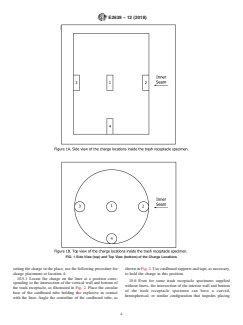
test and the testing laboratory (see Fig. 1):
ment of an explosive’s power and is used to compare an explosive’s
10.1.1 Center of the receptacle, halfway up the interior
effectiveness relative to TNT by mass (weight) only. Engineers can
substituteoneexplosiveforanotherwhenusingblastingequationsthatare without contact with the wall,
designed for TNT. For example, if a timber cutting charge requires 1 kg
10.1.2 In contact with the wall on the inner seam, halfway
of TNT to work, it would take 0.75 kg of C4 to have the same effect. For
up the interior,
further discussions on the potential and relative strength of explosives, see
10.1.3 In contact with the wall 180° opposite the inner
Fundamentals of Naval Weapons Systems, Chapter 12.
seam, halfway up the interior, and
7.1.1 Mass of Explosive Charge—Determinethemassofthe
10.1.4 In contact with the wall and bottom of the receptacle
explosive charge by agreement between the party commission-
90° from the inner seam.
ing the test and the testing laboratory.
10.2 In cases where there is no agreement for placing the
7.1.2 Fabricate the charge by packing C4 charge (or the
explosive charge, place the charge in contact with the wall on
agreed upon explosive) into a cylindrical cardboard tube. The
the inner seam, halfway up the interior, as described in 10.1.2.
height of the explosive packed in the cardboard tube shall be
within 1.0 to 1.5 times the diameter of the tube. For ease of
10.3 Incasewheretheinnerseamofthetrashreceptacletest
handling, use masking or duct tape to close the top and bottom
specimen is not visible, the testing laboratory shall ask the
openings of the packed cardboard tube.
receptacle manufacturer to indicate the inner seam location.
7.1.3 The density of the packed explosive charge shall be
10.4 For the locations described in 10.1.1, 10.1.2, and
uniform throughout the cardboard tube. For purposes of this
10.1.3, support the charge with a consumable, non-blast
standard test method, the charge is considered to be uniformly
absorbing support such as a cardboard cylinder.
packed in the cardboard tube if the explosive charge density is
3 3
10.5 For trash receptacle specimens supplied with liners, in
at least 1.4 g/cm (0.051 lb/in. ).
some cases, the intersection of the interior wall and bottom of
the trash receptacle specimen can have a curved,
hemispherical, or similar configuration that impedes placing
Fundamentals of Naval Weapons Systems, Chapter 12, Weapons and Systems
the explosive charge in location 4 (see Fig. 1) as described in
Engineering Department, United States Naval Academy, http://www.fas.org/man/
dod-101/navy/docs/fun/part12.htm. 10.1.4. In such cases, as shown by visual examination when
E2639 − 12 (2018)
FIG. 1 Side View (top) and Top View (bottom) of the Charge Locations
setting the charge in the place, use the following procedure for showninFig.2.Usecardboardsupportsandtape,asnecessary,
charge placement at location 4:
to hold the charge in this position.
10.5.1 Locate the charge on the liner at a position corre-
10.6 Even for some trash receptacle specimens supplied
sponding to the intersection of the vertical wall and bottom of
without liners, the intersection of the interior wall and bottom
the trash receptacle, as illustrated in Fig. 2. Place the circular
of the trash receptacle specimen can have a curved,
base of the cardboard tube holding the explosive in contact
hemispherical, or similar configuration that impedes placing
with the liner. Angle the centerline of the cardboard tube, as
E2639 − 12 (2018)
FIG. 2 Positioning of the Explosive Charge at the Intersection of the Wall and Base of the Trash Receptacle for those Specimens in
which this Location has a Curved, Hemispherical, or Similar Configuration (see 10.5 and 10.6).
the explosive charge in location 4 (see Fig. 1) as described in 11.1.1.4 A camera station on which is mounted normal-
10.1.4. In such cases, as shown by visual examination when speed and high-speed video cameras.
setting the charge in the place, use the following procedure for
11.1.1.5 Optional pressure sensors and an optional data
charge placement at location 4:
acquisition system used at the discretion of users of the
10.6.1 Locate the charge on the specimen interior at a
standard if the magnitude of overpressures generated during
position corresponding to the intersection of the vertical wall
the explosion are recorded (see Appendix X1).
andbottomofthetrashreceptacle,asillustratedinFig.2.Place
11.2 Test Platform—The test platform on which the trash
the circular base of the cardboard tube holding the explosive in
receptacle specimen is placed during testing shall be a steel
contact with the trash receptacle wall. Angle the centerline of
plate having a minimum thickness of 150 mm (6 in.) and a
the cardboard tube, as shown in Fig. 2. Use cardboard supports
minimum length and a minimum width of 1.2 by 1.2 m (4.0 by
and tape, as necessary, to hold the charge in this position.
4.0 ft), respectively. Place this steel plate in the center of the
test arena.
11. Test Arena
11.3 Witness Panels—Construct witness panels using 9.5
11.1 The test arena shall consist of a flat, open-air terrain
mm ( ⁄8 in.) exterior,Agrade veneer plywood sheets conform-
that is approximately circular and without obstructions. The
ing to the requirements of Voluntary Product Standard PS 1.
diameter of this terrain shall be a minimum of 76 m (250 ft).
Attach the sheets measuring 1.2 m (4 ft) wide by 2.4 m (8 ft)
11.1.1 Fig. 3 shows a schematic of the test arena. The key
high with nails or screws to nominal 2 by 4 wooden frames.
components of the test arena are:
Place 24 witness panels 9 m (30 ft) from the center of the test
11.1.1.1 The test platform, on which the trash receptacle is
platform as shown in Fig. 3. For those panels that are in close
placed during testing,
proximity to each other, separate adjacent panels by approxi-
11.1.1.2 Witness panels arranged around the trash recep-
mately 0.6 m (2 ft). With the A-face of the plywood sheets
tacle specimen to register any fragment damage from the
oriented toward the trash receptacle test specimen, secure the
explosion.
witness panels in a vertical position to the terrain using an
11.1.1.3 Silhouettes placed across the test arena for qualita-
adequate quantity of anchors or sand bags or both.
tive and visual purposes of assessing fragmentation damage
Silhouettes are only used for tests incorporating fragmentation 11.3.1 Number the witness panels consecutively for docu-
charges (see 7.2). mentation purposes (see Fig. 3).
E2639 − 12 (2018)
Ten silhouettes numbered as given below; distances are measured from the center of the test platform. Silhouettes are only used for tests incorporating
fragmentation charges.
- No. 1 is 0.6 m (2 ft) in line with panel no. 24.
- No. 2 is 1.2 m (4 ft) in line with panel no. 4.
- No. 3 is 1.8 m (6 ft) in line with panel no. 21.
- No. 4 is 2.4 m (8 ft) in line with panel no. 10.
- No. 5 is 3.0 m (10 ft) in line with panel no. 11.
- No. 6 is 3.6 m (12 ft) in line with panel no. 18.
- No. 7 is 4.2 m (14 ft) in line with panel no. 12.
- No. 8 is 4.8 m (16 ft) in line with panel no. 14.
- No. 9 is 5.4 m (18 ft) in line with panel no. 7.
- No. 1
...