

ASTM E2021-15(2023)
(Test Method)Standard Test Method for Hot-Surface Ignition Temperature of Dust Layers
General Information
- Abstract
SIGNIFICANCE AND USE
5.1 This test method is applicable to dusts and powders, and provides a procedure for performing laboratory tests to evaluate hot-surface ignition temperatures of dust layers.
5.2 The test data can be of value in determining safe operating conditions in industrial plants, mines, manufacturing processes, and locations of material usage and storage.
5.3 Due to variation of ignition temperature with layer thickness, the test data at one thickness may not be applicable to all industrial situations (see Appendix X1). Tests at various layer thicknesses may provide a means for extrapolation to thicker layers, as listed in the following for pulverized Pittsburgh bituminous coal dust (2). Mathematical modeling of layer ignition at various layer thicknesses is described in Ref. (3).
Layer Thickness, mm
Hot-Surface Ignition Temperature, °C
6.4
300
9.4
260
12.7
240
25.4
210
5.4 This hot plate test method allows for loss of heat from the top surface of the dust layer, and therefore generally gives a higher ignition temperature for a material than Test Method E771, which is a more adiabatic system.
5.5 This test method for dust layers generally will give a lower ignition temperature than Test Method E1491, which is for dust clouds. The layer ignition temperature is determined while monitoring for periods of minutes to hours, while the dust cloud is only exposed to the furnace for a period of seconds.
Note 1: Much of the literature data for layer ignition is actually from a basket in a heated furnace (4), known as the modified Godbert-Greenwald furnace test. Other data are from nonstandardized hot plates (5-9).
5.6 Additional information on the significance and use of this test method may be found in Ref. (10).
SCOPE
1.1 This test method covers a laboratory procedure to determine the hot-surface ignition temperature of dust layers, that is, measuring the minimum temperature at which a dust layer will self-heat. The test consists of a dust layer heated on a hot plate.2,3
1.2 Data obtained from this test method provide a relative measure of the hot-surface ignition temperature of a dust layer.
1.3 This test method should be used to measure and describe the properties of materials in response to heat and flame under controlled laboratory conditions and should not be used to describe or appraise the fire hazard or fire hazard risk of materials, products, or assemblies under actual fire conditions. However, results of this test method may be used as elements of a fire risk assessment that takes into account all of the factors that are pertinent to an assessment of the fire hazard risk of a particular end use product.
1.4 The values stated in SI units are to be regarded as standard. No other units of measurement are included in this standard.
1.5 This standard does not purport to address all of the safety concerns, if any, associated with its use. It is the responsibility of the user of this standard to establish appropriate safety, health, and environmental practices and determine the applicability of regulatory limitations prior to use. Specific precautionary statements are given in Section 8.
1.6 This international standard was developed in accordance with internationally recognized principles on standardization established in the Decision on Principles for the Development of International Standards, Guides and Recommendations issued by the World Trade Organization Technical Barriers to Trade (TBT) Committee.
- Status
- Published
- Publication Date
- 30-Apr-2023
- Technical Committee
- E27 - Hazard Potential of Chemicals
- Drafting Committee
- E27.04 - Flammability and Ignitability of Chemicals
Overview
ASTM E2021-15(2023): Standard Test Method for Hot-Surface Ignition Temperature of Dust Layers specifies a laboratory method to determine the minimum temperature at which a dust layer will self-ignite on a heated surface. Developed by ASTM International, this standard is widely used to assess the ignition properties of dusts and powders under controlled laboratory conditions. Determining hot-surface ignition temperature is crucial for industries handling combustible dusts, as it provides valuable data for safety evaluations, risk assessments, and process optimization to prevent fire incidents.
Key Topics
Test Methodology
The standard describes a test using a metal plate (hot plate) on which a specified dust layer is heated to pre-set temperatures. Ignition is identified by a significant temperature rise (at least 50°C above plate temperature) or visible signs of combustion.Applicability
ASTM E2021-15(2023) applies to a broad range of organic and inorganic dusts and powders, but should not be used with explosive or highly reactive materials.Impact of Layer Thickness
The ignition temperature of dust layers may vary significantly with layer thickness. The standard notes that results for one thickness may not represent all practical situations. Testing at multiple thicknesses or mathematical modeling is recommended for thorough risk evaluation.Comparison with Other Methods
- This hot plate test often produces higher ignition temperatures than more adiabatic test methods (e.g., ASTM E771).
- It typically results in lower ignition temperatures compared to dust cloud ignition methods (e.g., ASTM E1491).
Safety and Limitations
The method provides a relative measure of hot-surface ignition temperature for laboratory comparison, not a direct assessment of fire risk in real-world conditions. Users must apply suitable safety, health, and environmental practices during testing.
Applications
Industrial Safety
Data from ASTM E2021-15(2023) help determine safe operating temperatures and handling practices in facilities such as:- Chemical and pharmaceutical plants
- Mines and mineral processing sites
- Food and agricultural processing facilities
- Manufacturing operations where combustible dust is generated
Materials Storage and Handling
The test method informs decisions on storage environments and process equipment design to prevent unintended ignition of settled dust layers.Fire Risk Assessment
Although not a direct predictor of fire hazards in actual conditions, results provide an essential component in comprehensive fire risk assessments that evaluate all relevant factors for a given material or process.Regulatory Compliance
Following standard test methods such as ASTM E2021-15(2023) aids organizations in demonstrating compliance with international safety standards and regulations regarding the management of combustible dust hazards.
Related Standards
- ASTM E771: Test Method for Spontaneous Heating Tendency of Materials (withdrawn)
- ASTM E1491: Test Method for Minimum Autoignition Temperature of Dust Clouds
- ASTM E1445: Terminology Relating to Hazard Potential of Chemicals
- IEC 1241-2-1: Electrical Apparatus for Use in the Presence of Combustible Dust - Test Methods for Determining the Minimum Ignition Temperatures of Dusts
Summary
ASTM E2021-15(2023) plays a vital role in dust hazard management by providing a standardized laboratory method to evaluate the hot-surface ignition temperature of dust layers. This enables safer industrial operations, informed fire risk assessment, and support for regulatory compliance, making it an essential standard for industries dealing with combustible dusts.
Relations
- Effective Date
- 15-Nov-2023
- Refers
ASTM E1491-06(2019) - Standard Test Method for Minimum Autoignition Temperature of Dust Clouds - Effective Date
- 15-Feb-2019
- Effective Date
- 01-Feb-2015
- Refers
ASTM E1491-06(2012) - Standard Test Method for Minimum Autoignition Temperature of Dust Clouds - Effective Date
- 01-Dec-2012
- Effective Date
- 15-May-2008
- Effective Date
- 01-Oct-2006
- Effective Date
- 10-Jul-2003
- Effective Date
- 10-Jun-2002
- Refers
ASTM E1491-97(2002) - Standard Test Method for Minimum Autoignition Temperature of Dust Clouds - Effective Date
- 10-Sep-1997
- Effective Date
- 01-Jan-1996
Get Certified
Connect with accredited certification bodies for this standard

CIS Institut d.o.o.
Personal Protective Equipment (PPE) certification body. Notified Body NB-2890 for EU Regulation 2016/425 PPE.

Kiwa BDA Testing
Building and construction product certification.
Kmetijski inštitut Slovenije
Agricultural Institute of Slovenia. Soil testing, plant health, agricultural product analysis.
Sponsored listings
Frequently Asked Questions
ASTM E2021-15(2023) is a standard published by ASTM International. Its full title is "Standard Test Method for Hot-Surface Ignition Temperature of Dust Layers". This standard covers: SIGNIFICANCE AND USE 5.1 This test method is applicable to dusts and powders, and provides a procedure for performing laboratory tests to evaluate hot-surface ignition temperatures of dust layers. 5.2 The test data can be of value in determining safe operating conditions in industrial plants, mines, manufacturing processes, and locations of material usage and storage. 5.3 Due to variation of ignition temperature with layer thickness, the test data at one thickness may not be applicable to all industrial situations (see Appendix X1). Tests at various layer thicknesses may provide a means for extrapolation to thicker layers, as listed in the following for pulverized Pittsburgh bituminous coal dust (2). Mathematical modeling of layer ignition at various layer thicknesses is described in Ref. (3). Layer Thickness, mm Hot-Surface Ignition Temperature, °C 6.4 300 9.4 260 12.7 240 25.4 210 5.4 This hot plate test method allows for loss of heat from the top surface of the dust layer, and therefore generally gives a higher ignition temperature for a material than Test Method E771, which is a more adiabatic system. 5.5 This test method for dust layers generally will give a lower ignition temperature than Test Method E1491, which is for dust clouds. The layer ignition temperature is determined while monitoring for periods of minutes to hours, while the dust cloud is only exposed to the furnace for a period of seconds. Note 1: Much of the literature data for layer ignition is actually from a basket in a heated furnace (4), known as the modified Godbert-Greenwald furnace test. Other data are from nonstandardized hot plates (5-9). 5.6 Additional information on the significance and use of this test method may be found in Ref. (10). SCOPE 1.1 This test method covers a laboratory procedure to determine the hot-surface ignition temperature of dust layers, that is, measuring the minimum temperature at which a dust layer will self-heat. The test consists of a dust layer heated on a hot plate.2,3 1.2 Data obtained from this test method provide a relative measure of the hot-surface ignition temperature of a dust layer. 1.3 This test method should be used to measure and describe the properties of materials in response to heat and flame under controlled laboratory conditions and should not be used to describe or appraise the fire hazard or fire hazard risk of materials, products, or assemblies under actual fire conditions. However, results of this test method may be used as elements of a fire risk assessment that takes into account all of the factors that are pertinent to an assessment of the fire hazard risk of a particular end use product. 1.4 The values stated in SI units are to be regarded as standard. No other units of measurement are included in this standard. 1.5 This standard does not purport to address all of the safety concerns, if any, associated with its use. It is the responsibility of the user of this standard to establish appropriate safety, health, and environmental practices and determine the applicability of regulatory limitations prior to use. Specific precautionary statements are given in Section 8. 1.6 This international standard was developed in accordance with internationally recognized principles on standardization established in the Decision on Principles for the Development of International Standards, Guides and Recommendations issued by the World Trade Organization Technical Barriers to Trade (TBT) Committee.
SIGNIFICANCE AND USE 5.1 This test method is applicable to dusts and powders, and provides a procedure for performing laboratory tests to evaluate hot-surface ignition temperatures of dust layers. 5.2 The test data can be of value in determining safe operating conditions in industrial plants, mines, manufacturing processes, and locations of material usage and storage. 5.3 Due to variation of ignition temperature with layer thickness, the test data at one thickness may not be applicable to all industrial situations (see Appendix X1). Tests at various layer thicknesses may provide a means for extrapolation to thicker layers, as listed in the following for pulverized Pittsburgh bituminous coal dust (2). Mathematical modeling of layer ignition at various layer thicknesses is described in Ref. (3). Layer Thickness, mm Hot-Surface Ignition Temperature, °C 6.4 300 9.4 260 12.7 240 25.4 210 5.4 This hot plate test method allows for loss of heat from the top surface of the dust layer, and therefore generally gives a higher ignition temperature for a material than Test Method E771, which is a more adiabatic system. 5.5 This test method for dust layers generally will give a lower ignition temperature than Test Method E1491, which is for dust clouds. The layer ignition temperature is determined while monitoring for periods of minutes to hours, while the dust cloud is only exposed to the furnace for a period of seconds. Note 1: Much of the literature data for layer ignition is actually from a basket in a heated furnace (4), known as the modified Godbert-Greenwald furnace test. Other data are from nonstandardized hot plates (5-9). 5.6 Additional information on the significance and use of this test method may be found in Ref. (10). SCOPE 1.1 This test method covers a laboratory procedure to determine the hot-surface ignition temperature of dust layers, that is, measuring the minimum temperature at which a dust layer will self-heat. The test consists of a dust layer heated on a hot plate.2,3 1.2 Data obtained from this test method provide a relative measure of the hot-surface ignition temperature of a dust layer. 1.3 This test method should be used to measure and describe the properties of materials in response to heat and flame under controlled laboratory conditions and should not be used to describe or appraise the fire hazard or fire hazard risk of materials, products, or assemblies under actual fire conditions. However, results of this test method may be used as elements of a fire risk assessment that takes into account all of the factors that are pertinent to an assessment of the fire hazard risk of a particular end use product. 1.4 The values stated in SI units are to be regarded as standard. No other units of measurement are included in this standard. 1.5 This standard does not purport to address all of the safety concerns, if any, associated with its use. It is the responsibility of the user of this standard to establish appropriate safety, health, and environmental practices and determine the applicability of regulatory limitations prior to use. Specific precautionary statements are given in Section 8. 1.6 This international standard was developed in accordance with internationally recognized principles on standardization established in the Decision on Principles for the Development of International Standards, Guides and Recommendations issued by the World Trade Organization Technical Barriers to Trade (TBT) Committee.
ASTM E2021-15(2023) is classified under the following ICS (International Classification for Standards) categories: 13.230 - Explosion protection. The ICS classification helps identify the subject area and facilitates finding related standards.
ASTM E2021-15(2023) has the following relationships with other standards: It is inter standard links to ASTM E1445-08(2023), ASTM E1491-06(2019), ASTM E1445-08(2015), ASTM E1491-06(2012), ASTM E1445-08, ASTM E1491-06, ASTM E1445-03, ASTM E1445-02, ASTM E1491-97(2002), ASTM E771-90(1996). Understanding these relationships helps ensure you are using the most current and applicable version of the standard.
ASTM E2021-15(2023) is available in PDF format for immediate download after purchase. The document can be added to your cart and obtained through the secure checkout process. Digital delivery ensures instant access to the complete standard document.
Standards Content (Sample)
This international standard was developed in accordance with internationally recognized principles on standardization established in the Decision on Principles for the
Development of International Standards, Guides and Recommendations issued by the World Trade Organization Technical Barriers to Trade (TBT) Committee.
Designation: E2021 − 15 (Reapproved 2023)
Standard Test Method for
Hot-Surface Ignition Temperature of Dust Layers
This standard is issued under the fixed designation E2021; the number immediately following the designation indicates the year of
original adoption or, in the case of revision, the year of last revision. A number in parentheses indicates the year of last reapproval. A
superscript epsilon (´) indicates an editorial change since the last revision or reapproval.
1. Scope 2. Referenced Documents
1.1 This test method covers a laboratory procedure to 2.1 ASTM Standards:
determine the hot-surface ignition temperature of dust layers, E771 Test Method for Spontaneous Heating Tendency of
Materials (Withdrawn 2001)
that is, measuring the minimum temperature at which a dust
layer will self-heat. The test consists of a dust layer heated on E1445 Terminology Relating to Hazard Potential of Chemi-
2,3
cals
a hot plate.
E1491 Test Method for Minimum Autoignition Temperature
1.2 Data obtained from this test method provide a relative
of Dust Clouds
measure of the hot-surface ignition temperature of a dust layer.
2.2 IEC Standard:
1.3 This test method should be used to measure and describe
IEC 1241-2-1 Electrical Apparatus for Use in the Presence
the properties of materials in response to heat and flame under
of Combustible Dust; Part 2: Test Methods—Section 1:
controlled laboratory conditions and should not be used to
Methods for Determining the Minimum Ignition Tempera-
describe or appraise the fire hazard or fire hazard risk of
tures of Dusts, Method A
materials, products, or assemblies under actual fire conditions.
However, results of this test method may be used as elements
3. Terminology
of a fire risk assessment that takes into account all of the factors
3.1 Definitions—For definitions of other terms used in this
that are pertinent to an assessment of the fire hazard risk of a
standard, see Terminology E1445.
particular end use product.
3.2 Definitions of Terms Specific to This Standard:
1.4 The values stated in SI units are to be regarded as
3.2.1 hot-surface ignition temperature of a dust layer,
standard. No other units of measurement are included in this
n—lowest set temperature of the hot plate that causes ignition
standard.
of the dust layer.
1.5 This standard does not purport to address all of the
3.2.2 ignition of a dust layer, n—initiation of self-heating or
safety concerns, if any, associated with its use. It is the
combustion in a material under test.
responsibility of the user of this standard to establish appro-
priate safety, health, and environmental practices and deter- 3.2.3 ignition time, n—time between the start of heating and
the point at which the maximum temperature or flaming
mine the applicability of regulatory limitations prior to use.
Specific precautionary statements are given in Section 8. combustion is reached.
1.6 This international standard was developed in accor-
3.2.4 temperature rise, ΔT, n—the difference between T
max
dance with internationally recognized principles on standard-
and the initial set temperature of the hot plate.
ization established in the Decision on Principles for the
3.2.5 T , n—maximum temperature measured during test.
max
Development of International Standards, Guides and Recom-
mendations issued by the World Trade Organization Technical
4. Summary of Test Method
Barriers to Trade (TBT) Committee.
4.1 The test material is placed within a metal ring on top of
a hot plate, that is at a preset constant temperature.
This test method is under the jurisdiction of ASTM Committee E27 on Hazard
Potential of Chemicals and is the direct responsibility of Subcommittee E27.04 on
the Flammability and Ignitability of Chemicals. For referenced ASTM standards, visit the ASTM website, www.astm.org, or
Current edition approved May 1, 2023. Published May 2023. Originally contact ASTM Customer Service at service@astm.org. For Annual Book of ASTM
approved in 1999. Last previous edition approved in 2015 as E2021 – 15. DOI: Standards volume information, refer to the standard’s Document Summary page on
10.1520/E2021-15R23 the ASTM website.
2 5
This test method is based on recommendations of the National Materials The last approved version of this historical standard is referenced on
Advisory Board of the National Academy of Sciences (1). www.astm.org.
3 6
The boldface numbers in parentheses refer to the list of references at the end of Available from American National Standards Institute (ANSI), 25 W. 43rd St.,
this standard. 4th Floor, New York, NY 10036, http://www.ansi.org.
Copyright © ASTM International, 100 Barr Harbor Drive, PO Box C700, West Conshohocken, PA 19428-2959. United States
E2021 − 15 (2023)
NOTE 1—Much of the literature data for layer ignition is actually from
4.2 The sample temperature is monitored to determine
a basket in a heated furnace (4), known as the modified Godbert-
temperature rise due to oxidative reactions or decomposition
Greenwald furnace test. Other data are from nonstandardized hot plates
reactions, or both.
(5-9).
4.3 Ignition is considered to have taken place when either of
5.6 Additional information on the significance and use of
the following occurs:
this test method may be found in Ref. (10).
4.3.1 Temperature in the dust layer at position of thermo-
couple rises at least 50 °C above the hot plate temperature, or
6. Limitations and Interferences
4.3.2 Visible evidence of combustion is apparent, such as
6.1 This test method should not be used with materials
red glow or flame.
having explosive or highly reactive properties.
4.4 Hot plate surface temperature is varied from test to test,
6.2 If the metal (for example, aluminum) plate or ring reacts
as necessary, until the hot-surface ignition temperature is
with the test material, choose another type of metal that does
determined.
not react.
5. Significance and Use
7. Apparatus
5.1 This test method is applicable to dusts and powders, and
provides a procedure for performing laboratory tests to evalu-
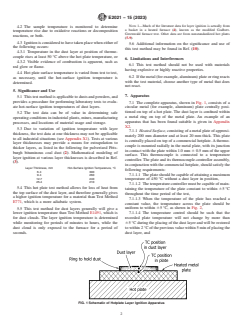
7.1 The complete apparatus, shown in Fig. 1, consists of a
ate hot-surface ignition temperatures of dust layers.
circular metal (for example, aluminum) plate centrally posi-
tioned on top of a hot plate. The dust layer is confined within
5.2 The test data can be of value in determining safe
a metal ring on top of the metal plate. An example of an
operating conditions in industrial plants, mines, manufacturing
apparatus that has been found suitable is given in Appendix
processes, and locations of material usage and storage.
X2.
5.3 Due to variation of ignition temperature with layer
7.1.1 Heated Surface, consisting of a metal plate of approxi-
thickness, the test data at one thickness may not be applicable
mately 200 mm diameter and at least 20 mm thick. This plate
to all industrial situations (see Appendix X1). Tests at various
is centrally placed on top of a commercial hotplate. A thermo-
layer thicknesses may provide a means for extrapolation to
couple is mounted radially in the metal plate, with its junction
thicker layers, as listed in the following for pulverized Pitts-
in contact with the plate within 1.0 mm 6 0.5 mm of the upper
burgh bituminous coal dust (2). Mathematical modeling of
surface. This thermocouple is connected to a temperature
layer ignition at various layer thicknesses is described in Ref.
controller. The plate and its thermocouple-controller assembly,
(3).
in conjunction with the commercial hotplate, should satisfy the
Layer Thickness, mm Hot-Surface Ignition Temperature, °C
following requirements:
6.4 300
7.1.1.1 The plate should be capable of attaining a maximum
9.4 260
12.7 240
temperature of 450 °C without a dust layer in position,
25.4 210
7.1.1.2 The temperature controller must be capable of main-
5.4 This hot plate test method allows for loss of heat from
taining the temperature of the plate constant to within 65 °C
the top surface of the dust layer, and therefore generally gives
throughout the time period of the test,
a higher ignition temperature for a material than Test Method
7.1.1.3 When the temperature of the plate has reached a
E771, which is a more adiabatic system.
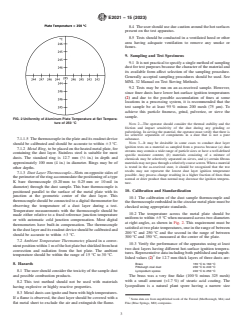
constant value, the temperature across the plate should be
uniform to within 65 °C, as shown in Fig. 2,
5.5 This test method for dust layers generally will give a
lower ignition temperature than Test Method E1491, which is 7.1.1.4 The temperature control should be such that the
for dust clouds. The layer ignition temperature is determined recorded plate temperature will not change by more than
while monitoring for periods of minutes to hours, while the 65 °C during the placing of the dust layer and will be restored
dust cloud is only exposed to the furnace for a period of to within 2 °C of the previous value within 5 min of placing the
seconds. dust layer, and
FIG. 1 Schematic of Hotplate Layer Ignition Apparatus
E2021 − 15 (2023)
8.4 The user should use due caution around the hot surfaces
present on the test apparatus.
8.5 Tests should be conducted in a ventilated hood or other
area having adequate ventilation to remove any smoke or
fumes.
9. Sampling and Test Specimens
9.1 It is not practical to specify a single method of sampling
dust for test purposes because the character of the material and
its available form affect selection of the sampling procedure.
Generally accepted sampling procedures should be used. See
MNL 32 Manual on Test Sieving Methods.
9.2 Tests may be run on an as-received sample. However,
since finer dusts have lower hot-surface ignition temperatures
(2) and due to the possible accumulation of fines at some
locations in a processing system, it is recommended that the
test sample be at least 95 % minus 200 mesh (75 μm). To
achieve this particle fineness, grind, pulverize, or sieve the
sample.
FIG. 2 Uniformity of Aluminum Plate Temperature at Set Tempera-
ture of 250 °C
NOTE 2—The operator should consider the thermal stability and the
friction and impact sensitivity of the dust during any grinding or
pulverizing. In sieving the material, the operator must verify that there is
no selective separation of components in a dust that is not a pure
7.1.1.5 The thermocouple in the plate and its readout device substance.
NOTE 3—It may be desirable in some cases to conduct dust layer
should be calibrated and should be accurate to within 63 °C.
ignition tests on a material as sampled from a process because (a) dust
7.1.2 Metal Ring, to be placed on the heated metal plate, for
streams may contain a wide range of particle sizes or have a well-defined
containing the dust layer. Stainless steel is suitable for most
specific moisture content, (b) materials consisting of a mixture of
dusts. The standard ring is 12.7 mm ( ⁄2 in.) in depth and
chemicals may be selectively separated on sieves, and (c) certain fibrous
approximately 100 mm (4 in.) in diameter. Rings may be of materials may not pass through a relatively coarse screen. When a material
is tested in the as-received state, it should be recognized that the test
other depths.
results may not represent the lowest dust layer ignition temperature
7.1.3 Dust Layer Thermocouple—Slots on opposite sides of
possible. Any process change resulting in a higher fraction of fines than
the perimeter of the ring accommodate the positioning of a type
normal or drier product than normal may decrease the ignition tempera-
K bare thermocouple (0.20 mm to 0.25 mm or 10 mil in
ture.
diameter) through the dust sample. This bare thermocouple is
10. Calibration and Standardization
positioned parallel to the surface of the metal plate with its
junction at the geometric center of the dust layer. This
10.1 The calibration of the dust sample thermocouple and
thermocouple should be connected to a digital thermometer for
the thermocouple embedded in the circular metal plate must be
observing the temperature of a dust layer during a test.
checked using appropriate standards.
Temperature measurements with the thermocouple should be
10.2 The temperature across the metal plate should be
made either relative to a fixed reference junction temperature
uniform to within 65 °C when measured across two diameters
or with automatic cold junction compensation. Most digital
at right angles, as shown in Fig. 2. This requirement must be
thermometers have built-in compensation. The thermocouple
satisfied at two plate temperatures, one in the range of between
in the dust layer and its readout device should be calibrated and
200 °C and 250 °C and the second in the range of between
should be accurate to within 63 °C.
300 °C and 350 °C, measured at the center of the plate.
7.2 Ambient Temperature Thermometer, placed in a conve-
10.3 Verify the performance of the apparatus using at least
nient position within 1 m of the hot plate but shielded from heat
two dust layers having different hot-surface ignition tempera-
convection and radiation from the hot plate. The ambient
tures. Representative data including both published and unpub-
temperature should be within the range of 15 °C to 30 °C.
lished values (2) for 12.7 mm thick layers of three dusts are:
Brass 155 °C to 160 °C
8. Hazards
Pittsburgh coal dust 230 °C to 240 °C
8.1 The user should consider the toxicity of the sample dust Lycopodium spores 240 °C to 250 °C
and possible combustion products.
The brass was a very fine flake (100 % minus 325 mesh)
with a small amount (<1.7 %) of stearic acid coating. The
8.2 This test method should not be used with materials
lycopodium is a natural plant spore having a narrow size
having explosive or highly reactive properties.
8.3 Metal dusts can ignite and burn with high temperatures.
If a flame is observed, the dust layer should be covered with a
Some data are from unpublished work of the Fenwal (Marlborough, MA) and
flat metal sheet to exclude the air and extinguish the flame. Fike (Blue Springs, MO) companies.
E2021 − 15 (2023)
distribution with 100 % minus 200 mesh and mass median 11.2.3 Continuously monitor the temperatures of the hot
diameter of ;28 μm. This is the reticulate form Lycopodium plate and of the dust layer as a function of time to the end of
clavatum. The Pittsburgh seam bituminous coal has ;80 %
the test. A typical test period is two hours. Continue the test if
minus 200 mesh, a mass median diameter of ;45 μm, and any self-heating is evident. Self-heating may be indicated by
36 % volatility. Additional data that can be used for calibration
localized heavy smoke, or increasing temperature. Terminate
are those listed in 5.3 for different layer thicknesses of this coal
the test if the layer has completely melted, ignited, or reached
dust.
a maximum temperature without igniting and is cooling down.
NOTE 5—Ignition in particulate or fine dusts exposed to elevated
11. Procedure
temperatures generally is preceded by a more or less protracted period of
11.1 General Set-Up—Set up the apparatus in a position free
self-heating, usually due to atmospheric oxidation. Depending on the
from drafts while exhausting smoke and fumes. Ensure that the
temperature of exposure, self-heating may result in no more than a
transient, although sometimes substantial, rise in temperature within the
air flow in the hood is sufficient for removing smoke and
material that does not lead to the propagation of combustion. It is
fumes, but low enough so as not to disturb the layer or affect
necessary to be certain that failure to ignite at a given temperature is not
the test results. This can be achieved by adjusting the baffles in
merely a result of premature termination of a test. Thus, the temperatures
the back of the hood. If desired, an angled mirror can be
at which ignition fails to occur must be confirmed by continuing a test
provided above the test sample for visual observation.
long enough to establish that any such transient self-heating is definitely
decreasing in rate, and the temperature inside the layer is decreasing to a
11.2 Procedure for Individual Test:
steady value comparable to or lower than the temperature of
...