

ASTM D6082-23
(Test Method)Standard Test Method for High Temperature Foaming Characteristics of Lubricating Oils
General Information
- Abstract
SIGNIFICANCE AND USE
5.1 The tendency of oils to foam at high temperature can be a serious problem in systems such as high-speed gearing, high volume pumping, and splash lubrication. Foaming can cause inadequate lubrication, cavitation, and loss of lubricant due to overflow, and these events can lead to mechanical failure.
5.2 Correlation between the amount of foam created or the time for foam to collapse, or both, and actual lubrication failure has not been established. Such relations should be empirically determined for foam sensitive applications.
SCOPE
1.1 This test method covers the procedure for determining the foaming characteristics of lubricating oils (specifically transmission fluid and motor oil) at 150 °C.
1.2 Foaming characteristics of lubricating oils at temperatures up to 93.5 °C are determined by Test Method D892 or IP 146.
1.3 The values stated in SI units are to be regarded as standard.
1.3.1 Exception—The values given in parentheses are provided for information only.
1.4 WARNING—Mercury has been designated by many regulatory agencies as a hazardous substance that can cause serious medical issues. Mercury, or its vapor, has been demonstrated to be hazardous to health and corrosive to materials. Use caution when handling mercury and mercury-containing products. See the applicable product Safety Data Sheet (SDS) for additional information. The potential exists that selling mercury or mercury-containing products, or both, is prohibited by local or national law. Users must determine legality of sales in their location.
1.5 This standard does not purport to address all of the safety concerns, if any, associated with its use. It is the responsibility of the user of this standard to establish appropriate safety, health, and environmental practices and determine the applicability of regulatory limitations prior to use.
1.6 This international standard was developed in accordance with internationally recognized principles on standardization established in the Decision on Principles for the Development of International Standards, Guides and Recommendations issued by the World Trade Organization Technical Barriers to Trade (TBT) Committee.
- Status
- Published
- Publication Date
- 30-Jun-2023
- Technical Committee
- D02 - Petroleum Products, Liquid Fuels, and Lubricants
- Drafting Committee
- D02.06 - Analysis of Liquid Fuels and Lubricants
Buy Documents
ASTM D6082-23 - Standard Test Method for High Temperature Foaming Characteristics of Lubricating Oils
REDLINE ASTM D6082-23 - Standard Test Method for High Temperature Foaming Characteristics of Lubricating Oils
Overview
ASTM D6082-23: Standard Test Method for High Temperature Foaming Characteristics of Lubricating Oils establishes a procedure for determining how lubricating oils - notably transmission fluids and motor oils - behave under high temperature foaming conditions. Specifically, this test assesses foaming tendencies at 150°C, which is critical for evaluating oil performance in high-stress environments where excessive foam can result in hardware failure.
Foaming in lubricating oils can cause serious operational issues such as:
- Inadequate lubrication
- Cavitation
- Oil overflow and loss of lubricant
Such failures are of particular concern in systems with high-speed gears, high-volume pumps, and splash lubrication. The method outlined in ASTM D6082-23 provides a standardized approach for labs and manufacturers to compare oils and monitor their foaming tendencies under defined conditions.
Key Topics
- Test Method Scope: Measures the foaming properties of lubricating oils at 150°C, with static and kinetic foam volumes, foam stability, collapse time, and total volume increase as key indicators.
- Terminology: Defines industry terms such as “static foam”, “kinetic foam”, “foam stability”, and “collapse time” relevant to lubricant and petroleum testing.
- Apparatus Requirements: Specifies use of graduated cylinders, diffusers, air flow meters, and temperature control equipment to maintain precise testing conditions.
- Preparation and Safety: Emphasizes thorough cleaning of test apparatus and strict adherence to safety protocols, especially considering the use of hazardous materials (like mercury thermometers and flammable solvents).
- Procedure: Details sample handling, preparation (including optional blending), test execution, and measurement steps to ensure repeatable, comparable results.
- Results and Reporting: Stipulates how to calculate, interpret, and report the results, including total volume increase and percent volume increase.
- Precision and Reproducibility: Provides statistical boundaries for measurement repeatability and reproducibility, facilitating reliable interlaboratory comparisons.
Applications
ASTM D6082-23 is essential in numerous fields including:
- Automotive and Industrial Lubricant Testing: Lubricant formulators and engine manufacturers use this standard to qualify oils for high-stress applications such as automotive transmissions, industrial gearboxes, and turbine lubrication systems.
- Research & Development: R&D labs employ this method when developing new or improved lubricant formulations, especially where high-temperature operation is a concern.
- Quality Assurance: Oil producers and distributors rely on standardized foaming tests to ensure consistent product performance, minimizing operational risk for end-users.
- Regulatory Compliance: Laboratories and manufacturers use this standard to demonstrate compliance with industry and customer requirements for lubricant performance under high-temperature conditions.
Related Standards
Users of ASTM D6082-23 may also reference:
- ASTM D892: Standard Test Method for Foaming Characteristics of Lubricating Oils (for temperatures up to 93.5°C)
- IP 146: Energy Institute’s Standard for testing foaming characteristics of lubricating oils
- ASTM D4175: Terminology relating to petroleum products, fuels, and lubricants-key for understanding definitions used throughout ASTM D6082-23
- ASTM E128: For maximum pore diameter and permeability of laboratory filters
Practical Value
Implementing ASTM D6082-23 improves reliability in product development, quality control, and equipment operation where oil foaming at high temperatures poses a significant risk. By following this internationally recognized method, organizations gain:
- Consistency: Achieve reliable, standardized results across different operators and laboratories.
- Risk Reduction: Identify oils prone to excessive foaming before operational deployment, reducing potential for equipment failure.
- Decision Support: Supply critical data for lubricant selection and formulation, ensuring optimal performance in demanding high-temperature environments.
Keywords: ASTM D6082-23, high temperature foaming, lubricating oils, foam stability, oil testing standard, transmission fluid, motor oil, lubricant quality, petroleum standards, laboratory oil test.
Relations
- Refers
ASTM D4175-23a - Standard Terminology Relating to Petroleum Products, Liquid Fuels, and Lubricants - Effective Date
- 15-Dec-2023
- Effective Date
- 01-Oct-2023
- Refers
ASTM D4175-23e1 - Standard Terminology Relating to Petroleum Products, Liquid Fuels, and Lubricants - Effective Date
- 01-Jul-2023
- Effective Date
- 01-Nov-2019
- Effective Date
- 01-Jan-2019
- Effective Date
- 01-Nov-2012
- Effective Date
- 01-Oct-2011
- Effective Date
- 01-Oct-2011
- Effective Date
- 01-Jan-2011
- Effective Date
- 01-Oct-2010
- Effective Date
- 01-Nov-2007
- Effective Date
- 01-Aug-2006
- Effective Date
- 01-Dec-2005
- Effective Date
- 01-May-2005
- Effective Date
- 10-May-2003
Buy Documents
ASTM D6082-23 - Standard Test Method for High Temperature Foaming Characteristics of Lubricating Oils
REDLINE ASTM D6082-23 - Standard Test Method for High Temperature Foaming Characteristics of Lubricating Oils
Get Certified
Connect with accredited certification bodies for this standard

Element Materials Technology
Materials testing and product certification.

ABS Group Brazil
ABS Group certification services in Brazil.

ABS Quality Evaluations Inc.
American Bureau of Shipping quality certification.
Sponsored listings
Frequently Asked Questions
ASTM D6082-23 is a standard published by ASTM International. Its full title is "Standard Test Method for High Temperature Foaming Characteristics of Lubricating Oils". This standard covers: SIGNIFICANCE AND USE 5.1 The tendency of oils to foam at high temperature can be a serious problem in systems such as high-speed gearing, high volume pumping, and splash lubrication. Foaming can cause inadequate lubrication, cavitation, and loss of lubricant due to overflow, and these events can lead to mechanical failure. 5.2 Correlation between the amount of foam created or the time for foam to collapse, or both, and actual lubrication failure has not been established. Such relations should be empirically determined for foam sensitive applications. SCOPE 1.1 This test method covers the procedure for determining the foaming characteristics of lubricating oils (specifically transmission fluid and motor oil) at 150 °C. 1.2 Foaming characteristics of lubricating oils at temperatures up to 93.5 °C are determined by Test Method D892 or IP 146. 1.3 The values stated in SI units are to be regarded as standard. 1.3.1 Exception—The values given in parentheses are provided for information only. 1.4 WARNING—Mercury has been designated by many regulatory agencies as a hazardous substance that can cause serious medical issues. Mercury, or its vapor, has been demonstrated to be hazardous to health and corrosive to materials. Use caution when handling mercury and mercury-containing products. See the applicable product Safety Data Sheet (SDS) for additional information. The potential exists that selling mercury or mercury-containing products, or both, is prohibited by local or national law. Users must determine legality of sales in their location. 1.5 This standard does not purport to address all of the safety concerns, if any, associated with its use. It is the responsibility of the user of this standard to establish appropriate safety, health, and environmental practices and determine the applicability of regulatory limitations prior to use. 1.6 This international standard was developed in accordance with internationally recognized principles on standardization established in the Decision on Principles for the Development of International Standards, Guides and Recommendations issued by the World Trade Organization Technical Barriers to Trade (TBT) Committee.
SIGNIFICANCE AND USE 5.1 The tendency of oils to foam at high temperature can be a serious problem in systems such as high-speed gearing, high volume pumping, and splash lubrication. Foaming can cause inadequate lubrication, cavitation, and loss of lubricant due to overflow, and these events can lead to mechanical failure. 5.2 Correlation between the amount of foam created or the time for foam to collapse, or both, and actual lubrication failure has not been established. Such relations should be empirically determined for foam sensitive applications. SCOPE 1.1 This test method covers the procedure for determining the foaming characteristics of lubricating oils (specifically transmission fluid and motor oil) at 150 °C. 1.2 Foaming characteristics of lubricating oils at temperatures up to 93.5 °C are determined by Test Method D892 or IP 146. 1.3 The values stated in SI units are to be regarded as standard. 1.3.1 Exception—The values given in parentheses are provided for information only. 1.4 WARNING—Mercury has been designated by many regulatory agencies as a hazardous substance that can cause serious medical issues. Mercury, or its vapor, has been demonstrated to be hazardous to health and corrosive to materials. Use caution when handling mercury and mercury-containing products. See the applicable product Safety Data Sheet (SDS) for additional information. The potential exists that selling mercury or mercury-containing products, or both, is prohibited by local or national law. Users must determine legality of sales in their location. 1.5 This standard does not purport to address all of the safety concerns, if any, associated with its use. It is the responsibility of the user of this standard to establish appropriate safety, health, and environmental practices and determine the applicability of regulatory limitations prior to use. 1.6 This international standard was developed in accordance with internationally recognized principles on standardization established in the Decision on Principles for the Development of International Standards, Guides and Recommendations issued by the World Trade Organization Technical Barriers to Trade (TBT) Committee.
ASTM D6082-23 is classified under the following ICS (International Classification for Standards) categories: 75.100 - Lubricants, industrial oils and related products. The ICS classification helps identify the subject area and facilitates finding related standards.
ASTM D6082-23 has the following relationships with other standards: It is inter standard links to ASTM D4175-23a, ASTM D892-23, ASTM D4175-23e1, ASTM E128-99(2019), ASTM E1272-02(2019), ASTM E1272-02(2012), ASTM D892-11a, ASTM E128-99(2011), ASTM D892-11, ASTM D892-10, ASTM E1272-02(2007), ASTM D892-06e1, ASTM D892-05, ASTM E128-99(2005), ASTM D892-03. Understanding these relationships helps ensure you are using the most current and applicable version of the standard.
ASTM D6082-23 is available in PDF format for immediate download after purchase. The document can be added to your cart and obtained through the secure checkout process. Digital delivery ensures instant access to the complete standard document.
Standards Content (Sample)
This international standard was developed in accordance with internationally recognized principles on standardization established in the Decision on Principles for the
Development of International Standards, Guides and Recommendations issued by the World Trade Organization Technical Barriers to Trade (TBT) Committee.
Designation: D6082 − 23
Standard Test Method for
High Temperature Foaming Characteristics of Lubricating
Oils
This standard is issued under the fixed designation D6082; the number immediately following the designation indicates the year of
original adoption or, in the case of revision, the year of last revision. A number in parentheses indicates the year of last reapproval. A
superscript epsilon (´) indicates an editorial change since the last revision or reapproval.
1. Scope* 2. Referenced Documents
2.1 ASTM Standards:
1.1 This test method covers the procedure for determining
D892 Test Method for Foaming Characteristics of Lubricat-
the foaming characteristics of lubricating oils (specifically
ing Oils
transmission fluid and motor oil) at 150 °C.
D4175 Terminology Relating to Petroleum Products, Liquid
1.2 Foaming characteristics of lubricating oils at tempera-
Fuels, and Lubricants
tures up to 93.5 °C are determined by Test Method D892 or IP
E128 Test Method for Maximum Pore Diameter and Perme-
146.
ability of Rigid Porous Filters for Laboratory Use
E1272 Specification for Laboratory Glass Graduated Cylin-
1.3 The values stated in SI units are to be regarded as
ders
standard.
2.2 Energy Institute Standards:
1.3.1 Exception—The values given in parentheses are pro-
IP 146 Standard Method of Test for Foaming Characteristics
vided for information only.
of Lubricating Oils
1.4 WARNING—Mercury has been designated by many
3. Terminology
regulatory agencies as a hazardous substance that can cause
serious medical issues. Mercury, or its vapor, has been dem-
3.1 Definitions:
onstrated to be hazardous to health and corrosive to materials. 3.1.1 For definitions of terms used in this test method, refer
Use caution when handling mercury and mercury-containing
to Terminology D4175.
products. See the applicable product Safety Data Sheet (SDS) 3.1.2 diffuser, n—for gas, a device for dispersing gas into a
for additional information. The potential exists that selling liquid (Test Method D892).
3.1.2.1 Discussion—Although diffusers can be made of
mercury or mercury-containing products, or both, is prohibited
either metallic or non-metallic materials, in this test method the
by local or national law. Users must determine legality of sales
diffuser is sintered stainless steel.
in their location.
3.1.3 entrained air (or gas), n—in liquids, a two-phase
1.5 This standard does not purport to address all of the
mixture of air (or gas) dispersed in a liquid in which the liquid
safety concerns, if any, associated with its use. It is the
is the major component on a volumetric basis.
responsibility of the user of this standard to establish appro-
3.1.3.1 Discussion—The air (or gas) is in the form of
priate safety, health, and environmental practices and deter-
discrete bubbles of about 10 μm to 1000 μm in diameter. The
mine the applicability of regulatory limitations prior to use.
bubbles are not uniformly dispersed. In time, they rise to the
1.6 This international standard was developed in accor-
surface to coalesce to form larger bubbles which break or form
dance with internationally recognized principles on standard-
foam. Subsurface coalescence can also occur, in which case,
ization established in the Decision on Principles for the
the bubbles will rise more rapidly.
Development of International Standards, Guides and Recom-
3.1.4 foam, n—in liquids, a collection of bubbles formed in
mendations issued by the World Trade Organization Technical
or on the surface of a liquid in which the air or gas is the major
Barriers to Trade (TBT) Committee.
component on a volumetric basis.
1 2
This test method is under the jurisdiction of ASTM Committee D02 on For referenced ASTM standards, visit the ASTM website, www.astm.org, or
Petroleum Products, Liquid Fuels, and Lubricants and is the direct responsibility of contact ASTM Customer Service at service@astm.org. For Annual Book of ASTM
Subcommittee D02.06 on Analysis of Liquid Fuels and Lubricants. Standards volume information, refer to the standard’s Document Summary page on
Current edition approved July 1, 2023. Published July 2023. Originally approved the ASTM website.
in 1997. Last previous edition approved in 2022 as D6082 – 22. DOI: 10.1520/ Available from Energy Institute, 61 New Cavendish St., London, WIG 7AR,
D6082-23. U.K., http://www.energyinst.org.uk.
*A Summary of Changes section appears at the end of this standard
Copyright © ASTM International, 100 Barr Harbor Drive, PO Box C700, West Conshohocken, PA 19428-2959. United States
D6082 − 23
FIG. 1 Terminology Diagram
3.1.5 gas, n—a fluid (such as air) that has neither indepen- 3.2.4 foam stability, n—in foam testing, the amount of static
dent shape nor volume but tends to expand indefinitely.
foam remaining at specified times following the disconnecting
of the air supply.
3.1.6 lubricant, n—any material interposed between two
surfaces that reduces friction or wear between them.
3.2.4.1 five-second foam stability, n—the amount of static
3.1.6.1 Discussion—In this test method, the lubricant is an
foam present 5 s after disconnecting the air supply.
oil which may or may not contain additives such as foam
3.2.4.2 fifteen-second foam stability, n—the amount of static
inhibitors.
foam present 15 s after disconnecting the air supply.
3.1.7 maximum pore diameter, n—in gas diffusion, the
3.2.4.3 one-minute foam stability, n—the amount of static
diameter of a capillary of circular cross-section which is
equivalent (with respect to surface tension effects) to the foam present 1 min after disconnecting the air supply.
largest pore of the diffuser under consideration. The pore
3.2.4.4 five-minute foam stability, n—the amount of static
dimension is expressed in micrometers (μm).
foam present 5 min after disconnecting the air supply.
3.1.8 permeability, n—in gas diffusion, the rate of a sub-
3.2.4.5 ten-minute foam stability, n—the amount of static
stance that passes through a material (diffuser) under given
foam present 10 min after disconnecting the air supply.
conditions.
3.2.5 foaming tendency, n—in foam testing, the amount of
3.2 Definitions of Terms Specific to This Standard:
static foam immediately before the cessation of air flow.
3.2.1 bottom volume, n—the volume of liquid sample, that
is, sample substantially free of air, at any given time during the
3.2.6 kinetic foam, n—entrained air that has been created by
test.
the passage of air through the diffuser during the test (see Fig.
3.2.2 collapse time, n—in foam testing, the time in seconds, 1).
for zero foam to appear after the air is disconnected at the end
3.2.6.1 Discussion—Because the process of passing air
of the five minute air blowing time.
through the diffuser and the oil sample during the test has
3.2.3 dynamic bubble, n—the first bubble to pass through resulted in an increase in volume and because such entrained
and escape from the diffuser followed by a continuous succes- air can be considered as foam on its way to being made, the
sion of bubbles when testing for the pore diameter in Annex
term kinetic foam has been introduced.
A1.
3.2.7 percent volume increase, n—in foam testing, the in-
3.2.3.1 Discussion—When a diffuser is immersed in a liquid
crease in total volume expressed as a percentage of the initial
such as propan-2-ol, air can be trapped in the pores. It can
total volume with diffuser in place at test temperature.
escape eventually or as soon as a pressure is applied to the
3.2.8 static foam, n—foam that has been created by the
diffuser. When testing for pore diameter (Annex A1), the
escape of such bubbles is to be ignored. passage of air through the diffuser during the test (see Fig. 1).
D6082 − 23
FIG. 2 Typical Liquid Bath
3.2.9 top volume, n—the volume of the foam (if any), liquid, time for the foam to collapse are measured and the percent
diffuser, and the submersed portion of the delivery tube (see increase in total volume calculated.
Fig. 1).
5. Significance and Use
3.2.10 total volume, n—in foam testing, the volume of foam,
5.1 The tendency of oils to foam at high temperature can be
liquid, diffuser, and submersed portion of delivery tube (see
a serious problem in systems such as high-speed gearing, high
Fig. 1).
volume pumping, and splash lubrication. Foaming can cause
3.2.10.1 initial total volume (V ), n—in foam testing, the
inadequate lubrication, cavitation, and loss of lubricant due to
volume of the foam, liquid, diffuser, and submersed portion of
overflow, and these events can lead to mechanical failure.
the delivery tube at test temperature prior to connecting the air
5.2 Correlation between the amount of foam created or the
supply.
time for foam to collapse, or both, and actual lubrication failure
3.2.10.2 final total volume (V ), n—in foam testing, the
has not been established. Such relations should be empirically
volume of the foam, liquid, diffuser, and submersed portion of
determined for foam sensitive applications.
the delivery tube just before disconnecting the air supply.
3.2.11 zero foam, n—in foam testing, occurs when any
6. Apparatus
portion of the top surface of the liquid is free of bubbles.
6.1 Heating Bath, any heating system capable of maintain-
ing a sample temperature of 150 °C 6 1 °C (see Fig. 2).
4. Summary of Test Method
NOTE 1—The precision of this test method was determined using only
4.1 A measured quantity of sample is heated to 49 °C for
liquid baths.
30 min and allowed to cool to room temperature. The sample is
6.1.1 Heating Transfer Fluid, any liquid with low volatility,
transferred to a 1000 mL graduated cylinder, heated to 150 °C,
at the test temperature, chemical stability and sufficient low
and aerated at 200 mL ⁄min with dry air for 5 min with a metal
viscosity to permit stirring.
diffuser. The amount of foam generated before disconnecting
2 2
the air, the amount of static foam at optional times after
NOTE 2—A 4 mm /s to 7 mm /s (cSt) polyalphaolefin has been found to
disconnecting the air (list of options in Section 10); and the be a suitable fluid. Silicone fluids are foam inhibitors and their use may
D6082 − 23
FIG. 3 Gas Diffuser and Air Tube Dimensions
alter the foam characteristics of the test sample and should be discouraged.
cient capacity to measure a flow rate of at least 6000 mL ⁄min,
NOTE 3—A slow purge of nitrogen gas through the fluid, or as a blanket
while generating a back pressure of no more than 10 mm of
over the bath fluid, reduces darkening (oxidation) of the bath fluid.
water, is required.
6.2 Foaming Test Apparatus, 1000 mL graduated cylinder
6.4 Laboratory Oven, without fan, capable of maintaining
(of cylinders meeting Specification E1272 Class B tolerance
49 °C 6 1 °C.
requirement of 66 mL and having at least graduations of
10 mL), fitted with a device to overcome buoyancy if a liquid
6.5 Stirrer, capable of 500 r ⁄min 6 100 r ⁄min, fitted with a
bath is used and modified to have a circular top. It shall be
3.81 cm, 3-blade, 1.5-pitch marine propeller.
capable of withstanding the extreme temperature conditions of
6.6 Stainless Steel Diffuser, 5 μm stainless steel diffuser
this test method.
meeting the specifications of pore size 15 μm to 60 μm and
NOTE 4—It may be necessary to confirm the volume of the cylinder.
permeability between 3000 mL ⁄min to 6000 mL ⁄min when
NOTE 5—A heavy metal ring large enough to fit over the outside and
tested according to the method given in Annex A1 (see Fig. 3).
rest on the bottom of the cylinder has been found to be suitable to
6.6.1 Calibration verification of new diffusers and calibra-
overcome buoyancy.
NOTE 6—Graduated cylinders having a pouring spout can be prepared
tion after each set (10 samples or less) of evaluations is
for this test method by making a horizontal cut below the spout and
required.
removing the part above the cut. The cut edges of the cylinder should be
fire-polished or smoothed by grinding.
6.7 Thermometer, or other temperature sensing device ca-
pable of measuring 150 °C 6 0.2 °C.
6.3 Flow Meter and Regulator, calibrated and capable of
maintaining air flow volume of 200 mL ⁄min 6 5 mL ⁄min. 6.7.1 Digital thermometers with a minimum accuracy of
6.3.1 A gas volume meter graduated in hundredths of a litre, 0.1 % of reading 0.5 °C (1 °F) with 0.1° resolution throughout
or a technically equivalent flow measuring device, with suffi- range, and J, K, and T type thermocouples probe style
D6082 − 23
compatible have been found suitable for operation with either 9. Preparation of Apparatus
liquid or air foam baths.
9.1 Thorough cleansing of the test cylinder, gas diffuser, and
6.7.2 A low noise iron-constantan J type thermocouple
air-inlet tube is essential after each use to remove any additive
probe 457 mm (18 in.) in length, constructed of a 304 s/s
remaining from previous tests which can seriously interfere
sheath, with a glass-filled nylon connector body rated from
with results of subsequent tests.
–29 °C to 220 °C immersed in the sample at a minimum of
9.1.1 Cylinder—Rinse the cylinder with heptane
100 mm has been found suitable for operation with either
(Warning—Flammable. Vapor harmful), followed by directing
liquid or air foam baths.
a current of compressed air into the cylinder. Wash the cylinder
6.8 Timing Device, capable of measuring minutes and sec- with a suitable detergent. Rinse the cylinder in turn with
onds (61 s). distilled water, then acetone (Warning—Extremely flam-
mable. Vapors may cause flash fire), and dry with a current of
6.9 High Speed Blender, with a container capacity of one
compressed air or in a drying oven. Interior cylinder walls that
litre, capable of maintaining a speed of 22 000 r ⁄min (62000).
drain distilled water cleanly, that is without drops forming, are
adequately cleaned.
7. Reagents
NOTE 8—Certain detergents are notorious for adhering to glass,
7.1 Purity of Reagents—Reagent grade chemicals shall be
therefore it is important to realize that such a circumstance can affect the
used in all tests. Unless otherwise indicated, it is intended that
test result. Several rinsings with water and acetone may be required.
all reagents conform to the specifications of the Committee on
9.1.2 Gas Diffuser and Air Tube—Clean the gas diffuser by
Analytical Reagents of the American Chemical Society where
washing it with toluene (Warning—Flammable. Vapor harm-
such specifications are available. Other grades may be used,
ful) and heptane. Immerse the gas diffuser in about 300 mL of
provided it is first ascertained that the reagent is of sufficiently
toluene. Flush a portion of the toluene back and forth through
high purity to permit its use without lessening the accuracy of
the gas diffuser at least five times with vacuum and air
the determination.
pressure. Repeat the process with heptane. After the final
7.2 Acetone, (Warning—Extremely flammable. Vapors
washing, dry both tube and gas diffuser thoroughly by forcing
may cause flash fire.)
clean air through them. Wipe the outside of the air-inlet tube
7.3 Compressed Air, hydrocarbon free and dry to a dew
first with toluene, then with a clean cloth moistened with
point of −60 °C or lower.
heptane, and finally with a clean dry cloth. Do not wipe the
diffuser.
7.4 Heptane, (Warning—Flammable. Vapor harmful.)
NOTE 9—Certain samples may contain ingredients which may not be
7.5 Propan-2-ol, (Warning—Flammable. Vapor harmful.)
adequately removed by this process and, because these can affect the next
7.6 Toluene, (Warning—Flammable. Vapor harmful.)
test, more rigorous cleaning may be required; this is recommended. When
alternate diffuser cleaning methods are used certain cautions should be
NOTE 7—Solvents with equivalent cleaning characteristics can be
observed:
...
This document is not an ASTM standard and is intended only to provide the user of an ASTM standard an indication of what changes have been made to the previous version. Because
it may not be technically possible to adequately depict all changes accurately, ASTM recommends that users consult prior editions as appropriate. In all cases only the current version
of the standard as published by ASTM is to be considered the official document.
Designation: D6082 − 22 D6082 − 23
Standard Test Method for
High Temperature Foaming Characteristics of Lubricating
Oils
This standard is issued under the fixed designation D6082; the number immediately following the designation indicates the year of
original adoption or, in the case of revision, the year of last revision. A number in parentheses indicates the year of last reapproval. A
superscript epsilon (´) indicates an editorial change since the last revision or reapproval.
1. Scope*
1.1 This test method covers the procedure for determining the foaming characteristics of lubricating oils (specifically transmission
fluid and motor oil) at 150 °C.
1.2 Foaming characteristics of lubricating oils at temperatures up to 93.5 °C are determined by Test Method D892 or IP 146.
1.3 The values stated in SI units are to be regarded as standard.
1.3.1 Exception—The values given in parentheses are provided for information only.
1.4 WARNING—Mercury has been designated by many regulatory agencies as a hazardous substance that can cause serious
medical issues. Mercury, or its vapor, has been demonstrated to be hazardous to health and corrosive to materials. Use caution
when handling mercury and mercury-containing products. See the applicable product Safety Data Sheet (SDS) for additional
information. The potential exists that selling mercury or mercury-containing products, or both, is prohibited by local or national
law. Users must determine legality of sales in their location.
1.5 This standard does not purport to address all of the safety concerns, if any, associated with its use. It is the responsibility
of the user of this standard to establish appropriate safety, health, and environmental practices and determine the applicability of
regulatory limitations prior to use.
1.6 This international standard was developed in accordance with internationally recognized principles on standardization
established in the Decision on Principles for the Development of International Standards, Guides and Recommendations issued
by the World Trade Organization Technical Barriers to Trade (TBT) Committee.
2. Referenced Documents
2.1 ASTM Standards:
D892 Test Method for Foaming Characteristics of Lubricating Oils
D4175 Terminology Relating to Petroleum Products, Liquid Fuels, and Lubricants
E128 Test Method for Maximum Pore Diameter and Permeability of Rigid Porous Filters for Laboratory Use
E1272 Specification for Laboratory Glass Graduated Cylinders
This test method is under the jurisdiction of ASTM Committee D02 on Petroleum Products, Liquid Fuels, and Lubricants and is the direct responsibility of Subcommittee
D02.06 on Analysis of Liquid Fuels and Lubricants.
Current edition approved Nov. 1, 2022July 1, 2023. Published November 2022July 2023. Originally approved in 1997. Last previous edition approved in 20172022 as
D6082 – 12 (2017).D6082 – 22. DOI: 10.1520/D6082-22.10.1520/D6082-23.
For referenced ASTM standards, visit the ASTM website, www.astm.org, or contact ASTM Customer Service at service@astm.org. For Annual Book of ASTM Standards
volume information, refer to the standard’s Document Summary page on the ASTM website.
*A Summary of Changes section appears at the end of this standard
Copyright © ASTM International, 100 Barr Harbor Drive, PO Box C700, West Conshohocken, PA 19428-2959. United States
D6082 − 23
2.2 Energy Institute Standards:
IP 146 Standard Method of Test for Foaming Characteristics of Lubricating Oils
3. Terminology
3.1 Definitions:
3.1.1 For definitions of terms used in this test method, refer to Terminology D4175.
3.1.2 diffuser, n—for gas, a device for dispersing gas into a liquid (Test Method D892).
3.1.2.1 Discussion—
Although diffusers can be made of either metallic or non-metallic materials, in this test method the diffuser is sintered stainless
steel.
3.1.3 entrained air (or gas), n—in liquids, a two-phase mixture of air (or gas) dispersed in a liquid in which the liquid is the major
component on a volumetric basis.
3.1.3.1 Discussion—
The air (or gas) is in the form of discrete bubbles of about 10 μm to 1000 μm in diameter. The bubbles are not uniformly dispersed.
In time, they rise to the surface to coalesce to form larger bubbles which break or form foam. Subsurface coalescence can also
occur, in which case, the bubbles will rise more rapidly.
3.1.4 foam, n—in liquids, a collection of bubbles formed in or on the surface of a liquid in which the air or gas is the major
component on a volumetric basis.
3.1.5 gas, n—a fluid (such as air) that has neither independent shape nor volume but tends to expand indefinitely.
3.1.6 lubricant, n—any material interposed between two surfaces that reduces friction or wear between them.
3.1.6.1 Discussion—
In this test method, the lubricant is an oil which may or may not contain additives such as foam inhibitors.
3.1.7 maximum pore diameter, n—in gas diffusion, the diameter of a capillary of circular cross-section which is equivalent (with
respect to surface tension effects) to the largest pore of the diffuser under consideration. The pore dimension is expressed in
micrometers (μm).
3.1.8 permeability, n—in gas diffusion, the rate of a substance that passes through a material (diffuser) under given conditions.
3.2 Definitions of Terms Specific to This Standard:
3.2.1 bottom volume, n—the volume of liquid sample, that is, sample substantially free of air, at any given time during the test.
3.2.2 collapse time, n—in foam testing, the time in seconds, for zero foam to appear after the air is disconnected at the end of the
five minute air blowing time.
3.2.3 dynamic bubble, n—the first bubble to pass through and escape from the diffuser followed by a continuous succession of
bubbles when testing for the pore diameter in Annex A1.
3.2.3.1 Discussion—
When a diffuser is immersed in a liquid such as propan-2-ol, air can be trapped in the pores. It can escape eventually or as soon
as a pressure is applied to the diffuser. When testing for pore diameter (Annex A1), the escape of such bubbles is to be ignored.
3.2.4 foam stability, n—in foam testing, the amount of static foam remaining at specified times following the disconnecting of the
air supply.
3.2.4.1 five-second foam stability, n—the amount of static foam present 5 s after disconnecting the air supply.
3.2.4.2 fifteen-second foam stability, n—the amount of static foam present 15 s after disconnecting the air supply.
3.2.4.3 one-minute foam stability, n—the amount of static foam present 1 min after disconnecting the air supply.
Available from Energy Institute, 61 New Cavendish St., London, WIG 7AR, U.K., http://www.energyinst.org.uk.
D6082 − 23
FIG. 1 Terminology Diagram
3.2.4.4 five-minute foam stability, n—the amount of static foam present 5 min after disconnecting the air supply.
3.2.4.5 ten-minute foam stability, n—the amount of static foam present 10 min after disconnecting the air supply.
3.2.5 foaming tendency, n—in foam testing, the amount of static foam immediately before the cessation of air flow.
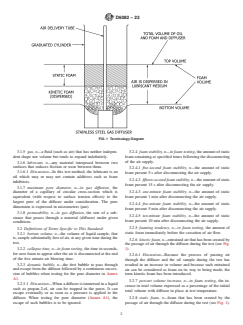
3.2.6 kinetic foam, n—entrained air that has been created by the passage of air through the diffuser during the test (see Fig. 1).
3.2.6.1 Discussion—
Because the process of passing air through the diffuser and the oil sample during the test has resulted in an increase in volume and
because such entrained air can be considered as foam on its way to being made, the term kinetic foam has been introduced.
3.2.7 percent volume increase, n—in foam testing, the increase in total volume expressed as a percentage of the initial total volume
with diffuser in place at test temperature.
3.2.8 static foam, n—foam that has been created by the passage of air through the diffuser during the test (see Fig. 1).
3.2.9 top volume, n—the volume of the foam (if any), liquid, diffuser, and the submersed portion of the delivery tube (see Fig. 1).
3.2.10 total volume, n—in foam testing, the volume of foam, liquid, diffuser, and submersed portion of delivery tube (see Fig. 1).
3.2.10.1 initial total volume (V ), n—in foam testing, the volume of the foam, liquid, diffuser, and submersed portion of the
delivery tube at test temperature prior to connecting the air supply.
3.2.10.2 final total volume (V ), n—in foam testing, the volume of the foam, liquid, diffuser, and submersed portion of the
delivery tube just before disconnecting the air supply.
3.2.11 zero foam, n—in foam testing, occurs when any portion of the top surface of the liquid is free of bubbles.
4. Summary of Test Method
4.1 A measured quantity of sample is heated to 49 °C for 30 min and allowed to cool to room temperature. The sample is
transferred to a 1000 mL graduated cylinder, heated to 150 °C, and aerated at 200 mL ⁄min with dry air for 5 min with a metal
D6082 − 23
FIG. 2 Typical Liquid Bath
diffuser. The amount of foam generated before disconnecting the air, the amount of static foam at optional times after disconnecting
the air (list of options in Section 10); and the time for the foam to collapse are measured and the percent increase in total volume
calculated.
5. Significance and Use
5.1 The tendency of oils to foam at high temperature can be a serious problem in systems such as high-speed gearing, high volume
pumping, and splash lubrication. Foaming can cause inadequate lubrication, cavitation, and loss of lubricant due to overflow, and
these events can lead to mechanical failure.
5.2 Correlation between the amount of foam created or the time for foam to collapse, or both, and actual lubrication failure has
not been established. Such relations should be empirically determined for foam sensitive applications.
6. Apparatus
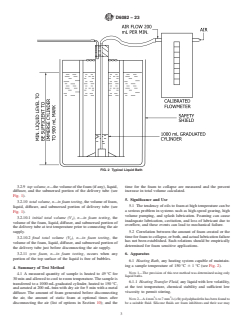
6.1 Heating Bath, any heating system capable of maintaining a sample temperature of 150 °C 6 1 °C (see Fig. 2).
NOTE 1—The precision of this test method was determined using only liquid baths.
6.1.1 Heating Transfer Fluid, any liquid with low volatility, at the test temperature, chemical stability and sufficient low viscosity
to permit stirring.
2 2
NOTE 2—A 4 mm /s to 7 mm /s (cSt) polyalphaolefin has been found to be a suitable fluid. Silicone fluids are foam inhibitors and their use may alter
the foam characteristics of the test sample and should be discouraged.
D6082 − 23
NOTE 3—A slow purge of nitrogen gas through the fluid, or as a blanket over the bath fluid, reduces darkening (oxidation) of the bath fluid.
6.2 Foaming Test Apparatus, 1000 mL graduated cylinder (of cylinders meeting Specification E1272 Class B tolerance
requirement of 66 mL and having at least graduations of 10 mL), fitted with a device to overcome buoyancy if a liquid bath is
used and modified to have a circular top. It shall be capable of withstanding the extreme temperature conditions of this test method.
NOTE 4—It may be necessary to confirm the volume of the cylinder.
NOTE 5—A heavy metal ring large enough to fit over the outside and rest on the bottom of the cylinder has been found to be suitable to overcome
buoyancy.
NOTE 6—Graduated cylinders having a pouring spout can be prepared for this test method by making a horizontal cut below the spout and removing the
part above the cut. The cut edges of the cylinder should be fire-polished or smoothed by grinding.
6.3 Flow Meter and Regulator, calibrated and capable of maintaining air flow volume of 200 mL ⁄min 6 5 mL ⁄min.
6.3.1 A gas volume meter graduated in hundredths of a litre, or a technically equivalent flow measuring device, with sufficient
capacity to measure a flow rate of at least 6000 mL ⁄min, while generating a back pressure of no more than 10 mm of water, is
required.
6.4 Laboratory Oven, without fan, capable of maintaining 49 °C 6 1 °C.
6.5 Stirrer, capable of 500 r ⁄min 6 100 r ⁄min, fitted with a 3.81 cm, 3-blade, 1.5-pitch marine propeller.
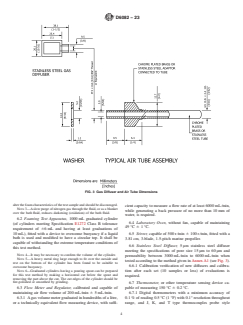
6.6 Stainless Steel Diffuser, 5 μm stainless steel diffuser meeting the specifications of pore size 15 μm to 60 μm and permeability
between 3000 mL ⁄min to 6000 mL ⁄min when tested according to the method given in Annex A1 (see Fig. 3).
6.6.1 Calibration verification of new diffusers and calibration after each set (10 samples or less) of evaluations is required.
6.7 Thermometer, or other temperature sensing device capable of measuring 150 °C 6 0.2 °C.
6.7.1 Digital thermometers with a minimum accuracy of 0.1 % of reading 0.5 °C (1 °F) with 0.1° resolution throughout range, and
J, K, and T type thermocouples probe style compatible have been found suitable for operation with either liquid or air foam baths.
6.7.2 A low noise iron-constantan J type thermocouple probe 457 mm (18 in.) in length, constructed of a 304 s/s sheath, with a
glass-filled nylon connector body rated from –29 °C to 220 °C immersed in the sample at a minimum of 100 mm has been found
suitable for operation with either liquid or air foam baths.
6.8 Timing Device, capable of measuring minutes and seconds (61 s).
6.9 High Speed Blender, with a container capacity of one litre, capable of maintaining a speed of 22 000 r ⁄min (62000).
7. Reagents
7.1 Purity of Reagents—Reagent grade chemicals shall be used in all tests. Unless otherwise indicated, it is intended that all
reagents conform to the specifications of the Committee on Analytical Reagents of the American Chemical Society where such
specifications are available. Other grades may be used, provided it is first ascertained that the reagent is of sufficiently high purity
to permit its use without lessening the accuracy of the determination.
7.2 Acetone, (Warning—Extremely flammable. Vapors may cause flash fire.)
7.3 Compressed Air, hydrocarbon free and dry to a dew point of −60 °C or lower.
ACS Reagent Chemicals, Specifications and Procedures for Reagents and Standard-Grade Reference Materials, American Chemical Society, Washington, DC. For
suggestions on the testing of reagents not listed by the American Chemical Society, see Analar Standards for Laboratory Chemicals, BDH Ltd., Poole, Dorset, U.K., and
the United States Pharmacopeia and National Formulary, U.S. Pharmacopeial Convention, Inc. (USPC), Rockville, MD.
D6082 − 23
FIG. 3 Gas Diffuser and Air Tube Dimensions
7.4 Heptane, (Warning—Flammable. Vapor harmful.)
7.5 Propan-2-ol, (Warning—Flammable. Vapor harmful.)
7.6 Toluene, (Warning—Flammable. Vapor harmful.)
NOTE 7—Solvents with equivalent cleaning characteristics can be substituted for toluene.
8. Hazards
8.1 (Warning—Users of this test method shall be fully trained and familiar with all normal laboratory practice, or under the
immediate supervision of such a person. It is the responsibility of the operator to ensure that all local legislative and statutory
requirements are met.)
8.2 (Warning—Cleaning solvents have flash points lower than usual laboratory ambient temperatures. Avoid the possibility of a
fire or explosion.)
8.3 (Warning—The fumes from the test oil and bath must be vented in a manner compatible with local environmental
regulations.)
D6082 − 23
8.4 (Warning—Some apparatus assemblies can have as much as 20 L of bath oil at 150 °C. Therefore, in the event of a breakage
of the containing vessel, suitable containment of the spill is advisable.)
9. Preparation of Apparatus
9.1 Thorough cleansing of the test cylinder, gas diffuser, and air-inlet tube is essential after each use to remove any additive
remaining from previous tests which can seriously interfere with results of subsequent tests.
9.1.1 Cylinder—Rinse the cylinder with heptane (Warning—Flammable. Vapor harmful), followed by directing a current of
compressed air into the cylinder. Wash the cylinder with a suitable detergent. Rinse the cylinder in turn with distilled water, then
acetone (Warning—Extremely flammable. Vapors may cause fla
...