

ASTM D892-23
(Test Method)Standard Test Method for Foaming Characteristics of Lubricating Oils
General Information
- Abstract
SIGNIFICANCE AND USE
5.1 The tendency of oils to foam can be a serious problem in systems such as high-speed gearing, high-volume pumping, and splash lubrication. Inadequate lubrication, cavitation, and overflow loss of lubricant can lead to mechanical failure. This test method is used in the evaluation of oils for such operating conditions.
SCOPE
1.1 This test method covers the determination of the foaming characteristics of lubricating oils at 24 °C and 93.5 °C. Means of empirically rating the foaming tendency and the stability of the foam are described.
1.2 WARNING—Mercury has been designated by many regulatory agencies as a hazardous substance that can cause serious medical issues. Mercury, or its vapor, has been demonstrated to be hazardous to health and corrosive to materials. Use caution when handling mercury and mercury-containing products. See the applicable product Safety Data Sheet (SDS) for additional information. The potential exists that selling mercury or mercury-containing products, or both, is prohibited by local or national law. Users must determine legality of sales in their location.
1.3 The values stated in SI units are to be regarded as standard. The values given in parentheses after SI units are provided for information only and are not considered standard.
1.4 This standard does not purport to address all of the safety concerns, if any, associated with its use. It is the responsibility of the user of this standard to establish appropriate safety, health, and environmental practices and determine the applicability of regulatory limitations prior to use. For specific warning statements, see Sections 7, 8, and 9.1.1.
1.5 This international standard was developed in accordance with internationally recognized principles on standardization established in the Decision on Principles for the Development of International Standards, Guides and Recommendations issued by the World Trade Organization Technical Barriers to Trade (TBT) Committee.
- Status
- Published
- Publication Date
- 30-Sep-2023
- Technical Committee
- D02 - Petroleum Products, Liquid Fuels, and Lubricants
- Drafting Committee
- D02.06 - Analysis of Liquid Fuels and Lubricants
Overview
ASTM D892-23: Standard Test Method for Foaming Characteristics of Lubricating Oils is a critical international standard developed by ASTM International. This test method establishes procedures for evaluating the foaming tendencies and foam stability of lubricating oils at specified temperatures (24 °C and 93.5 °C). The propensity of lubricating oils to foam can significantly impact mechanical systems such as high-speed gears, high-volume pumps, and splash lubrication systems. Excessive foaming may lead to inadequate lubrication, cavitation, or even mechanical failure, making foam testing essential for quality assurance in oil formulation and application.
Key Topics
- Foaming Tendency: Measures the amount of foam generated when air is introduced into the oil under controlled conditions.
- Foam Stability: Assesses how long the foam persists after air flow is stopped.
- Test Conditions: Procedures specified at both ambient (24 °C) and elevated (93.5 °C) temperatures to simulate real-world operating environments.
- Apparatus and Materials: Use of specialized graduated cylinders, gas diffusers, temperature-controlled baths, and precise flowmeters as specified in the standard.
- Sample Handling: Guidance on cleaning, preparation, and handling to ensure accurate, repeatable results. Proper cleaning of test apparatus and avoidance of contamination are essential.
- Safety Considerations: Emphasis on safe handling of hazardous substances (such as mercury or flammable cleaning agents) and compliance with health, safety, and local regulatory requirements.
Applications
The foaming characteristics measured by ASTM D892-23 play a pivotal role in various industries and applications, including:
- Automotive lubricants: Ensuring that engine oils and transmission fluids perform reliably under dynamic conditions without excessive foam generation.
- Industrial hydraulic systems: Preventing foam-related failures in high-volume pumps by selecting oils with proven low foaming characteristics.
- Gear oils and machine lubricants: Reducing the risk of lubricant loss due to overflow or system malfunction from foam formation in gearboxes and other mechanical assemblies.
- Quality control and oil formulation: Offering oil manufacturers a standardized means to assess and compare the performance of different additives and base oils.
- Routine maintenance and troubleshooting: Assisting maintenance teams in identifying lubricants prone to problematic foaming, optimizing equipment uptime and performance.
Related Standards
For comprehensive lubricant testing and terminology, ASTM D892-23 references and complements several other ASTM standards:
- ASTM D445: Test Method for Kinematic Viscosity of Transparent and Opaque Liquids.
- ASTM D4175: Standard Terminology Relating to Petroleum Products, Liquid Fuels, and Lubricants.
- ASTM D6082: Test Method for High Temperature Foaming Characteristics of Lubricating Oils.
- ASTM E1: Specification for ASTM Liquid-in-Glass Thermometers.
- ASTM E128: Test Method for Maximum Pore Diameter and Permeability of Rigid Porous Filters.
- ASTM E1272: Specification for Laboratory Glass Graduated Cylinders.
Practical Value
ASTM D892-23 is an essential reference for laboratories, lubricant manufacturers, QA/QC specialists, and engineers involved with lubricant product development and maintenance. By following this standard, organizations can:
- Improve the reliability and safety of mechanical systems
- Optimize oil formulation for minimal foaming
- Demonstrate regulatory compliance and adherence to global quality benchmarks
- Troubleshoot and resolve foam-related operational issues effectively
Adopting ASTM D892-23 ensures consistent, internationally recognized assessment of foaming characteristics, supporting both product quality and end-user satisfaction.
Relations
- Effective Date
- 01-Oct-2023
- Effective Date
- 01-Apr-2024
- Refers
ASTM D4175-23a - Standard Terminology Relating to Petroleum Products, Liquid Fuels, and Lubricants - Effective Date
- 15-Dec-2023
- Effective Date
- 01-Nov-2023
- Refers
ASTM D4175-23 - Standard Terminology Relating to Petroleum Products, Liquid Fuels, and Lubricants - Effective Date
- 01-Jul-2023
- Refers
ASTM D4175-23e1 - Standard Terminology Relating to Petroleum Products, Liquid Fuels, and Lubricants - Effective Date
- 01-Jul-2023
- Effective Date
- 15-May-2021
- Effective Date
- 01-Oct-2023
- Effective Date
- 01-Oct-2023
- Effective Date
- 01-Oct-2023
- Effective Date
- 01-Oct-2023
- Effective Date
- 01-Oct-2023
- Referred By
ASTM D7752-18 - Standard Practice for Evaluating Compatibility of Mixtures of Hydraulic Fluids - Effective Date
- 01-Oct-2023
- Referred By
ASTM D5760-19 - Standard Specification for Performance of Manual Transmission Gear Lubricants - Effective Date
- 01-Oct-2023
- Effective Date
- 01-Oct-2023
Get Certified
Connect with accredited certification bodies for this standard

Element Materials Technology
Materials testing and product certification.

ABS Group Brazil
ABS Group certification services in Brazil.

ABS Quality Evaluations Inc.
American Bureau of Shipping quality certification.
Sponsored listings
Frequently Asked Questions
ASTM D892-23 is a standard published by ASTM International. Its full title is "Standard Test Method for Foaming Characteristics of Lubricating Oils". This standard covers: SIGNIFICANCE AND USE 5.1 The tendency of oils to foam can be a serious problem in systems such as high-speed gearing, high-volume pumping, and splash lubrication. Inadequate lubrication, cavitation, and overflow loss of lubricant can lead to mechanical failure. This test method is used in the evaluation of oils for such operating conditions. SCOPE 1.1 This test method covers the determination of the foaming characteristics of lubricating oils at 24 °C and 93.5 °C. Means of empirically rating the foaming tendency and the stability of the foam are described. 1.2 WARNING—Mercury has been designated by many regulatory agencies as a hazardous substance that can cause serious medical issues. Mercury, or its vapor, has been demonstrated to be hazardous to health and corrosive to materials. Use caution when handling mercury and mercury-containing products. See the applicable product Safety Data Sheet (SDS) for additional information. The potential exists that selling mercury or mercury-containing products, or both, is prohibited by local or national law. Users must determine legality of sales in their location. 1.3 The values stated in SI units are to be regarded as standard. The values given in parentheses after SI units are provided for information only and are not considered standard. 1.4 This standard does not purport to address all of the safety concerns, if any, associated with its use. It is the responsibility of the user of this standard to establish appropriate safety, health, and environmental practices and determine the applicability of regulatory limitations prior to use. For specific warning statements, see Sections 7, 8, and 9.1.1. 1.5 This international standard was developed in accordance with internationally recognized principles on standardization established in the Decision on Principles for the Development of International Standards, Guides and Recommendations issued by the World Trade Organization Technical Barriers to Trade (TBT) Committee.
SIGNIFICANCE AND USE 5.1 The tendency of oils to foam can be a serious problem in systems such as high-speed gearing, high-volume pumping, and splash lubrication. Inadequate lubrication, cavitation, and overflow loss of lubricant can lead to mechanical failure. This test method is used in the evaluation of oils for such operating conditions. SCOPE 1.1 This test method covers the determination of the foaming characteristics of lubricating oils at 24 °C and 93.5 °C. Means of empirically rating the foaming tendency and the stability of the foam are described. 1.2 WARNING—Mercury has been designated by many regulatory agencies as a hazardous substance that can cause serious medical issues. Mercury, or its vapor, has been demonstrated to be hazardous to health and corrosive to materials. Use caution when handling mercury and mercury-containing products. See the applicable product Safety Data Sheet (SDS) for additional information. The potential exists that selling mercury or mercury-containing products, or both, is prohibited by local or national law. Users must determine legality of sales in their location. 1.3 The values stated in SI units are to be regarded as standard. The values given in parentheses after SI units are provided for information only and are not considered standard. 1.4 This standard does not purport to address all of the safety concerns, if any, associated with its use. It is the responsibility of the user of this standard to establish appropriate safety, health, and environmental practices and determine the applicability of regulatory limitations prior to use. For specific warning statements, see Sections 7, 8, and 9.1.1. 1.5 This international standard was developed in accordance with internationally recognized principles on standardization established in the Decision on Principles for the Development of International Standards, Guides and Recommendations issued by the World Trade Organization Technical Barriers to Trade (TBT) Committee.
ASTM D892-23 is classified under the following ICS (International Classification for Standards) categories: 75.100 - Lubricants, industrial oils and related products. The ICS classification helps identify the subject area and facilitates finding related standards.
ASTM D892-23 has the following relationships with other standards: It is inter standard links to ASTM D892-18e1, ASTM D445-24, ASTM D4175-23a, ASTM D445-23, ASTM D4175-23, ASTM D4175-23e1, ASTM D445-21e2, ASTM D7044-15, ASTM D7578-20, ASTM D6158-18, ASTM D8324-21, ASTM D7450-19, ASTM D7752-18, ASTM D5760-19, ASTM D6666-20. Understanding these relationships helps ensure you are using the most current and applicable version of the standard.
ASTM D892-23 is available in PDF format for immediate download after purchase. The document can be added to your cart and obtained through the secure checkout process. Digital delivery ensures instant access to the complete standard document.
Standards Content (Sample)
This international standard was developed in accordance with internationally recognized principles on standardization established in the Decision on Principles for the
Development of International Standards, Guides and Recommendations issued by the World Trade Organization Technical Barriers to Trade (TBT) Committee.
Designation: D892 − 23 British Standard 5092
Standard Test Method for
Foaming Characteristics of Lubricating Oils
This standard is issued under the fixed designation D892; the number immediately following the designation indicates the year of
original adoption or, in the case of revision, the year of last revision. A number in parentheses indicates the year of last reapproval. A
superscript epsilon (´) indicates an editorial change since the last revision or reapproval.
This standard has been approved for use by agencies of the U.S. Department of Defense.
1. Scope* 2. Referenced Documents
1.1 This test method covers the determination of the foam- 2.1 ASTM Standards:
ing characteristics of lubricating oils at 24 °C and 93.5 °C. D445 Test Method for Kinematic Viscosity of Transparent
Means of empirically rating the foaming tendency and the and Opaque Liquids (and Calculation of Dynamic Viscos-
stability of the foam are described. ity)
D4175 Terminology Relating to Petroleum Products, Liquid
1.2 WARNING—Mercury has been designated by many
Fuels, and Lubricants
regulatory agencies as a hazardous substance that can cause
D6082 Test Method for High Temperature Foaming Charac-
serious medical issues. Mercury, or its vapor, has been dem-
teristics of Lubricating Oils
onstrated to be hazardous to health and corrosive to materials.
E1 Specification for ASTM Liquid-in-Glass Thermometers
Use caution when handling mercury and mercury-containing
E128 Test Method for Maximum Pore Diameter and Perme-
products. See the applicable product Safety Data Sheet (SDS)
ability of Rigid Porous Filters for Laboratory Use
for additional information. The potential exists that selling
E1272 Specification for Laboratory Glass Graduated Cylin-
mercury or mercury-containing products, or both, is prohibited
ders
by local or national law. Users must determine legality of sales
in their location.
3. Terminology
1.3 The values stated in SI units are to be regarded as
3.1 Definitions:
standard. The values given in parentheses after SI units are
3.1.1 For definitions of terms used in this test method, refer
provided for information only and are not considered standard.
to Terminology D4175.
1.4 This standard does not purport to address all of the
3.1.2 diffuser, n—for gas, a device for dispersing gas into a
safety concerns, if any, associated with its use. It is the
fluid.
responsibility of the user of this standard to establish appro-
3.1.2.1 Discussion—In this test method the diffuser may be
priate safety, health, and environmental practices and deter-
made of either metallic or non-metallic materials.
mine the applicability of regulatory limitations prior to use.
3.1.3 entrained air (or gas), n—in liquids, a two-phase
For specific warning statements, see Sections 7, 8, and 9.1.1.
mixture of air (or gas) dispersed in a liquid in which the liquid
1.5 This international standard was developed in accor-
is the major component on a volumetric basis.
dance with internationally recognized principles on standard-
3.1.3.1 Discussion—Entrained air (or gas) may form micro
ization established in the Decision on Principles for the
size bubbles in liquids that are not uniformly dispersed and that
Development of International Standards, Guides and Recom-
may coalesce to form larger bubbles below or at the surface
mendations issued by the World Trade Organization Technical
which break or form foam.
Barriers to Trade (TBT) Committee.
3.1.4 foam, n—in liquids, a collection of bubbles formed in
or on the surface of a liquid in which the air or gas is the major
component on a volumetric basis.
This test method is under the jurisdiction of Committee D02 on Petroleum
Products, Liquid Fuels, and Lubricants and is the direct responsibility of Subcom-
mittee D02.06 on Analysis of Liquid Fuels and Lubricants. For referenced ASTM standards, visit the ASTM website, www.astm.org, or
Current edition approved Oct. 1, 2023. Published October 2023. Originally contact ASTM Customer Service at service@astm.org. For Annual Book of ASTM
ɛ1
approved in 1946. Last previous edition approved in 2018 as D892 – 18 . Standards volume information, refer to the standard’s Document Summary page on
DOI:10.1520/D0892-23. the ASTM website.
*A Summary of Changes section appears at the end of this standard
Copyright © ASTM International, 100 Barr Harbor Drive, PO Box C700, West Conshohocken, PA 19428-2959. United States
D892 − 23
FIG. 1 Foaming Test Apparatus
3.1.5 lubricant, n—any material interposed between two 4. Summary of Test Method
surfaces that reduces friction or wear between them. D6082
4.1 Sequence I—A portion of sample, maintained at a bath
3.1.5.1 Discussion—In this test method, the lubricant is an
temperature of 24 °C 6 0.5 °C is blown with air at a constant
oil which may or may not contain additives such as foam
rate (94 mL ⁄min 6 5 mL ⁄min ) for 5 min, then allowed to
inhibitors.
settle for 10 min (unless the case described in 3.2.2.1 applies,
3.1.6 maximum pore diameter, n—in gas diffusion, the
in which case, the time duration can be shortened). The volume
diameter of a circular cross-section of a capillary is equivalent
of foam is measured at the end of both periods.
to the largest pore of the diffuser under consideration.
4.2 Sequence II—A second portion of sample, maintained at
3.1.6.1 Discussion—The pore dimension is expressed in
a bath temperature of 93.5 °C 6 0.5 °C, is analyzed using the
micrometres (μm).
same air flow rate and blowing and settling time duration as
3.1.7 permeability, n—in gas diffusion, the rate of a sub-
indicated in 4.1.
stance that passes through a material (diffuser) under given
4.3 Sequence III—The sample portion used in conducting
conditions.
Sequence II is used for Sequence III, where any remaining
3.2 Definitions of Terms Specific to This Standard:
foam is collapsed and the sample portion temperature cooled
3.2.1 dynamic bubble, n—the first bubble to pass through
below 43.5 °C by allowing the test cylinder to stand in air at
and escape from the diffuser followed by a continuous succes-
room temperature, before placing the cylinder in the bath
sion of bubbles when testing for the maximum pore diameter in
maintained at 24 °C 6 0.5 °C. The same air flow rate and
Annex A1.
blowing and settling time duration as indicated in 4.1 is
3.2.1.1 Discussion—When a diffuser is immersed in a
followed.
liquid, air can be trapped in the pores. It can escape eventually
or as soon as a pressure is applied to the diffuser. When testing 5. Significance and Use
for maximum pore diameter (Annex A1) the escape of such
5.1 The tendency of oils to foam can be a serious problem
bubble shall be ignored.
in systems such as high-speed gearing, high-volume pumping,
3.2.2 foam stability, n—in foam testing, the amount of foam
and splash lubrication. Inadequate lubrication, cavitation, and
remaining at the specified time following the disconnecting of
overflow loss of lubricant can lead to mechanical failure. This
the air supply.
test method is used in the evaluation of oils for such operating
3.2.2.1 Discussion—In this test method, foam stability is
conditions.
determined from measurements made 10 min 6 10 s after
6. Apparatus
disconnecting the air supply. In cases after the air supply has
been disconnected, where the foam collapses to 0 mL before
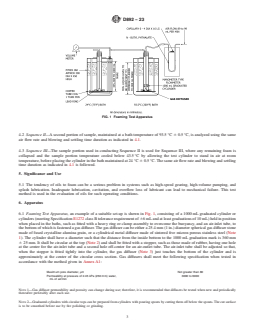
6.1 Foaming Test Apparatus, an example of a suitable
the 10 min settling time has elapsed, the test may be terminated
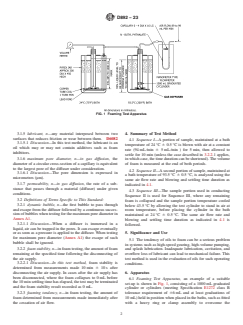
set-up is shown in Fig. 1, consisting of a 1000 mL graduated
and the foam stability result recorded as 0 mL.
cylinder or cylinders (meeting Specification E1272 class B
3.2.3 foaming tendency, n—in foam testing, the amount of tolerance requirement of 66 mL and at least graduations of
foam determined from measurements made immediately after 10 mL) held in position when placed in the baths, such as fitted
the cessation of air flow. with a heavy ring or clamp assembly to overcome the
D892 − 23
Dimensions in millimetres (inches)
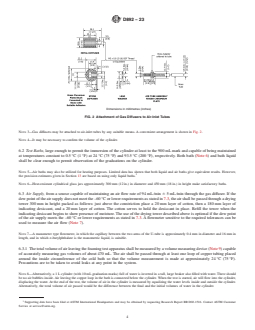
FIG. 2 Attachment of Gas Diffusers to Air-Inlet Tubes
However, the precision estimates given in Section 13 are based on using
buoyancy, and an air-inlet tube, to the bottom of which is
only liquid baths.
fastened a gas diffuser. The gas diffuser can be either a
NOTE 6—Heat-resistant cylindrical glass jars approximately 300 mm
25.4 mm (1 in.) diameter spherical gas diffuser stone made of
(12 in.) in diameter and 450 mm (18 in.) in height make satisfactory baths.
fused crystalline alumina grain, or a cylindrical metal diffuser
6.3 Air Supply, from a source capable of maintaining an air
made of sintered five micron porous stainless steel (Note 1).
flow rate of 94 mL ⁄min 6 5 mL ⁄min through the gas diffuser.
The cylinder shall have a diameter such that the distance from
If the dew point of the air supply does not meet the –60 °C or
the inside bottom to the 1000 mL graduation mark is 360 mm
lower requirements as stated in 7.3, the air shall be passed
6 25 mm. It shall be circular at the top (Note 2) and shall be
through a drying tower 300 mm in height packed as follows:
fitted with a stopper, such as those made of rubber, having one
just above the constriction place a 20 mm layer of cotton, then
hole at the center for the air-inlet tube and a second hole
a 180 mm layer of indicating desiccant, and a 20 mm layer of
off-center for an air-outlet tube. The air-inlet tube shall be
cotton. The cotton serves to hold the desiccant in place. Refill
adjusted so that, when the stopper is fitted tightly into the
the tower when the indicating desiccant begins to show
cylinder, the gas diffuser (Note 3) just touches the bottom of
presence of moisture. The use of the drying tower described
the cylinder and is approximately at the center of the circular
above is optional if the dew point of the air supply meets the
cross section. Gas diffusers shall meet the following specifica-
–60 °C or lower requirements as stated in 7.3. A flowmeter
tion when tested in accordance with the method given in Annex
sensitive to the required tolerances can be used to measure the
A1:
air flow (Note 7).
Maximum pore diameter, μm Not greater than 80
Permeability at pressure of 2.45 kPa (250 mm) water, 3000 to 6000
NOTE 7—A manometer type flowmeter, in which the capillary between
mL of air/min
the two arms of the U-tube is approximately 0.4 mm in diameter and
16 mm in length, and in which n-butylphthalate is the manometric liquid,
NOTE 1—Gas diffuser permeability and porosity can change during use;
is suitable.
therefore, it is recommended that diffusers be tested when new and
periodically thereafter preferably after each use.
6.3.1 The total volume of air leaving the foaming test
NOTE 2—Graduated cylinders with circular tops can be prepared from
apparatus shall be measured by a volume measuring device
cylinders with pouring spouts by cutting them off below the spouts. The
(Note 9) capable of accurately measuring gas volumes of about
cut surface is to be smoothed before use by fire polishing or grinding.
470 mL. The air shall be passed through at least one loop of
NOTE 3—Gas diffusers may be attached to air-inlet tubes by any suitable
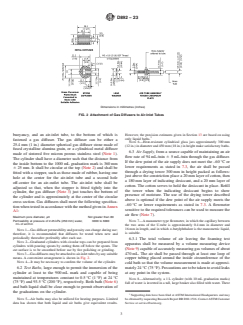
means. A convenient arrangement is shown in Fig. 2.
copper tubing placed around the inside circumference of the
NOTE 4—It may be necessary to confirm the volume of the cylinder.
cold bath so that the volume measurement is made at approxi-
mately 24 °C (75 °F). Precautions are to be taken to avoid leaks
6.2 Test Baths, large enough to permit the immersion of the
at any point in the system.
cylinder at least to the 900 mL mark and capable of being
maintained at temperatures constant to 0.5 °C (1 °F) at 24 °C
NOTE 8—Alternatively, a 1 L cylinder (with 10 mL graduation marks)
(75 °F) and 93.5 °C (200 °F), respectively. Both bath (Note 6)
full of water is inverted in a tall, large beaker also filled with water. There
and bath liquid shall be clear enough to permit observation of
the graduations on the cylinder.
Supporting data have been filed at ASTM International Headquarters and may
NOTE 5—Air baths may also be utilized for heating purposes. Limited be obtained by requesting Research Report RR:D02-1516. Contact ASTM Customer
data has shown that both liquid and air baths give equivalent results. Service at service@astm.org.
D892 − 23
should be no air bubbles inside. Air leaving the copper loop in the bath is
8.2 (Warning—Cleaning solvents have flash points lower
connected below the cylinder. When the test is started, air will flow into
than ambient temperatures. Avoid the possibility of fire or
the cylinder, displacing the water. At the end of the test, the volume of air
explosion.)
in the cylinder is measured by equalizing the water levels inside and
outside the cylinder. Alternatively, the total volume of air passed would be
8.3 (Warning—The fumes from the test oil and the bath
the difference between the final and the initial volumes of water in the
shall be vented in a manner compatible with local government
cylinder.
regulations.)
NOTE 9—A wet test meter calibrated in hundredths of a litre is suitable.
8.4 (Warning—Some apparatus assemblies can have as
6.4 Timer, graduated and accurate to 1 s or better.
much as 20 L of heat transfer oil at 93.5 °C. Therefore, in the
6.5 Temperature Sensing Device, capable of covering the
event of breakage of the containing vessel, provisions for
temperature range from at least 20 °C to 100 °C, with an
suitable containment of the spill is advisable.)
accuracy of 60.5 °C. A thermometer having a range as shown
9. Preparation of Apparatus
below and conforming to the requirements as prescribed in
Specification E1 or specifications for IP thermometers has been
9.1 Thorough cleansing of the test cylinder (9.1.1) and gas
found suitable to use:
diffuser and air-inlet tube (9.1.2) is essential after each use to
Temperature Thermometer remove any additive remaining from previous tests which can
Range ASTM No. IP
seriously interfere with results of subsequent tests. The crite-
20 °C to 102 °C 12C 64C
rion that the test cylinder is adequately cleaned is that the
interior walls drain water cleanly, without drops forming. As
7. Reagents and Materials
for the gas diffuser and air-inlet tube, the criterion for adequate
7.1 Purity of Reagents—Reagent grade chemicals shall be
cleaning is that no visual evidence of residual material remains
used in all cases. Unless indicated otherwise, it is intended that
from a prior analysis prior to conducting a subsequent analysis.
all reagents conform to the specifications of the committee on
9.1.1 Cylinder—One suitable technique for cleaning the
Analytical Reagents of the American Chemical Society where
cylinder is to rinse the cylinder with heptane. (Warning—
such specifications are available. Other grades may be used,
Flammable, vapor harmful.) Wash the cylinder with a suitable
provided it is first ascertained that the reagent is of sufficiently
detergent. Rinse the cylinder, in turn, with distilled water, then
high purity to permit its use without lessening the accuracy of
acetone (Warning—Extremely flammable, vapors can cause a
the determination.
flash fire) and dry in a current of the compressed air or in a
drying oven.
7.2 Acetone—(Warning—Extremely flammable, vapors
can cause a flash fire).
NOTE 10—Certain detergents are notorious for adhering to glass;
therefore, it is important to realize that such a circumstance can affect the
7.3 Compressed Air, hydrocarbon free and dry to a dew
test result. Several rinsings with water and acetone may be required.
point of −60 °C or lower, otherwise the drying tower described
9.1.2 Gas Diffuser and Air Tube—One suitable technique
in 6.3 shall be used.
for cleaning the gas diffuser and air tube is to first clean the
7.4 Cleaning Reagents—such as heptane (Warning—
inside of the air tube (disassembled from the gas diffuser) with
Flammable, vapor harmful) and toluene (methylbenzene) for
toluene and heptane. Next, connect the air tube and gas diffuser
use in cleaning the cylinder, gas diffuser, and air-inlet tube.
and immerse the gas diffuser in about 300 mL of toluene. Flush
Other reagents with equivalent cleaning and solvency charac-
a portion of the toluene back and forth through the gas diffuser
teristics may be substituted as appropriate, provided the re-
at least five times with vacuum and air pressure. Repeat the
quirements in 9.1 are satisfied.
process with heptane. After the final washing, dry both the air
7.5 Propan-2-ol—for use in determining the maximum pore tube and the gas diffuser thoroughly by forcing clean air
Note 11). Wipe the outside of the air inlet
diameter if a metallic diffuser is used (see A1.2.1). (Solvents through them (see
with equivalent cleaning and solvency characteristics may be tube, first with a cloth moistened with heptane, then a dry cloth.
Do not wipe the gas diffuser.
substituted for propan-2-ol.)
NOTE 11—Certain samples may contain ingredients which may not be
8. Hazards
adequately removed by this process and, because these can affect the next
test, more rigorous cleaning may be required; this is recommended. When
8.1 (Warning—Users of this test method shall be trained
alternate diffuser cleaning methods are used certain cautions should be
and familiar with all normal laboratory practices, or under the
observed: (1) Non-metallic diffusers may have absorbed as well as
immediate supervision of such a person. It is the responsibility
adsorbed these interfering ingredients or the cleaners, or both, and this
shall be considered before proceeding to the next test. (2) So that all tests
of the operator to ensure that all local legislative and statutory
performed start off under the same circumstances, when alternate diffuser
requirements are met.)
cleaning methods are used, the final rinsing process shall be as detailed in
9.1.2. (3) See also Note 1.
10. Procedure
ACS Reagent Chemicals, Specifications and Procedures for Reagents and
Standard-Grade Reference Materials, American Chemical Society, Washington,
10.1 Sequence I—Without mechanical shaking or stirring,
DC. For suggestions on the testing of reagents not listed by the American Chemical
decant approximately 200 mL of sample into a beaker (see
Society, see Analar Standards for Laboratory Chemicals, BDH Ltd., Poole, Dorset,
10.1.1). Heat to 49 °C 6 3 °C and allow to cool to 24 °C 6
U.K., and the United States Pharmacopeia and National Formulary, U.S. Pharma-
copeial Convention, Inc. (USPC), Rockville, MD. 3 °C. See Option A for stored sample (see 10.5). Each step of
D892 − 23
NOTE 12—Temperature sensing devices may be utilized to ensure
the procedure described in 10.3 and 10.4, respectively, shall be
sample temperature equilibrium during test. Limited data has shown that
carried out within 3 h after completion of the previous step. In
leaving the temperature sensing devices in the sample gives equivalent
10.5.1, the test shall be carried out as soon as compatible with
results. However, the precision estimates given in Section 13 are based on
the temperature specification and not more than 3 h after
exclusion of temperature probes.
immersion of the cylinder in the 93.5 °C (200 °F) bath.
10.4 Sequence III—Collapse any foam remaining after the
10.1.1 If a sample arrives in the lab and it has been
test at 93.5 °C (200 °F) (10.3), by stirring. Cool the sample to
determined that it is at or above 49 °C 6 3 °C, the heating step
a temperature below 43.5 °C (110 °F) by allowing the test
in 10.1 may be eliminated. Heating the sample to 49 °C 6 3 °C
cylinder to stand in air at room temperature, then place the
in 10.1 is intended to remove any thermal history before
cylinder in the bath maintained at 24 °C 6 0.5 °C (75 °F 6
proceeding, which is not an issue for samples arriving in the
1 °F). After the oil has reached bath temperature, insert a
lab already at or above 49 °C 6 3 °C.
cleaned air-inlet tube and gas diffuser and proceed as described
10.2 Pour the sample into the 1000 mL cylinder until the
in 10.2, recording the foam value at the end of the blowing and
liquid level is at the 190 mL mark. Visually estimate the level
settling periods. (See 10.2.1.)
to be within 5 mL. Immerse the cylinder at least to the 900 mL
10.5 Some lubricants with modern additives can pass their
mark in the bath maintained at 24 °C 6 0.5 °C (75 °F 6 1 °F).
foam requirements when blended (with the antifoam properly
When the oil has reached the bath temperature, insert the gas
dispersed in small particle sizes) but fail to meet the same
diffuser and the air-inlet tube with the air source disconnected,
requirements after two or more weeks’ storage. (It appears that
and permit the gas diffuser to soak for about 5 min. Connect the
the polar dispersant additives have the potency to attract and
air-outlet tube to the air volume measuring device. At the end
hold antifoam particles, such that the apparent increased
of 5 min, connect to the air source, adjust the air flow rate to
antifoam size results in decreased effectiveness to control foam
94 mL ⁄min 6 5 mL ⁄min, and force clean dry air through the
in Test Method D892.) However, if the same stored oil is
gas diffuser for 5 min 6 3 s, timed from the first appearance of
merely decanted and poured into engines, transmissions, or
air bubbles rising from the gas diffuser. At the end of this
gear boxes and those uni
...
This document is not an ASTM standard and is intended only to provide the user of an ASTM standard an indication of what changes have been made to the previous version. Because
it may not be technically possible to adequately depict all changes accurately, ASTM recommends that users consult prior editions as appropriate. In all cases only the current version
of the standard as published by ASTM is to be considered the official document.
´1
Designation: D892 − 18 D892 − 23 British Standard 5092
Standard Test Method for
Foaming Characteristics of Lubricating Oils
This standard is issued under the fixed designation D892; the number immediately following the designation indicates the year of
original adoption or, in the case of revision, the year of last revision. A number in parentheses indicates the year of last reapproval. A
superscript epsilon (´) indicates an editorial change since the last revision or reapproval.
This standard has been approved for use by agencies of the U.S. Department of Defense.
ε NOTE—Editorially removed joint designation in February 2023.
1. Scope*
1.1 This test method covers the determination of the foaming characteristics of lubricating oils at 24 °C and 93.5 °C. Means of
empirically rating the foaming tendency and the stability of the foam are described.
1.2 WARNING—Mercury has been designated by many regulatory agencies as a hazardous materialsubstance that can cause
central nervous system, kidney and liver damage. serious medical issues. Mercury, or its vapor, may has been demonstrated to be
hazardous to health and corrosive to materials. Caution should be taken Use caution when handling mercury and mercury
containing mercury-containing products. See the applicable product Material Safety Data Sheet (MSDS) for details and EPA’s
website—http://www.epa.gov/mercury/faq.htm—for additional information. Users should be aware (SDS) for additional informa-
tion. The potential exists that selling mercury and/or mercury containing products into your state or country may be prohibited by
law.or mercury-containing products, or both, is prohibited by local or national law. Users must determine legality of sales in their
location.
1.3 The values stated in SI units are to be regarded as standard. The values given in parentheses after SI units are provided for
information only and are not considered standard.
1.4 This standard does not purport to address all of the safety concerns, if any, associated with its use. It is the responsibility
of the user of this standard to establish appropriate safety, health, and environmental practices and determine the applicability of
regulatory limitations prior to use. For specific warning statements, see Sections 7, 8, and 9.1.1.
1.5 This international standard was developed in accordance with internationally recognized principles on standardization
established in the Decision on Principles for the Development of International Standards, Guides and Recommendations issued
by the World Trade Organization Technical Barriers to Trade (TBT) Committee.
2. Referenced Documents
2.1 ASTM Standards:
D445 Test Method for Kinematic Viscosity of Transparent and Opaque Liquids (and Calculation of Dynamic Viscosity)
D4175 Terminology Relating to Petroleum Products, Liquid Fuels, and Lubricants
D6082 Test Method for High Temperature Foaming Characteristics of Lubricating Oils
E1 Specification for ASTM Liquid-in-Glass Thermometers
This test method is under the jurisdiction of Committee D02 on Petroleum Products, Liquid Fuels, and Lubricants and is the direct responsibility of Subcommittee D02.06
on Analysis of Liquid Fuels and Lubricants.
Current edition approved April 15, 2018Oct. 1, 2023. Published May 2018October 2023. Originally approved in 1946. Last previous edition approved in 20132018 as
ɛ1
D892 – 13D892 – 18 . DOI:10.1520/D0892-18E01.DOI:10.1520/D0892-23.
For referenced ASTM standards, visit the ASTM website, www.astm.org, or contact ASTM Customer Service at service@astm.org. For Annual Book of ASTM Standards
volume information, refer to the standard’s Document Summary page on the ASTM website.
*A Summary of Changes section appears at the end of this standard
Copyright © ASTM International, 100 Barr Harbor Drive, PO Box C700, West Conshohocken, PA 19428-2959. United States
D892 − 23
E128 Test Method for Maximum Pore Diameter and Permeability of Rigid Porous Filters for Laboratory Use
E1272 Specification for Laboratory Glass Graduated Cylinders
3. Terminology
3.1 Definitions:
3.1.1 For definitions of terms used in this test method, refer to Terminology D4175.
3.1.2 diffuser, n—for gas, a device for dispersing gas into a fluid.
3.1.2.1 Discussion—
In this test method the diffuser may be made of either metallic or non-metallic materials.
3.1.3 entrained air (or gas), n—in liquids, a two-phase mixture of air (or gas) dispersed in a liquid in which the liquid is the major
component on a volumetric basis.
3.1.3.1 Discussion—
Entrained air (or gas) may form micro size bubbles in liquids that are not uniformly dispersed and that may coalesce to form larger
bubbles below or at the surface which break or form foam.
3.1.4 foam, n—in liquids, a collection of bubbles formed in or on the surface of a liquid in which the air or gas is the major
component on a volumetric basis.
3.1.5 lubricant, n—any material interposed between two surfaces that reduces friction or wear between them. D6082
3.1.5.1 Discussion—
In this test method, the lubricant is an oil which may or may not contain additives such as foam inhibitors.
3.1.6 maximum pore diameter, n—in gas diffusion, the diameter of a circular cross-section of a capillary is equivalent to the largest
pore of the diffuser under consideration.
3.1.6.1 Discussion—
The pore dimension is expressed in micrometres (μm).
3.1.7 permeability, n—in gas diffusion, the rate of a substance that passes through a material (diffuser) under given conditions.
3.2 Definitions of Terms Specific to This Standard:
3.2.1 dynamic bubble, n—the first bubble to pass through and escape from the diffuser followed by a continuous succession of
bubbles when testing for the maximum pore diameter in Annex A1.
3.2.1.1 Discussion—
When a diffuser is immersed in a liquid, air can be trapped in the pores. It can escape eventually or as soon as a pressure is applied
to the diffuser. When testing for maximum pore diameter (Annex A1) the escape of such bubble shall be ignored.
3.2.2 foam stability, n—in foam testing, the amount of foam remaining at the specified time following the disconnecting of the
air supply.
3.2.2.1 Discussion—
In this test method, foam stability is determined from measurements made 10 min 6 10 s after disconnecting the air supply. In
cases after the air supply has been disconnected, where the foam collapses to 0 mL before the 10 min settling time has elapsed,
the test may be terminated and the foam stability result recorded as 0 mL.
3.2.3 foaming tendency, n—in foam testing, the amount of foam determined from measurements made immediately after the
cessation of air flow.
4. Summary of Test Method
4.1 Sequence I—A portion of sample, maintained at a bath temperature of 24 °C 6 0.5 °C is blown with air at a constant rate
(94 mL ⁄min 6 5 mL ⁄min ) for 5 min, then allowed to settle for 10 min (unless the case described in 3.2.2.1 applies, in which case,
the time duration can be shortened). The volume of foam is measured at the end of both periods.
D892 − 23
FIG. 1 Foaming Test Apparatus
4.2 Sequence II—A second portion of sample, maintained at a bath temperature of 93.5 °C 6 0.5 °C, is analyzed using the same
air flow rate and blowing and settling time duration as indicated in 4.1.
4.3 Sequence III—The sample portion used in conducting Sequence II is used for Sequence III, where any remaining foam is
collapsed and the sample portion temperature cooled below 43.5 °C by allowing the test cylinder to stand in air at room
temperature, before placing the cylinder in the bath maintained at 24 °C 6 0.5 °C. The same air flow rate and blowing and settling
time duration as indicated in 4.1 is followed.
5. Significance and Use
5.1 The tendency of oils to foam can be a serious problem in systems such as high-speed gearing, high-volume pumping, and
splash lubrication. Inadequate lubrication, cavitation, and overflow loss of lubricant can lead to mechanical failure. This test
method is used in the evaluation of oils for such operating conditions.
6. Apparatus
6.1 Foaming Test Apparatus, an example of a suitable set-up is shown in Fig. 1, consisting of a 1000 mL graduated cylinder or
cylinders (meeting Specification E1272 class B tolerance requirement of 66 mL and at least graduations of 10 mL) held in position
when placed in the baths, such as fitted with a heavy ring or clamp assembly to overcome the buoyancy, and an air-inlet tube, to
the bottom of which is fastened a gas diffuser. The gas diffuser can be either a 25.4 mm (1 in.) diameter spherical gas diffuser stone
made of fused crystalline alumina grain, or a cylindrical metal diffuser made of sintered five micron porous stainless steel (Note
1). The cylinder shall have a diameter such that the distance from the inside bottom to the 1000 mL graduation mark is 360 mm
6 25 mm. It shall be circular at the top (Note 2) and shall be fitted with a stopper, such as those made of rubber, having one hole
at the center for the air-inlet tube and a second hole off-center for an air-outlet tube. The air-inlet tube shall be adjusted so that,
when the stopper is fitted tightly into the cylinder, the gas diffuser (Note 3) just touches the bottom of the cylinder and is
approximately at the center of the circular cross section. Gas diffusers shall meet the following specification when tested in
accordance with the method given in Annex A1:
Maximum pore diameter, μm Not greater than 80
Permeability at pressure of 2.45 kPa (250 mm) water, 3000 to 6000
mL of air/min
NOTE 1—Gas diffuser permeability and porosity can change during use; therefore, it is recommended that diffusers be tested when new and periodically
thereafter preferably after each use.
NOTE 2—Graduated cylinders with circular tops can be prepared from cylinders with pouring spouts by cutting them off below the spouts. The cut surface
is to be smoothed before use by fire polishing or grinding.
D892 − 23
Dimensions in millimetres (inches)
FIG. 2 Attachment of Gas Diffusers to Air-Inlet Tubes
NOTE 3—Gas diffusers may be attached to air-inlet tubes by any suitable means. A convenient arrangement is shown in Fig. 2.
NOTE 4—It may be necessary to confirm the volume of the cylinder.
6.2 Test Baths, large enough to permit the immersion of the cylinder at least to the 900 mL mark and capable of being maintained
at temperatures constant to 0.5 °C (1 °F) at 24 °C (75 °F) and 93.5 °C (200 °F), respectively. Both bath (Note 6) and bath liquid
shall be clear enough to permit observation of the graduations on the cylinder.
NOTE 5—Air baths may also be utilized for heating purposes. Limited data has shown that both liquid and air baths give equivalent results. However,
the precision estimates given in Section 13 are based on using only liquid baths.
NOTE 6—Heat-resistant cylindrical glass jars approximately 300 mm (12 in.) in diameter and 450 mm (18 in.) in height make satisfactory baths.
6.3 Air Supply, from a source capable of maintaining an air flow rate of 94 mL ⁄min 6 5 mL ⁄min through the gas diffuser. If the
dew point of the air supply does not meet the –60 °C or lower requirements as stated in 7.3, the air shall be passed through a drying
tower 300 mm in height packed as follows: just above the constriction place a 20 mm layer of cotton, then a 180 mm layer of
indicating desiccant, and a 20 mm layer of cotton. The cotton serves to hold the desiccant in place. Refill the tower when the
indicating desiccant begins to show presence of moisture. The use of the drying tower described above is optional if the dew point
of the air supply meets the –60 °C or lower requirements as stated in 7.3. A flowmeter sensitive to the required tolerances can be
used to measure the air flow (Note 7).
NOTE 7—A manometer type flowmeter, in which the capillary between the two arms of the U-tube is approximately 0.4 mm in diameter and 16 mm in
length, and in which n-butylphthalate is the manometric liquid, is suitable.
6.3.1 The total volume of air leaving the foaming test apparatus shall be measured by a volume measuring device (Note 9) capable
of accurately measuring gas volumes of about 470 mL. The air shall be passed through at least one loop of copper tubing placed
around the inside circumference of the cold bath so that the volume measurement is made at approximately 24 °C (75 °F).
Precautions are to be taken to avoid leaks at any point in the system.
NOTE 8—Alternatively, a 1 L cylinder (with 10 mL graduation marks) full of water is inverted in a tall, large beaker also filled with water. There should
be no air bubbles inside. Air leaving the copper loop in the bath is connected below the cylinder. When the test is started, air will flow into the cylinder,
displacing the water. At the end of the test, the volume of air in the cylinder is measured by equalizing the water levels inside and outside the cylinder.
Alternatively, the total volume of air passed would be the difference between the final and the initial volumes of water in the cylinder.
Supporting data have been filed at ASTM International Headquarters and may be obtained by requesting Research Report RR:D02-1516. Contact ASTM Customer
Service at service@astm.org.
D892 − 23
NOTE 9—A wet test meter calibrated in hundredths of a litre is suitable.
6.4 Timer, graduated and accurate to 1 s or better.
6.5 Temperature Sensing Device, capable of covering the temperature range from at least 20 °C to 100 °C, with an accuracy of
60.5 °C. A thermometer having a range as shown below and conforming to the requirements as prescribed in Specification E1 or
specifications for IP thermometers has been found suitable to use:
Temperature Thermometer
Range ASTM No. IP
20 °C to 102 °C 12C 64C
7. Reagents and Materials
7.1 Purity of Reagents—Reagent grade chemicals shall be used in all cases. Unless indicated otherwise, it is intended that all
reagents conform to the specifications of the committee on Analytical Reagents of the American Chemical Society where such
specifications are available. Other grades may be used, provided it is first ascertained that the reagent is of sufficiently high purity
to permit its use without lessening the accuracy of the determination.
7.2 Acetone—(Warning—Extremely flammable, vapors can cause a flash fire).
7.3 Compressed Air, hydrocarbon free and dry to a dew point of −60 °C or lower, otherwise the drying tower described in 6.3 shall
be used.
7.4 Cleaning Reagents—such as heptane (Warning—Flammable, vapor harmful) and toluene (methylbenzene) for use in cleaning
the cylinder, gas diffuser, and air-inlet tube. Other reagents with equivalent cleaning and solvency characteristics may be
substituted as appropriate, provided the requirements in 9.1 are satisfied.
7.5 Propan-2-ol—for use in determining the maximum pore diameter if a metallic diffuser is used (see A1.2.1). (Solvents with
equivalent cleaning and solvency characteristics may be substituted for propan-2-ol.)
8. Hazards
8.1 (Warning—Users of this test method shall be trained and familiar with all normal laboratory practices, or under the immediate
supervision of such a person. It is the responsibility of the operator to ensure that all local legislative and statutory requirements
are met.)
8.2 (Warning—Cleaning solvents have flash points lower than ambient temperatures. Avoid the possibility of fire or explosion.)
8.3 (Warning—The fumes from the test oil and the bath shall be vented in a manner compatible with local government
regulations.)
8.4 (Warning—Some apparatus assemblies can have as much as 20 L of heat transfer oil at 93.5 °C. Therefore, in the event of
breakage of the containing vessel, provisions for suitable containment of the spill is advisable.)
9. Preparation of Apparatus
9.1 Thorough cleansing of the test cylinder (9.1.1) and gas diffuser and air-inlet tube (9.1.2) is essential after each use to remove
any additive remaining from previous tests which can seriously interfere with results of subsequent tests. The criterion that the test
cylinder is adequately cleaned is that the interior walls drain water cleanly, without drops forming. As for the gas diffuser and
air-inlet tube, the criterion for adequate cleaning is that no visual evidence of residual material remains from a prior analysis prior
to conducting a subsequent analysis.
Reagent Chemicals, American Chemical Society Specifications,ACS Reagent Chemicals, Specifications and Procedures for Reagents and Standard-Grade Reference
Materials, American Chemical Society, Washington, DC. For Suggestionssuggestions on the testing of reagents not listed by the American Chemical Society, see
AnnualAnalar Standards for Laboratory Chemicals, BDH Ltd., Poole, Dorset, U.K., and the United States Pharmacopeia and National Formulary, U.S. Pharmacopeial
Convention, Inc. (USPC), Rockville, MD.
D892 − 23
9.1.1 Cylinder—One suitable technique for cleaning the cylinder is to rinse the cylinder with heptane. (Warning—Flammable,
vapor harmful.) Wash the cylinder with a suitable detergent. Rinse the cylinder, in turn, with distilled water, then acetone
(Warning—Extremely flammable, vapors can cause a flash fire) and dry in a current of the compressed air or in a drying oven.
NOTE 10—Certain detergents are notorious for adhering to glass; therefore, it is important to realize that such a circumstance can affect the test result.
Several rinsings with water and acetone may be required.
9.1.2 Gas Diffuser and Air Tube—One suitable technique for cleaning the gas diffuser and air tube is to first clean the inside of
the air tube (disassembled from the gas diffuser) with toluene and heptane. Next, connect the air tube and gas diffuser and immerse
the gas diffuser in about 300 mL of toluene. Flush a portion of the toluene back and forth through the gas diffuser at least five times
with vacuum and air pressure. Repeat the process with heptane. After the final washing, dry both the air tube and the gas diffuser
thoroughly by forcing clean air through them (see Note 11). Wipe the outside of the air inlet tube, first with a cloth moistened with
heptane, then a dry cloth. Do not wipe the gas diffuser.
NOTE 11—Certain samples may contain ingredients which may not be adequately removed by this process and, because these can affect the next test, more
rigorous cleaning may be required; this is recommended. When alternate diffuser cleaning methods are used certain cautions should be observed: (1)
Non-metallic diffusers may have absorbed as well as adsorbed these interfering ingredients or the cleaners, or both, and this shall be considered before
proceeding to the next test. (2) So that all tests performed start off under the same circumstances, when alternate diffuser cleaning methods are used, the
final rinsing process shall be as detailed in 9.1.2. (3) See also Note 1.
10. Procedure
10.1 Sequence I—Without mechanical shaking or stirring, decant approximately 200 mL of sample into a beaker (see 10.1.1). Heat
to 49 °C 6 3 °C and allow to cool to 24 °C 6 3 °C. See Option A for stored sample (see 10.5). Each step of the procedure described
in 10.3 and 10.4, respectively, shall be carried out within 3 h after completion of the previous step. In 10.5.1, the test shall be carried
out as soon as compatible with the temperature specification and not more than 3 h after immersion of the cylinder in the 93.5 °C
(200 °F) bath.
10.1.1 If a sample arrives in the lab and it has been determined that it is at or above 49 °C 6 3 °C, the heating step in 10.1 may
be eliminated. Heating the sample to 49 °C 6 3 °C in 10.1 is intended to remove any thermal history before proceeding, which
is not an issue for samples arriving in the lab already at or above 49 °C 6 3 °C.
10.2 Pour the sample into the 1000 mL cylinder until the liquid level is at the 190 mL mark. Visually estimate the level to be within
5 mL. Immerse the cylinder at least to the 900 mL mark in the bath maintained at 24 °C 6 0.5 °C (75 °F 6 1 °F). When the oil
has reached the bath temperature, insert the gas diffuser and the air-inlet tube with the air source disconnected, and permit the gas
diffuser to soak for about 5 min. Connect the air-outlet tube to the air volume measuring device. At the end of 5 min, connect to
the air source, adjust the air flow rate to 94 mL ⁄min 6 5 mL ⁄min, and force clean dry air through the gas diffuser for 5 min 6
3 s, timed from the first appearance of air bubbles rising from the gas diffuser. At the end of this period, shut off the air flow by
disconnecting the hose from the flow meter and immediately record the volume of foam; that is, the volume between the oil level
and the top of the foam. The total air volume which has passed through the system shall be 470 mL 6 25 mL. Allow the cylinder
to stand for 10 min 6 10 s and again record the volume of foam (see 10.2.1).
10.2.1 In cases after the air supply has been disconnected, where the foam collapses to 0 mL before the 10 min settling time has
elapsed, the test may be terminated and the foam stability result recorded as 0 mL.
10.3 Sequence II—Pour a second portion of sample into a cleaned 1000 mL cylinder until the liquid level is at the 180 mL mark.
Visually estimate the level to be within 5 mL. Immerse the cylinder at least to the 900 mL mark in the bath maintained at 93.5 °C
6 0.5 °C. When the oil has reached and equilibrated with the bath temperature requirements in 10.2 (see 10.3.1), insert a clean
gas diffuser and air-inlet tube and proceed as described in 10.2, recording the volume of foam at the end of the blowing and settling
periods. In cases where 10.2.1 applies, the test procedure may continue to Sequence III.
10.3.1 One way to verify the oil temperature has equilibrated with the bath temperature is by che
...