

ASTM F877-24
(Specification)Standard Specification for Crosslinked Polyethylene (PEX) Hot- and Cold-Water Distribution Systems
General Information
- Abstract
ABSTRACT
This specification covers requirements, test methods, and methods of marking for crosslinked polyethylene plastic hot- and cold-water distribution systems components made in one standard dimension ratio. Components are comprised of tubing and fittings intended for use in residential and commercial, hot and cold, potable water distribution systems as well as sealed central heating, including under-floor heating systems. Requirements and test methods are included for materials, workmanship, dimensions and tolerances, burst pressure, sustained pressure, excessive temperature and pressure, temperature cycling tests, and bend strength. Also included are tests related to system malfunctions.
SCOPE
1.1 This specification covers requirements, test methods, and marking requirements for system components when tested with nominal SDR9 crosslinked polyethylene (PEX) tubing as a system. Systems are intended for 100 psi (0.69 MPa) water service up to and including a maximum working temperature of 180 °F (82 °C). Requirements and test methods are included for materials, workmanship, dimensions and tolerances, burst pressure, hydrostatic sustained pressure, excessive temperature and pressure, corrosion resistance, and thermocycling tests. The components covered by this specification are intended for use in, but not limited to, residential and commercial hot and cold potable water distribution systems or other applications such as reclaimed water, fire protection, municipal water service lines, building supply lines, radiant heating and cooling systems, hydronic distribution systems, snow and ice melting systems, geothermal ground loops, district heating, turf conditioning, compressed air distribution, and building services pipe.
1.2 The text of this specification references notes, footnotes, and appendixes which provide explanatory material. These notes and footnotes (excluding those in tables and figures) shall not be considered as requirements of the specification.
1.3 The values stated in inch-pound units are to be regarded as standard. The values given in parentheses are mathematical conversions to SI units that are provided for information only and are not considered standard.
Note 1: Suggested hydrostatic design stresses and hydrostatic pressure ratings for tubing and fittings are listed in Appendix X1. Design, assembly, and installation considerations are discussed in Appendix X2. An optional performance qualification and an in-plant quality control program are recommended in Appendix X3. For additional information on the use of PEX tubing for high-temperature non-potable applications and for chlorinated potable water, see PPI Technical Notes 52 and 53, respectively.
1.4 The following safety hazards caveat pertains only to the test method portion, Section 7, of this specification: This standard does not purport to address all of the safety concerns, if any, associated with its use. It is the responsibility of the user of this standard to establish appropriate safety, health, and environmental practices and determine the applicability of regulatory limitations prior to use.
1.5 This international standard was developed in accordance with internationally recognized principles on standardization established in the Decision on Principles for the Development of International Standards, Guides and Recommendations issued by the World Trade Organization Technical Barriers to Trade (TBT) Committee.
- Status
- Published
- Publication Date
- 31-Jan-2024
- Technical Committee
- F17 - Plastic Piping Systems
- Drafting Committee
- F17.61 - Water
Buy Documents
ASTM F877-24 - Standard Specification for Crosslinked Polyethylene (PEX) Hot- and Cold-Water Distribution Systems
REDLINE ASTM F877-24 - Standard Specification for Crosslinked Polyethylene (PEX) Hot- and Cold-Water Distribution Systems
Overview
ASTM F877-24: Standard Specification for Crosslinked Polyethylene (PEX) Hot- and Cold-Water Distribution Systems is a comprehensive international standard developed by ASTM for the specification, testing, and marking of crosslinked polyethylene (PEX) distribution systems. These systems include tubing and fittings designed for use in residential and commercial hot and cold potable water distribution, as well as in applications such as radiant heating, snow/ice melting, and geothermal systems. The standard ensures PEX systems meet critical requirements for materials, performance, durability, and safety, making them suitable for high-demand and long-term water supply and hydronic heating installations.
Key Topics
ASTM F877-24 addresses essential aspects of PEX water distribution system components, including:
- Material Requirements: Specifications for crosslinked polyethylene and compatible fittings, ensuring suitability for potable water and heating system use.
- Performance Testing: Methods for testing burst pressure, sustained hydrostatic pressure, temperature cycling, corrosion resistance, and excessive temperature/pressure scenarios.
- Dimensions and Tolerances: Standardization of system components with nominal SDR9 PEX tubing for compatibility and consistency.
- Quality and Workmanship: Guidelines to ensure uniformity, cleanliness, absence of defects, and integrity in PEX components.
- Marking and Certification: Requirements for legible marking of manufacturer, standard designation, and certification marks confirming products meet performance and safety requirements.
- Safety and Installation Considerations: Recommendations for proper storage, handling, assembly, and installation to ensure system integrity and longevity.
Applications
ASTM F877-24 PEX systems are widely used in a variety of demanding environments and applications, offering proven reliability, flexibility, and resistance to temperature and pressure fluctuations. Typical uses include:
- Residential and Commercial Potable Water Distribution: Hot and cold water supply lines benefiting from corrosion resistance and ease of installation.
- Hydronic and Radiant Heating Systems: Underfloor heating, snow and ice melting, and radiant cooling systems requiring flexible, high-performance piping.
- Municipal and Building Service Lines: Service lines for municipal water, reclaimed water, and fire protection systems.
- Geothermal and District Heating: Ground loops and district energy supply, where PEX durability and pressure capabilities are critical.
- Compressed Air and Turf Conditioning: Applications beyond water distribution, leveraging the mechanical performance of PEX.
The standard provides assurance that components are tested to withstand 100 psi water service up to 180 °F (82 °C), and meet rigorous criteria for pressure cycling, corrosion, and extreme conditions, ensuring safe long-term operation.
Related Standards
For optimal system selection and compliance, ASTM F877-24 should be used alongside related standards, including:
- ASTM F876: Specification for Crosslinked Polyethylene (PEX) Tubing.
- ASTM F1807, F1960, F2080, F2098, F2159, F2434, F2735, F2854, F3347, F3348: Specifications for a range of fittings compatible with SDR9 PEX tubing.
- ASSE 1061: Performance Requirements for Push-Fit Fittings.
- NSF/ANSI Standards 14 and 61: Requirements for plastic piping for potable water and drinking water system components.
- AWWA and ANSI Standards: For reference to steel pipe and broad piping system compliance.
- Plastic Pipe Institute Technical Notes 52 and 53: Guidance for high-temperature non-potable and chlorinated potable PEX applications.
By adhering to ASTM F877-24 and these referenced standards, professionals can ensure that PEX hot- and cold-water distribution systems deliver safe, efficient, and reliable performance across a wide range of built environments.
Keywords: ASTM F877-24, PEX water distribution, crosslinked polyethylene piping, potable water systems, hydronic heating, pressure testing, thermal cycling, plumbing standards, commercial water supply, radiant heating.
Relations
- Effective Date
- 01-Feb-2024
- Effective Date
- 01-Dec-2023
- Effective Date
- 01-Feb-2024
- Effective Date
- 01-Feb-2024
- Effective Date
- 01-Feb-2024
- Effective Date
- 01-Feb-2024
- Effective Date
- 01-Feb-2024
- Effective Date
- 01-Feb-2024
- Effective Date
- 01-Feb-2024
- Effective Date
- 01-Feb-2024
- Effective Date
- 01-Feb-2024
- Effective Date
- 01-Feb-2024
- Effective Date
- 01-Feb-2024
- Effective Date
- 01-Feb-2024
Buy Documents
ASTM F877-24 - Standard Specification for Crosslinked Polyethylene (PEX) Hot- and Cold-Water Distribution Systems
REDLINE ASTM F877-24 - Standard Specification for Crosslinked Polyethylene (PEX) Hot- and Cold-Water Distribution Systems
Get Certified
Connect with accredited certification bodies for this standard

Institut za varilstvo d.o.o. (Welding Institute)
Slovenia's leading welding institute since 1952. ISO 3834, EN 1090, pressure equipment certification, NDT personnel, welder qualification. Only IIW Au
Sponsored listings
Frequently Asked Questions
ASTM F877-24 is a technical specification published by ASTM International. Its full title is "Standard Specification for Crosslinked Polyethylene (PEX) Hot- and Cold-Water Distribution Systems". This standard covers: ABSTRACT This specification covers requirements, test methods, and methods of marking for crosslinked polyethylene plastic hot- and cold-water distribution systems components made in one standard dimension ratio. Components are comprised of tubing and fittings intended for use in residential and commercial, hot and cold, potable water distribution systems as well as sealed central heating, including under-floor heating systems. Requirements and test methods are included for materials, workmanship, dimensions and tolerances, burst pressure, sustained pressure, excessive temperature and pressure, temperature cycling tests, and bend strength. Also included are tests related to system malfunctions. SCOPE 1.1 This specification covers requirements, test methods, and marking requirements for system components when tested with nominal SDR9 crosslinked polyethylene (PEX) tubing as a system. Systems are intended for 100 psi (0.69 MPa) water service up to and including a maximum working temperature of 180 °F (82 °C). Requirements and test methods are included for materials, workmanship, dimensions and tolerances, burst pressure, hydrostatic sustained pressure, excessive temperature and pressure, corrosion resistance, and thermocycling tests. The components covered by this specification are intended for use in, but not limited to, residential and commercial hot and cold potable water distribution systems or other applications such as reclaimed water, fire protection, municipal water service lines, building supply lines, radiant heating and cooling systems, hydronic distribution systems, snow and ice melting systems, geothermal ground loops, district heating, turf conditioning, compressed air distribution, and building services pipe. 1.2 The text of this specification references notes, footnotes, and appendixes which provide explanatory material. These notes and footnotes (excluding those in tables and figures) shall not be considered as requirements of the specification. 1.3 The values stated in inch-pound units are to be regarded as standard. The values given in parentheses are mathematical conversions to SI units that are provided for information only and are not considered standard. Note 1: Suggested hydrostatic design stresses and hydrostatic pressure ratings for tubing and fittings are listed in Appendix X1. Design, assembly, and installation considerations are discussed in Appendix X2. An optional performance qualification and an in-plant quality control program are recommended in Appendix X3. For additional information on the use of PEX tubing for high-temperature non-potable applications and for chlorinated potable water, see PPI Technical Notes 52 and 53, respectively. 1.4 The following safety hazards caveat pertains only to the test method portion, Section 7, of this specification: This standard does not purport to address all of the safety concerns, if any, associated with its use. It is the responsibility of the user of this standard to establish appropriate safety, health, and environmental practices and determine the applicability of regulatory limitations prior to use. 1.5 This international standard was developed in accordance with internationally recognized principles on standardization established in the Decision on Principles for the Development of International Standards, Guides and Recommendations issued by the World Trade Organization Technical Barriers to Trade (TBT) Committee.
ABSTRACT This specification covers requirements, test methods, and methods of marking for crosslinked polyethylene plastic hot- and cold-water distribution systems components made in one standard dimension ratio. Components are comprised of tubing and fittings intended for use in residential and commercial, hot and cold, potable water distribution systems as well as sealed central heating, including under-floor heating systems. Requirements and test methods are included for materials, workmanship, dimensions and tolerances, burst pressure, sustained pressure, excessive temperature and pressure, temperature cycling tests, and bend strength. Also included are tests related to system malfunctions. SCOPE 1.1 This specification covers requirements, test methods, and marking requirements for system components when tested with nominal SDR9 crosslinked polyethylene (PEX) tubing as a system. Systems are intended for 100 psi (0.69 MPa) water service up to and including a maximum working temperature of 180 °F (82 °C). Requirements and test methods are included for materials, workmanship, dimensions and tolerances, burst pressure, hydrostatic sustained pressure, excessive temperature and pressure, corrosion resistance, and thermocycling tests. The components covered by this specification are intended for use in, but not limited to, residential and commercial hot and cold potable water distribution systems or other applications such as reclaimed water, fire protection, municipal water service lines, building supply lines, radiant heating and cooling systems, hydronic distribution systems, snow and ice melting systems, geothermal ground loops, district heating, turf conditioning, compressed air distribution, and building services pipe. 1.2 The text of this specification references notes, footnotes, and appendixes which provide explanatory material. These notes and footnotes (excluding those in tables and figures) shall not be considered as requirements of the specification. 1.3 The values stated in inch-pound units are to be regarded as standard. The values given in parentheses are mathematical conversions to SI units that are provided for information only and are not considered standard. Note 1: Suggested hydrostatic design stresses and hydrostatic pressure ratings for tubing and fittings are listed in Appendix X1. Design, assembly, and installation considerations are discussed in Appendix X2. An optional performance qualification and an in-plant quality control program are recommended in Appendix X3. For additional information on the use of PEX tubing for high-temperature non-potable applications and for chlorinated potable water, see PPI Technical Notes 52 and 53, respectively. 1.4 The following safety hazards caveat pertains only to the test method portion, Section 7, of this specification: This standard does not purport to address all of the safety concerns, if any, associated with its use. It is the responsibility of the user of this standard to establish appropriate safety, health, and environmental practices and determine the applicability of regulatory limitations prior to use. 1.5 This international standard was developed in accordance with internationally recognized principles on standardization established in the Decision on Principles for the Development of International Standards, Guides and Recommendations issued by the World Trade Organization Technical Barriers to Trade (TBT) Committee.
ASTM F877-24 is classified under the following ICS (International Classification for Standards) categories: 23.040.20 - Plastics pipes. The ICS classification helps identify the subject area and facilitates finding related standards.
ASTM F877-24 has the following relationships with other standards: It is inter standard links to ASTM F877-23, ASTM F876-23a, ASTM F3253-24, ASTM F3347-23, ASTM F2854-21, ASTM F876-24, ASTM F412-23, ASTM F3348-23a, ASTM F2098-18, ASTM F1807-23, ASTM F2735-23, ASTM F2080-23, ASTM F1960-23b, ASTM F2434-19. Understanding these relationships helps ensure you are using the most current and applicable version of the standard.
ASTM F877-24 is available in PDF format for immediate download after purchase. The document can be added to your cart and obtained through the secure checkout process. Digital delivery ensures instant access to the complete standard document.
Standards Content (Sample)
This international standard was developed in accordance with internationally recognized principles on standardization established in the Decision on Principles for the
Development of International Standards, Guides and Recommendations issued by the World Trade Organization Technical Barriers to Trade (TBT) Committee.
Designation: F877 − 24 An American National Standard
Standard Specification for
Crosslinked Polyethylene (PEX) Hot- and Cold-Water
Distribution Systems
This standard is issued under the fixed designation F877; the number immediately following the designation indicates the year of original
adoption or, in the case of revision, the year of last revision. A number in parentheses indicates the year of last reapproval. A superscript
epsilon (´) indicates an editorial change since the last revision or reapproval.
1. Scope* standard does not purport to address all of the safety concerns,
if any, associated with its use. It is the responsibility of the user
1.1 This specification covers requirements, test methods,
of this standard to establish appropriate safety, health, and
and marking requirements for system components when tested
environmental practices and determine the applicability of
with nominal SDR9 crosslinked polyethylene (PEX) tubing as
regulatory limitations prior to use.
a system. Systems are intended for 100 psi (0.69 MPa) water
1.5 This international standard was developed in accor-
service up to and including a maximum working temperature
dance with internationally recognized principles on standard-
of 180 °F (82 °C). Requirements and test methods are included
ization established in the Decision on Principles for the
for materials, workmanship, dimensions and tolerances, burst
Development of International Standards, Guides and Recom-
pressure, hydrostatic sustained pressure, excessive temperature
mendations issued by the World Trade Organization Technical
and pressure, corrosion resistance, and thermocycling tests.
Barriers to Trade (TBT) Committee.
The components covered by this specification are intended for
use in, but not limited to, residential and commercial hot and
2. Referenced Documents
cold potable water distribution systems or other applications
2.1 ASTM Standards:
such as reclaimed water, fire protection, municipal water
D618 Practice for Conditioning Plastics for Testing
service lines, building supply lines, radiant heating and cooling
D1598 Test Method for Time-to-Failure of Plastic Pipe
systems, hydronic distribution systems, snow and ice melting
Under Constant Internal Pressure
systems, geothermal ground loops, district heating, turf
D1599 Test Method for Resistance to Short-Time Hydraulic
conditioning, compressed air distribution, and building ser-
Pressure of Plastic Pipe, Tubing, and Fittings
vices pipe.
D1600 Terminology for Abbreviated Terms Relating to Plas-
1.2 The text of this specification references notes, footnotes,
tics (Withdrawn 2024)
and appendixes which provide explanatory material. These
D2749 Symbols for Dimensions of Plastic Pipe Fittings
notes and footnotes (excluding those in tables and figures) shall
D2837 Test Method for Obtaining Hydrostatic Design Basis
not be considered as requirements of the specification.
for Thermoplastic Pipe Materials or Pressure Design Basis
for Thermoplastic Pipe Products
1.3 The values stated in inch-pound units are to be regarded
F412 Terminology Relating to Plastic Piping Systems
as standard. The values given in parentheses are mathematical
F876 Specification for Crosslinked Polyethylene (PEX) Tub-
conversions to SI units that are provided for information only
ing
and are not considered standard.
F1807 Specification for Metal Insert Fittings Utilizing a
NOTE 1—Suggested hydrostatic design stresses and hydrostatic pressure
Copper Crimp Ring, or Alternate Stainless Steel Clamps,
ratings for tubing and fittings are listed in Appendix X1. Design,
for SDR9 Cross-linked Polyethylene (PEX) Tubing and
assembly, and installation considerations are discussed in Appendix X2.
An optional performance qualification and an in-plant quality control SDR9 Polyethylene of Raised Temperature (PE-RT) Tub-
program are recommended in Appendix X3. For additional information on
ing
the use of PEX tubing for high-temperature non-potable applications and
F1960 Specification for Cold Expansion Fittings with PEX
for chlorinated potable water, see PPI Technical Notes 52 and 53,
Reinforcing Rings for Use with Cross-linked Polyethylene
respectively.
(PEX) and Polyethylene of Raised Temperature (PE-RT)
1.4 The following safety hazards caveat pertains only to the
Tubing
test method portion, Section 7, of this specification: This
For referenced ASTM standards, visit the ASTM website, www.astm.org, or
This specification is under the jurisdiction of ASTM Committee F17 on Plastic contact ASTM Customer Service at service@astm.org. For Annual Book of ASTM
Piping Systems and is the direct responsibility of Subcommittee F17.61 on Water. Standards volume information, refer to the standard’s Document Summary page on
Current edition approved Feb. 1, 2024. Published February 2024. Originally the ASTM website.
approved in 1984. Last previous approved 2023 as F877 – 23. DOI: 10.1520/F0877- The last approved version of this historical standard is referenced on
24. www.astm.org.
*A Summary of Changes section appears at the end of this standard
Copyright © ASTM International, 100 Barr Harbor Drive, PO Box C700, West Conshohocken, PA 19428-2959. United States
F877 − 24
F2080 Specification for Cold-Expansion Fittings with Metal 2.8 Plastic Pipe Institute Technical Notes:
Compression-Sleeves for Crosslinked Polyethylene (PEX) Technical Note-52 Guide to High-Temperature Applications
Pipe and SDR9 Polyethylene of Raised Temperature of Non-Potable PEX Pipe and Tubing Systems
(PE-RT) Pipe Technical Note-53 Guide to Chlorine Resistance Ratings of
F2098 Specification for Stainless Steel Clamps for Securing PEX Pipes and Tubing for Potable Water Applications
SDR9 Cross-linked Polyethylene (PEX) Tubing and
3. Terminology
SDR9 Polyethylene of Raised Temperature (PE-RT) to
Metal Insert and Plastic Insert Fittings
3.1 The terminology used in this specification is in accor-
F2159 Specification for Plastic Insert Fittings Utilizing a
dance with Terminology F412, Terminology D1600, and Sym-
Copper Crimp Ring, or Alternate Stainless Steel Clamps
bols D2749, unless otherwise specified. The abbreviation for
for SDR9 Crosslinked Polyethylene (PEX) Tubing and
crosslinked polyethylene is PEX. Plastic tubing denotes a
SDR9 Polyethylene of Raised Temperature (PE-RT) Tub-
particular diameter schedule of plastic pipe in which outside
ing
diameter of the tubing is equal to the nominal size plus ⁄8 in.
F2434 Specification for Metal Insert Fittings Utilizing a
Plastic pipe outside diameter schedule conforms to ANSI
Copper Crimp Ring for SDR9 Cross-linked Polyethylene
B 36.10.
(PEX) Tubing and SDR9 Cross-linked Polyethylene/
3.2 Definitions of Terms Specific to This Standard:
Aluminum/Cross-linked Polyethylene (PEX-AL-PEX)
3.2.1 crosslinked polyethylene plastics—a polyethylene ma-
Tubing
terial that has undergone a change in molecular structure
F2735 Specification for Plastic Insert Fittings For SDR9
through processing whereby a majority of the polymer chains
Cross-linked Polyethylene (PEX) and Polyethylene of
are chemically linked.
Raised Temperature (PE-RT) Tubing
3.2.2 fitting—a piping component used to join or terminate
F2854 Specification for Push-Fit Crosslinked Polyethylene
sections of PEX tubing or to provide changes of direction or
(PEX) Mechanical Fittings for Crosslinked Polyethylene
branching in a piping system. This includes appurtenances
(PEX) Tubing
such as couplings, elbows, tees, or plugs used to connect tubing
F3347 Specification for Metal Press Insert Fittings with
or as an accessory to tubing.
Factory Assembled Stainless Steel Press Sleeve for SDR9
3.2.3 standard dimension ratio (SDR)—the ratio of outside
Cross-linked Polyethylene (PEX) Tubing and SDR9 Poly-
ethylene of Raised Temperature (PE-RT) Tubing diameter to wall thickness. For PEX tubing, it is calculated by
dividing the average outside diameter of the tubing in inches or
F3348 Specification for Plastic Press Insert Fittings with
Factory Assembled Stainless Steel Press Sleeve for SDR9 in millimeters by the minimum wall thickness in inches or
millimeters. If the wall thickness calculated by this formula is
Cross-linked Polyethylene (PEX) Tubing and SDR9 Poly-
ethylene of Raised Temperature (PE-RT) Tubing less than 0.070 in. (1.78 mm) it shall be arbitrarily increased to
4 5
0.070 in. except for nominal tubing sizes ⁄16 and smaller, as
2.2 ASSE Standard:
specified in Table 3. The SDR values shall be rounded to the
ASSE 1061 Performance Requirements for Push-Fit Fittings
nearest 0.5.
2.3 ANSI Standards:
B 36.10 Welded and Seamless Wrought Steel Pipe
3.2.4 manifold—an appurtenance that has at least one inlet
and multiple outlets with integral fittings, valves, or both.
2.4 AWWA Standard:
Manual M-11, Steel Pipe Design and Installation
3.2.5 system components—fittings, valves with integral
2.5 Federal Standard:
fittings, and manifolds which connect directly to PEX tubing
Fed Std. No. 123 Marking for Shipment (Civil Agencies)
made in accordance with Specification F876.
2.6 Military Standard:
3.2.6 system component assembly—system component con-
MIL-STD-129 Marking for Shipment and Storage
nected directly to PEX tubing made in accordance with
2.7 NSF Standard:
Specification F876.
NSF/ANSI Standard No. 14 for Plastic Piping Components
4. Materials
and Related Materials
NSF/ANSI Standard No. 61 for Drinking Water System
4.1 General—PEX systems shall use crosslinked polyethyl-
Components-Health Effects
ene tubing as described in Specification F876.
4.2 Fitting and manifold materials shall meet the applicable
requirements as described in Specifications F1807, F1960,
F2080, F2098, F2159, F2434, F2735, F2854, F3347 or F3348,
Available from ASSE International, 18927 Hickory Creek Dr, Suite 220,
or Standard ASSE 1061.
Mokena, IL 60448, http://www.asse-plumbing.org
Available from American National Standards Institute (ANSI), 25 W. 43rd St.,
4.3 Certification—PEX tubing and system components,
4th Floor, New York, NY 10036, http://www.ansi.org.
used for the distribution of potable water, shall be products
Available from American Water Works Association (AWWA), 6666 W. Quincy
approved for that service by the regulatory bodies having such
Ave., Denver, CO 80235, http://www.awwa.org.
Available from DLA Document Services, Building 4/D, 700 Robbins Ave.,
Philadelphia, PA 19111-5094, http://quicksearch.dla.mil.
8 9
Available from NSF International, P.O. Box 130140, 789 N. Dixboro Rd., Ann Available from Plastics Pipe Institute (PPI), 105 Decker Court, Suite 825,
Arbor, MI 48113-0140, http://www.nsf.org. Irving, TX 75062, http://www.plasticpipe.org.
F877 − 24
jurisdiction. These products shall be tested for that service by 6.5.2 System components with integral shut-offs (valves)
a nationally recognized testing laboratory that is accredited for shall be tested with all ports in the full-open or unrestricted
this specification and shall bear the certification mark of the position.
testing agency. 6.5.2.1 If the system component assembly has more than
one connection size, the test pressure selected from Table 1
5. Classification
shall be based upon the largest nominal PEX connection.
5.1 Fittings—This specification classifies fittings, including
6.6 Hydrostatic Sustained Pressure Strength
system components, intended for use in systems with PEX
6.6.1 System component assemblies shall meet the mini-
tubing, by a maximum continuous use temperature that shall be
mum hydrostatic sustained pressure strength requirements
180 °F (82 °C) and by nominal tubing sizes (NTS) from ⁄8
shown in Table 2 when tested in accordance with 7.5. Test
through 6 on the basis of resistance to burst pressure, hydro-
duration shall be 1000 h.
static sustained pressure, excessive temperature pressure
6.6.1.1 System components with integral shut-off (valves)
capability, and by thermocycling. Fittings shall be compatible
shall be tested with all ports in the full-open or unrestricted
with tubing made to the requirements of Specification F876.
position.
6.7 Thermocycling:
6. Requirements
6.7.1 System components, assembled using the manufactur-
6.1 General—Compliance with this specification requires
er’s instructions, shall not leak after completion of 1000 cycles
that fittings contained in Specifications F1807, F1960, F2080,
between the temperatures of 60 °F (16 °C) and 180 °F (82 °C)
F2098, F2159, F2434, F2735, F2854, F3347 and F3348 and
when tested in accordance with 7.6.
system components must meet all requirements of this section.
6.7.1.1 System components with integral shut-offs (valves)
Compliance with this specification requires that fittings con-
shall be tested with all ports in the full open or unrestricted
tained in Standard ASSE 1061 must meet all requirements of
position.
this section with the exception of 6.3.
6.8 Excessive Temperature/Pressure Capability—System
6.2 Workmanship—Fittings shall be homogeneous
component assemblies shall not fail as defined in Test Method
throughout, uniform in appearance and free of cracks, holes,
D1598 in less than 30 days (720 h) when tested in accordance
blisters, voids, foreign inclusions, or other defects that are
with 7.8.
visible to the naked eye and may affect fitting integrity. All
sealing surfaces shall be smooth and free of foreign material.
NOTE 2—The rationale for test requirement 6.8 is so that in the event of
a domestic hot-water system malfunction, PEX tubing and system
6.3 Dimensions and Tolerances:
components shall have adequate strength to accommodate short-term
6.3.1 The dimensions and tolerances of fittings shall meet
conditions, 48 h, of 210 °F (99 °C), 150 psi (1034 kPa) until repairs can
the specific requirements contained in Specifications F1807, be made.
F1960, F2080, F2098, F2159, F2434, F2735, F3347 and F3348
6.8.1 System components with integral shut-offs (valves)
or other recognized specification.
shall be tested with all ports in the full open or unrestricted
position.
6.4 Corrosion Resistance—Fittings intended for potable
water applications shall comply with dezincification resistance
NOTE 3—Tests applicable to assemblies and bends (6.5, 6.6, 6.7, and
and stress corrosion cracking resistance requirements of NSF/
6.8) are intended to be performance qualification tests and not tests
required of each fitting.
ANSI Standard 14.
6.5 Hydrostatic Burst:
7. Test Methods
6.5.1 System component assemblies assembled using the
7.1 General—Sections 7.4, 7.5, 7.6, 7.7, and 7.8 shall use
manufacturer’s instructions shall meet the minimum hydro-
separate sets of assemblies for each test.
static burst requirements shown in Table 1 when tested in
accordance with 7.7. 7.2 Conditioning—The test specimens should be condi-
tioned at 73 6 4 °F (23 6 2 °C) and 50 6 10 % relative
humidity for not less than 40 h prior to test in accordance with
TABLE 1 Burst Pressure Requirements for
SDR9 PEX System Component Assemblies Practice D618, for those tests where conditioning is required.
Nominal Minimum Burst Pressures at
Tubing Different Temperatures
TABLE 2 Minimum Hydrostatic Sustained Pressure
Size
A
Requirements for SDR9 PEX System Component Assemblies
A A
psi at (MPa) at psi at (MPa) at
Nominal Tubing Size Pressure Required for Test,
73 °F 180 °F
(23 °C) (82 °C)
A
psi (MPa)
⁄8 870 (6.00) 390 (2.69)
180 °F (82 °C)
⁄4 752 (5.19) 336 (2.32)
3 1
⁄8 620 (4.27) 275 (1.90) ⁄8 355 (2.45)
1 1
⁄2 480 (3.31) 215 (1.48) ⁄4 305 (2.10)
⁄8 and 475 (3.27) 210 (1.45) ⁄8 250 (1.72)
larger ⁄2 195 (1.34)
⁄8 and larger 190 (1.31)
A
The fiber stress for SDR9 PEX tubing used to derive this test pressure is:
A
at 73 °F (23 °C) 1900 psi (13.10 MPa). The fiber stress for SDR9 PEX tubing used to derive this test pressure is: 770 psi
at 180 °F (82 °C) 850 psi (5.86 MPa). (5.31 MPa) at 180 °F (82 °C).
F877 − 24
7.3 Test Conditions—Conduct the tests in the standard
Water immersion at 180 °F (82 °C) 2 min (min)
Air immersion at ambient 2 min (max)
laboratory atmosphere of 73 6 4 °F (23 6 2 °C) and 50 6 5 %
Water immersion at 60 °F (16 °C) 2 min (min)
relative humidity, unless otherwise specified in the test meth-
Air immersion at ambient 2 min (max)
ods or in this specification.
Upon the completion of 1000 thermal cycles, immerse the
specimen assembly
...
This document is not an ASTM standard and is intended only to provide the user of an ASTM standard an indication of what changes have been made to the previous version. Because
it may not be technically possible to adequately depict all changes accurately, ASTM recommends that users consult prior editions as appropriate. In all cases only the current version
of the standard as published by ASTM is to be considered the official document.
Designation: F877 − 23 F877 − 24 An American National Standard
Standard Specification for
Crosslinked Polyethylene (PEX) Hot- and Cold-Water
Distribution Systems
This standard is issued under the fixed designation F877; the number immediately following the designation indicates the year of original
adoption or, in the case of revision, the year of last revision. A number in parentheses indicates the year of last reapproval. A superscript
epsilon (´) indicates an editorial change since the last revision or reapproval.
1. Scope*
1.1 This specification covers requirements, test methods, and marking requirements for system components when tested with
nominal SDR9 crosslinked polyethylene (PEX) tubing as a system. Systems are intended for 100 psi (0.69 MPa) water service up
to and including a maximum working temperature of 180 °F (82 °C). Requirements and test methods are included for materials,
workmanship, dimensions and tolerances, burst pressure, hydrostatic sustained pressure, excessive temperature and pressure,
corrosion resistance, and thermocycling tests. The components covered by this specification are intended for use in, but not limited
to, residential and commercial hot and cold potable water distribution systems or other applications such as reclaimed water, fire
protection, municipal water service lines, building supply lines, radiant heating and cooling systems, hydronic distribution systems,
snow and ice melting systems, geothermal ground loops, district heating, turf conditioning, compressed air distribution, and
building services pipe.
1.2 The text of this specification references notes, footnotes, and appendixes which provide explanatory material. These notes and
footnotes (excluding those in tables and figures) shall not be considered as requirements of the specification.
1.3 The values stated in inch-pound units are to be regarded as standard. The values given in parentheses are mathematical
conversions to SI units that are provided for information only and are not considered standard.
NOTE 1—Suggested hydrostatic design stresses and hydrostatic pressure ratings for tubing and fittings are listed in Appendix X1. Design, assembly, and
installation considerations are discussed in Appendix X2. An optional performance qualification and an in-plant quality control program are recommended
in Appendix X3. For additional information on the use of PEX tubing for high-temperature non-potable applications and for chlorinated potable water,
see PPI Technical Notes 52 and 53, respectively.
1.4 The following safety hazards caveat pertains only to the test method portion, Section 7, of this specification: This standard
does not purport to address all of the safety concerns, if any, associated with its use. It is the responsibility of the user of this
standard to establish appropriate safety, health, and environmental practices and determine the applicability of regulatory
limitations prior to use.
1.5 This international standard was developed in accordance with internationally recognized principles on standardization
established in the Decision on Principles for the Development of International Standards, Guides and Recommendations issued
by the World Trade Organization Technical Barriers to Trade (TBT) Committee.
This specification is under the jurisdiction of ASTM Committee F17 on Plastic Piping Systems and is the direct responsibility of Subcommittee F17.61 on Water.
Current edition approved Feb. 1, 2023Feb. 1, 2024. Published February 2023February 2024. Originally approved in 1984. Last previous approved 20222023 as
F877 – 22.F877 – 23. DOI: 10.1520/F0877-23.10.1520/F0877-24.
*A Summary of Changes section appears at the end of this standard
Copyright © ASTM International, 100 Barr Harbor Drive, PO Box C700, West Conshohocken, PA 19428-2959. United States
F877 − 24
2. Referenced Documents
2.1 ASTM Standards:
D618 Practice for Conditioning Plastics for Testing
D1598 Test Method for Time-to-Failure of Plastic Pipe Under Constant Internal Pressure
D1599 Test Method for Resistance to Short-Time Hydraulic Pressure of Plastic Pipe, Tubing, and Fittings
D1600 Terminology for Abbreviated Terms Relating to Plastics (Withdrawn 2024)
D2749 Symbols for Dimensions of Plastic Pipe Fittings
D2837 Test Method for Obtaining Hydrostatic Design Basis for Thermoplastic Pipe Materials or Pressure Design Basis for
Thermoplastic Pipe Products
F412 Terminology Relating to Plastic Piping Systems
F876 Specification for Crosslinked Polyethylene (PEX) Tubing
F1807 Specification for Metal Insert Fittings Utilizing a Copper Crimp Ring, or Alternate Stainless Steel Clamps, for SDR9
Cross-linked Polyethylene (PEX) Tubing and SDR9 Polyethylene of Raised Temperature (PE-RT) Tubing
F1960 Specification for Cold Expansion Fittings with PEX Reinforcing Rings for Use with Cross-linked Polyethylene (PEX)
and Polyethylene of Raised Temperature (PE-RT) Tubing
F2080 Specification for Cold-Expansion Fittings with Metal Compression-Sleeves for Crosslinked Polyethylene (PEX) Pipe and
SDR9 Polyethylene of Raised Temperature (PE-RT) Pipe
F2098 Specification for Stainless Steel Clamps for Securing SDR9 Cross-linked Polyethylene (PEX) Tubing and SDR9
Polyethylene of Raised Temperature (PE-RT) to Metal Insert and Plastic Insert Fittings
F2159 Specification for Plastic Insert Fittings Utilizing a Copper Crimp Ring, or Alternate Stainless Steel Clamps for SDR9
Crosslinked Polyethylene (PEX) Tubing and SDR9 Polyethylene of Raised Temperature (PE-RT) Tubing
F2434 Specification for Metal Insert Fittings Utilizing a Copper Crimp Ring for SDR9 Cross-linked Polyethylene (PEX) Tubing
and SDR9 Cross-linked Polyethylene/Aluminum/Cross-linked Polyethylene (PEX-AL-PEX) Tubing
F2735 Specification for Plastic Insert Fittings For SDR9 Cross-linked Polyethylene (PEX) and Polyethylene of Raised
Temperature (PE-RT) Tubing
F2854 Specification for Push-Fit Crosslinked Polyethylene (PEX) Mechanical Fittings for Crosslinked Polyethylene (PEX)
Tubing
F3347 Specification for Metal Press Insert Fittings with Factory Assembled Stainless Steel Press Sleeve for SDR9 Cross-linked
Polyethylene (PEX) Tubing and SDR9 Polyethylene of Raised Temperature (PE-RT) Tubing
F3348 Specification for Plastic Press Insert Fittings with Factory Assembled Stainless Steel Press Sleeve for SDR9 Cross-linked
Polyethylene (PEX) Tubing and SDR9 Polyethylene of Raised Temperature (PE-RT) Tubing
2.2 ASSE Standard:
ASSE 1061 Performance Requirements for Push-Fit Fittings
2.3 ANSI Standards:
B 36.10 Welded and Seamless Wrought Steel Pipe
2.4 AWWA Standard:
Manual M-11, Steel Pipe Design and Installation
2.5 Federal Standard:
Fed Std. No. 123 Marking for Shipment (Civil Agencies)
2.6 Military Standard:
MIL-STD-129 Marking for Shipment and Storage
2.7 NSF Standard:
NSF/ANSI Standard No. 14 for Plastic Piping Components and Related Materials
NSF/ANSI Standard No. 61 for Drinking Water System Components-Health Effects
2.8 Plastic Pipe Institute Technical Notes:
Technical Note-52 Guide to High-Temperature Applications of Non-Potable PEX Pipe and Tubing Systems
Technical Note-53 Guide to Chlorine Resistance Ratings of PEX Pipes and Tubing for Potable Water Applications
For referenced ASTM standards, visit the ASTM website, www.astm.org, or contact ASTM Customer Service at service@astm.org. For Annual Book of ASTM Standards
volume information, refer to the standard’s Document Summary page on the ASTM website.
The last approved version of this historical standard is referenced on www.astm.org.
Available from ASSE International, 18927 Hickory Creek Dr, Suite 220, Mokena, IL 60448, http://www.asse-plumbing.org
Available from American National Standards Institute (ANSI), 25 W. 43rd St., 4th Floor, New York, NY 10036, http://www.ansi.org.
Available from American Water Works Association (AWWA), 6666 W. Quincy Ave., Denver, CO 80235, http://www.awwa.org.
Available from DLA Document Services, Building 4/D, 700 Robbins Ave., Philadelphia, PA 19111-5094, http://quicksearch.dla.mil.
Available from NSF International, P.O. Box 130140, 789 N. Dixboro Rd., Ann Arbor, MI 48113-0140, http://www.nsf.org.
Available from Plastics Pipe Institute (PPI), 105 Decker Court, Suite 825, Irving, TX 75062, http://www.plasticpipe.org.
F877 − 24
3. Terminology
3.1 The terminology used in this specification is in accordance with Terminology F412, Terminology D1600, and Symbols D2749,
unless otherwise specified. The abbreviation for crosslinked polyethylene is PEX. Plastic tubing denotes a particular diameter
schedule of plastic pipe in which outside diameter of the tubing is equal to the nominal size plus ⁄8 in. Plastic pipe outside diameter
schedule conforms to ANSI B 36.10.
3.2 Definitions of Terms Specific to This Standard:
3.2.1 crosslinked polyethylene plastics—a polyethylene material that has undergone a change in molecular structure through
processing whereby a majority of the polymer chains are chemically linked.
3.2.2 fitting—a piping component used to join or terminate sections of PEX tubing or to provide changes of direction or branching
in a piping system. This includes appurtenances such as couplings, elbows, tees, or plugs used to connect tubing or as an accessory
to tubing.
3.2.3 standard dimension ratio (SDR)—the ratio of outside diameter to wall thickness. For PEX tubing, it is calculated by dividing
the average outside diameter of the tubing in inches or in millimeters by the minimum wall thickness in inches or millimeters. If
the wall thickness calculated by this formula is less than 0.070 in. (1.78 mm) it shall be arbitrarily increased to 0.070 in. except
for nominal tubing sizes ⁄16 and smaller, as specified in Table 3. The SDR values shall be rounded to the nearest 0.5.
3.2.4 manifold—an appurtenance that has at least one inlet and multiple outlets with integral fittings, valves, or both.
3.2.5 system components—fittings, valves with integral fittings, and manifolds which connect directly to PEX tubing made in
accordance with Specification F876.
3.2.6 system component assembly—system component connected directly to PEX tubing made in accordance with Specification
F876.
4. Materials
4.1 General—PEX systems shall use crosslinked polyethylene tubing as described in Specification F876.
4.2 Fitting and manifold materials shall meet the applicable requirements as described in Specifications F1807, F1960, F2080,
F2098, F2159, F2434, F2735, F2854, F3347 or F3348, or Standard ASSE 1061.
4.3 Certification—PEX tubing and system components, used for the distribution of potable water, shall be products approved for
that service by the regulatory bodies having such jurisdiction. These products shall be tested for that service by a nationally
recognized testing laboratory that is accredited for this specification and shall bear the certification mark of the testing agency.
5. Classification
5.1 Fittings—This specification classifies fittings, including system components, intended for use in systems with PEX tubing, by
a maximum continuous use temperature that shall be 180 °F (82 °C) and by nominal tubing sizes (NTS) from ⁄8 through 6 on the
basis of resistance to burst pressure, hydrostatic sustained pressure, excessive temperature pressure capability, and by
thermocycling. Fittings shall be compatible with tubing made to the requirements of Specification F876.
6. Requirements
6.1 General—Compliance with this specification requires that fittings contained in Specifications F1807, F1960, F2080, F2098,
F2159, F2434, F2735, F2854, F3347 and F3348 and system components must meet all requirements of this section. Compliance
with this specification requires that fittings contained in Standard ASSE 1061 must meet all requirements of this section with the
exception of 6.3.
6.2 Workmanship—Fittings shall be homogeneous throughout, uniform in appearance and free of cracks, holes, blisters, voids,
foreign inclusions, or other defects that are visible to the naked eye and may affect fitting integrity. All sealing surfaces shall be
smooth and free of foreign material.
F877 − 24
6.3 Dimensions and Tolerances:
6.3.1 The dimensions and tolerances of fittings shall meet the specific requirements contained in Specifications F1807, F1960,
F2080, F2098, F2159, F2434, F2735, F3347 and F3348 or other recognized specification.
6.4 Corrosion Resistance—Fittings intended for potable water applications shall comply with dezincification resistance and stress
corrosion cracking resistance requirements of NSF/ANSI Standard 14.
6.5 Hydrostatic Burst:
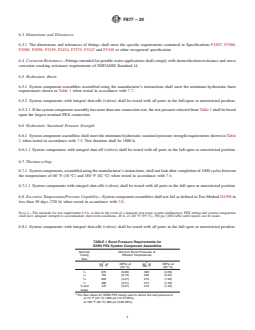
6.5.1 System component assemblies assembled using the manufacturer’s instructions shall meet the minimum hydrostatic burst
requirements shown in Table 1 when tested in accordance with 7.7.
6.5.2 System components with integral shut-offs (valves) shall be tested with all ports in the full-open or unrestricted position.
6.5.2.1 If the system component assembly has more than one connection size, the test pressure selected from Table 1 shall be based
upon the largest nominal PEX connection.
6.6 Hydrostatic Sustained Pressure Strength
6.6.1 System component assemblies shall meet the minimum hydrostatic sustained pressure strength requirements shown in Table
2 when tested in accordance with 7.5. Test duration shall be 1000 h.
6.6.1.1 System components with integral shut-off (valves) shall be tested with all ports in the full-open or unrestricted position.
6.7 Thermocycling:
6.7.1 System components, assembled using the manufacturer’s instructions, shall not leak after completion of 1000 cycles between
the temperatures of 60 °F (16 °C) and 180 °F (82 °C) when tested in accordance with 7.6.
6.7.1.1 System components with integral shut-offs (valves) shall be tested with all ports in the full open or unrestricted position.
6.8 Excessive Temperature/Pressure Capability—System component assemblies shall not fail as defined in Test Method D1598 in
less than 30 days (720 h) when tested in accordance with 7.8.
NOTE 2—The rationale for test requirement 6.8 is so that in the event of a domestic hot-water system malfunction, PEX tubing and system components
shall have adequate strength to accommodate short-term conditions, 48 h, of 210 °F (99 °C), 150 psi (1034 kPa) until repairs can be made.
6.8.1 System components with integral shut-offs (valves) shall be tested with all ports in the full open or unrestricted position.
TABLE 1 Burst Pressure Requirements for
SDR9 PEX System Component Assemblies
Nominal Minimum Burst Pressures at
Tubing Different Temperatures
Size
A A
psi at (MPa) at psi at (MPa) at
73 °F 180 °F
(23 °C) (82 °C)
⁄8 870 (6.00) 390 (2.69)
⁄4 752 (5.19) 336 (2.32)
⁄8 620 (4.27) 275 (1.90)
⁄2 480 (3.31) 215 (1.48)
⁄8 and 475 (3.27) 210 (1.45)
larger
A
The fiber stress for SDR9 PEX tubing used to derive this test pressure is:
at 73 °F (23 °C) 1900 psi (13.10 MPa).
at 180 °F (82 °C) 850 psi (5.86 MPa).
F877 − 24
TABLE 2 Minimum Hydrostatic Sustained Pressure
A
Requirements for SDR9 PEX System Component Assemblies
Nominal Tubing Size Pressure Required for Test,
A
psi (MPa)
180 °F (82 °C)
⁄8 355 (2.45)
⁄4 305 (2.10)
⁄8 250 (1.72)
⁄2 195 (1.34)
⁄8 and larger 190 (1.31)
A
The fiber stress for SDR9 PEX tubing used to derive this test pressure is: 770 psi
(5.31 MPa) at 180 °F (82 °C).
NOTE 3—Tests applicable to assemblies and bends (6.5, 6.6, 6.7, and 6.8) are intended to be performance qualification tests and not tests required of each
fitting.
7. Test Methods
7.1 General—Sections 7.4, 7.5, 7.6, 7.7, and 7.8 shall use separate sets of assemblies for each test.
7.2 Conditioning—The test specimens should be conditioned at 73 6 4 °F (23 6 2 °C) and 50 6 10 % relative humidity for not
less than 40 h prior to test in accordance with Practice D618, for those tests where conditioning is required.
7.3 Test Conditions—Conduct the tests in the standard laboratory atmosphere of 73 6 4 °F (23 6 2 °C) and 50 6 5 % relative
humidity, unless otherwise specified in the test methods or in this specification.
7.4 Sampling—A sufficient quantity of tubing and system components, as agreed upon by the purchaser and the seller, shall be
selected and tested to determine conformance with this specification. In the case of no prior agreement, random samples selected
by the testing laboratory shall be de
...