

ASTM F876-24
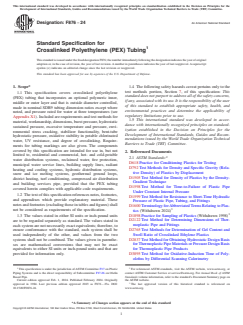
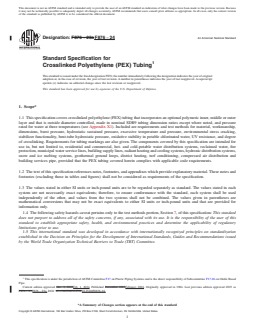
(Specification)Standard Specification for Crosslinked Polyethylene (PEX) Tubing
General Information
- Abstract
ABSTRACT
This specification covers crosslinked polyethylene (PEX) tubing that is outside diameter controlled, made in standard thermoplastic tubing dimension ratios, and pressure rated for water at three temperatures. This specification covers one PEX tubing material in one standard dimension ratio and having pressure ratings for water of three temperatures. The pressure ratings decrease as the temperature is increased. PEX tubing shall be made from polyethylene compounds which have been crosslinked by peroxides, Azo compounds, or silane compounds in extrusion, or by electron beam after extrusion, or by other means such that the tubing meets the performance requirements. The following tests shall be performed: dimensions and tolerances; density; sustained pressure test; burst pressure; environmental stress cracking test; degree of crosslinking; stabilizer functionality; and oxidative stability in potable chlorinated water applications.
SCOPE
1.1 This specification covers crosslinked polyethylene (PEX) tubing that incorporates an optional polymeric inner, middle or outer layer and that is outside diameter controlled, made in nominal SDR9 tubing dimension ratios except where noted, and pressure rated for water at three temperatures (see Appendix X1). Included are requirements and test methods for material, workmanship, dimensions, burst pressure, hydrostatic sustained pressure, excessive temperature and pressure, environmental stress cracking, stabilizer functionality, bent-tube hydrostatic pressure, oxidative stability in potable chlorinated water, UV resistance, and degree of crosslinking. Requirements for tubing markings are also given. The components covered by this specification are intended for use in, but not limited to, residential and commercial, hot- and cold-potable water distribution systems, reclaimed water, fire protection, municipal water service lines, building supply lines, radiant heating and cooling systems, hydronic distribution systems, snow and ice melting systems, geothermal ground loops, district heating, turf conditioning, compressed air distribution and building services pipe, provided that the PEX tubing covered herein complies with applicable code requirements.
1.2 The text of this specification references notes, footnotes, and appendixes which provide explanatory material. These notes and footnotes (excluding those in tables and figures) shall not be considered as requirements of the specification.
1.3 The values stated in either SI units or inch-pound units are to be regarded separately as standard. The values stated in each system are not necessarily exact equivalents; therefore, to ensure conformance with the standard, each system shall be used independently of the other, and values from the two systems shall not be combined. The values given in parentheses are mathematical conversions that may not be exact equivalents to either SI units or inch-pound units and that are provided for information only.
1.4 The following safety hazards caveat pertains only to the test methods portion, Section 7, of this specification: This standard does not purport to address all of the safety concerns, if any, associated with its use. It is the responsibility of the user of this standard to establish appropriate safety, health, and environmental practices and determine the applicability of regulatory limitations prior to use.
1.5 This international standard was developed in accordance with internationally recognized principles on standardization established in the Decision on Principles for the Development of International Standards, Guides and Recommendations issued by the World Trade Organization Technical Barriers to Trade (TBT) Committee.
- Status
- Published
- Publication Date
- 31-Jan-2024
- Technical Committee
- F17 - Plastic Piping Systems
- Drafting Committee
- F17.26 - Olefin Based Pipe
Buy Documents
ASTM F876-24 - Standard Specification for Crosslinked Polyethylene (PEX) Tubing
REDLINE ASTM F876-24 - Standard Specification for Crosslinked Polyethylene (PEX) Tubing
Overview
ASTM F876-24: Standard Specification for Crosslinked Polyethylene (PEX) Tubing provides comprehensive requirements for PEX tubing used in a wide range of water and fluid distribution systems. Developed by ASTM International, this standard delivers essential guidelines for materials, dimensions, pressure ratings, and performance characteristics of PEX tubing. Following globally recognized principles for standards development, ASTM F876-24 supports quality, safety, and interoperability across residential, commercial, and industrial piping applications.
Key Topics
ASTM F876-24 specifies the following central aspects for PEX tubing:
- Material Requirements: PEX tubing must use polyethylene compounds that have been crosslinked by approved methods (peroxides, silane compounds, electron beam, or others) to ensure long-term durability and performance.
- Dimension Control: Tubing is manufactured in Standard Dimension Ratio 9 (SDR9) with strict tolerances for outside diameter, wall thickness, and out-of-roundness, ensuring consistency and compatibility.
- Pressure Ratings: PEX tubing is pressure-rated for water at three key temperatures (typically 73°F, 180°F, and 200°F). Ratings decrease as temperature increases, supporting a range of plumbing applications.
- Performance Testing: Key tests include:
- Dimensions and tolerances
- Density
- Sustained pressure and burst pressure
- Environmental stress cracking
- Degree of crosslinking
- Stabilizer functionality
- Oxidative stability (especially in potable chlorinated water)
- Marking Requirements: Tubing must be permanently marked, including a designation code indicating chlorine resistance, UV resistance, and hydrostatic design stress.
- Layered Tubing: Permits optional polymeric layers, provided core PEX requirements are retained.
- Safety & Compliance: The standard addresses safety, health, and environmental practices associated with manufacturing and installation.
Applications
ASTM F876-24 PEX tubing is engineered for robust, reliable performance in a variety of applications, such as:
- Residential and Commercial Plumbing: Suitable for hot and cold potable water distribution in homes, apartments, offices, and large buildings.
- Fire Protection Systems: Used in water-based fire suppression installations.
- Municipal Water Service Lines: Reliable for service connections between water mains and buildings.
- Mechanical Systems: Includes radiant floor heating, radiant cooling, hydronic distribution, and snow/ice melting systems.
- Geothermal and District Heating: Well-suited for underground heat exchange loops and district heating piping.
- Reclaimed Water Distribution: Compatible with non-potable water reuse systems.
- Compressed Air and Building Services: PEX materials may be employed in certain low-pressure, non-critical compressed air piping.
Use of PEX tubing in these systems can result in easier installations, reduced costs, resistance to corrosion and scaling, and compliance with plumbing codes when manufactured and installed according to ASTM F876-24.
Related Standards
For optimal performance and regulatory compliance, ASTM F876-24 should be referenced in conjunction with related standards:
- ASTM F877: Specification for PEX Hot- and Cold-Water Distribution Systems
- NSF/ANSI 14: Plastic Piping System Components and Materials
- NSF/ANSI/CAN 61: Drinking Water System Components – Health Effects
- ISO 15875: Plastics piping systems for hot and cold water installations - Crosslinked polyethylene (PE-X)
- PPI TR-3 / TR-4: Guidance for hydrostatic design basis, pressure ratings, and strength of thermoplastic piping
- ASTM D1598 & D1599: Procedures for pressure testing of plastic pipe
- ASTM F2023 & F2657: Test methods for evaluating oxidative and UV stability of PEX pipes and tubing
Referencing these standards ensures comprehensive understanding and proper application of PEX tubing in accordance with international best practices.
Keywords: ASTM F876-24, crosslinked polyethylene tubing, PEX, SDR9, PEX specification, pressure-rated tubing, plumbing standards, water distribution, pipe performance, ASTM PEX tubing, building services piping
Relations
- Effective Date
- 01-Feb-2024
- Effective Date
- 01-Feb-2024
- Effective Date
- 01-Feb-2024
- Effective Date
- 01-Feb-2024
- Effective Date
- 01-Jul-2023
- Effective Date
- 01-Feb-2023
- Effective Date
- 01-Sep-2016
- Effective Date
- 01-Feb-2024
- Effective Date
- 01-Feb-2024
- Effective Date
- 01-Feb-2024
- Effective Date
- 01-Feb-2024
- Effective Date
- 01-Feb-2024
- Effective Date
- 01-Feb-2024
- Effective Date
- 01-Feb-2024
- Effective Date
- 01-Feb-2024
Buy Documents
ASTM F876-24 - Standard Specification for Crosslinked Polyethylene (PEX) Tubing
REDLINE ASTM F876-24 - Standard Specification for Crosslinked Polyethylene (PEX) Tubing
Get Certified
Connect with accredited certification bodies for this standard

Institut za varilstvo d.o.o. (Welding Institute)
Slovenia's leading welding institute since 1952. ISO 3834, EN 1090, pressure equipment certification, NDT personnel, welder qualification. Only IIW Au
Sponsored listings
Frequently Asked Questions
ASTM F876-24 is a technical specification published by ASTM International. Its full title is "Standard Specification for Crosslinked Polyethylene (PEX) Tubing". This standard covers: ABSTRACT This specification covers crosslinked polyethylene (PEX) tubing that is outside diameter controlled, made in standard thermoplastic tubing dimension ratios, and pressure rated for water at three temperatures. This specification covers one PEX tubing material in one standard dimension ratio and having pressure ratings for water of three temperatures. The pressure ratings decrease as the temperature is increased. PEX tubing shall be made from polyethylene compounds which have been crosslinked by peroxides, Azo compounds, or silane compounds in extrusion, or by electron beam after extrusion, or by other means such that the tubing meets the performance requirements. The following tests shall be performed: dimensions and tolerances; density; sustained pressure test; burst pressure; environmental stress cracking test; degree of crosslinking; stabilizer functionality; and oxidative stability in potable chlorinated water applications. SCOPE 1.1 This specification covers crosslinked polyethylene (PEX) tubing that incorporates an optional polymeric inner, middle or outer layer and that is outside diameter controlled, made in nominal SDR9 tubing dimension ratios except where noted, and pressure rated for water at three temperatures (see Appendix X1). Included are requirements and test methods for material, workmanship, dimensions, burst pressure, hydrostatic sustained pressure, excessive temperature and pressure, environmental stress cracking, stabilizer functionality, bent-tube hydrostatic pressure, oxidative stability in potable chlorinated water, UV resistance, and degree of crosslinking. Requirements for tubing markings are also given. The components covered by this specification are intended for use in, but not limited to, residential and commercial, hot- and cold-potable water distribution systems, reclaimed water, fire protection, municipal water service lines, building supply lines, radiant heating and cooling systems, hydronic distribution systems, snow and ice melting systems, geothermal ground loops, district heating, turf conditioning, compressed air distribution and building services pipe, provided that the PEX tubing covered herein complies with applicable code requirements. 1.2 The text of this specification references notes, footnotes, and appendixes which provide explanatory material. These notes and footnotes (excluding those in tables and figures) shall not be considered as requirements of the specification. 1.3 The values stated in either SI units or inch-pound units are to be regarded separately as standard. The values stated in each system are not necessarily exact equivalents; therefore, to ensure conformance with the standard, each system shall be used independently of the other, and values from the two systems shall not be combined. The values given in parentheses are mathematical conversions that may not be exact equivalents to either SI units or inch-pound units and that are provided for information only. 1.4 The following safety hazards caveat pertains only to the test methods portion, Section 7, of this specification: This standard does not purport to address all of the safety concerns, if any, associated with its use. It is the responsibility of the user of this standard to establish appropriate safety, health, and environmental practices and determine the applicability of regulatory limitations prior to use. 1.5 This international standard was developed in accordance with internationally recognized principles on standardization established in the Decision on Principles for the Development of International Standards, Guides and Recommendations issued by the World Trade Organization Technical Barriers to Trade (TBT) Committee.
ABSTRACT This specification covers crosslinked polyethylene (PEX) tubing that is outside diameter controlled, made in standard thermoplastic tubing dimension ratios, and pressure rated for water at three temperatures. This specification covers one PEX tubing material in one standard dimension ratio and having pressure ratings for water of three temperatures. The pressure ratings decrease as the temperature is increased. PEX tubing shall be made from polyethylene compounds which have been crosslinked by peroxides, Azo compounds, or silane compounds in extrusion, or by electron beam after extrusion, or by other means such that the tubing meets the performance requirements. The following tests shall be performed: dimensions and tolerances; density; sustained pressure test; burst pressure; environmental stress cracking test; degree of crosslinking; stabilizer functionality; and oxidative stability in potable chlorinated water applications. SCOPE 1.1 This specification covers crosslinked polyethylene (PEX) tubing that incorporates an optional polymeric inner, middle or outer layer and that is outside diameter controlled, made in nominal SDR9 tubing dimension ratios except where noted, and pressure rated for water at three temperatures (see Appendix X1). Included are requirements and test methods for material, workmanship, dimensions, burst pressure, hydrostatic sustained pressure, excessive temperature and pressure, environmental stress cracking, stabilizer functionality, bent-tube hydrostatic pressure, oxidative stability in potable chlorinated water, UV resistance, and degree of crosslinking. Requirements for tubing markings are also given. The components covered by this specification are intended for use in, but not limited to, residential and commercial, hot- and cold-potable water distribution systems, reclaimed water, fire protection, municipal water service lines, building supply lines, radiant heating and cooling systems, hydronic distribution systems, snow and ice melting systems, geothermal ground loops, district heating, turf conditioning, compressed air distribution and building services pipe, provided that the PEX tubing covered herein complies with applicable code requirements. 1.2 The text of this specification references notes, footnotes, and appendixes which provide explanatory material. These notes and footnotes (excluding those in tables and figures) shall not be considered as requirements of the specification. 1.3 The values stated in either SI units or inch-pound units are to be regarded separately as standard. The values stated in each system are not necessarily exact equivalents; therefore, to ensure conformance with the standard, each system shall be used independently of the other, and values from the two systems shall not be combined. The values given in parentheses are mathematical conversions that may not be exact equivalents to either SI units or inch-pound units and that are provided for information only. 1.4 The following safety hazards caveat pertains only to the test methods portion, Section 7, of this specification: This standard does not purport to address all of the safety concerns, if any, associated with its use. It is the responsibility of the user of this standard to establish appropriate safety, health, and environmental practices and determine the applicability of regulatory limitations prior to use. 1.5 This international standard was developed in accordance with internationally recognized principles on standardization established in the Decision on Principles for the Development of International Standards, Guides and Recommendations issued by the World Trade Organization Technical Barriers to Trade (TBT) Committee.
ASTM F876-24 is classified under the following ICS (International Classification for Standards) categories: 23.040.20 - Plastics pipes. The ICS classification helps identify the subject area and facilitates finding related standards.
ASTM F876-24 has the following relationships with other standards: It is inter standard links to ASTM F876-23a, ASTM D2765-16(2024), ASTM F877-24, ASTM F1281-24, ASTM F1281-23a, ASTM F877-23, ASTM D2765-16, ASTM F2854-21, ASTM F3536-22, ASTM F2165-19, ASTM F2080-23, ASTM F412-23, ASTM F2968/F2968M-21, ASTM F2023-21, ASTM F3348-23a. Understanding these relationships helps ensure you are using the most current and applicable version of the standard.
ASTM F876-24 is available in PDF format for immediate download after purchase. The document can be added to your cart and obtained through the secure checkout process. Digital delivery ensures instant access to the complete standard document.
Standards Content (Sample)
This international standard was developed in accordance with internationally recognized principles on standardization established in the Decision on Principles for the
Development of International Standards, Guides and Recommendations issued by the World Trade Organization Technical Barriers to Trade (TBT) Committee.
Designation: F876 − 24 An American National Standard
Standard Specification for
Crosslinked Polyethylene (PEX) Tubing
This standard is issued under the fixed designation F876; the number immediately following the designation indicates the year of original
adoption or, in the case of revision, the year of last revision. A number in parentheses indicates the year of last reapproval. A superscript
epsilon (´) indicates an editorial change since the last revision or reapproval.
This standard has been approved for use by agencies of the U.S. Department of Defense.
1. Scope* 1.4 The following safety hazards caveat pertains only to the
test methods portion, Section 7, of this specification: This
1.1 This specification covers crosslinked polyethylene
standard does not purport to address all of the safety concerns,
(PEX) tubing that incorporates an optional polymeric inner,
if any, associated with its use. It is the responsibility of the user
middle or outer layer and that is outside diameter controlled,
of this standard to establish appropriate safety, health, and
made in nominal SDR9 tubing dimension ratios except where
environmental practices and determine the applicability of
noted, and pressure rated for water at three temperatures (see
regulatory limitations prior to use.
Appendix X1). Included are requirements and test methods for
1.5 This international standard was developed in accor-
material, workmanship, dimensions, burst pressure, hydrostatic
dance with internationally recognized principles on standard-
sustained pressure, excessive temperature and pressure, envi-
ization established in the Decision on Principles for the
ronmental stress cracking, stabilizer functionality, bent-tube
Development of International Standards, Guides and Recom-
hydrostatic pressure, oxidative stability in potable chlorinated
mendations issued by the World Trade Organization Technical
water, UV resistance, and degree of crosslinking. Require-
Barriers to Trade (TBT) Committee.
ments for tubing markings are also given. The components
covered by this specification are intended for use in, but not
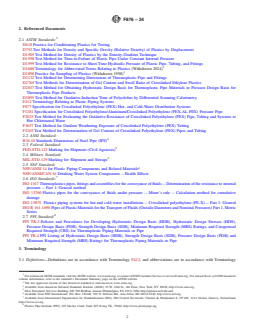
2. Referenced Documents
limited to, residential and commercial, hot- and cold-potable
2.1 ASTM Standards:
water distribution systems, reclaimed water, fire protection,
D618 Practice for Conditioning Plastics for Testing
municipal water service lines, building supply lines, radiant
D792 Test Methods for Density and Specific Gravity (Rela-
heating and cooling systems, hydronic distribution systems,
tive Density) of Plastics by Displacement
snow and ice melting systems, geothermal ground loops,
D1505 Test Method for Density of Plastics by the Density-
district heating, turf conditioning, compressed air distribution
Gradient Technique
and building services pipe, provided that the PEX tubing
D1598 Test Method for Time-to-Failure of Plastic Pipe
covered herein complies with applicable code requirements.
Under Constant Internal Pressure
1.2 The text of this specification references notes, footnotes,
D1599 Test Method for Resistance to Short-Time Hydraulic
and appendixes which provide explanatory material. These
Pressure of Plastic Pipe, Tubing, and Fittings
notes and footnotes (excluding those in tables and figures) shall
D1600 Terminology for Abbreviated Terms Relating to Plas-
not be considered as requirements of the specification.
tics (Withdrawn 2024)
1.3 The values stated in either SI units or inch-pound units D1898 Practice for Sampling of Plastics (Withdrawn 1998)
D2122 Test Method for Determining Dimensions of Ther-
are to be regarded separately as standard. The values stated in
each system are not necessarily exact equivalents; therefore, to moplastic Pipe and Fittings
D2765 Test Methods for Determination of Gel Content and
ensure conformance with the standard, each system shall be
used independently of the other, and values from the two Swell Ratio of Crosslinked Ethylene Plastics
D2837 Test Method for Obtaining Hydrostatic Design Basis
systems shall not be combined. The values given in parenthe-
for Thermoplastic Pipe Materials or Pressure Design Basis
ses are mathematical conversions that may not be exact
for Thermoplastic Pipe Products
equivalents to either SI units or inch-pound units and that are
D3895 Test Method for Oxidative-Induction Time of Poly-
provided for information only.
olefins by Differential Scanning Calorimetry
1 2
This specification is under the jurisdiction of ASTM Committee F17 on Plastic For referenced ASTM standards, visit the ASTM website, www.astm.org, or
Piping Systems and is the direct responsibility of Subcommittee F17.26 on Olefin contact ASTM Customer Service at service@astm.org. For Annual Book of ASTM
Based Pipe. Standards volume information, refer to the standard’s Document Summary page on
Current edition approved Feb. 1, 2024. Published February 2024. Originally the ASTM website.
approved in 1984. Last previous edition approved 2023 as F876 – 23a. DOI: The last approved version of this historical standard is referenced on
10.1520/F0876-24. www.astm.org.
*A Summary of Changes section appears at the end of this standard
Copyright © ASTM International, 100 Barr Harbor Drive, PO Box C700, West Conshohocken, PA 19428-2959. United States
F876 − 24
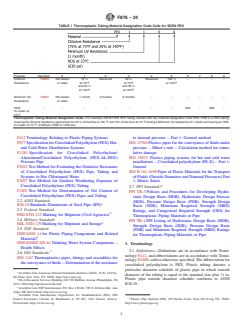
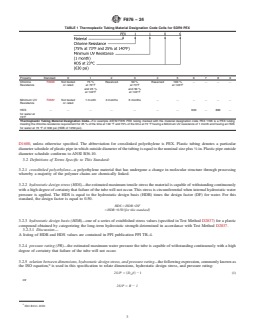
TABLE 1 Thermoplastic Tubing Material Designation Code Cells for SDR9 PEX
Property Standard 0 1 2 3 4 5 6 7 8 9
Chlorine F2023 Not tested 75 % Reserved 50 % Reserved 100 % . . . .
Resistance or rated at 73°F at 73°F at 140°F
and 25 % and 50 %
at 140°F at 140°F
Minimum UV F2657 Not tested 1 month 3 months 6 months . . . . . .
Resistance or rated
HDS . . . . . . . 630 . 800 .
for water at
73°F
Thermoplastic Tubing Material Designation Code—For example ASTM F876 PEX tubing marked with the material designation code PEX 1106 is a PEX tubing
meeting the chlorine resistance requirement for 25 % of the time at 140 °F and 75% of the time at 73 °F having a Minimum UV resistance of 1 month and having an HDS
for water at 73 °F of 630 psi (HDB of 1250 psi).
F412 Terminology Relating to Plastic Piping Systems to internal pressure -- Part 1: General method
F877 Specification for Crosslinked Polyethylene (PEX) Hot- ISO 13760 Plastics pipes for the conveyance of fluids under
and Cold-Water Distribution Systems pressure -- Miner’s rule -- Calculation method for cumu-
F1281 Specification for Crosslinked Polyethylene/ lative damage
Aluminum/Crosslinked Polyethylene (PEX-AL-PEX) ISO 15875 Plastics piping systems for hot and cold water
Pressure Pipe installations -- Crosslinked polyethylene (PE-X) -- Part 1:
F2023 Test Method for Evaluating the Oxidative Resistance General
of Crosslinked Polyethylene (PEX) Pipe, Tubing and ISO R 161-1690 Pipes of Plastic Materials for the Transport
Systems to Hot Chlorinated Water of Fluids (Outside Diameters and Nominal Pressures) Part
F2657 Test Method for Outdoor Weathering Exposure of 1, Metric Series
Crosslinked Polyethylene (PEX) Tubing
2.7 PPI Standard:
F3203 Test Method for Determination of Gel Content of
PPI TR-3 Policies and Procedures for Developing Hydro-
Crosslinked Polyethylene (PEX) Pipes and Tubing
static Design Basis (HDB), Hydrostatic Design Stresses
2.2 ANSI Standard:
(HDS), Pressure Design Basis (PDB), Strength Design
B36.10 Standards Dimensions of Steel Pipe (IPS)
Basis (SDB), Minimum Required Strength (MRS)
2.3 Federal Standard:
Ratings, and Categorized Required Strength (CRS) for
FED-STD-123 Marking for Shipment (Civil Agencies)
Thermoplastic Piping Materials or Pipe
2.4 Military Standard:
PPI TR-4 PPI Listing of Hydrostatic Design Basis (HDB),
MIL-STD-129 Marking for Shipment and Storage
Strength Design Basis (SDB), Pressure Design Basis
2.5 NSF Standard:
(PDB) and Minimum Required Strength (MRS) Ratings
NSF/ANSI 14 for Plastic Piping Components and Related
for Thermoplastic Piping Materials or Pipe
Materials
NSF/ANSI/CAN 61 Drinking Water System Components –
3. Terminology
Health Effects
3.1 Definitions—Definitions are in accordance with Termi-
2.6 ISO Standards:
nology F412, and abbreviations are in accordance with Termi-
ISO 1167 Thermoplastics pipes, fittings and assemblies for
nology D1600, unless otherwise specified. The abbreviation for
the conveyance of fluids -- Determination of the resistance
crosslinked polyethylene is PEX. Plastic tubing denotes a
particular diameter schedule of plastic pipe in which outside
Available from American National Standards Institute (ANSI), 25 W. 43rd St.,
diameter of the tubing is equal to the nominal size plus ⁄8 in.
4th Floor, New York, NY 10036, http://www.ansi.org.
5 Plastic pipe outside diameter schedule conforms to ANSI
DLA Document Services Building 4/D 700 Robbins Avenue Philadelphia, PA
19111-5094 http://quicksearch.dla.mil/ B36.10.
Available from NSF International, P.O. Box 130140, 789 N. Dixboro Rd., Ann
Arbor, MI 48113-0140, http://www.nsf.org.
Available from International Organization for Standardization (ISO), ISO
Central Secretariat, Chemin de Blandonnet 8, CP 401, 1214 Vernier, Geneva, Plastics Pipe Institute (PPI), 105 Decker Court, Suite 825 Irving TX, 75062.
Switzerland, https://www.iso.org. http://www.plasticpipe.org
F876 − 24
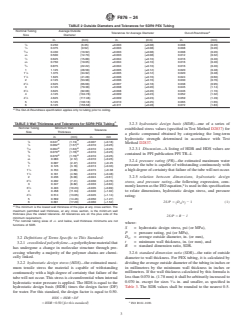
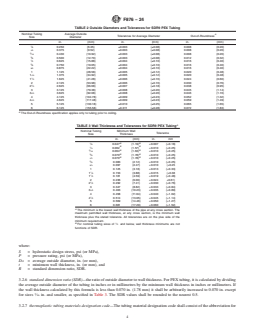
TABLE 2 Outside Diameters and Tolerances for SDR9 PEX Tubing
Nominal Tubing Average Outside
A
Tolerances for Average Diameter Out-of-Roundness
Size Diameter
in. (mm) in. (mm) in. (mm)
⁄8 0.250 (6.35) ±0.003 (±0.08) 0.008 (0.20)
⁄4 0.375 (9.52) ±0.003 (±0.08) 0.008 (0.20)
⁄16 0.430 (10.92) ±0.003 (±0.08) 0.008 (0.20)
⁄8 0.500 (12.70) ±0.003 (±0.08) 0.012 (0.32)
⁄2 0.625 (15.88) ±0.004 (±0.10) 0.016 (0.40)
⁄8 0.750 (19.05) ±0.004 (±0.10) 0.016 (0.40)
⁄4 0.875 (22.22) ±0.004 (±0.10) 0.016 (0.40)
1 1.125 (28.58) ±0.005 (±0.12) 0.020 (0.48)
1 ⁄4 1.375 (34.92) ±0.005 (±0.12) 0.020 (0.48)
1 ⁄2 1.625 (41.28) ±0.006 (±0.16) 0.024 (0.60)
2 2.125 (53.98) ±0.006 (±0.16) 0.030 (0.76)
2 ⁄2 2.625 (66.68) ±0.007 (±0.18) 0.038 (0.95)
3 3.125 (79.38) ±0.008 (±0.20) 0.045 (1.14)
3 ⁄2 3.625 (92.08) ±0.008 (±0.20) 0.046 (1.16)
4 4.125 (104.78) ±0.009 (±0.23) 0.052 (1.32)
4 ⁄2 4.625 (117.48) ±0.009 (±0.23) 0.059 (1.49)
5 5.125 (130.18) ±0.010 (±0.25) 0.065 (1.65)
6 6.125 (155.58) ±0.011 (±0.28) 0.072 (1.83)
A
The Out-of-Roundness specification applies only to tubing prior to coiling.
A
TABLE 3 Wall Thickness and Tolerances for SDR9 PEX Tubing
3.2.3 hydrostatic design basis (HDB)—one of a series of
Nominal Tubing Minimum Wall
established stress values (specified in Test Method D2837) for
Tolerance
Size Thickness
a plastic compound obtained by categorizing the long-term
in. (mm) in. mm
hydrostatic strength determined in accordance with Test
B B
⁄8 0.047 (1.19) +0.007 (+0.18)
Method D2837.
B B
⁄4 0.062 (1.57) +0.010 (+0.25)
B B
⁄16 0.064 (1.63) +0.010 (+0.25) 3.2.3.1 Discussion—A listing of HDB and HDS values are
B B
⁄8 0.070 (1.78) +0.010 (+0.25)
contained in PPI publication PPI TR–4.
B B
⁄2 0.070 (1.78) +0.010 (+0.25)
⁄8 0.083 (2.12) +0.010 (+0.25)
3.2.4 pressure rating (PR)—the estimated maximum water
⁄4 0.097 (2.47) +0.010 (+0.25
pressure the tube is capable of withstanding continuously with
1 0.125 (3.18) +0.013 (+0.33)
1 ⁄4 0.153 (3.88) +0.015 (+0.38 a high degree of certainty that failure of the tube will not occur.
1 ⁄2 0.181 (4.59) +0.019 (+0.48)
2 0.236 (6.00) +0.024 +0.61) 3.2.5 relation between dimensions, hydrostatic design
2 ⁄2 0.292 (7.41) +0.030 (+0.76)
stress, and pressure rating—the following expression, com-
3 0.347 (8.82) +0.033 (+0.84)
monly known as the ISO equation, is used in this specification
3 ⁄2 0.403 (10.23) +0.035 (+0.89)
4 0.458 (11.64) +0.040 (+1.02) to relate dimensions, hydrostatic design stress, and pressure
4 ⁄2 0.514 (13.05) +0.045 (+1.14)
rating:
5 0.569 (14.46) +0.050 (+1.27)
6 0.681 (17.29) +0.060 (+1.52)
2S/P 5 ~D /t! 2 1 (1)
O
A
The minimum is the lowest wall thickness of the pipe at any cross section. The
or
maximum permitted wall thickness, at any cross section, is the minimum wall
thickness plus the stated tolerance. All tolerances are on the plus side of the
2S/P 5 R 2 1
minimum requirement.
B
For nominal tubing sizes of ⁄2 and below, wall thickness minimums are not
where:
functions of SDR.
S = hydrostatic design stress, psi (or MPa),
P = pressure rating, psi (or MPa),
D = average outside diameter, in. (or mm),
3.2 Definitions of Terms Specific to This Standard: O
t = minimum wall thickness, in. (or mm), and
3.2.1 crosslinked polyethylene—a polyethylene material that
R = standard dimension ratio, SDR.
has undergone a change in molecular structure through pro-
cessing whereby a majority of the polymer chains are chemi-
3.2.6 standard dimension ratio (SDR)—the ratio of outside
cally linked.
diameter to wall thickness. For PEX tubing, it is calculated by
dividing the average outside diameter of the tubing in inches or
3.2.2 hydrostatic design stress (HDS)—the estimated maxi-
in millimetres by the minimum wall thickness in inches or
mum tensile stress the material is capable of withstanding
millimetres. If the wall thickness calculated by this formula is
continuously with a high degree of certainty that failure of the
less than 0.070 in. (1.78 mm) it shall be arbitrarily increased to
tube will not occur. This stress is circumferential when internal
0.070 in. except for sizes ⁄16 in. and smaller, as specified in
hydrostatic water pressure is applied. The HDS is equal to the
Table 3. The SDR values shall be rounded to the nearest 0.5.
hydrostatic design basis (HDB) times the design factor (DF)
for water. For this standard, the design factor is equal to 0.50.
HDS 5 HDB × DF
5HDB × 0.50 for this standard ISO R161-1690.
~ !
F876 − 24
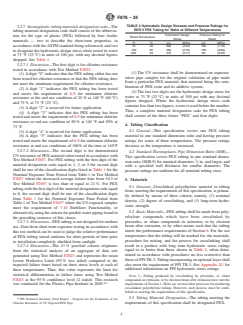
TABLE 4 Hydrostatic Design Stresses and Pressure Ratings for
3.2.7 thermoplastic tubing materials designation code—The
SDR 9 PEX Tubing for Water at Different Temperatures
tubing material designation code shall consist of the abbrevia-
Hydrostatic Design Pressure Rating for
tion for the type of plastic (PEX) followed by four Arabic
Rated Temperature
Stress Water
numerals — two to describe the short-term properties, in
°F °C psi (MPa) psi (MPa)
accordance with the ASTM standard being referenced, and two
73 23 630 (4.34) 160 (1.10)
180 82 400 (2.76) 100 (0.69)
to designate the hydrostatic design stress when tested in water
200 93 315 (2.17) 80 (0.55)
at 73 °F (23 °C) in units of 100 psi, with any decimal figures
dropped. See Table 1.
3.2.7.1 Discussion—The first digit is for chlorine resistance
tested in accordance with Test Method F2023.
(1) The UV resistance shall be demonstrated on represen-
(1) A digit “0” indicates that the PEX tubing either has not
tative pipe samples for the original validation of pipe made
been tested for chlorine resistance or that the PEX tubing does
from a particular PEX material, that material being the com-
not meet the minimum requirement for chlorine resistance.
bination of PEX resin and its additive system.
(2) A digit “1” indicates the PEX tubing has been tested
(2) The last two digits are the hydrostatic design stress for
and meets the requirement of 6.9 for minimum chlorine
water at 73 °F (23 °C) in units of 100 psi with any decimal
resistance at the end use condition of 25 % at 140 °F (60 °C)
figures dropped. Where the hydrostatic design stress code
and 75 % at 73 °F (23 °C).
contains less than two figures, a zero is used before the number.
(3) A digit “2” is reserved for future application.
Thus, a complete material designation code for PEX tubing
(4) A digit “3” indicates that the PEX tubing has been
shall consist of the three letters “PEX” and four digits.
tested and meets the requirement of 6.9 for minimum chlorine
resistance at end use condition of 50 % at 140 °F and 50% at
4. Tubing Classification
73 °F.
4.1 General—This specification covers one PEX tubing
(5) A digit “4” is reserved for future application.
material in one standard dimension ratio and having pressure
(6) A digit “5” indicates that the PEX tubing has been
ratings for water of three temperatures. The pressure ratings
tested and meets the requirement of 6.9 for minimum chlorine
decrease as the temperature is increased.
resistance at end use conditions of 100% of the time at 140°F
3.2.7.2 Discussion—The second digit is for demonstrated
4.2 Standard Thermoplastic Pipe Dimension Ratio (SDR)—
UV resistance of PEX material when tested in accordance with
This specification covers PEX tubing in one standard dimen-
Test Method F2657. For PEX tubing with the first digit of the 5
sion ratio (SDR 9) for nominal diameters ⁄8 in. and larger, and
material designation code equal to 1, 3, or 5 the second digit
with a specified wall thickness for smaller diameters. The
shall be one of the classification digits listed in Table 1 for the
pressure ratings are uniform for all nominal tubing sizes.
Nominal Exposure Time Period from Table 1 in Test Method
F2657 where the decreased average failure time from 10.3 of
5. Materials
Test Method F2657 is less than or equal to 21 %. For PEX
5.1 General—Crosslinked polyethylene material in tubing
tubing with the first digit of the material designation code equal
form, meeting the requirements of this specification, is primar-
to 0, the second digit shall be one of the classification digits
ily defined by means of three criteria, namely, (1) nominal
from Table 1 for the Nominal Exposure Time Period from
density, (2) degree of crosslinking, and (3) long-term hydro-
Table 1 of Test Method F2657 where the UV-exposed samples
static strength.
meet the requirement of 7.10 Stabilizer Functionality, or
5.2 Basic Materials—PEX tubing shall be made from poly-
alternatively using the criteria for potable water piping found in
ethylene compounds which have been crosslinked by
the preceding sentence of this clause.
peroxides, or silane compounds in extrusion, or by electron
3.2.7.3 Discussion—PEX tubing is not designed for outdoor
beam after extrusion, or by other means such that the tubing
use. Data from short-term exposure testing in accordance with
meets the performance requirements of Section 6. For the use
this test method can be used to judge the relative performance
temperatures that the tubing will be marked for, the materials,
of PEX tubing stored outdoors for short periods of time prior
procedure for mixing, and the process for crosslinking shall
to installation completely shielded from sunlight.
result in a product with long term hydrostatic stress ratings
3.2.7.4 Discussion—The 21 % pass/fail criteria originates
equal to or better than those shown in Table 4, when deter-
from the statistical analysis of an aggregate of data sets
mined in accordance with procedures no less restrictive than
generated using Test Method F2023 and represents the mean
those of PPI TR-3. Tubing incorporating an optional layer shall
Lower Predictive Limit (95 % two sided) compared to the
also meet the requirement of PPI TR-3. See Appendix X1 for
expected failure times based on three stress levels at each of
additional information on PPI hydrostatic stress ratings.
three temperatures. Thus, this value represents the limit for
statistical differentiation in failure times using Test Method
NOTE 1—Tubing produced by crosslinking by peroxides, or silane
F2023 at the 95 % confidence level (2 sided). This research
compounds in extrusion, or by electron beam after extrusion have met the
requirements of Section 6. There are several other processes for producing
was conducted for the Plastics Pipe Institute in 2005.
crosslinked polyethylene tubing. However, each process must be estab-
lished as meeting the requirements of this specification.
5.3 Tubing Material Designation—The tubing meeting the
PPI Technical literature, Final Report – Proposal for the Evaluation of the
Chlorine Resistance of UV Exposed PEX Pipe. requirements of this specification shall be designated PEX.
F876 − 24
TABLE 5 Minimum Hydrostatic Sustained Pressure Requirements for SDR9 PEX Tubing
A
Nominal Pressure Required for Test, psi
(MPa)
Tubing
Size
(NTS)
73 °F (23 °C) 180 °F (82 °C) 200 °F (93 °C)
⁄8 595 (4.10) 355 (2.45) 300 (2.07)
⁄4 515 (3.55) 305 (2.10) 260 (1.79)
⁄8 425 (2.93) 250 (1.72) 210 (1.45)
⁄2 330 (2.28) 195 (1.34) 165 (1.14)
⁄8 and larger 325 (2.24) 190 (1.31) 165 (1.14)
A
The hoop stresses used to derive these test pressures are:
at 73 °F (23 °C) 1300 psi (8.96 MPa).
at 180 °F (82 °C) 770 psi (5.31 MPa).
at 200 °F (93 °C) 650 psi (4.48 MPa).
TABLE 6 Minimum 165-Hour Hydrostatic Sustained Pressure
6. Requirements
Requirements for SDR9 PEX Tubing
6.1 Workmanship—The tubing shall be uniform in appear-
A†‡
Nominal Pressure Required for Test, psi (MPa)
ance and consistent throughout. The walls shall be free of Tubing Size 73 °F (23 °C) 200 °F (93 °C)
(NTS)
cracks, holes, blisters, voids, foreign inclusion, or other defects
⁄8 639 (4.41) 320 (2.21)
that are visible to the naked eye and that affect the wall
⁄4 547 (3.77) 274 (1.89)
integrity. The tubing shall be as uniform as commercially
⁄8 450 (3.10) 225 (1.55)
⁄2 349 (2.41) 175 (1.21)
practicable in color, opacity, density, and other physical prop-
⁄8 and 345 (2.38) 172 (1.19)
erties.
larger
A
6.2 Dimensions and Tolerances:
The hoop stresses used to derive these test pressures are 1380 psi (9.51 MPa)
at 73 °F (23 °C) and 690 psi (4.76 MPa at 200 °F (93 °C)).
6.2.1 Outside Diameters—The outside diameters and toler-
†
Editorially corrected in March 2022.
ances of the tubing including the layers shall be as shown in
‡
Editorially corrected in April 2022.
Table 2, when measured in accordance with 7.4 and 7.4.1.
6.2.1.1 Layer—Tubing that incorporates an inner, middle or
outer layer have to meet the minimum wall thickness and
6.6 Environmental Stress Cracking— There shall be no loss
tolerances requirements as specified in Table 3. In addition, the
of pressure in the tubing, when tested in accordance with 7.8.
layer shall not result in the reduction of the total PEX material
below that specified in Table 3. In the case of tubing with a
6.7 Degree of Crosslinking—When tested in accordance
middle layer, the total base PEX material wall thickness shall
with 7.9, the degree of crosslinking for PEX tubing material
be the sum of the inner and outer base PEX material wall
shall be within the range from 65 % to 89 % inclusive.
thicknesses.
Depending on the process used, the following minimum
6.2.2 Wall Thickness—The wall thickness and tolerances
percentage crosslinking values shall be achieved: 70 % by
shall be as shown in Table 3, when measured in accordance
peroxides, 65 % by electron beam, or 65 % by silane com-
with 7.4 and 7.4.2.
pounds.
5 6.7.1 Layer—For tubing with a layer, the degree of cross-
NOTE 2—Tubing diameters less than ⁄8 in. diameter have minimum
linking of the PEX material excluding the layer shall be in
wall thicknesses based on both hydrostatic and mechanical strength.
accordance with 6.7.
6.2.3 Out-of Roundness—The maximum out-of roundness
requirements, shown in Table 2 for tubing, apply to the
NOTE 3—Techniques as found in Test Methods D2765.
average, measured diameter. Tubing shall be measured prior to
6.8 Stabilizer Functionality—There shall be no loss of
coiling.
pressure in the tubing, when tested in accordance with 7.10.
6.2.4 Coil diameters—PEX tubing may be supplied in either
6.9 Oxidative Stability in Potable Chlorinated Water
straight lengths or coils with a minimum coiling diameter
Applications—PEX tubing intended for use in the transport of
based on a tubing bend radius of 10 times the outside diameter.
potable water shall have a minimum extrapolated time-to-time
6.3 Density—When determined in accordance with 7.5, the
failure of 50 years and comply with the requirements for a first
crosslinked polyethylene tubing shall have a minimum density
digit of “1” or higher in the PEX Tubing Material Designation
of 0.926 g/cm .
Code when tested and evaluated in accordance with 7.11.
6.4 Hydrostatic Sustained Pressure Strength—The tubing
6.10 Oxidative Stability in Outdoor Weathering Exposure
shall not fail, balloon, burst, or weep as defined in Test Method
(UltraViolet)—PEX tubing intended for use in the transport of
D1598, at the test pressures shown in Table 5 or Table 6 when
potable water shall comply with the requirements for a second
tested in accordance with 7.6.
digit of “1” or higher in the PEX Tubing Material Designation
6.5 Hydrostatic Burst Pressure—The minimum burst pres- Code when tested and evaluated in accordance with Test
sure for PEX plastic tubing shall be as shown in Table 7, when Method F2657 where the decreased average failure time is less
determined in accordance with 7.7. than or equal to 21 %.
F876 − 24
TABLE 7 Burst Pressure Requirements for Water at Different Temperatures for SDR9 PEX Tubing
A
Nominal Tubing Minimum Burst Pressures at Different Temperatures, psi (MPa)
Size
(NTS)
73 °F (23 °C) 180 °F (82 °C)
⁄8 870 (6.00) 390 (2.69)
⁄4 752 (5.19) 336 (2.32)
⁄8 620 (4.27) 275 (1.90)
⁄2 480 (3.31) 215 (1.48)
⁄8 and larger 475 (3.27) 210 (1.45)
A
The hoop stresses used to derive these test pressures are:
at 73 °F (23 °C) 1900 psi (13.10 MPa).
at 180 °F (82 °C) 850 psi (5.86 MPa).
NOTE 4—Test Method F2657 provides a measure of the effects of
6.14.1 Tubing shall be used with fitting systems that are
natural sunlight ultraviolet exposure; however, outdoor weathering in
specifically recommended for use by the PEX tubing manu-
accordance with Test Method F2657 requires open outside exposure that
facturer as a result of testing to the system performance
also includes incidental exposure to natural environmental conditions
requirements in Specification F877 Section 6: Hydrostatic
(cyclical temperature change, dust, precipitation, humidity, etc.).
Accordingly, testing per Test Method F2657 incorporates weathering Burst; Hydrostatic Sustained Pressure Strength; Thermocy-
exposure during the measurement of UV resistance.
cling; and Excessive Temperature/Pressure Capability and,
when applicable, the requirements of the reference fitting
6.11 Adhesion Test—Tubing that incorporates an optional
standard.
inner, middle or outer layer shall not show any delamination
when tested in accordance with 9.3.1 of Specification F1281.
NOTE 7—Tests applicable to tubing and fittings assemblies are intended
to be performance qualification tests of joints and not tests required of
6.12 Bent Tube Hydrostatic Sustained Pressure Strength:
each fitting configuration.
6.12.1 General—PEX tubing, up to and including 1 in.
nominal diameter, can be installed bent by using either of two
7. Test Methods
techniques described in X3.2.4 and X3.2.5, provided that
7.1 Conditioning—Condition the specimens at 73 °F 6 4 °F
6.12.2 and 6.12.3 requirements are met.
(23 °C 6 2 °C) and 50 % 6 10 % relative humidity for not less
NOTE 5—PEX tubing, larger than 1 in. nominal diameter, is typically
than 40 h prior to test in accordance with Procedure A of
installed as main distribution lines and is installed in straight runs. Fittings
Practice D618, for those tests where conditioning is required.
are used when a change in direction of 90° or greater and a bend radius of
6 times the outside diameter is needed. The test procedures in 6.12.2 and In cases of disagreement, the tolerances shall be 62 °F
6.12.3 are intended to evaluate PEX tubing installed in tight bend
(61 °C) and 62 % relative humidity.
applications in accordance with the procedures in X3.2.4 and X3.2.5. This
7.2 Test Conditions—Conduct the test in the standard labo-
application applies to tubing up to and including 1 in nominal diameter
only.
ratory atmosphere of 73 °F 6 4 °F (23 °C 6 2 °C) and 50 % 6
10 % relative humidity, unless otherwise specified in the test
6.12.2 Hot-bent tubing, with a radius of 2.5 times the
methods or in this specification. In cases of disagreement, the
outside diameter and consisting of a continuous bend length
tolerances shall be 62 °F (61 °C) and 62 % relative humidity.
inducing not less than 90° angle, shall meet the minimum
hydrostatic sustained pressure strength requirements for 180 °F
7.3 Sampling—A sufficient quantity of tubing, as agreed
as shown in Table 5 when tested in accordance with 7.6. The
upon by the purchaser and the seller, shall be selected and
bend length and bend angle is kept throughout the testing
tested to determine conformance with this specification (see
period by rigid supports immediately outside the bend.
Practice D1898). In the case of no prior agreement, random
6.12.3 Cold-bent tubing, with a radius of 6 times the outside
samples selected by the testing laboratory shall be deemed
diameter and consisting of a continuous bend length inducing
adequate.
not less than 90° angle, shall meet the minimum hydrostatic
7.3.1 Test Specimens—Not less than 50 % of the test speci-
sustained pressure strength requirements for 180 °F as shown
mens required for any pressure test shall have at least a part of
in Table 5 when tested in accordance with 7.6. The bend length
the marking in their central sections. The central section is that
and bend angle is kept throughout the testing period by rigid
portion of tubing that is at least one tubing diameter away from
secures immediately outside the bend.
an end closure.
6.13 Excessive Temperature—Pressure Capacity:
7.4 Dimensions and Tolerances—Use any length of tubing
6.13.1 Tubing shall not fail as defined in Test Method
to determine the dimensions. Measure in accordance with Test
D1598 in less than 30 days (720 h) when tested in accordance
Method D2122.
with 7.12.
7.4.1 Outside Diameter—Measure the outside diameter of
the tubing in accordance with Test Method D2122. The referee
NOTE 6—The rationale for test requirement 6.13 is so that in the event
method of measurement is to be by circumferential wrap tape.
of a domestic hot-water system malfunction, PEX tubing should have
adequate strength to accommodate short-term conditions, 48 h of 210 °F
The tolerance for out-of-roundness shall apply only to tubing
(99 °C), 150 psi (1034 kPa) until repairs can be made.
prior to shipment. Averaging micrometer or vernier caliper
6.14 Tubing qualification with fitting system(s): measurements, four (4) maximum and minimum diameter
F876 − 24
measurements at any cross section, may be used for quality in. (305 mm and 457 mm)
...
This document is not an ASTM standard and is intended only to provide the user of an ASTM standard an indication of what changes have been made to the previous version. Because
it may not be technically possible to adequately depict all changes accurately, ASTM recommends that users consult prior editions as appropriate. In all cases only the current version
of the standard as published by ASTM is to be considered the official document.
Designation: F876 − 23a F876 − 24 An American National Standard
Standard Specification for
Crosslinked Polyethylene (PEX) Tubing
This standard is issued under the fixed designation F876; the number immediately following the designation indicates the year of original
adoption or, in the case of revision, the year of last revision. A number in parentheses indicates the year of last reapproval. A superscript
epsilon (´) indicates an editorial change since the last revision or reapproval.
This standard has been approved for use by agencies of the U.S. Department of Defense.
1. Scope*
1.1 This specification covers crosslinked polyethylene (PEX) tubing that incorporates an optional polymeric inner, middle or outer
layer and that is outside diameter controlled, made in nominal SDR9 tubing dimension ratios except where noted, and pressure
rated for water at three temperatures (see Appendix X1). Included are requirements and test methods for material, workmanship,
dimensions, burst pressure, hydrostatic sustained pressure, excessive temperature and pressure, environmental stress cracking,
stabilizer functionality, bent-tube hydrostatic pressure, oxidative stability in potable chlorinated water, UV resistance, and degree
of crosslinking. Requirements for tubing markings are also given. The components covered by this specification are intended for
use in, but not limited to, residential and commercial, hot- and cold-potable water distribution systems, reclaimed water, fire
protection, municipal water service lines, building supply lines, radiant heating and cooling systems, hydronic distribution systems,
snow and ice melting systems, geothermal ground loops, district heating, turf conditioning, compressed air distribution and
building services pipe, provided that the PEX tubing covered herein complies with applicable code requirements.
1.2 The text of this specification references notes, footnotes, and appendixes which provide explanatory material. These notes and
footnotes (excluding those in tables and figures) shall not be considered as requirements of the specification.
1.3 The values stated in either SI units or inch-pound units are to be regarded separately as standard. The values stated in each
system are not necessarily exact equivalents; therefore, to ensure conformance with the standard, each system shall be used
independently of the other, and values from the two systems shall not be combined. The values given in parentheses are
mathematical conversions that may not be exact equivalents to either SI units or inch-pound units and that are provided for
information only.
1.4 The following safety hazards caveat pertains only to the test methods portion, Section 7, of this specification: This standard
does not purport to address all of the safety concerns, if any, associated with its use. It is the responsibility of the user of this
standard to establish appropriate safety, health, and environmental practices and determine the applicability of regulatory
limitations prior to use.
1.5 This international standard was developed in accordance with internationally recognized principles on standardization
established in the Decision on Principles for the Development of International Standards, Guides and Recommendations issued
by the World Trade Organization Technical Barriers to Trade (TBT) Committee.
This specification is under the jurisdiction of ASTM Committee F17 on Plastic Piping Systems and is the direct responsibility of Subcommittee F17.26 on Olefin Based
Pipe.
Current edition approved Dec. 1, 2023Feb. 1, 2024. Published December 2023February 2024. Originally approved in 1984. Last previous edition approved 2023 as
F876 – 23.F876 – 23a. DOI: 10.1520/F0876-23A.10.1520/F0876-24.
*A Summary of Changes section appears at the end of this standard
Copyright © ASTM International, 100 Barr Harbor Drive, PO Box C700, West Conshohocken, PA 19428-2959. United States
F876 − 24
2. Referenced Documents
2.1 ASTM Standards:
D618 Practice for Conditioning Plastics for Testing
D792 Test Methods for Density and Specific Gravity (Relative Density) of Plastics by Displacement
D1505 Test Method for Density of Plastics by the Density-Gradient Technique
D1598 Test Method for Time-to-Failure of Plastic Pipe Under Constant Internal Pressure
D1599 Test Method for Resistance to Short-Time Hydraulic Pressure of Plastic Pipe, Tubing, and Fittings
D1600 Terminology for Abbreviated Terms Relating to Plastics (Withdrawn 2024)
D1898 Practice for Sampling of Plastics (Withdrawn 1998)
D2122 Test Method for Determining Dimensions of Thermoplastic Pipe and Fittings
D2765 Test Methods for Determination of Gel Content and Swell Ratio of Crosslinked Ethylene Plastics
D2837 Test Method for Obtaining Hydrostatic Design Basis for Thermoplastic Pipe Materials or Pressure Design Basis for
Thermoplastic Pipe Products
D3895 Test Method for Oxidative-Induction Time of Polyolefins by Differential Scanning Calorimetry
F412 Terminology Relating to Plastic Piping Systems
F877 Specification for Crosslinked Polyethylene (PEX) Hot- and Cold-Water Distribution Systems
F1281 Specification for Crosslinked Polyethylene/Aluminum/Crosslinked Polyethylene (PEX-AL-PEX) Pressure Pipe
F2023 Test Method for Evaluating the Oxidative Resistance of Crosslinked Polyethylene (PEX) Pipe, Tubing and Systems to
Hot Chlorinated Water
F2657 Test Method for Outdoor Weathering Exposure of Crosslinked Polyethylene (PEX) Tubing
F3203 Test Method for Determination of Gel Content of Crosslinked Polyethylene (PEX) Pipes and Tubing
2.2 ANSI Standard:
B36.10 Standards Dimensions of Steel Pipe (IPS)
2.3 Federal Standard:
FED-STD-123 Marking for Shipment (Civil Agencies)
2.4 Military Standard:
MIL-STD-129 Marking for Shipment and Storage
2.5 NSF Standard:
NSF/ANSI 14 for Plastic Piping Components and Related Materials
NSF/ANSI/CAN 61 Drinking Water System Components – Health Effects
2.6 ISO Standards:
ISO 1167 Thermoplastics pipes, fittings and assemblies for the conveyance of fluids -- Determination of the resistance to internal
pressure -- Part 1: General method
ISO 13760 Plastics pipes for the conveyance of fluids under pressure -- Miner’s rule -- Calculation method for cumulative
damage
ISO 15875 Plastics piping systems for hot and cold water installations -- Crosslinked polyethylene (PE-X) -- Part 1: General
ISO R 161-1690 Pipes of Plastic Materials for the Transport of Fluids (Outside Diameters and Nominal Pressures) Part 1, Metric
Series
2.7 PPI Standard:
PPI TR-3 Policies and Procedures for Developing Hydrostatic Design Basis (HDB), Hydrostatic Design Stresses (HDS),
Pressure Design Basis (PDB), Strength Design Basis (SDB), Minimum Required Strength (MRS) Ratings, and Categorized
Required Strength (CRS) for Thermoplastic Piping Materials or Pipe
PPI TR-4 PPI Listing of Hydrostatic Design Basis (HDB), Strength Design Basis (SDB), Pressure Design Basis (PDB) and
Minimum Required Strength (MRS) Ratings for Thermoplastic Piping Materials or Pipe
3. Terminology
3.1 Definitions—Definitions are in accordance with Terminology F412, and abbreviations are in accordance with Terminology
For referenced ASTM standards, visit the ASTM website, www.astm.org, or contact ASTM Customer Service at service@astm.org. For Annual Book of ASTM Standards
volume information, refer to the standard’s Document Summary page on the ASTM website.
The last approved version of this historical standard is referenced on www.astm.org.
Available from American National Standards Institute (ANSI), 25 W. 43rd St., 4th Floor, New York, NY 10036, http://www.ansi.org.
DLA Document Services Building 4/D 700 Robbins Avenue Philadelphia, PA 19111-5094 http://quicksearch.dla.mil/
Available from NSF International, P.O. Box 130140, 789 N. Dixboro Rd., Ann Arbor, MI 48113-0140, http://www.nsf.org.
Available from International Organization for Standardization (ISO), ISO Central Secretariat, Chemin de Blandonnet 8, CP 401, 1214 Vernier, Geneva, Switzerland,
https://www.iso.org.
Plastics Pipe Institute (PPI), 105 Decker Court, Suite 825 Irving TX, 75062. http://www.plasticpipe.org
F876 − 24
TABLE 1 Thermoplastic Tubing Material Designation Code Cells for SDR9 PEX
Property Standard 0 1 2 3 4 5 6 7 8 9
Chlorine F2023 Not tested 75 % Reserved 50 % Reserved 100 % . . . .
Resistance or rated at 73°F at 73°F at 140°F
and 25 % and 50 %
at 140°F at 140°F
Minimum UV F2657 Not tested 1 month 3 months 6 months . . . . . .
Resistance or rated
HDS . . . . . . . 630 . 800 .
for water at
73°F
Thermoplastic Tubing Material Designation Code—For example ASTM F876 PEX tubing marked with the material designation code PEX 1106 is a PEX tubing
meeting the chlorine resistance requirement for 25 % of the time at 140 °F and 75% of the time at 73 °F having a Minimum UV resistance of 1 month and having an HDS
for water at 73 °F of 630 psi (HDB of 1250 psi).
D1600, unless otherwise specified. The abbreviation for crosslinked polyethylene is PEX. Plastic tubing denotes a particular
diameter schedule of plastic pipe in which outside diameter of the tubing is equal to the nominal size plus ⁄8 in. Plastic pipe outside
diameter schedule conforms to ANSI B36.10.
3.2 Definitions of Terms Specific to This Standard:
3.2.1 crosslinked polyethylene—a polyethylene material that has undergone a change in molecular structure through processing
whereby a majority of the polymer chains are chemically linked.
3.2.2 hydrostatic design stress (HDS)—the estimated maximum tensile stress the material is capable of withstanding continuously
with a high degree of certainty that failure of the tube will not occur. This stress is circumferential when internal hydrostatic water
pressure is applied. The HDS is equal to the hydrostatic design basis (HDB) times the design factor (DF) for water. For this
standard, the design factor is equal to 0.50.
HDS 5 HDB ×DF
5HDB ×0.50 ~for this standard!
3.2.3 hydrostatic design basis (HDB)—one of a series of established stress values (specified in Test Method D2837) for a plastic
compound obtained by categorizing the long-term hydrostatic strength determined in accordance with Test Method D2837.
3.2.3.1 Discussion—
A listing of HDB and HDS values are contained in PPI publication PPI TR–4.
3.2.4 pressure rating (PR)—the estimated maximum water pressure the tube is capable of withstanding continuously with a high
degree of certainty that failure of the tube will not occur.
3.2.5 relation between dimensions, hydrostatic design stress, and pressure rating—the following expression, commonly known as
the ISO equation, is used in this specification to relate dimensions, hydrostatic design stress, and pressure rating:
2S/P 5 D /t 2 1 (1)
~ !
O
or
2S/P 5 R 2 1
ISO R161-1690.
F876 − 24
TABLE 2 Outside Diameters and Tolerances for SDR9 PEX Tubing
Nominal Tubing Average Outside
A
Tolerances for Average Diameter Out-of-Roundness
Size Diameter
in. (mm) in. (mm) in. (mm)
⁄8 0.250 (6.35) ±0.003 (±0.08) 0.008 (0.20)
⁄4 0.375 (9.52) ±0.003 (±0.08) 0.008 (0.20)
⁄16 0.430 (10.92) ±0.003 (±0.08) 0.008 (0.20)
⁄8 0.500 (12.70) ±0.003 (±0.08) 0.012 (0.32)
⁄2 0.625 (15.88) ±0.004 (±0.10) 0.016 (0.40)
⁄8 0.750 (19.05) ±0.004 (±0.10) 0.016 (0.40)
⁄4 0.875 (22.22) ±0.004 (±0.10) 0.016 (0.40)
1 1.125 (28.58) ±0.005 (±0.12) 0.020 (0.48)
1 ⁄4 1.375 (34.92) ±0.005 (±0.12) 0.020 (0.48)
1 ⁄2 1.625 (41.28) ±0.006 (±0.16) 0.024 (0.60)
2 2.125 (53.98) ±0.006 (±0.16) 0.030 (0.76)
2 ⁄2 2.625 (66.68) ±0.007 (±0.18) 0.038 (0.95)
3 3.125 (79.38) ±0.008 (±0.20) 0.045 (1.14)
3 ⁄2 3.625 (92.08) ±0.008 (±0.20) 0.046 (1.16)
4 4.125 (104.78) ±0.009 (±0.23) 0.052 (1.32)
4 ⁄2 4.625 (117.48) ±0.009 (±0.23) 0.059 (1.49)
5 5.125 (130.18) ±0.010 (±0.25) 0.065 (1.65)
6 6.125 (155.58) ±0.011 (±0.28) 0.072 (1.83)
A
The Out-of-Roundness specification applies only to tubing prior to coiling.
A
TABLE 3 Wall Thickness and Tolerances for SDR9 PEX Tubing
Nominal Tubing Minimum Wall
Tolerance
Size Thickness
in. (mm) in. mm
B B
⁄8 0.047 (1.19) +0.007 (+0.18)
B B
⁄4 0.062 (1.57) +0.010 (+0.25)
B B
⁄16 0.064 (1.63) +0.010 (+0.25)
B B
⁄8 0.070 (1.78) +0.010 (+0.25)
B B
⁄2 0.070 (1.78) +0.010 (+0.25)
⁄8 0.083 (2.12) +0.010 (+0.25)
⁄4 0.097 (2.47) +0.010 (+0.25
1 0.125 (3.18) +0.013 (+0.33)
1 ⁄4 0.153 (3.88) +0.015 (+0.38
1 ⁄2 0.181 (4.59) +0.019 (+0.48)
2 0.236 (6.00) +0.024 +0.61)
2 ⁄2 0.292 (7.41) +0.030 (+0.76)
3 0.347 (8.82) +0.033 (+0.84)
3 ⁄2 0.403 (10.23) +0.035 (+0.89)
4 0.458 (11.64) +0.040 (+1.02)
4 ⁄2 0.514 (13.05) +0.045 (+1.14)
5 0.569 (14.46) +0.050 (+1.27)
6 0.681 (17.29) +0.060 (+1.52)
A
The minimum is the lowest wall thickness of the pipe at any cross section. The
maximum permitted wall thickness, at any cross section, is the minimum wall
thickness plus the stated tolerance. All tolerances are on the plus side of the
minimum requirement.
B
For nominal tubing sizes of ⁄2 and below, wall thickness minimums are not
functions of SDR.
where:
S = hydrostatic design stress, psi (or MPa),
P = pressure rating, psi (or MPa),
D = average outside diameter, in. (or mm),
O
t = minimum wall thickness, in. (or mm), and
R = standard dimension ratio, SDR.
3.2.6 standard dimension ratio (SDR)—the ratio of outside diameter to wall thickness. For PEX tubing, it is calculated by dividing
the average outside diameter of the tubing in inches or in millimetres by the minimum wall thickness in inches or millimetres. If
the wall thickness calculated by this formula is less than 0.070 in. (1.78 mm) it shall be arbitrarily increased to 0.070 in. except
for sizes ⁄16 in. and smaller, as specified in Table 3. The SDR values shall be rounded to the nearest 0.5.
3.2.7 thermoplastic tubing materials designation code—The tubing material designation code shall consist of the abbreviation for
F876 − 24
the type of plastic (PEX) followed by four Arabic numerals — two to describe the short-term properties, in accordance with the
ASTM standard being referenced, and two to designate the hydrostatic design stress when tested in water at 73 °F (23 °C) in units
of 100 psi, with any decimal figures dropped. See Table 1.
3.2.7.1 Discussion—
The first digit is for chlorine resistance tested in accordance with Test Method F2023.
(1) A digit “0” indicates that the PEX tubing either has not been tested for chlorine resistance or that the PEX tubing does not
meet the minimum requirement for chlorine resistance.
(2) A digit “1” indicates the PEX tubing has been tested and meets the requirement of 6.9 for minimum chlorine resistance at
the end use condition of 25 % at 140 °F (60 °C) and 75 % at 73 °F (23 °C).
(3) A digit “2” is reserved for future application.
(4) A digit “3” indicates that the PEX tubing has been tested and meets the requirement of 6.9 for minimum chlorine resistance
at end use condition of 50 % at 140 °F and 50% at 73 °F.
(5) A digit “4” is reserved for future application.
(6) A digit “5” indicates that the PEX tubing has been tested and meets the requirement of 6.9 for minimum chlorine resistance
at end use conditions of 100% of the time at 140°F
3.2.7.2 Discussion—
The second digit is for demonstrated UV resistance of PEX material when tested in accordance with Test Method F2657. For PEX
tubing with the first digit of the material designation code equal to 1, 3, or 5 the second digit shall be one of the classification digits
listed in Table 1 for the Nominal Exposure Time Period from Table 1 in Test Method F2657 where the decreased average failure
time from 10.3 of Test Method F2657 is less than or equal to 21 %. For PEX tubing with the first digit of the material designation
code equal to 0, the second digit shall be one of the classification digits from Table 1 for the Nominal Exposure Time Period from
Table 1 of Test Method F2657 where the UV-exposed samples meet the requirement of 7.10 Stabilizer Functionality, or
alternatively using the criteria for potable water piping found in the preceding sentence of this clause.
3.2.7.3 Discussion—
PEX tubing is not designed for outdoor use. Data from short-term exposure testing in accordance with this test method can be used
to judge the relative performance of PEX tubing stored outdoors for short periods of time prior to installation completely shielded
from sunlight.
3.2.7.4 Discussion—
The 21 % pass/fail criteria originates from the statistical analysis of an aggregate of data sets generated using Test Method F2023
and represents the mean Lower Predictive Limit (95 % two sided) compared to the expected failure times based on three stress
levels at each of three temperatures. Thus, this value represents the limit for statistical differentiation in failure times using Test
Method F2023 at the 95 % confidence level (2 sided). This research was conducted for the Plastics Pipe Institute in 2005.
(1) The UV resistance shall be demonstrated on representative pipe samples for the original validation of pipe made from a
particular PEX material, that material being the combination of PEX resin and its additive system.
(2) The last two digits are the hydrostatic design stress for water at 73 °F (23 °C) in units of 100 psi with any decimal figures
dropped. Where the hydrostatic design stress code contains less than two figures, a zero is used before the number. Thus, a
complete material designation code for PEX tubing shall consist of the three letters “PEX” and four digits.
4. Tubing Classification
4.1 General—This specification covers one PEX tubing material in one standard dimension ratio and having pressure ratings for
water of three temperatures. The pressure ratings decrease as the temperature is increased.
4.2 Standard Thermoplastic Pipe Dimension Ratio (SDR)—This specification covers PEX tubing in one standard dimension ratio
(SDR 9) for nominal diameters ⁄8 in. and larger, and with a specified wall thickness for smaller diameters. The pressure ratings
are uniform for all nominal tubing sizes.
5. Materials
5.1 General—Crosslinked polyethylene material in tubing form, meeting the requirements of this specification, is primarily
defined by means of three criteria, namely, (1) nominal density, (2) degree of crosslinking, and (3) long-term hydrostatic strength.
5.2 Basic Materials—PEX tubing shall be made from polyethylene compounds which have been crosslinked by peroxides, or
silane compounds in extrusion, or by electron beam after extrusion, or by other means such that the tubing meets the performance
requirements of Section 6. For the use temperatures that the tubing will be marked for, the materials, procedure for mixing, and
PPI Technical literature, Final Report – Proposal for the Evaluation of the Chlorine Resistance of UV Exposed PEX Pipe.
F876 − 24
TABLE 4 Hydrostatic Design Stresses and Pressure Ratings for
SDR 9 PEX Tubing for Water at Different Temperatures
Hydrostatic Design Pressure Rating for
Rated Temperature
Stress Water
°F °C psi (MPa) psi (MPa)
73 23 630 (4.34) 160 (1.10)
180 82 400 (2.76) 100 (0.69)
200 93 315 (2.17) 80 (0.55)
the process for crosslinking shall result in a product with long term hydrostatic stress ratings equal to or better than those shown
in Table 4, when determined in accordance with procedures no less restrictive than those of PPI TR-3. Tubing incorporating an
optional layer shall also meet the requirement of PPI TR-3. See Appendix X1 for additional information on PPI hydrostatic stress
ratings.
NOTE 1—Tubing produced by crosslinking by peroxides, or silane compounds in extrusion, or by electron beam after extrusion have met the requirements
of Section 6. There are several other processes for producing crosslinked polyethylene tubing. However, each process must be established as meeting the
requirements of this specification.
5.3 Tubing Material Designation—The tubing meeting the requirements of this specification shall be designated PEX.
6. Requirements
6.1 Workmanship—The tubing shall be uniform in appearance and consistent throughout. The walls shall be free of cracks, holes,
blisters, voids, foreign inclusion, or other defects that are visible to the naked eye and that affect the wall integrity. The tubing shall
be as uniform as commercially practicable in color, opacity, density, and other physical properties.
6.2 Dimensions and Tolerances:
6.2.1 Outside Diameters—The outside diameters and tolerances of the tubing including the layers shall be as shown in Table 2,
when measured in accordance with 7.4 and 7.4.1.
6.2.1.1 Layer—Tubing that incorporates an inner, middle or outer layer have to meet the minimum wall thickness and tolerances
requirements as specified in Table 3. In addition, the layer shall not result in the reduction of the total PEX material below that
specified in Table 3. In the case of tubing with a middle layer, the total base PEX material wall thickness shall be the sum of the
inner and outer base PEX material wall thicknesses.
6.2.2 Wall Thickness—The wall thickness and tolerances shall be as shown in Table 3, when measured in accordance with 7.4 and
7.4.2.
NOTE 2—Tubing diameters less than ⁄8 in. diameter have minimum wall thicknesses based on both hydrostatic and mechanical strength.
6.2.3 Out-of Roundness—The maximum out-of roundness requirements, shown in Table 2 for tubing, apply to the average,
measured diameter. Tubing shall be measured prior to coiling.
6.2.4 Coil diameters—PEX tubing may be supplied in either straight lengths or coils with a minimum coiling diameter based on
a tubing bend radius of 10 times the outside diameter.
6.3 Density—When determined in accordance with 7.5, the crosslinked polyethylene tubing shall have a minimum density of
0.926 g/cm .
6.4 Hydrostatic Sustained Pressure Strength—The tubing shall not fail, balloon, burst, or weep as defined in Test Method D1598,
at the test pressures shown in Table 5 or Table 6 when tested in accordance with 7.6.
6.5 Hydrostatic Burst Pressure—The minimum burst pressure for PEX plastic tubing shall be as shown in Table 7, when
determined in accordance with 7.7.
F876 − 24
TABLE 5 Minimum Hydrostatic Sustained Pressure Requirements for SDR9 PEX Tubing
A
Nominal Pressure Required for Test, psi
(MPa)
Tubing
Size
(NTS)
73 °F (23 °C) 180 °F (82 °C) 200 °F (93 °C)
⁄8 595 (4.10) 355 (2.45) 300 (2.07)
⁄4 515 (3.55) 305 (2.10) 260 (1.79)
⁄8 425 (2.93) 250 (1.72) 210 (1.45)
⁄2 330 (2.28) 195 (1.34) 165 (1.14)
⁄8 and larger 325 (2.24) 190 (1.31) 165 (1.14)
A
The hoop stresses used to derive these test pressures are:
at 73 °F (23 °C) 1300 psi (8.96 MPa).
at 180 °F (82 °C) 770 psi (5.31 MPa).
at 200 °F (93 °C) 650 psi (4.48 MPa).
TABLE 6 Minimum 165-Hour Hydrostatic Sustained Pressure
Requirements for SDR9 PEX Tubing
A†‡
Nominal Pressure Required for Test, psi (MPa)
Tubing Size 73 °F (23 °C) 200 °F (93 °C)
(NTS)
⁄8 639 (4.41) 320 (2.21)
⁄4 547 (3.77) 274 (1.89)
⁄8 450 (3.10) 225 (1.55)
⁄2 349 (2.41) 175 (1.21)
⁄8 and 345 (2.38) 172 (1.19)
larger
A
The hoop stresses used to derive these test pressures are 1380 psi (9.51 MPa)
at 73 °F (23 °C) and 690 psi (4.76 MPa at 200 °F (93 °C)).
†
Editorially corrected in March 2022.
‡
Editorially corrected in April 2022.
6.6 Environmental Stress Cracking— There shall be no loss of pressure in the tubing, when tested in accordance with 7.8.
6.7 Degree of Crosslinking—When tested in accordance with 7.9, the degree of crosslinking for PEX tubing material shall be
within the range from 65 % to 89 % inclusive. Depending on the process used, the following minimum percentage crosslinking
values shall be achieved: 70 % by peroxides, 65 % by electron beam, or 65 % by silane compounds.
6.7.1 Layer—For tubing with a layer, the degree of cross-linking of the PEX material excluding the layer shall be in accordance
with 6.7.
NOTE 3—Techniques as found in Test Methods D2765.
6.8 Stabilizer Functionality—There shall be no loss of pressure in the tubing, when tested in accordance with 7.10.
6.9 Oxidative Stability in Potable Chlorinated Water Applications—PEX tubing intended for use in the transport of potable water
shall have a minimum extrapolated time-to-time failure of 50 years and comply with the requirements for a first digit of “1” or
higher in the PEX Tubing Material Designation Code when tested and evaluated in accordance with 7.11.
6.10 Oxidative Stability in Outdoor Weathering Exposure (UltraViolet)—PEX tubing intended for use in the transport of potable
water shall comply with the requirements for a second digit of “1” or higher in the PEX Tubing Material Designation Code when
tested and evaluated in accordance with Test Method F2657 where the decreased average failure time is less than or equal to 21 %.
NOTE 4—Test Method F2657 provides a measure of the effects of natural sunlight ultraviolet exposure; however, outdoor weathering in accordance with
Test Method F2657 requires open outside exposure that also includes incidental exposure to natural environmental conditions (cyclical temperature
change, dust, precipitation, humidity, etc.). Accordingly, testing per Test Method F2657 incorporates weathering exposure during the measurement of UV
resistance.
F876 − 24
TABLE 7 Burst Pressure Requirements for Water at Different Temperatures for SDR9 PEX Tubing
A
Nominal Tubing Minimum Burst Pressures at Different Temperatures, psi (MPa)
Size
(NTS)
73 °F (23 °C) 180 °F (82 °C)
⁄8 870 (6.00) 390 (2.69)
⁄4 752 (5.19) 336 (2.32)
⁄8 620 (4.27) 275 (1.90)
⁄2 480 (3.31) 215 (1.48)
⁄8 and larger 475 (3.27) 210 (1.45)
A
The hoop stresses used to derive these test pressures are:
at 73 °F (23 °C) 1900 psi (13.10 MPa).
at 180 °F (82 °C) 850 psi (5.86 MPa).
6.11 Adhesion Test—Tubing that incorporates an optional inner, middle or outer layer shall not show any delamination when tested
in accordance with 9.3.1 of Specification F1281.
6.12 Bent Tube Hydrostatic Sustained Pressure Strength:
6.12.1 General—PEX tubing, up to and including 1 in. nominal diameter, can be installed bent by using either of two techniques
described in X3.2.4 and X3.2.5, provided that 6.12.2 and 6.12.3 requirements are met.
NOTE 5—PEX tubing, larger than 1 in. nominal diameter, is typically installed as main distribution lines and is installed in straight runs. Fittings are used
when a change in direction of 90° or greater and a bend radius of 6 times the outside diameter is needed. The test procedures in 6.12.2 and 6.12.3 are
intended to evaluate PEX tubing installed in tight bend applications in accordance with the procedures in X3.2.4 and X3.2.5. This application applies to
tubing up to and including 1 in nominal diameter only.
6.12.2 Hot-bent tubing, with a radius of 2.5 times the outside diameter and consisting of a continuous bend length inducing not
less than 90° angle, shall meet the minimum hydrostatic sustained pressure strength requirements for 180 °F as shown in Table
5 when tested in accordance with 7.6. The bend length and bend angle is kept throughout the testing period by rigid supports
immediately outside the bend.
6.12.3 Cold-bent tubing, with a radius of 6 times the outside diameter and consisting of a continuous bend length inducing not
less than 90° angle, shall meet the minimum hydrostatic sustained pressure strength requirements for 180 °F as shown in Table
5 when tested in accordance with 7.6. The bend length and bend angle is kept throughout the testing period by rigid secures
immediately outside the bend.
6.13 Excessive Temperature—Pressure Capacity:
6.13.1 Tubing shall not fail as defined in Test Method D1598 in less than 30 days (720 h) when tested in accordance with 7.12.
NOTE 6—The rationale for test requirement 6.13 is so that in the event of a domestic hot-water system malfunction, PEX tubing should have adequate
strength to accommodate short-term conditions, 48 h of 210 °F (99 °C), 150 psi (1034 kPa) until repairs can be made.
6.14 Tubing qualification with fitting system(s):
6.14.1 Tubing shall be used with fitting systems that are specifically recommended for use by the PEX tubing manufacturer as a
result of testing to the system performance requirements in Specification F877 Section 6: Hydrostatic Burst; Hydrostatic Sustained
Pressure Strength; Thermocycling; and Excessive Temperature/Pressure Capability and, when applicable, the requirements of the
reference fitting standard.
NOTE 7—Tests applicable to tubing and fittings assemblies are intended to be performance qualification tests of joints and not tests required of each fitting
configuration.
7. Test Methods
7.1 Conditioning—Condition the specimens at 73 °F 6 4 °F (23 °C 6 2 °C) and 50 % 6 10 % relative humidity for not less than
F876 − 24
40 h prior to test in accordance with Procedure A of Practice D618, for those tests where conditioning is required. In cases of
disagreement, the tolerances shall be 62 °F (61 °C) and 62 % relative humidity.
7.2 Test Conditions—Conduct the test in the standard laboratory atmosphere of 73 °F 6 4 °F (23 °C 6 2 °C) and 50 % 6 10 %
relative humidity, unless otherwise specified in the test methods or in this specification. In cases of disagreement, the tolerances
shall be 62 °F (61 °C) and 62 % relative humidity.
7.3 Sampling—A sufficient quantity of tubing, as agreed upon by the purchaser and the seller, shall be selected and tested to
determine conformance with this specification (see Practice D1898). In the case of no prior agreement, random samples selected
by the testing laboratory shall be deemed adequate.
7.3.1 Test Specimens—Not less than 50 % of the test specimens required for any pressure test shall have at least a part of the
marking in their central sections. The central section is that portion of tubing that is at least one tubing diameter away from an
end closure.
7.4 Dimensions and Tolerances—Use any length of tubing to determine the dimensions. Measure in accordance with Test Method
D2122.
7.4.1 Outside Diameter—Measure the outside diameter of the tubing in accordance with Test Method D2122. The referee method
of measurement is to be by circumferential wrap tape. The tolerance for out-of-roundness shall apply only to tubing prior to
shipment. Averaging micrometer or vernier caliper measurements, four (4) maximum and minimum diameter measurements at any
cross section, may be used for quality control checks if desired.
7.4.2 Wall Thickness—Make micrometer measurements of the wall thickness in accordance with Test Method D2122 to determine
the maximum and minimum values. Measure the wall thickness at both ends of the tubing to the nearest 0.001 in. (0.025 mm).
7.4.2.1 L
...