

ASTM F2023-21
(Test Method)Standard Test Method for Evaluating the Oxidative Resistance of Crosslinked Polyethylene (PEX) Pipe, Tubing and Systems to Hot Chlorinated Water
General Information
- Abstract
SIGNIFICANCE AND USE
5.1 Environment or oxidative time-to-fail data derived from this test method, analyzed in accordance with Section 13, are suitable for extrapolation to typical end-use temperatures and hoop stresses. The extrapolated value(s) provides a relative indication of the resistance of the tested PEX pipe or tubing or system to the oxidative effects of hot, chlorinated water for conditions equivalent to those conditions under which the test data were obtained. The performance of a material or piping product under actual conditions of installation and use is dependent upon a number of factors including installation methods, use patterns, water quality, nature and magnitude of localized stresses, and other variables of an actual, operating hot-and-cold water distribution system that are not addressed in this test method. As such, the extrapolated values do not constitute a representation that a PEX tube or system with a given extrapolated time-to-failure value will perform for that period of time under actual use conditions.
SCOPE
1.1 This test method describes the general requirements for evaluating the long-term, chlorinated water, oxidative resistance of cross-linked polyethylene (PEX) pipe or tubing produced in accordance with PEX specifications, such as Specification F876 or Specification F2788/F2788M by exposure to hot, chlorinated water. This test method outlines the requirements of a pressurized flow-through test system, typical test pressures, test-fluid characteristics, failure type, and data analysis.
Note 1: Other known disinfecting systems (chlorine dioxide, ozone, and chloramines) are also used for protection of potable water. Free-chlorine is the most common disinfectant in use today. A PPI research project examined the relative aggressiveness of free chlorine and chloramines on PEX pipes, both at the same 4.0 ppm concentration and the same test temperatures. The results of the testing showed pipe failure times approximately 40% longer when tested with chloramines compared to testing with free chlorine, at the tested conditions. Based on these results, the data suggests that chloramines are less aggressive than free chlorine to PEX pipes.
1.2 Guidelines and requirements for test temperatures, test hoop stresses, and other test criteria have been established by prior testing of PEX pipe or tubing produced by the three most common commercial methods of cross-linking: silane, peroxide, and electron-beam (see Note 2). Other related system components that typically appear in a PEX hot-and-cold water distribution system can be evaluated with the PEX pipe or tubing. When testing PEX pipe or tubing and fittings as a system, it is recommended that the anticipated end-use fitting type(s) and material(s) be included in the test circuit since it is known that some fitting types and materials can impact failure times. Specimens used shall be representative of the piping product(s) and material(s) under investigation.
Note 2: The procedures described in this test method (with some modifications of test temperatures or stresses, or both) have been used to evaluate pipes manufactured from polybutylene (PB), polyethylene (PE), polypropylene (PP), multilayer (polymer-metal composite), copper, and stainless steel.
1.3 This test method is applicable to PEX pipe or tubing and systems used for transport of potable water containing free-chlorine for disinfecting purposes. The oxidizing potential of the test-fluid specified in this test method exceeds that typically found in potable water systems across the United States.
1.4 The values stated in inch-pound units are to be regarded as standard. The values given in parentheses are mathematical conversions to SI units that are provided for information only and are not considered standard.
1.5 The following precautionary caveat pertains only to the test method portion, Section 12, of this specification. This standard does not purport to address all...
- Status
- Published
- Publication Date
- 14-Dec-2021
- Technical Committee
- F17 - Plastic Piping Systems
- Drafting Committee
- F17.40 - Test Methods
Buy Documents
ASTM F2023-21 - Standard Test Method for Evaluating the Oxidative Resistance of Crosslinked Polyethylene (PEX) Pipe, Tubing and Systems to Hot Chlorinated Water
REDLINE ASTM F2023-21 - Standard Test Method for Evaluating the Oxidative Resistance of Crosslinked Polyethylene (PEX) Pipe, Tubing and Systems to Hot Chlorinated Water
Overview
ASTM F2023-21 is the recognized standard test method for evaluating the oxidative resistance of crosslinked polyethylene (PEX) pipe, tubing, and systems to hot chlorinated water. Developed by ASTM International, this test method is essential for manufacturers, laboratories, and quality professionals involved in qualifying PEX products for use in potable water distribution systems, particularly where disinfection by chlorine is common. The standard provides a systematic approach to determine the long-term performance of PEX pipe and related components when exposed to hot, chlorinated water under controlled conditions.
Key Topics
- Oxidative Resistance Evaluation: This standard outlines requirements for assessing how well PEX pipes, tubing, and systems withstand the oxidative effects caused by hot, chlorinated water, which is a primary disinfectant in potable water systems.
- Test Apparatus and Conditions: It describes a pressurized flow-through system for exposing PEX samples to defined test fluids. The test employs control of temperature, pressure, flow rates, and free-chlorine concentration.
- Failure Modes: Only failures resulting from oxidative (Stage III) degradation are considered for data analysis, ensuring a reliable indication of chemical resistance.
- Test Parameters: Criteria such as test temperature, hoop stress, and time-to-failure extrapolation are specified to support comparative analysis and product qualification.
- Data Analysis: The use of regression analysis for extrapolating test data to real-world service conditions is mandated, with alternative methods referenced for cumulative damage prediction.
- Test Fluid Specifications: Reverse osmosis or deionized water, adjusted for pH and free-chlorine, is used to maximize consistency and relevance across testing locations.
Applications
- PEX Pipe Qualification: ASTM F2023-21 is integral in qualifying PEX pipe and tubing for use in hot and cold potable water distribution systems where chlorinated water is standard.
- System Evaluation: The method enables the assessment not only of standalone PEX pipes and tubing but also the performance of integrated systems, including fittings and related components as used in actual plumbing installations.
- Comparative Analysis: It supports product development and quality assurance by providing a comparative measure of oxidative resistance between different PEX materials and manufacturing processes (silane, peroxide, electron-beam crosslinking).
- Regulatory and Code Compliance: Adherence to this test method helps manufacturers ensure their products meet building codes and plumbing standards regarding longevity and safety in chlorinated water environments.
- Material Selection: The outcomes guide engineers and specifiers in choosing suitable piping materials for environments with aggressive water disinfection regimes.
Related Standards
- ASTM F876: Specification for Crosslinked Polyethylene (PEX) Tubing, detailing dimensional and material requirements for PEX piping.
- ASTM F2788/F2788M: Specification for Metric and Inch-sized Crosslinked Polyethylene (PEX) Pipe.
- ASTM D2122: Test Method for Determining Dimensions of Thermoplastic Pipe and Fittings.
- ASTM F412: Terminology for Plastic Piping Systems.
- ISO 9080: Methods for Extrapolation of Hydrostatic Stress Rupture Data for Thermoplastic Pipe.
- ISO 13760: Calculation Method for Cumulative Damage (Miner’s Rule) for Plastic Pipes.
- Plastics Pipe Institute (PPI) TN-16: Guidance for projecting the performance of polyethylene piping components.
ASTM F2023-21 is a critical resource for ensuring the long-term reliability and safety of PEX pipe systems in modern water distribution networks-providing industry stakeholders with a standardized, reproducible method for evaluating oxidative resistance to hot, chlorinated water.
Relations
- Effective Date
- 01-Feb-2024
- Effective Date
- 01-Dec-2023
- Effective Date
- 01-Apr-2020
- Effective Date
- 01-Aug-2019
- Effective Date
- 15-Apr-2019
- Effective Date
- 01-Jan-2019
- Effective Date
- 01-Feb-2018
- Refers
ASTM D1600-18 - Standard Terminology for Abbreviated Terms Relating to Plastics (Withdrawn 2024) - Effective Date
- 01-Jan-2018
- Effective Date
- 15-Nov-2017
- Effective Date
- 01-Aug-2017
- Effective Date
- 01-Feb-2017
- Effective Date
- 15-Nov-2016
- Effective Date
- 01-Aug-2016
- Effective Date
- 01-Dec-2015
- Effective Date
- 01-Jun-2015
Buy Documents
ASTM F2023-21 - Standard Test Method for Evaluating the Oxidative Resistance of Crosslinked Polyethylene (PEX) Pipe, Tubing and Systems to Hot Chlorinated Water
REDLINE ASTM F2023-21 - Standard Test Method for Evaluating the Oxidative Resistance of Crosslinked Polyethylene (PEX) Pipe, Tubing and Systems to Hot Chlorinated Water
Get Certified
Connect with accredited certification bodies for this standard

Institut za varilstvo d.o.o. (Welding Institute)
Slovenia's leading welding institute since 1952. ISO 3834, EN 1090, pressure equipment certification, NDT personnel, welder qualification. Only IIW Au
Sponsored listings
Frequently Asked Questions
ASTM F2023-21 is a standard published by ASTM International. Its full title is "Standard Test Method for Evaluating the Oxidative Resistance of Crosslinked Polyethylene (PEX) Pipe, Tubing and Systems to Hot Chlorinated Water". This standard covers: SIGNIFICANCE AND USE 5.1 Environment or oxidative time-to-fail data derived from this test method, analyzed in accordance with Section 13, are suitable for extrapolation to typical end-use temperatures and hoop stresses. The extrapolated value(s) provides a relative indication of the resistance of the tested PEX pipe or tubing or system to the oxidative effects of hot, chlorinated water for conditions equivalent to those conditions under which the test data were obtained. The performance of a material or piping product under actual conditions of installation and use is dependent upon a number of factors including installation methods, use patterns, water quality, nature and magnitude of localized stresses, and other variables of an actual, operating hot-and-cold water distribution system that are not addressed in this test method. As such, the extrapolated values do not constitute a representation that a PEX tube or system with a given extrapolated time-to-failure value will perform for that period of time under actual use conditions. SCOPE 1.1 This test method describes the general requirements for evaluating the long-term, chlorinated water, oxidative resistance of cross-linked polyethylene (PEX) pipe or tubing produced in accordance with PEX specifications, such as Specification F876 or Specification F2788/F2788M by exposure to hot, chlorinated water. This test method outlines the requirements of a pressurized flow-through test system, typical test pressures, test-fluid characteristics, failure type, and data analysis. Note 1: Other known disinfecting systems (chlorine dioxide, ozone, and chloramines) are also used for protection of potable water. Free-chlorine is the most common disinfectant in use today. A PPI research project examined the relative aggressiveness of free chlorine and chloramines on PEX pipes, both at the same 4.0 ppm concentration and the same test temperatures. The results of the testing showed pipe failure times approximately 40% longer when tested with chloramines compared to testing with free chlorine, at the tested conditions. Based on these results, the data suggests that chloramines are less aggressive than free chlorine to PEX pipes. 1.2 Guidelines and requirements for test temperatures, test hoop stresses, and other test criteria have been established by prior testing of PEX pipe or tubing produced by the three most common commercial methods of cross-linking: silane, peroxide, and electron-beam (see Note 2). Other related system components that typically appear in a PEX hot-and-cold water distribution system can be evaluated with the PEX pipe or tubing. When testing PEX pipe or tubing and fittings as a system, it is recommended that the anticipated end-use fitting type(s) and material(s) be included in the test circuit since it is known that some fitting types and materials can impact failure times. Specimens used shall be representative of the piping product(s) and material(s) under investigation. Note 2: The procedures described in this test method (with some modifications of test temperatures or stresses, or both) have been used to evaluate pipes manufactured from polybutylene (PB), polyethylene (PE), polypropylene (PP), multilayer (polymer-metal composite), copper, and stainless steel. 1.3 This test method is applicable to PEX pipe or tubing and systems used for transport of potable water containing free-chlorine for disinfecting purposes. The oxidizing potential of the test-fluid specified in this test method exceeds that typically found in potable water systems across the United States. 1.4 The values stated in inch-pound units are to be regarded as standard. The values given in parentheses are mathematical conversions to SI units that are provided for information only and are not considered standard. 1.5 The following precautionary caveat pertains only to the test method portion, Section 12, of this specification. This standard does not purport to address all...
SIGNIFICANCE AND USE 5.1 Environment or oxidative time-to-fail data derived from this test method, analyzed in accordance with Section 13, are suitable for extrapolation to typical end-use temperatures and hoop stresses. The extrapolated value(s) provides a relative indication of the resistance of the tested PEX pipe or tubing or system to the oxidative effects of hot, chlorinated water for conditions equivalent to those conditions under which the test data were obtained. The performance of a material or piping product under actual conditions of installation and use is dependent upon a number of factors including installation methods, use patterns, water quality, nature and magnitude of localized stresses, and other variables of an actual, operating hot-and-cold water distribution system that are not addressed in this test method. As such, the extrapolated values do not constitute a representation that a PEX tube or system with a given extrapolated time-to-failure value will perform for that period of time under actual use conditions. SCOPE 1.1 This test method describes the general requirements for evaluating the long-term, chlorinated water, oxidative resistance of cross-linked polyethylene (PEX) pipe or tubing produced in accordance with PEX specifications, such as Specification F876 or Specification F2788/F2788M by exposure to hot, chlorinated water. This test method outlines the requirements of a pressurized flow-through test system, typical test pressures, test-fluid characteristics, failure type, and data analysis. Note 1: Other known disinfecting systems (chlorine dioxide, ozone, and chloramines) are also used for protection of potable water. Free-chlorine is the most common disinfectant in use today. A PPI research project examined the relative aggressiveness of free chlorine and chloramines on PEX pipes, both at the same 4.0 ppm concentration and the same test temperatures. The results of the testing showed pipe failure times approximately 40% longer when tested with chloramines compared to testing with free chlorine, at the tested conditions. Based on these results, the data suggests that chloramines are less aggressive than free chlorine to PEX pipes. 1.2 Guidelines and requirements for test temperatures, test hoop stresses, and other test criteria have been established by prior testing of PEX pipe or tubing produced by the three most common commercial methods of cross-linking: silane, peroxide, and electron-beam (see Note 2). Other related system components that typically appear in a PEX hot-and-cold water distribution system can be evaluated with the PEX pipe or tubing. When testing PEX pipe or tubing and fittings as a system, it is recommended that the anticipated end-use fitting type(s) and material(s) be included in the test circuit since it is known that some fitting types and materials can impact failure times. Specimens used shall be representative of the piping product(s) and material(s) under investigation. Note 2: The procedures described in this test method (with some modifications of test temperatures or stresses, or both) have been used to evaluate pipes manufactured from polybutylene (PB), polyethylene (PE), polypropylene (PP), multilayer (polymer-metal composite), copper, and stainless steel. 1.3 This test method is applicable to PEX pipe or tubing and systems used for transport of potable water containing free-chlorine for disinfecting purposes. The oxidizing potential of the test-fluid specified in this test method exceeds that typically found in potable water systems across the United States. 1.4 The values stated in inch-pound units are to be regarded as standard. The values given in parentheses are mathematical conversions to SI units that are provided for information only and are not considered standard. 1.5 The following precautionary caveat pertains only to the test method portion, Section 12, of this specification. This standard does not purport to address all...
ASTM F2023-21 is classified under the following ICS (International Classification for Standards) categories: 23.040.20 - Plastics pipes. The ICS classification helps identify the subject area and facilitates finding related standards.
ASTM F2023-21 has the following relationships with other standards: It is inter standard links to ASTM F876-24, ASTM F876-23a, ASTM F412-20, ASTM F2788/F2788M-19a, ASTM F2788/F2788M-19, ASTM F412-19, ASTM F2788/F2788M-18, ASTM D1600-18, ASTM F2788/F2788M-17, ASTM F412-17a, ASTM F412-17, ASTM F412-16a, ASTM F412-16, ASTM F2788/F2788M-15, ASTM F412-15. Understanding these relationships helps ensure you are using the most current and applicable version of the standard.
ASTM F2023-21 is available in PDF format for immediate download after purchase. The document can be added to your cart and obtained through the secure checkout process. Digital delivery ensures instant access to the complete standard document.
Standards Content (Sample)
This international standard was developed in accordance with internationally recognized principles on standardization established in the Decision on Principles for the
Development of International Standards, Guides and Recommendations issued by the World Trade Organization Technical Barriers to Trade (TBT) Committee.
Designation: F2023 − 21
Standard Test Method for
Evaluating the Oxidative Resistance of Crosslinked
Polyethylene (PEX) Pipe, Tubing and Systems to Hot
Chlorinated Water
This standard is issued under the fixed designation F2023; the number immediately following the designation indicates the year of
original adoption or, in the case of revision, the year of last revision.Anumber in parentheses indicates the year of last reapproval.A
superscript epsilon (´) indicates an editorial change since the last revision or reapproval.
evaluate pipes manufactured from polybutylene (PB), polyethylene (PE),
1. Scope*
polypropylene (PP), multilayer (polymer-metal composite), copper, and
1.1 This test method describes the general requirements for
stainless steel.
evaluating the long-term, chlorinated water, oxidative resis-
1.3 ThistestmethodisapplicabletoPEXpipeortubingand
tance of cross-linked polyethylene (PEX) pipe or tubing
systems used for transport of potable water containing free-
produced in accordance with PEX specifications, such as
chlorine for disinfecting purposes. The oxidizing potential of
Specification F876 or Specification F2788/F2788M by expo-
thetest-fluidspecifiedinthistestmethodexceedsthattypically
sure to hot, chlorinated water. This test method outlines the
found in potable water systems across the United States.
requirementsofapressurizedflow-throughtestsystem,typical
1.4 The values stated in inch-pound units are to be regarded
test pressures, test-fluid characteristics, failure type, and data
as standard. The values given in parentheses are mathematical
analysis.
conversions to SI units that are provided for information only
NOTE 1—Other known disinfecting systems (chlorine dioxide, ozone,
and are not considered standard.
and chloramines) are also used for protection of potable water. Free-
chlorine is the most common disinfectant in use today. A PPI research 1.5 The following precautionary caveat pertains only to the
projectexaminedtherelativeaggressivenessoffreechlorineandchloram-
test method portion, Section 12, of this specification. This
ines on PEX pipes, both at the same 4.0 ppm concentration and the same
standard does not purport to address all of the safety concerns,
test temperatures. The results of the testing showed pipe failure times
if any, associated with its use. It is the responsibility of the user
approximately 40% longer when tested with chloramines compared to
of this standard to establish appropriate safety, health, and
testing with free chlorine, at the tested conditions. Based on these results,
thedatasuggeststhatchloraminesarelessaggressivethanfreechlorineto environmental practices and determine the applicability of
PEX pipes.
regulatory limitations prior to use.
1.2 Guidelines and requirements for test temperatures, test 1.6 This international standard was developed in accor-
dance with internationally recognized principles on standard-
hoop stresses, and other test criteria have been established by
prior testing of PEX pipe or tubing produced by the three most ization established in the Decision on Principles for the
Development of International Standards, Guides and Recom-
common commercial methods of cross-linking: silane,
peroxide,andelectron-beam(seeNote2).Otherrelatedsystem mendations issued by the World Trade Organization Technical
Barriers to Trade (TBT) Committee.
components that typically appear in a PEX hot-and-cold water
distribution system can be evaluated with the PEX pipe or
tubing. When testing PEX pipe or tubing and fittings as a 2. Referenced Documents
system, it is recommended that the anticipated end-use fitting 2
2.1 ASTM Standards:
type(s) and material(s) be included in the test circuit since it is
D1600TerminologyforAbbreviatedTermsRelatingtoPlas-
known that some fitting types and materials can impact failure
tics
times. Specimens used shall be representative of the piping
D2122Test Method for Determining Dimensions of Ther-
product(s) and material(s) under investigation.
moplastic Pipe and Fittings
F412Terminology Relating to Plastic Piping Systems
NOTE 2—The procedures described in this test method (with some
modifications of test temperatures or stresses, or both) have been used to
F876SpecificationforCrosslinkedPolyethylene(PEX)Tub-
ing
This test method is under the jurisdiction ofASTM Committee F17 on Plastic
Piping Systems and is the direct responsibility of Subcommittee F17.40 on Test
Methods. For referenced ASTM standards, visit the ASTM website, www.astm.org, or
Current edition approved Dec. 15, 2021. Published January 2022. Originally contact ASTM Customer Service at service@astm.org. For Annual Book of ASTM
approved in 2000. Last previous edition approved in 2015 as F2023–15. DOI: Standards volume information, refer to the standard’s Document Summary page on
10.1520/F2023-21. the ASTM website.
*A Summary of Changes section appears at the end of this standard
Copyright © ASTM International, 100 Barr Harbor Drive, PO Box C700, West Conshohocken, PA 19428-2959. United States
F2023 − 21
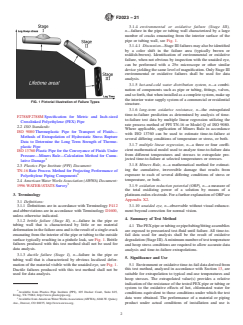
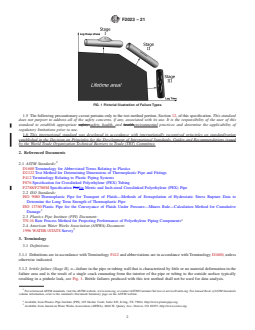
3.1.4 environmental or oxidative failure (Stage III),
n—failure in the pipe or tubing wall characterized by a large
number of cracks emanating from the interior surface of the
pipe or tubing wall, see Fig. 1.
3.1.4.1 Discussion—StageIIIfailuresmayalsobeidentified
by a color shift in the failure area (typically brown or
reddish-brown). Identification of environmental or oxidative
failure, when not obvious by inspection with the unaided eye,
can be performed with a 25× microscope or other similar
deviceyieldingthesamelevelofmagnification.OnlyStageIII
environmental or oxidative failures shall be used for data
analysis.
3.1.5 hot-and-cold water distribution system, n—a combi-
nation of components such as pipe or tubing, fittings, valves,
andsoforth,thatwheninstalledasacompletesystem,makeup
the interior water supply system of a commercial or residential
FIG. 1 Pictorial Illustration of Failure Types
structure.
3.1.6 long-term oxidative resistance, n—the extrapolated
time-to-failure prediction as determined by analysis of time-
F2788/F2788M Specification for Metric and Inch-sized
to-failure test data by multiple linear regression utilizing the
Crosslinked Polyethylene (PEX) Pipe
rate process method of PPI TN-16 or Model Q of ISO 9080.
2.2 ISO Standards:
Where applicable, application of Miners Rule in accordance
ISO 9080Thermoplastic Pipe for Transport of Fluids—
with ISO 13760 can be used to estimate time-to-failure at
Methods of Extrapolation of Hydrostatic Stress Rupture
several differing conditions of temperature or stress, or both.
Data to Determine the Long Term Strength of Thermo-
3.1.7 multiple linear regression, n—a three or four coeffi-
plastic Pipe
cient mathematical model used to analyze time-to-failure data
ISO 13760Plastic Pipe for the Conveyance of Fluids Under
from different temperatures and stresses to extrapolate pro-
Pressure—Miners Rule—Calculation Method for Cumu-
3 jected time-to-failure at selected temperatures or stresses.
lative Damage
3.1.8 Miners Rule, n—a mathematical method for estimat-
2.3 Plastics Pipe Institute (PPI) Document:
ing the cumulative, irreversible damage that results from
TN-16Rate Process Method for Projecting Performance of
exposure to each of several differing conditions of stress or
Polyethylene Piping Components
temperature, or both.
2.4 American Water Works Association (AWWA) Document:
3.1.9 oxidation reduction potential (ORP), n—a measure of
1996 WATER:\STATSSurvey
the total oxidizing power of a solution by means of a
3. Terminology platinum-redoxelectrode.ForafurtherexplanationofORPsee
Appendix X2.
3.1 Definitions:
3.1.10 unaided eye, n—observable without visual enhance-
3.1.1 Definitions are in accordance with Terminology F412
ment beyond correction for normal vision.
and abbreviations are in accordance with Terminology D1600,
unless otherwise indicated.
4. Summary of Test Method
3.1.2 brittle failure (Stage II), n—failure in the pipe or
tubing wall that is characterized by little or no material
4.1 ThePEXpipeortubingorpipe/tubing/fittingassemblies
deformationinthefailureareaandistheresultofasinglecrack
are exposed to pressurized test-fluid until failure. All time-to-
emanating from the interior of the pipe or tubing to the outside
fail data used for analysis shall be the result of oxidative
surface typically resulting in a pinhole leak, see Fig. 1. Brittle
degradation(StageIII).Aminimumnumberoftesttemperature
failures produced with this test method shall not be used for
and hoop stress conditions are required to allow accurate data
data analysis.
analysis and time-to-failure extrapolations.
3.1.3 ductile failure (Stage I), n—failure in the pipe or
5. Significance and Use
tubing wall that is characterized by obvious localized defor-
5.1 Environment or oxidative time-to-fail data derived from
mation of the material visible with the unaided eye, see Fig. 1.
Ductile failures produced with this test method shall not be this test method, analyzed in accordance with Section 13, are
suitable for extrapolation to typical end-use temperatures and
used for data analysis.
hoop stresses. The extrapolated value(s) provides a relative
indication of the resistance of the tested PEX pipe or tubing or
system to the oxidative effects of hot, chlorinated water for
Available from Plastics Pipe Institute (PPI), 105 Decker Court, Suite 825,
conditions equivalent to those conditions under which the test
Irving, TX 75062, http://www.plasticpipe.org.
data were obtained. The performance of a material or piping
Available fromAmericanWaterWorksAssociation (AWWA), 6666W. Quincy
Ave., Denver, CO 80235, http://www.awwa.org. product under actual conditions of installation and use is
F2023 − 21
dependent upon a number of factors including installation individual time-to-failure data points at the same temperature
methods, use patterns, water quality, nature and magnitude of and hoop stress condition. Statistical reliability of the analysis
localized stresses, and other variables of an actual, operating of the resultant data will be benefited by obtaining additional
hot-and-coldwaterdistributionsystemthatarenotaddressedin data points at each temperature/hoop stress condition.
this test method. As such, the extrapolated values do not 7.4.1 Test Unit Distribution—Time-to-failure data points
constitute a representation that a PEX tube or system with a shall be obtained at 2 test hoop stresses at each of a minimum
given extrapolated time-to-failure value will perform for that of 3 test temperatures for a minimum of 12 data points.As an
period of time under actual use conditions. alternate, obtain time-to-failure data for the temperature/hoop
stress combinations of the three-temperature matrix of PPI
6. Apparatus
TN-16, see Note 3. Hoop stresses shall be separated by a least
80 psi (0.55 MPa).
6.1 Pressurized Flow-Through Test System—Asystemcom-
prised of the necessary pump(s), fittings, piping, heaters,
NOTE 3—When using the PPI TN-16 matrix, Temperature T , which
sensors, and meters that is capable of maintaining the required requires testing at only one stress, refers to the lowest test temperature.
test pressures within the tolerance specified in 9.1.3, the
7.4.2 Test Temperature Selection—Temperatures of 239°F
required test temperatures within the tolerance of 9.1.2, and
(115°C), 221°F (105°C), and 203°F (95°C) have been
flow the test-fluid through the specimens continually at a flow
utilized in prior testing of PEX, see Note 4. Adjacent test
rate within the tolerance specified in 9.1.4. Cyclic pressure
temperaturesshallbeseparatedbyatleast18°F(10°C).Other
variations, such as those produced by some pumping systems,
test temperatures may be used, but the maximum test tempera-
shallnotproducepressureexcursionsthatexceedthetolerance
ture shall not exceed 239°F (115°C).
stated in 9.1.3.
NOTE 4—Prior testing indicates that for the test temperatures stated in
6.1.1 Recirculating Test System—A flow-through test sys-
7.4.2, hoop stresses to yield Stage III failures within reasonable testing
tem that repeatedly reconditions the test-fluid and passes it
times are between 160 psi (1.10 MPa) and 400 psi (2.76 MPa). For a true
through the specimens. For purposes of this test method, the
SDR9 tube, those hoop stresses correspond to test pressures of 40 psig
test-fluid shall be monitored at a sufficient frequency to ensure (275.9kPa)to100psig(689.7kPa).Ifaselectedtesthoopstressproduces
Stage I or Stage II failures, the stress will need to be reduced to produce
that it continuously meets the test-fluid parameters and water
Stage III failures at all temperatures.
quality criteria. A portion of the total system volume shall be
purged and replaced with fresh test-fluid continually. 7.4.2.1 Relationship of Internal Pressure to Hoop Stress—
The hoop stress in the pipe or tubing wall is calculated by the
6.1.2 Single-Pass Test System—A flow-through test system
that passes the test-fluid through the specimens only once and following expression, commonly known as the ISO equation:
is discarded.
2S/P 5 DR 21 (1)
6.2 Specimen Holders—Test specimens shall be supported
or
to minimize or eliminate externally induced stresses. Speci-
2S/P 5 D /t 21 (2)
~ !
o
mens shall be allowed to freely expand bi-directionally.
where:
7. Sampling, Test Specimens, and Test Units
S = stress in the circumferential or hoop direction, psi
7.1 Sampling—Selectatrandom,asufficientamountofpipe
(MPa),
or tubing to satisfy the specimen requirements of this test
P = internal pressure, psig (kPa),
method.When testing as a system, randomly select a sufficient t = minimum wall thickness, in. (mm),
DR = dimension ratio, DR, and
quantity of fittings.
D = average outside diameter, in. (mm).
o
7.2 Test Specimen Size—The PEX pipe or tubing specimens
shall be 12 to 18 in. (300 to 460 mm) in length between fitting
8. Calibration and Standardization
closures or between fitting joints.
8.1 Measuring Equipment—All measuring and testing
7.2.1 Dimensions Measurement—Measure and record the
equipment having an effect on the accuracy or validity of the
critical dimensions for pipe or tubing and fittings. For pipe or
calibrations or tests shall be calibrated or verified, or both,
tubing, measure the average outside diameter and wall-
before being put into service.
thickness in accordance with Test Method D2122. For fittings,
measure those dimensions critical to the function of the joint,
9. Test Fluid
as well as minimum body wall thickness.
9.1 Internal Test Fluid—The test fluid shall be reverse
7.3 Testing as a System—When testing PEX pipe or tubing
osmosis (RO) or deionized (DI) water prepared in accordance
and related system components (such as fittings) as a system,
with 9.1.1.
the other components shall be attached to the PEX pipe or
9.1.1 RO or DI Water Test-Fluid Preparation—Test fluid
tubing in the same manner as in actual service. For fittings, the
prepared from RO or DI water shall have a pH in the range
particular fitting style shall be installed in accordance with the
from 6.5 to 8.0 and contain 2.5 ppm to 5 ppm (milligrams per
manufacturer’s instructions or the ASTM specification when
litre) of free-chlorine. The chosen pH shall be maintained to
applicable.
60.2 and the chosen free-chlorine concentration shall be
7.4 Minimum Required Test Units—A minimum of six test maintained to 60.2 ppm. The pH and free-chlorine concentra-
units is required. A test unit is comprised of two or more tion combination shall yield a minimum ORP of 825 mV for
F2023 − 21
TABLE 1 Extrapolation Conditions at Constant Temperature
the test fluid, see Note 5. Testing shall be conducted with the
same nominal pH and free-chlorine concentration for all test DR Pressure, Temperature,
psig (kPa) °F (°C)
units.
9 or lower 80 (550) 180 (82), 140 (60), 73
NOTE 5—It is anticipated that use of RO or DI water may improve (23)
A
interlaboratory reproducibility; however, RO or DI water does not Any DR 160 (1100) 73 (23)
generally exist in real service. Since tap water (locally available potable A
SDR 11 and higher pipe, tubing, and systems are extrapolated for cold water
water) quality can vary from location to location, and considering the
applications only in Table 1.
internationalapplicationofthistestmethod,itseemsprudenttoutilizeRO
or DI water to minimize possible disparities of results obtained from
laboratories in different geographical locations. Prior data obtained with
test-fluidhavinganORPof750mVorhigherstillprovidesaconservative
condition. Over the next 1 to 3 h, gradually increase the
extrapolation for potable-water conditions found in most areas of the
temperature and pressure of the test fluid to the test condition.
United States.
When the test fluid reaches the test condition temperature,
9.1.2 Test Fluid Temperature Control—The test fluid enter-
pressure, and flow rate, and the external environment has
ing each specimen shall be maintained to 61.8°F (61°C) of
reached the test temperature in accordance with Section 10,
the test temperature.
register the start time.
9.1.3 Pressure Control—The pressure of the
...
This document is not an ASTM standard and is intended only to provide the user of an ASTM standard an indication of what changes have been made to the previous version. Because
it may not be technically possible to adequately depict all changes accurately, ASTM recommends that users consult prior editions as appropriate. In all cases only the current version
of the standard as published by ASTM is to be considered the official document.
Designation: F2023 − 15 F2023 − 21
Standard Test Method for
Evaluating the Oxidative Resistance of Crosslinked
Polyethylene (PEX) Pipe, Tubing and Systems to Hot
Chlorinated Water
This standard is issued under the fixed designation F2023; the number immediately following the designation indicates the year of
original adoption or, in the case of revision, the year of last revision. A number in parentheses indicates the year of last reapproval. A
superscript epsilon (´) indicates an editorial change since the last revision or reapproval.
1. Scope*
1.1 This test method describes the general requirements for evaluating the long-term, chlorinated water, oxidative resistance of
cross-linked polyethylene (PEX) pipe or tubing produced in accordance with PEX specifications, such as Specification F876 or
Specification F2788/F2788M by exposure to hot, chlorinated water. This test method outlines the requirements of a pressurized
flow-through test system, typical test pressures, test-fluid characteristics, failure type, and data analysis.
NOTE 1—Other known disinfecting systems (chlorine dioxide, ozone, and chloramines) are also used for protection of potable water. Free-chlorine is the
most common disinfectant in use today. A PPI research project examined the relative aggressiveness of free chlorine and chloramines on PEX pipes, both
at the same 4.0 ppm concentration and the same test temperatures. The results of the testing showed pipe failure times approximately 40% longer when
tested with chloramines compared to testing with free chlorine, at the tested conditions. Based on these results, the data suggests that chloramines are
less aggressive than free chlorine to PEX pipes.
1.2 Guidelines and requirements for test temperatures, test hoop stresses, and other test criteria have been established by prior
testing of PEX pipe or tubing produced by the three most common commercial methods of cross-linking: silane, peroxide, and
electron-beam (see Note 2). Other related system components that typically appear in a PEX hot-and-cold water distribution system
can be evaluated with the PEX pipe or tubing. When testing PEX pipe or tubing and fittings as a system, it is recommended that
the anticipated end-use fitting type(s) and material(s) be included in the test circuit since it is known that some fitting types and
materials can impact failure times. Specimens used shall be representative of the piping product(s) and material(s) under
investigation.
NOTE 2—The procedures described in this test method (with some modifications of test temperatures or stresses, or both) have been used to evaluate pipes
manufactured from polybutylene (PB), polyethylene (PE), polypropylene (PP), multilayer (polymer-metal composite), copper, and stainless steel.
1.3 This test method is applicable to PEX pipe or tubing and systems used for transport of potable water containing free-chlorine
for disinfecting purposes. The oxidizing potential of the test-fluid specified in this test method exceeds that typically found in
potable water systems across the United States.
1.4 The values stated in inch-pound units are to be regarded as standard. The values given in parentheses are mathematical
conversions to SI units that are provided for information only and are not considered standard.
This test method is under the jurisdiction of ASTM Committee F17 on Plastic Piping Systems and is the direct responsibility of Subcommittee F17.40 on Test Methods.
Current edition approved Dec. 1, 2015Dec. 15, 2021. Published January 2016January 2022. Originally approved in 2000. Last previous edition approved in 20132015 as
F2023 – 13.F2023 – 15. DOI: 10.1520/F2023-15.10.1520/F2023-21.
*A Summary of Changes section appears at the end of this standard
Copyright © ASTM International, 100 Barr Harbor Drive, PO Box C700, West Conshohocken, PA 19428-2959. United States
F2023 − 21
FIG. 1 Pictorial Illustration of Failure Types
1.5 The following precautionary caveat pertains only to the test method portion, Section 12, of this specification. This standard
does not purport to address all of the safety concerns, if any, associated with its use. It is the responsibility of the user of this
standard to establish appropriate safety safety, health, and healthenvironmental practices and determine the applicability of
regulatory limitations prior to use.
1.6 This international standard was developed in accordance with internationally recognized principles on standardization
established in the Decision on Principles for the Development of International Standards, Guides and Recommendations issued
by the World Trade Organization Technical Barriers to Trade (TBT) Committee.
2. Referenced Documents
2.1 ASTM Standards:
D1600 Terminology for Abbreviated Terms Relating to Plastics
D2122 Test Method for Determining Dimensions of Thermoplastic Pipe and Fittings
F412 Terminology Relating to Plastic Piping Systems
F876 Specification for Crosslinked Polyethylene (PEX) Tubing
F2788/F2788M Specification Forfor Metric and Inch-sized Crosslinked Polyethylene (PEX) Pipe
2.2 ISO Standards:
ISO 9080 Thermoplastic Pipe for Transport of Fluids—Methods of Extrapolation of Hydrostatic Stress Rupture Data to
Determine the Long Term Strength of Thermoplastic Pipe
ISO 13760 Plastic Pipe for the Conveyance of Fluids Under Pressure—Miners Rule—Calculation Method for Cumulative
Damage
2.3 Plastics Pipe Institute (PPI) Document:
TN-16 Rate Process Method for Projecting Performance of Polyethylene Piping Components
2.4 American Water Works Association (AWWA) Document:
1996 WATER:\STATS Survey
3. Terminology
3.1 Definitions:
3.1.1 Definitions are in accordance with Terminology F412 and abbreviations are in accordance with Terminology D1600, unless
otherwise indicated.
3.1.2 brittle failure (Stage II), n—failure in the pipe or tubing wall that is characterized by little or no material deformation in the
failure area and is the result of a single crack emanating from the interior of the pipe or tubing to the outside surface typically
resulting in a pinhole leak, see Fig. 1. Brittle failures produced with this test method shall not be used for data analysis.
For referenced ASTM standards, visit the ASTM website, www.astm.org, or contact ASTM Customer Service at service@astm.org. For Annual Book of ASTM Standards
volume information, refer to the standard’s Document Summary page on the ASTM website.
Available from Plastics Pipe Institute (PPI), 105 Decker Court, Suite 825, Irving, TX 75062, http://www.plasticpipe.org.
Available from American Water Works Association (AWWA), 6666 W. Quincy Ave., Denver, CO 80235, http://www.awwa.org.
F2023 − 21
3.1.3 ductile failure (Stage I), n—failure in the pipe or tubing wall that is characterized by obvious localized deformation of the
material visible with the unaided eye, see Fig. 1. Ductile failures produced with this test method shall not be used for data analysis.
3.1.4 environmental or oxidative failure (Stage III), n—failure in the pipe or tubing wall characterized by a large number of cracks
emanating from the interior surface of the pipe or tubing wall, see Fig. 1.
3.1.4.1 Discussion—
Stage III failures may also be identified by a color shift in the failure area (typically brown or reddish-brown). Identification of
environmental or oxidative failure, when not obvious by inspection with the unaided eye, can be performed with a 25× microscope
or other similar device yielding the same level of magnification. Only Stage III environmental or oxidative failures shall be used
for data analysis.
3.1.5 hot-and-cold water distribution system, n—a combination of components such as pipe or tubing, fittings, valves, and so forth,
that when installed as a complete system, make up the interior water supply system of a commercial or residential structure.
3.1.6 long-term oxidative resistance, n—the extrapolated time-to-failure prediction as determined by analysis of time-to-failure
test data by multiple linear regression utilizing the rate process method of PPI TN-16 or Model Q of ISO 9080. Where applicable,
application of Miners Rule in accordance with ISO 13760 can be used to estimate time-to-failure at several differing conditions
of temperature or stress, or both.
3.1.7 multiple linear regression, n—a three or four coefficient mathematical model used to analyze time-to-failure data from
different temperatures and stresses to extrapolate projected time-to-failure at selected temperatures or stresses.
3.1.8 Miners Rule, n—a mathematical method for estimating the cumulative, irreversible damage that results from exposure to
each of several differing conditions of stress or temperature, or both.
3.1.9 oxidation reduction potential (ORP), n—a measure of the total oxidizing power of a solution by means of a platinum-redox
electrode. For a further explanation of ORP see Appendix X2.
3.1.10 unaided eye, n—observable without visual enhancement beyond correction for normal vision.
4. Summary of Test Method
4.1 The PEX pipe or tubing or pipe/tubing/fitting assemblies are exposed to pressurized test-fluid until failure. All time-to-fail data
used for analysis shall be the result of oxidative degradation (Stage III). A minimum number of test temperature and hoop stress
conditions are required to allow accurate data analysis and time-to-failure extrapolations.
5. Significance and Use
5.1 Environment or oxidative time-to-fail data derived from this test method, analyzed in accordance with Section 13, are suitable
for extrapolation to typical end-use temperatures and hoop stresses. The extrapolated value(s) provides a relative indication of the
resistance of the tested PEX pipe or tubing or system to the oxidative effects of hot, chlorinated water for conditions equivalent
to those conditions under which the test data were obtained. The performance of a material or piping product under actual
conditions of installation and use is dependent upon a number of factors including installation methods, use patterns, water quality,
nature and magnitude of localized stresses, and other variables of an actual, operating hot-and-cold water distribution system that
are not addressed in this test method. As such, the extrapolated values do not constitute a representation that a PEX tube or system
with a given extrapolated time-to-failure value will perform for that period of time under actual use conditions.
6. Apparatus
6.1 Pressurized Flow-Through Test System—A system comprised of the necessary pump(s), fittings, piping, heaters, sensors, and
meters that is capable of maintaining the required test pressures within the tolerance specified in 9.1.3, the required test
temperatures within the tolerance of 9.1.2, and flow the test-fluid through the specimens continually at a flow rate within the
tolerance specified in 9.1.4. Cyclic pressure variations, such as those produced by some pumping systems, shall not produce
pressure excursions that exceed the tolerance stated in 9.1.3.
6.1.1 Recirculating Test System—A flow-through test system that repeatedly reconditions the test-fluid and passes it through the
F2023 − 21
specimens. For purposes of this test method, the test-fluid shall be monitored at a sufficient frequency to ensure that it continuously
meets the test-fluid parameters and water quality criteria. A portion of the total system volume shall be purged and replaced with
fresh test-fluid continually.
6.1.2 Single-Pass Test System—A flow-through test system that passes the test-fluid through the specimens only once and is
discarded.
6.2 Specimen Holders—Test specimens shall be supported to minimize or eliminate externally induced stresses. Specimens shall
be allowed to freely expand bi-directionally.
7. Sampling, Test Specimens, and Test Units
7.1 Sampling—Select at random, a sufficient amount of pipe or tubing to satisfy the specimen requirements of this test method.
When testing as a system, randomly select a sufficient quantity of fittings.
7.2 Test Specimen Size—The PEX pipe or tubing specimens shall be 12 to 18 in. (300 to 460 mm) in length between fitting closures
or between fitting joints.
7.2.1 Dimensions Measurement—Measure and record the critical dimensions for pipe or tubing and fittings. For pipe or tubing,
measure the average outside diameter and wall-thickness in accordance with Test Method D2122. For fittings, measure those
dimensions critical to the function of the joint, as well as minimum body wall thickness.
7.3 Testing as a System—When testing PEX pipe or tubing and related system components (such as fittings) as a system, the other
components shall be attached to the PEX pipe or tubing in the same manner as in actual service. For fittings, the particular fitting
style shall be installed in accordance with the manufacturer’s instructions or the ASTM specification when applicable.
7.4 Minimum Required Test Units—A minimum of six test units is required. A test unit is comprised of two or more individual
time-to-failure data points at the same temperature and hoop stress condition. Statistical reliability of the analysis of the resultant
data will be benefited by obtaining additional data points at each temperature/hoop stress condition.
7.4.1 Test Unit Distribution—Time-to-failure data points shall be obtained at 2 test hoop stresses at each of a minimum of 3 test
temperatures for a minimum of 12 data points. As an alternate, obtain time-to-failure data for the temperature/hoop stress
combinations of the three-temperature matrix of PPI TN-16, see Note 3. Hoop stresses shall be separated by a least 80 psi (0.55
MPa).
NOTE 3—When using the PPI TN-16 matrix, Temperature T , which requires testing at only one stress, refers to the lowest test temperature.
7.4.2 Test Temperature Selection—Temperatures of 239°F (115°C), 221°F (105°C), and 203°F (95°C)239 °F (115 °C), 221 °F
(105 °C), and 203 °F (95 °C) have been utilized in prior testing of PEX, see Note 4. Adjacent test temperatures shall be separated
by at least 18°F (10°C).18 °F (10 °C). Other test temperatures may be used, but the maximum test temperature shall not exceed
239°F (115°C).239 °F (115 °C).
NOTE 4—Prior testing indicates that for the test temperatures stated in 7.4.2, hoop stresses to yield Stage III failures within reasonable testing times are
between 160 psi (1.10 MPa) and 400 psi (2.76 MPa). For a true SDR9 tube, those hoop stresses correspond to test pressures of 40 psig (275.9 kPa) to
100 psig (689.7 kPa). If a selected test hoop stress produces Stage I or Stage II failures, the stress will need to be reduced to produce Stage III failures
at all temperatures.
7.4.2.1 Relationship of Internal Pressure to Hoop Stress—The hoop stress in the pipe or tubing wall is calculated by the following
expression, commonly known as the ISO equation:
2S/P 5 DR 2 1 (1)
or
2S/P 5 D /t 2 1 (2)
~ !
o
F2023 − 21
where:
S = stress in the circumferential or hoop direction, psi (MPa),
P = internal pressure, psig (kPa),
t = minimum wall thickness, in. (mm),
DR = dimension ratio, DR, and
D = average outside diameter, in. (mm).
o
8. Calibration and Standardization
8.1 Measuring Equipment—All measuring and testing equipment having an effect on the accuracy or validity of the calibrations
or tests shall be calibrated or verified, or both, before being put into service.
9. Test Fluid
9.1 Internal Test Fluid—The test fluid shall be reverse osmosis (RO) or deionized (DI) water prepared in accordance with 9.1.1.
9.1.1 RO or DI Water Test-Fluid Preparation—Test fluid prepared from RO or DI water shall have a pH in the range from 6.5
to 8.0 and contain 2.5 ppm to 5 ppm (milligrams per litre) of free-chlorine. The chosen pH shall be maintained to 60.2 and the
chosen free-chlorine concentration shall be maintained to 60.2 ppm. The pH and free-chlorine concentration combination shall
yield a minimum ORP of 825 mV for the test fluid, see Note 5. Testing shall be conducted with the same nominal pH and
free-chlorine concentration for all test units.
NOTE 5—It is anticipated that use of RO or DI water may improve interlaboratory reproducibility; however, RO or DI water does not generally exist in
real service. Since tap water (locally available potable water) quality can vary from location to location, and considering the international application of
this test method, it seems prudent to utilize RO or DI water to minimize possible disparities of results obtained from laboratories in different geographical
locations. Prior data obtained with test-fluid having an ORP of 750 mV or higher still provides a conservative extrapolation for potable-water conditions
found in most areas of the United States.
9.1.2 Test Fluid Temperature Control—The test fluid entering each specimen shall be maintained to 61.8°F (61°C)61.8 °F
(61 °C) of the test temperature.
9.1.3 Pressure Control—The pressure of the test fluid shall be maintained to 63 psig (620.69 kPa).
9.1.4 Test Fluid Flow Rate—The flow rate of the test fluid shall yield a minimum velocity of 0.12 fps (0.04 mps). For the nominal
size ⁄2 in., SDR9 pipe or tubing, this corresponds to a flow rate of 0.06 gpm (0.23 LPM). The formula used to calculate the flow
rates for other sizes and DRs is as follows:
π id/2 *FPS*720
~ !
5 gpm (3)
where:
id = measured inside diameter of the pipe or tubing, in.
9.2 Test Fluid Instrument Accuracy:
9.2.1 pH—The pH measurement and control instruments shall have an accuracy of 0.1 pH or better.
9.2.2 Free-Chlorine—Free-chlorine content measurement and control instruments shall have an accuracy of 0.1 ppm or better.
9.2.3 ORP—The ORP measurement and control instruments shall have an accuracy of 610 mV or better.
10. External Environment
10.1 The exterior environment shall be air and shall be maintained at the target temperatu
...