

ASTM E2905/E2905M-20
(Practice)Standard Practice for Examination of Mill and Kiln Girth Gear Teeth—Electromagnetic Methods
General Information
- Abstract
SIGNIFICANCE AND USE
5.1 Visual interpretation of gear teeth condition is different from examining for cracks or early signs of macro-pitting. Visual interpretation is referred to ASNI/AGMA 1010-F14.
5.1.1 The purpose of using an eddy current array for mill girth gear tooth examination is it drastically reduces the examination time; covers a large area in one single pass; provides real-time cartography of the examined region, facilitating data interpretation; and improves reliability and probability of detection (POD). One tooth can be examined in less than 30 seconds.
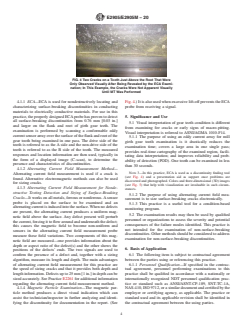
Note 3: In this practice, ECA is used as a discontinuity finding tool (see Fig. 4) and a presentation aid as support once problems are discovered and photographed. Colors and three-dimensional (3D) images (see Fig. 5) that help with visualization are invaluable in such circumstances.
5.1.2 The purpose of using alternating current field measurement is to size surface-breaking cracks electronically.
5.1.3 This practice is a useful tool for a condition-based monitoring program.
5.2 The examination results may then be used by qualified personnel or organizations to assess the severity and potential consequences of the failure modes identified. This practice is not intended for the examination of non-surface-breaking discontinuities. Other methods should be considered to address examination for non-surface-breaking discontinuities.
SCOPE
Note 1: Throughout the standard, “gear” means gear or pinion unless the gear is specifically identified.
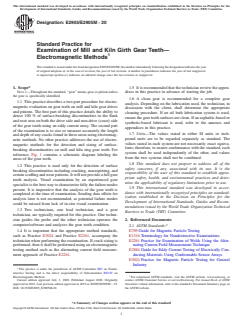
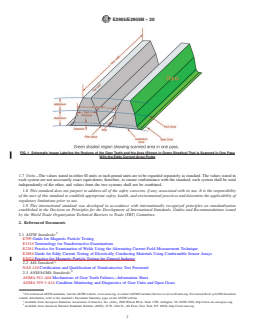
1.1 This practice describes a two-part procedure for electromagnetic evaluation on gear teeth on mill and kiln gear drives and pinions. The first part of this practice details the ability to detect 100 % of surface-breaking discontinuities in the flank and root area on both the drive side and non-drive (coast) side of the gear tooth using an eddy current array. The second part of the examination is to size or measure accurately the length and depth of any cracks found in these areas using electromagnetic methods. No other practice addresses the use of electromagnetic methods for the detection and sizing of surface-breaking discontinuities on mill and kiln ring gear teeth. For reference, Fig. 1 contains a schematic diagram labeling the areas of the gear teeth.
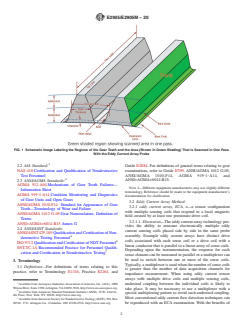
FIG. 1 Schematic Image Labeling the Regions of the Gear Teeth and the Area (Shown in Green Shading) That is Scanned in One Pass With the Eddy Current Array Probe
1.2 This practice is used only for the detection of surface breaking discontinuities including cracking, macropitting, and certain scuffing and wear patterns. It will not provide a full gear tooth analysis. Visual examination by an experienced gear specialist is the best way to characterize fully the failure modes present. It is imperative that the analysis of the gear teeth is completed at the time of examination. Sending data offsite for analysis later is not recommended, as potential failure modes could be missed from lack of in-situ visual examination.
1.3 Two technicians, one lead technician, and a gear technician, are typically required for this practice. One technician guides the probe and the other technician operates the computer/software and analyzes the gear teeth condition.
1.4 It is important that the appropriate method standards, such as Practice E3024 and Practice E2261, accompany the technician when performing the examination. If crack sizing is performed, then it shall be performed using an electromagnetic testing method such as the alternating current field measurement approach of Practice E2261.
1.5 It is recommended that the technician review the appendixes in this practice in advance of starting the job.
1.6 A clean gear is recommended for a complete gear analysis. Depending on the lubrication used, the technician, in discussion with the client, shall determine the appropriate cleaning procedure. If an oil bath lubrication system is used, ensure th...
- Status
- Published
- Publication Date
- 30-Jun-2020
- Technical Committee
- E07 - Nondestructive Testing
- Drafting Committee
- E07.07 - Electromagnetic Method
Buy Documents
ASTM E2905/E2905M-20 - Standard Practice for Examination of Mill and Kiln Girth Gear Teeth—Electromagnetic Methods
REDLINE ASTM E2905/E2905M-20 - Standard Practice for Examination of Mill and Kiln Girth Gear Teeth—Electromagnetic Methods
Overview
ASTM E2905/E2905M-20: Standard Practice for Examination of Mill and Kiln Girth Gear Teeth-Electromagnetic Methods provides guidelines for nondestructive testing (NDT) of mill and kiln girth gear teeth using advanced electromagnetic techniques. The standard primarily addresses the detection and sizing of surface-breaking discontinuities, such as cracks, macropitting, and certain wear patterns, utilizing eddy current array (ECA) and alternating current field measurement (ACFM) methods. These approaches provide rapid, reliable, and thorough gear inspections as part of an effective condition-based monitoring program, supporting the maintenance and reliability of large industrial gear drives.
Key Topics
Eddy Current Array (ECA) Examination:
- Allows for rapid detection of surface-breaking anomalies on gear teeth, covering large areas in a single pass.
- Provides real-time mapping and high visual clarity, improving the probability of detection and data interpretation.
- Enables full coverage of the addendum, dedendum, flank, and root areas on both drive and non-drive sides of the gear tooth.
Alternating Current Field Measurement (ACFM):
- Used for electronic sizing of surface-breaking cracks identified during ECA examination.
- Offers precise measurements for both crack length and depth, supporting engineering assessments.
Application Scope:
- Specifically targets crack detection, macropitting, and certain scuffing and wear patterns.
- Not intended for non-surface-breaking discontinuities; other NDT methods should be considered for subsurface defects.
- Complements visual examination, which remains essential for comprehensive gear failure mode assessment.
Personnel and Equipment:
- Typically requires a lead technician and a gear specialist to ensure proper probe operation and data analysis.
- Includes detailed procedures for gear preparation, cleaning, and examination techniques for optimal results.
Applications
The procedures specified in ASTM E2905/E2905M-20 are critical in industries where mill and kiln gear drives are fundamental to operation, including:
- Mining and Minerals Processing Plants:
Regular assessment of girth gears and pinions ensures uninterrupted mill operation and prevents costly failures. - Cement Plants:
Kiln gear evaluations help maintain equipment integrity and minimize downtime. - Power Generation Facilities:
Enables proactive maintenance of large open gears in drives and rotary kilns. - Heavy Industry Maintenance:
Facilitates root cause analysis and supports reliability-centered maintenance strategies.
Using ECA and ACFM methods delivers several practical benefits:
- Significant reduction in inspection time (one tooth can be examined in less than 30 seconds).
- Real-time, three-dimensional visualization enhances maintenance decision making.
- Improved detection reliability supports safety and extends equipment lifespan.
Related Standards
For comprehensive gear examination and consistent application of NDT best practices, ASTM E2905/E2905M-20 references and complements several key standards:
- ASTM E2261: Practice for Examination of Welds Using the Alternating Current Field Measurement Technique
- ASTM E3024: Practice for Magnetic Particle Testing for General Industry
- ASTM E709: Guide for Magnetic Particle Testing
- ASTM E2884: Guide for Eddy Current Testing of Electrically Conducting Materials Using Conformable Sensor Arrays
- ANSI/AGMA 1010-F14: Appearance of Gear Teeth-Terminology of Wear and Failure
- ANSI/AGMA 1012 G-05: Gear Nomenclature, Definition of Terms
- AGMA 919-1-A14: Condition Monitoring and Diagnostics of Gear Units and Open Gears
- SNT-TC-1A and ISO 9712: Personnel qualification and certification for nondestructive testing
Conclusion
ASTM E2905/E2905M-20 sets forth an effective framework for the electromagnetic examination of mill and kiln girth gear teeth. Integrating eddy current array and ACFM technologies enables efficient, accurate detection and sizing of critical surface defects. This standard supports essential preventive maintenance practices, extends the service life of high-value industrial assets, and underpins the foundations of a robust reliability program in sectors reliant on heavy gear-driven equipment.
Relations
- Effective Date
- 01-Jul-2020
- Effective Date
- 01-Feb-2024
- Effective Date
- 01-Dec-2019
- Effective Date
- 01-Mar-2019
- Effective Date
- 01-Jan-2018
- Effective Date
- 15-Jun-2017
- Effective Date
- 01-Feb-2017
- Effective Date
- 01-Aug-2016
- Effective Date
- 01-Feb-2016
- Effective Date
- 01-Dec-2015
- Effective Date
- 01-Sep-2015
- Effective Date
- 01-Jun-2014
- Effective Date
- 01-Jun-2014
- Effective Date
- 01-Dec-2013
- Effective Date
- 15-Jun-2013
Buy Documents
ASTM E2905/E2905M-20 - Standard Practice for Examination of Mill and Kiln Girth Gear Teeth—Electromagnetic Methods
REDLINE ASTM E2905/E2905M-20 - Standard Practice for Examination of Mill and Kiln Girth Gear Teeth—Electromagnetic Methods
Frequently Asked Questions
ASTM E2905/E2905M-20 is a standard published by ASTM International. Its full title is "Standard Practice for Examination of Mill and Kiln Girth Gear Teeth—Electromagnetic Methods". This standard covers: SIGNIFICANCE AND USE 5.1 Visual interpretation of gear teeth condition is different from examining for cracks or early signs of macro-pitting. Visual interpretation is referred to ASNI/AGMA 1010-F14. 5.1.1 The purpose of using an eddy current array for mill girth gear tooth examination is it drastically reduces the examination time; covers a large area in one single pass; provides real-time cartography of the examined region, facilitating data interpretation; and improves reliability and probability of detection (POD). One tooth can be examined in less than 30 seconds. Note 3: In this practice, ECA is used as a discontinuity finding tool (see Fig. 4) and a presentation aid as support once problems are discovered and photographed. Colors and three-dimensional (3D) images (see Fig. 5) that help with visualization are invaluable in such circumstances. 5.1.2 The purpose of using alternating current field measurement is to size surface-breaking cracks electronically. 5.1.3 This practice is a useful tool for a condition-based monitoring program. 5.2 The examination results may then be used by qualified personnel or organizations to assess the severity and potential consequences of the failure modes identified. This practice is not intended for the examination of non-surface-breaking discontinuities. Other methods should be considered to address examination for non-surface-breaking discontinuities. SCOPE Note 1: Throughout the standard, “gear” means gear or pinion unless the gear is specifically identified. 1.1 This practice describes a two-part procedure for electromagnetic evaluation on gear teeth on mill and kiln gear drives and pinions. The first part of this practice details the ability to detect 100 % of surface-breaking discontinuities in the flank and root area on both the drive side and non-drive (coast) side of the gear tooth using an eddy current array. The second part of the examination is to size or measure accurately the length and depth of any cracks found in these areas using electromagnetic methods. No other practice addresses the use of electromagnetic methods for the detection and sizing of surface-breaking discontinuities on mill and kiln ring gear teeth. For reference, Fig. 1 contains a schematic diagram labeling the areas of the gear teeth. FIG. 1 Schematic Image Labeling the Regions of the Gear Teeth and the Area (Shown in Green Shading) That is Scanned in One Pass With the Eddy Current Array Probe 1.2 This practice is used only for the detection of surface breaking discontinuities including cracking, macropitting, and certain scuffing and wear patterns. It will not provide a full gear tooth analysis. Visual examination by an experienced gear specialist is the best way to characterize fully the failure modes present. It is imperative that the analysis of the gear teeth is completed at the time of examination. Sending data offsite for analysis later is not recommended, as potential failure modes could be missed from lack of in-situ visual examination. 1.3 Two technicians, one lead technician, and a gear technician, are typically required for this practice. One technician guides the probe and the other technician operates the computer/software and analyzes the gear teeth condition. 1.4 It is important that the appropriate method standards, such as Practice E3024 and Practice E2261, accompany the technician when performing the examination. If crack sizing is performed, then it shall be performed using an electromagnetic testing method such as the alternating current field measurement approach of Practice E2261. 1.5 It is recommended that the technician review the appendixes in this practice in advance of starting the job. 1.6 A clean gear is recommended for a complete gear analysis. Depending on the lubrication used, the technician, in discussion with the client, shall determine the appropriate cleaning procedure. If an oil bath lubrication system is used, ensure th...
SIGNIFICANCE AND USE 5.1 Visual interpretation of gear teeth condition is different from examining for cracks or early signs of macro-pitting. Visual interpretation is referred to ASNI/AGMA 1010-F14. 5.1.1 The purpose of using an eddy current array for mill girth gear tooth examination is it drastically reduces the examination time; covers a large area in one single pass; provides real-time cartography of the examined region, facilitating data interpretation; and improves reliability and probability of detection (POD). One tooth can be examined in less than 30 seconds. Note 3: In this practice, ECA is used as a discontinuity finding tool (see Fig. 4) and a presentation aid as support once problems are discovered and photographed. Colors and three-dimensional (3D) images (see Fig. 5) that help with visualization are invaluable in such circumstances. 5.1.2 The purpose of using alternating current field measurement is to size surface-breaking cracks electronically. 5.1.3 This practice is a useful tool for a condition-based monitoring program. 5.2 The examination results may then be used by qualified personnel or organizations to assess the severity and potential consequences of the failure modes identified. This practice is not intended for the examination of non-surface-breaking discontinuities. Other methods should be considered to address examination for non-surface-breaking discontinuities. SCOPE Note 1: Throughout the standard, “gear” means gear or pinion unless the gear is specifically identified. 1.1 This practice describes a two-part procedure for electromagnetic evaluation on gear teeth on mill and kiln gear drives and pinions. The first part of this practice details the ability to detect 100 % of surface-breaking discontinuities in the flank and root area on both the drive side and non-drive (coast) side of the gear tooth using an eddy current array. The second part of the examination is to size or measure accurately the length and depth of any cracks found in these areas using electromagnetic methods. No other practice addresses the use of electromagnetic methods for the detection and sizing of surface-breaking discontinuities on mill and kiln ring gear teeth. For reference, Fig. 1 contains a schematic diagram labeling the areas of the gear teeth. FIG. 1 Schematic Image Labeling the Regions of the Gear Teeth and the Area (Shown in Green Shading) That is Scanned in One Pass With the Eddy Current Array Probe 1.2 This practice is used only for the detection of surface breaking discontinuities including cracking, macropitting, and certain scuffing and wear patterns. It will not provide a full gear tooth analysis. Visual examination by an experienced gear specialist is the best way to characterize fully the failure modes present. It is imperative that the analysis of the gear teeth is completed at the time of examination. Sending data offsite for analysis later is not recommended, as potential failure modes could be missed from lack of in-situ visual examination. 1.3 Two technicians, one lead technician, and a gear technician, are typically required for this practice. One technician guides the probe and the other technician operates the computer/software and analyzes the gear teeth condition. 1.4 It is important that the appropriate method standards, such as Practice E3024 and Practice E2261, accompany the technician when performing the examination. If crack sizing is performed, then it shall be performed using an electromagnetic testing method such as the alternating current field measurement approach of Practice E2261. 1.5 It is recommended that the technician review the appendixes in this practice in advance of starting the job. 1.6 A clean gear is recommended for a complete gear analysis. Depending on the lubrication used, the technician, in discussion with the client, shall determine the appropriate cleaning procedure. If an oil bath lubrication system is used, ensure th...
ASTM E2905/E2905M-20 is classified under the following ICS (International Classification for Standards) categories: 21.200 - Gears. The ICS classification helps identify the subject area and facilitates finding related standards.
ASTM E2905/E2905M-20 has the following relationships with other standards: It is inter standard links to ASTM E2905/E2905M-19, ASTM E1316-24, ASTM E1316-19b, ASTM E1316-19, ASTM E1316-18, ASTM E1316-17a, ASTM E1316-17, ASTM E1316-16a, ASTM E1316-16, ASTM E1316-15a, ASTM E1316-15, ASTM E1316-14, ASTM E1316-14e1, ASTM E1316-13d, ASTM E1316-13c. Understanding these relationships helps ensure you are using the most current and applicable version of the standard.
ASTM E2905/E2905M-20 is available in PDF format for immediate download after purchase. The document can be added to your cart and obtained through the secure checkout process. Digital delivery ensures instant access to the complete standard document.
Standards Content (Sample)
This international standard was developed in accordance with internationally recognized principles on standardization established in the Decision on Principles for the
Development of International Standards, Guides and Recommendations issued by the World Trade Organization Technical Barriers to Trade (TBT) Committee.
Designation: E2905/E2905M − 20
Standard Practice for
Examination of Mill and Kiln Girth Gear Teeth—
Electromagnetic Methods
ThisstandardisissuedunderthefixeddesignationE2905/E2905M;thenumberimmediatelyfollowingthedesignationindicatestheyear
of original adoption or, in the case of revision, the year of last revision. A number in parentheses indicates the year of last reapproval.
A superscript epsilon (´) indicates an editorial change since the last revision or reapproval.
1. Scope* 1.5 It is recommended that the technician review the appen-
NOTE 1—Throughout the standard, “gear” means gear or pinion unless
dixes in this practice in advance of starting the job.
the gear is specifically identified.
1.6 A clean gear is recommended for a complete gear
1.1 This practice describes a two-part procedure for electro-
analysis. Depending on the lubrication used, the technician, in
magnetic evaluation on gear teeth on mill and kiln gear drives
discussion with the client, shall determine the appropriate
and pinions. The first part of this practice details the ability to
cleaning procedure. If an oil bath lubrication system is used,
detect 100 % of surface-breaking discontinuities in the flank
ensurethegearteethsurfacesareclean.Ifanasphaltic-basedor
and root area on both the drive side and non-drive (coast) side
synthetic-based lubricant is used, refer to the annexes and
of the gear tooth using an eddy current array. The second part
appendices in this practice.
of the examination is to size or measure accurately the length
1.7 Units—The values stated in either SI units or inch-
and depth of any cracks found in these areas using electromag-
pound units are to be regarded separately as standard. The
netic methods. No other practice addresses the use of electro-
values stated in each system are not necessarily exact equiva-
magnetic methods for the detection and sizing of surface-
lents; therefore, to ensure conformance with the standard, each
breaking discontinuities on mill and kiln ring gear teeth. For
system shall be used independently of the other, and values
reference, Fig. 1 contains a schematic diagram labeling the
from the two systems shall not be combined.
areas of the gear teeth.
1.8 This standard does not purport to address all of the
1.2 This practice is used only for the detection of surface
safety concerns, if any, associated with its use. It is the
breaking discontinuities including cracking, macropitting, and
responsibility of the user of this standard to establish appro-
certainscuffingandwearpatterns.Itwillnotprovideafullgear
priate safety, health, and environmental practices and deter-
tooth analysis. Visual examination by an experienced gear
mine the applicability of regulatory limitations prior to use.
specialististhebestwaytocharacterizefullythefailuremodes
1.9 This international standard was developed in accor-
present. It is imperative that the analysis of the gear teeth is
dance with internationally recognized principles on standard-
completed at the time of examination. Sending data offsite for
ization established in the Decision on Principles for the
analysis later is not recommended, as potential failure modes
Development of International Standards, Guides and Recom-
could be missed from lack of in-situ visual examination.
mendations issued by the World Trade Organization Technical
1.3 Two technicians, one lead technician, and a gear
Barriers to Trade (TBT) Committee.
technician, are typically required for this practice. One techni-
cian guides the probe and the other technician operates the 2. Referenced Documents
computer/software and analyzes the gear teeth condition. 2
2.1 ASTM Standards:
1.4 It is important that the appropriate method standards, E709 Guide for Magnetic Particle Testing
such as Practice E3024 and Practice E2261, accompany the E1316 Terminology for Nondestructive Examinations
technician when performing the examination. If crack sizing is E2261 Practice for Examination of Welds Using the Alter-
performed, then it shall be performed using an electromagnetic nating Current Field Measurement Technique
testing method such as the alternating current field measure- E2884 Guide for Eddy Current Testing of Electrically Con-
ment approach of Practice E2261. ducting Materials Using Conformable Sensor Arrays
E3024 Practice for Magnetic Particle Testing for General
Industry
This practice is under the jurisdiction of ASTM Committee E07 on Nonde-
structive Testing and is the direct responsibility of Subcommittee E07.07 on
Electromagnetic Method. For referenced ASTM standards, visit the ASTM website, www.astm.org, or
Current edition approved July 1, 2020. Published August 2020. Originally contact ASTM Customer Service at service@astm.org. For Annual Book of ASTM
approved in 2012. Last previous edition approved in 2019 as E2905/E2905M – 19. Standards volume information, refer to the standard’s Document Summary page on
DOI: 10.1520/E2905_E2905M-20. the ASTM website.
*A Summary of Changes section appears at the end of this standard
Copyright © ASTM International, 100 Barr Harbor Drive, PO Box C700, West Conshohocken, PA 19428-2959. United States
E2905/E2905M − 20
FIG. 1 Schematic Image Labeling the Regions of the Gear Teeth and the Area (Shown in Green Shading) That is Scanned in One Pass
With the Eddy Current Array Probe
2.2 AIA Standard: Guide E2884. For definitions of general terms relating to gear
NAS 410 Certification and Qualification of Nondestructive examinations, refer to Guide E709, ANSI/AGMA 1012 G-05,
Test Personnel ANSI/AGMA 1010-F14, AGMA 919{1{A14, and
2.3 ANSI/AGMA Standards: ANSI+AGMA+6014-B15.
AGMA 912-A04 Mechanisms of Gear Tooth Failures—
NOTE 2—Different equipment manufacturers may use slightly different
Information Sheet
terminology. Reference should be made to the equipment manufacturer’s
AGMA 919{1{A14 Condition Monitoring and Diagnostics
documentation for clarification.
of Gear Units and Open Gears
3.2 Eddy Current Array Method:
ASNI/AGMA 1010-F14 Standard for Appearance of Gear
3.2.1 eddy current array, ECA, n—a sensor configuration
Teeth—Terminology of Wear and Failure
with multiple sensing coils that respond to a local magnetic
ANSI/AGMA 1012 G-05 Gear Nomenclature, Definition of
field created by at least one proximate drive coil.
Terms
3.2.1.1 Discussion—The eddy current array technology pro-
ANSI+AGMA+6014-B15 Annex G
vides the ability to measure electronically multiple eddy
2.4 ANSI/ASNT Standards:
current sensing coils placed side by side in the same probe
ANSI/ASNT-CP-189 QualificationandCertificationofNon-
assembly. Example eddy current arrays have distinct drive
destructive Testing Personnel
coils associated with each sense coil or a drive coil with a
ISO 9712 Qualification and Certification of NDTPersonnel
linear conductor that is parallel to a linear array of sense coils.
SNT-TC-1A Recommended Practice for Personnel Qualifi-
Depending upon the instrumentation, the response for each
cation and Certification in Nondestructive Testing
sense element can be measured in parallel or a multiplexer can
be used to switch between one or more of the sense coils.
3. Terminology
Typically,amultiplexerisusedwhenthenumberofsensecoils
3.1 Definitions—For definitions of terms relating to this
is greater than the number of data acquisition channels for
practice, refer to Terminology E1316, Practice E2261, and
impedance measurement. When using eddy current sensor
arrays with multiple drive coils and multiple sensing coils,
undesired coupling between the individual coils is likely to
Available fromAerospace IndustriesAssociation ofAmerica, Inc. (AIA), 1000
WilsonBlvd.,Suite1700,Arlington,VA22209-3928,http://www.aia-aerospace.org.
take place. It may be necessary to use a multiplexer with a
Available fromAmerican National Standards Institute (ANSI), 25 W. 43rd St.,
special multiplexing pattern to avoid such undesired coupling.
4th Floor, New York, NY 10036, http://www.ansi.org.
Most conventional eddy current flaw detection techniques can
AvailablefromAmericanSocietyforNondestructiveTesting(ASNT),P.O.Box
28518, 1711 Arlingate Ln., Columbus, OH 43228-0518, http://www.asnt.org. be reproduced with an ECA examination. With the benefits of
E2905/E2905M − 20
single-pass coverage, and enhanced imaging capabilities, ECA smaller defects. For this practice, a surface array probe, with
technologyprovidesaremarkablypowerfultoolandsignificant the ability of detecting all surface discontinuities—including
time savings during examinations compared to raster scanning cracks—is required for a successful examination.
with a single coil probe. (See Fig. 2.) 3.2.2.2 Discussion—Probe Quality—Probe operational life
varies depending on the environmental conditions within the
work area. Some of these environmental factors are
temperature, moisture, cleanliness, and the main factor being
surface roughness.
3.2.3 reference standard, n—shall contain at least one long
reference indicator to standardize all the channels of the array
atonceandalsorepresentativedefectsforflawcharacterization
during the examination.
3.2.4 set screws, n—conformable and substantially noncon-
ducting set screws on the probe that are used to allow small
lift-off adjustments or excursions on surface response.
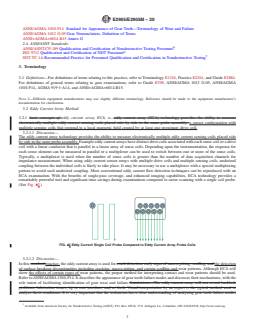
FIG. 2 Eddy Current Single Coil Probe Compared to Eddy Current
Array Probe Coils
3.2.5 system performance verification, n—use of a measure-
ment of one or more response values, typically physical
3.2.1.2 Discussion—In this practice, the eddy current array property values for a reference standard to confirm that the
is used for the detection of surface breaking discontinuities response values are within specified tolerances to validate the
including cracking, macro-pitting, and certain scuffing and system standardization and verify proper instrument operation.
wear patterns. Although ECA will show the effects of certain
4. Summary of Practice
types of wear patterns, the proper method for interpreting
contact and wear patterns should be used. Refer to ANSI/ 4.1 Gear-Cleaning Procedure—Typically, mill operations
AGMA 1010-F14. It describes the appearance of gear tooth
performs the gear tooth cleaning. However, in some cases, the
failure modes and discusses their mechanisms, with the sole technicians performing the examination may be required to
intent of facilitating identification of gear wear and failure.
clean the gear as per Appendix X2. Mill maintenance person-
nel are responsible for removing the guards for access to the
3.2.2 eddy current array probes, n—mechanical fixtures
gear teeth. Nondestructive examination (NDE) for mill and
designed to detect a specific type of discontinuity with an eddy
kiln girth gear teeth are provided for maintenance and as a part
current array and to conform to the shape of the part under
of an overall predictive maintenance plan.Visual interpretation
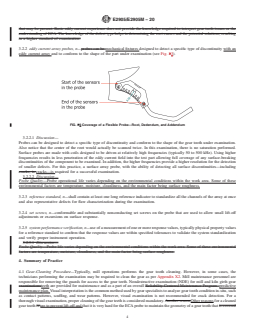
examination (see Fig. 3).
FIG. 3 Coverage of a Flexible Probe—Root, Dedendum, and Addendum
3.2.2.1 Discussion—Probes can be designed to detect a is the common method used by gear specialists to analyze gear
specific type of discontinuity and conform to the shape of the tooth condition in-situ, such as contact patterns, scuffing, and
gear tooth under examination.Also notice that the center of the wear patterns. However, visual examination is not recom-
root would actually be scanned twice. In this examination, mendedforcrackdetection.Forathoroughvisualexamination,
there is no saturation performed. Surface probes are made with proper cleaning of the gear teeth is considered mandatory.
coils designed to be driven at relatively high frequencies Otherreasonsforacleanedgeartootharetopreventlift-offand
(typically 50 to 500 kHz). Using higher frequencies results in that it is very hard for the ECAprobe to maintain the geometry
less penetration of the eddy current field into the test part of a gear tooth that has lubricant present, especially if the
allowing full coverage of any surface-breaking discontinuities lubricant is asphaltic-based or synthetic. If asphaltic or syn-
of the component to be examined. In addition, the higher thetic lubrication is used, refer to Appendix X2 for cleaning
frequencies provide a higher resolution for the detection of procedures.
E2905/E2905M − 20
FIG. 4 Two Cracks on a Tooth Just Above the Root That Were
Only Observed Visually After Being Revealed by the ECA Exami-
nation; In This Example, the Cracks Were Not Apparent Visually
Until MT Was Performed
4.1.1 ECA—ECA is used for nondestructively locating and Fig.4.)Itisalsousedwhenexcessivelift-offpreventstheECA
characterizing surface-breaking discontinuities in conducting probe from receiving a signal.
materials to electrically conductive materials. For use in this
5. Significance and Use
practice,theproperlydesignedECAprobehasproventodetect
all surface-breaking discontinuities from 0.76 mm [0.03 in.]
5.1 Visual interpretation of gear teeth condition is different
and larger on the flank and root of girth gear teeth. The
from examining for cracks or early signs of macro-pitting.
examination is performed by scanning a conformable eddy
Visual interpretation is referred to ASNI/AGMA 1010-F14.
currentsensorarrayoverthesurfaceoftheflankandrootofthe
5.1.1 The purpose of using an eddy current array for mill
gear tooth being examined in one pass. The drive side of the
girth gear tooth examination is it drastically reduces the
tooth is referred to as the A side and the non-drive side of the
examination time; covers a large area in one single pass;
tooth is referred to as the B side of the tooth. The measured
provides real-time cartography of the examined region, facili-
responses and location information are then used, typically in
tating data interpretation; and improves reliability and prob-
the form of a displayed image (C-scan), to determine the
ability of detection (POD). One tooth can be examined in less
presence and characteristics of discontinuities.
than 30 seconds.
4.1.2 Alternating Current Field Measurement Method—
NOTE 3—In this practice, ECA is used as a discontinuity finding tool
Alternating current field measurement is used if a crack is
(see Fig. 4) and a presentation aid as support once problems are
found. Alternative electromagnetic methods can also be used
discovered and photographed. Colors and three-dimensional (3D) images
for sizing cracks.
(see Fig. 5) that help with visualization are invaluable in such circum-
4.1.3 Alternating Current Field Measurement for Nonde- stances.
structive Testing Detection and Sizing of Surface-Breaking
5.1.2 The purpose of using alternating current field mea-
Cracks—Itworksonallmetals,ferrousornonferrous.Asensor
surement is to size surface-breaking cracks electronically.
probe is placed on the surface to be examined and an
5.1.3 This practice is a useful tool for a condition-based
alternatingcurrentisinducedintothesurface.Whennodefects
monitoring program.
are present, the alternating current produces a uniform mag-
5.2 The examination results may then be used by qualified
netic field above the surface. Any defect present will perturb
personnel or organizations to assess the severity and potential
thecurrent,forcingittoflowaroundandunderneaththedefect;
consequences of the failure modes identified. This practice is
this causes the magnetic field to become non-uniform and
not intended for the examination of non-surface-breaking
sensors in the alternating current field measurement probe
discontinuities. Other methods should be considered to address
measure these field variations. Two components of this mag-
examination for non-surface-breaking discontinuities.
netic field are measured—one provides information about the
depth or aspect ratio of the defect(s) and the other shows the
6. Basis of Application
positions of the defects’ ends. The two signals are used to
confirm the presence of a defect and, together with a sizing 6.1 The following item is subject to contractual agreement
algorithm, measure its length and depth. The main advantages between the parties using or referencing this practice.
of alternating current field measurement for this practice are 6.1.1 Personnel Qualification—If specified in the contrac-
the speed of sizing cracks and that it provides both depth and tual agreement, personnel performing examinations to this
lengthinformation.Defectsupto25mm[1in.]indepthcanbe practice shall be qualified in accordance with a nationally or
sized accurately. See PracticeE2261 for additional information internationally recognized NDT personnel qualification prac-
regarding the alternating current field measurement method. tice or standard such as ANSI/ASNT-CP-189, SNT-TC-1A,
4.1.4 Magnetic Particle Examination—The magnetic par- NAS-410,ISO9712,orasimilardocumentandcertifiedbythe
ticle method produces a direct visual indication which can employer or certifying agency, as applicable. The practice or
assist the technician/inspector in further analyzing and identi- standard used and its applicable revision shall be identified in
fying the discontinuity for documentation in the report. (See the contractual agreement between the using parties.
E2905/E2905M − 20
FIG. 5 Two- and Three-Dimensional View
7. Interferences nature are usually examined every year or two, so any residual
magnetism would be minimal. This application reduces the
7.1 Curvature of Examination Surface—For the examina-
noise level by an optimal probe configuration.
tion of gears or pinions with pronounced profiles, a flexible
probe is required that can adjust its curvature to the various 7.7 Limitations—The eddy current array will not detect all
profiles.Systemperformanceverificationtestsshouldberunto scuffing conditions, wear patterns, backlash problems, lubrica-
verify lift-off sensitivity by adjusting the set screws in the face tion issues, tip to root interference, and similar conditions.
of the array probe. Visual interpretation by an expert is the typical method used to
analyze these conditions. It is advised that the technician also
7.2 Surface Conditions—Thegeartoothflanksandrootscan
be a girth gear specialist who understands how to properly
be readily scanned with the ECA probe by adjusting the set
identify and characterize gear tooth failure modes. Basic eddy
screwstosetaproperlift-off.Geartoothsurfacesshallbeclean
current experience does not provide the knowledge required to
and free of any asphaltic or synthetic lubricant that could
interpret gear tooth issues or the understanding of ECA. The
interfere with proper lift-off of the ECAprobe against the gear
knowledge of the defect type helps in determining the root
tooth surface.
causes and the potential solutions, resulting in a higher
7.3 Pressure of the Probe Against Surface Under
standard of examination.
Examination—Sliding the probe across the gear tooth is all the
pressure that is required. 8. Apparatus
NOTE 4—The array probe has two set screws that allow for adjusting
8.1 Instrumentation—The electronic instrumentation shall
lift-off.
be capable of energizing the eddy current surface array with
7.4 Temperature—Eddy current measurements are generally
alternating current of one or more suitable frequencies and
affected by temperature variations of the material under exami-
shall be capable of measuring the impedance or variations in
nation. For this practice, once the gear has been cleaned, the
the impedance of each element in the surface array. The
temperature of the gear teeth is ready for examination.
equipment shall include a capability to correlate the impedance
7.5 Scanning Speed—The length of the C-scan image may variations, or property values derived from the impedance
depend upon how fast a gear tooth is scanned if a position values, with physical property changes for the material under
encoder is not used. This means that the number of acquisition examination.
points in the images may vary with the scan speed. As the
8.2 Eddy Current Surface Array—The eddy current surface
technician applies a filter with a given number of points on the
array shall be capable of inducing currents in the material
C-scan, this filter could cut or modify some indications.
under examination and sensing variations in the physical
Scanning speed should be at the same speed that is set in the
characteristics of the material under examination. Eddy current
scan parameters.
array (ECA) technology provides the ability to measure elec-
7.6 Residual Magnetism—In magnetic materials, residual tronically multiple eddy current coils placed side by side in the
magnetism may affect the measurement and appear as a local same probe assembly.The surface probe array shall have sense
property change. In this application, eddy current is induced in coils that cover the entire length of the surface to be examined.
the material by the applied alternating magnetic field. With a Thiscouldincludetworowsofcoilsoffsetbyonehalfbetween
probe configuration as in this application, the magnetism is the two rows. Such coils configuration, whichever the exciting
very weak. Residual magnetism would be detected if the gear mode (absolute, transmit-receive, differential, and so forth),
waspreviouslyexaminedusingmagneticparticle.Gearsofthis will allow good coverage all along the array and also avoid
E2905/E2905M − 20
dead zones. The ECA data responses can be displayed as an each channel to achieve it. After the standardization, other
image spanning the surface of the examined region of the gear defects can be scanned, such as three different long transversal
or as individual coil channels for analysis after examination. notches at depths from 1 to 3 to 5 mm [0.04 to 0.1 to 0.2 in.]
8.2.1 Depending upon the instrumentation, the response for long to 30 mm [1.2 in.] long.Also six holes ranging from 0.76
eachsenseelementcanbemeasuredinparalleloramultiplexer to 6 m
...
This document is not an ASTM standard and is intended only to provide the user of an ASTM standard an indication of what changes have been made to the previous version. Because
it may not be technically possible to adequately depict all changes accurately, ASTM recommends that users consult prior editions as appropriate. In all cases only the current version
of the standard as published by ASTM is to be considered the official document.
Designation: E2905/E2905M − 19 E2905/E2905M − 20
Standard Practice for
Examination of Mill and Kiln Girth Gear Teeth—
Electromagnetic Methods
This standard is issued under the fixed designation E2905/E2905M; the number immediately following the designation indicates the year
of original adoption or, in the case of revision, the year of last revision. A number in parentheses indicates the year of last reapproval.
A superscript epsilon (´) indicates an editorial change since the last revision or reapproval.
1. Scope*
NOTE 1—Throughout the standard, “gear” means gear or pinion unless the gear is specifically identified.
1.1 This practice describes a two-part procedure for electromagnetic evaluation on gear teeth on mill and kiln gear drives and
pinions. The first part of this practice details the ability to detect 100 % of surface-breaking discontinuities only in the addendum,
dedendum, flank and root area on both the drive side and non-drive (coast) side of the gear tooth using an eddy current array. The
second part of the examination is to size or measure accurately the length and depth of any cracks found in these areas using
electromagnetic methods. No other practice addresses the use of electromagnetic methods for the detection and sizing of
surface-breaking discontinuities on mill and kiln ring gear teeth. For reference, Fig. 1 contains a schematic diagram labeling the
areas of the gear teeth.
1.2 This practice is used only for crack detection, scuffing, wear patterns, and early signs of macro-pitting. the detection of surface
breaking discontinuities including cracking, macropitting, and certain scuffing and wear patterns. It will not provide a full gear
tooth analysis. Visual examination by an experienced gear specialist is the onlybest way to characterize fully the failure modes
present, their severity, and consequences. present. It is imperative that the analysis of the gear teeth is completed at the time of
examination. Sending data offsite for analysis later is not recommended, as potential failure modes could be missed from lack of
in-situ visual examination.
1.3 Two technicians, one gear specialist,lead technician, and a gear technician, are typically required for this practice. One
technician guides the probe and the other technician operates the computer/software and analyzes the gear teeth condition.
1.4 It is important that the appropriate method standards, such as GuidePractice E709E3024 and Practice E2261, if the alternating
current field measurement approach is used for crack sizing, accompany the technician when performing the examination.accom-
pany the technician when performing the examination. If crack sizing is performed, then it shall be performed using an
electromagnetic testing method such as the alternating current field measurement approach of Practice E2261.
1.5 It is recommended that the technician review the appendixes in this practice in advance of starting the job.
1.6 A clean gear is recommended for a complete gear analysis. Depending on the lubrication used, the technician, in discussion
with the client, shall determine the appropriate cleaning procedure. If an oil bath lubrication system is used, ensure the gear teeth
surfaces are clean. If an asphaltic-based or synthetic-based lubricant is used, refer to the annexes and appendices in this practice.
This practice is under the jurisdiction of ASTM Committee E07 on Nondestructive Testing and is the direct responsibility of Subcommittee E07.07 on Electromagnetic
Method.
Current edition approved July 15, 2019July 1, 2020. Published August 2019August 2020. Originally approved in 2012. Last previous edition approved in 20132019 as
E2905/E2905M – 13.19. DOI: 10.1520/E2905_E2905M-19.10.1520/E2905_E2905M-20.
*A Summary of Changes section appears at the end of this standard
Copyright © ASTM International, 100 Barr Harbor Drive, PO Box C700, West Conshohocken, PA 19428-2959. United States
E2905/E2905M − 20
FIG. 1 Schematic Image Labeling the Regions of the Gear Teeth and the Area (Shown in Green Shading) That is Scanned in One Pass
With the Eddy Current Array Probe
1.7 Units—The values stated in either SI units or inch-pound units are to be regarded separately as standard. The values stated in
each system are not necessarily exact equivalents; therefore, to ensure conformance with the standard, each system shall be used
independently of the other, and values from the two systems shall not be combined.
1.8 This standard does not purport to address all of the safety concerns, if any, associated with its use. It is the responsibility
of the user of this standard to establish appropriate safety, health, and environmental practices and determine the applicability of
regulatory limitations prior to use.
1.9 This international standard was developed in accordance with internationally recognized principles on standardization
established in the Decision on Principles for the Development of International Standards, Guides and Recommendations issued
by the World Trade Organization Technical Barriers to Trade (TBT) Committee.
2. Referenced Documents
2.1 ASTM Standards:
E709 Guide for Magnetic Particle Testing
E1316 Terminology for Nondestructive Examinations
E2261 Practice for Examination of Welds Using the Alternating Current Field Measurement Technique
E2884 Guide for Eddy Current Testing of Electrically Conducting Materials Using Conformable Sensor Arrays
E3024 Practice for Magnetic Particle Testing for General Industry
2.2 AIA Standard:
NAS 410 Certification and Qualification of Nondestructive Test Personnel
2.3 ANSI/AGMA Standards:
AGMA 912-A04 Mechanisms of Gear Tooth Failures—Information Sheet
AGMA 919{1{A14 Condition Monitoring and Diagnostics of Gear Units and Open Gears
For referenced ASTM standards, visit the ASTM website, www.astm.org, or contact ASTM Customer Service at service@astm.org. For Annual Book of ASTM Standards
volume information, refer to the standard’s Document Summary page on the ASTM website.
Available from Aerospace Industries Association of America, Inc. (AIA), 1000 Wilson Blvd., Suite 1700, Arlington, VA 22209-3928, http://www.aia-aerospace.org.
Available from American National Standards Institute (ANSI), 25 W. 43rd St., 4th Floor, New York, NY 10036, http://www.ansi.org.
E2905/E2905M − 20
ASNI/AGMA 1010-F14 Standard for Appearance of Gear Teeth—Terminology of Wear and Failure
ANSI/AGMA 1012 G-05 Gear Nomenclature, Definition of Terms
ANSI+AGMA+6014-B15 Annex G
2.4 ANSI/ASNT Standards:
ANSI/ASNT-CP-189 Qualification and Certification of Nondestructive Testing Personnel
ISO 9712 Qualification and Certification of NDT Personnel
SNT-TC-1A Recommended Practice for Personnel Qualification and Certification in Nondestructive Testing
3. Terminology
3.1 Definitions—For definitions of terms relating to this practice, refer to Terminology E1316, Practice E2261, and Guide E2884.
For definitions of general terms relating to gear examinations, refer to Guide E709, ANSI/AGMA 1012 G-05, ANSI/AGMA
1010-F14, AGMA 919{1{A14, and ANSI+AGMA+6014-B15.
NOTE 2—Different equipment manufacturers may use slightly different terminology. Reference should be made to the equipment manufacturer’s
documentation for clarification.
3.2 Eddy Current Array Method:
3.2.1 basic concepts of eddy current array, ECA, n—eddy current array (ECA) technology provides the ability to measure
electronically multiple eddy current sensing coils placed side by side in the same probe assembly. a sensor configuration with
multiple sensing coils that respond to a local magnetic field created by at least one proximate drive coil.
3.2.1.1 Discussion—
The eddy current array technology provides the ability to measure electronically multiple eddy current sensing coils placed side
by side in the same probe assembly. Example eddy current arrays have distinct drive coils associated with each sense coil or a drive
coil with a linear conductor that is parallel to a linear array of sense coils. Depending upon the instrumentation, the response for
each sense element can be measured in parallel or a multiplexer can be used to switch between one or more of the sense coils.
Typically, a multiplexer is used when the number of sense coils is greater than the number of data acquisition channels for
impedance measurement. When using eddy current sensor arrays with multiple drive coils and multiple sensing coils, undesired
coupling between the individual coils is likely to take place. It may be necessary to use a multiplexer with a special multiplexing
pattern to avoid such undesired coupling. Most conventional eddy current flaw detection techniques can be reproduced with an
ECA examination. With the benefits of single-pass coverage, and enhanced imaging capabilities, ECA technology provides a
remarkably powerful tool and significant time savings during examinations compared to raster scanning with a single coil probe.
(See Fig. 12.)
FIG. 12 Eddy Current Single Coil Probe Compared to Eddy Current Array Probe Coils
3.2.1.2 Discussion—
In this standard,practice, the eddy current array is used for crack detection, early signs of macro-pitting, scuffing, and the detection
of surface breaking discontinuities including cracking, macro-pitting, and certain scuffing and wear patterns. Although ECA will
show the effects of certain types of wear patterns, the proper method for interpreting contact and wear patterns should be used.
Refer to ANSI/AGMA 1010-F14. It describes the appearance of gear tooth failure modes and discusses their mechanisms, with the
sole intent of facilitating identification of gear wear and failure. Limitations—The eddy current array will not reveal backlash
problems, lubrication issues, tip to root interface, and so forth. Visual interpretation by an expert is the typical method used to
analyze these conditions. It is very important that the technician has a clear understanding of analyzing gear teeth failure modes
Available from American Society for Nondestructive Testing (ASNT), P.O. Box 28518, 1711 Arlingate Ln., Columbus, OH 43228-0518, http://www.asnt.org.
E2905/E2905M − 20
that may be present. Basic eddy current experience does not provide the knowledge required to interpret gear teeth issues or the
understanding of ECA. The knowledge of the defect type helps in determining the root causes and the potential solutions, resulting
in a higher standard of examination.
3.2.2 eddy current array probes, n—probes can be mechanical fixtures designed to detect a specific type of discontinuity with an
eddy current array and to conform to the shape of the part under examination (see Fig. 23).
FIG. 23 Coverage of a Flexible Probe—Root, Dedendum, and Addendum
3.2.2.1 Discussion—
Probes can be designed to detect a specific type of discontinuity and conform to the shape of the gear tooth under examination.
Also notice that the center of the root would actually be scanned twice. In this examination, there is no saturation performed.
Surface probes are made with coils designed to be driven at relatively high frequencies (typically 50 to 500 kHz). Using higher
frequencies results in less penetration of the eddy current field into the test part allowing full coverage of any surface-breaking
discontinuities of the component to be examined. In addition, the higher frequencies provide a higher resolution for the detection
of smaller defects. For this practice, a surface array probe, with the ability of detecting all surface discontinuities—including
cracks, is cracks—is required for a successful examination.
3.2.2.2 Discussion—
Probe Quality—Probe operational life varies depending on the environmental conditions within the work area. Some of these
environmental factors are temperature, moisture, cleanliness, and the main factor being surface roughness.
3.2.3 reference standard, n—shall contain at least one long reference indicator to standardize all the channels of the array at once
and also representative defects for flaw characterization during the examination.
3.2.4 set screws, n—conformable and substantially nonconducting set screws on the probe that are used to allow small lift-off
adjustments or excursions on surface response.
3.2.5 system performance verification, n—use of a measurement of one or more response values, typically physical property values
for a reference standard to confirm that the response values are within specified tolerances to validate the system standardization
and verify proper instrument operation.
3.2.5.1 Discussion—
Probe Quality—Probe life varies depending on the environmental conditions within the work area. Some of these environmental
factors are temperature, moisture, cleanliness, and the main factor being surface roughness.
4. Summary of Practice
4.1 Gear-Cleaning Procedure—Typically, mill operations performs the gear tooth cleaning. However, in some cases, the
technicians performing the examination may be required to clean the gear as per Appendix X2. Mill maintenance personnel are
responsible for removing the guards for access to the gear teeth. Nondestructive examination (NDE) for mill and kiln girth gear
examinationsteeth are provided for maintenance and as a part of an overall Reliability Centered Maintenance Program. predictive
maintenance plan. Visual interpretation is the common method used by gear specialists to analyze gear tooth condition in-situ, such
as contact patterns, scuffing, and wear patterns. However, visual examination is not recommended for crack detection. For a
thorough visual examination, proper cleaning of the gear teeth is considered mandatory. Another reasonOther reasons for a cleaned
gear tooth is are to prevent lift-off and that it is very hard for the ECA probe to maintain the geometry of a gear tooth that is covered
E2905/E2905M − 20
FIG. 34 Two Cracks on a Tooth Just Above the Root That Were
Only Observed Visually After Being Revealed by the ECA Exami-
nation; In This Example, the Cracks Were Not Apparent Visually
Until MT Was Performed
with lubricant, has lubricant present, especially if the lubricant is asphaltic-based or synthetic. If asphaltic or synthetic lubrication
is used, refer to Appendix X2 for cleaning procedures.
4.1.1 ECA—ECA is used for nondestructively locating and characterizing surface-breaking discontinuities in conducting materials
to electrically conductive materials. For use in this practice, the properly designed ECA probe has proven to detect all
surface-breaking discontinuities from 0.76 mm [0.03 in.] and larger on the addendum, dedendum, flank and root of girth gear teeth.
The examination is performed by scanning a conformable eddy current sensor array over the surface of the addendum, dedendum,
flank and root of the gear tooth being examined in one pass. The drive side of the tooth is referred to as the A side and the
nondrivenon-drive side of the tooth is referred to as the B side of the tooth. The measured responses and location information are
then used, typically in the form of a displayed image (C-scan), to determine the presence and characteristics of discontinuities.
4.1.2 Alternating Current Field Measurement Method—Alternating current field measurement is used if a crack is found.
Alternative electromagnetic methods can also be used for sizing cracks.
4.1.3 Alternating Current Field Measurement for Nondestructive Testing Detection and Sizing of Surface-Breaking Cracks—It
works on all metals, ferrous or nonferrous. A sensor probe is placed on the surface to be examined and an alternating current is
induced into the surface. When no defects are present, the alternating current produces a uniform magnetic field above the surface.
Any defect present will perturb the current, forcing it to flow around and underneath the defect; this causes the magnetic field to
become non-uniform and sensors in the alternating current field measurement probe measure these field variations. Two
components of this magnetic field are measured—one provides information about the depth or aspect ratio of the defect(s) and the
other shows the positions of the defects’ ends. The two signals are used to confirm the presence of a defect and, together with a
sizing algorithm, measure its length and depth. The main advantages of alternating current field measurement for this practice are
the speed of sizing cracks and that it provides both depth and length information. Defects up to 25 mm [1 in.] in depth can be sized
accurately. See Practice E2261 for additional information regarding the alternating current field measurement method.
4.1.4 Magnetic Particle Examination—Magnetic particle is used when an indication is found. It is used to visualize the indication
for the technician to make an assessment and document The magnetic particle method produces a direct visual indication which
can assist the technician/inspector in further analyzing and identifying the discontinuity for documentation in the report. (See Fig.
34.) It is also used when excessive lift-off prevents the ECA probe from receiving a signal.
5. Significance and Use
5.1 Visual interpretation of gear teeth condition is different from examining for cracks or early signs of macro-pitting. Visual
interpretation is referred to ASNI/AGMA 1010-F14.
5.1.1 The purpose of using an eddy current array for mill girth gear tooth examination is it drastically reduces the examination
time; covers a large area in one single pass; provides real-time cartography of the examined region, facilitating data interpretation;
and improves reliability and probability of detection (POD). One tooth can be examined in less than 30 seconds.
NOTE 3—In this standard,practice, ECA is used as a discontinuity finding tool (see Fig. 34) and a presentation aid as support once problems are discovered
and photographed. Colors and three-dimensional (3D) images (see Fig. 45) that help with visualization are invaluable in such circumstances.
E2905/E2905M − 20
FIG. 45 Two- and Three-Dimensional View
5.1.2 The purpose of using alternating current field measurement is to size surface-breaking cracks electronically.
5.1.3 This practice is a useful tool for a condition-based monitoring program.
5.2 The examination results may then be used by qualified personnel or organizations to assess criticality or probability of failure,
or both, or other engineering characteristics (beyond the scope of this practice). the severity and potential consequences of the
failure modes identified. This practice is not intended for the examination of non-surface-breaking discontinuities. Other methods
are available should be considered to address this if required.examination for non-surface-breaking discontinuities.
6. Basis of Application
6.1 The following item is subject to contractual agreement between the parties using or referencing this practice.
6.1.1 Personnel Qualification—If specified in the contractual agreement, personnel performing examinations to this practice shall
be qualified in accordance with a nationally or internationally recognized NDT personnel qualification practice or standard such
as ANSI/ASNT-CP-189, SNT-TC-1A, NAS-410, ISO 9712, or a similar document and certified by the employer or certifying
agency, as applicable. The practice or standard used and its applicable revision shall be identified in the contractual agreement
between the using parties.
7. Interferences—ECAInterferences
7.1 Curvature of Examination Surface—For the examination of gears or pinions with a pronounced involute profile, profiles, a
flexible probe is required that can adjust its curvature to the various involute profiles. System performance verification tests should
be run to verify lift-off sensitivity by adjusting the set screws in the face of the array probe.
7.2 Surface Conditions—Micropitting, macropitting, spalling, and so forth of gear teeth surfaces The gear tooth flanks and roots
can be readily scanned with the ECA probe by adjusting the set screws to set a proper lift-off. Gear tooth surfaces shall be clean
and free of any asphaltic or synthetic lubricant that could interfere with sliding proper lift-off of the ECA probe alongagainst the
gear tooth surface.
7.3 Pressure of the Probe Against Surface Under Examination—Sliding the probe across the gear tooth is all the pressure that is
required.
NOTE 4—The array probe has two set screws that allow for adjusting lift-off.
7.4 Temperature—Eddy current measurements are generally affected by temperature variations of the material under examination.
For this practice, once the gear has been cleaned, the temperature of the gear teeth is ready for examination.
E2905/E2905M − 20
7.5 Scanning Speed—The length of the C-scan image may depend upon how fast a gear tooth is scanned if a position encoder is
not used. This means that the number of acquisition points in the images may vary with the scan speed. As the technician applies
a filter with a given number of points on the C-scan, this filter could cut or modify some indications. Scanning speed should be
at the same speed that is set in the scan parameters.
7.6 Residual Magnetism—In magnetic materials, residual magnetism may affect the measurement and appear as a local property
change. In this application, eddy current is induced in the material by the applied alternating magnetic field. With a probe
configuration as in this application, the magnetism is very weak. Residual magnetism would be detected if the gear was previously
examined using magnetic particle. Gears of this nature are usually examined every year or two, so any residual magnetism would
be minimal. This application reduces the noise level by an optimal probe configuration.
7.7 Limitations—The eddy current array will not detect all scuffing conditions, wear patterns, backlash problems, lubrication
issues, tip to root interference, and similar conditions. Visual interpretation by an expert is the typical method used to analyze these
conditions. It is advised that the technician also be a girth gear specialist who understands how to properly identify and characterize
gear tooth failure modes. Basic eddy current experience does not provide the knowledge required to interpret gear tooth issues or
the understanding of ECA. The knowledge of the defect type helps in determining the root causes and the potential solutions,
resulting in a higher standard of examination.
8. Apparatus—ECAApparatus
8.1 Instrumentation—The electronic instrumentation shall be capable of energizing the eddy current surface array with alternating
current of one or more suitable frequencies and shall be capable of measuring changes the impedance or variations in the
impedance of each element in the surface array. The equipment shall include a capability to correlate the impedance variations
variations, or property values derived from the impedance values, with physical property changes for the material under
examination.
8.2 Eddy Current Surface Array—The eddy current surface array shall be capable of inducing currents in the material under
examination and sensing changesvariations in the physical characteristics of the material under examination. Eddy current array
(ECA) technology provides the ability to measure electronically multiple eddy current coils placed side by side in the same probe
assembly. The surface probe array shall have at least two rows of coils offset by one-half coil and covering sense coils that cover
the entire length of the surface to be examined. This could include two rows of coils offset by one half between the two rows. Such
coils configuration, whichever the exciting mode (absolute, transmit-receive, differential, and so forth), will allow good coverage
all along the array a
...