

ASTM C1316-08(2017)
(Test Method)Standard Test Method for Nondestructive Assay of Nuclear Material in Scrap and Waste by Passive-Active Neutron Counting Using 252Cf Shuffler
General Information
- Abstract
SIGNIFICANCE AND USE
5.1 This test method is used to determine the U and Pu content of scrap and waste in containers. Active measurement times have typically been 100 to 1000 s. Passive measurement times have typically been 400 s to several hours. The following limits may be further restricted depending upon specific matrix, calibration material, criticality safety, or counting equipment considerations.
5.1.1 The passive measurement has been applied to benign matrices in 208 L drums with Pu content ranging from 30 mg to 1 kg.
5.1.2 The active measurement has been applied to waste drums with 235U content ranging from about 100 mg to 1 kg.
5.2 This test method can be used to demonstrate compliance with the radioactivity levels specified in safeguards, waste, disposal, and environmental regulations (for example, see NRC regulatory guides 5.11, 5.53, DOE Order 5820.2a, and 10CFR61 sections 61.55 and sections 61.56, 40CFR191, and DOE/WIPP-069).
5.3 This test method could be used to detect diversion attempts that use shielding to encapsulate nuclear material.
5.4 The bias of the measurement results is related to the item size and density, the homogeneity and composition of the matrix, and the quantity and distribution of the nuclear material. The precision of the measurement results is related to the quantity of nuclear material and the count time of the measurement.
5.4.1 For both the matrix-specific and the matrix-correction approaches, the method assumes the calibration materials match the items to be measured with respect to the homogeneity and composition of the matrix, the neutron moderator and absorber content, and the quantity of nuclear material, to the extent they affect the measurement.
5.4.2 It is recommended that measurements be made on small containers of scrap and waste before they are combined in large containers. Special arrangement may be required to assay small containers to best effect in a large cavity general purpose shuffer.
5.4.3 It is recommend...
SCOPE
1.1 This test method covers the nondestructive assay of scrap and waste items for U, Pu, or both, using a 252 Cf shuffler. Shuffler measurements have been applied to a variety of matrix materials in containers of up to several 100 L. Corrections are made for the effects of matrix material. Applications of this test method include measurements for safeguards, accountability, TRU, and U waste segregation, disposal, and process control purposes (1, 2, 3).2
1.1.1 This test method uses passive neutron coincidence counting (4) to measure the 240Pu-effective mass. It has been used to assay items with total Pu contents between 0.03 g and 1000 g. It could be used to measure other spontaneously fissioning isotopes such as Cm and Cf. It specifically describes the approach used with shift register electronics; however, it can be adapted to other electronics.
1.1.2 This test method uses neutron irradiation with a moveable Cf source and counting of the delayed neutrons from the induced fissions to measure the 235U equivalent fissile mass. It has been used to assay items with 235U contents between 0.1 g and 1000 g. It could be used to assay other fissile and fissionable isotopes.
1.2 This test method requires knowledge of the relative isotopic composition (See Test Method C1030) of the special nuclear material to determine the mass of the different elements from the measurable quantities.
1.3 The values stated in SI units are to be regarded as standard. No other units of measurement are included in this standard.
1.4 The techniques described in this test method have been applied to materials other than scrap and waste. These other applications are not addressed in this test method.
1.5 This standard does not purport to address all of the safety concerns, if any, associated with its use. It is the responsibility of the user of this standard to establish appropriate safety and health practices and determine the applicab...
- Status
- Published
- Publication Date
- 31-Dec-2016
- Technical Committee
- C26 - Nuclear Fuel Cycle
- Drafting Committee
- C26.10 - Non Destructive Assay
Overview
ASTM C1316-08(2017), "Standard Test Method for Nondestructive Assay of Nuclear Material in Scrap and Waste by Passive-Active Neutron Counting Using 252Cf Shuffler," is an internationally recognized method developed by ASTM for determining the quantity of uranium (U) and plutonium (Pu) in scrap and waste materials. This standard provides a robust nondestructive assay (NDA) technique using a 252Cf (Californium-252) shuffler, employing both passive and active neutron counting. The method assists in meeting regulatory compliance, safeguards, waste disposal requirements, and nuclear accountability within the nuclear industry.
Key Topics
- Passive and Active Neutron Counting:
- Passive counting measures spontaneously emitted neutrons, predominantly from Pu isotopes, providing data on plutonium content.
- Active counting involves neutron irradiation (using a moveable 252Cf source) and counts delayed neutrons from induced fissions, typically to quantify uranium (especially 235U).
- Detection Limits and Measurement Range:
- Effective for Pu content from 30 mg to 1 kg in 208-liter drums.
- Suited for 235U content from 100 mg to 1 kg; can be applied to other fissile/fissionable isotopes.
- Calibration and Corrections:
- Correction for matrix effects (moderators/absorbers) is crucial for accuracy.
- Requires matching calibration materials and knowledge of isotopic compositions.
- Bias and Precision Factors:
- Influenced by item size, density, homogeneity, and nuclear material distribution.
- Calibration and control measures help manage sources of measurement uncertainty.
- Compliance and Safeguards:
- Supports regulatory compliance for radioactivity (e.g., NRC, DOE, EPA) and enables detection of material diversion attempts.
Applications
- Nuclear Waste Segregation and Disposal:
- Ensures accurate quantification of special nuclear materials in waste, supporting safe handling, transport, and disposal procedures in line with regulatory requirements.
- Environmental and Regulatory Compliance:
- The method is referenced for meeting various U.S. and international guidelines (e.g., NRC regulatory guides, DOE Orders, 10CFR61).
- Nuclear Safeguards and Material Accountability:
- Supports safeguards by providing reliable data for accounting special nuclear material, thereby reducing risks of loss or diversion.
- Process Control in Nuclear Facilities:
- Used for continuous monitoring in process streams, allowing operators to adjust processes based on real-time data.
- Homogeneity and Packaging Assurance:
- Recommends testing smaller containers before combining into larger units for accurate measurement, with implications for effective waste management practices.
- Detection of Shielded Material:
- Useful for identifying attempts to shield and conceal nuclear material, adding an extra layer of security.
Related Standards
For best results and comprehensive compliance, consider these related ASTM and ANSI standards:
- ASTM C1009: Guide for establishing and maintaining quality assurance programs in nuclear analytical laboratories.
- ASTM C1030: Test method for determination of plutonium isotopic composition by gamma-ray spectrometry.
- ASTM C1207: Nondestructive assay of plutonium in scrap and waste by passive neutron coincidence counting.
- ASTM C1133: Nondestructive assay of special nuclear material in low-density scrap and waste.
- ASTM C1490: Guide for selection, training, and qualification of NDA personnel.
- ANSI N15.20: Guide to calibrating NDA systems.
These standards collectively support robust, reliable, and compliant measurement systems in the nuclear industry, ensuring safety, regulatory alignment, and operational efficiency.
This summary provides essential information for professionals seeking reliable, standardized methods for nondestructive assay of uranium and plutonium in nuclear waste using passive-active neutron counting with a 252Cf shuffler, supporting compliance and best practices across the nuclear sector.
Relations
- Effective Date
- 01-Jan-2017
- Effective Date
- 01-Sep-2018
- Effective Date
- 01-Jul-2018
- Effective Date
- 01-Apr-2018
- Effective Date
- 01-Feb-2015
- Effective Date
- 01-Jan-2013
- Effective Date
- 01-Jun-2012
- Effective Date
- 01-Jun-2012
- Effective Date
- 01-Jun-2011
- Effective Date
- 01-Jun-2011
- Effective Date
- 01-Nov-2010
- Effective Date
- 01-Nov-2010
- Effective Date
- 01-Oct-2010
- Effective Date
- 01-Jun-2010
- Effective Date
- 01-Jun-2010
Get Certified
Connect with accredited certification bodies for this standard

CIS Institut d.o.o.
Personal Protective Equipment (PPE) certification body. Notified Body NB-2890 for EU Regulation 2016/425 PPE.

Kiwa BDA Testing
Building and construction product certification.
Kmetijski inštitut Slovenije
Agricultural Institute of Slovenia. Soil testing, plant health, agricultural product analysis.
Sponsored listings
Frequently Asked Questions
ASTM C1316-08(2017) is a standard published by ASTM International. Its full title is "Standard Test Method for Nondestructive Assay of Nuclear Material in Scrap and Waste by Passive-Active Neutron Counting Using <sup>252</sup>Cf Shuffler". This standard covers: SIGNIFICANCE AND USE 5.1 This test method is used to determine the U and Pu content of scrap and waste in containers. Active measurement times have typically been 100 to 1000 s. Passive measurement times have typically been 400 s to several hours. The following limits may be further restricted depending upon specific matrix, calibration material, criticality safety, or counting equipment considerations. 5.1.1 The passive measurement has been applied to benign matrices in 208 L drums with Pu content ranging from 30 mg to 1 kg. 5.1.2 The active measurement has been applied to waste drums with 235U content ranging from about 100 mg to 1 kg. 5.2 This test method can be used to demonstrate compliance with the radioactivity levels specified in safeguards, waste, disposal, and environmental regulations (for example, see NRC regulatory guides 5.11, 5.53, DOE Order 5820.2a, and 10CFR61 sections 61.55 and sections 61.56, 40CFR191, and DOE/WIPP-069). 5.3 This test method could be used to detect diversion attempts that use shielding to encapsulate nuclear material. 5.4 The bias of the measurement results is related to the item size and density, the homogeneity and composition of the matrix, and the quantity and distribution of the nuclear material. The precision of the measurement results is related to the quantity of nuclear material and the count time of the measurement. 5.4.1 For both the matrix-specific and the matrix-correction approaches, the method assumes the calibration materials match the items to be measured with respect to the homogeneity and composition of the matrix, the neutron moderator and absorber content, and the quantity of nuclear material, to the extent they affect the measurement. 5.4.2 It is recommended that measurements be made on small containers of scrap and waste before they are combined in large containers. Special arrangement may be required to assay small containers to best effect in a large cavity general purpose shuffer. 5.4.3 It is recommend... SCOPE 1.1 This test method covers the nondestructive assay of scrap and waste items for U, Pu, or both, using a 252 Cf shuffler. Shuffler measurements have been applied to a variety of matrix materials in containers of up to several 100 L. Corrections are made for the effects of matrix material. Applications of this test method include measurements for safeguards, accountability, TRU, and U waste segregation, disposal, and process control purposes (1, 2, 3).2 1.1.1 This test method uses passive neutron coincidence counting (4) to measure the 240Pu-effective mass. It has been used to assay items with total Pu contents between 0.03 g and 1000 g. It could be used to measure other spontaneously fissioning isotopes such as Cm and Cf. It specifically describes the approach used with shift register electronics; however, it can be adapted to other electronics. 1.1.2 This test method uses neutron irradiation with a moveable Cf source and counting of the delayed neutrons from the induced fissions to measure the 235U equivalent fissile mass. It has been used to assay items with 235U contents between 0.1 g and 1000 g. It could be used to assay other fissile and fissionable isotopes. 1.2 This test method requires knowledge of the relative isotopic composition (See Test Method C1030) of the special nuclear material to determine the mass of the different elements from the measurable quantities. 1.3 The values stated in SI units are to be regarded as standard. No other units of measurement are included in this standard. 1.4 The techniques described in this test method have been applied to materials other than scrap and waste. These other applications are not addressed in this test method. 1.5 This standard does not purport to address all of the safety concerns, if any, associated with its use. It is the responsibility of the user of this standard to establish appropriate safety and health practices and determine the applicab...
SIGNIFICANCE AND USE 5.1 This test method is used to determine the U and Pu content of scrap and waste in containers. Active measurement times have typically been 100 to 1000 s. Passive measurement times have typically been 400 s to several hours. The following limits may be further restricted depending upon specific matrix, calibration material, criticality safety, or counting equipment considerations. 5.1.1 The passive measurement has been applied to benign matrices in 208 L drums with Pu content ranging from 30 mg to 1 kg. 5.1.2 The active measurement has been applied to waste drums with 235U content ranging from about 100 mg to 1 kg. 5.2 This test method can be used to demonstrate compliance with the radioactivity levels specified in safeguards, waste, disposal, and environmental regulations (for example, see NRC regulatory guides 5.11, 5.53, DOE Order 5820.2a, and 10CFR61 sections 61.55 and sections 61.56, 40CFR191, and DOE/WIPP-069). 5.3 This test method could be used to detect diversion attempts that use shielding to encapsulate nuclear material. 5.4 The bias of the measurement results is related to the item size and density, the homogeneity and composition of the matrix, and the quantity and distribution of the nuclear material. The precision of the measurement results is related to the quantity of nuclear material and the count time of the measurement. 5.4.1 For both the matrix-specific and the matrix-correction approaches, the method assumes the calibration materials match the items to be measured with respect to the homogeneity and composition of the matrix, the neutron moderator and absorber content, and the quantity of nuclear material, to the extent they affect the measurement. 5.4.2 It is recommended that measurements be made on small containers of scrap and waste before they are combined in large containers. Special arrangement may be required to assay small containers to best effect in a large cavity general purpose shuffer. 5.4.3 It is recommend... SCOPE 1.1 This test method covers the nondestructive assay of scrap and waste items for U, Pu, or both, using a 252 Cf shuffler. Shuffler measurements have been applied to a variety of matrix materials in containers of up to several 100 L. Corrections are made for the effects of matrix material. Applications of this test method include measurements for safeguards, accountability, TRU, and U waste segregation, disposal, and process control purposes (1, 2, 3).2 1.1.1 This test method uses passive neutron coincidence counting (4) to measure the 240Pu-effective mass. It has been used to assay items with total Pu contents between 0.03 g and 1000 g. It could be used to measure other spontaneously fissioning isotopes such as Cm and Cf. It specifically describes the approach used with shift register electronics; however, it can be adapted to other electronics. 1.1.2 This test method uses neutron irradiation with a moveable Cf source and counting of the delayed neutrons from the induced fissions to measure the 235U equivalent fissile mass. It has been used to assay items with 235U contents between 0.1 g and 1000 g. It could be used to assay other fissile and fissionable isotopes. 1.2 This test method requires knowledge of the relative isotopic composition (See Test Method C1030) of the special nuclear material to determine the mass of the different elements from the measurable quantities. 1.3 The values stated in SI units are to be regarded as standard. No other units of measurement are included in this standard. 1.4 The techniques described in this test method have been applied to materials other than scrap and waste. These other applications are not addressed in this test method. 1.5 This standard does not purport to address all of the safety concerns, if any, associated with its use. It is the responsibility of the user of this standard to establish appropriate safety and health practices and determine the applicab...
ASTM C1316-08(2017) is classified under the following ICS (International Classification for Standards) categories: 13.030.30 - Special wastes. The ICS classification helps identify the subject area and facilitates finding related standards.
ASTM C1316-08(2017) has the following relationships with other standards: It is inter standard links to ASTM C1316-08, ASTM C1156-18, ASTM C1215-18, ASTM C1673-10a(2018), ASTM C1128-15, ASTM C1009-13, ASTM C1210-12, ASTM C1215-92(2012)e1, ASTM C1156-03(2011), ASTM C1068-03(2011), ASTM C1673-10ae1, ASTM C1673-10a, ASTM C1490-04(2010), ASTM C1207-10, ASTM C1673-10. Understanding these relationships helps ensure you are using the most current and applicable version of the standard.
ASTM C1316-08(2017) is available in PDF format for immediate download after purchase. The document can be added to your cart and obtained through the secure checkout process. Digital delivery ensures instant access to the complete standard document.
Standards Content (Sample)
This international standard was developed in accordance with internationally recognized principles on standardization established in the Decision on Principles for the
Development of International Standards, Guides and Recommendations issued by the World Trade Organization Technical Barriers to Trade (TBT) Committee.
Designation: C1316 − 08 (Reapproved 2017)
Standard Test Method for
Nondestructive Assay of Nuclear Material in Scrap and
Waste by Passive-Active Neutron Counting Using Cf
Shuffler
This standard is issued under the fixed designation C1316; the number immediately following the designation indicates the year of
original adoption or, in the case of revision, the year of last revision.Anumber in parentheses indicates the year of last reapproval.A
superscript epsilon (´) indicates an editorial change since the last revision or reapproval.
1. Scope 1.5 This standard does not purport to address all of the
safety concerns, if any, associated with its use. It is the
1.1 This test method covers the nondestructive assay of
252 responsibility of the user of this standard to establish appro-
scrapandwasteitemsforU,Pu,orboth,usinga Cfshuffler.
priate safety and health practices and determine the applica-
Shufflermeasurementshavebeenappliedtoavarietyofmatrix
bility of regulatory limitations prior to use. Specific precau-
materials in containers of up to several 100 L. Corrections are
tionary statements are given in Section 8.
madefortheeffectsofmatrixmaterial.Applicationsofthistest
method include measurements for safeguards, accountability,
2. Referenced Documents
TRU, and U waste segregation, disposal, and process control
2.1 ASTM Standards:
purposes (1, 2, 3).
C1009Guide for Establishing and Maintaining a Quality
1.1.1 This test method uses passive neutron coincidence
AssuranceProgramforAnalyticalLaboratoriesWithinthe
counting (4) to measure the Pu-effective mass. It has been
Nuclear Industry
used to assay items with total Pu contents between 0.03 g and
C1030TestMethodforDeterminationofPlutoniumIsotopic
1000 g. It could be used to measure other spontaneously
Composition by Gamma-Ray Spectrometry
fissioningisotopessuchasCmandCf.Itspecificallydescribes
C1068Guide for Qualification of Measurement Methods by
the approach used with shift register electronics; however, it
a Laboratory Within the Nuclear Industry
can be adapted to other electronics.
C1128Guide for Preparation of Working Reference Materi-
1.1.2 This test method uses neutron irradiation with a
als for Use in Analysis of Nuclear Fuel Cycle Materials
moveableCfsourceandcountingofthedelayedneutronsfrom
C1133Test Method for Nondestructive Assay of Special
the induced fissions to measure the U equivalent fissile
Nuclear Material in Low-Density Scrap and Waste by
mass. It has been used to assay items with U contents
Segmented Passive Gamma-Ray Scanning
between0.1gand1000g.Itcouldbeusedtoassayotherfissile
C1156Guide for Establishing Calibration for a Measure-
and fissionable isotopes.
ment Method Used toAnalyze Nuclear Fuel Cycle Mate-
1.2 This test method requires knowledge of the relative
rials
isotopic composition (See Test Method C1030) of the special
C1207Test Method for NondestructiveAssay of Plutonium
nuclearmaterialtodeterminethemassofthedifferentelements
in Scrap and Waste by Passive Neutron Coincidence
from the measurable quantities.
Counting
1.3 The values stated in SI units are to be regarded as
C1210Guide for Establishing a Measurement System Qual-
standard. No other units of measurement are included in this
ity Control Program for Analytical Chemistry Laborato-
standard.
ries Within the Nuclear Industry
C1215Guide for Preparing and Interpreting Precision and
1.4 The techniques described in this test method have been
Bias Statements in Test Method Standards Used in the
applied to materials other than scrap and waste. These other
Nuclear Industry
applications are not addressed in this test method.
C1490GuidefortheSelection,TrainingandQualificationof
Nondestructive Assay (NDA) Personnel
ThistestmethodisunderthejurisdictionofASTMCommitteeC26onNuclear
C1592Guide for Nondestructive Assay Measurements
Fuel Cycle and is the direct responsibility of Subcommittee C26.10 on Non
Destructive Assay.
Current edition approved Jan. 1, 2017. Published January 2017. Originally
approved in 1995. Last previous edition approved in 2008 as C1316–08. DOI: For referenced ASTM standards, visit the ASTM website, www.astm.org, or
10.1520/C1316-08R17. contact ASTM Customer Service at service@astm.org. For Annual Book of ASTM
The boldface numbers in parentheses refer to a list of references at the end of Standards volume information, refer to the standard’s Document Summary page on
this test method. the ASTM website.
Copyright © ASTM International, 100 Barr Harbor Drive, PO Box C700, West Conshohocken, PA 19428-2959. United States
C1316 − 08 (2017)
C1673Terminology of C26.10 NondestructiveAssay Meth- 4.2 Either corrections are made for the effects of neutron
ods absorbers and moderators in the matrix, or a matrix-specific
calibration is used. The effect that needs correction is the
2.2 ANSI Documents:
ANSI 15.20Guide to Calibrating Nondestructive Assay increaseordecreaseinthespecificneutronsignalcausedbythe
matrix.
Systems
ANSI N15.36Nondestructive Assay Measurement Control
4.3 Correctionsaremadefordeadtime,neutronbackground,
and Assurance
and the Cf source decay.
3. Terminology
4.4 The active mode also induces fissions in Pu if it is
present in the assay item. The passive measurement of Pu can
3.1 Definitions—Terms shall be defined in accordance with
be used to correct the active measurement of U effective for
Terminology C1673.
the presence of Pu.
3.2 Definitions of Terms Specific to This Standard:
4.5 Calibrations are generally based on measurements of
3.2.1 active mode, n—determines total fissile mass in the
well documented reference materials (8) and may be extended
assayeditemthroughneutroninterrogationandcountingofthe
delayed neutrons from induced fissions. by calculation (9-11). The method includes measurement
control tests to verify reliable and stable performance of the
4. Summary of Test Method
instrument.
4.1 This test method consists of two distinct modes of
5. Significance and Use
operation:passiveandactive.Theinstrumentthatperformsthe
active mode measurement is referred to as a shuffler due to the
5.1 This test method is used to determine the U and Pu
cyclic motion of the Cf source. This test method usually
content of scrap and waste in containers.Active measurement
reliesonpassiveneutroncoincidencecountingtodeterminethe
times have typically been 100 to 1000 s. Passive measurement
Pu content of the item, and active neutron irradiation followed
timeshavetypicallybeen400stoseveralhours.Thefollowing
by delayed neutron counting to determine the U content.
limits may be further restricted depending upon specific
4.1.1 Passive Neutron Coincidence Counting Mode—The
matrix, calibration material, criticality safety, or counting
even mass isotopes of Pu fission spontaneously. On average
equipment considerations.
approximately2.2promptneutronsareemittedperfission.The
5.1.1 The passive measurement has been applied to benign
number of coincident fission neutrons detected by the instru-
matrices in 208 L drums with Pu content ranging from 30 mg
ment is correlated to the quantity of even mass isotopes of Pu.
to 1 kg.
ThetotalPumassisdeterminedfromtheknownisotopicratios
5.1.2 The active measurement has been applied to waste
and the measured quantity of even mass isotopes. This test
drums with U content ranging from about 100 mg to 1 kg.
method refers specifically to the shift register coincidence
counting electronics (see (4) and Test Method C1207).
5.2 Thistestmethodcanbeusedtodemonstratecompliance
4.1.2 Active Neutron (Shuffler) Mode—Fissions
with the radioactivity levels specified in safeguards, waste,
235 239
in U, Pu and other fissile nuclides can be induced by
disposal,andenvironmentalregulations(forexample,seeNRC
bombarding them with neutrons. Approximately 1% of the
regulatory guides 5.11, 5.53, DOE Order 5820.2a, and
neutrons emitted per fission are delayed in time, being emitted
10CFR61 sections 61.55 and sections 61.56, 40CFR191, and
fromthefissionproductsoverthetimerangefromµstoseveral
DOE/WIPP-069).
minutes after the fission event. Roberts et. al (5) were the first
5.3 This test method could be used to detect diversion
to observe delayed neutron emission. We now know that over
attempts that use shielding to encapsulate nuclear material.
270delayedneutronprecursorscontributetotheyieldalthough
the time behavior can be adequately described for most 5.4 The bias of the measurement results is related to the
purposes using a few (six to eight) effective groups each with item size and density, the homogeneity and composition of the
a characteristic time constant. The idea of detecting delayed matrix, and the quantity and distribution of the nuclear mate-
neutrons for the analysis of U has been attributed to Echo rial. The precision of the measurement results is related to the
and Turk (6). The active shuffler mode consists of several quantity of nuclear material and the count time of the mea-
irradiate-count cycles, or shuffles, of the Cf neutron source surement.
betweenthepositionsillustratedinFig.1. Cfemitsafission
5.4.1 For both the matrix-specific and the matrix-correction
neutron spectrum. During each shuffle, the Cf source is
approaches, the method assumes the calibration materials
moved close to the item for a short irradiation, then moved to
match the items to be measured with respect to the homoge-
ashieldedpositionwhilethedelayedneutronsarecounted.The
neityandcompositionofthematrix,theneutronmoderatorand
number of delayed neutrons detected is correlated with the
absorber content, and the quantity of nuclear material, to the
quantity of fissile and fissionable material.The total U mass is
extent they affect the measurement.
determined from the known relative isotopic compostion and
5.4.2 It is recommended that measurements be made on
the measured quantity of U equivalent (7).
small containers of scrap and waste before they are combined
in large containers. Special arrangement may be required to
assay small containers to best effect in a large cavity general
Available fromAmerican National Standards Institute (ANSI), 25 W. 43rd St.,
4th Floor, New York, NY 10036, http://www.ansi.org. purpose shuffer.
C1316 − 08 (2017)
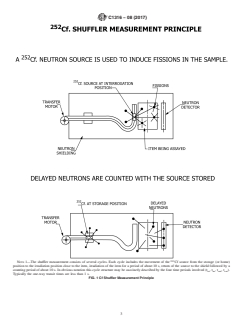
NOTE 1—The shuffler measurement consists of several cycles. Each cycle includes the movement of the Cf source from the storage (or home)
position to the irradiation position close to the item, irradiation of the item for a period of about 10 s, return of the source to the shield followed by a
counting period of about 10 s. In obvious notation this cycle structure may be succinctly described by the four time periods involved (t ,t ,t ,t ).
in irr out cnt
Typically the one-way transit times are less than 1 s.
FIG. 1 Cf Shuffler Measurement Principle
C1316 − 08 (2017)
5.4.3 It is recommended that measurements be made on 6.3.1 Active Mode (Self-Shielding)—The nuclear material
containers with homogeneous contents. In general, heteroge- on the surface of the lump shields the inside of the lump from
neity in the distribution of nuclear material, neutron the interrogating neutrons (15, 16).
moderators, and neutron absorbers has the potential to cause 6.3.2 Passive Mode (Multiplication)—Neutrons originating
biased results.
in the lump induce fissions in the same lump which boosts the
specific coincident rate.
5.5 This test method requires that the relative isotopic
compositions of the contributing elements are known.
6.4 Moderators in the matrix can cause a bias in the
measurement results, unless a correction is made or an appro-
5.6 This test method assumes that the distribution of the
priate matrix specific calibration is used. The magnitude and
contributingisotopesisuniformthroughoutthecontainerwhen
direction of this bias depend on the quantity of moderator
the matrix affects neutron transport.
present, the distribution of the fissile material, and the size of
5.7 This test method assumes that lump affects are
the item (2, 17).
unimportant—that is to say that large quantities of special
6.4.1 Although moderation is the greatest potential source
nuclear material are not concentrated in a small portion of the
of bias for passive measurements, the passive method is
container.
generallylesssusceptibletothepresenceofmoderatorthanthe
5.8 Forbestresultsfromtheapplicationofthistestmethod,
active method.
appropriate packaging of the items is required. Suitable train-
6.4.2 Thepresenceofabsorbersinthematrixcancausebias
ing of the personnel who package the scrap and waste prior to
if there is sufficient moderator present. The moderator slows
measurement should be provided (for example, see ANSI
fast neutrons which can then be captured more effectively by
15.20, Guide C1009, Guide C1490, and Guide C1068 for
the absorbers.
training guidance). Sometimes site specific conditions and
6.4.3 The instrument produces a nonuniform response
requirements may have greater bearing.
across the container, the severity varying with the concentra-
tion of hydrogen in the matrix. A source at the center of the
6. Interferences
container can produce either a higher or lower response than
6.1 Potential sources of measurement interference include
the same source located at the surface of the container
unexpected nuclear material contributing to the active or
depending on the item and instrument design.
passive neutron signal, self-shielding by lumps of fissile
6.5 Background neutron count rates from cosmic ray-
material, neutron self-multiplication, excessive quantities of
induced spallation can degrade the measurement sensitivity
absorbers or moderators in the matrix, heterogeneity of the
(detection limit) and the measurement precision for small
matrix, and the non-uniformity of the nuclear material spatial
masses (18, 19).
distribution especially within a moderating matrix. In general,
the greatest potential source of bias for active neutron mea-
6.6 High-background count rates mask the instrument re-
surement is heterogeneity of the nuclear material within a sponse to small quantities of special nuclear material for both
highly moderating matrix, while the greatest for passive
the active and passive modes (20-22).
neutron measurement is neutron moderation and absorption
6.7 High gamma dose rates eminating from the item (>10
(12).
–1
mSv h of penetrating radiation) may cause pile-up and
6.2 The techniques described in this test method cannot
break-down in the He-filled proportional neutron detectors
distinguishwhichisotopeisgeneratingthemeasuredresponse.
(23). Care should be taken to ensure the item is within the
If more than one nuclide that produces a response is present,
acceptable range of the instrument.
therelativeabundancesandrelativespecificresponsesofthose
6.8 Certain other elements may produce delayed neutrons
nuclides must be known.
following (fast) neutron irradiation (24).
6.2.1 Active Mode—The unidentified presence of other fis-
sionable nuclides will increase the delayed neutron count rate,
7. Apparatus
causing an overestimation of the U content. For example, a
7.1 The apparatus used in this test method can be obtained
calibrationbasedonhighlyenrichedUwillcausebiasedresults
commercially. Specific applications may require customized
if the unknowns actually contain low-enriched U due to the
designs to cope with (for example) container sizes, container
potential difference in the fractional contribution arising from
weights,activitylevels,integrationintothefacility (23, 25-28).
the fast fission in U (13, 14).
The following description is one possible design. Fig. 2 is a
6.2.2 Passive Mode—The unidentified presence of other
cutaway illustration of a shuffler to measure 208 L drums. In
spontaneous fission nuclides, such as Cm and Cf, will increase
thisdesign,the Cfsourcestorageshieldispositionedontop
the coincident neutron rates, causing an overestimation of the
of the measurement chamber. This design weighs approxi-
Pu content. The active mode measurement of Pu is generally
mately 8000 kg, and is 3 m high and2min diameter.
notsensitivetothissourceofbias(althoughcountingprecision
may be affected) because the masses of concern are so small
7.2 Counting Assembly—see Fig. 3.
and present a comparatively tiny induced fission signal.
7.2.1 The neutron detectors are He-filled cylindrical pro-
6.3 Lumps of nuclear material can exhibit self-shielding or portional counters embedded in polyethylene, located around
multiplication. This effect is often larger for moderating the item in a near 4π geometry. The detection efficiency for
(hydrogenous) matrices. neutrons of fission energy should be above about 15%. Larger
C1316 − 08 (2017)
NOTE 1—A sketch of a shuffler designed to assay 208-L drums. The
source storage shield is a 2000-kg, 1.2-m cube that resides close to the
measurement chamber. In this design it is on top of the measurement
chamber. This configuration reduces the footprint of the instrument and
may reduce the cosmic ray induced background somewhat. Other con-
figurations are also in common use. The stepping motor drives the Cf
source through the source transfer (or guide) tube between the storage
position and the irradiation position inside the measurement chamber.
FIG. 2 Shuffler for 208-L Drums of Waste
detection efficiencies generally provide better precision and
lower detection limits for a given count time subject to cycle
time, source coupling and other operational parameters. The
counter detection efficiency should vary less than 10% over
the item volume with no item present.
7.2.2 The flux monitors are He-filled proportional counters
mounted on the inner walls of the measurement chamber and
not embedded in polyethylene. One flux monitor is covered
with Cd approximately 1 mm thick; the other is bare and
NOTE 1—The front and top views of the measurement chamber shown
responds predominantly to thermal neutrons. The Cd shields
inFig.2areshownhereingreaterdetail.The208Ldrumsitsonarotating
the so-called fast flux monitor from thermal neutrons;
platform above the bottom detector bank. Six side banks surround the
therefore, the two flux monitors can be compared in order to
item, with the Cf source transfer tube at the back. The two flux monitors
provide information about the neutron energy distribution are placed at the rear of the item chamber.
FIG. 3 Shuffler Detector Bank Diagram
emerging from the item when the Cf shuffler is brought up.
Measured matrix corrections are functions of the fast and
thermal flux monitor rates.
taken in the routing of and shielding to the intervening guide
7.3 Shielding—The quantity of radiation shielding for
tubesoastomanagethetimeaverageddoserateinthevicinity.
the Cf source is governed by personnel safety requirements
7.4 Electronics—High count rate, commercially available
although control of the background is also a consideration.
nuclearelectronicsprovidestandardlogicpulsesfromthe He-
7.3.1 The measurement chamber is typically surrounded by
filled proportional counters. These pulses are typically pro-
0.3 to 0.6 m of materials such as polyethylene and borated
252 cessed by shift register coincidence electronics for the passive
polyethylenetoshieldtheoperatorduringthe Cfirradiation.
252 measurement, and by gated fast scalers or a multi-channel
7.3.2 The shield for the Cf storage position is typically
scaling system for the active measurement. Other correlated
about 0.6 m thick (1.2-m cube), depending on the source
neutron counting electronics can be used, with appropriate
strength,orthesourceisplaced1.8munderground.Composite
changes to the data reduction equations.
shields are more effective than polyethylene alone for
252 252
large Cfsources (29).Thesourcehomepositionmayhavea 7.5 Cf Source Drive System—The source is attached to a
heavy-metal shield to reduce direct gamma dose.The compos- flexible drive cable that runs inside a guide tube. The source
ite shield concept should also takes into account secondary movement is controlled by stepping motors or an alternative
capture gamma-ray generation. If the source store is not method that offers precise timing, positioning, and computer
directly mated to the measurement chamber, care should be control. During the active measurement, variations in the
C1316 − 08 (2017)
timing of the source transit, irradiation or counting portions of
the shuffles cause variations in the measured response. Com-
ponents should be selected to reduce this potential problem to
negligible levels.
7.6 Cf sources are commercially available and are usu-
ally replaced every few years (typically of the order of two
half-lifes) subject to preserving desired active detection limits
andprecisions.Thevendorshouldunderstandthesafetyissues
and provide guidance in addressing them.
7.6.1 The source vendor should encapsulate the Cf, se-
curely attach the source drive cable, provide shielded shipping
casks, and assist with the source installation and disposal.
7.6.2 The source vendor should be requested to provide
documentation for the ruggedness and integrity of the source
encapsulation and perform swipes to demonstrate that the
outside of the source capsule is not contaminated.
7.7 Data acquisition and reduction, control of the source
motion, and the diagnostic tests require interfacing the instru-
ment to a computer as illustrated in Fig. 4. The computer and
software normally are provided by the instrument vendor.
7.8 Customized Design Issues:
7.8.1 An initial Cf source size of 550 µg is generally
adequate for measurements of 208 Ldrums. Performance for a
given source strength can be tailored to some considerable
extentbyadjustingthechamberdesign—inparticulardetection
efficiency and source coupling play important roles.
7.8.2 It is recommended that the size of the measurement
chamber be just slightly larger than the size of the items to be
measured. If small items require measurement in a large
measurement chamber, the items should generally be centered
NOTE 1—The electrical components and their connections are indi-
inthechamber.Couplingoftheinterrogationsourcetotheitem
cated. The Cf source is moved by the stepping motor and associated
and of the item to the flux monitors may need special
driver. Three source sensors are used to verify the source position. The
considerationandacontainerspecificcalibrationwillgenerally
detector signals are amplified and discriminated in junction boxes into
be needed.
which the He-filled cylindrical proportional counters are fastened. The
logic outputs of the discriminators are fed to scalers and a coincidence
7.8.3 During an active measurement of a large item, the
counting module. The computer controls the source and rotator and
item should be rotated and the Cf source should scan the
receives the results from the scalers and coincidence counter according to
vertical length of the item. Some designs use continuous
the strict timing sequence in use.
rotation and scanning motion (2) while others acquire data
FIG. 4 Shuffler Electronic Controls Diagram
using a series of discrete angular and source positions (21, 27,
28). Discrete scans can provide input for optional analysis
algorithms(suchasmightprovidecoarsespatialcorrections)or
mightbeusefulwhereasymmetricpatternof Heproportional
special nuclear material. The down side of using a Cd liner,
counters can not be used (for example if the instrument is
however, is that the sensitivity be over an order of magnitude
constrained by the interface to a hot cell).
poorer. The prospects and potential benefits of spectrum
7.8.4 The standard shuffler configuration assumes some tailoring are discussed in (30). It should also be noted that
hydrogenous and some metallic matrices will be measured. some containers (for example, those with concrete liner or
The interrogation-neutron energies are therefore kept high by known to possess a particular waste characteristics) and some
not using spectrum tailoring materials between the Cf source chambers(forexample,thoserequiringsignificantPbshielding
and the item being measured and by using a steel reflector to control the gamma-ray does rate on the He proportional
behind the Cf source (1, 2). This configuration also includes counters) introduce neutron transport peculiarities that should
liningtheassaychamberwithCd,whichpreventsneutronsthat be considered as an integral part of the design process (21, 26,
are thermalized in the polyethylene of the detector banks from 27).
entering the measurement chamber. Thermal neutrons gener- 7.8.4.1 When it is assured that (a) lumps are not a signifi-
ally penetrate less deeply into the matrix and consequently cant problem and (b) the matrix is a weak moderator, a
spatial uncertainties will generally be higher if the matrix and polyethylenesleevecanbeplacedaroundtheassayitemforthe
special nuclear material distribution are not homogeneous. active mode measurement to reduce the energies of the
Thermal neutrons also are less pentrating into aggregates of interrogating neutrons, enhancing the fission rate, the
C1316 − 08 (2017)
precision, and the sensitivity. A different calibration is neces- 9.2.3 Perform the initial setup recommended by the system
sary for polyethylene “sleeve” measurements. An alternative manufacturer, obtaining assistance as needed.
scheme is to make the Cd liner removable to achieve the same
9.2.3.1 Most electronics settings are optimized by the
objective (30).
manufacturer, and changing them may affect the instrument’s
performance.
8. Hazards
9.2.3.2 The initial setup might include verifying or testing
8.1 Safety Hazards—Consult qualified professionals as
thefollowingitems:(a)thatallsoftwareisloadedandrunning;
needed.
(b) the safety features for the Cf source drive mechanism; (c)
8.1.1 Take precautions to maintain personnel radiation ex-
the operation of the source drive mechanism; (d) the status
posures as low as reasonably achievable (ALARA). See also
lamps; (e) the deadtime coefficients and the coincidence gate
GuideC1592.Typicaldosesatthesurfaceoftheinstrumentare
length; (f) the rotation motor; (g) the Cf source transfer
–1
<20 µSv h .
velocity,acceleration,andscanningparameters;(h)theparallel
8.1.1.1 Theradiationdosefrom550µg Cf(unshielded)is
port inputs and outputs; and (i) testing the neutron detection
–1
about 10 mSv h at 1 m, consisting of both gamma and
electronics with background and with small sources.
neutron radiation. Large Cf sources require remote
9.3 Calibration: Preparation—Use this test method with a
handling, shielding, and interlocks on automatic transfer
scrap and waste management plan that segregates materials
mechanismstohelppreventinadvertentorexcessiveexposure.
with respect to their neutron moderation and absorption prop-
8.1.1.2 For large source shields, the gamma rays resulting
erties. References (2) and (32) describe calibration exercises
from neutron capture in hydrogen can contribute significantly
and provide illustrative data. The passive calibration is con-
to the dose on the outside of the shield; shields loaded with B
ventional (see C1207) and Cf may be used as a surrogate
or Li can greatly reduce this effect.
for Pu (33). Additional sources of information can be
eff
8.1.2 Take precautions to prevent inhalation, ingestion, or
found in Guides C1009, C1068, C1128, C1156, C1210, and
the spread of radioactive contamination. Periodic alpha moni-
C1215; ANSI Guide15.20; NRC Guides 5.11 and 5.53; DOE
toringofcalibrationmaterials,measurementcontrolitems,and
Order 435.1; and U.S. Regulations 10CFR61 and 40CFR141.
scrap and waste containers to verify their integrity is recom-
9.3.1 Determine the different material types that represent
mended. Periodic inspection and monitoring of the shuffler
the scrap or waste streams to be measured.
source and guide tube should be carried out.
9.3.2 Prepare and characterize the calibration materials.
8.1.3 Take precautions regarding nuclear criticality, espe-
They should represent the material types with respect to
cially of unknown items. The measurement chamber approxi-
parameters that affect the measurement, such as moderation
mates a reflecting geometry for fast neutrons. Do not assume
and absorption. The calibration materials should span the
that waste is not of criticality concern.
special nuclear material mass ranges expected in the scrap or
8.1.4 Take precautions to prevent inhalation, ingestion, or
waste to be measured. The fabrication should document
the spread of Cd and Pb, if used as shielding. They should be
traceability for the special nuclear material parameters.
covered with nontoxic materials.
9.3.3 Record the calibration procedure and data. The data
8.1.5 Take precautions to avoid contact with high voltage.
should demonstrate the variation of the volume weighted
The proportional counters require low current supplies of
average instrument response as a function of the nuclear
approximately 2 kV.
material mass and the matrix.
8.2 The results of this test method might be used to make
9.3.4 The volume weighted average (VWA) response is an
decisions regarding, for example, the handling and disposal of
estimate of the count rate that would be obtained from a item
items or the cessation of safeguards on the items. Consult
containing a homogeneous matrix with a uniform distribution
qualified professionals and Guide C1490 as needed.
ofspecialnuclearmaterial.Onepossiblewayofestimatingthe
VWAresponse (2, 34) is a weighted average calculated from a
9. Initial Preparation of Apparatus
seriesofmeasurements.Oneormorephysicallysmallcapsules
9.1 The initial preparation of the shuffler passive/active
of special nuclear material of known and ideally low self-
neutron (PAN) apparatus is outlined in 9.2 through 9.6, which
shielding are placed in containers filled with uncontaminated
discuss the initial setup, calibration, and the initialization of
matrix material to estimate the response of the instrument to
measurement control. The details of preparation are site-
different matrices. Placement is typically along tubes which
specific, dependent on the material categories to be measured,
run the length of the containers and are placed in the matrix at
and are generally performed by experts (31).
the areal center of equal area columns. For 208 L drums
9.2 Initial Setup: typically3to5radialpositionsand5to7axialpositionswould
9.2.1 The apparatus weight exceeds typical industrial floor be used to define the centroids of the voxels, depending on the
load capacities. Check for adequate floor load capacity before severity of the matrix, which defines the spatial gradients. The
installation. VWA of the measured response map is computed along with
9.2.2 Locate the apparatus to minimize radiation exposure thecorrespondingstandarddeviationwhichisindicativeofthe
to the operator from scrap and waste items. The shuffler’s potential bias from measurements made with nonuniform
shielding typically screens the measurement chamber from (single point-like) distributions of special nuclear material.
most sources of background although ultimately detection Spatial mapping using encapsulated sources is also often a
limits are governed by background conditions (18, 20). pragmaticwaytodecreasethecostofgeneratingabroadrange
C1316 − 08 (2017)
calibration compared to characterizing and storing suitable through the origin. The user should verify the appropriateness
distributed calibration materials for large sets of diverse of this with measurements of matrix material without special
matrices. Spatial maps also lend themselves to numerical nuclear material present.
spatial integration schemes. Monte Carlo simulations bench-
9.4.5.3 Calibration data for scrap measurements of high
marked to a reference measurement may also be used to
mass items may not be suitable for fitting with a linear
generateVWAresponsesusingbasicknowledgeoftheneutron
function.
transport properties along with knowledge of the matrix
9.5 Determining the Matrix Correction—This section is not
compositions (for example, the measured response at only a
applicable if the matrix-specific calibration is being used. It
single position within a test matrix can be scaled by the
describes a procedure that determines the relationship between
calculated VWA-to-point ratio). In this way fewer experimen-
the measured flux monitor response and the neutron modera-
tal points are needed which can accelerate the calibration
tionandabsorptioneffectsofthematrixonthemeasuredcount
process.As a general rule however, measurements across a set
rate for uniform items. This relationship will determine a
of test matrices should be made and this is especially useful in
correction to the count rate data that is made before the
establishingfluxmonitor(orAdd-A-Source)trendswithmatrix
calibration described in 9.4 is used. Different corrections are
characteristics which are more difficult to model accurately.
required for the active and passive modes.
9.4 Calibration: Response vs. Mass—Thiscalibrationdeter-
9.5.1 Determinetherangeofmatrixcorrectionfortheactive
mines the relationship between the measured instrument re-
and passive modes separately.
sponse and the mass of nuclear material. If the matrix-specific
9.5.1.1 At some point, the moderator and absorber content
calibration approach is being used, this calibration data is
will be sufficiently large as to shield the innermost locations in
obtainedusingthespecificmatrixfoundintheunknowns (32).
the item. The user should not try to make a correction for this
Otherwise, a benign matrix is used.The flux monitor data may
measurementsituation,wherespecialnuclearmaterialcouldbe
be recorded for later use in assessing whether the correct
in the item but not respond.
matrix-specific calibration is being used. If the polyethylene
9.5.1.2 Theusermustchoosehowlargearesponsevariation
sleeve is used for measurements of a certain material category,
with position is acceptable to meet the measurement objec-
then the calibration data must be acquired with it also (2, 32,
–1
tives. A hydrogen density of 0.03 g mL will yield a
35).
maximum-to-minimum response variation of approximately
9.4.1 active mode—relatesthedelayedneutroncountrateto
2.4 for 208-L drums (2).
the effective or equivalent U mass (7).
9.5.2 Measure the flux monitor responses and the count
9.4.2 passive mode—relates the coincident neutron count
rates from the source for each matrix. The measurement
rate to the effective mass of Pu (7).
precisions should be smaller than those typically obtained in
9.4.3 Determine the range of the calibration. This is often
measurements of unknowns or small enough to make an
defined by the smallest and largest masses used in the calibra-
acceptable contribution to the overall measurement error.
tion.
9.5.3 Demonstrate that the flux monitor response is ad-
9.4.3.1 The best fit to the calibration function within the
equately independent of the special nuclear material source
calibration range sometimes yields nonsensical results outside
size and location in the item.
of the calibration range. Any use of the instrument outside of
9.5.4 Analyze the data to determine a suitable flux monitor
the calibration range should be evaluated carefully.
correction function. The choice of correction function will
9.4.3.2 If the calibration is extended to very small masses,
depend on the characteristics of the material categories. Sev-
the range should begin at zero instead of the lowest mass used
eralfunctionshavebeenusedtoperformanempiricalfittothis
in the calibration.The user should evaluate the response of the
type of data (2, 12, 17, 29, 38).
instrument with matrix items that contain no special nuclear
9.5.4.1 The corrected data in Fig. 5 for passive and Fig. 6
material.
for active measurements of homogenous distributions of U,
9.4.4 Measure each calibration mass such that the measure-
shown only as an example, both used the following empirical
ment precision is better than that expected for assay items of
functional form (2):
similar mass by using longer count times or replicate counts.
p~R! 2
9.4.4.1 Measurements of small mass items can have large
CF 51/R , wheretheexponent p R 5 a1 R 1a2 R1a3 (1)
~ !
uncertainties due to lack of signal. If the measurement preci-
where:
sion is 10% or worse, such measurements might be more
CF = the rate correction factor. In Section 11 we
useful to check the calibration rather than determine it.
use subscripts a and p to indicate the active
9.4.5 Analyzethecalibrationdatatodetermineanappropri-
and passive correction factors respectively,
ate function.The choice of calibration function will depend on
R = bare-to-Cd-covered flux monitor response
thecharacteristicsofthematerialcategoriesandthecalibration
ratio,
mass range (1, 2, 29, 32, 36-43).
a1, a2 and a3 = fitted coefficients specific to the mode (pas-
9.4.5.1 Calibration data for waste measurements with small
sive or active) and instrument.
amountsofspecialnuclearmaterialcangenerallybefittedwith
a linear function.
9.5.5 An alternative approach is the matrix-specific
9.4.5.2 If the calibration is extended to very small masses, calibration,wheretheuserattemptstomatchthematrixeffects
the calibration might produce less bias if the fit is forced of the unknown items with the calibration items (32). This
C1316 − 08 (2017)
9.6.1 Determine the measurement control item responses
and their uncertainties. These values are the ones to which
future measurements will be compared (see 10.1).
9.6.2 Items used in measurement control must provide
consistent measured values within statistical expectations each
time they are measured. Perform corrections for radioactive
decay when necessary.
9.6.3 Documentation of the measurement control of the
instrument may be required (that is, DOE Order 474.1).
9.6.4 The choice of control limits and the action required
after a “failure” should take into consideration the measure-
ment uncertainties and the probability of a false positive (44).
10. Procedure
10.1 After calibration, the procedure consists of measure-
ments of items with unknown special nuclear material content
NOTE 1—The measured active response per gram of U in 208-L
and measurements that demonstrate that the apparatus is
drumsisshownfor20matrices.Boththeuncorrectedresponse(+)andthe
calibrated and functioning properly (measurement control).
flux monitor corrected response (x) are plotted. The relative standard
deviation of the corrected responses is 14%. The matrices span a wide
10.2 Measurement Control—Measurementcontrolmeasure-
range of characteristics typical of those found in facilities (2).The largest
ments are made before assays of unknowns and are inter-
hydrogen content in a matrix was 9.65 kg; the largest boron content was
0.20 kg. spersed between measurements of unknowns to verify proper
FIG. 5 Active Response as a Function of Flux Monitor Ratio
functioning of the instrument. If the measurement control
indicates the instrument response has changed, determine the
causeandmakethenecessaryrepairs.Inaddition,allmeasure-
ments of unknowns since the last successful test are suspect
and may need to be repeated.
10.2.1 Background Measurements—Perform periodic back-
ground measurements (44).
10.2.1.1 Passive Mode—Traditional practice is to perform
these measurements daily with no special nuclear material in
theassaychamber.Lowtotalneutroncountratesverifythatno
breakdownoftheproportionalcountersortheirelectronicshas
occurred. Count rates of zero suggest the detector high voltage
is off, part of the detection electronics is nonfunctional, or the
detector electronics are disconnected. This background mea-
surement is generally used in the passive calculations.
10.2.1.2 Active Mode—Abackgroundmeasurementismade
atthestartofeachassaywhiletheitemisintheassaychamber,
beforethesourceshufflesbegin.ForacombinedPANassaythe
NOTE 1—The measured passive response per gram of Pu in 208-L
eff
active background is usually the non-deadtime corrected pas-
drumsisshownfor18matrices.Boththeuncorrectedresponse(+)andthe
sive data.
flux monitor corrected response (x) are plotted. The relative standard
deviation of the corrected responses is 12%. The matrices cover a wide 10.2.2 Measurement Control Bias Measurement—Perform
range of characteristics typical of those found in facilities (2).The largest
periodic measurements of stable items containing special
hydrogen content in a matrix was 9.65 kg; the largest boron content was
nuclear material to verify the stability of the instrument
0.20 kg.
response (44). Typically high and low masses are used on
FIG. 6 Passive Response as a Function of Flux Monitor Ratio
different days. Traditional practice is to perform a daily
measurement for instruments used daily although more fre-
quent state of health checks may be made subject to an
approach might use the flux monitor data to verify that the
application specific consequence analysis. For instruments
calibration and item matrices are suitably matched.
usedintermittently,thischeckisrecommendedbeforeandafter
eachuse.Agreementwiththepreviousvaluewithinthecontrol
9.6 Initialize Measurement Control—The need for adjust-
ment of the instrument can be determined by measurement limits indicates long-term stability of the instrument’s re-
sponse. Long-term stability suggests that the calibration is still
control procedures (44) (ANSI N15.36). These procedures
make use of background measurements, replicate measure- valid.Lowresultsmayindicatethatadetectorordetectorbank
mentsofaspecificitem,andperiodicremeasurementofcertain is not functioning correctly. High results may indicate electri-
items. cal noise.
C1316 − 08 (2017)
10.2.2.1 The measurement control item used for the check 10.3.4 The following diagnostic tests are recommended for
must provide a consistent response. Corrections should be each measurement.
made for radioactive decay.
10.3.4.1 Passive Mode—(a)Thetotalneutroncountratecan
10.2.2.2 The uncertainty estimated from counting statistics be used to estimate the accidentals rate (4, 41). Lack of
forthesemeasurementswillbeconstantforagivencounttime, agreement within statistical uncertainties between the esti-
except for changes due to source decay. Otherwise, the source mated and measured accidentals count rates suggests a hard-
of variation should be investigated. warefailureinthecoincidencecircuitryorthatthebackground
neutron count rate changed significantly during the measure-
10.2.3 Measurement Control Precision Measurement—
ment. Note that for a symmetric counter and fairly homoge-
Perform periodic replicate counts of different items to verify
neous items the passive rate should remain approximately
the estimates of the measurement precision (44). This test
constant as the item is rotated. For some designs, however, the
might be conducted monthly or after each calibration. Statis-
item must be held fixed during data acquisition and indexed to
ticalagreementbetweenthestandarddeviationofthereplicates
obtain a rotational average for this test to pass. (b) Each
and the uncertainty estimate from a single measurement’s
measurement can be divided into several short counting
counting statistics indicates short-term stability of the instru-
periods, and statistical tests performed looking for outliers in
ment’s response. Lack of agreement might indicate back-
the individual counting periods (12, 36, 41, 45, 46). This
ground variations, electrical instabilities, mechanical changes,
“outlier” test reduces the effects of cosmic ray background or
or errors in the implementation of the software algorithms.
of changing conditions during the measurement. Outliers are
10.3 Item Measurements:
generally replaced with data from an additional counting
10.3.1 Position the item to be measured in the counting
period, which is obtained without operator intervention by the
chamber. The counting geometry should be the same for all
software.
measurements. If the polyethylene sleeve is used for assay of
10.3.4.2 Active Mode—(a)Adetectorbankwithzerocounts
an item then the calibration used for the analysis should have
issuspectandreportedwithanerrormessage (1, 2).Thiserror
been obtained in the “sleeve” configuration.
condition might indicate the detector bank is not functional. If
10.3.2 Measure for the chosen count times.
...