

ASTM C1751-21
(Guide)Standard Guide for Sampling Radioactive Tank Waste
General Information
- Abstract
SIGNIFICANCE AND USE
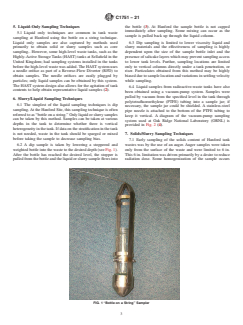
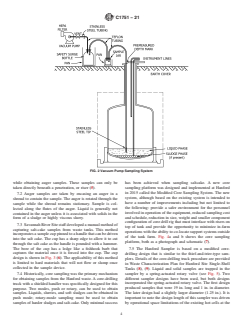
4.1 Obtaining samples of high-level waste created during the reprocessing of spent nuclear fuels presents unique challenges. Generally, high-level waste is stored in tanks with limited access to decrease the potential for radiation exposure to personnel. Samples must be obtained remotely because of the high radiation dose from the bulk material and the samples, samples require shielding for handling, transport, and storage. The quantity of sample that can be obtained and transported is small due to the hazardous nature of the samples as well as their high radiation dose.
4.2 Many high-level wastes have been treated to remove strontium (Sr) or cesium (Cs), or both, have undergone liquid volume reductions through pumping and forced evaporation or have been pH modified, or both, to decrease corrosion of the tanks. These processes, as well as waste streams added from multiple process plant operations, often resulted in precipitation, and produced multiphase wastes that are heterogeneous. Evaporation of water from waste with significant dissolved salts concentrations has occurred in some tanks due to the high heat load associated with the high-level waste and by pumping and intentional evaporative processing, resulting in the formation of a saltcake or crusts, or both. Organic layers exist in some waste tanks, creating additional heterogeneity in the wastes.
4.3 Many of the sampling systems have limitations including the ability to sample varying depths in the tank and the depth of sampling. Sampling in Hanford tanks is constrained by riser diameter, riser location and riser availability.
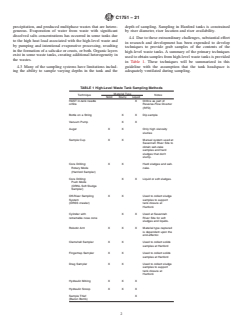
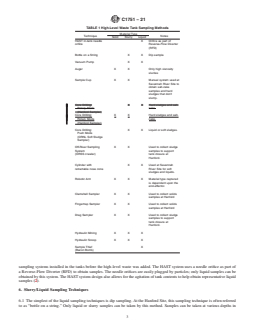
4.4 Due to these extraordinary challenges, substantial effort in research and development has been expended to develop techniques to provide grab samples of the contents of the high-level waste tanks. A summary of the primary techniques used to obtain samples from high-level waste tanks is provided in Table 1. These techniques will be summarized in this guideline with the assum...
SCOPE
1.1 This guide addresses techniques used to obtain samples from tanks containing high-level radioactive waste created during the reprocessing of spent nuclear fuels. Guidance on selecting appropriate sampling devices for waste covered by the Resource Conservation and Recovery Act (RCRA) is also provided by the United States Environmental Protection Agency (EPA) (1).2 Vapor sampling of the head-space is not included in this guide because it does not significantly affect slurry retrieval, pipeline transport, plugging, or mixing.
1.2 The values stated in inch-pound units are to be regarded as standard. No other units of measurement are included in this standard.
1.3 This standard does not purport to address all of the safety concerns, if any, associated with its use. It is the responsibility of the user of this standard to establish appropriate safety and health practices and determine the applicability of regulatory limitations prior to use.
1.4 This international standard was developed in accordance with internationally recognized principles on standardization established in the Decision on Principles for the Development of International Standards, Guides and Recommendations issued by the World Trade Organization Technical Barriers to Trade (TBT) Committee.
- Status
- Published
- Publication Date
- 31-Dec-2020
- Technical Committee
- C26 - Nuclear Fuel Cycle
- Drafting Committee
- C26.13 - Spent Fuel and High Level Waste
Overview
ASTM C1751-21: Standard Guide for Sampling Radioactive Tank Waste provides comprehensive guidance on techniques and best practices for obtaining representative samples from tanks containing high-level radioactive waste generated during the reprocessing of spent nuclear fuels. Developed under the jurisdiction of ASTM Committee C26 on Nuclear Fuel Cycle, this standard addresses the significant health, safety, and technical challenges involved in sampling hazardous waste stored in environments with restricted access and high radiation levels.
The guide is intended for professionals involved in environmental management, nuclear facility operations, and waste characterization. It focuses on remote sampling methods due to the high radiation dose levels, ensuring that adequate shielding and safety protocols are maintained throughout the process.
Key Topics
- Sampling Challenges: High-level radioactive waste tanks often feature limited access to minimize exposure risks. Samples must be obtained remotely, and only small quantities can be safely extracted and transported.
- Waste Complexity: Tank contents can be heterogeneous, including liquid, sludge, saltcake, and crusts, as well as organic layers, due to various treatment processes (e.g., strontium or cesium removal, volume reduction, pH modification).
- Sampling Techniques: The standard summarizes primary methods such as:
- Liquid sampling (e.g., bottle-on-a-string, vacuum pump systems)
- Solid and slurry sampling (e.g., core drilling, augers, sample cups)
- Robotic and remote-operated tools (e.g., Light-Duty Utility Arms, Extended Reach End-Effectors)
- Specialized equipment for sampling at different tank depths and locations, including off-riser systems and clamshell/drag samplers
- Sampling Plan Design: Emphasizes the importance of defining sampling objectives, selecting appropriate locations and sample types, considering variation and bias, and ensuring results are representative of overall tank contents.
- Regulatory Guidance: References additional guidance, such as the EPA’s Resource Conservation and Recovery Act (RCRA) requirements for certain waste sampling scenarios.
Applications
- Nuclear Waste Management: Ensures safe and reliable characterization of tank waste prior to treatment, retrieval, transfer, or disposal activities.
- Facility Operations: Supports ongoing operational safety by enabling accurate assessment of residual waste in tanks at sites such as Hanford, Savannah River, Sellafield, and Oak Ridge National Laboratory.
- Regulatory Compliance: Facilitates compliance with federal and international regulations on hazardous and radioactive waste, supporting documentation needed for closure plans, waste transfers, and remediation efforts.
- Research and Development: Assists R&D initiatives aiming to improve sampling methods, reduce personnel exposure, and obtain more representative samples from increasingly complex waste matrices.
Related Standards
- ASTM D1129: Terminology Relating to Water
- EPA RCRA Waste Sampling Guidance: Technical Guidance, SW-846, Chapter 9
- DOE Waste Management References: Various technical documents referenced within ASTM C1751-21 related to site-specific procedures (Hanford, ORNL, Savannah River, Sellafield)
- Standards and guides addressing sample collection, transportation, analysis, and safety protocols for hazardous materials
Keywords: radioactive waste sampling, high-level waste, tank waste, hazardous waste characterization, remote sampling, core sampling, ASTM C1751, nuclear facility, waste management standards
By following ASTM C1751-21, organizations ensure the integrity and safety of sampling activities in high-radiation environments, improving both operational efficiency and regulatory compliance in the management of radioactive tank waste.
Relations
- Effective Date
- 01-May-2020
- Effective Date
- 01-Mar-2010
- Effective Date
- 01-Sep-2006
- Effective Date
- 01-Sep-2006
- Effective Date
- 15-Feb-2006
- Effective Date
- 01-Mar-2004
- Effective Date
- 01-Mar-2004
- Effective Date
- 10-Aug-2003
- Effective Date
- 10-Mar-2003
- Effective Date
- 10-Jul-2002
- Effective Date
- 10-Jul-2002
- Effective Date
- 10-Feb-2002
- Effective Date
- 10-Feb-2002
Get Certified
Connect with accredited certification bodies for this standard

CIS Institut d.o.o.
Personal Protective Equipment (PPE) certification body. Notified Body NB-2890 for EU Regulation 2016/425 PPE.

Kiwa BDA Testing
Building and construction product certification.
Kmetijski inštitut Slovenije
Agricultural Institute of Slovenia. Soil testing, plant health, agricultural product analysis.
Sponsored listings
Frequently Asked Questions
ASTM C1751-21 is a guide published by ASTM International. Its full title is "Standard Guide for Sampling Radioactive Tank Waste". This standard covers: SIGNIFICANCE AND USE 4.1 Obtaining samples of high-level waste created during the reprocessing of spent nuclear fuels presents unique challenges. Generally, high-level waste is stored in tanks with limited access to decrease the potential for radiation exposure to personnel. Samples must be obtained remotely because of the high radiation dose from the bulk material and the samples, samples require shielding for handling, transport, and storage. The quantity of sample that can be obtained and transported is small due to the hazardous nature of the samples as well as their high radiation dose. 4.2 Many high-level wastes have been treated to remove strontium (Sr) or cesium (Cs), or both, have undergone liquid volume reductions through pumping and forced evaporation or have been pH modified, or both, to decrease corrosion of the tanks. These processes, as well as waste streams added from multiple process plant operations, often resulted in precipitation, and produced multiphase wastes that are heterogeneous. Evaporation of water from waste with significant dissolved salts concentrations has occurred in some tanks due to the high heat load associated with the high-level waste and by pumping and intentional evaporative processing, resulting in the formation of a saltcake or crusts, or both. Organic layers exist in some waste tanks, creating additional heterogeneity in the wastes. 4.3 Many of the sampling systems have limitations including the ability to sample varying depths in the tank and the depth of sampling. Sampling in Hanford tanks is constrained by riser diameter, riser location and riser availability. 4.4 Due to these extraordinary challenges, substantial effort in research and development has been expended to develop techniques to provide grab samples of the contents of the high-level waste tanks. A summary of the primary techniques used to obtain samples from high-level waste tanks is provided in Table 1. These techniques will be summarized in this guideline with the assum... SCOPE 1.1 This guide addresses techniques used to obtain samples from tanks containing high-level radioactive waste created during the reprocessing of spent nuclear fuels. Guidance on selecting appropriate sampling devices for waste covered by the Resource Conservation and Recovery Act (RCRA) is also provided by the United States Environmental Protection Agency (EPA) (1).2 Vapor sampling of the head-space is not included in this guide because it does not significantly affect slurry retrieval, pipeline transport, plugging, or mixing. 1.2 The values stated in inch-pound units are to be regarded as standard. No other units of measurement are included in this standard. 1.3 This standard does not purport to address all of the safety concerns, if any, associated with its use. It is the responsibility of the user of this standard to establish appropriate safety and health practices and determine the applicability of regulatory limitations prior to use. 1.4 This international standard was developed in accordance with internationally recognized principles on standardization established in the Decision on Principles for the Development of International Standards, Guides and Recommendations issued by the World Trade Organization Technical Barriers to Trade (TBT) Committee.
SIGNIFICANCE AND USE 4.1 Obtaining samples of high-level waste created during the reprocessing of spent nuclear fuels presents unique challenges. Generally, high-level waste is stored in tanks with limited access to decrease the potential for radiation exposure to personnel. Samples must be obtained remotely because of the high radiation dose from the bulk material and the samples, samples require shielding for handling, transport, and storage. The quantity of sample that can be obtained and transported is small due to the hazardous nature of the samples as well as their high radiation dose. 4.2 Many high-level wastes have been treated to remove strontium (Sr) or cesium (Cs), or both, have undergone liquid volume reductions through pumping and forced evaporation or have been pH modified, or both, to decrease corrosion of the tanks. These processes, as well as waste streams added from multiple process plant operations, often resulted in precipitation, and produced multiphase wastes that are heterogeneous. Evaporation of water from waste with significant dissolved salts concentrations has occurred in some tanks due to the high heat load associated with the high-level waste and by pumping and intentional evaporative processing, resulting in the formation of a saltcake or crusts, or both. Organic layers exist in some waste tanks, creating additional heterogeneity in the wastes. 4.3 Many of the sampling systems have limitations including the ability to sample varying depths in the tank and the depth of sampling. Sampling in Hanford tanks is constrained by riser diameter, riser location and riser availability. 4.4 Due to these extraordinary challenges, substantial effort in research and development has been expended to develop techniques to provide grab samples of the contents of the high-level waste tanks. A summary of the primary techniques used to obtain samples from high-level waste tanks is provided in Table 1. These techniques will be summarized in this guideline with the assum... SCOPE 1.1 This guide addresses techniques used to obtain samples from tanks containing high-level radioactive waste created during the reprocessing of spent nuclear fuels. Guidance on selecting appropriate sampling devices for waste covered by the Resource Conservation and Recovery Act (RCRA) is also provided by the United States Environmental Protection Agency (EPA) (1).2 Vapor sampling of the head-space is not included in this guide because it does not significantly affect slurry retrieval, pipeline transport, plugging, or mixing. 1.2 The values stated in inch-pound units are to be regarded as standard. No other units of measurement are included in this standard. 1.3 This standard does not purport to address all of the safety concerns, if any, associated with its use. It is the responsibility of the user of this standard to establish appropriate safety and health practices and determine the applicability of regulatory limitations prior to use. 1.4 This international standard was developed in accordance with internationally recognized principles on standardization established in the Decision on Principles for the Development of International Standards, Guides and Recommendations issued by the World Trade Organization Technical Barriers to Trade (TBT) Committee.
ASTM C1751-21 is classified under the following ICS (International Classification for Standards) categories: 13.030.30 - Special wastes. The ICS classification helps identify the subject area and facilitates finding related standards.
ASTM C1751-21 has the following relationships with other standards: It is inter standard links to ASTM D1129-13(2020)e2, ASTM D1129-10, ASTM D1129-06a, ASTM D1129-06ae1, ASTM D1129-06, ASTM D1129-04, ASTM D1129-04e1, ASTM D1129-03a, ASTM D1129-03, ASTM D1129-02a, ASTM D1129-01, ASTM D1129-02, ASTM D1129-99a. Understanding these relationships helps ensure you are using the most current and applicable version of the standard.
ASTM C1751-21 is available in PDF format for immediate download after purchase. The document can be added to your cart and obtained through the secure checkout process. Digital delivery ensures instant access to the complete standard document.
Standards Content (Sample)
This international standard was developed in accordance with internationally recognized principles on standardization established in the Decision on Principles for the
Development of International Standards, Guides and Recommendations issued by the World Trade Organization Technical Barriers to Trade (TBT) Committee.
Designation: C1751 − 21
Standard Guide for
Sampling Radioactive Tank Waste
This standard is issued under the fixed designation C1751; the number immediately following the designation indicates the year of
original adoption or, in the case of revision, the year of last revision. A number in parentheses indicates the year of last reapproval. A
superscript epsilon (´) indicates an editorial change since the last revision or reapproval.
1. Scope 3.2 Definitions of Terms Specific to This Standard:
3.2.1 forced evaporation, n—intentional concentration of a
1.1 This guide addresses techniques used to obtain samples
waste solution using heat or vacuum, or both, primarily to
from tanks containing high-level radioactive waste created
remove water or other solvents.
during the reprocessing of spent nuclear fuels. Guidance on
selecting appropriate sampling devices for waste covered by 3.2.2 pH modified, n—a description of a solution where the
the Resource Conservation and Recovery Act (RCRA) is also pH is adjusted with either an acid or base material to achieve
provided by the United States Environmental Protection a desired pH level to minimize tank corrosion.
Agency (EPA) (1). Vapor sampling of the head-space is not
3.2.3 soft sludge, n—a sludge with a low viscosity where
included in this guide because it does not significantly affect
minimal sampling device pressure could be used to penetrate
slurry retrieval, pipeline transport, plugging, or mixing.
the sludge layer.
1.2 The values stated in inch-pound units are to be regarded
3.2.4 sparge, n—a process of delivering a chemically inert
as standard. No other units of measurement are included in this
gas through fluids to displace materials for the purpose of
standard.
mixing.
1.3 This standard does not purport to address all of the
3.3 Acronyms:
safety concerns, if any, associated with its use. It is the
3.3.1 EREE—Extended Reach End-Effector
responsibility of the user of this standard to establish appro-
3.3.2 HAST—Highly-Active Storage Tanks
priate safety, health, and environmental practices and deter-
mine the applicability of regulatory limitations prior to use. 3.3.3 LDUAs—Light-Duty Utility Arms
1.4 This international standard was developed in accor-
3.3.4 NPH—Normal Paraffin Hydrocarbons
dance with internationally recognized principles on standard-
3.3.5 ORNL—Oak Ridge National Laboratory
ization established in the Decision on Principles for the
3.3.6 PTFE—Polytetrafluoroethylene
Development of International Standards, Guides and Recom-
mendations issued by the World Trade Organization Technical
3.3.7 PVC—Polyvinyl Chloride
Barriers to Trade (TBT) Committee.
3.3.8 RFD—Reverse-Flow Diverter
2. Referenced Documents
4. Significance and Use
2.1 ASTM Standards:
4.1 Obtaining samples of high-level waste created during
D1129 Terminology Relating to Water
the reprocessing of spent nuclear fuels presents unique chal-
3. Terminology
lenges. Generally, high-level waste is stored in tanks with
limited access to decrease the potential for radiation exposure
3.1 Definitions—For definitions of terms used in this
to personnel. Samples must be obtained remotely because of
method, refer to Terminology D1129.
the high radiation dose from the bulk material and the samples,
samples require shielding for handling, transport, and storage.
This guide is under the jurisdiction of ASTM Committee C26 on Nuclear Fuel
The quantity of sample that can be obtained and transported is
Cycle and is the direct responsibility of Subcommittee C26.13 on Spent Fuel and
small due to the hazardous nature of the samples as well as
High Level Waste.
their high radiation dose.
Current edition approved Jan. 1, 2021. Published March 2021. Originally
approved in 2011. Last previous edition approved in 2020 as C1751 – 20. DOI:
4.2 Many high-level wastes have been treated to remove
10.1520/C1751-21.
strontium (Sr) or cesium (Cs), or both, have undergone liquid
The boldface numbers in parentheses refer to a list of references at the end of
this standard.
volume reductions through pumping and forced evaporation or
For referenced ASTM standards, visit the ASTM website, www.astm.org, or
have been pH modified, or both, to decrease corrosion of the
contact ASTM Customer Service at service@astm.org. For Annual Book of ASTM
tanks. These processes, as well as waste streams added from
Standards volume information, refer to the standard’s Document Summary page on
the ASTM website. multiple process plant operations, often resulted in
Copyright © ASTM International, 100 Barr Harbor Drive, PO Box C700, West Conshohocken, PA 19428-2959. United States
C1751 − 21
precipitation, and produced multiphase wastes that are hetero- depth of sampling. Sampling in Hanford tanks is constrained
geneous. Evaporation of water from waste with significant by riser diameter, riser location and riser availability.
dissolved salts concentrations has occurred in some tanks due
4.4 Due to these extraordinary challenges, substantial effort
to the high heat load associated with the high-level waste and
in research and development has been expended to develop
by pumping and intentional evaporative processing, resulting
techniques to provide grab samples of the contents of the
in the formation of a saltcake or crusts, or both. Organic layers
high-level waste tanks. A summary of the primary techniques
exist in some waste tanks, creating additional heterogeneity in
used to obtain samples from high-level waste tanks is provided
the wastes.
in Table 1. These techniques will be summarized in this
4.3 Many of the sampling systems have limitations includ- guideline with the assumption that the tank headspace is
ing the ability to sample varying depths in the tank and the adequately ventilated during sampling.
TABLE 1 High-Level Waste Tank Sampling Methods
Material Type
Technique Notes
Solid Slurry Liquid
HAST in-tank needle X Orifice as part of
orifice Reverse-Flow Diverter
(RFD)
Bottle on a String X X Dip sample
Vacuum Pump X X
Auger X X Only high viscosity
slurries
Sample Cup X X Manual system used at
Savannah River Site to
obtain salt-cake
samples and hard
sludges that don’t
slump.
Core Drilling: X X Hard sludges and salt-
Rotary Mode cake.
(Hanford Sampler)
Core Drilling: X X Liquid or soft sludges.
Push Mode
(ORNL Soft Sludge
Sampler)
Off-Riser Sampling X X Used to collect sludge
System samples to support
(ORSS crawler) tank closure at
Hanford.
Cylinder with X X Used at Savannah
retractable nose cone River Site for soft
sludges and liquids.
Robotic Arm X X X Material type captured
is dependent upon the
end-effector.
Clamshell Sampler X X Used to collect solids
samples at Hanford
Fingertrap Sampler X X Used to collect solids
samples at Hanford
Drag Sampler X X Used to collect sludge
samples to support
tank closure at
Hanford.
Hydraulic Mining X X X
Hydraulic Scoop X X X
Sample Thief X
(Bacon Bomb)
C1751 − 21
5. Liquid-Only Sampling Techniques the bottle (3). At Hanford the sample bottle is not capped
immediately after sampling. Some mixing can occur as the
5.1 Liquid only techniques are common in tank waste
sample is pulled back up through the liquid column.
sampling at Hanford using the bottle on a string technique.
Liquid only samples are also captured by methods used 6.3 Dip sampling is limited to lower viscosity liquid and
primarily to obtain solid or slurry samples such as core slurry materials and the effectiveness of sampling is highly
sampling. However, some high-level waste tanks, such as the dependent upon the size of the sample bottle inlet and the
Highly-Active Storage Tanks (HAST) tanks at Sellafield in the presence of saltcake layers which may prevent sampling access
United Kingdom; had sampling systems installed in the tanks to lower tank levels. Further, sampling locations are limited
before the high-level waste was added. The HAST system uses only to vertical columns directly under a tank penetration, or
a needle orifice as part of a Reverse-Flow Diverter (RFD) to riser. Particulates obtained from this method may be highly
obtain samples. The needle orifices are easily plugged by biased due to sample location and variations in settling velocity
particles; only liquid samples can be obtained by this system. while sampling.
The HAST system design also allows for the agitation of tank
6.4 Liquid samples from radioactive-waste tanks have also
contents to help obtain representative liquid samples (2).
been obtained using a vacuum-pump system. Samples were
pulled by vacuum from the specified level in the tank through
6. Slurry/Liquid Sampling Techniques
polytetrafluoroethylene (PTFE) tubing into a sample jar; if
6.1 The simplest of the liquid sampling techniques is dip
necessary, the sample jar could be shielded. A stainless-steel
sampling. At the Hanford Site, this sampling technique is often
pipe nozzle is attached to the bottom of the PTFE tubing to
referred to as “bottle on a string.” Only liquid or slurry samples
keep it vertical. A diagram of the vacuum-pump sampling
can be taken by this method. Samples can be taken at various
system used at Oak Ridge National Laboratory (ORNL) is
depths in the tank to determine whether there is vertical
provided in Fig. 2 (4).
heterogeneity in the tank. If data on the stratification in the tank
is not needed, waste in the tank should be sparged or mixed 7. Solids/Slurry Sampling Techniques
before taking the sample to decrease sampling bias.
7.1 Early sampling of the solids content of Hanford tank
6.2 A dip sample is taken by lowering a stoppered and wastes was by the use of an auger. Auger samples were taken
weighted bottle into the waste to the desired depth (see Fig. 1). only from the surface of the waste and were limited to 6 in.
After the bottle has reached the desired level, the stopper is This 6 in. limitation was driven primarily by a desire to reduce
pulled from the bottle and the liquid or slurry sample flows into radiation dose. Some homogenization of the sample occurs
FIG. 1 “Bottle on a String” Sampler
C1751 − 21
FIG. 2 Vacuum Pump Sampling System
while obtaining auger samples. These samples can only be has been achieved when sampling saltcake. A new core
taken directly beneath a penetration, or riser (5).
sampling platform was designed and implemented at Hanford
in 2015 called the Modified Core Sampling System. The new
7.2 Auger samples are taken by encasing an auger in a
system, although based on the existing system is intended to
shroud to contain the sample. The auger is rotated through the
have a number of improvements including but not limited to
sample while the shroud remains stationary. Sample is col-
the following: provide a safer environment for the personnel
lected along the flutes of the auger. Liquid is generally not
involved in operation of the equipment, reduced sampling cost
contained in the auger unless it is associated with solids in the
and schedule, reduction in size, weight and smaller component
form of a sludge or highly viscous slurry.
configuration of core drill rig that must interface with risers on
7.3 Savannah River Site staff developed a manual method of
top of tank and provide the opportunity to minimize in-farm
capturing salt-cake samples from waste tanks. This method
operations with the ability to co-locate support systems outside
incorporates a sample cup pinned to a handle that can be driven
of the tank farm. Fig. 4a and b shows the core sampling
into the salt cake. The cup has a sharp edge to allow it to cut
platform, both as a photograph and schematic (7).
through the salt cake as the handle is pounded with a hammer.
The bore of the cup has a ledge like a fishhook barb that
7.5 The Hanford Sampler is based on a modified core-
captures the material once it is forced into the cup. The cup
drilling design that is similar to the thief-and-trier-type sam-
design is shown in Fig. 3 (6). The applicability of this method
plers. Details of the core-drilling truck procedure are provided
is limited to hard materials that will not flow or slump once
in Waste Characterization Plan for Hanford Site Single-Shell
collected in the sample device.
Tanks (8), (9). Liquid and solid samples are trapped in the
sampler by a spring-actuated rotary valve (see Fig. 5). Two
7.4 Historically, core sampling was the primary mechanism
different sampler designs have been used, but both designs
for obtaining samples from the Hanford waste. A core-drilling
incorporated the spring-actuated rotary valve. The first design
truck with a shielded handler was specifically designed for this
produced samples that were 19 in. long and 1 in. in diameter.
purpose. Two modes, push or rotary, can be used to obtain
samples. Liquids, slurries, and soft sludges can be obtained in The later design had a slightly larger diameter (1.25 in.). It is
important to note the design length of this sampler was driven
push mode; rotary-mode sampling must be used to obtain
samples of harder sludges and salt-cake. Only minimal success by operational space limitations of the existing hot cells at the
C1751 − 21
FIG. 3 Savannah River Site Salt-Cake Sample Cup
time. Core samples can be taken at varying depths to obtain this sampler is provided in an ORNL technical document
samples that comprise the entire depth of the waste. A sliding describing the sampling and analysis of radioactive waste tanks
piston in the sampler controls the height of the sample being
(4).
collected. A hydrostatic fluid is added via the drill string to
7.7 The Savannah River Site developed a similar method for
keep the waste from slumping into the void created by the
obtaining soft sludges. The sampler is a cylinder with a
sample when the sampler is pulled from the tank. Normal
retractable nose cone at the bottom. Sections of pipe are added
paraffin hydrocarbons (NPH) were initially used as the hydro-
to the sampler to lower it to the desired depth in the tank.
static fluid. Nitrogen gas has also been used.
Penetration into the sludge is achieved by using the collective
7.6 A sampler based on the same principle was used at
weight of the sampler and pipe sections. Once the desired
ORNL to obtain samples of soft sludges from waste tanks at
depth is achieved, the nose cone is retracted into the cylinder,
that site. Samples are collected by manually pushing a polyvi-
forming an annulus between the cone and cylinder. Gases and
nyl chloride (PVC) pipe with a detachable handle assembly
liquids pass through a vent at the top of the cylinder, allowing
into the sludge in the tank. A bottom closure that can be
the sludge to be trapped in the cylinder. After the cylinder is
controlled from above by the operator is incorporated into the
closed, the sampler is raised out of the tank into a shielded cask
sampler Fig. 6. This sampler is capable of capturing both liquid
(10).
and soft sludge samples. A brief description of the operation of
C1751 − 21
FIG. 4 a. Core Sampling Platform
...
This document is not an ASTM standard and is intended only to provide the user of an ASTM standard an indication of what changes have been made to the previous version. Because
it may not be technically possible to adequately depict all changes accurately, ASTM recommends that users consult prior editions as appropriate. In all cases only the current version
of the standard as published by ASTM is to be considered the official document.
Designation: C1751 − 20 C1751 − 21
Standard Guide for
Sampling Radioactive Tank Waste
This standard is issued under the fixed designation C1751; the number immediately following the designation indicates the year of
original adoption or, in the case of revision, the year of last revision. A number in parentheses indicates the year of last reapproval. A
superscript epsilon (´) indicates an editorial change since the last revision or reapproval.
1. Scope
1.1 This guide addresses techniques used to obtain samples from tanks containing high-level radioactive waste created during the
reprocessing of spent nuclear fuels. Guidance on selecting appropriate sampling devices for waste covered by the Resource
Conservation and Recovery Act (RCRA) is also provided by the United States Environmental Protection Agency (EPA) (1). Vapor
sampling of the head-space is not included in this guide because it does not significantly affect slurry retrieval, pipeline transport,
plugging, or mixing.
1.2 The values stated in inch-pound units are to be regarded as standard. No other units of measurement are included in this
standard.
1.3 This standard does not purport to address all of the safety concerns, if any, associated with its use. It is the responsibility of
the user of this standard to establish appropriate safety and health practices and determine the applicability of regulatory
limitations prior to use.
1.4 This international standard was developed in accordance with internationally recognized principles on standardization
established in the Decision on Principles for the Development of International Standards, Guides and Recommendations issued
by the World Trade Organization Technical Barriers to Trade (TBT) Committee.
2. Referenced Documents
2.1 ASTM Standards:
D1129 Terminology Relating to Water
3. Terminology
3.1 Definitions—For definitions of terms used in this method, refer to Terminology D1129.
3.2 Definitions of Terms Specific to This Standard:
3.2.1 forced evaporation, n—intentional concentration of a waste solution using heat or vacuum, or both, primarily to remove
water or other solvents.
This practiceguide is under the jurisdiction of ASTM Committee C26 on Nuclear Fuel Cycle and is the direct responsibility of Subcommittee C26.13 on Spent Fuel and
High Level Waste.
Current edition approved Jan. 1, 2020Jan. 1, 2021. Published January 2020March 2021. Originally approved in 2011. Last previous edition approved in 20112020 as
C1751 – 11.C1751 – 20. DOI: 10.1520/C1751-20.10.1520/C1751-21.
The boldface numbers in parentheses refer to a list of references at the end of this standard.
For referenced ASTM standards, visit the ASTM website, www.astm.org, or contact ASTM Customer Service at service@astm.org. For Annual Book of ASTM Standards
volume information, refer to the standard’s Document Summary page on the ASTM website.
Copyright © ASTM International, 100 Barr Harbor Drive, PO Box C700, West Conshohocken, PA 19428-2959. United States
C1751 − 21
3.2.2 pH modified, n—a description of a solution where the pH is adjusted with either an acid or base material to achieve a desired
pH level to minimize tank corrosion.
3.2.3 soft sludge, n—a sludge with a low viscosity where minimal sampling device pressure could be used to penetrate the sludge
layer.
3.2.4 sparge, n—a process of delivering a chemically inert gas through fluids to displace materials for the purpose of mixing.
3.3 Acronyms:
3.3.1 EREE—Extended Reach End-Effector
3.3.2 HAST—Highly-Active Storage Tanks
3.3.3 LDUAs—Light-Duty Utility Arms
3.3.4 NPH—Normal Paraffin Hydrocarbons
3.3.5 ORNL—Oak Ridge National Laboratory
3.3.6 PTFE—Polytetrafluoroethylene
3.3.7 PVC—Polyvinyl Chloride
3.3.8 RFD—Reverse-Flow Diverter
4. Significance and Use
4.1 Obtaining samples of high-level waste created during the reprocessing of spent nuclear fuels presents unique challenges.
Generally, high-level waste is stored in tanks with limited access to decrease the potential for radiation exposure to personnel.
Samples must be obtained remotely because of the high radiation dose from the bulk material and the samples;samples, samples
require shielding for handling, transport, and storage. The quantity of sample that can be obtained and transported is small due to
the hazardous nature of the samples as well as their high radiation dose.
4.2 Many high-level wastes have been treated to remove strontium (Sr) or cesium (Cs), or both, have undergone liquid volume
reductions through pumping and forced evaporation or have been pH modified, or both, to decrease corrosion of the tanks. These
processes, as well as waste streams added from multiple process plant operations, often resulted in precipitation, and produced
multiphase wastes that are heterogeneous. Evaporation of water from waste with significant dissolved salts concentrations has
occurred in some tanks due to the high heat load associated with the high-level waste and by pumping and intentional evaporative
processing, resulting in the formation of a saltcake or crusts, or both. Organic layers exist in some waste tanks, creating additional
heterogeneity in the wastes.
4.3 Many of the sampling systems have limitations including the ability to sample varying depths in the tank and the depth of
sampling. Sampling in Hanford tanks is constrained by riser diameter, riser location and riser availability.
4.4 Due to these extraordinary challenges, substantial effort in research and development has been expended to develop techniques
to provide grab samples of the contents of the high-level waste tanks. A summary of the primary techniques used to obtain samples
from high-level waste tanks is provided in Table 1. These techniques will be summarized in this guideline with the assumption that
the tank headspace is adequately ventilated during sampling.
5. Liquid-Only Sampling Techniques
5.1 Liquid only techniques are common in tank waste sampling at Hanford using the bottle on a string technique. Liquid only
samples are also captured by methods used primarily to obtain solid or slurry samples such as core sampling. However, some
high-level waste tanks, such as the Highly-Active Storage Tanks (HAST) tanks at Sellafield in the United Kingdom,Kingdom; had
C1751 − 21
TABLE 1 High-Level Waste Tank Sampling Methods
Material Type
Technique Notes
Solid Slurry Liquid
HAST in-tank needle X Orifice as part of
orifice Reverse-Flow Diverter
(RFD)
Bottle on a String X X Dip sample
Vacuum Pump X X
Auger X X Only high viscosity
slurries
Sample Cup X X Manual system used at
Savannah River Site to
obtain salt-cake
samples and hard
sludges that don’t
slump.
Core Drilling: X X Hard sludges and salt-
Rotary Mode cake.
(Hanford Sampler)
Core Drilling: X X Hard sludges and salt-
Rotary Mode cake.
(Hanford Sampler)
Core Drilling: X X Liquid or soft sludges.
Push Mode
(ORNL Soft Sludge
Sampler)
Off-Riser Sampling X X Used to collect sludge
System samples to support
(ORSS crawler) tank closure at
Hanford.
Cylinder with X X Used at Savannah
retractable nose cone River Site for soft
sludges and liquids.
Robotic Arm X X X Material type captured
is dependent upon the
end-effector.
Clamshell Sampler X X Used to collect solids
samples at Hanford
Fingertrap Sampler X X Used to collect solids
samples at Hanford
Drag Sampler X X Used to collect sludge
samples to support
tank closure at
Hanford.
Hydraulic Mining X X X
Hydraulic Scoop X X X
Sample Thief X
(Bacon Bomb)
sampling systems installed in the tanks before the high-level waste was added. The HAST system uses a needle orifice as part of
a Reverse-Flow Diverter (RFD) to obtain samples. The needle orifices are easily plugged by particles; only liquid samples can be
obtained by this system. The HAST system design also allows for the agitation of tank contents to help obtain representative liquid
samples (2).
6. Slurry/Liquid Sampling Techniques
6.1 The simplest of the liquid sampling techniques is dip sampling. At the Hanford Site, this sampling technique is often referred
to as “bottle on a string.” Only liquid or slurry samples can be taken by this method. Samples can be taken at various depths in
C1751 − 21
the tank to determine whether there is vertical heterogeneity in the tank. If data on the stratification in the tank is not needed, waste
in the tank should be sparged or mixed before taking the sample to decrease sampling bias.
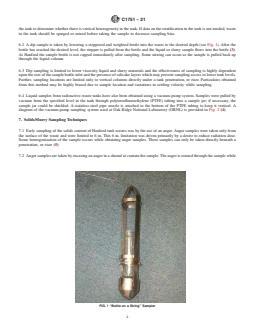
6.2 A dip sample is taken by lowering a stoppered and weighted bottle into the waste to the desired depth (see Fig. 1). After the
bottle has reached the desired level, the stopper is pulled from the bottle and the liquid or slurry sample flows into the bottle (3).
At Hanford the sample bottle is not capped immediately after sampling. Some mixing can occur as the sample is pulled back up
through the liquid column.
6.3 Dip sampling is limited to lower viscosity liquid and slurry materials and the effectiveness of sampling is highly dependent
upon the size of the sample bottle inlet and the presence of saltcake layers which may prevent sampling access to lower tank levels.
Further, sampling locations are limited only to vertical columns directly under a tank penetration, or riser. Particulates obtained
from this method may be highly biased due to sample location and variations in settling velocity while sampling.
6.4 Liquid samples from radioactive-waste tanks have also been obtained using a vacuum-pump system. Samples were pulled by
vacuum from the specified level in the tank through polytetrafluoroethylene (PTFE) tubing into a sample jar; if necessary, the
sample jar could be shielded. A stainless-steel pipe nozzle is attached to the bottom of the PTFE tubing to keep it vertical. A
diagram of the vacuum-pump sampling system used at Oak Ridge National Laboratory (ORNL) is provided in Fig. 2 (4).
7. Solids/Slurry Sampling Techniques
7.1 Early sampling of the solids content of Hanford tank wastes was by the use of an auger. Auger samples were taken only from
the surface of the waste and were limited to 6 in. This 6 in. limitation was driven primarily by a desire to reduce radiation dose.
Some homogenization of the sample occurs while obtaining auger samples. These samples can only be taken directly beneath a
penetration, or riser (5).
7.2 Auger samples are taken by encasing an auger in a shroud to contain the sample. The auger is rotated through the sample while
FIG. 1 “Bottle on a String” Sampler
C1751 − 21
FIG. 2 Vacuum Pump Sampling System
the shroud remains stationary. Sample is collected along the flutes of the auger. Liquid is generally not contained in the auger unless
it is associated with solids in the form of a sludge or highly viscous slurry.
7.3 Savannah River Site staff developed a manual method of capturing salt-cake samples from waste tanks. This method
incorporates a sample cup pinned to a handle that can be driven into the salt cake. The cup has a sharp edge to allow it to cut
through the salt cake as the handle is pounded with a hammer. The bore of the cup has a ledge like a fishhook barb that captures
the material once it is forced into the cup. The cup design is shown in Fig. 3 (6). The applicability of this method is limited to hard
materials that will not flow or slump once collected in the sample device.
7.4 Historically, core sampling was the primary mechanism for obtaining samples from the Hanford waste. A core-drilling truck
with a shielded handler was specifically designed for this purpose. Two modes, push or rotary, can be used to obtain samples.
Liquids, slurries, and soft sludges can be obtained in push mode; rotary-mode sampling must be used to obtain samples of harder
sludges and salt-cake. Only minimal success has been achieved when sampling saltcake. A new core sampling platform was
designed and implemented at Hanford in 2015 called the Modified Core Sampling System. The new system, although based on
the existing system is intended to have a number of improvements including but not limited to the following: provide a safer
environment for the personnel involved in operation of the equipment, reduced sampling cost and schedule, reduction in size,
weight and smaller component configuration of core drill rig that must interface with risers on top of tank and provide the
opportunity to minimize in-farm operations with the ability to co-locate support systems outside of the tank farm. Fig. 4a and b
shows the core sampling platform, both as a photograph and schematic (7).
7.5 The Hanford Sampler is based on a modified core-drilling design that is similar to the thief-and-trier-type samplers. Details
of the core-drilling truck procedure are provided in Waste Characterization Plan for Hanford Site Single-Shell Tanks (8),(9). Liquid
and solid samples are trapped in the sampler by a spring-actuated rotary valve (see Fig. 5). Two different sampler designs have
been used, but both designs incorporated the spring-actuated rotary valve. The first design produced samples that were 19 in. long
and 1 in. in diameter. The later design had a slightly larger diameter (1.25 in.). It is important to note the design length of this
C1751 − 21
FIG. 3 Savannah River Site Salt-Cake Sample Cup
sampler was driven by operational space limitations of the existing hot cells at the time. Core samples can be taken at varying
depths to obtain samples that comprise the entire depth of the waste. A sliding piston in the sampler controls the height of the
sample being collected. A hydrostatic fluid is added via the drill string to keep the waste from slumping into the void created by
the sample when the sampler is pulled from the tank. Normal paraffin hydrocarbons (NPH) were initially used as the hydrostatic
fluid. Nitrogen gas has also been used.
7.6 A sampler based on the same principle was used at ORNL to obtain samples of soft sludges from waste tanks at that site.
Samples are collected by manually pushing a polyvinyl chloride (PVC) pipe with a detachable handle assembly into the sludge
in the tank. A bottom closure that can be controlled from above by the operator is incorporated into the sampler Fig. 6. This sampler
is capable of capturing both liquid and soft sludge samples. A brief description of the operation of this sampler is provided in an
ORNL technical document describing the sampling and analysis of radioactive waste tanks (4).
7.7 The Savannah River Site developed a similar method for obtaining soft sludges. The sampler is a cylinder with a retractable
nose cone at the bottom. Sections of pipe are added to the sampler to lower it to the desired depth in the tank. Penetration into
the sludge is achieved by using the collective weight of the sampler and pipe sections. Once the desired depth is achieved, the nose
cone is retracted into the cylinder, forming an annulus between the cone and cylinder. Gases and liquids pass through a vent at
the top of the cylinder, allowing the sludge to be trapped in the cylinder. After the cylinder is closed, the sampler is raised out of
the tank into a shielded cask (10).
C1751 − 21
FIG. 4 a. Core Sampling Platform
C1751 − 21
FIG. 4 b. Core Sampling Platform (continued)
C1751 − 21
FIG. 5 Hanford Core Sampler
FIG. 6 ORNL Soft Sludge Sampler
7.8 The ability to collect closure samples of s
...