

ASTM D6907-22
(Practice)Standard Practice for Sampling Soils and Contaminated Media with Hand-Operated Bucket Augers
General Information
- Abstract
SIGNIFICANCE AND USE
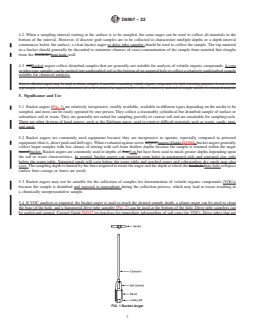
5.1 Bucket augers (Fig. 1) are relatively inexpensive, readily available, available in different types depending on the media to be sampled, and most can be easily operated by one person. They collect a reasonably cylindrical but disturbed sample of surface or subsurface soil or waste. They are generally not suited for sampling gravelly or coarser soil and are unsuitable for sampling rock. There are other designs of hand augers, such as the Edelman auger, used to retrieve difficult materials such as waste, sands, peat, and mud.
FIG. 1 Bucket Auger
5.2 Bucket augers are commonly used equipment because they are inexpensive to operate, especially compared to powered equipment (that is, direct push and drill rigs). When evaluated against screw augers (Guide D4700), bucket augers generally collect larger samples with less chance of mixing with soil from shallow depths because the sample is retained within the auger bucket. Bucket augers are commonly used to depths of 3 m but have been used to much greater depths depending upon the soil or waste characteristics. In general, bucket augers can maintain open holes in unsaturated soils and saturated clay soils below the water table. Saturated sands will cave below the water table and perched zones and cohesionless dry sands may also cave. The sampling depth is limited by the force required to rotate the auger and the depth at which the bore hole collapses (unless bore casings or liners are used).
5.3 Bucket augers may not be suitable for the collection of samples for determination of volatile organic compounds (VOCs) because the sample is disturbed and exposed to atmosphere during the collection process, which may lead to losses resulting in a chemically unrepresentative sample.
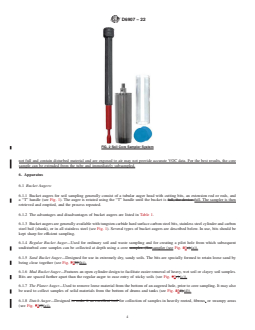
5.4 If VOC analysis is required, the bucket auger is used to reach the desired sample depth, a planer auger can be used to clean the base of the hole, and a hammered drive tube sampler (Fig. 2) can be used at the bottom of the hole. Drive ...
SCOPE
1.1 This practice describes the procedures and equipment used to collect surface and subsurface soil and contaminated media samples for chemical analysis using a hand-operated bucket auger (sometimes referred to as a barrel auger). Several types of bucket augers exist and are designed for sampling various types of soil. All bucket augers collect disturbed samples. Bucket augers can also be used to auger to the desired sampling depth and then, using a core-type sampler, collect a relatively undisturbed sample suitable for chemical analysis.
1.2 This practice does not cover the use of large 300 mm or greater diameter bucket augers mechanically operated by large drill rigs or similar equipment, such as those described in Practice D1452/D1452M, paragraph 5.2.4. Practice D1452/D1452M on auger borings refers to this hand auger included in Practice D6907 as a barrel auger.
1.3 Refer to Guides D4700 and D6232 for information on other hand samplers. The bucket auger is often used for shallow surface soil sampling, but there are many other types of handheld augers, flight, screw, rotary powered, and agricultural push tube samplers. Practice D1452/D1452M addresses larger powered solid stem flight auger systems.
1.4 This standard does not address soil samples obtained with mechanical drilling, direct push, and sonic machines (refer to Guides D6286/D6286M and D6169/D6169M) or for collecting cores from submerged sediments (Guide D4823).
1.5 This practice does not address sampling objectives (see Practice D5792), general sample planning (see Guide D4687), and sampling design (for example, where to collect samples and what depth to sample (see Guide D6044)). Sampling for volatile organic compounds (see Guide D4547), equipment cleaning and decontamination (see Practice D5088), sample handling after collection such as compositing and subsampling (see Guide D6051), and sample preservation (Guide D4220/D4220M) are used in this s...
- Status
- Published
- Publication Date
- 14-May-2022
- Technical Committee
- D34 - Waste Management
- Drafting Committee
- D34.01.03 - Sampling Equipment
Buy Documents
ASTM D6907-22 - Standard Practice for Sampling Soils and Contaminated Media with Hand-Operated Bucket Augers
REDLINE ASTM D6907-22 - Standard Practice for Sampling Soils and Contaminated Media with Hand-Operated Bucket Augers
Overview
ASTM D6907-22 is a standard practice developed by ASTM International for sampling soils and contaminated media with hand-operated bucket augers. This practice outlines the procedures and equipment required to collect both surface and subsurface samples for chemical analysis, specializing in soil and waste environments. Due to the simplicity and economic nature of the equipment, bucket augers are widely used for environmental site investigations, waste management activities, and geotechnical studies.
Hand-operated bucket augers are valued for their portability, low cost, and ability to collect relatively large, disturbed samples. They can be used by a single operator and are available in several designs tailored for different soil types. This standard covers best practices for sample collection, equipment selection, handling protocols, and limitations, ensuring reliable and representative data for environmental and geotechnical assessments.
Key Topics
- Hand-Operated Bucket Auger Use: Guidance on selecting and operating appropriate augers for specific soil conditions, including clay, sand, and organic-rich soils.
- Sample Collection Procedures: Standardized steps for preparing equipment, collecting and handling samples to minimize contamination, and documenting findings.
- Sample Integrity and Limitations:
- Bucket augers provide disturbed soil samples, which can be inadequate for analyses requiring undisturbed material or samples containing volatile organic compounds (VOCs).
- Recommendations for supplementing with specialized tools (e.g., drive tube samplers) to retrieve undisturbed core samples or better VOC retention.
- Depth and Soil Type Considerations:
- Suitable for unsaturated soils and saturated clays.
- Limited effectiveness in gravelly, rocky, cohesionless dry sands, or below the water table where borehole collapse is likely.
- Typical depth range is up to 3 meters, extendable under favorable conditions.
- Data and Quality Management: Requirements for field documentation, adopting Data Quality Objectives, proper sample labelling, and thorough decontamination between samples.
Applications
The procedures described in ASTM D6907-22 are applicable across many environmental and geotechnical scenarios, including:
- Site Remediation and Assessment: Collecting samples from contaminated sites to evaluate soil composition, contaminant levels, and suitability for remediation projects.
- Environmental Site Characterization: Gathering data for regulatory compliance, land development, or brownfield redevelopment by analyzing surface and near-surface soils.
- Waste Management: Sampling waste material stored on-site to monitor potential leaching or contamination spread.
- Agricultural and Land-Use Studies: Investigating soil properties for crop suitability or assessing pre-development baseline soil conditions.
- Groundwater and Vadose Zone Investigations: Examining unsaturated soils above the water table for contaminant migration studies.
Advantages:
- Cost-effective and easy to operate
- Suitable for remote or restricted access sites
- Capable of larger sample volume compared to some alternative hand tool methods
Limitations:
- Unable to collect undisturbed samples directly
- Not recommended for quantitative VOC analysis without supplemental tools
- Depth and soil-type restrictions apply
Related Standards
When implementing ASTMD6907-22, it is important to consider its relationship with other ASTM standards to cover all aspects of field sampling and analysis:
- ASTM D1452/D1452M - Practice for Soil Exploration and Sampling by Auger Borings
- ASTM D4547 - Guide for Sampling Waste and Soils for Volatile Organic Compounds
- ASTM D4700 - Guide for Soil Sampling from the Vadose Zone
- ASTM D6232 - Guide for Selection of Sampling Equipment for Waste and Contaminated Media Data Collection Activities
- ASTM D4823 - Guide for Core Sampling Submerged, Unconsolidated Sediments
- ASTM D5088 - Practice for Decontamination of Field Equipment Used at Waste Sites
- ASTM D6051 - Guide for Composite Sampling and Field Subsampling for Environmental Waste Management Activities
This collaborative use of standards ensures comprehensive, reliable, and compliant soil and waste sampling for environmental science and engineering applications.
Relations
- Effective Date
- 01-Nov-2023
- Effective Date
- 01-Nov-2023
- Effective Date
- 01-May-2020
- Effective Date
- 01-May-2020
- Effective Date
- 01-Nov-2019
- Effective Date
- 01-Nov-2018
- Effective Date
- 01-May-2018
- Effective Date
- 01-Sep-2017
- Effective Date
- 15-Jul-2017
- Effective Date
- 01-Nov-2016
- Effective Date
- 01-Nov-2016
- Effective Date
- 01-Feb-2016
- Effective Date
- 01-Sep-2015
- Effective Date
- 01-Sep-2015
- Effective Date
- 01-Aug-2015
Buy Documents
ASTM D6907-22 - Standard Practice for Sampling Soils and Contaminated Media with Hand-Operated Bucket Augers
REDLINE ASTM D6907-22 - Standard Practice for Sampling Soils and Contaminated Media with Hand-Operated Bucket Augers
Get Certified
Connect with accredited certification bodies for this standard

CIS Institut d.o.o.
Personal Protective Equipment (PPE) certification body. Notified Body NB-2890 for EU Regulation 2016/425 PPE.

Kiwa BDA Testing
Building and construction product certification.
Kmetijski inštitut Slovenije
Agricultural Institute of Slovenia. Soil testing, plant health, agricultural product analysis.
Sponsored listings
Frequently Asked Questions
ASTM D6907-22 is a standard published by ASTM International. Its full title is "Standard Practice for Sampling Soils and Contaminated Media with Hand-Operated Bucket Augers". This standard covers: SIGNIFICANCE AND USE 5.1 Bucket augers (Fig. 1) are relatively inexpensive, readily available, available in different types depending on the media to be sampled, and most can be easily operated by one person. They collect a reasonably cylindrical but disturbed sample of surface or subsurface soil or waste. They are generally not suited for sampling gravelly or coarser soil and are unsuitable for sampling rock. There are other designs of hand augers, such as the Edelman auger, used to retrieve difficult materials such as waste, sands, peat, and mud. FIG. 1 Bucket Auger 5.2 Bucket augers are commonly used equipment because they are inexpensive to operate, especially compared to powered equipment (that is, direct push and drill rigs). When evaluated against screw augers (Guide D4700), bucket augers generally collect larger samples with less chance of mixing with soil from shallow depths because the sample is retained within the auger bucket. Bucket augers are commonly used to depths of 3 m but have been used to much greater depths depending upon the soil or waste characteristics. In general, bucket augers can maintain open holes in unsaturated soils and saturated clay soils below the water table. Saturated sands will cave below the water table and perched zones and cohesionless dry sands may also cave. The sampling depth is limited by the force required to rotate the auger and the depth at which the bore hole collapses (unless bore casings or liners are used). 5.3 Bucket augers may not be suitable for the collection of samples for determination of volatile organic compounds (VOCs) because the sample is disturbed and exposed to atmosphere during the collection process, which may lead to losses resulting in a chemically unrepresentative sample. 5.4 If VOC analysis is required, the bucket auger is used to reach the desired sample depth, a planer auger can be used to clean the base of the hole, and a hammered drive tube sampler (Fig. 2) can be used at the bottom of the hole. Drive ... SCOPE 1.1 This practice describes the procedures and equipment used to collect surface and subsurface soil and contaminated media samples for chemical analysis using a hand-operated bucket auger (sometimes referred to as a barrel auger). Several types of bucket augers exist and are designed for sampling various types of soil. All bucket augers collect disturbed samples. Bucket augers can also be used to auger to the desired sampling depth and then, using a core-type sampler, collect a relatively undisturbed sample suitable for chemical analysis. 1.2 This practice does not cover the use of large 300 mm or greater diameter bucket augers mechanically operated by large drill rigs or similar equipment, such as those described in Practice D1452/D1452M, paragraph 5.2.4. Practice D1452/D1452M on auger borings refers to this hand auger included in Practice D6907 as a barrel auger. 1.3 Refer to Guides D4700 and D6232 for information on other hand samplers. The bucket auger is often used for shallow surface soil sampling, but there are many other types of handheld augers, flight, screw, rotary powered, and agricultural push tube samplers. Practice D1452/D1452M addresses larger powered solid stem flight auger systems. 1.4 This standard does not address soil samples obtained with mechanical drilling, direct push, and sonic machines (refer to Guides D6286/D6286M and D6169/D6169M) or for collecting cores from submerged sediments (Guide D4823). 1.5 This practice does not address sampling objectives (see Practice D5792), general sample planning (see Guide D4687), and sampling design (for example, where to collect samples and what depth to sample (see Guide D6044)). Sampling for volatile organic compounds (see Guide D4547), equipment cleaning and decontamination (see Practice D5088), sample handling after collection such as compositing and subsampling (see Guide D6051), and sample preservation (Guide D4220/D4220M) are used in this s...
SIGNIFICANCE AND USE 5.1 Bucket augers (Fig. 1) are relatively inexpensive, readily available, available in different types depending on the media to be sampled, and most can be easily operated by one person. They collect a reasonably cylindrical but disturbed sample of surface or subsurface soil or waste. They are generally not suited for sampling gravelly or coarser soil and are unsuitable for sampling rock. There are other designs of hand augers, such as the Edelman auger, used to retrieve difficult materials such as waste, sands, peat, and mud. FIG. 1 Bucket Auger 5.2 Bucket augers are commonly used equipment because they are inexpensive to operate, especially compared to powered equipment (that is, direct push and drill rigs). When evaluated against screw augers (Guide D4700), bucket augers generally collect larger samples with less chance of mixing with soil from shallow depths because the sample is retained within the auger bucket. Bucket augers are commonly used to depths of 3 m but have been used to much greater depths depending upon the soil or waste characteristics. In general, bucket augers can maintain open holes in unsaturated soils and saturated clay soils below the water table. Saturated sands will cave below the water table and perched zones and cohesionless dry sands may also cave. The sampling depth is limited by the force required to rotate the auger and the depth at which the bore hole collapses (unless bore casings or liners are used). 5.3 Bucket augers may not be suitable for the collection of samples for determination of volatile organic compounds (VOCs) because the sample is disturbed and exposed to atmosphere during the collection process, which may lead to losses resulting in a chemically unrepresentative sample. 5.4 If VOC analysis is required, the bucket auger is used to reach the desired sample depth, a planer auger can be used to clean the base of the hole, and a hammered drive tube sampler (Fig. 2) can be used at the bottom of the hole. Drive ... SCOPE 1.1 This practice describes the procedures and equipment used to collect surface and subsurface soil and contaminated media samples for chemical analysis using a hand-operated bucket auger (sometimes referred to as a barrel auger). Several types of bucket augers exist and are designed for sampling various types of soil. All bucket augers collect disturbed samples. Bucket augers can also be used to auger to the desired sampling depth and then, using a core-type sampler, collect a relatively undisturbed sample suitable for chemical analysis. 1.2 This practice does not cover the use of large 300 mm or greater diameter bucket augers mechanically operated by large drill rigs or similar equipment, such as those described in Practice D1452/D1452M, paragraph 5.2.4. Practice D1452/D1452M on auger borings refers to this hand auger included in Practice D6907 as a barrel auger. 1.3 Refer to Guides D4700 and D6232 for information on other hand samplers. The bucket auger is often used for shallow surface soil sampling, but there are many other types of handheld augers, flight, screw, rotary powered, and agricultural push tube samplers. Practice D1452/D1452M addresses larger powered solid stem flight auger systems. 1.4 This standard does not address soil samples obtained with mechanical drilling, direct push, and sonic machines (refer to Guides D6286/D6286M and D6169/D6169M) or for collecting cores from submerged sediments (Guide D4823). 1.5 This practice does not address sampling objectives (see Practice D5792), general sample planning (see Guide D4687), and sampling design (for example, where to collect samples and what depth to sample (see Guide D6044)). Sampling for volatile organic compounds (see Guide D4547), equipment cleaning and decontamination (see Practice D5088), sample handling after collection such as compositing and subsampling (see Guide D6051), and sample preservation (Guide D4220/D4220M) are used in this s...
ASTM D6907-22 is classified under the following ICS (International Classification for Standards) categories: 13.080.05 - Examination of soils in general. The ICS classification helps identify the subject area and facilitates finding related standards.
ASTM D6907-22 has the following relationships with other standards: It is inter standard links to ASTM D5681-23, ASTM D5792-10(2023), ASTM D6286/D6286M-20, ASTM D5088-20, ASTM D4823-95(2019), ASTM D5681-18, ASTM D5283-18, ASTM D5681-17, ASTM D2488-17, ASTM D5681-16a, ASTM D1452/D1452M-16, ASTM D5681-16, ASTM D4547-15, ASTM D5792-10(2015), ASTM D5088-15a. Understanding these relationships helps ensure you are using the most current and applicable version of the standard.
ASTM D6907-22 is available in PDF format for immediate download after purchase. The document can be added to your cart and obtained through the secure checkout process. Digital delivery ensures instant access to the complete standard document.
Standards Content (Sample)
This international standard was developed in accordance with internationally recognized principles on standardization established in the Decision on Principles for the
Development of International Standards, Guides and Recommendations issued by the World Trade Organization Technical Barriers to Trade (TBT) Committee.
Designation: D6907 − 22
Standard Practice for
Sampling Soils and Contaminated Media with Hand-
Operated Bucket Augers
This standard is issued under the fixed designation D6907; the number immediately following the designation indicates the year of
original adoption or, in the case of revision, the year of last revision. A number in parentheses indicates the year of last reapproval. A
superscript epsilon (´) indicates an editorial change since the last revision or reapproval.
1. Scope* 1.6 Units—The values stated in SI units are to be regarded
as standard. No other units of measurement are included in this
1.1 This practice describes the procedures and equipment
standard. All observed and calculated values shall conform to
used to collect surface and subsurface soil and contaminated
the guidelines for significant digits and rounding established in
media samples for chemical analysis using a hand-operated
Practice D6026. Reporting of test results in units other than SI
bucket auger (sometimes referred to as a barrel auger). Several
shall not be regarded as nonconformance with this standard.
types of bucket augers exist and are designed for sampling
various types of soil. All bucket augers collect disturbed 1.7 This practice offers a set of instructions for performing
samples. Bucket augers can also be used to auger to the desired one or more specific operations. This document cannot replace
sampling depth and then, using a core-type sampler, collect a educationorexperienceandshouldbeusedinconjunctionwith
relatively undisturbed sample suitable for chemical analysis. professional judgment. Not all aspects of this practice may be
applicable in all circumstances. This ASTM standard is not
1.2 This practice does not cover the use of large 300 mm or
intended to represent or replace the standard of care by which
greater diameter bucket augers mechanically operated by large
the adequacy of a given professional service must be judged,
drill rigs or similar equipment, such as those described in
nor should this document be applied without consideration of
Practice D1452/D1452M, paragraph 5.2.4. Practice D1452/
a project’s many unique aspects. The word “Standard” in the
D1452M on auger borings refers to this hand auger included in
title of this document means only that the document has been
Practice D6907 as a barrel auger.
approved through the ASTM consensus process.
1.3 Refer to Guides D4700 and D6232 for information on
1.8 This standard does not purport to address all of the
other hand samplers. The bucket auger is often used for
safety concerns, if any, associated with its use. It is the
shallow surface soil sampling, but there are many other types
responsibility of the user of this standard to establish appro-
of handheld augers, flight, screw, rotary powered, and agricul-
priate safety, health, and environmental practices and deter-
tural push tube samplers. Practice D1452/D1452M addresses
mine the applicability of regulatory limitations prior to use.
larger powered solid stem flight auger systems.
1.9 This international standard was developed in accor-
1.4 This standard does not address soil samples obtained
dance with internationally recognized principles on standard-
with mechanical drilling, direct push, and sonic machines
ization established in the Decision on Principles for the
(refer to Guides D6286/D6286M and D6169/D6169M)orfor
Development of International Standards, Guides and Recom-
collecting cores from submerged sediments (Guide D4823).
mendations issued by the World Trade Organization Technical
Barriers to Trade (TBT) Committee.
1.5 This practice does not address sampling objectives (see
Practice D5792), general sample planning (see Guide D4687),
2. Referenced Documents
and sampling design (for example, where to collect samples
and what depth to sample (see Guide D6044)). Sampling for 2.1 ASTM Standards:
volatile organic compounds (see Guide D4547), equipment
D1452/D1452M Practice for Soil Exploration and Sampling
cleaning and decontamination (see Practice D5088), sample by Auger Borings
handling after collection such as compositing and subsampling
D2488 Practice for Description and Identification of Soils
(see Guide D6051), and sample preservation (Guide D4220/ (Visual-Manual Procedures)
D4220M) are used in this standard.
D4220/D4220M Practices for Preserving and Transporting
Soil Samples
This practice is under the jurisdiction of ASTM Committee D34 on Waste
Management and is the direct responsibility of Subcommittee D34.01.03 on
Sampling Equipment. For referenced ASTM standards, visit the ASTM website, www.astm.org, or
Current edition approved May 15, 2022. Published May 2022. Originally contact ASTM Customer Service at service@astm.org. For Annual Book of ASTM
approved in 2005. Last previous edition approved in 2016 as D6907 – 05 (2016). Standards volume information, refer to the standard’s Document Summary page on
DOI: 10.1520/D6907-22. the ASTM website.
*A Summary of Changes section appears at the end of this standard
Copyright © ASTM International, 100 Barr Harbor Drive, PO Box C700, West Conshohocken, PA 19428-2959. United States
D6907 − 22
D4547 Guide for Sampling Waste and Soils for Volatile core or tube-type sampler can be pushed into undisturbed soil
Organic Compounds at the bottom of an augured hole to collect a relatively
D4687 Guide for General Planning of Waste Sampling undisturbed sample suitable for chemical analysis.
D4700 Guide for Soil Sampling from the Vadose Zone
5. Significance and Use
D4823 Guide for Core Sampling Submerged, Unconsoli-
dated Sediments
5.1 Bucket augers (Fig. 1) are relatively inexpensive, read-
D5088 Practice for Decontamination of Field Equipment
ily available, available in different types depending on the
Used at Waste Sites media to be sampled, and most can be easily operated by one
D5283 Practice for Generation of Environmental Data Re-
person. They collect a reasonably cylindrical but disturbed
lated to Waste Management Activities: Quality Assurance sample of surface or subsurface soil or waste. They are
and Quality Control Planning and Implementation
generally not suited for sampling gravelly or coarser soil and
D5434 Guide for Field Logging of Subsurface Explorations are unsuitable for sampling rock. There are other designs of
of Soil and Rock (Withdrawn 2021)
hand augers, such as the Edelman auger, used to retrieve
D5681 Terminology for Waste and Waste Management difficult materials such as waste, sands, peat, and mud.
D5792 Practice for Generation of Environmental Data Re-
5.2 Bucket augers are commonly used equipment because
lated to Waste Management Activities: Development of
they are inexpensive to operate, especially compared to pow-
Data Quality Objectives
ered equipment (that is, direct push and drill rigs). When
D6026 Practice for Using Significant Digits and Data Re-
evaluated against screw augers (Guide D4700), bucket augers
cords in Geotechnical Data
generally collect larger samples with less chance of mixing
D6044 Guide for Representative Sampling for Management
with soil from shallow depths because the sample is retained
of Waste and Contaminated Media
within the auger bucket. Bucket augers are commonly used to
D6051 Guide for Composite Sampling and Field Subsam-
depths of 3 m but have been used to much greater depths
pling for Environmental Waste Management Activities
depending upon the soil or waste characteristics. In general,
D6169/D6169M Guide for Selection of Subsurface Soil and
bucket augers can maintain open holes in unsaturated soils and
Rock Sampling Devices for Environmental and Geotech-
saturated clay soils below the water table. Saturated sands will
nical Investigations
cave below the water table and perched zones and cohesionless
D6232 Guide for Selection of Sampling Equipment for
dry sands may also cave. The sampling depth is limited by the
WasteandContaminatedMediaDataCollectionActivities
force required to rotate the auger and the depth at which the
D6286/D6286M Guide for Selection of Drilling and Direct
bore hole collapses (unless bore casings or liners are used).
Push Methods for Geotechnical and Environmental Sub-
5.3 Bucket augers may not be suitable for the collection of
surface Site Characterization
samples for determination of volatile organic compounds
(VOCs) because the sample is disturbed and exposed to
3. Terminology
atmosphere during the collection process, which may lead to
3.1 Definitions—For definitions of terms used in this
losses resulting in a chemically unrepresentative sample.
standard, see Terminology D5681.
5.4 If VOC analysis is required, the bucket auger is used to
4. Summary of Practice reach the desired sample depth, a planer auger can be used to
clean the base of the hole, and a hammered drive tube sampler
4.1 Typically, bucket augers are tubular devices with cutting
(Fig. 2) can be used at the bottom of the hole. Drive tube
bits on the bottom that are pushed and twisted into the media
samplers can be sealed and capped. Consult Guide D4547 on
and removed when the tubular “bucket” section is full. The
bore hole is advanced one bucket at a time.The practical depth
of investigation using a bucket auger is related to the material
being sampled.
4.2 When a sampling interval starting at the surface is to be
sampled, the same auger can be used to collect all materials to
the bottom of the interval. However, if discrete grab samples
are to be collected to characterize multiple depths or a depth
interval commences below the surface, a clean bucket auger or
drive tube sampler should be used to collect the sample. The
top material in a bucket should generally be discarded to
minimize chances of cross-contamination of the sample from
material that sloughs from the bore hole wall.
4.3 Bucket augers collect disturbed samples that are gener-
ally not suitable for analysis of volatile organic compounds.A
The last approved version of this historical standard is referenced on
www.astm.org. FIG. 1 Bucket Auger
D6907 − 22
6.1.4 Regular Bucket Auger—Used for ordinary soil and
waste sampling and for creating a pilot hole from which
subsequent undisturbed core samples can be collected at depth
using a core sampler (see Fig. 3(a)).
6.1.5 Sand Bucket Auger—Designed for use in extremely
dry, sandy soils. The bits are specially formed to retain loose
sand by being close together (see Fig. 3(b)).
6.1.6 Mud Bucket Auger—Features an open cylinder design
to facilitate easier removal of heavy, wet soil or clayey soil
samples. Bits are spaced further apart than the regular auger to
ease entry of sticky soils (see Fig. 3(c)).
6.1.7 The Planer Auger—Used to remove loose material
from the bottom of an augered hole, prior to core sampling. It
may also be used to collect samples of solid materials from the
bottom of drums and tanks (see Fig. 3(d)).
6.1.8 Dutch Auger—Designed for collection of samples in
heavily rooted, fibrous, or swampy areas (see Fig. 3(e)).
6.1.9 Other—Other types of aug
...
This document is not an ASTM standard and is intended only to provide the user of an ASTM standard an indication of what changes have been made to the previous version. Because
it may not be technically possible to adequately depict all changes accurately, ASTM recommends that users consult prior editions as appropriate. In all cases only the current version
of the standard as published by ASTM is to be considered the official document.
Designation: D6907 − 05 (Reapproved 2016) D6907 − 22
Standard Practice for
Sampling Soils and Contaminated Media with Hand-
Operated Bucket Augers
This standard is issued under the fixed designation D6907; the number immediately following the designation indicates the year of
original adoption or, in the case of revision, the year of last revision. A number in parentheses indicates the year of last reapproval. A
superscript epsilon (´) indicates an editorial change since the last revision or reapproval.
1. Scope Scope*
1.1 This practice describes the procedures and equipment used to collect surface and subsurface soil and contaminated media
samples for chemical analysis using a hand-operated bucket auger (hereafter(sometimes referred to as a bucket auger; sometimes
referred to as a barrel auger). Several types of bucket augers exist and are designed for sampling various types of soil. All bucket
augers collect disturbed samples, but bucket samples. Bucket augers can also be used to auger to the desired sampling depth and
then, using a core-type sampler, collect a relatively undisturbed sample.sample suitable for chemical analysis.
1.2 This practice does not cover the use of large (12-in. 300 mm or greater diameter)diameter bucket augers mechanically operated
by large drill rigs or similar equipment, such as those described in Practice D1452D1452/D1452M, section 3.2.4.paragraph 5.2.4.
Practice D1452/D1452M on auger borings refers to this hand auger included in Practice D6907 as a barrel auger.
1.3 Refer to Guides D4700 and D6232The term for information on other hand samplers. The bucket auger is used to differentiate
this type of hand operated auger from others of the solid or hollow stem types thatoften used for shallow surface soil sampling,
but there are many other types of handheld augers, flight, screw, rotary powered, and agricultural push tube samplers. Practice
D1452/D1452M are also hand held or operated.addresses larger powered solid stem flight auger systems.
1.4 This standard does not address soil samples obtained with mechanical drilling, direct push, and sonic machines (refer to Guides
D6286/D6286M and D6169/D6169M) or for collecting cores from submerged sediments (Guide D4823).
1.5 This practice does not address sampling objectives (see Practice D5792), general sample planning (see Guide D4687), and
sampling design (for example, where to collect samples and what depth to sample [see(see Guide D6044]), sampling)). Sampling
for volatile organic compounds (see Guide D4547), equipment cleaning and decontamination (see Practice D5088), sample
handling after collection such as compositing and subsampling (see Guide D6051), and sample preservation. Forpreservation
(Guide D4220/D4220Minformation on other types of augers, see Practice ) are used in this standard.D1452 and Guide D4700.
1.6 Units—The values stated in SI units are to be regarded as standard. No other units of measurement are included in this
standard. All observed and calculated values shall conform to the guidelines for significant digits and rounding established in
Practice D6026. Reporting of test results in units other than SI shall not be regarded as nonconformance with this standard.
1.7 This practice offers a set of instructions for performing one or more specific operations. This document cannot replace
education or experience and should be used in conjunction with professional judgment. Not all aspects of this practice may be
This practice is under the jurisdiction of ASTM Committee D34 on Waste Management and is the direct responsibility of Subcommittee D34.01.03 on Sampling
Equipment.
Current edition approved Oct. 15, 2016May 15, 2022. Published October 2016May 2022. Originally approved in 2005. Last previous edition approved in 20102016 as
D6907 – 05 (2010).(2016). DOI: 10.1520/D6907-05R16.10.1520/D6907-22.
*A Summary of Changes section appears at the end of this standard
Copyright © ASTM International, 100 Barr Harbor Drive, PO Box C700, West Conshohocken, PA 19428-2959. United States
D6907 − 22
applicable in all circumstances. This ASTM standard is not intended to represent or replace the standard of care by which the
adequacy of a given professional service must be judged, nor should this document be applied without consideration of a project’s
many unique aspects. The word “Standard” in the title of this document means only that the document has been approved through
the ASTM consensus process.
1.8 This standard does not purport to address all of the safety concerns, if any, associated with its use. It is the responsibility
of the user of this standard to establish appropriate safety safety, health, and healthenvironmental practices and determine the
applicability of regulatory limitations prior to use.
1.9 This international standard was developed in accordance with internationally recognized principles on standardization
established in the Decision on Principles for the Development of International Standards, Guides and Recommendations issued
by the World Trade Organization Technical Barriers to Trade (TBT) Committee.
2. Referenced Documents
2.1 ASTM Standards:
D1452D1452/D1452M Practice for Soil Exploration and Sampling by Auger Borings
D2488 Practice for Description and Identification of Soils (Visual-Manual Procedures)
D4220/D4220M Practices for Preserving and Transporting Soil Samples
D4547 Guide for Sampling Waste and Soils for Volatile Organic Compounds
D4687 Guide for General Planning of Waste Sampling
D4700 Guide for Soil Sampling from the Vadose Zone
D4823 Guide for Core Sampling Submerged, Unconsolidated Sediments
D5088 Practice for Decontamination of Field Equipment Used at Waste Sites
D5283 Practice for Generation of Environmental Data Related to Waste Management Activities: Quality Assurance and Quality
Control Planning and Implementation
D5434 Guide for Field Logging of Subsurface Explorations of Soil and Rock (Withdrawn 2021)
D5681 Terminology for Waste and Waste Management
D5792 Practice for Generation of Environmental Data Related to Waste Management Activities: Development of Data Quality
Objectives
D6026 Practice for Using Significant Digits and Data Records in Geotechnical Data
D6044 Guide for Representative Sampling for Management of Waste and Contaminated Media
D6051 Guide for Composite Sampling and Field Subsampling for Environmental Waste Management Activities
D6169/D6169M Guide for Selection of Subsurface Soil and Rock Sampling Devices for Environmental and Geotechnical
Investigations
D6232 Guide for Selection of Sampling Equipment for Waste and Contaminated Media Data Collection Activities
D6282 Guide for Direct Push Soil Sampling for Environmental Site Characterizations
D6286D6286/D6286M Guide for Selection of Drilling and Direct Push Methods for Geotechnical and Environmental
Subsurface Site Characterization
3. Terminology
3.1 Definitions—Except where noted, all terms and symbols in this practice are inFor definitions of terms used in this standard,
see Terminology D5681accordance with the following publications. In order of consideration they are:.
3.1.1 Terminology D5681 for Waste and Waste Management,
3.1.2 Compilation of ASTM Standard Terminology, and
3.1.3 Webster’s New Collegiate Dictionary.
4. Summary of Practice
4.1 Typically, bucket augers are tubular devices with cutting bits on the bottom that are pushed and twisted into the media and
removed when the tubular “bucket” section is full. The borehole bore hole is advanced one bucket at a time. The practical depth
of investigation using a bucket auger is related to the material being sampled.
For referenced ASTM standards, visit the ASTM website, www.astm.org, or contact ASTM Customer Service at service@astm.org. For Annual Book of ASTM Standards
volume information, refer to the standard’s Document Summary page on the ASTM website.
The last approved version of this historical standard is referenced on www.astm.org.
D6907 − 22
4.2 When a sampling interval starting at the surface is to be sampled, the same auger can be used to collect all materials to the
bottom of the interval. However, if discrete grab samples are to be collected to characterize multiple depths or a depth interval
commences below the surface, a clean bucket auger or drive tube sampler should be used to collect the sample. The top material
in a bucket should generally be discarded to minimize chances of cross-contamination of the sample from material that sloughs
from the borehole bore hole wall.
4.3 AllBucket augers collect disturbed samples that are generally not suitable for analysis of volatile organic compounds. A core
or tube-type sampler can be pushed into undisturbed soil at the bottom of an augured hole to collect a relatively undisturbed sample
suitable for chemical analysis.
NOTE 1—Bucket augers may be used to obtain samples of materials containing volatile organic compounds for field screening purposes. A core or tube
type sampler can be pushed into undisturbed soil at the bottom of an augered hole to collect a relatively undisturbed sample suitable for chemical analysis.
5. Significance and Use
5.1 Bucket augers (Fig. 1) are relatively inexpensive, readily available, available in different types depending on the media to be
sampled, and most can be easily operated by one person. They collect a reasonably cylindrical but disturbed sample of surface or
subsurface soil or waste. They are generally not suited for sampling gravelly or coarser soil and are unsuitable for sampling rock.
There are other designs of hand augers, such as the Edelman auger, used to retrieve difficult materials such as waste, sands, peat,
and mud.
5.2 Bucket augers are commonly used equipment because they are inexpensive to operate, especially compared to powered
equipment (that is, direct push and drill rigs). When evaluated against screw augers, augers (Guide D4700), bucket augers generally
collect larger samples with less chance of mixing with soil from shallow depths because the sample is retained within the auger
barrel.bucket. Bucket augers are commonly used to depths of 3 m 3 m but have been used to much greater depths depending upon
the soil or waste characteristics. In general, bucket augers can maintain open holes in unsaturated soils and saturated clay soils
below the water table. Saturated sands will cave below the water table and perched zones and cohesionless dry sands may also
cave. The sampling depth is limited by the force required to rotate the auger and the depth at which the borehole bore hole collapses
(unless bore casings or liners are used).
5.3 Bucket augers may not be suitable for the collection of samples for determination of volatile organic compounds (VOCs)
because the sample is disturbed and exposed to atmosphere during the collection process, which may lead to losses resulting in
a chemically unrepresentative sample.
5.4 If VOC analysis is required, the bucket auger is used to reach the desired sample depth, a planer auger can be used to clean
the base of the hole, and a hammered drive tube sampler (Fig. 2) can be used at the bottom of the hole. Drive tube samplers can
be sealed and capped. Consult Guide D4547 on practices for immediate subsampling of soil cores for VOCs. Drive tubes that are
FIG. 1 Bucket Auger
D6907 − 22
FIG. 2 Soil Core Sampler System
not full and contain disturbed material and are exposed to air may not provide accurate VOC data. For the best results, the core
sample can be extruded from the tube and immediately subsampled.
6. Apparatus
6.1 Bucket Augers:
6.1.1 Bucket augers for soil sampling generally consist of a tubular auger head with cutting bits, an extension rod or rods, and
a “T” handle (see Fig. 1). The auger is rotated using the “T” handle until the bucket is full, the device full. The sampler is then
retrieved and emptied, and the process repeated.
6.1.2 The advantages and disadvantages of bucket augers are listed in Table 1.
6.1.3 Bucket augers are generally available with tungsten carbide hard surface carbon steel bits, stainless steel cylinder and carbon
steel bail (shank), or in all stainless steel (see Fig. 1). Several types of bucket augers are described below. In use, bits should be
kept sharp for efficient sampling.
6.1.4 Regular Bucket Auger—Used for ordinary soil and waste sampling and f
...