

ASTM D1452/D1452M-16
(Practice)Standard Practice for Soil Exploration and Sampling by Auger Borings
General Information
- Abstract
SIGNIFICANCE AND USE
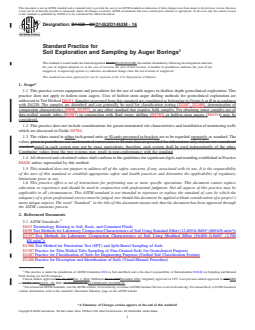
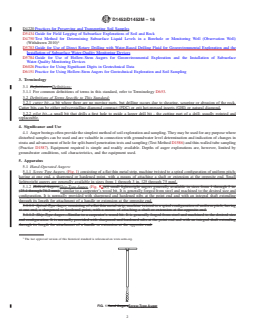
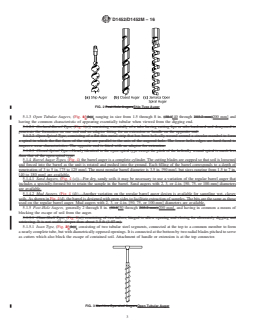
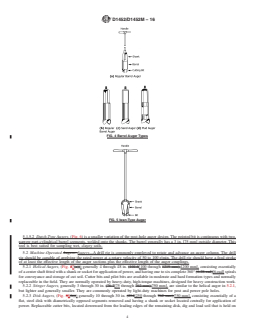
4.1 Auger borings often provide the simplest method of soil exploration and sampling. They may be used for any purpose where disturbed samples can be used and are valuable in connection with groundwater level determination and indication of changes in strata and advancement of hole for split-barrel penetration tests and sampling (Test Method D1586) and thin-walled tube sampling (Practice D1587). Equipment required is simple and readily available. Depths of auger explorations are, however, limited by groundwater conditions, soil characteristics, and the equipment used.
SCOPE
1.1 This practice covers equipment and procedures for the use of earth augers in shallow depth geotechnical exploration. This practice does not apply to hollow-stem augers. Uses of hollow-stem auger drilling methods for geotechnical exploration are addressed in Test Method D6151. Samples recovered from this standard are considered as belonging to Group A or B in accordance with D4220. The samples are disturbed and can generally be used for classification testing (D2487, D2488), determination of compaction characteristics (D698, D1557), or any other standard that requires bulk samples. For obtaining intact samples use of thin-walled sample tubes (D1587) in conjunction with fluid rotary drilling (D5783) or hollow-stem augers (D6151) may be considered.
1.2 This practice does not include considerations for geoenvironmental site characteristics and installation of monitoring wells which are discussed in Guide D5784.
1.3 The values stated in either inch-pound units or SI units presented in brackets are to be regarded separately as standard. The values stated in each system may not be exact equivalents; therefore, each system shall be used independently of the other. Combining values from the two systems may result in non-conformance with the standard
1.4 All observed and calculated values shall conform to the guidelines for significant digits and rounding established in Practice D6026 unless superseded by this method.
1.5 This standard does not purport to address all of the safety concerns, if any, associated with its use. It is the responsibility of the user of this standard to establish appropriate safety and health practices and determine the applicability of regulatory limitations prior to use.
1.6 This practice offers a set of instructions for performing one or more specific operations. This document cannot replace education or experience and should be used in conjunction with professional judgment. Not all aspects of this practice may be applicable in all circumstances. This ASTM standard is not intended to represent or replace the standard of care by which the adequacy of a given professional service must be judged, nor should this document be applied without consideration of a project's many unique aspects. The word “Standard” in the title of this document means only that the document has been approved through the ASTM consensus process.
- Status
- Published
- Publication Date
- 31-Oct-2016
- Technical Committee
- D18 - Soil and Rock
- Drafting Committee
- D18.02 - Sampling and Related Field Testing for Soil Evaluations
Overview
ASTM D1452/D1452M-16: Standard Practice for Soil Exploration and Sampling by Auger Borings sets forth methods and equipment for using earth augers in shallow depth geotechnical exploration. Issued by ASTM International, this standard guides field personnel and engineers in the collection of disturbed soil samples for laboratory testing and soil classification. Auger borings offer a straightforward, accessible method that is invaluable for projects involving subsurface exploration, determination of groundwater levels, and soil sampling where undisturbed samples are not required.
This standard is widely referenced in civil engineering, construction, and environmental fields where preliminary soil investigation is necessary.
Key Topics
Scope and Limitations
The standard addresses procedures for soil exploration using earth augers, including hand- and machine-operated augers for shallow subsurface sampling. It excludes hollow-stem auger techniques, which are covered under ASTM D6151.Sample Types and Use
Samples recovered are considered disturbed and suitable for classification (ASTM D2487, D2488), compaction characteristics (ASTM D698, D1557), or other bulk sample analyses. The practice is not intended for obtaining intact soil samples.Operational Procedures
- Identification of underground utilities and safety hazards prior to boring
- Advancing and rotating augers to the desired depth
- Extraction, labeling, and preservation of soil samples for laboratory use
- Proper casing when boreholes do not maintain their structure, particularly below groundwater levels
- Monitoring and documenting groundwater levels
Reporting Requirements
Documentation includes specifics on project location, auger type and size, crew, boring depth, soil classifications, groundwater elevations, and field conditions-as guided by ASTM D5434.
Applications
The practice described in ASTM D1452/D1452M-16 is fundamental in several key areas:
Geotechnical Investigations
Used extensively for site characterization before construction of buildings, infrastructure, bridges, and other civil works. It supports the determination of soil stratification and basic material properties required for foundation design.Groundwater Studies
Auger borings provide an effective means for initially identifying groundwater tables and seepage zones-an essential step in hydrogeological investigations.Environmental Assessments
While the standard itself does not directly address geoenvironmental monitoring well installation, its sampling methods are often a preliminary activity within wider site assessments where disturbed samples are sufficient.Soil Classification and Compaction Testing The samples extracted are suitable for laboratory analysis, including soil classification (Unified Soil Classification System) and compaction studies critical in road construction, embankment design, and grading projects.
Related Standards
Users of ASTM D1452/D1452M-16 will often reference or integrate the following ASTM standards for a comprehensive soil exploration program:
- ASTM D6151: Hollow-Stem Auger Drilling Methods for Geotechnical Exploration
- ASTM D2487, D2488: Practices for Soil Classification and Description
- ASTM D1586: Standard Penetration Test (SPT) and Split-Barrel Sampling
- ASTM D4220: Practices for Preserving and Transporting Soil Samples
- ASTM D698, D1557: Laboratory Compaction Characteristics of Soil
- ASTM D5434: Field Logging of Subsurface Explorations
- ASTM D5784: Installation of Monitoring Wells in Geoenvironmental Exploration
Practical Value
ASTM D1452/D1452M-16 provides a reliable, cost-effective approach for gathering essential geotechnical information at shallow depths. Its straightforward procedures support safe and efficient field operations, accurate data collection, and effective planning for construction and environmental projects. By following its guidelines, professionals can ensure quality in subsurface investigations and support successful project outcomes grounded in sound geotechnical data.
Relations
- Effective Date
- 01-Nov-2016
- Effective Date
- 15-Dec-2017
- Effective Date
- 15-Dec-2017
- Effective Date
- 15-Jul-2017
- Effective Date
- 01-Aug-2014
- Effective Date
- 01-Sep-2012
- Effective Date
- 15-May-2012
- Effective Date
- 01-May-2012
- Effective Date
- 01-May-2012
- Effective Date
- 01-May-2012
- Effective Date
- 01-Nov-2011
- Effective Date
- 01-Sep-2011
- Effective Date
- 01-May-2011
- Effective Date
- 01-Jan-2010
- Effective Date
- 15-Jun-2009
Get Certified
Connect with accredited certification bodies for this standard

Zavod za gradbeništvo Slovenije (ZAG) - Inšpekcija
ZAG inspection body for construction products, structures, and materials.
Sponsored listings
Frequently Asked Questions
ASTM D1452/D1452M-16 is a standard published by ASTM International. Its full title is "Standard Practice for Soil Exploration and Sampling by Auger Borings". This standard covers: SIGNIFICANCE AND USE 4.1 Auger borings often provide the simplest method of soil exploration and sampling. They may be used for any purpose where disturbed samples can be used and are valuable in connection with groundwater level determination and indication of changes in strata and advancement of hole for split-barrel penetration tests and sampling (Test Method D1586) and thin-walled tube sampling (Practice D1587). Equipment required is simple and readily available. Depths of auger explorations are, however, limited by groundwater conditions, soil characteristics, and the equipment used. SCOPE 1.1 This practice covers equipment and procedures for the use of earth augers in shallow depth geotechnical exploration. This practice does not apply to hollow-stem augers. Uses of hollow-stem auger drilling methods for geotechnical exploration are addressed in Test Method D6151. Samples recovered from this standard are considered as belonging to Group A or B in accordance with D4220. The samples are disturbed and can generally be used for classification testing (D2487, D2488), determination of compaction characteristics (D698, D1557), or any other standard that requires bulk samples. For obtaining intact samples use of thin-walled sample tubes (D1587) in conjunction with fluid rotary drilling (D5783) or hollow-stem augers (D6151) may be considered. 1.2 This practice does not include considerations for geoenvironmental site characteristics and installation of monitoring wells which are discussed in Guide D5784. 1.3 The values stated in either inch-pound units or SI units presented in brackets are to be regarded separately as standard. The values stated in each system may not be exact equivalents; therefore, each system shall be used independently of the other. Combining values from the two systems may result in non-conformance with the standard 1.4 All observed and calculated values shall conform to the guidelines for significant digits and rounding established in Practice D6026 unless superseded by this method. 1.5 This standard does not purport to address all of the safety concerns, if any, associated with its use. It is the responsibility of the user of this standard to establish appropriate safety and health practices and determine the applicability of regulatory limitations prior to use. 1.6 This practice offers a set of instructions for performing one or more specific operations. This document cannot replace education or experience and should be used in conjunction with professional judgment. Not all aspects of this practice may be applicable in all circumstances. This ASTM standard is not intended to represent or replace the standard of care by which the adequacy of a given professional service must be judged, nor should this document be applied without consideration of a project's many unique aspects. The word “Standard” in the title of this document means only that the document has been approved through the ASTM consensus process.
SIGNIFICANCE AND USE 4.1 Auger borings often provide the simplest method of soil exploration and sampling. They may be used for any purpose where disturbed samples can be used and are valuable in connection with groundwater level determination and indication of changes in strata and advancement of hole for split-barrel penetration tests and sampling (Test Method D1586) and thin-walled tube sampling (Practice D1587). Equipment required is simple and readily available. Depths of auger explorations are, however, limited by groundwater conditions, soil characteristics, and the equipment used. SCOPE 1.1 This practice covers equipment and procedures for the use of earth augers in shallow depth geotechnical exploration. This practice does not apply to hollow-stem augers. Uses of hollow-stem auger drilling methods for geotechnical exploration are addressed in Test Method D6151. Samples recovered from this standard are considered as belonging to Group A or B in accordance with D4220. The samples are disturbed and can generally be used for classification testing (D2487, D2488), determination of compaction characteristics (D698, D1557), or any other standard that requires bulk samples. For obtaining intact samples use of thin-walled sample tubes (D1587) in conjunction with fluid rotary drilling (D5783) or hollow-stem augers (D6151) may be considered. 1.2 This practice does not include considerations for geoenvironmental site characteristics and installation of monitoring wells which are discussed in Guide D5784. 1.3 The values stated in either inch-pound units or SI units presented in brackets are to be regarded separately as standard. The values stated in each system may not be exact equivalents; therefore, each system shall be used independently of the other. Combining values from the two systems may result in non-conformance with the standard 1.4 All observed and calculated values shall conform to the guidelines for significant digits and rounding established in Practice D6026 unless superseded by this method. 1.5 This standard does not purport to address all of the safety concerns, if any, associated with its use. It is the responsibility of the user of this standard to establish appropriate safety and health practices and determine the applicability of regulatory limitations prior to use. 1.6 This practice offers a set of instructions for performing one or more specific operations. This document cannot replace education or experience and should be used in conjunction with professional judgment. Not all aspects of this practice may be applicable in all circumstances. This ASTM standard is not intended to represent or replace the standard of care by which the adequacy of a given professional service must be judged, nor should this document be applied without consideration of a project's many unique aspects. The word “Standard” in the title of this document means only that the document has been approved through the ASTM consensus process.
ASTM D1452/D1452M-16 is classified under the following ICS (International Classification for Standards) categories: 93.020 - Earthworks. Excavations. Foundation construction. Underground works. The ICS classification helps identify the subject area and facilitates finding related standards.
ASTM D1452/D1452M-16 has the following relationships with other standards: It is inter standard links to ASTM D1452-09, ASTM D2487-17e1, ASTM D2487-17, ASTM D2488-17, ASTM D653-14, ASTM D5783-95(2012), ASTM D1587-08(2012)e1, ASTM D1557-12, ASTM D698-12, ASTM D698-12e1, ASTM D1586-11, ASTM D653-11, ASTM D2487-11, ASTM D2487-10, ASTM D2488-09a. Understanding these relationships helps ensure you are using the most current and applicable version of the standard.
ASTM D1452/D1452M-16 is available in PDF format for immediate download after purchase. The document can be added to your cart and obtained through the secure checkout process. Digital delivery ensures instant access to the complete standard document.
Standards Content (Sample)
This international standard was developed in accordance with internationally recognized principles on standardization established in the Decision on Principles for the
Development of International Standards, Guides and Recommendations issued by the World Trade Organization Technical Barriers to Trade (TBT) Committee.
Designation: D1452/D1452M − 16
Standard Practice for
Soil Exploration and Sampling by Auger Borings
This standard is issued under the fixed designation D1452/D1452M; the number immediately following the designation indicates the
year of original adoption or, in the case of revision, the year of last revision. A number in parentheses indicates the year of last
reapproval. A superscript epsilon (´) indicates an editorial change since the last revision or reapproval.
This standard has been approved for use by agencies of the U.S. Department of Defense.
1. Scope* be applicable in all circumstances. This ASTM standard is not
intended to represent or replace the standard of care by which
1.1 This practice covers equipment and procedures for the
the adequacy of a given professional service must be judged,
use of earth augers in shallow depth geotechnical exploration.
nor should this document be applied without consideration of
This practice does not apply to hollow-stem augers. Uses of
a project’s many unique aspects. The word “Standard” in the
hollow-stem auger drilling methods for geotechnical explora-
title of this document means only that the document has been
tion are addressed in Test Method D6151. Samples recovered
approved through the ASTM consensus process.
from this standard are considered as belonging to Group A or
1.7 This international standard was developed in accor-
B in accordance with D4220. The samples are disturbed and
dance with internationally recognized principles on standard-
can generally be used for classification testing (D2487,
ization established in the Decision on Principles for the
D2488), determination of compaction characteristics (D698,
Development of International Standards, Guides and Recom-
D1557), or any other standard that requires bulk samples. For
mendations issued by the World Trade Organization Technical
obtaining intact samples use of thin-walled sample tubes
Barriers to Trade (TBT) Committee.
(D1587) in conjunction with fluid rotary drilling (D5783)or
hollow-stem augers (D6151) may be considered.
2. Referenced Documents
1.2 This practice does not include considerations for geoen-
2.1 ASTM Standards:
vironmental site characteristics and installation of monitoring
D653 Terminology Relating to Soil, Rock, and Contained
wells which are discussed in Guide D5784.
Fluids
1.3 The values stated in either inch-pound units or SI units
D698 Test Methods for Laboratory Compaction Character-
presented in brackets are to be regarded separately as standard.
istics of Soil Using Standard Effort (12,400 ft-lbf/ft (600
The values stated in each system may not be exact equivalents;
kN-m/m ))
therefore,eachsystemshallbeusedindependentlyoftheother.
D1557 Test Methods for Laboratory Compaction Character-
Combining values from the two systems may result in non-
istics of Soil Using Modified Effort (56,000 ft-lbf/ft
conformance with the standard
(2,700 kN-m/m ))
D1586 Test Method for Standard PenetrationTest (SPT) and
1.4 All observed and calculated values shall conform to the
Split-Barrel Sampling of Soils
guidelines for significant digits and rounding established in
D1587 Practice for Thin-Walled Tube Sampling of Fine-
Practice D6026 unless superseded by this method.
Grained Soils for Geotechnical Purposes
1.5 This standard does not purport to address all of the
D2487 Practice for Classification of Soils for Engineering
safety concerns, if any, associated with its use. It is the
Purposes (Unified Soil Classification System)
responsibility of the user of this standard to establish appro-
D2488 Practice for Description and Identification of Soils
priate safety and health practices and determine the applica-
(Visual-Manual Procedures)
bility of regulatory limitations prior to use.
D4220 Practices for Preserving and Transporting Soil
1.6 This practice offers a set of instructions for performing
Samples
one or more specific operations. This document cannot replace
D5434 Guide for Field Logging of Subsurface Explorations
education or experience and should be used in conjunction
of Soil and Rock
withprofessionaljudgment.Notallaspectsofthispracticemay
D4750 Test Method for Determining Subsurface Liquid
Levels in a Borehole or Monitoring Well (Observation
This practice is under the jurisdiction of ASTM Committee D18 on Soil and
Rock and is the direct responsibility of Subcommittee D18.02 on Sampling and
Related Field Testing for Soil Evaluations. For referenced ASTM standards, visit the ASTM website, www.astm.org, or
Current edition approved Nov. 1, 2016. Published November 2016. Originally contact ASTM Customer Service at service@astm.org. For Annual Book of ASTM
approved in 1957. Last previous edition approved in 2009 as D1452 – 09. DOI: Standards volume information, refer to the standard’s Document Summary page on
10.1520/D1452_D1452M-16. the ASTM website.
*A Summary of Changes section appears at the end of this standard
Copyright © ASTM International, 100 Barr Harbor Drive, PO Box C700, West Conshohocken, PA 19428-2959. United States
D1452/D1452M − 16
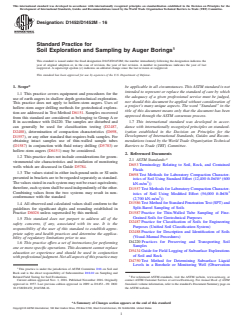
Well) (Withdrawn 2010) metal strip, machine twisted to a spiral configuration of
D5783 Guide for Use of Direct Rotary Drilling with Water- uniform pitch; having at one end, a sharpened or hardened
Based Drilling Fluid for Geoenvironmental Exploration point, with a means of attaching a shaft or extension at the
and the Installation of Subsurface Water-Quality Monitor- opposite end. Small lightweight augers are generally available
ing Devices in sizes from 1 through 3 in. [25 through 75 mm].
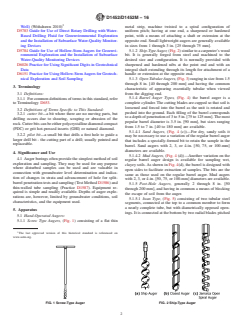
D5784 Guide for Use of Hollow-Stem Augers for Geoenvi- 5.1.2 Ship-TypeAuger,(Fig.2)similartoacarpenter’swood
ronmental Exploration and the Installation of Subsurface bit. It is generally forged from steel and machined to the
Water-Quality Monitoring Devices desired size and configuration. It is normally provided with
D6026 Practice for Using Significant Digits in Geotechnical sharpened and hardened nibs at the point end and with an
Data integral shaft extending through its length for attachment of a
D6151 Practice for Using Hollow-StemAugers for Geotech- handle or extension at the opposite end.
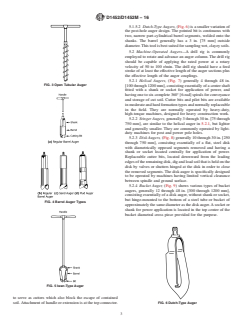
nical Exploration and Soil Sampling 5.1.3 OpenTubularAugers,(Fig.3)ranginginsizefrom1.5
through 8 in. [40 through 200 mm] and having the common
3. Terminology
characteristic of appearing essentially tubular when viewed
3.1 Definitions: from the digging end.
5.1.4 Barrel Auger Types, (Fig. 4) the barrel auger is a
3.1.1 Forcommondefinitionsoftermsinthisstandard,refer
to Terminology D653. complete cylinder. The cutting blades are cupped so that soil is
loosened and forced into the barrel as the unit is rotated and
3.2 Definitions of Terms Specific to This Standard:
pushed into the ground. Each filling of the barrel corresponds
3.2.1 cutter bit—a bit where there are no moving parts, but
to a depth of penetration of 3 to 5 in. [75 to 125 mm].The most
drilling occurs due to shearing, scraping or abrasion of the
popular barrel diameter is 3.5 in. [90 mm], but sizes ranging
rock.Cutterbitscanbeeitherpolycrystallinediamondcompact
from 1.5 to 7 in. [40 to 180 mm] are available.
(PDC) or grit hot-pressed inserts (GHI) or natural diamond.
5.1.4.1 Sand Augers, (Fig. 4 (c))—For dry, sandy soils it
3.2.2 pilot bit—a small bit that drills a first hole to guide a
may be necessary to use a variation of the regular barrel auger
larger drill bit - the cutting part of a drill; usually pointed and
that includes a specially-formed bit to retain the sample in the
replaceable.
barrel. Sand augers with 2, 3, or 4-in. [50, 75, or 100-mm]
diameters are available.
4. Significance and Use
5.1.4.2 Mud Augers, (Fig. 4 (d))—Another variation on the
4.1 Auger borings often provide the simplest method of soil
regular barrel auger design is available for sampling wet,
exploration and sampling. They may be used for any purpose
clayey soils.As shown in Fig. 4(d), the barrel is designed with
where disturbed samples can be used and are valuable in
open sides to facilitate extraction of samples. The bits are the
connection with groundwater level determination and indica-
same as those used on the regular barrel auger. Mud augers
tion of changes in strata and advancement of hole for split-
with 2, 3, or 4-in. [50, 75, or 100-mm] diameters are available.
barrelpenetrationtestsandsampling(TestMethodD1586)and
5.1.5 Post-Hole Augers, generally 2 through 8 in. [50
thin-walled tube sampling (Practice D1587). Equipment re-
through 200 mm], and having in common a means of blocking
quired is simple and readily available. Depths of auger explo-
the escape of soil from the auger.
rations are, however, limited by groundwater conditions, soil
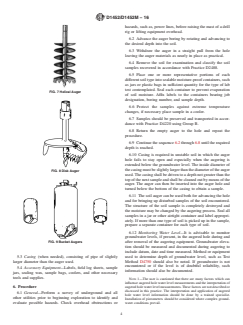
5.1.5.1 Iwan Type, (Fig. 5) consisting of two tubular steel
characteristics, and the equipment used.
segments, connected at the top to a common member to form
a nearly complete tube, but with diametrically opposed open-
5. Apparatus
ings. It is connected at the bottom by two radial blades pitched
5.1 Hand-Operated Augers:
5.1.1 Screw Type Augers, (Fig. 1) consisting of a flat thin
The last approved version of this historical standard is referenced on
www.astm.org.
FIG. 1 Screw-Type Auger FIG. 2 Ship-Type Auger
D1452/D1452M − 16
5.1.5.2 Dutch-Type Augers, (Fig. 6) is a smaller variation of
the post-hole auger design. The pointed bit is continuous with
two,
...
This document is not an ASTM standard and is intended only to provide the user of an ASTM standard an indication of what changes have been made to the previous version. Because
it may not be technically possible to adequately depict all changes accurately, ASTM recommends that users consult prior editions as appropriate. In all cases only the current version
of the standard as published by ASTM is to be considered the official document.
Designation: D1452 − 09 D1452/D1452M − 16
Standard Practice for
Soil Exploration and Sampling by Auger Borings
This standard is issued under the fixed designation D1452;D1452/D1452M; the number immediately following the designation indicates
the year of original adoption or, in the case of revision, the year of last revision. A number in parentheses indicates the year of last
reapproval. A superscript epsilon (´) indicates an editorial change since the last revision or reapproval.
This standard has been approved for use by agencies of the U.S. Department of Defense.
1. Scope*
1.1 This practice covers equipment and procedures for the use of earth augers in shallow depth geotechnical exploration. This
practice does not apply to hollow-stem augers. Uses of hollow-stem auger drilling methods for geotechnical exploration are
addressed in Test Method D6151. Samples recovered from this standard are considered as belonging to Group A or B in accordance
with D4220. The samples are disturbed and can generally be used for classification testing (D2487, D2488), determination of
compaction characteristics (D698, D1557), or any other standard that requires bulk samples. For obtaining intact samples use of
thin-walled sample tubes (D1587) in conjunction with fluid rotary drilling (D5783) or hollow-stem augers (D6151.) may be
considered.
1.2 This practice does not include considerations for geoenvironmental site characteristics and installation of monitoring wells
which are discussed in Guide D5784.
1.3 The values stated in either inch-pound units or SI units presented in brackets are to be regarded separately as standard. The
values given in parentheses are mathematical conversions to SI units that are provided for information only and are not considered
standard.stated in each system may not be exact equivalents; therefore, each system shall be used independently of the other.
Combining values from the two systems may result in non-conformance with the standard
1.4 All observed and calculated values shall conform to the guidelines for significant digits and rounding established in Practice
D6026 unless superseded by this method.
1.5 This standard does not purport to address all of the safety concerns, if any, associated with its use. It is the responsibility
of the user of this standard to establish appropriate safety and health practices and determine the applicability of regulatory
limitations prior to use.
1.6 This practice offers a set of instructions for performing one or more specific operations. This document cannot replace
education or experience and should be used in conjunction with professional judgment. Not all aspects of this practice may be
applicable in all circumstances. This ASTM standard is not intended to represent or replace the standard of care by which the
adequacy of a given professional service must be judged, nor should this document be applied without consideration of a project’s
many unique aspects. The word “Standard” in the title of this document means only that the document has been approved through
the ASTM consensus process.
2. Referenced Documents
2.1 ASTM Standards:
D653 Terminology Relating to Soil, Rock, and Contained Fluids
3 3
D698 Test Methods for Laboratory Compaction Characteristics of Soil Using Standard Effort (12,400 ft-lbf/ft (600 kN-m/m ))
D1557 Test Methods for Laboratory Compaction Characteristics of Soil Using Modified Effort (56,000 ft-lbf/ft (2,700
kN-m/m ))
D1586 Test Method for Penetration Test (SPT) and Split-Barrel Sampling of Soils
D1587 Practice for Thin-Walled Tube Sampling of Fine-Grained Soils for Geotechnical Purposes
D2487 Practice for Classification of Soils for Engineering Purposes (Unified Soil Classification System)
D2488 Practice for Description and Identification of Soils (Visual-Manual Procedure)
This practice is under the jurisdiction of ASTM Committee D18 on Soil and Rock and is the direct responsibility of Subcommittee D18.02 on Sampling and Related
Field Testing for Soil Evaluations.
Current edition approved Feb. 15, 2009Nov. 1, 2016. Published March 2009November 2016. Originally approved in 1957. Last previous edition approved in 20072009
as D1452 – 07a.D1452 – 09. DOI: 10.1520/D1452-09.10.1520/D1452_D1452M-16.
For referenced ASTM standards, visit the ASTM website, www.astm.org, or contact ASTM Customer Service at service@astm.org. For Annual Book of ASTM Standards
volume information, refer to the standard’s Document Summary page on the ASTM website.
*A Summary of Changes section appears at the end of this standard
Copyright © ASTM International, 100 Barr Harbor Drive, PO Box C700, West Conshohocken, PA 19428-2959. United States
D1452/D1452M − 16
D4220 Practices for Preserving and Transporting Soil Samples
D5434 Guide for Field Logging of Subsurface Explorations of Soil and Rock
D4750 Test Method for Determining Subsurface Liquid Levels in a Borehole or Monitoring Well (Observation Well)
(Withdrawn 2010)
D5783 Guide for Use of Direct Rotary Drilling with Water-Based Drilling Fluid for Geoenvironmental Exploration and the
Installation of Subsurface Water-Quality Monitoring Devices
D5784 Guide for Use of Hollow-Stem Augers for Geoenvironmental Exploration and the Installation of Subsurface
Water-Quality Monitoring Devices
D6026 Practice for Using Significant Digits in Geotechnical Data
D6151 Practice for Using Hollow-Stem Augers for Geotechnical Exploration and Soil Sampling
3. Terminology
3.1 Definitions—Definitions:
3.1.1 For common definitions of terms in this standard, refer to Terminology D653.
3.2 Definitions of Terms Specific to This Standard:
3.2.1 cutter bit—a bit where there are no moving parts, but drilling occurs due to shearing, scraping or abrasion of the rock.
Cutter bits can be either polycrystalline diamond compact (PDC) or grit hot-pressed inserts (GHI) or natural diamond.
3.2.2 pilot bit—a small bit that drills a first hole to guide a larger drill bit - the cutting part of a drill; usually pointed and
replaceable.
4. Significance and Use
4.1 Auger borings often provide the simplest method of soil exploration and sampling. They may be used for any purpose where
disturbed samples can be used and are valuable in connection with groundwater level determination and indication of changes in
strata and advancement of hole for split-barrel penetration tests and sampling (Test Method D1586) and thin-walled tube sampling
(Practice D1587). Equipment required is simple and readily available. Depths of auger explorations are, however, limited by
groundwater conditions, soil characteristics, and the equipment used.
5. Apparatus
5.1 Hand-Operated Augers:
5.1.1 Screw Type Augers, (Fig. 1) consisting of a flat thin metal strip, machine twisted to a spiral configuration of uniform pitch;
having at one end, a sharpened or hardened point, with a means of attaching a shaft or extension at the opposite end. Small
lightweight augers are generally available in sizes from 1 through 3 in. [25 through 75 mm].
5.1.2 Helical Augers,Ship-Type Auger, (Fig. 12(a)) small lightweight augers generally available in sizes from 1 through 3 in.
(25.4 through 76.2 mm).) similar to a carpenter’s wood bit. It is generally forged from steel and machined to the desired size and
configuration. It is normally provided with sharpened and hardened nibs at the point end and with an integral shaft extending
through its length for attachment of a handle or extension at the opposite end.
5.1.1.1 Spiral-Type Auger, consisting of a flat thin metal strip, machine twisted to a spiral configuration of uniform pitch; having
at one end, a sharpened or hardened point, with a means of attaching a shaft or extension at the opposite end.
5.1.1.2 Ship-Type Auger—Similar to a carpenter’s wood bit. It is generally forged from steel and machined to the desired size
and configuration. It is normally provided with sharpened and hardened nibs at the point end and with an integral shaft extending
through its length for attachment of a handle or extension at the opposite end.
The last approved version of this historical standard is referenced on www.astm.org.
FIG. 1 Hand AugersScrew-Type Auger
D1452/D1452M − 16
FIG. 2 Post-Hole AugersShip-Type Auger
5.1.3 Open Tubular Augers, (Fig. 13(b))) ranging in size from 1.5 through 8 in. (38.1[40 through 203.2 mm)200 mm] and
having the common characteristic of appearing essentially tubular when viewed from the digging end.
5.1.2.1 Orchard-Barrel Type, (Fig. 1(c)) consisting essentially of a tube having cutting lips or nibs hardened and sharpened to
penetrate the formation on one end and an adaptor fitting for an extension or handle on the opposite end.
5.1.2.2 Open-Spiral Type, consisting of a flat thin metal strip that has been helically wound around a circular mandrel to form
a spiral in which the flat faces of the strip are parallel to the axis of the augered hole. The lower helix edges are hard-faced to
improve wear characteristics. The opposite end is fitted with an adaptor for extension.
5.1.2.3 Closed-Spiral Type—Nearly identical to the open-spiral type except the pitch of the helically wound spiral is much less
than that of the open-spiral type.
5.1.4 Barrel Auger Types, (Fig. 4) the barrel auger is a complete cylinder. The cutting blades are cupped so that soil is loosened
and forced into the barrel as the unit is rotated and pushed into the ground. Each filling of the barrel corresponds to a depth of
penetration of 3 to 5 in. [75 to 125 mm]. The most popular barrel diameter is 3.5 in. [90 mm], but sizes ranging from 1.5 to 7 in.
[40 to 180 mm] are available.
5.1.4.1 Sand Augers, (Fig. 4 (c))—For dry, sandy soils it may be necessary to use a variation of the regular barrel auger that
includes a specially-formed bit to retain the sample in the barrel. Sand augers with 2, 3, or 4-in. [50, 75, or 100-mm] diameters
are available.
5.1.4.2 Mud Augers, (Fig. 4 (d))—Another variation on the regular barrel auger design is available for sampling wet, clayey
soils. As shown in Fig. 4(d), the barrel is designed with open sides to facilitate extraction of samples. The bits are the same as those
used on the regular barrel auger. Mud augers with 2, 3, or 4-in. [50, 75, or 100-mm] diameters are available.
5.1.5 Post-Hole Augers, generally 2 through 8 in. (50.8[50 through 203.2 mm),200 mm], and having in common a means of
blocking the escape of soil from the auger.
5.1.3.1 Clam-Shell Type, (Fig. 2(a)) consisting of two halves, hinged to allow opening and closing for alternately digging and
retrieving. It is not usable deeper than about 3.5 ft (1.07 m).
5.1.5.1 Iwan Type, (Fig. 25(b))) consisting of two tubular steel segments, connected at the top to a common m
...